
THIRD QUARTER

PERSONALIT
Y
October 23, 2012
OBJECTIVES
At the end of the discussion about
Personality you are expected to:

COGNITIVE:
– identify the major theories of personality
– compare and contrast the different
theories of personality
AFFECTIVE
–sustain interest in studying the
personality of a person
PSYCHOMOTOR
–imitate the positive
characteristics of Filipinos
Various Meanings of
Personality
From Latin Words
Ancient Latin

Medieval Latin

persona

personalitas

“mask”
These are the personas that people
project and display, but also includes the
inner characteristics and qualities.
In Literature
Personality as a Personality as an
construct
area of inquiry
Not directly
From theoretical
and empirical
observable but
investigations
must be inferred
of personality
from observed
events
Conclusion
Personality is not an existing
substantive entity to be
searched for, but a complex
construct to be developed and
defined by the observer
- Bischof, 1970;Hall and Lindsey, 1978;
Sarason, 1972-
Major Theories of
Personality
PSYCHOANALYTIC THEORY

TRAIT THEORY
SOCIAL LEARNING THEORY

HUMANISTIC THEORY
INSTINCT
inborn psychological
representation (wish) of an
inner somatic source of
bodily excitation (need)
Ex. State of hunger
LIFE INSTINCTS

DEATH INSTINCTS

• Serve the
purpose of the
survival of the
individual and
the human race
• All pleasurable
acts

• Self-destructive
behavior as an
expression of
the energy
created by
death instincts.
The Structure of Personality
Conscious

Everything we
Everything we
are aware of
are aware of

Preconscious

Memories that have
Memories that have
minimal and emotional
significance
significance

Unconscious

Outside of our
Outside of our
consciousness
consciousness
CONSCIOUS
(thoughts, perceptions)

PRECONSCIOUS
(memories, habits)

UNCONSCIOUS
(urges, repressed ideas, desires)
ID, EGO, SUPEREGO
ID

Pleasure Principle

Contained completely in the
unconscious level and is present at
birth
Calls for immediate reduction of
tension that may arise or calls for
immediate gratification
EGO

Reality Principle

Contained completely in the three
sections
Acts to delay the satisfaction of an
id impulse, until an appropriate
object is located in the external
environment
SUPEREGO

Moral Arbiter

Contained in the three sections
Serves as an “in-dwelling parent”
Blocks ego gratification because
not all reality striving of the ego is
necessarily moral
ANXIETY
Develops out of the conflict
among the id, ego and superego
Is the state of tension that
motivates us to do something
REALITY ANXIETY
• the fear of danger from the
external world, and the level
of such anxiety is
proportionate to the degree of
the real threat.
NEUROTIC ANXIETY
• the fear the instinct will get
out of hand and cause one
to do something for which
one will be punished.
MORAL ANXIETY

• the fear of one’s
conscience
DEFENSE MECHANISM
Characteristics:
1.They are unconscious, the
person is never aware to using
the defense,
2.They deny, falsify or distort
readily to some degree
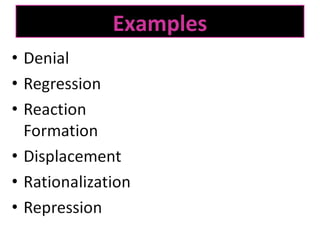
Examples
DENIAL
• Refusing to admit that something
unpleasant is happening
Ex. A 50-year-old man is wearing

clothes for teenagers
REGRESSION
• Returning to more primitive
levels of behavior
Ex. Mary was homesick and
anxious when she started college.
Se slept with her favorite teddy
bear again
REACTION FORMATION
• Transforming anxiety-producing
thoughts into their opposites in
consciousness
Ex. John has unconscious hostility
toward his father but he acts very
affectionate toward him
RATIONALIZATION
• Justifying failures with socially
acceptable reasons instead of the
real reasons
Ex. After Carla rejected him, Phil told
his friends that he didn’t think she
was attractive.
DISPLACEMENT
• Discharging pent-up feelings on
object less dangerous than those
that initially aroused the emotion.
Ex. Mark slams the door after knowing
that his little brother broke his bike.
REPRESSION
• Blocking a threatening memory
from consciousness
Ex. Abuse victims sometimes don’t
recall events from their childhood
OTHERS
• Projection
• Sublimation
• Intellectualization
• Aim Inhibition
• Avoidance
The theory gives emphasis
to both individual
differences and the total
personality
Common and Unique Traits
Common Traits

Unique Traits

describe a
group of
individuals

pattern of
traits
possessed by
specific
individuals
Source and Surface Traits
Source Traits

• Underlying
causes of overt
behavior
Constitutional
traits and
environmentworld traits

Surface Traits
• behaviors which
appear superficially
like traits but they
lack consistency
over time
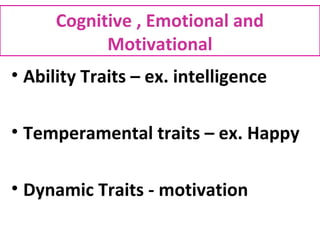
Cognitive , Emotional and
Motivational
• Ability Traits – ex. intelligence
• Temperamental traits – ex. Happy
• Dynamic Traits - motivation
Dynamic Traits
ERGS
• Constitutional
traits which may
be equivalent to
primary drives,
biological needs
or instinct

METAERGS
• Learned drives,
divided into
sentiments
and attitudes
Sentiment and Attitudes
Sentiments

Attitudes

• Learned traits • Overt
expressions of
that are less
influential
the influence
than the ergs of ergs and
sentiments
conclusion
The Trait theory of Cattell states
that behavior is determined by
heredity, environment and the
interaction of heredity and
environment
Cattell further asserts that when an
individual’s traits are:
A. pointed out or specified
B. weighted according to their importance in
given situation
C. when temporary influences such as illness,
anxiety are taken into consideration
“then a person's behavior can be predicted with
considerable accuracy”
Specification equations
Social Learning Approaches
• Emphasize the importance of
environment or situational
determinants of behavior
• Behavior is the product of a
continuous interaction between
personal and environmental
variables
Reciprocal Determinism
“environmental conditions shape
behavior through learning, and
the person’s behavior in return
shapes the environment”
Modeling Theory
1. Attentional processes
2. Retentional processes
3. Motor reproduction processes
4. Motivational and reinforcement
processes
Major determinants of behavior
Antecedents (past)
Consequence (result)
Cognitive factors (how we are
motivated)
Conclusion
Social learning theory as regards to
personality development
assumes that an individual is
born with only elementary
reflexes and genetically
influenced behavior potentials
According to Bandura, all actual
behavior patterns must be
learned through traditional
learning (by reinforcement)
and observational learning (by
modeling)
Humanistic View

Emphasizes the person’s
self-concept and striving
for growth and selfactualization
Rogers’ Theory
Rogers believes in the primacy of
self-actualization for the basis of
his non-directive or clientcentered therapy
Rogers Theory centers on the self,
or self-concept which refers to the
image people have of themselves,
which may or may not correspond
to reality as others see it.
Organismic striving
Most basic level of motivation is
striving for actualization
Self-regard and positive regard

These are attitudes
essential for the
enhancement and
fulfillment of the
individual
fully functioning person
A person who feels wanted,
highly valued and loved when
he was a child and is likely to
develop a positive self-concept,
become open to experience,
and have the capacity to
achieve actualization
Maslow’s Theory
Maslow’s theory of motivation
and the striving for selfactualization led him to
develop the concept of
hierarchy of needs
SELF-ACTUALIZATION

AESTHETIC
INTELLECTUAL
SELF-ESTEEM
LOVE AND BELONGINGNESS

SAFETY/SECURITY
BIOLOGICAL NEEDS
The Filipino Character
Based on the study conducted in
1988 which is commissioned by
the Senate Committee on
Education, Arts and Culture and
the Committee on Social Justice,
Welfare and Development
Strengths of the Filipino Character

•
•
•
•
•
•
•

Pakikipagkapwa-Tao
Family Orientation
Joy and Humor
Flexibility, Adaptability, and Creativity
Hard work and Industry
Faith and Religiosity
Ability to Survive
Pakikipagkapwa-Tao
Filipinos value the meaning of
relationship, they are open to
others, feel one with others
and sensitive to others’
feeling.
Family Orientation
Filipinos have a strong belief in “Blood
is thicker than water”. To the
Filipino, one’s family is the source of
emotional and material support and
one’s main commitment and
responsibility.
Joy and Humor

Filipinos have a cheerful
and fun-loving approach
to life through its ups
and downs
Flexibility, Adaptability, and
Creativity
Filipinos have a great capacity to
adjust and adapt to different
circumstances and surrounding
environment, both physical and
social. Creative, resourceful and
quick learners and have the ability to
improvise and make use what ever is
available.
Hard work and Industry
Filipinos have the capacity for hard
work given the proper conditions,
the desire to raise one’s standard of
living and posses the essentials of a
decent life for ones family, makes
the Filipino work very hard.
Faith and Religiosity
Filipinos as Catholics have a deep
faith and respect to God. The
result of Filipinos’ faith are
courage, inner peace as well as
the capacity to accept tragedy
and death.
Ability to Survive
This strength is manifested in
Filipinos’ capacity for
endurance despite difficult
times
WEAKNESSES OF THE FILIPINO CHARACTER
•
•
•
•
•
•
•

Extreme Personalism.
Extreme Family-Centeredness
Lack of Discipline.
Passivity and Lack of Initiative.
Colonial Mentality.
Kanya-Kanya Syndrome.
Lack of Self-Analysis and Self-Reflection.
Extreme Personalism
Filipinos view the world in terms of
personal relationships and the
extent to which one is able to
personally relate to things and
people
Extreme Family-Centeredness
While concern for the family is one of the
Filipino's greatest strengths, in the
extreme it becomes a serious flaw.
Excessive concern for the family creates
an in-group to which the Filipino is fiercely
loyal, to the detriment of concern for the
larger community or the common good.
Lack of Discipline
We have a casual and relaxed
attitude towards time and space
which manifests itself in lack of
precision and compulsiveness, in
poor time management and in
procrastination.
Passivity and Lack of Initiative
Filipinos are generally passive and
lacking in initiative. One waits to
be told what has to be done.
Colonial Mentality
Filipinos have a colonial mentality
which is made up of two dimensions:
the first is a lack of patriotism or an
active awareness, appreciation, and
love of the Philippines; the second is
an actual preference for things
foreign.
Kanya-Kanya Syndrome/Crab
Mentality
Filipinos have a selfish, self-serving
attitude that generates a feeling of
envy and competitiveness towards
others, particularly one's peers, who
seem to have gained some status or
prestige.
Lack of Self-Analysis and SelfReflection

There is a tendency in the Filipino
to be superficial and even
somewhat flighty. In the face of
serious problems both personal
and social, there is lack of
analysis or reflection.
The roots of the Filipino Character
• The home environment
• The social environment
• Culture and language
• History
• The educational system
The roots of the Filipino Character
• Religion
• The economic environment
• The political environment
• Mass media
• Leadership and role models
Personality

Personality

  • 1.
  • 3.
    OBJECTIVES At the endof the discussion about Personality you are expected to: COGNITIVE: – identify the major theories of personality – compare and contrast the different theories of personality
  • 4.
    AFFECTIVE –sustain interest instudying the personality of a person PSYCHOMOTOR –imitate the positive characteristics of Filipinos
  • 6.
  • 7.
    From Latin Words AncientLatin Medieval Latin persona personalitas “mask” These are the personas that people project and display, but also includes the inner characteristics and qualities.
  • 8.
    In Literature Personality asa Personality as an construct area of inquiry Not directly From theoretical and empirical observable but investigations must be inferred of personality from observed events
  • 9.
    Conclusion Personality is notan existing substantive entity to be searched for, but a complex construct to be developed and defined by the observer - Bischof, 1970;Hall and Lindsey, 1978; Sarason, 1972-
  • 10.
  • 11.
    PSYCHOANALYTIC THEORY TRAIT THEORY SOCIALLEARNING THEORY HUMANISTIC THEORY
  • 13.
    INSTINCT inborn psychological representation (wish)of an inner somatic source of bodily excitation (need) Ex. State of hunger
  • 14.
    LIFE INSTINCTS DEATH INSTINCTS •Serve the purpose of the survival of the individual and the human race • All pleasurable acts • Self-destructive behavior as an expression of the energy created by death instincts.
  • 15.
    The Structure ofPersonality
  • 16.
    Conscious Everything we Everything we areaware of are aware of Preconscious Memories that have Memories that have minimal and emotional minimal and emotional significance significance Unconscious Outside of our Outside of our consciousness consciousness
  • 17.
  • 18.
  • 19.
    ID Pleasure Principle Contained completelyin the unconscious level and is present at birth Calls for immediate reduction of tension that may arise or calls for immediate gratification
  • 20.
    EGO Reality Principle Contained completelyin the three sections Acts to delay the satisfaction of an id impulse, until an appropriate object is located in the external environment
  • 21.
    SUPEREGO Moral Arbiter Contained inthe three sections Serves as an “in-dwelling parent” Blocks ego gratification because not all reality striving of the ego is necessarily moral
  • 23.
    ANXIETY Develops out ofthe conflict among the id, ego and superego Is the state of tension that motivates us to do something
  • 24.
    REALITY ANXIETY • thefear of danger from the external world, and the level of such anxiety is proportionate to the degree of the real threat.
  • 25.
    NEUROTIC ANXIETY • thefear the instinct will get out of hand and cause one to do something for which one will be punished.
  • 26.
    MORAL ANXIETY • thefear of one’s conscience
  • 27.
    DEFENSE MECHANISM Characteristics: 1.They areunconscious, the person is never aware to using the defense, 2.They deny, falsify or distort readily to some degree
  • 28.
  • 29.
    DENIAL • Refusing toadmit that something unpleasant is happening Ex. A 50-year-old man is wearing clothes for teenagers
  • 30.
    REGRESSION • Returning tomore primitive levels of behavior Ex. Mary was homesick and anxious when she started college. Se slept with her favorite teddy bear again
  • 31.
    REACTION FORMATION • Transforminganxiety-producing thoughts into their opposites in consciousness Ex. John has unconscious hostility toward his father but he acts very affectionate toward him
  • 32.
    RATIONALIZATION • Justifying failureswith socially acceptable reasons instead of the real reasons Ex. After Carla rejected him, Phil told his friends that he didn’t think she was attractive.
  • 33.
    DISPLACEMENT • Discharging pent-upfeelings on object less dangerous than those that initially aroused the emotion. Ex. Mark slams the door after knowing that his little brother broke his bike.
  • 34.
    REPRESSION • Blocking athreatening memory from consciousness Ex. Abuse victims sometimes don’t recall events from their childhood
  • 35.
    OTHERS • Projection • Sublimation •Intellectualization • Aim Inhibition • Avoidance
  • 37.
    The theory givesemphasis to both individual differences and the total personality
  • 38.
    Common and UniqueTraits Common Traits Unique Traits describe a group of individuals pattern of traits possessed by specific individuals
  • 39.
    Source and SurfaceTraits Source Traits • Underlying causes of overt behavior Constitutional traits and environmentworld traits Surface Traits • behaviors which appear superficially like traits but they lack consistency over time
  • 40.
    Cognitive , Emotionaland Motivational • Ability Traits – ex. intelligence • Temperamental traits – ex. Happy • Dynamic Traits - motivation
  • 41.
    Dynamic Traits ERGS • Constitutional traitswhich may be equivalent to primary drives, biological needs or instinct METAERGS • Learned drives, divided into sentiments and attitudes
  • 42.
    Sentiment and Attitudes Sentiments Attitudes •Learned traits • Overt expressions of that are less influential the influence than the ergs of ergs and sentiments
  • 43.
    conclusion The Trait theoryof Cattell states that behavior is determined by heredity, environment and the interaction of heredity and environment
  • 44.
    Cattell further assertsthat when an individual’s traits are: A. pointed out or specified B. weighted according to their importance in given situation C. when temporary influences such as illness, anxiety are taken into consideration “then a person's behavior can be predicted with considerable accuracy” Specification equations
  • 46.
    Social Learning Approaches •Emphasize the importance of environment or situational determinants of behavior • Behavior is the product of a continuous interaction between personal and environmental variables
  • 47.
    Reciprocal Determinism “environmental conditionsshape behavior through learning, and the person’s behavior in return shapes the environment”
  • 48.
    Modeling Theory 1. Attentionalprocesses 2. Retentional processes 3. Motor reproduction processes 4. Motivational and reinforcement processes
  • 49.
    Major determinants ofbehavior Antecedents (past) Consequence (result) Cognitive factors (how we are motivated)
  • 50.
    Conclusion Social learning theoryas regards to personality development assumes that an individual is born with only elementary reflexes and genetically influenced behavior potentials
  • 51.
    According to Bandura,all actual behavior patterns must be learned through traditional learning (by reinforcement) and observational learning (by modeling)
  • 53.
    Humanistic View Emphasizes theperson’s self-concept and striving for growth and selfactualization
  • 54.
    Rogers’ Theory Rogers believesin the primacy of self-actualization for the basis of his non-directive or clientcentered therapy
  • 55.
    Rogers Theory centerson the self, or self-concept which refers to the image people have of themselves, which may or may not correspond to reality as others see it.
  • 56.
    Organismic striving Most basiclevel of motivation is striving for actualization
  • 57.
    Self-regard and positiveregard These are attitudes essential for the enhancement and fulfillment of the individual
  • 58.
    fully functioning person Aperson who feels wanted, highly valued and loved when he was a child and is likely to develop a positive self-concept, become open to experience, and have the capacity to achieve actualization
  • 59.
    Maslow’s Theory Maslow’s theoryof motivation and the striving for selfactualization led him to develop the concept of hierarchy of needs
  • 60.
  • 61.
  • 62.
    Based on thestudy conducted in 1988 which is commissioned by the Senate Committee on Education, Arts and Culture and the Committee on Social Justice, Welfare and Development
  • 64.
    Strengths of theFilipino Character Strengths of the Filipino Character • • • • • • • Pakikipagkapwa-Tao Family Orientation Joy and Humor Flexibility, Adaptability, and Creativity Hard work and Industry Faith and Religiosity Ability to Survive
  • 65.
    Pakikipagkapwa-Tao Filipinos value themeaning of relationship, they are open to others, feel one with others and sensitive to others’ feeling.
  • 66.
    Family Orientation Filipinos havea strong belief in “Blood is thicker than water”. To the Filipino, one’s family is the source of emotional and material support and one’s main commitment and responsibility.
  • 67.
    Joy and Humor Filipinoshave a cheerful and fun-loving approach to life through its ups and downs
  • 68.
    Flexibility, Adaptability, and Creativity Filipinoshave a great capacity to adjust and adapt to different circumstances and surrounding environment, both physical and social. Creative, resourceful and quick learners and have the ability to improvise and make use what ever is available.
  • 69.
    Hard work andIndustry Filipinos have the capacity for hard work given the proper conditions, the desire to raise one’s standard of living and posses the essentials of a decent life for ones family, makes the Filipino work very hard.
  • 70.
    Faith and Religiosity Filipinosas Catholics have a deep faith and respect to God. The result of Filipinos’ faith are courage, inner peace as well as the capacity to accept tragedy and death.
  • 71.
    Ability to Survive Thisstrength is manifested in Filipinos’ capacity for endurance despite difficult times
  • 72.
    WEAKNESSES OF THEFILIPINO CHARACTER • • • • • • • Extreme Personalism. Extreme Family-Centeredness Lack of Discipline. Passivity and Lack of Initiative. Colonial Mentality. Kanya-Kanya Syndrome. Lack of Self-Analysis and Self-Reflection.
  • 73.
    Extreme Personalism Filipinos viewthe world in terms of personal relationships and the extent to which one is able to personally relate to things and people
  • 74.
    Extreme Family-Centeredness While concernfor the family is one of the Filipino's greatest strengths, in the extreme it becomes a serious flaw. Excessive concern for the family creates an in-group to which the Filipino is fiercely loyal, to the detriment of concern for the larger community or the common good.
  • 75.
    Lack of Discipline Wehave a casual and relaxed attitude towards time and space which manifests itself in lack of precision and compulsiveness, in poor time management and in procrastination.
  • 76.
    Passivity and Lackof Initiative Filipinos are generally passive and lacking in initiative. One waits to be told what has to be done.
  • 77.
    Colonial Mentality Filipinos havea colonial mentality which is made up of two dimensions: the first is a lack of patriotism or an active awareness, appreciation, and love of the Philippines; the second is an actual preference for things foreign.
  • 78.
    Kanya-Kanya Syndrome/Crab Mentality Filipinos havea selfish, self-serving attitude that generates a feeling of envy and competitiveness towards others, particularly one's peers, who seem to have gained some status or prestige.
  • 79.
    Lack of Self-Analysisand SelfReflection There is a tendency in the Filipino to be superficial and even somewhat flighty. In the face of serious problems both personal and social, there is lack of analysis or reflection.
  • 80.
    The roots ofthe Filipino Character • The home environment • The social environment • Culture and language • History • The educational system
  • 81.
    The roots ofthe Filipino Character • Religion • The economic environment • The political environment • Mass media • Leadership and role models