





EMOTIONS
December 4, 2012
OBJECTIVES
At the end of the discussion about “Emotion”,
you are expected to:

COGNITIVE:
Ψ determine various Theories of
Emotion
Ψ describe and understand the nature
of emotion
AFFECTIVE:
control unnecessary emotion
Ψ listen critically and purposely with
one’s sharing of emotion
Ψ

PSYCHOMOTOR:
Ψ

demonstrate effective ways of
handling emotions
Emotion
Charades
“Imagine a world
without emotions”
It was not your birthday. There were no
special occasions. A dear friend
nevertheless decided to buy you a gift,
something she knew would make you
overjoyed. She wrapped it beautifully
with colorful papers and attractive
ribbons. She excitedly jumped out of the
closet to surprise you with a gift. But
you had no emotional reaction. You
simply looked at her and the gift with a
blank stare.
Wouldn’t this
disappoint your
friend terribly?
Wouldn’t your
world appear to
be so dull and
unexciting?
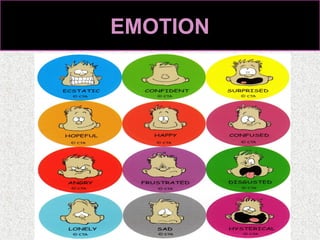
EMOTION
What is it?
“spontaneous reaction and
movement either towards an
appraised pleasurable object or
stimulus (positive) or away from an
appraised unpleasurable object or
stimulus (negative) with its
corresponding physiological and
motor reactions”
(Fr. Ben Carlos, S.J.)
ELEMENTS
OF
EMOTION
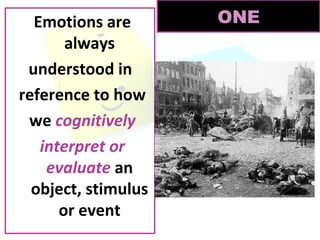
Emotions are
always
understood in
reference to how
we cognitively
interpret or
evaluate an
object, stimulus
or event

ONE
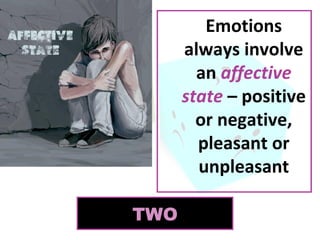
Emotions
always involve
an affective
state – positive
or negative,
pleasant or
unpleasant


TWO
THREE
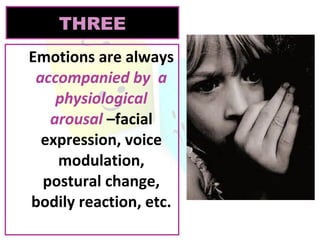
Emotions are always
accompanied by a
physiological
arousal –facial
expression, voice
modulation,
postural change,
bodily reaction, etc.
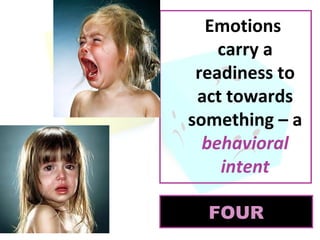
Emotions
carry a
readiness to
act towards
something – a
behavioral
intent
FOUR
TYPES
OF
EMOTION
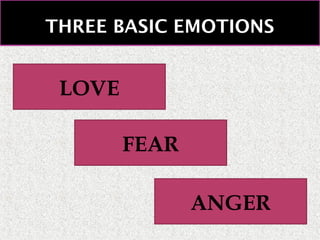
THREE BASIC EMOTIONS

LOVE
FEAR
ANGER
CHARACTERISTICS
OF
EMOTION
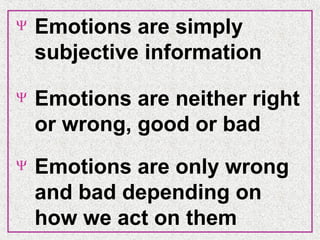
Ψ

Emotions are simply
subjective information

Ψ

Emotions are neither right
or wrong, good or bad

Ψ

Emotions are only wrong
and bad depending on
how we act on them
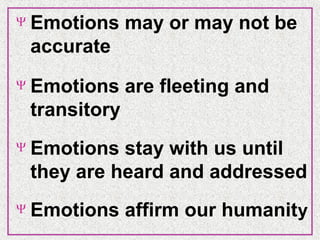
Ψ

Emotions may or may not be
accurate

Ψ

Emotions are fleeting and
transitory

Ψ

Emotions stay with us until
they are heard and addressed

Ψ

Emotions affirm our humanity
THEORIES OF
EMOTION
JAMES-LANGE THEORY
(William James and Carl Lange)

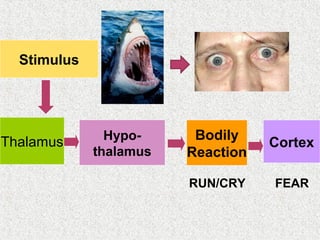
This theory proposes that
conscious emotional experiences
are caused by the feedback to the
cerebral cortex from physiological
reactions and behavior
Stimulus

Thalamus

Hypothalamus

Bodily
Reaction

Cortex

RUN/CRY

FEAR
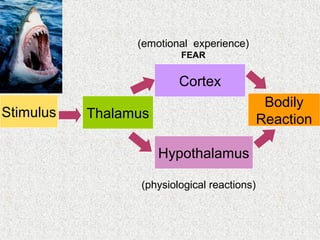
This theory states that the
conscious emotional
experiences and physiological
reaction and behavior are
relatively independent events
(emotional experience)
FEAR

Cortex
Stimulus

Bodily
Reaction

Thalamus
Hypothalamus
(physiological reactions)
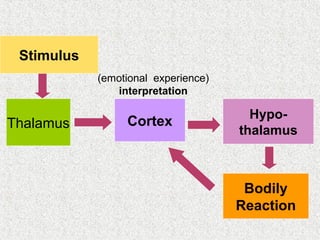
This theory states that individual
is not affected by the events but
by the individual’s interpretation
of these
Stimulus
(emotional experience)
interpretation

Thalamus

Cortex

Hypothalamus

Bodily
Reaction
Cannon-Bard Theory further
believes that emotional arousal
is diffused and not specific to
different emotions
That is why sexual attraction is
mistaken for love
THE
MANAGEMENT
OF EMOTIONS
(Ernest Tan)
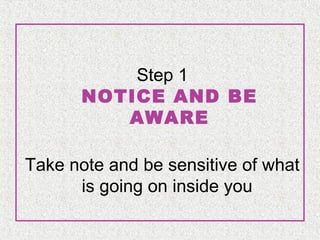
Step 1
NOTICE AND BE
AWARE
Take note and be sensitive of what
is going on inside you
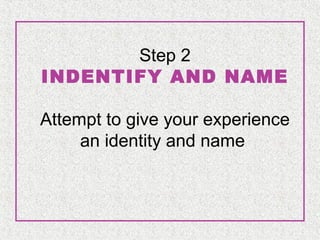
Step 2
INDENTIFY AND NAME
Attempt to give your experience
an identity and name
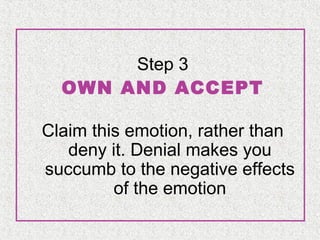
Step 3
OWN AND ACCEPT
Claim this emotion, rather than
deny it. Denial makes you
succumb to the negative effects
of the emotion
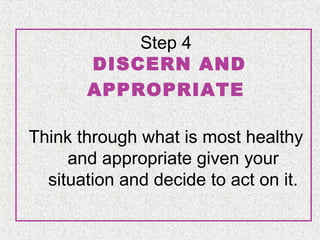
Step 4
DISCERN AND
APPROPRIATE
Think through what is most healthy
and appropriate given your
situation and decide to act on it.
EMOTIONAL
INTELLIGENCE
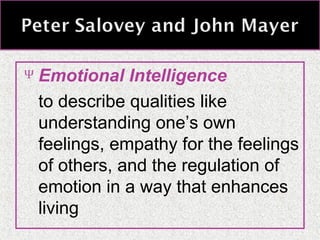
Ψ

Emotional Intelligence
to describe qualities like
understanding one’s own
feelings, empathy for the feelings
of others, and the regulation of
emotion in a way that enhances
living
Ψ He

introduce the term EQ
which refers to Emotional
Intelligence
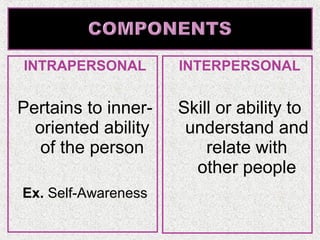
INTRAPERSONAL

INTERPERSONAL

Pertains to inneroriented ability
of the person

Skill or ability to
understand and
relate with
other people

Ex. Self-Awareness
Emotion

Emotion