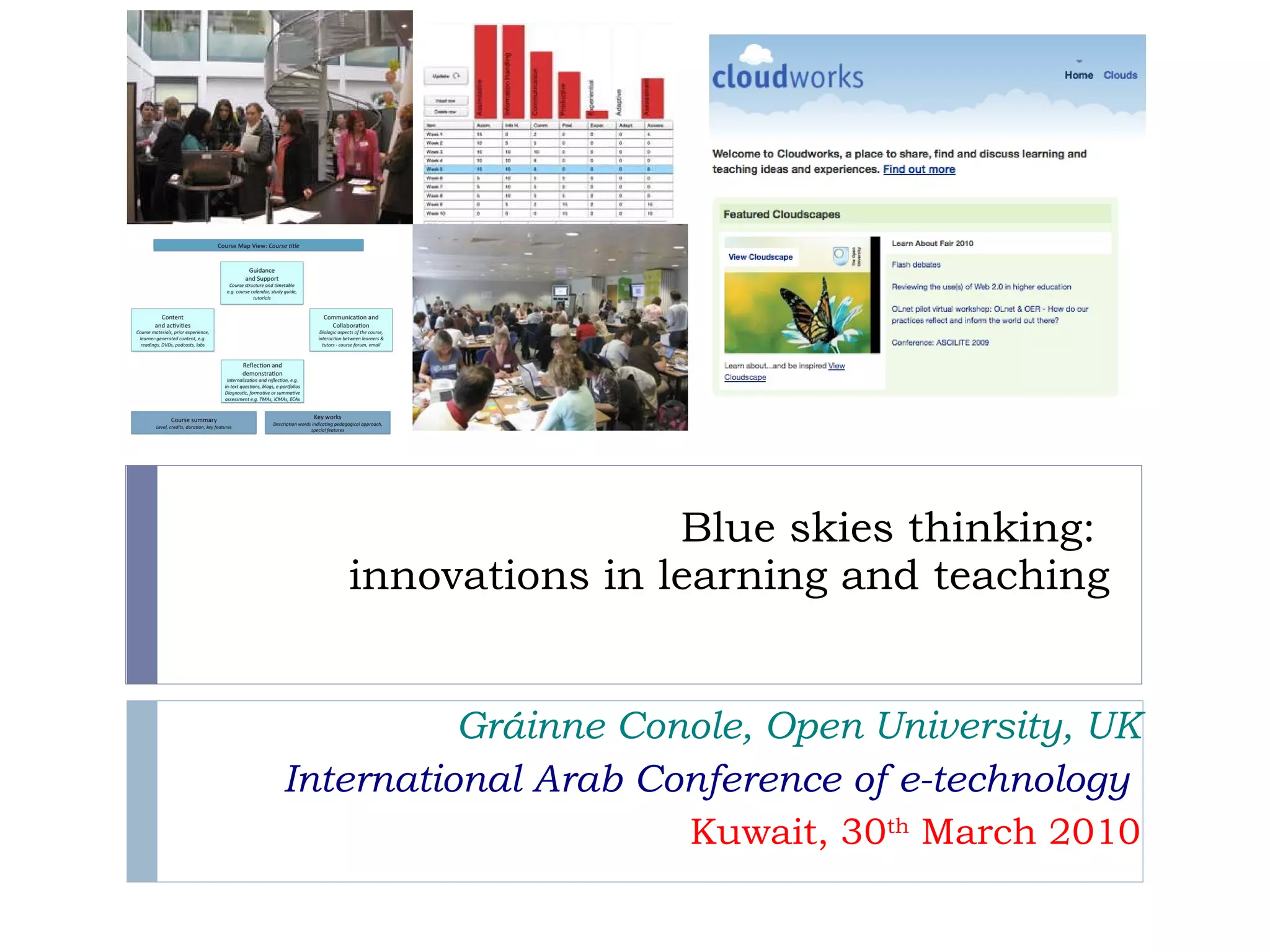
Blue skies thinking:  innovations in learning and teaching Gráinne Conole, Open University, UK International Arab Conference of e-technology  Kuwait, 30 th  March 2010
Outline Focus The changing nature of education: how can we design for learning in this new context? Empirical evidence base The broader landscape A review of web 2.0 in HE A review of pedagogical models Designing for learning at the OU OU Learning Design Initiative Open Educational Resources and the Olnet initiative
A little context… My background: Irish PhD Chemistry Professor of e-learning Learners and teachers  experiences  of using technologies New approaches to  design Open Educational  Resources Learning  theories Strategy and policy
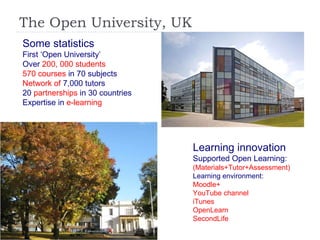
The Open University, UK Some statistics First ‘Open University’ Over   200, 000 students 570 courses  in 70 subjects Network of  7,000 tutors 20   partnerships  in 30 countries Expertise in  e-learning Learning innovation Supported Open Learning: (Materials+Tutor+Assessment) Learning environment:  Moodle+ YouTube channel iTunes OpenLearn SecondLife
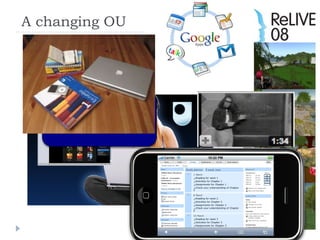
A changing OU Open University UK: From broadcast TV  to multi-channel
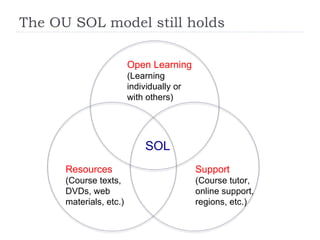
The OU SOL model still holds SOL Open Learning (Learning individually or  with others) Resources  (Course texts, DVDs, web materials, etc.) Support (Course tutor, online support, regions, etc.)
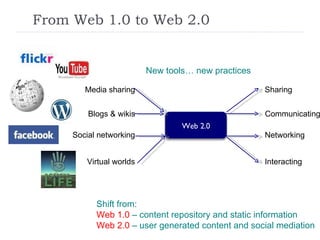
From Web 1.0 to Web 2.0 New tools… new practices Shift from: Web 1.0  – content repository and static information Web 2.0  – user generated content and social mediation Web 2.0 Sharing Communicating Networking Interacting Media sharing Blogs & wikis Social networking Virtual worlds
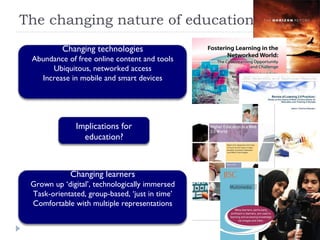
The changing nature of education Changing technologies Abundance of free online content and tools Ubiquitous, networked access Increase in mobile and smart devices Changing learners Grown up ‘digital’, technologically immersed Task-orientated, group-based, ‘just in time’ Comfortable with multiple representations Implications for education?
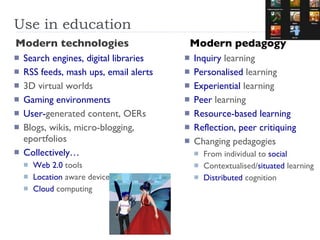
Use in education Modern technologies Modern pedagogy Search engines, digital libraries RSS feeds, mash ups, email alerts 3D virtual worlds Gaming environments User- generated content, OERs Blogs, wikis, micro-blogging, eportfolios Collectively… Web 2.0  tools Location  aware devices Cloud  computing Inquiry  learning Personalised  learning Experiential  learning Peer  learning Resource-based learning Reflection, peer critiquing Changing pedagogies From individual to  social Contextualised/ situated  learning Distributed  cognition
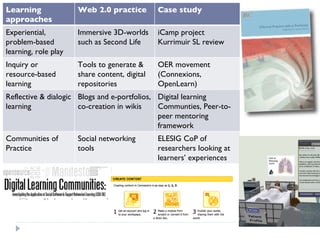
Learning approaches Web 2.0 practice Case study Experiential,  problem-based learning, role play Immersive 3D-worlds such as Second Life iCamp project Kurrimuir SL review Inquiry or resource-based learning Tools to generate & share content, digital repositories OER movement (Connexions, OpenLearn) Reflective & dialogic learning Blogs and e-portfolios, co-creation in wikis Digital learning Communties, Peer-to-peer mentoring framework Communities of Practice Social networking tools ELESIG CoP of researchers looking at learners’ experiences
Digital literacies Jenkins twelve skills for participatory culture Play  – experimentation/problem solving Performance  – alternative identities Simulation  – construct models of real-world processes Appropriation  – sample and remix of media content Multitasking  – scanning and then focusing on salient details Distributed cognition  – interaction to expand mental capacities Collective intelligence  - to pool knowledge with others Judgment  – evaluation reliability of different information Transmedia navigation  – follow the flow of stories across modalities Networking  – search for,  synthesize and dissemination information Negotiation  – travel diverse communities, multiple perspectives Visualisation  – different data representations for ideas, patterns, trends
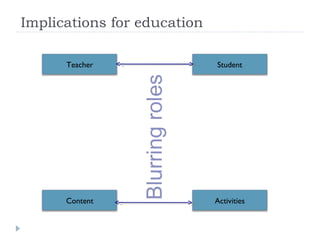
Implications for education Teacher Student Content Activities
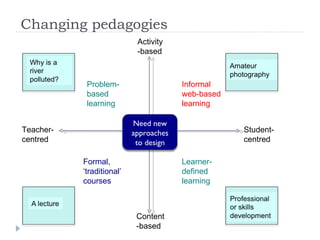
Changing pedagogies Formal, ‘traditional’  courses Problem-based learning Learner-defined learning Informal web-based learning Teacher-centred Student- centred Activity-based Content-based Need new approaches to design
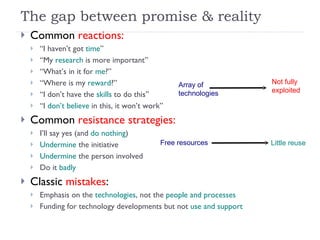
The gap between promise & reality Common  reactions:   “ I haven’t got  time ” “ My  research  is more important” “ What’s in it for  me ?” “ Where is my  reward ?” “ I don’t have the  skills  to do this” “ I  don’t believe  in this, it won’t work” Common  resistance strategies: I’ll say yes (and  do nothing ) Undermine  the initiative Undermine  the person involved Do it  badly Classic  mistakes : Emphasis on the  technologies , not the  people and processes Funding for technology developments but not  use and support Free resources Little reuse Array of  technologies Not fully  exploited
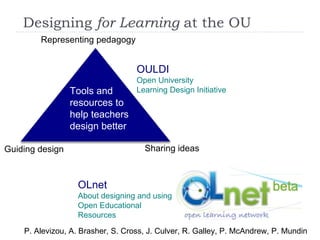
Designing  for Learning  at the OU   P. Alevizou, A. Brasher, S. Cross, J. Culver, R. Galley, P. McAndrew, P. Mundin Representing pedagogy Guiding design Sharing ideas Tools and resources to help teachers design better OULDI Open University  Learning Design Initiative OLnet About designing and using Open Educational Resources
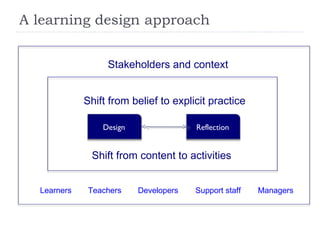
A learning design approach Shift from content to activities Design Reflection Shift from belief to explicit practice Learners Teachers Developers Support staff Managers Stakeholders and context
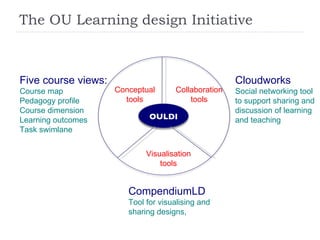
The OU Learning design Initiative Five course views: Course map Pedagogy profile Course dimension Learning outcomes Task swimlane Cloudworks Social networking tool to support sharing and discussion of learning and teaching CompendiumLD Tool for visualising and sharing designs,  OULDI Conceptual tools Visualisation tools Collaboration tools
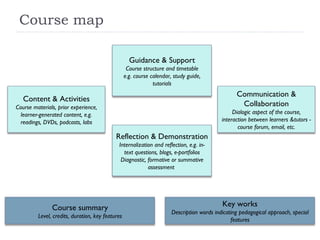
Course map Guidance & Support Course structure and timetable e.g. course calendar, study guide, tutorials Reflection & Demonstration Internalization and reflection, e.g. in-text questions, blogs, e-portfolios Diagnostic, formative or summative assessment  Content & Activities Course materials, prior experience, learner-generated content, e.g. readings, DVDs, podcasts, labs Communication & Collaboration Dialogic aspect of the course, interaction between learners &tutors - course forum, email, etc. Course summary Level, credits, duration, key features Key works Description words indicating pedagogical approach, special features
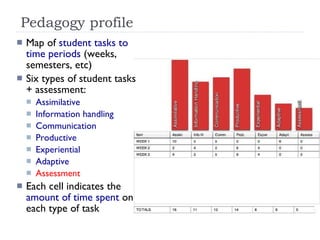
Pedagogy profile Map of  student tasks to time periods  (weeks, semesters, etc) Six types of student tasks + assessment: Assimilative  Information handling Communication Productive Experiential Adaptive Assessment Each cell indicates the  amount of time spent  on each type of task
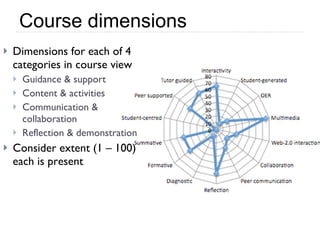
Dimensions for each of 4 categories in course view Guidance & support Content & activities Communication & collaboration Reflection & demonstration Consider extent (1 – 100) each is present  Course dimensions
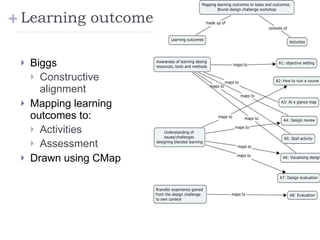
Learning outcomes mapping Biggs Constructive alignment Mapping learning outcomes to: Activities Assessment Drawn using CMap
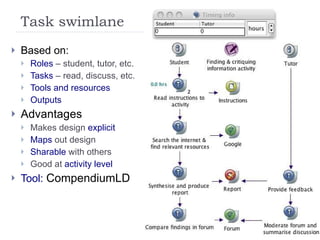
Task swimlane Based on: Roles  – student, tutor, etc. Tasks  – read, discuss, etc. Tools and resources Outputs Advantages Makes design  explicit Maps  out design Sharable  with others Good at  activity level Tool:  CompendiumLD
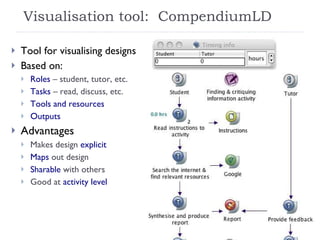
Visualisation tool:  CompendiumLD Tool for visualising designs Based on: Roles  – student, tutor, etc. Tasks  – read, discuss, etc. Tools and resources Outputs Advantages Makes design  explicit Maps  out design Sharable  with others Good at  activity level
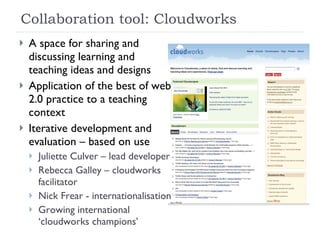
Collaboration tool: Cloudworks A space for sharing and discussing learning and teaching ideas and designs Application of the best of web 2.0 practice to a teaching context Iterative development and evaluation – based on use Juliette Culver – lead developer Rebecca Galley – cloudworks facilitator Nick Frear - internationalisation Growing international ‘cloudworks champions’
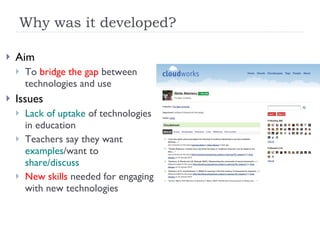
Why was it developed? Aim To  bridge the gap  between technologies and use Issues Lack of uptake  of technologies in education Teachers say they want  examples /want to  share/discuss New skills  needed for engaging with new technologies
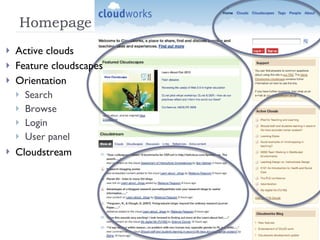
Homepage Active clouds Feature cloudscapes Orientation Search Browse Login User panel Cloudstream
Key concepts Clouds:  core objects in Cloudworks Cloudscapes:  collections of clouds
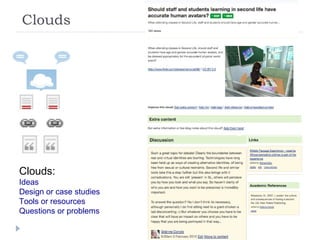
Clouds Clouds:  Ideas Design or case studies Tools or resources Questions or problems
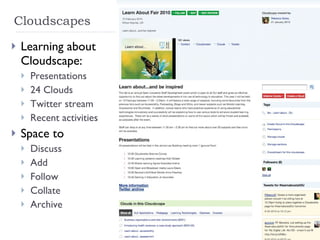
Cloudscapes Learning about Cloudscape: Presentations 24 Clouds Twitter stream Recent activities Space to Discuss Add  Follow Collate Archive
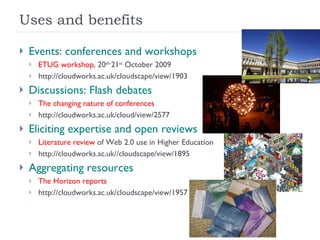
Uses and benefits Events: conferences and workshops ETUG workshop , 20 th- 21 st  October 2009 http://cloudworks.ac.uk/cloudscape/view/1903 Discussions: Flash debates The changing nature of conferences http://cloudworks.ac.uk/cloud/view/2577 Eliciting expertise and open reviews Literature review  of Web 2.0 use in Higher Education http://cloudworks.ac.uk//cloudscape/view/1895 Aggregating resources The Horizon reports http://cloudworks.ac.uk/cloudscape/view/1957
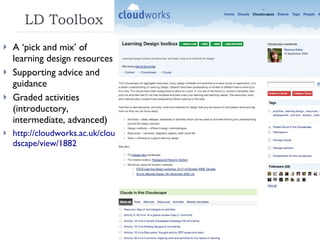
LD Toolbox A ‘pick and mix’ of learning design resources Supporting advice and guidance Graded activities (introductory, intermediate, advanced) http://cloudworks.ac.uk/cloudscape/view/1882
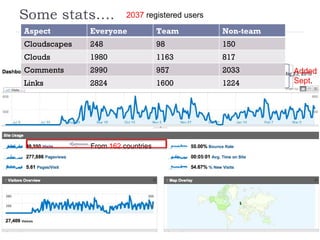
Some stats…. 2037  registered users Aspect Everyone Team Non-team Cloudscapes 248 98 150 Clouds 1980 1163 817 Comments 2990 957 2033 Links 2824 1600 1224 Added Sept . From  162  countries
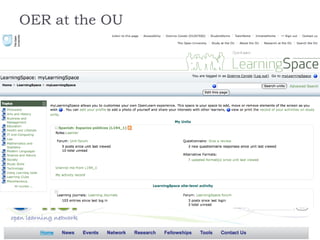
OER at the OU OpenLearn  Repository of OER Built in Moodle Set of collaboration tools (Flashmeeting, Compendium, etc.) Olnet OU and Carnegie Melon Global network of support for design and use of OER Fellowship scheme Applying Learning Design tools to OER
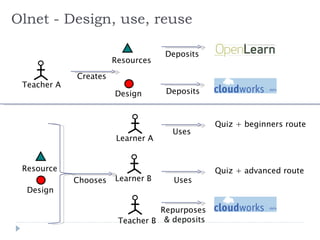
Olnet - Design, use, reuse Teacher A Resources Design Creates Deposits Deposits Learner A Resource Design Learner B Teacher B Chooses Uses Quiz + beginners route Uses Quiz + advanced route Repurposes  & deposits
Final thoughts Students  increasingly digital  – demands on institutions?  Students and teachers -  personalised  environment of tools vs.  institutional  tools?  What new forms of  blended learning spaces  are needed? How do we support  new approaches to design and delivery  of courses to make more effective use of technologies and lead to an enhance student learning experience? How do we take account of a  digital divide  that is ever narrower but deeper? What  new digital literacy skills  will learners and teachers need ?  What  new pedagogical models  are needed to marry the affordances of personalisation with the best affordances of technologies? How do we account for  blurring boundaries  (real/virtual, formal/informal, etc)?
References and links Conole, G. and Alevizou, P.  (forthcoming), The use(s) of web 2.0 in HE, Report for the HE Academy, Open University: Milton Keynes Conole, G. (2010), A review of pedagogical models and frameworks, available online at  http://cloudworks.ac.uk/index.php/cloudscape/view/2009 Conole, G. and Culver, J. (2010) 'The design of Cloudworks: applying social networking practice to foster the exchange of learning and teaching ideas and designs'  Computers and Education , 54(2): 679 - 692. Conole, G., Brasher, A., Cross, S., Weller, M., Clark, P. and White, J. (2008), Visualising learning design to foster and support good practice and creativity, Educational Media International, Volume 54, Issue 3, 177-194. Conole, G., McAndrew, P. and Dimitriadis, Y. (forthcoming), ‘The role of CSCL pedagogical patterns as mediating artefacts for repurposing Open Educational Resources’, in F. Pozzi and D. Persico (Eds), Techniques for Fostering Collaboration in Online Learning Communities: Theoretical and Practical
References and links Conole, G. and McAndrew, P. (2010), A new approach to supporting the design and use of OER: Harnessing the power of web 2.0, M. Edner and M. Schiefner (eds), Looking toward the future of technology enhanced education: ubiquitous learning and the digital nature. De Freitas, S. and Conole. G. (forthcoming), Learners experiences: how pervasive and integrative tools influence expectations of study, in R. Sharpe and H. Beetham (Eds), Rethinking learning for a digital age,  RoutledgeFalmer: London .  Conole, G. (2010), State of the art review of e-learning and learning design, Deliverable for the EU-funded Design-Practice project, available online at  http://cloudworks.ac.uk/index.php/cloud/view/2894 Conole, G. and Oliver, M. (2007), Contemporary perspectives in e-learning research, RoutledgeFalmer: London.
Images used from Flckr http://www.flickr.com/photos/victoriapeckham/3919034822/ http://www.flickr.com/photos/4everyoung/313308360/ http://www.flickr.com/photos/roham/2852341868/ http://www.flickr.com/photos/cogdog/4292337320/

Conole Kuwait

  • 1.
    Blue skies thinking: innovations in learning and teaching Gráinne Conole, Open University, UK International Arab Conference of e-technology Kuwait, 30 th March 2010
  • 2.
    Outline Focus Thechanging nature of education: how can we design for learning in this new context? Empirical evidence base The broader landscape A review of web 2.0 in HE A review of pedagogical models Designing for learning at the OU OU Learning Design Initiative Open Educational Resources and the Olnet initiative
  • 3.
    A little context…My background: Irish PhD Chemistry Professor of e-learning Learners and teachers experiences of using technologies New approaches to design Open Educational Resources Learning theories Strategy and policy
  • 4.
    The Open University,UK Some statistics First ‘Open University’ Over 200, 000 students 570 courses in 70 subjects Network of 7,000 tutors 20 partnerships in 30 countries Expertise in e-learning Learning innovation Supported Open Learning: (Materials+Tutor+Assessment) Learning environment: Moodle+ YouTube channel iTunes OpenLearn SecondLife
  • 5.
    A changing OUOpen University UK: From broadcast TV to multi-channel
  • 6.
    The OU SOLmodel still holds SOL Open Learning (Learning individually or with others) Resources (Course texts, DVDs, web materials, etc.) Support (Course tutor, online support, regions, etc.)
  • 7.
    From Web 1.0to Web 2.0 New tools… new practices Shift from: Web 1.0 – content repository and static information Web 2.0 – user generated content and social mediation Web 2.0 Sharing Communicating Networking Interacting Media sharing Blogs & wikis Social networking Virtual worlds
  • 8.
    The changing natureof education Changing technologies Abundance of free online content and tools Ubiquitous, networked access Increase in mobile and smart devices Changing learners Grown up ‘digital’, technologically immersed Task-orientated, group-based, ‘just in time’ Comfortable with multiple representations Implications for education?
  • 9.
    Use in educationModern technologies Modern pedagogy Search engines, digital libraries RSS feeds, mash ups, email alerts 3D virtual worlds Gaming environments User- generated content, OERs Blogs, wikis, micro-blogging, eportfolios Collectively… Web 2.0 tools Location aware devices Cloud computing Inquiry learning Personalised learning Experiential learning Peer learning Resource-based learning Reflection, peer critiquing Changing pedagogies From individual to social Contextualised/ situated learning Distributed cognition
  • 10.
    Learning approaches Web2.0 practice Case study Experiential, problem-based learning, role play Immersive 3D-worlds such as Second Life iCamp project Kurrimuir SL review Inquiry or resource-based learning Tools to generate & share content, digital repositories OER movement (Connexions, OpenLearn) Reflective & dialogic learning Blogs and e-portfolios, co-creation in wikis Digital learning Communties, Peer-to-peer mentoring framework Communities of Practice Social networking tools ELESIG CoP of researchers looking at learners’ experiences
  • 11.
    Digital literacies Jenkinstwelve skills for participatory culture Play – experimentation/problem solving Performance – alternative identities Simulation – construct models of real-world processes Appropriation – sample and remix of media content Multitasking – scanning and then focusing on salient details Distributed cognition – interaction to expand mental capacities Collective intelligence - to pool knowledge with others Judgment – evaluation reliability of different information Transmedia navigation – follow the flow of stories across modalities Networking – search for, synthesize and dissemination information Negotiation – travel diverse communities, multiple perspectives Visualisation – different data representations for ideas, patterns, trends
  • 12.
    Implications for educationTeacher Student Content Activities
  • 13.
    Changing pedagogies Formal,‘traditional’ courses Problem-based learning Learner-defined learning Informal web-based learning Teacher-centred Student- centred Activity-based Content-based Need new approaches to design
  • 14.
    The gap betweenpromise & reality Common reactions: “ I haven’t got time ” “ My research is more important” “ What’s in it for me ?” “ Where is my reward ?” “ I don’t have the skills to do this” “ I don’t believe in this, it won’t work” Common resistance strategies: I’ll say yes (and do nothing ) Undermine the initiative Undermine the person involved Do it badly Classic mistakes : Emphasis on the technologies , not the people and processes Funding for technology developments but not use and support Free resources Little reuse Array of technologies Not fully exploited
  • 15.
    Designing forLearning at the OU P. Alevizou, A. Brasher, S. Cross, J. Culver, R. Galley, P. McAndrew, P. Mundin Representing pedagogy Guiding design Sharing ideas Tools and resources to help teachers design better OULDI Open University Learning Design Initiative OLnet About designing and using Open Educational Resources
  • 16.
    A learning designapproach Shift from content to activities Design Reflection Shift from belief to explicit practice Learners Teachers Developers Support staff Managers Stakeholders and context
  • 17.
    The OU Learningdesign Initiative Five course views: Course map Pedagogy profile Course dimension Learning outcomes Task swimlane Cloudworks Social networking tool to support sharing and discussion of learning and teaching CompendiumLD Tool for visualising and sharing designs, OULDI Conceptual tools Visualisation tools Collaboration tools
  • 18.
    Course map Guidance& Support Course structure and timetable e.g. course calendar, study guide, tutorials Reflection & Demonstration Internalization and reflection, e.g. in-text questions, blogs, e-portfolios Diagnostic, formative or summative assessment Content & Activities Course materials, prior experience, learner-generated content, e.g. readings, DVDs, podcasts, labs Communication & Collaboration Dialogic aspect of the course, interaction between learners &tutors - course forum, email, etc. Course summary Level, credits, duration, key features Key works Description words indicating pedagogical approach, special features
  • 19.
    Pedagogy profile Mapof student tasks to time periods (weeks, semesters, etc) Six types of student tasks + assessment: Assimilative Information handling Communication Productive Experiential Adaptive Assessment Each cell indicates the amount of time spent on each type of task
  • 20.
    Dimensions for eachof 4 categories in course view Guidance & support Content & activities Communication & collaboration Reflection & demonstration Consider extent (1 – 100) each is present Course dimensions
  • 21.
    Learning outcomes mappingBiggs Constructive alignment Mapping learning outcomes to: Activities Assessment Drawn using CMap
  • 22.
    Task swimlane Basedon: Roles – student, tutor, etc. Tasks – read, discuss, etc. Tools and resources Outputs Advantages Makes design explicit Maps out design Sharable with others Good at activity level Tool: CompendiumLD
  • 23.
    Visualisation tool: CompendiumLD Tool for visualising designs Based on: Roles – student, tutor, etc. Tasks – read, discuss, etc. Tools and resources Outputs Advantages Makes design explicit Maps out design Sharable with others Good at activity level
  • 24.
    Collaboration tool: CloudworksA space for sharing and discussing learning and teaching ideas and designs Application of the best of web 2.0 practice to a teaching context Iterative development and evaluation – based on use Juliette Culver – lead developer Rebecca Galley – cloudworks facilitator Nick Frear - internationalisation Growing international ‘cloudworks champions’
  • 25.
    Why was itdeveloped? Aim To bridge the gap between technologies and use Issues Lack of uptake of technologies in education Teachers say they want examples /want to share/discuss New skills needed for engaging with new technologies
  • 26.
    Homepage Active cloudsFeature cloudscapes Orientation Search Browse Login User panel Cloudstream
  • 27.
    Key concepts Clouds: core objects in Cloudworks Cloudscapes: collections of clouds
  • 28.
    Clouds Clouds: Ideas Design or case studies Tools or resources Questions or problems
  • 29.
    Cloudscapes Learning aboutCloudscape: Presentations 24 Clouds Twitter stream Recent activities Space to Discuss Add Follow Collate Archive
  • 30.
    Uses and benefitsEvents: conferences and workshops ETUG workshop , 20 th- 21 st October 2009 http://cloudworks.ac.uk/cloudscape/view/1903 Discussions: Flash debates The changing nature of conferences http://cloudworks.ac.uk/cloud/view/2577 Eliciting expertise and open reviews Literature review of Web 2.0 use in Higher Education http://cloudworks.ac.uk//cloudscape/view/1895 Aggregating resources The Horizon reports http://cloudworks.ac.uk/cloudscape/view/1957
  • 31.
    LD Toolbox A‘pick and mix’ of learning design resources Supporting advice and guidance Graded activities (introductory, intermediate, advanced) http://cloudworks.ac.uk/cloudscape/view/1882
  • 32.
    Some stats…. 2037 registered users Aspect Everyone Team Non-team Cloudscapes 248 98 150 Clouds 1980 1163 817 Comments 2990 957 2033 Links 2824 1600 1224 Added Sept . From 162 countries
  • 33.
    OER at theOU OpenLearn Repository of OER Built in Moodle Set of collaboration tools (Flashmeeting, Compendium, etc.) Olnet OU and Carnegie Melon Global network of support for design and use of OER Fellowship scheme Applying Learning Design tools to OER
  • 34.
    Olnet - Design,use, reuse Teacher A Resources Design Creates Deposits Deposits Learner A Resource Design Learner B Teacher B Chooses Uses Quiz + beginners route Uses Quiz + advanced route Repurposes & deposits
  • 35.
    Final thoughts Students increasingly digital – demands on institutions? Students and teachers - personalised environment of tools vs. institutional tools? What new forms of blended learning spaces are needed? How do we support new approaches to design and delivery of courses to make more effective use of technologies and lead to an enhance student learning experience? How do we take account of a digital divide that is ever narrower but deeper? What new digital literacy skills will learners and teachers need ? What new pedagogical models are needed to marry the affordances of personalisation with the best affordances of technologies? How do we account for blurring boundaries (real/virtual, formal/informal, etc)?
  • 36.
    References and linksConole, G. and Alevizou, P. (forthcoming), The use(s) of web 2.0 in HE, Report for the HE Academy, Open University: Milton Keynes Conole, G. (2010), A review of pedagogical models and frameworks, available online at http://cloudworks.ac.uk/index.php/cloudscape/view/2009 Conole, G. and Culver, J. (2010) 'The design of Cloudworks: applying social networking practice to foster the exchange of learning and teaching ideas and designs' Computers and Education , 54(2): 679 - 692. Conole, G., Brasher, A., Cross, S., Weller, M., Clark, P. and White, J. (2008), Visualising learning design to foster and support good practice and creativity, Educational Media International, Volume 54, Issue 3, 177-194. Conole, G., McAndrew, P. and Dimitriadis, Y. (forthcoming), ‘The role of CSCL pedagogical patterns as mediating artefacts for repurposing Open Educational Resources’, in F. Pozzi and D. Persico (Eds), Techniques for Fostering Collaboration in Online Learning Communities: Theoretical and Practical
  • 37.
    References and linksConole, G. and McAndrew, P. (2010), A new approach to supporting the design and use of OER: Harnessing the power of web 2.0, M. Edner and M. Schiefner (eds), Looking toward the future of technology enhanced education: ubiquitous learning and the digital nature. De Freitas, S. and Conole. G. (forthcoming), Learners experiences: how pervasive and integrative tools influence expectations of study, in R. Sharpe and H. Beetham (Eds), Rethinking learning for a digital age, RoutledgeFalmer: London . Conole, G. (2010), State of the art review of e-learning and learning design, Deliverable for the EU-funded Design-Practice project, available online at http://cloudworks.ac.uk/index.php/cloud/view/2894 Conole, G. and Oliver, M. (2007), Contemporary perspectives in e-learning research, RoutledgeFalmer: London.
  • 38.
    Images used fromFlckr http://www.flickr.com/photos/victoriapeckham/3919034822/ http://www.flickr.com/photos/4everyoung/313308360/ http://www.flickr.com/photos/roham/2852341868/ http://www.flickr.com/photos/cogdog/4292337320/

Editor's Notes

  • #21 Content & activities Communication & collaboration Reflection & demonstration Guidance & support