Predict
   Observe
   Explain
     Gráinne Conole,
  University of Leicester
Learning Design Workshop,
  Online Educa, 30/11/11

  http://ecx.images-amazon.com/images/I/5121Cl3IRRL._SL500_AA300_.jpg
Background
•   POE strategy used to uncover individual students’ predictions, and
    their reasons for making these, about a specific event (White and
    Gunstone, 1992)

•   Uses:

    •   find students' initial ideas

    •   provide teachers with information about students’ thinking

    •   generate discussion

    •   motivate students to want to explore the concept

    •   generate investigations.
Steps
Step 1: Demonstrate
• Set up a demonstration of an event, related to the focus topic, that may
  surprise students, and which can be observed.
• Tell the students what you are going to be doing.
Step 2: Predict
• Ask the students to independently write their prediction of what will
  happen.
• Ask them what they think they will see and why they think this.
Step 3: Observe
• Carry out the demonstration.
• Allow time to focus on observation.
• Ask students to write down what they do observe.
Step 4: Explain
• Ask students to amend or add to their explanation to take account of the
  observation.
• After students have committed their explanations to paper, discuss their
  ideas together.
                    Via: http://arb.nzcer.org.nz/strategies/poe.php
AUTC Learning Designs


                Oliver and Herrington, 1999
http://www.learningdesigns.uow.edu.au/exemplars/info/LD44/index.html
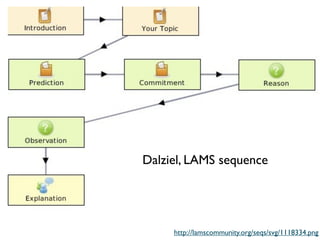
Dalziel, LAMS sequence


     http://lamscommunity.org/seqs/svg/1118334.png
POE using a discussion forum and a wiki


            http://lamscommunity.org/lamscentral/sequence?seq_id=1334409
Outcomes
•   Informed by social contructivism

•   The collaborative use of the POE computer tasks is
    designed to facilitate peer discussions and promote
    conceptual development and consensual meaning-
    making in the domain of science:

    •   Articulation and justification of a student’s own ideas

    •   Reflection on the viability of other students’ ideas.

    •   Critical reflection on a student’s own ideas.

    •   Construction and negotiation of new ideas.
References

•   Oliver, R., and Herrington, J. (2001). Teaching and learning online: a
    beginners guide to e-learning and e-teaching in Higher Education. Perth:
    Edith Cowan University.


•   White, R. T., & Gunstone, R. F. (1992). Probing Understanding. Great
    Britain: Falmer Press.


            http://www.ascilite.org.au/conferences/perth04/procs/siviter4.gif

Conole poe

  • 1.
    Predict Observe Explain Gráinne Conole, University of Leicester Learning Design Workshop, Online Educa, 30/11/11 http://ecx.images-amazon.com/images/I/5121Cl3IRRL._SL500_AA300_.jpg
  • 2.
    Background • POE strategy used to uncover individual students’ predictions, and their reasons for making these, about a specific event (White and Gunstone, 1992) • Uses: • find students' initial ideas • provide teachers with information about students’ thinking • generate discussion • motivate students to want to explore the concept • generate investigations.
  • 3.
    Steps Step 1: Demonstrate •Set up a demonstration of an event, related to the focus topic, that may surprise students, and which can be observed. • Tell the students what you are going to be doing. Step 2: Predict • Ask the students to independently write their prediction of what will happen. • Ask them what they think they will see and why they think this. Step 3: Observe • Carry out the demonstration. • Allow time to focus on observation. • Ask students to write down what they do observe. Step 4: Explain • Ask students to amend or add to their explanation to take account of the observation. • After students have committed their explanations to paper, discuss their ideas together. Via: http://arb.nzcer.org.nz/strategies/poe.php
  • 4.
    AUTC Learning Designs Oliver and Herrington, 1999
  • 5.
  • 6.
    Dalziel, LAMS sequence http://lamscommunity.org/seqs/svg/1118334.png
  • 7.
    POE using adiscussion forum and a wiki http://lamscommunity.org/lamscentral/sequence?seq_id=1334409
  • 8.
    Outcomes • Informed by social contructivism • The collaborative use of the POE computer tasks is designed to facilitate peer discussions and promote conceptual development and consensual meaning- making in the domain of science: • Articulation and justification of a student’s own ideas • Reflection on the viability of other students’ ideas. • Critical reflection on a student’s own ideas. • Construction and negotiation of new ideas.
  • 9.
    References • Oliver, R., and Herrington, J. (2001). Teaching and learning online: a beginners guide to e-learning and e-teaching in Higher Education. Perth: Edith Cowan University. • White, R. T., & Gunstone, R. F. (1992). Probing Understanding. Great Britain: Falmer Press. http://www.ascilite.org.au/conferences/perth04/procs/siviter4.gif

Editor's Notes