Designing Collaborative Learning Sessions that Promote Creative Problem Solving Using Design Patterns  Symeon Retalis ( [email_address] ) M. Katsamani, P. Georgiakakis, G. Lazakidou, O. Petropoulou &T. Kargidis University of Piraeus  Department of Digital Systems Computer Supported Learning Engineering Laboratory http://cosy.ted.unipi.gr
Overview Motivation of our work Supporting Teachers/Practitioners Designing effective scripts for supporting the computer supported collaborative creative (CSCC) process Learning Flow Design Patterns Variations of Design Patters Adding recommendations to tools to support CSCC scripts Concluding remarks i dSpace  project  on Tooling and Training for collaborative product innovation  http://idspace-project.org
What Is Creativity? Creativity is best described as the human capacity regularly to  solve problems  in a way that is initially novel but ultimately acceptable in a culture.  Creativity process  is an intense  collaborative process  of generating and exploring ideas meant to contribute to  innovative solution of particular problems Innovation is transformation of  existing knowledge  and ideas into  new  or  better  commercial product that  add value  to the customer.” (Carter Evans & Koop 1990)
What Is Innovation? Source: Ed Ashford, presentation by SAS Global
Collaboration for Innovation … Source: Michael Beyerlein (2006), Keynote Address at American Creativity Association International Conference 2006 Unfocused activities and free collaboration does not necessarily produce effective learning outcomes
Tools for supporting collaboration for innovation - Affordances http://share.skype.com/sites/en/2005/08/the_skypeforumde_skype_picture.html
Need for better pedagogy Explicit, dedicated pedagogical strategies to enhance of creative problem solving is relatively scarce (Baruah and Paulus, 2008). Collaborative Strategies : Jigsaw, TPS, Pyramid, Role Playing, eARMA Creativity Strategies : Six Hats, SCAMPER, 5H1W
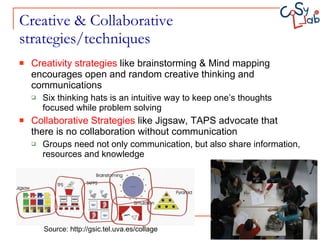
Creative & Collaborative strategies/techniques Creativity strategies   like brainstorming & Mind mapping encourages open and random creative thinking and communications Six thinking hats is an intuitive way to keep one’s thoughts focused while problem solving Collaborative Strategies  like Jigsaw, TAPS advocate that there is no collaboration without communication Groups need not only communication, but also share information, resources and knowledge Source: http://gsic.tel.uva.es/collage
Needs when designing CSCC situations Dynamic learning scenarios need for:  Structured designs of collaborative creative problem solving situations Flexible customizable designs of computer supported collaborative creativity situations (CSCC)  Activity level (macro): Collaborative  learning flow , i.e., sequence of activities that make up a learning process Action level (micro): Detailed learning actions within an activity
What is a design pattern? A  Solution  to a  Problem  in a  Context Alexander  defines a pattern as follows:  ".... Each pattern describes a  problem  which  occurs over   and over  again  in our environment , and then describes the core of the  solution  to that problem, in such a way that you can  use this solution a   million times over , without ever doing it the same way twice"  [Alexander, C., Ishikawa, S., Silverstein, M., Jacobson, M., Fiksdahl-King, I., & Angel, S. (1977). A Pattern Language. Oxford University Press, New York.] Solution Problem Context
Patterns Can … Capture expert practice in specific context Provide common nomenclature for designers  Provide “shorthand” for effectively communicating complex principles Help documentation and justification of the rationale Capture the most important aspects of a problem solution in a standard format with a formalism Show multiple examples of solutions Become a tool for collaboration among peers who are interested in designing  activities
TPS CLFP Thinking, forming pairs and sharing Source: http://gsic.tel.uva.es/collage
eARMA CLFP for collaborative problem solving Problem Solving Steps Definition of the problem Constructing a strategy  Organizing information Allocation of resources Monitoring the solving process Evaluating the solving process and outcomes  (Sternberg, 2003)
The CLFP design pattern format Element  Explanation  Name Name of the FDP Context Environment type in which the CLFP could be applied Problem  Learning problem to be solved by the CLFP Solution Description of the proposal by the CLFP for solving the problem Actors and Actions Description of the actors involved in the collaborative activity described by the CLFP as well as their activities Types of Tasks Description of the types of groups of learners identified and how they are related, types of tasks, together with their sequence, performed by the actors involved in the activity. Example A real-world learning activity capable of being structured according to the CLFP Related patterns Names of other interrelated patterns References List of resources for further reading
Variations of a strategy in a CLFP A new element needs to be added, entitled “ variations ”.  This element will specify what to change and under which conditions in the sequence of activities, the resources or the tools.  All these changes need to be justified in order to illuminate the rationale behind these variations. to give advice to designers on how to make effective mixtures of strategies without harnessing the basic educational philosophy and added value
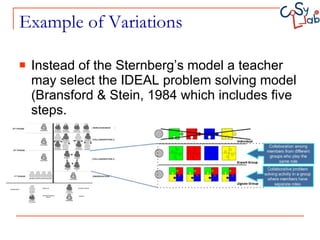
Example of Variations Instead of the Sternberg’s model a teacher may select the IDEAL problem solving model (Bransford & Stein, 1984 which includes five steps.
Variations of a strategy in a CLFP – Preparation of a cocktail During the preparation of a cocktail,  the cornerstone is an understanding of the relationships between strong and weak, sour and sweet  in CSCL, a designer should blend the phases, the resources, and the tools (i.e. the ingredients) together cautiously.  Otherwise, this scenario will resemble a weak or watery development like a cocktail with inappropriate flavour, texture and colour. Source: http://www.vincenzos.com/images/cocktail.gif
Recommendations during the CSCC process Higher order , which will help a practitioner to choose among the most suitable creativity strategy for a specific scenario/case. This choice will be based on elements such as the type of learning objectives need to be accomplished, the complexity of implementing a strategy as a whole and as per activities of the strategy. Organisational recommendations  which will involve decisions about the formation of groups, leadership schema, etc.  Technological   recommendations  which will concern the use of specific tools, features for the implementation of the strategy into a real specific scenario/case.
Selection criteria based on the operations types and activities  Learning objectives . An example TAPPS strategy can help in accomplishing the procedural objective of “promoting analytical reasoning skills”. Types of problems that are best served with the strategies . For example, Jigsaw is most appropriate when a problem to be solved is “complex and can be easily divided into sections or independent sub-problems”. Complexity or risk  in terms of collaborative learning experienced needed. For example Jigsaw is complex and is probably more appropriate for experienced participants
Selection criteria complexity: low|high type-of-problem: closed|open physical-requirements: yes|no emotions-dependent: yes|no  interactive: low|high supporting-action: exporation|combination|transformation|evaluation // characterization by Boden distance: short|long // the distance between an given input and the possibly resulting idea moderator: yes|no expert_participants: yes|no
Recommendations in computable format
The example of the eARMA strategy The example eARMA strategy: complexity: high type-of-problem: closed physical-requirements: no emotions-dependent: no  interactive: high supporting-action: exploration, combination, evaluation  distance: short  moderator: no expert_participants: no
Open Issues… Are design patterns effective tools for guiding novice designers/practitioners? Building recommender systems Usable & effective for novice designer s/ practitioners Creating systems for supporting collaborative creativity processes based on design patterns
Collaboration for Innovation Source: http://images.wnec.edu/teamwork.gif The present work was carried out as part of  the IST FP 7 project “ idSpace : Tooling and Training for collaborative product innovation  http://idspace-project.org  (ref  FP7-IST-2007-1-41-216799) the Leonardo da Vinci project “ A Framework for Preparing Teachers to Teach with ICT ” (ref LLP-LdV-TOI-09-CY-167918) Symeon Retalis ( [email_address] )

Nle2010 retalis-ppt

  • 1.
    Designing Collaborative LearningSessions that Promote Creative Problem Solving Using Design Patterns Symeon Retalis ( [email_address] ) M. Katsamani, P. Georgiakakis, G. Lazakidou, O. Petropoulou &T. Kargidis University of Piraeus Department of Digital Systems Computer Supported Learning Engineering Laboratory http://cosy.ted.unipi.gr
  • 2.
    Overview Motivation ofour work Supporting Teachers/Practitioners Designing effective scripts for supporting the computer supported collaborative creative (CSCC) process Learning Flow Design Patterns Variations of Design Patters Adding recommendations to tools to support CSCC scripts Concluding remarks i dSpace project on Tooling and Training for collaborative product innovation http://idspace-project.org
  • 3.
    What Is Creativity?Creativity is best described as the human capacity regularly to solve problems in a way that is initially novel but ultimately acceptable in a culture. Creativity process is an intense collaborative process of generating and exploring ideas meant to contribute to innovative solution of particular problems Innovation is transformation of existing knowledge and ideas into new or better commercial product that add value to the customer.” (Carter Evans & Koop 1990)
  • 4.
    What Is Innovation?Source: Ed Ashford, presentation by SAS Global
  • 5.
    Collaboration for Innovation… Source: Michael Beyerlein (2006), Keynote Address at American Creativity Association International Conference 2006 Unfocused activities and free collaboration does not necessarily produce effective learning outcomes
  • 6.
    Tools for supportingcollaboration for innovation - Affordances http://share.skype.com/sites/en/2005/08/the_skypeforumde_skype_picture.html
  • 7.
    Need for betterpedagogy Explicit, dedicated pedagogical strategies to enhance of creative problem solving is relatively scarce (Baruah and Paulus, 2008). Collaborative Strategies : Jigsaw, TPS, Pyramid, Role Playing, eARMA Creativity Strategies : Six Hats, SCAMPER, 5H1W
  • 8.
    Creative & Collaborativestrategies/techniques Creativity strategies like brainstorming & Mind mapping encourages open and random creative thinking and communications Six thinking hats is an intuitive way to keep one’s thoughts focused while problem solving Collaborative Strategies like Jigsaw, TAPS advocate that there is no collaboration without communication Groups need not only communication, but also share information, resources and knowledge Source: http://gsic.tel.uva.es/collage
  • 9.
    Needs when designingCSCC situations Dynamic learning scenarios need for: Structured designs of collaborative creative problem solving situations Flexible customizable designs of computer supported collaborative creativity situations (CSCC) Activity level (macro): Collaborative learning flow , i.e., sequence of activities that make up a learning process Action level (micro): Detailed learning actions within an activity
  • 10.
    What is adesign pattern? A Solution to a Problem in a Context Alexander defines a pattern as follows: ".... Each pattern describes a problem which occurs over and over again in our environment , and then describes the core of the solution to that problem, in such a way that you can use this solution a million times over , without ever doing it the same way twice" [Alexander, C., Ishikawa, S., Silverstein, M., Jacobson, M., Fiksdahl-King, I., & Angel, S. (1977). A Pattern Language. Oxford University Press, New York.] Solution Problem Context
  • 11.
    Patterns Can …Capture expert practice in specific context Provide common nomenclature for designers Provide “shorthand” for effectively communicating complex principles Help documentation and justification of the rationale Capture the most important aspects of a problem solution in a standard format with a formalism Show multiple examples of solutions Become a tool for collaboration among peers who are interested in designing activities
  • 12.
    TPS CLFP Thinking,forming pairs and sharing Source: http://gsic.tel.uva.es/collage
  • 13.
    eARMA CLFP forcollaborative problem solving Problem Solving Steps Definition of the problem Constructing a strategy Organizing information Allocation of resources Monitoring the solving process Evaluating the solving process and outcomes (Sternberg, 2003)
  • 14.
    The CLFP designpattern format Element Explanation Name Name of the FDP Context Environment type in which the CLFP could be applied Problem Learning problem to be solved by the CLFP Solution Description of the proposal by the CLFP for solving the problem Actors and Actions Description of the actors involved in the collaborative activity described by the CLFP as well as their activities Types of Tasks Description of the types of groups of learners identified and how they are related, types of tasks, together with their sequence, performed by the actors involved in the activity. Example A real-world learning activity capable of being structured according to the CLFP Related patterns Names of other interrelated patterns References List of resources for further reading
  • 15.
    Variations of astrategy in a CLFP A new element needs to be added, entitled “ variations ”. This element will specify what to change and under which conditions in the sequence of activities, the resources or the tools. All these changes need to be justified in order to illuminate the rationale behind these variations. to give advice to designers on how to make effective mixtures of strategies without harnessing the basic educational philosophy and added value
  • 16.
    Example of VariationsInstead of the Sternberg’s model a teacher may select the IDEAL problem solving model (Bransford & Stein, 1984 which includes five steps.
  • 17.
    Variations of astrategy in a CLFP – Preparation of a cocktail During the preparation of a cocktail, the cornerstone is an understanding of the relationships between strong and weak, sour and sweet in CSCL, a designer should blend the phases, the resources, and the tools (i.e. the ingredients) together cautiously. Otherwise, this scenario will resemble a weak or watery development like a cocktail with inappropriate flavour, texture and colour. Source: http://www.vincenzos.com/images/cocktail.gif
  • 18.
    Recommendations during theCSCC process Higher order , which will help a practitioner to choose among the most suitable creativity strategy for a specific scenario/case. This choice will be based on elements such as the type of learning objectives need to be accomplished, the complexity of implementing a strategy as a whole and as per activities of the strategy. Organisational recommendations which will involve decisions about the formation of groups, leadership schema, etc. Technological recommendations which will concern the use of specific tools, features for the implementation of the strategy into a real specific scenario/case.
  • 19.
    Selection criteria basedon the operations types and activities Learning objectives . An example TAPPS strategy can help in accomplishing the procedural objective of “promoting analytical reasoning skills”. Types of problems that are best served with the strategies . For example, Jigsaw is most appropriate when a problem to be solved is “complex and can be easily divided into sections or independent sub-problems”. Complexity or risk in terms of collaborative learning experienced needed. For example Jigsaw is complex and is probably more appropriate for experienced participants
  • 20.
    Selection criteria complexity:low|high type-of-problem: closed|open physical-requirements: yes|no emotions-dependent: yes|no interactive: low|high supporting-action: exporation|combination|transformation|evaluation // characterization by Boden distance: short|long // the distance between an given input and the possibly resulting idea moderator: yes|no expert_participants: yes|no
  • 21.
  • 22.
    The example ofthe eARMA strategy The example eARMA strategy: complexity: high type-of-problem: closed physical-requirements: no emotions-dependent: no interactive: high supporting-action: exploration, combination, evaluation distance: short moderator: no expert_participants: no
  • 23.
    Open Issues… Aredesign patterns effective tools for guiding novice designers/practitioners? Building recommender systems Usable & effective for novice designer s/ practitioners Creating systems for supporting collaborative creativity processes based on design patterns
  • 24.
    Collaboration for InnovationSource: http://images.wnec.edu/teamwork.gif The present work was carried out as part of the IST FP 7 project “ idSpace : Tooling and Training for collaborative product innovation http://idspace-project.org (ref FP7-IST-2007-1-41-216799) the Leonardo da Vinci project “ A Framework for Preparing Teachers to Teach with ICT ” (ref LLP-LdV-TOI-09-CY-167918) Symeon Retalis ( [email_address] )

Editor's Notes

  • #14 Να γίνει αναφορά στη λειτουργία του Moodle