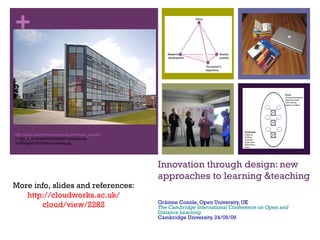
Innovation through design: new approaches to learning &teaching Gráinne Conole, Open University, UK The Cambridge International Conference on Open and Distance Learning  Cambridge University, 24/09/09 More info, slides and references: http://cloudworks.ac.uk/ cloud/view/2282 http://static.worldarchitecturenews.com/news_images/ 11190_3_JLB%20PREFERRED%20External %20Image%201000px%20wide.jpg
Outline The  paradoxes  between the promise and reality of technologoes Why do so many  innovations fail? Connecting  research and practice  and towards a vision for  open design Illustrative case studies:  OU Learning Design Initiative & Olnet (an Open Educational Resource Network) Reflections and questions  in cloudworks!
Paradoxes New technologies offer new pedagogical opportunities Potential for reuse with Open Educational Resources Liberating learning beyond formal structures Open Educational  Resources Little evidence  of  reuse Array of  technologies Not fully  exploited New pedagogies New learning models
Why do great initiatives often fail? Common  reactions:   “ I haven’t got  time ” “ My  research  is more important” “ What’s in it for  me ?” “ Where is my  reward ?” “ I don’t have the  skills  to do this” “ I  don’t believe  in this, it won’t work” Common  resistance strategies: I’ll say yes (and  do nothing ) Undermine  the initiative Undermine  the person involved Do it  badly Classic  mistakes : Emphasis on the  technologies , not the  people and processes Funding for technology developments but not  use and support
The solution? Connection… Institutional & national funding Embedding in strategy Aligning to technology trends Changing user behaviour Drivers and challenges Actual use in practice What’s in it for me? Evidence of impact Policy Teacher  practice Research & development The learner’s  experience
Bridging the gap Personalised Situative Social Experiential Reflective Adaptive Contextual Networked Immersive Collective “ Open Design” Characteristics of  good pedagogy  Affordances of new technologies
Open Design: a definition/approach Aims to widen access to good ideas and designs, to share practice Design for all types of learning activity Formal course Individual learning activity Informal study group activity Blurring of boundaries Teacher – Learner Formal – informal Real – virtual Principles Open Sharable Explicit:  design process explicit & sharable Designers and users Builds on open source principles Assessment Learning outcomes Tasks Aspects of design
Realising “open design” Evidence base (interviews, surveys, observation, web stats,  expert panels, focus groups)  Development (resources,  methods, tools,  session types, interventions) Trialing  (within the OU,  workshops &  conferences,  project partners) Open University Learning Design Initiative & The Olnet network
OU Learning Design Initiative Design methods: schema & patterns Tools:  Visualisation & guidance Events:  Cloudworks:  sharing & discussing
Olnet: redefining openness
Converging practices Modern technologies Modern pedagogy Web 2.0  practices Location  aware technologies Adaptation  & customisation Second life/ immersive  worlds Google  it! “ Expert badges” , World of warcraft  User- generated content Blogging, peer  critiquing Cloud  computing From individual to  social Contextualised and  situated  learning Personalised  learning Experiential  learning Inquiry  learning Peer  learning Open  Educational Resources Reflection Distributed  cognition
Cloudworks: Harnessing web 2.0
Key concepts Clouds:  Learning & teaching ideas Design or case studies Tools or resources Questions or problems Cloudscapes: Conferences Workshops Course team Student cohort Research theme Project
User profile
Activity stream
Features Dynamic list of clouds + new comments Comments on clouds + cloudscapes Can “follow” people + cloudscapes RSS feeds of cloudscapes + people Embedding: pictures, video, presentations Twitter feeds for people +cloudscapes Email alerts Activity streams
Emergent patterns of use Events: conferences and workshops ALT-C conference , 8-11 th  September 2009 http://cloudworks.ac.uk/index.php/cloudscape/view/1870 Discussions: Flash debates Is Twitter killing blogging? http://cloudworks.ac.uk/index.php/cloud/view/2266 Eliciting expertise Literature review  of educational technologist http://cloudworks.ac.uk/index.php/cloudscape/view/1872 Aggregating resources En Rumbo  Spanish course http://cloudworks.ac.uk/index.php/cloudscape/view/776
Open design and mediation Can we develop new innovative mediating artefacts? How can we make the design more explicit and sharable ? Designer Design Has an  inherent Learning activity or OER Creates Mediating  artefacts Mediating artefacts Visualisation: CompendiumLD Methods: Schema & patterns Sharing: Cloudworks User – can now repurpose
Open Design in practice
Design, use, reuse Designer OER Design Creates Deposits Deposits Learner A OER Design Learner B Tutor  Chooses Uses Quiz + beginners route Uses Quiz + advanced route Repurposes  & deposits
Process design Prior designs  & resources New designs Content:  (OER repositories, etc) Designs:  (Pedagogical  Patterns,  CompendiumLD designs)  New OER  & designs
Conclusions Motivation : helping teachers/designers make more innovative use of technologies to create better learner experiences Approach : development of a range of resources, tools, methods and events to support this Evidence-base and agile development : on-going evaluation and reflection to enhance understanding and drive future developments Reflection : How effective is this? Where to next? Is it transferable? How “open” can we really expect teachers/learners to be?
Innovation through design: new approaches to learning &teaching Gráinne Conole, Open University, UK The Cambridge International Conference on Open and Distance Learning  Cambridge University, 24/09/09 More info, slides and references: http://cloudworks.ac.uk/ cloud/view/2282 http://static.worldarchitecturenews.com/news_images/ 11190_3_JLB%20PREFERRED%20External %20Image%201000px%20wide.jpg

Conole Cambridge

  • 1.
    Innovation through design:new approaches to learning &teaching Gráinne Conole, Open University, UK The Cambridge International Conference on Open and Distance Learning Cambridge University, 24/09/09 More info, slides and references: http://cloudworks.ac.uk/ cloud/view/2282 http://static.worldarchitecturenews.com/news_images/ 11190_3_JLB%20PREFERRED%20External %20Image%201000px%20wide.jpg
  • 2.
    Outline The paradoxes between the promise and reality of technologoes Why do so many innovations fail? Connecting research and practice and towards a vision for open design Illustrative case studies: OU Learning Design Initiative & Olnet (an Open Educational Resource Network) Reflections and questions in cloudworks!
  • 3.
    Paradoxes New technologiesoffer new pedagogical opportunities Potential for reuse with Open Educational Resources Liberating learning beyond formal structures Open Educational Resources Little evidence of reuse Array of technologies Not fully exploited New pedagogies New learning models
  • 4.
    Why do greatinitiatives often fail? Common reactions: “ I haven’t got time ” “ My research is more important” “ What’s in it for me ?” “ Where is my reward ?” “ I don’t have the skills to do this” “ I don’t believe in this, it won’t work” Common resistance strategies: I’ll say yes (and do nothing ) Undermine the initiative Undermine the person involved Do it badly Classic mistakes : Emphasis on the technologies , not the people and processes Funding for technology developments but not use and support
  • 5.
    The solution? Connection…Institutional & national funding Embedding in strategy Aligning to technology trends Changing user behaviour Drivers and challenges Actual use in practice What’s in it for me? Evidence of impact Policy Teacher practice Research & development The learner’s experience
  • 6.
    Bridging the gapPersonalised Situative Social Experiential Reflective Adaptive Contextual Networked Immersive Collective “ Open Design” Characteristics of good pedagogy Affordances of new technologies
  • 7.
    Open Design: adefinition/approach Aims to widen access to good ideas and designs, to share practice Design for all types of learning activity Formal course Individual learning activity Informal study group activity Blurring of boundaries Teacher – Learner Formal – informal Real – virtual Principles Open Sharable Explicit: design process explicit & sharable Designers and users Builds on open source principles Assessment Learning outcomes Tasks Aspects of design
  • 8.
    Realising “open design”Evidence base (interviews, surveys, observation, web stats, expert panels, focus groups) Development (resources, methods, tools, session types, interventions) Trialing (within the OU, workshops & conferences, project partners) Open University Learning Design Initiative & The Olnet network
  • 9.
    OU Learning DesignInitiative Design methods: schema & patterns Tools: Visualisation & guidance Events: Cloudworks: sharing & discussing
  • 10.
  • 11.
    Converging practices Moderntechnologies Modern pedagogy Web 2.0 practices Location aware technologies Adaptation & customisation Second life/ immersive worlds Google it! “ Expert badges” , World of warcraft User- generated content Blogging, peer critiquing Cloud computing From individual to social Contextualised and situated learning Personalised learning Experiential learning Inquiry learning Peer learning Open Educational Resources Reflection Distributed cognition
  • 12.
  • 13.
    Key concepts Clouds: Learning & teaching ideas Design or case studies Tools or resources Questions or problems Cloudscapes: Conferences Workshops Course team Student cohort Research theme Project
  • 14.
  • 15.
  • 16.
    Features Dynamic listof clouds + new comments Comments on clouds + cloudscapes Can “follow” people + cloudscapes RSS feeds of cloudscapes + people Embedding: pictures, video, presentations Twitter feeds for people +cloudscapes Email alerts Activity streams
  • 17.
    Emergent patterns ofuse Events: conferences and workshops ALT-C conference , 8-11 th September 2009 http://cloudworks.ac.uk/index.php/cloudscape/view/1870 Discussions: Flash debates Is Twitter killing blogging? http://cloudworks.ac.uk/index.php/cloud/view/2266 Eliciting expertise Literature review of educational technologist http://cloudworks.ac.uk/index.php/cloudscape/view/1872 Aggregating resources En Rumbo Spanish course http://cloudworks.ac.uk/index.php/cloudscape/view/776
  • 18.
    Open design andmediation Can we develop new innovative mediating artefacts? How can we make the design more explicit and sharable ? Designer Design Has an inherent Learning activity or OER Creates Mediating artefacts Mediating artefacts Visualisation: CompendiumLD Methods: Schema & patterns Sharing: Cloudworks User – can now repurpose
  • 19.
  • 20.
    Design, use, reuseDesigner OER Design Creates Deposits Deposits Learner A OER Design Learner B Tutor Chooses Uses Quiz + beginners route Uses Quiz + advanced route Repurposes & deposits
  • 21.
    Process design Priordesigns & resources New designs Content: (OER repositories, etc) Designs: (Pedagogical Patterns, CompendiumLD designs) New OER & designs
  • 22.
    Conclusions Motivation :helping teachers/designers make more innovative use of technologies to create better learner experiences Approach : development of a range of resources, tools, methods and events to support this Evidence-base and agile development : on-going evaluation and reflection to enhance understanding and drive future developments Reflection : How effective is this? Where to next? Is it transferable? How “open” can we really expect teachers/learners to be?
  • 23.
    Innovation through design:new approaches to learning &teaching Gráinne Conole, Open University, UK The Cambridge International Conference on Open and Distance Learning Cambridge University, 24/09/09 More info, slides and references: http://cloudworks.ac.uk/ cloud/view/2282 http://static.worldarchitecturenews.com/news_images/ 11190_3_JLB%20PREFERRED%20External %20Image%201000px%20wide.jpg