What are the implications of new social and participatory media on assessment practices?Gráinne Conole,The Open University, UKE-Assessment Scotland conference, Dundee3rd September 2010
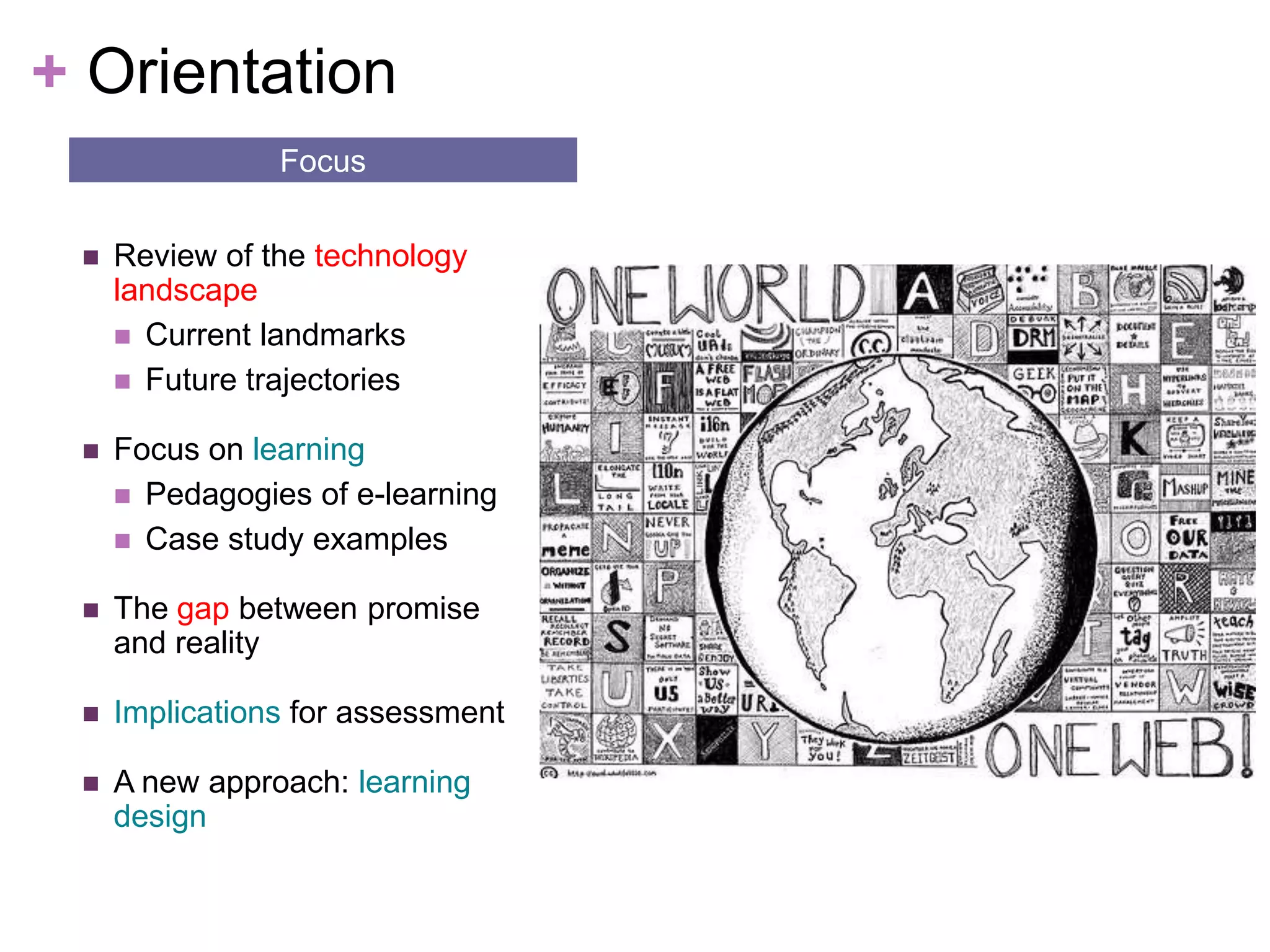
OrientationFocusReview of the technology landscape Current landmarks Future trajectoriesFocus on learningPedagogies of e-learningCase study examplesThe gap between promise and realityImplications for assessmentA new approach: learning design
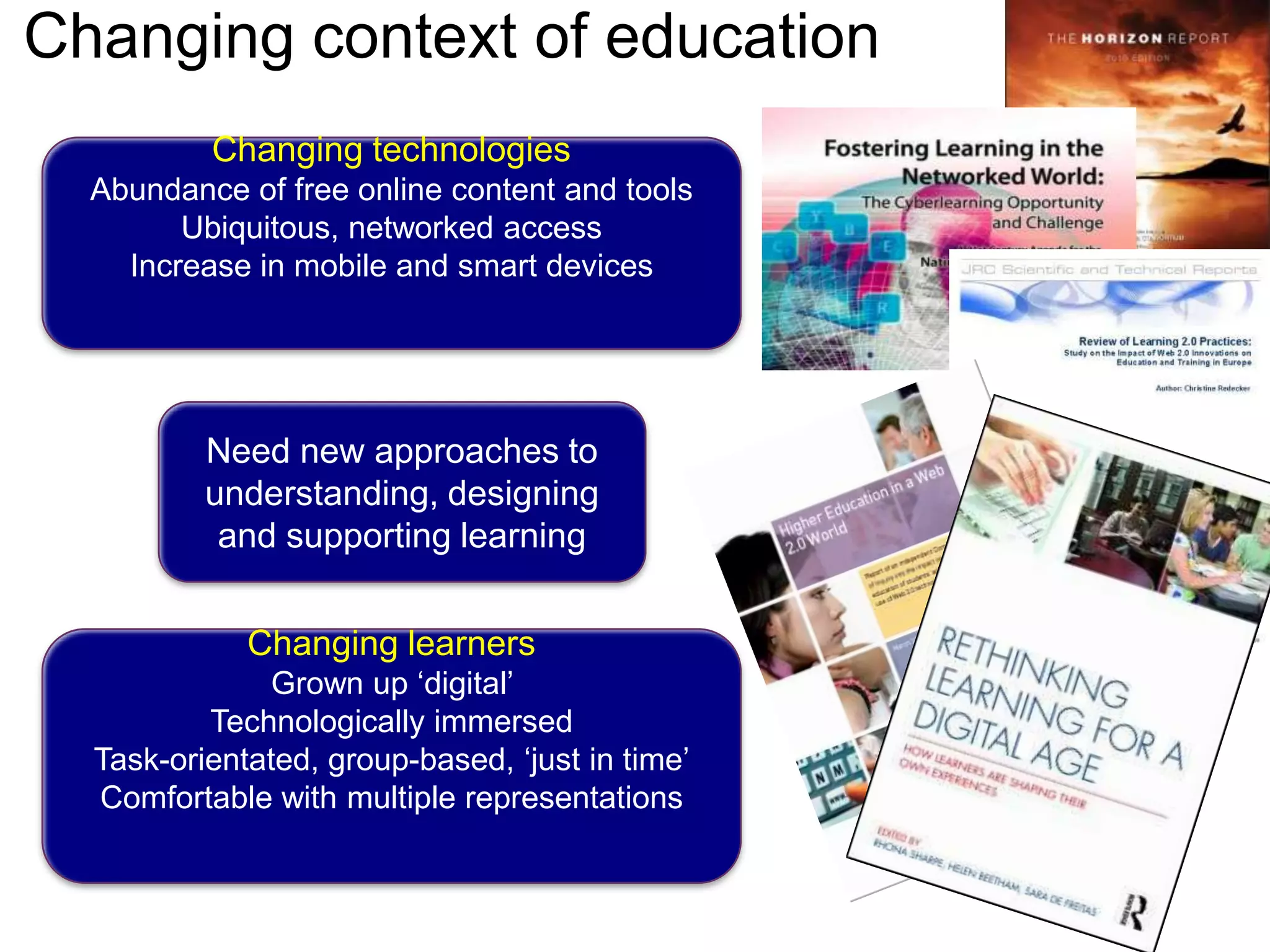
Changing context of educationChanging technologiesAbundance of free online content and toolsUbiquitous, networked accessIncrease in mobile and smart devicesNeed new approaches to understanding, designing and supporting learningChanging learnersGrown up ‘digital’ Technologically immersedTask-orientated, group-based, ‘just in time’Comfortable with multiple representations
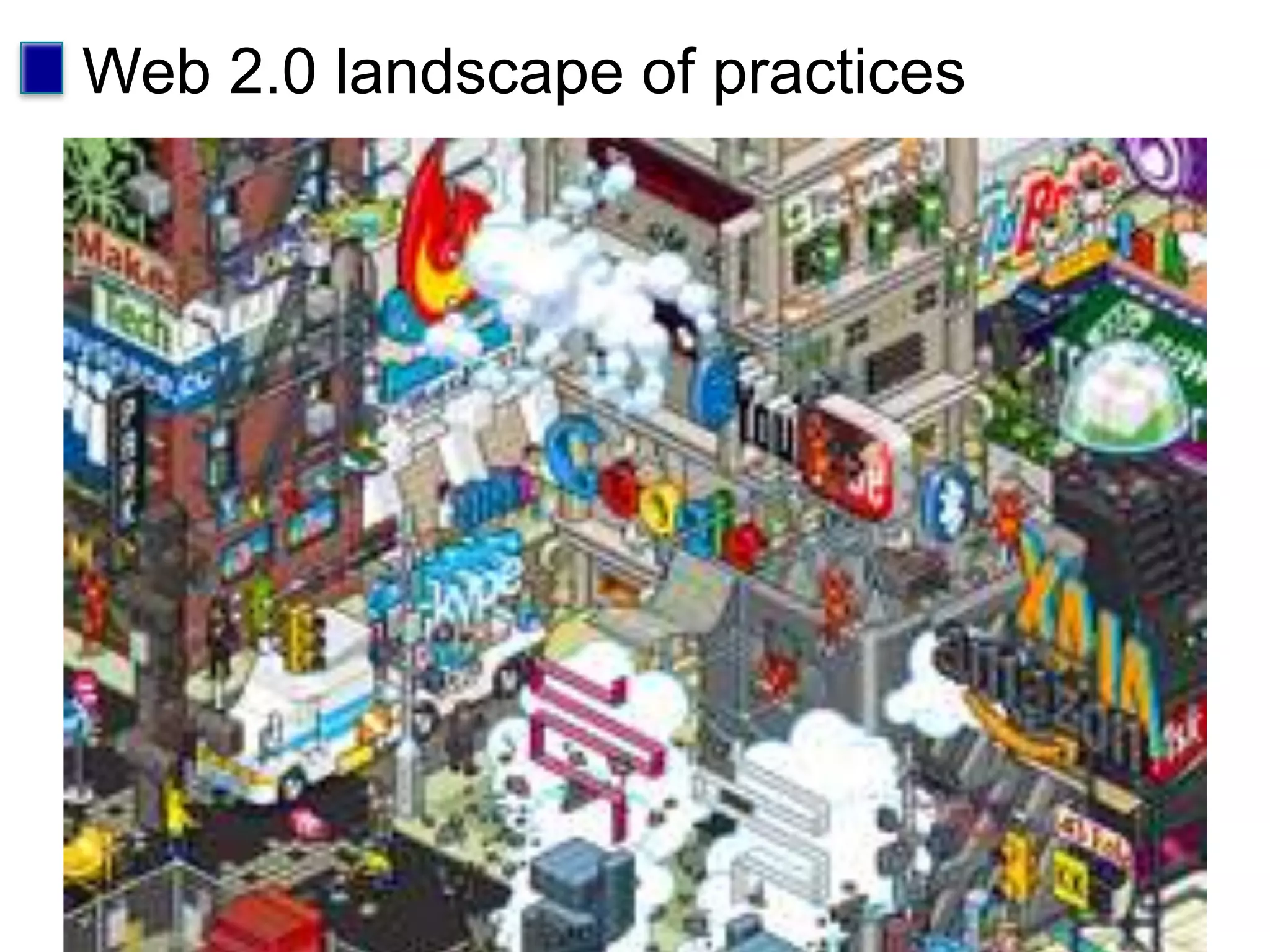
Web 2.0 landscape of practices
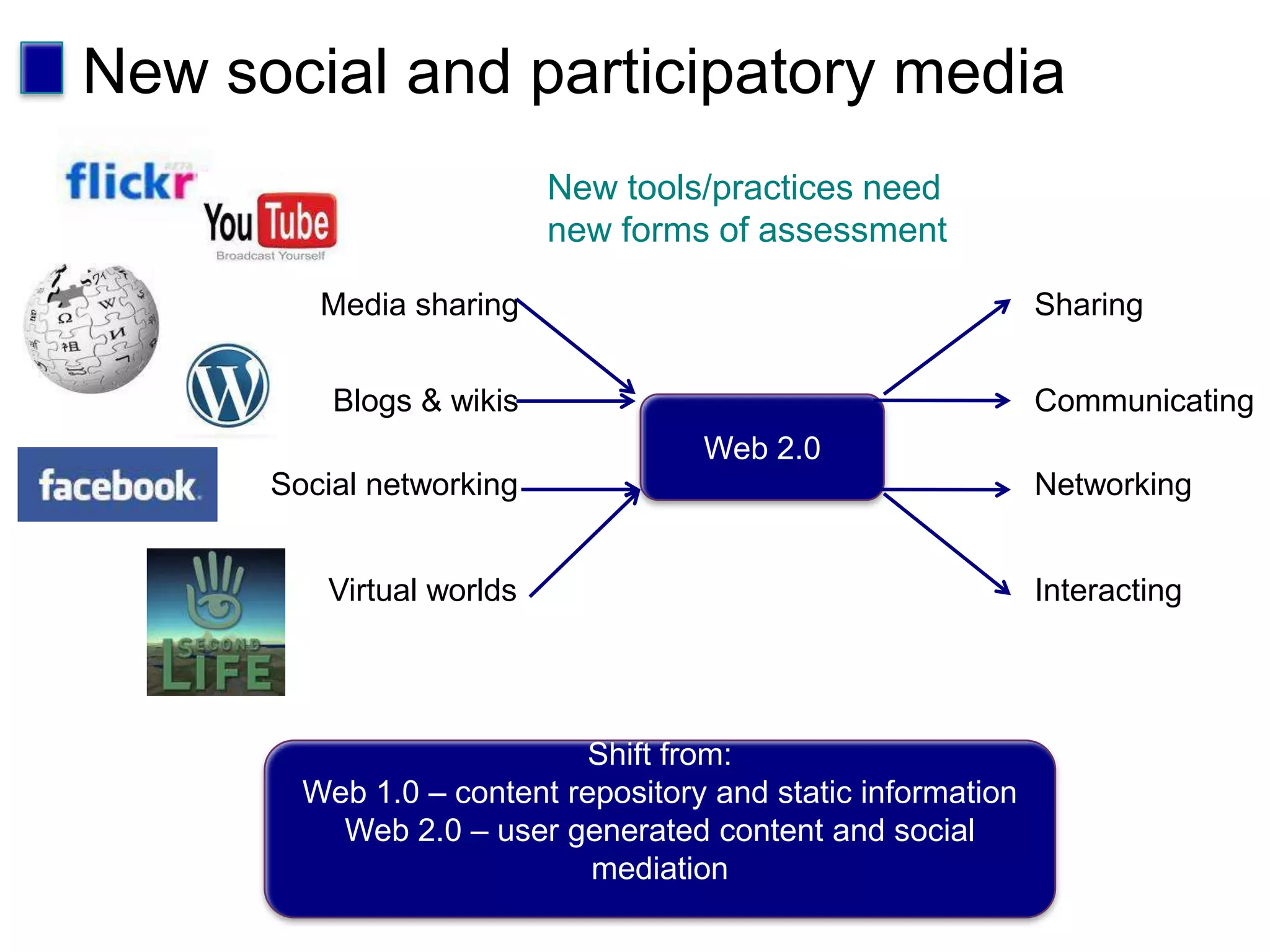
New social and participatory mediaNew tools/practices need new forms of assessmentSharingMedia sharingWeb 2.0CommunicatingBlogs & wikisNetworkingSocial networkingInteractingVirtual worldsShift from:Web 1.0 – content repository and static informationWeb 2.0 – user generated content and social mediation
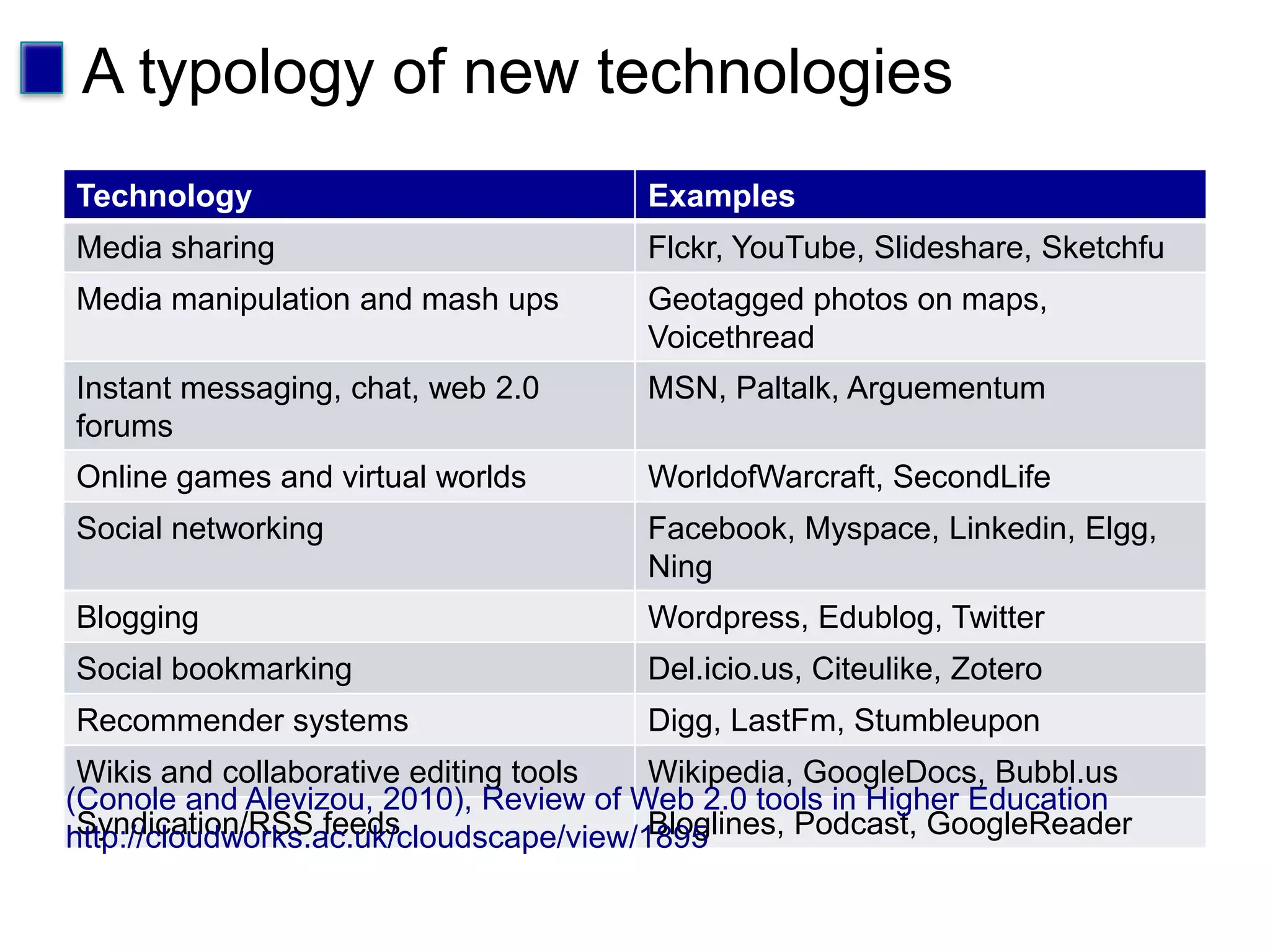
A typology of new technologies(Conole and Alevizou, 2010), Review of Web 2.0 tools in Higher Educationhttp://cloudworks.ac.uk/cloudscape/view/1895
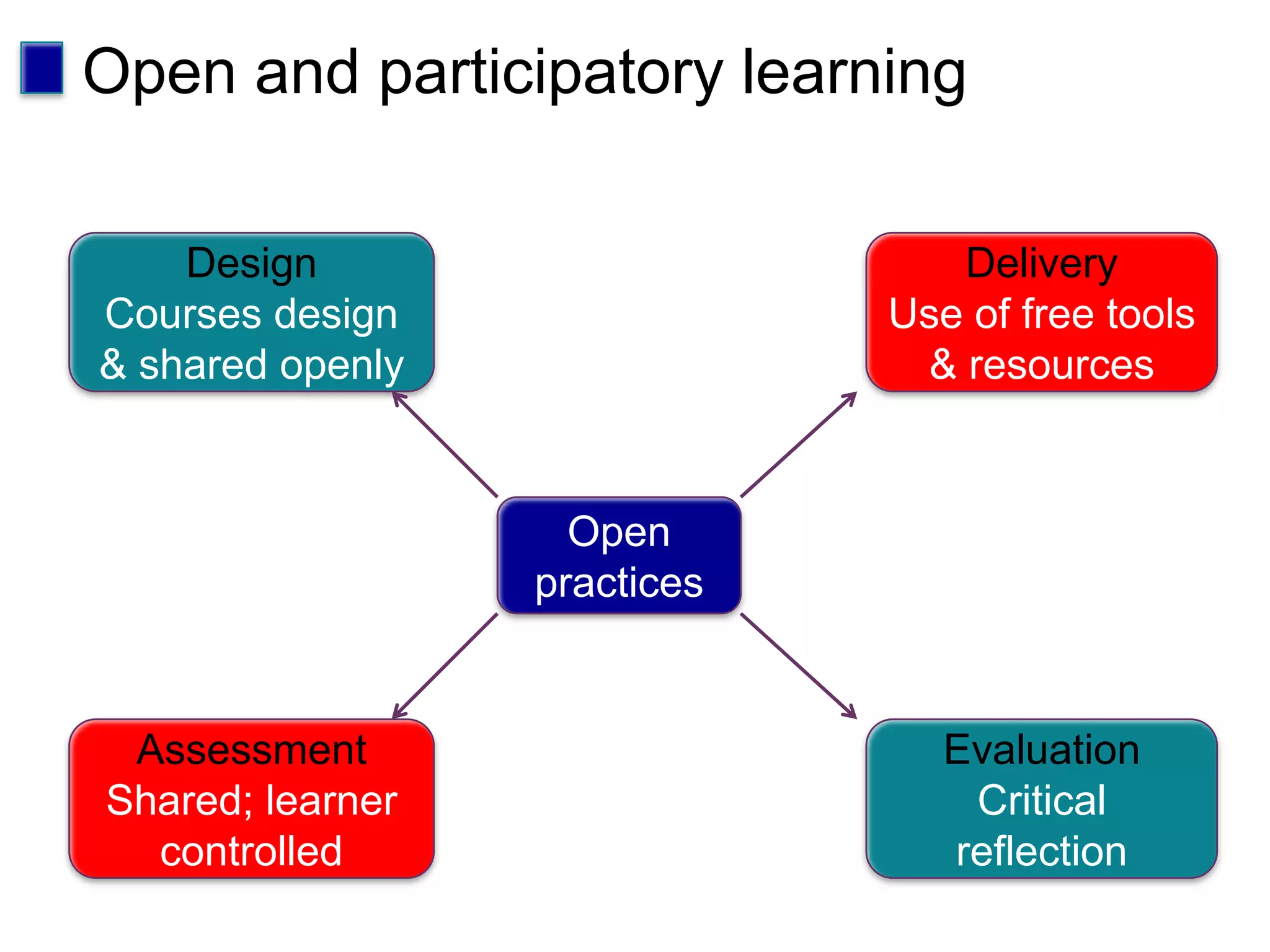
Open and participatory learningDesignCourses design & shared openlyDeliveryUse of free tools & resourcesOpen practicesEvaluationCritical reflectionAssessmentShared; learner controlled
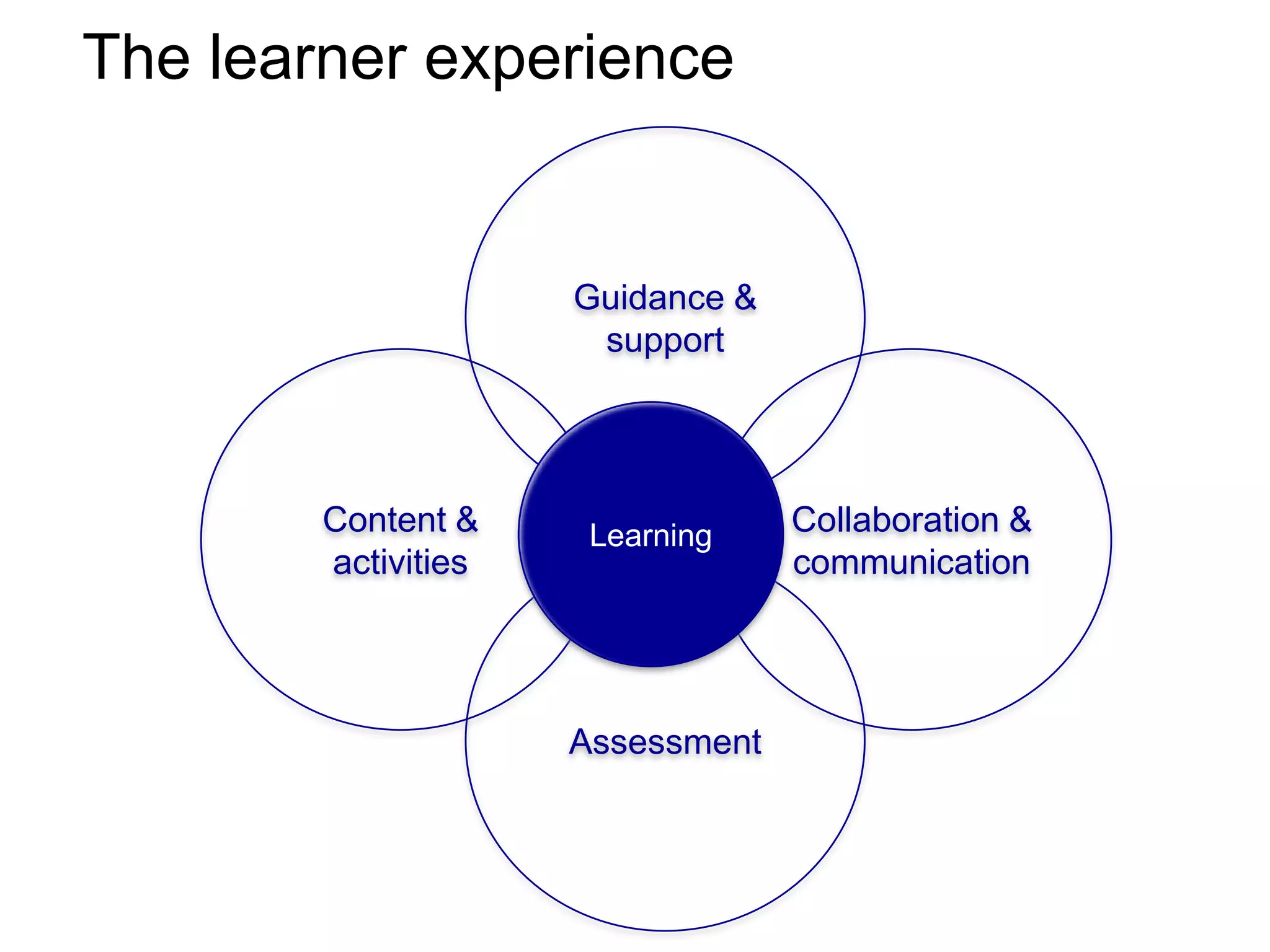
The learner experienceGuidance & supportCollaboration & communicationContent & activitiesLearningAssessment
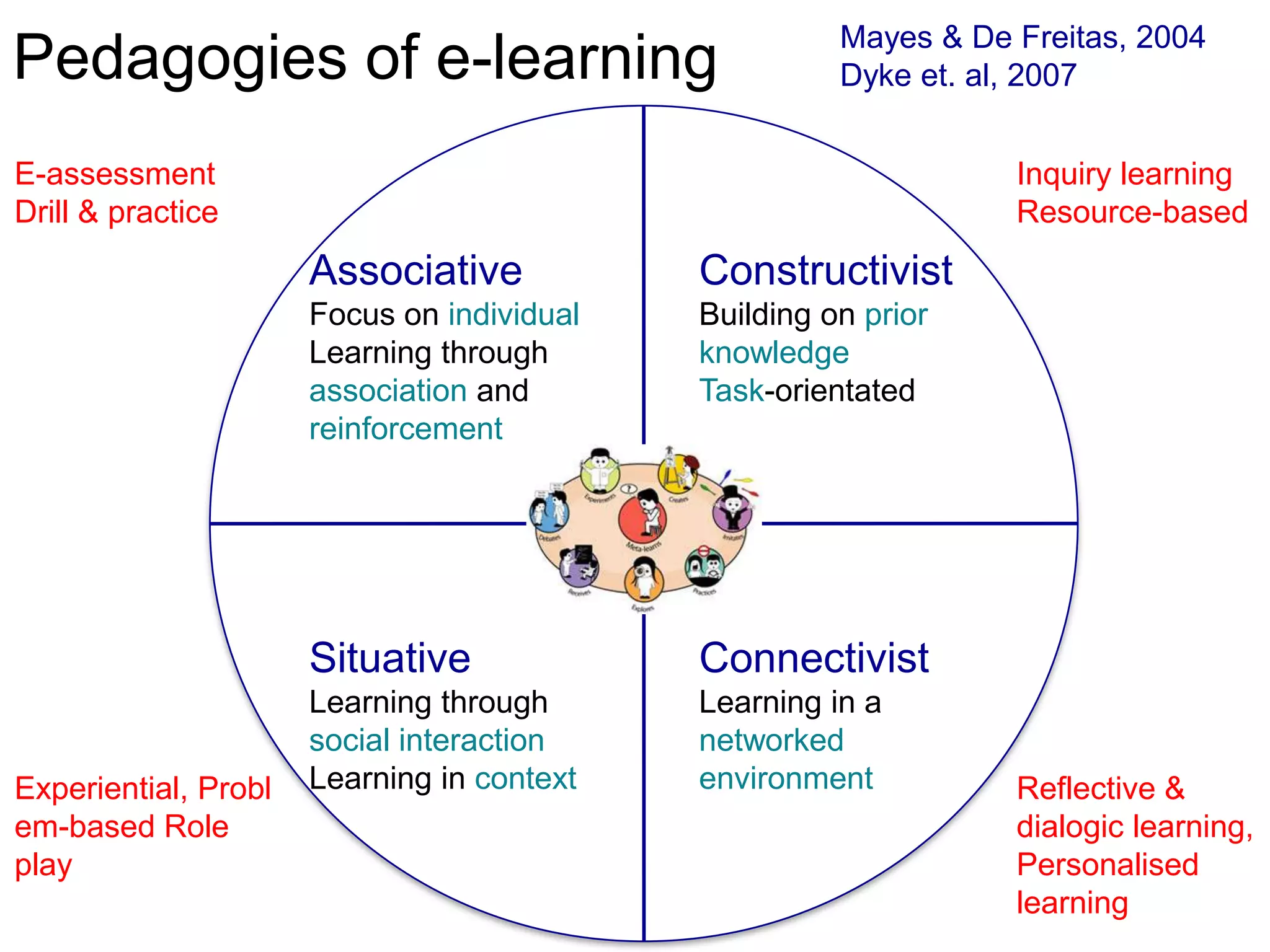
Pedagogies of e-learningMayes & De Freitas, 2004Dyke et. al, 2007AE-assessmentDrill & practiceInquiry learningResource-basedAssociativeFocus on individualLearning through association and reinforcementConstructivistBuilding on prior knowledgeTask-orientatedSituativeLearning through social interactionLearning in contextConnectivistLearning in a networked environmentExperiential, Problem-based Role playReflective & dialogic learning, Personalised learning
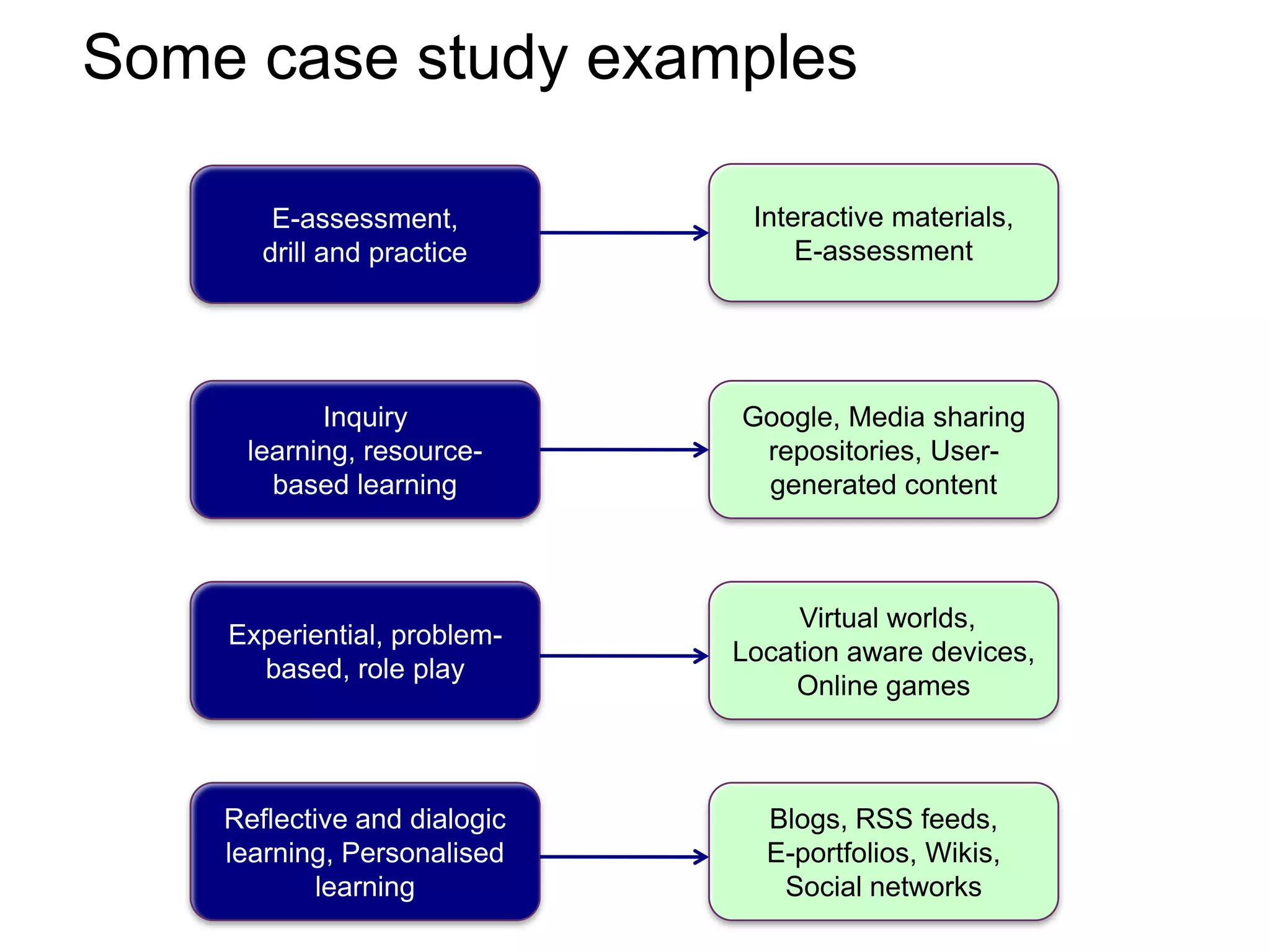
Some case study examplesInteractive materials, E-assessmentE-assessment, drill and practice Virtual worlds, Location aware devices, Online games Inquiry learning, resource-based learningGoogle, Media sharing repositories, User-generated contentExperiential, problem-based, role playBlogs, RSS feeds, E-portfolios, Wikis,Social networksReflective and dialogic learning, Personalised learning
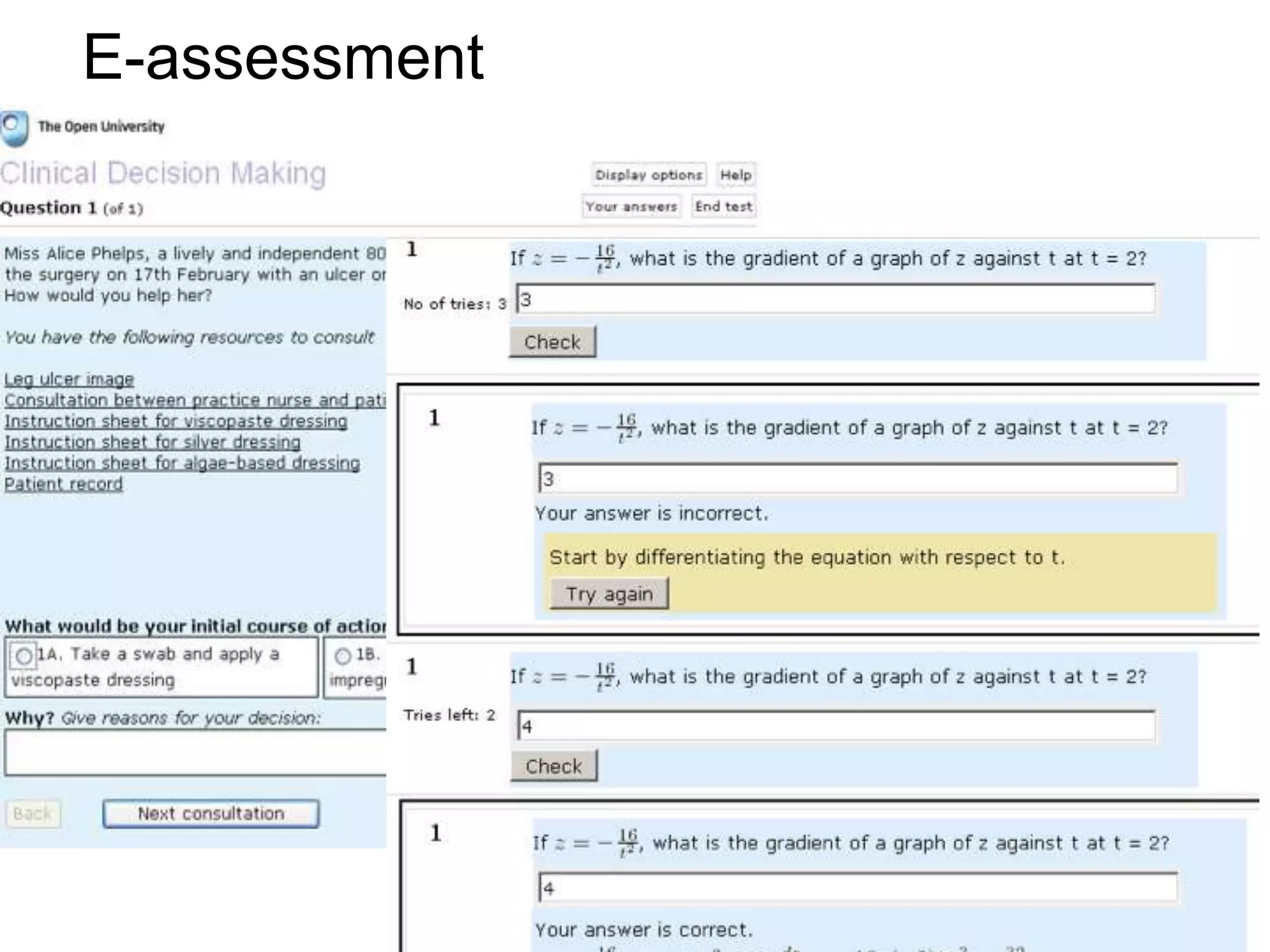
E-assessment
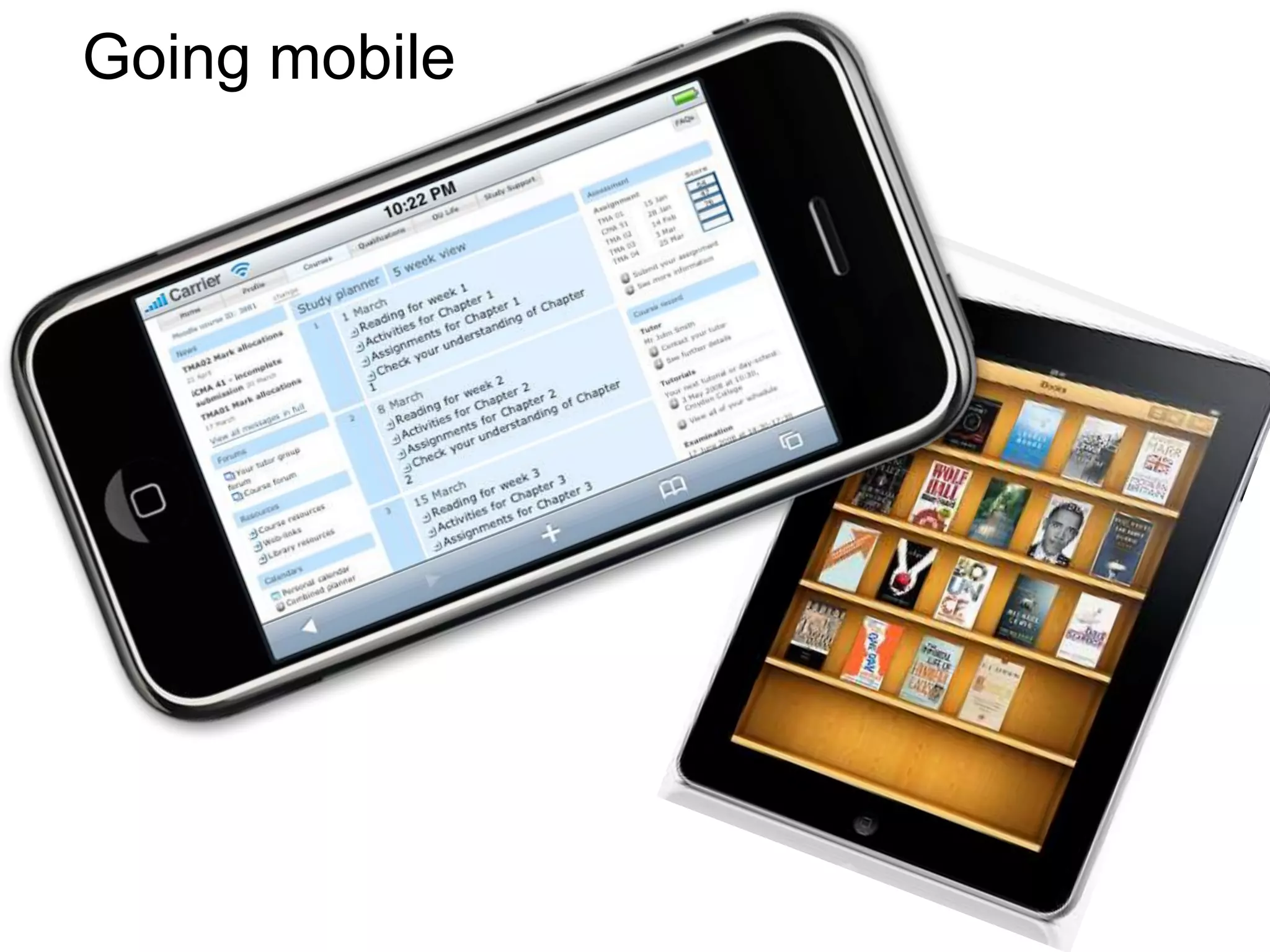
Going mobile
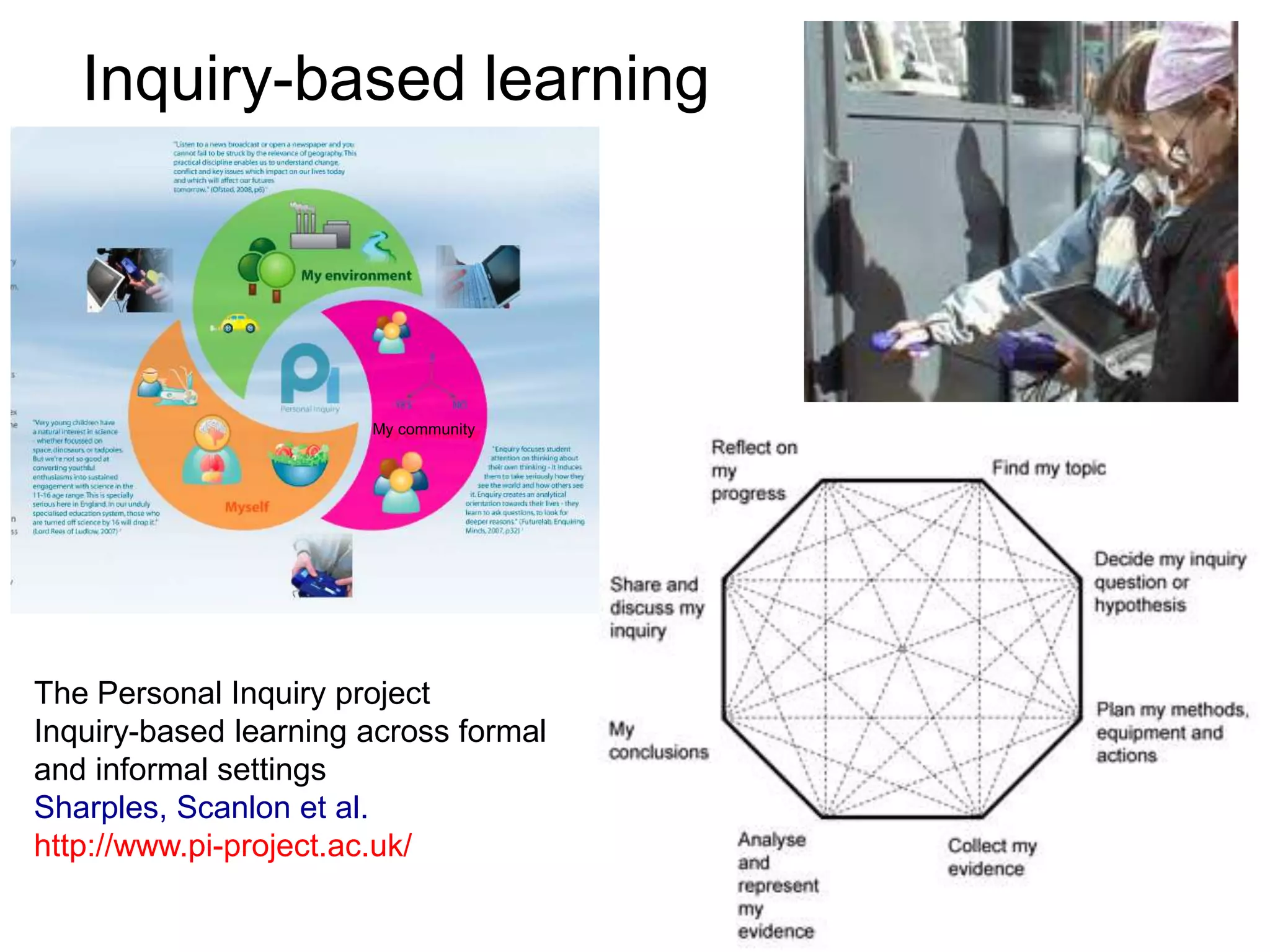
Inquiry-based learningMy communityThe Personal Inquiry projectInquiry-based learning across formal and informal settingsSharples, Scanlon et al.http://www.pi-project.ac.uk/
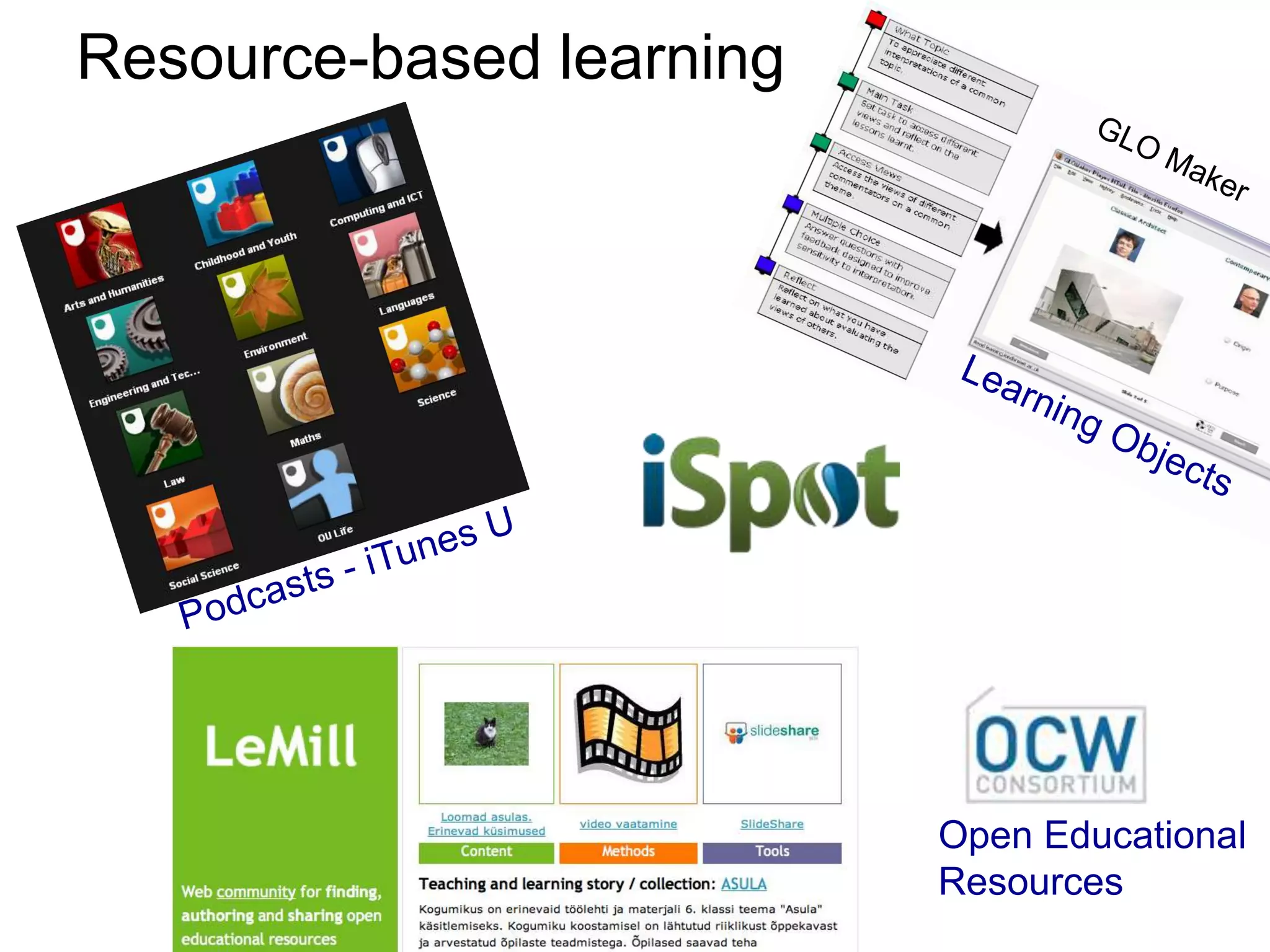
Resource-based learningGLO MakerLearning ObjectsPodcasts - iTunes UOpen Educational Resources
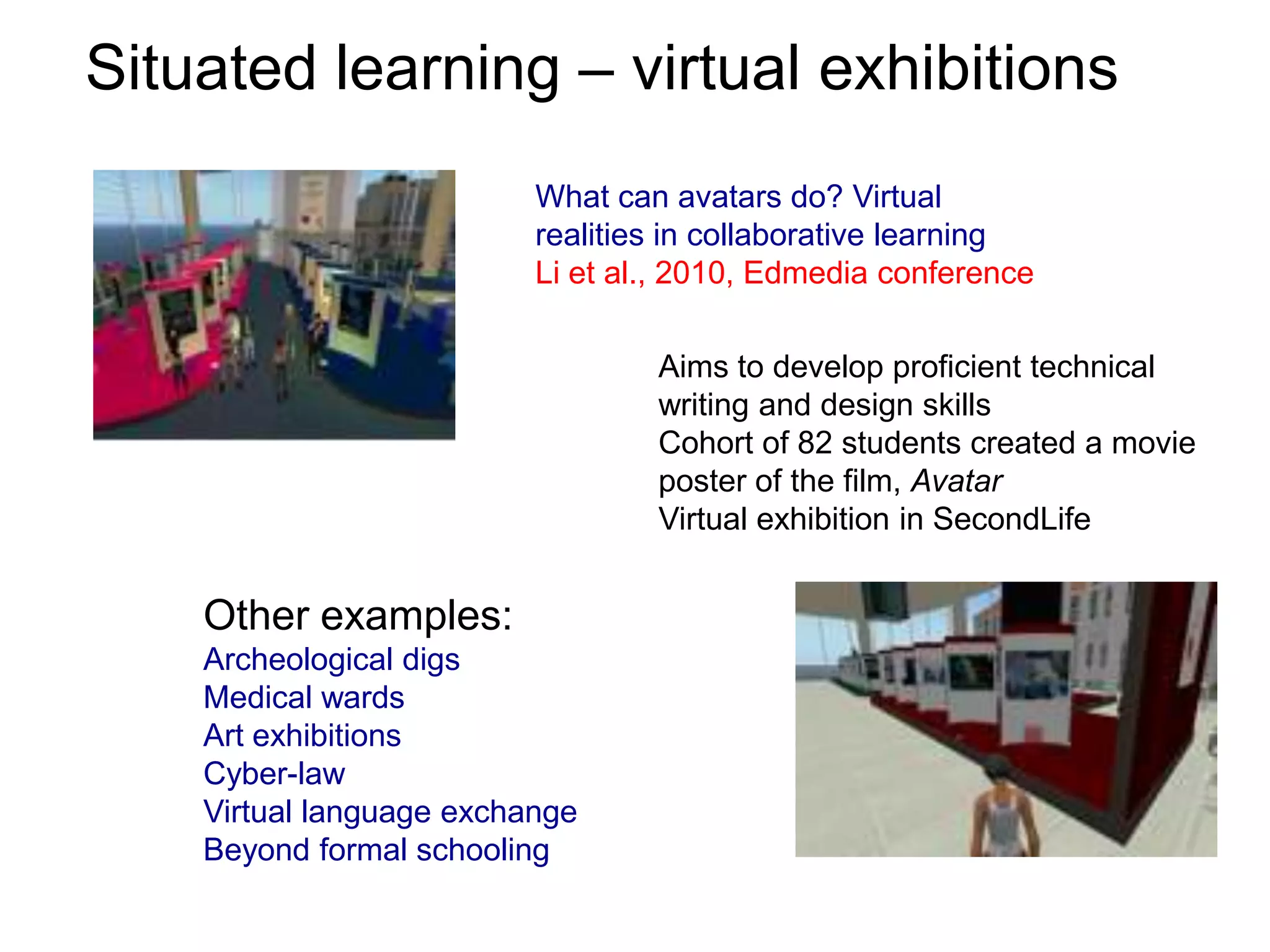
Situated learning – virtual exhibitionsWhat can avatars do? Virtual realities in collaborative learningLi et al., 2010, Edmedia conferenceAims to develop proficient technical writing and design skillsCohort of 82 students created a movie poster of the film, AvatarVirtual exhibition in SecondLifeOther examples:Archeological digsMedical wardsArt exhibitionsCyber-lawVirtual language exchangeBeyond formal schooling
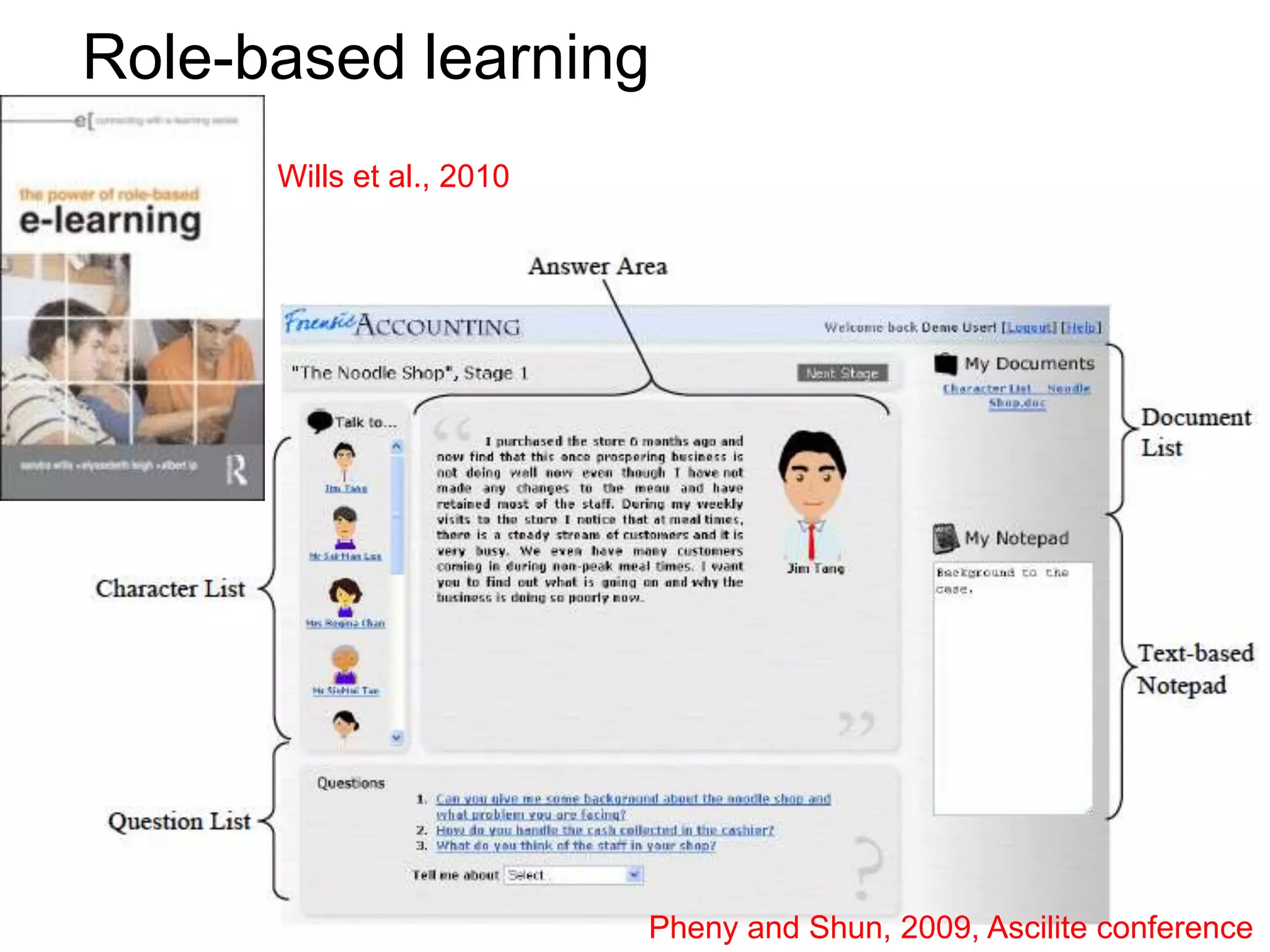
Role-based learningWills et al., 2010Pheny and Shun, 2009, Ascilite conference
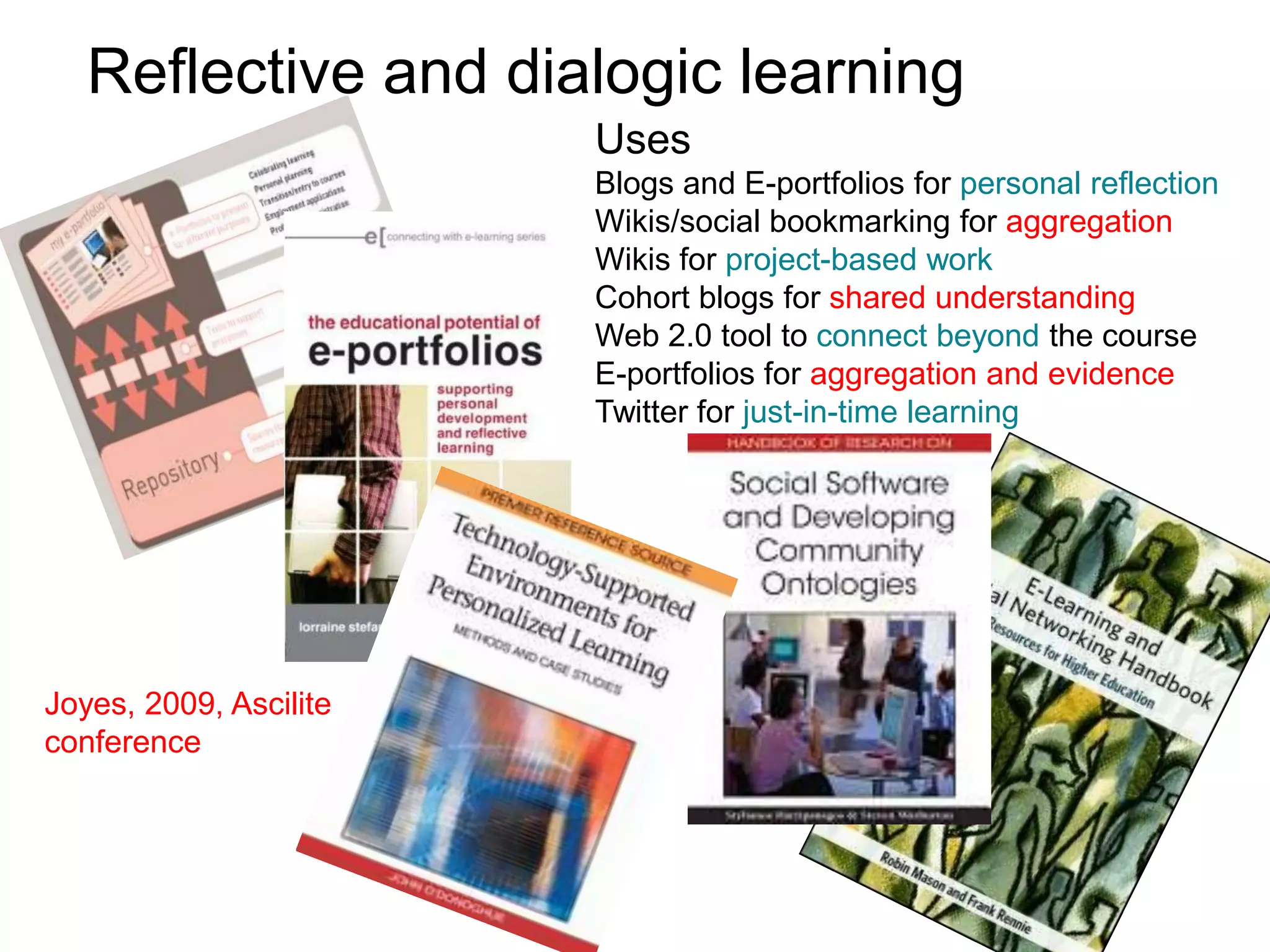
Reflective and dialogic learningUsesBlogs and E-portfolios for personal reflection Wikis/social bookmarking for aggregationWikis for project-based workCohort blogs for shared understandingWeb 2.0 tool to connect beyond the courseE-portfolios for aggregation and evidenceTwitter for just-in-time learning Joyes, 2009, Ascilite conference
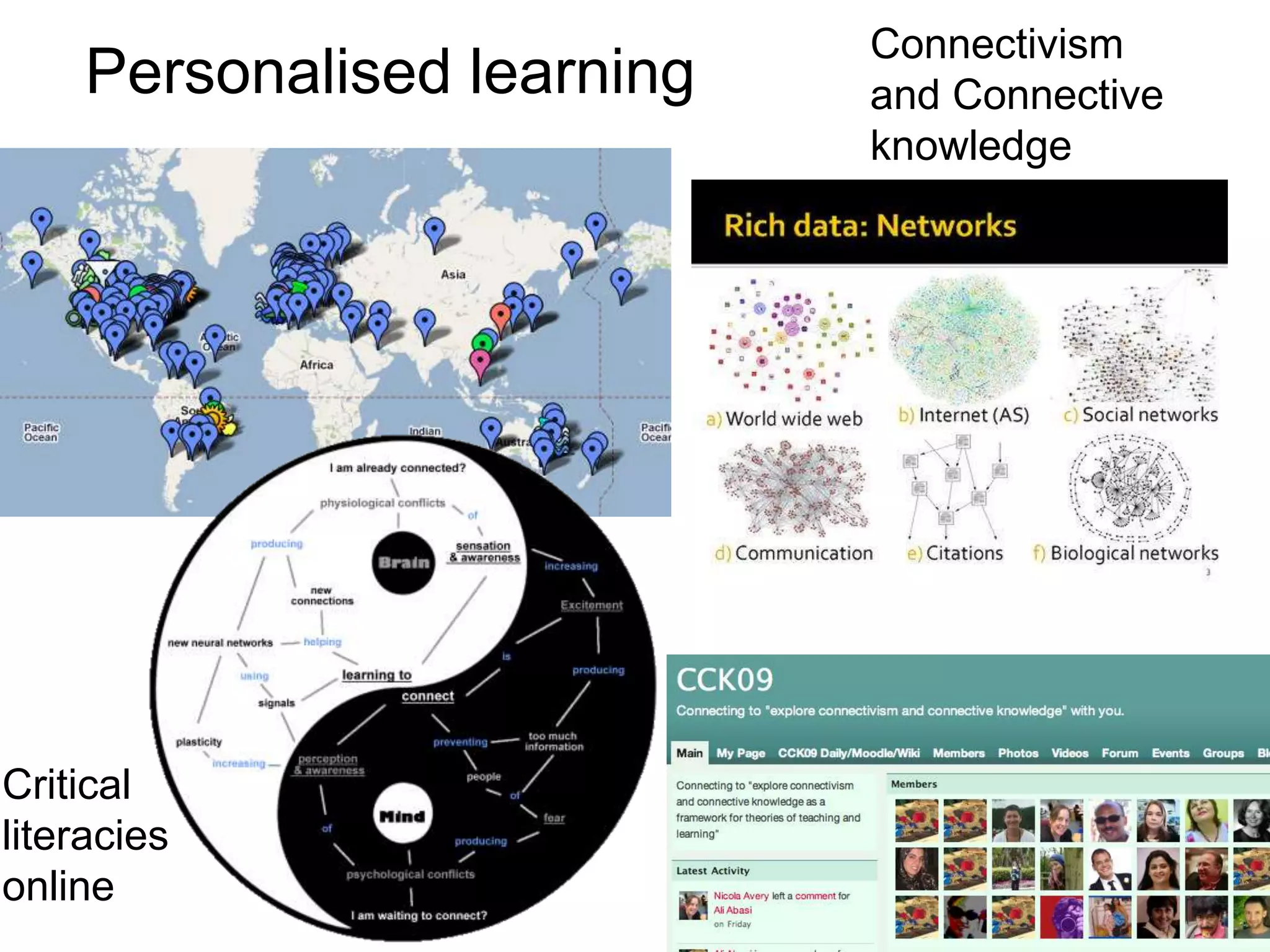
Connectivism and Connective knowledge Personalised learningCritical literacies online
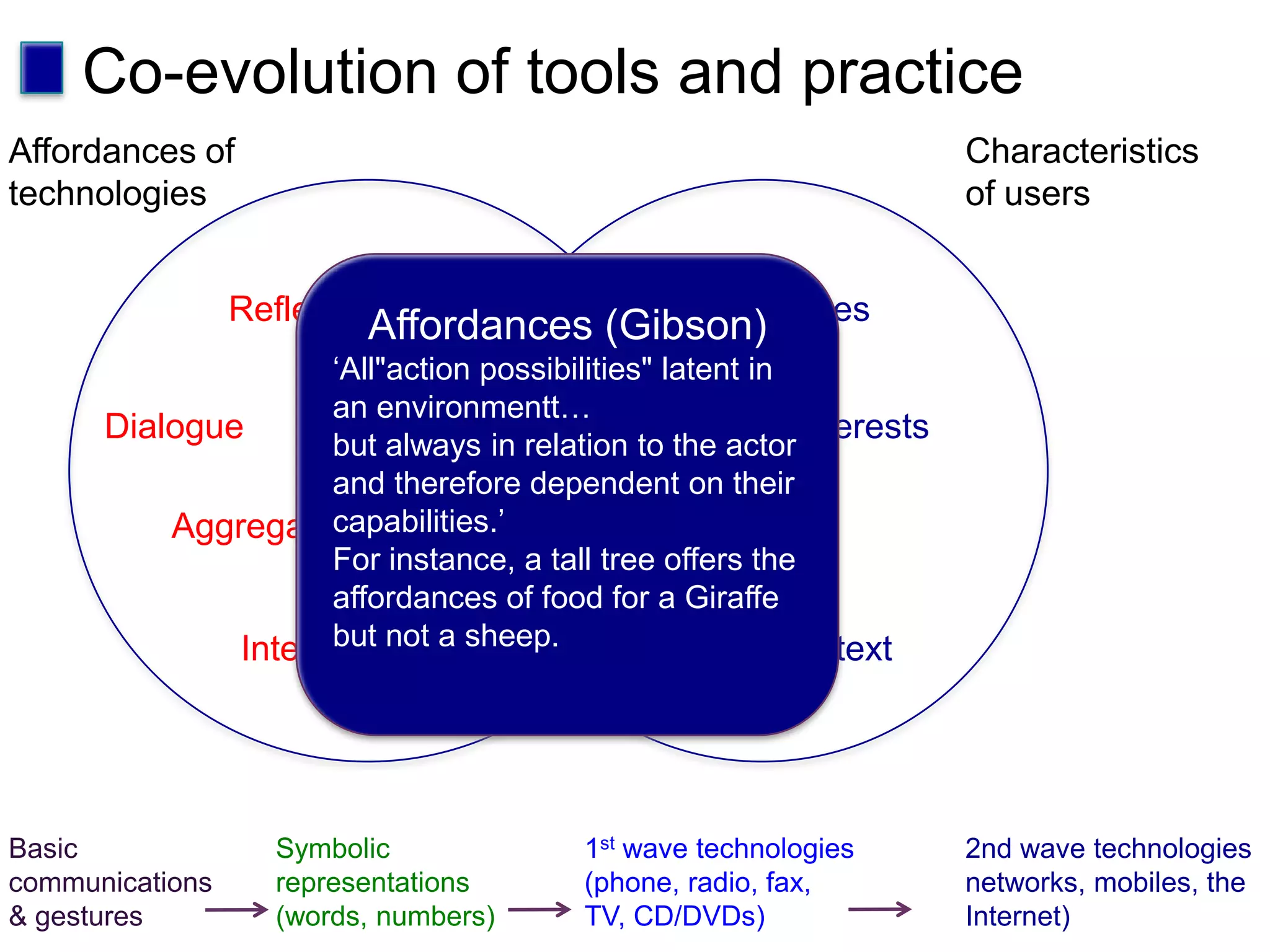
Co-evolution of tools and practiceCharacteristics of usersAffordances of technologiesAffordances (Gibson)‘All"action possibilities" latent in an environmentt…but always in relation to the actor and therefore dependent on their capabilities.’For instance, a tall tree offers the affordances of food for a Giraffe but not a sheep.PreferencesReflectionInterestsDialogueEvolvingpracticesAggregationSkillsContextInteractivityBasic communications & gesturesSymbolic representations (words, numbers)1st wave technologies (phone, radio, fax,  TV, CD/DVDs)2nd wave technologies networks, mobiles, the Internet)
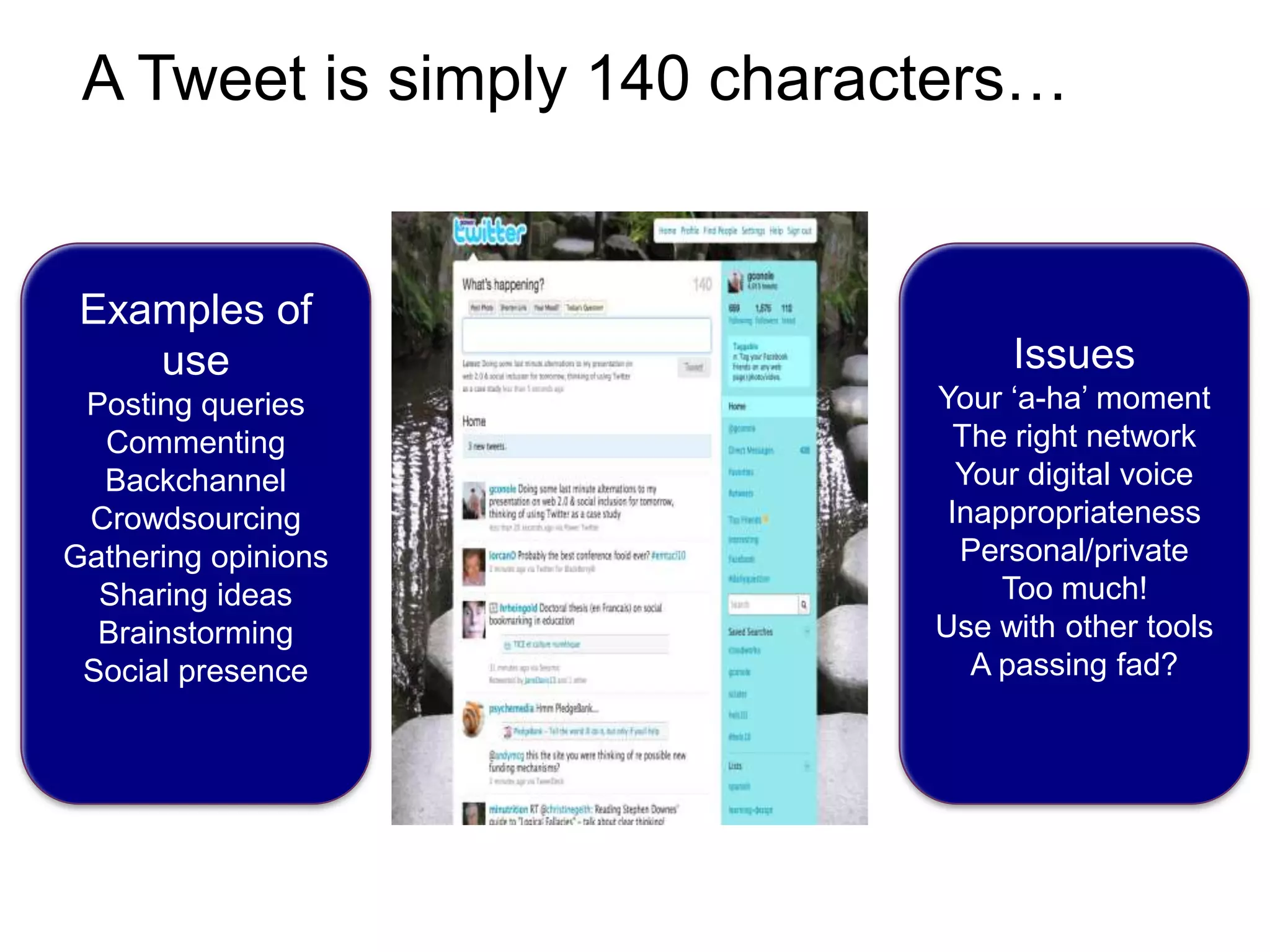
A Tweet is simply 140 characters…Examples of usePosting queriesCommentingBackchannelCrowdsourcingGathering opinionsSharing ideasBrainstormingSocial presenceIssuesYour ‘a-ha’ momentThe right networkYour digital voiceInappropriateness Personal/privateToo much!Use with other toolsA passing fad?
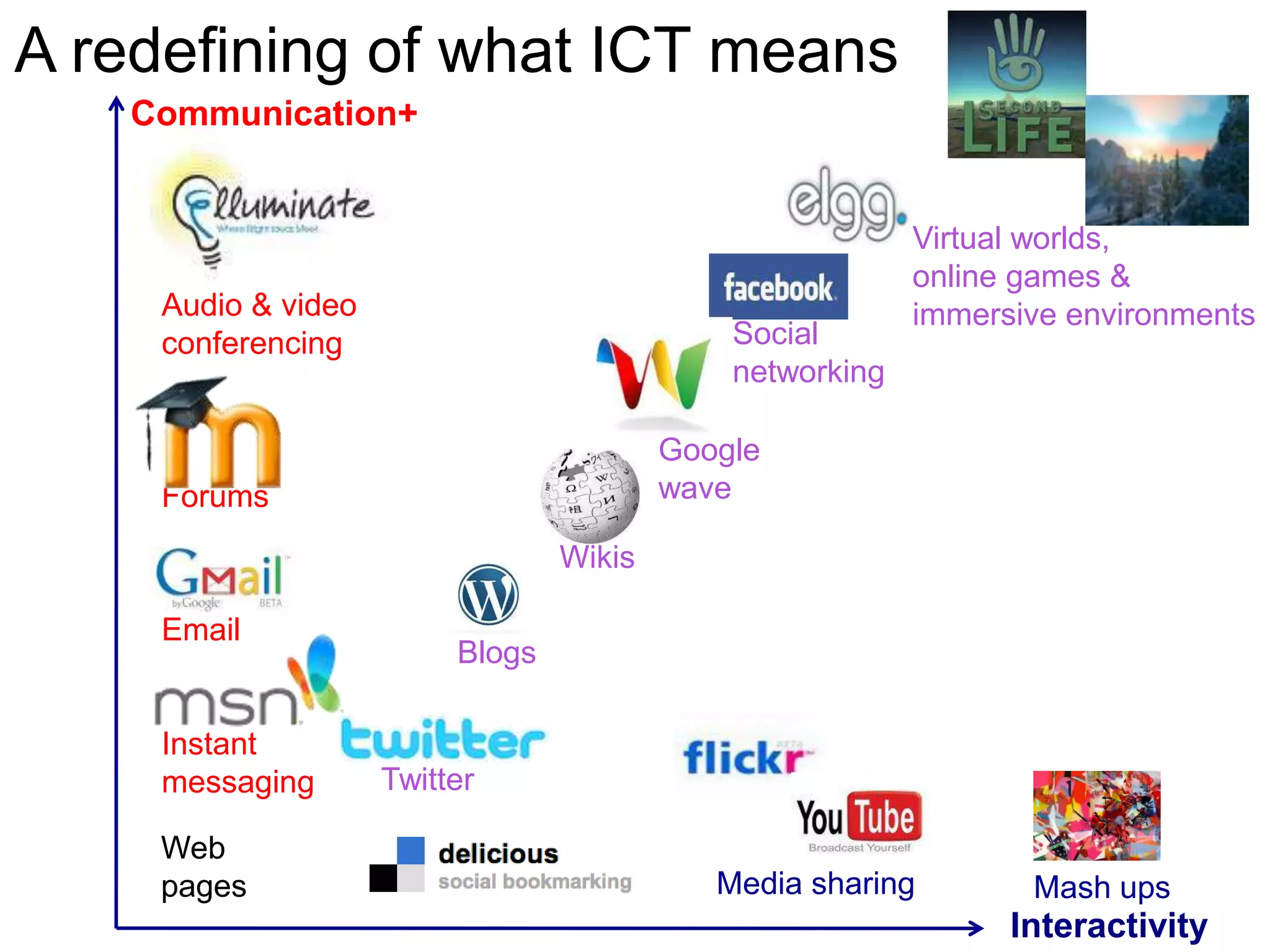
Communication+A redefining of what ICT meansAudio & video conferencingMedia sharingForumsGoogle waveEmailWikisBlogsInstant messagingTwitterInteractivityVirtual worlds, online games & immersive environments Web pagesSocial networkingMash ups
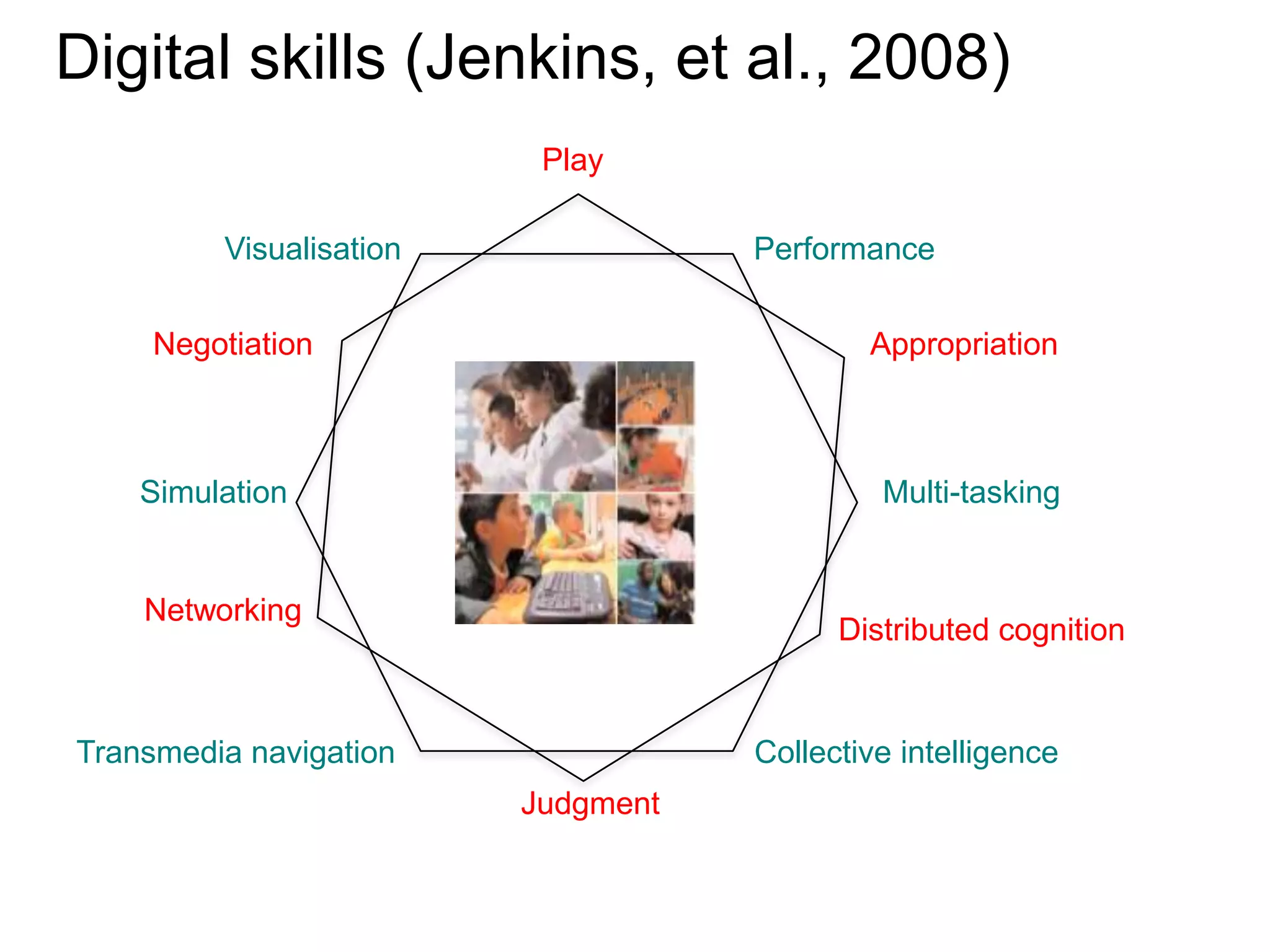
Digital skills (Jenkins, et al., 2008)PlayPerformanceVisualisationAppropriationNegotiationMulti-taskingSimulationNetworkingDistributed cognitionCollective intelligenceTransmedia navigationJudgment
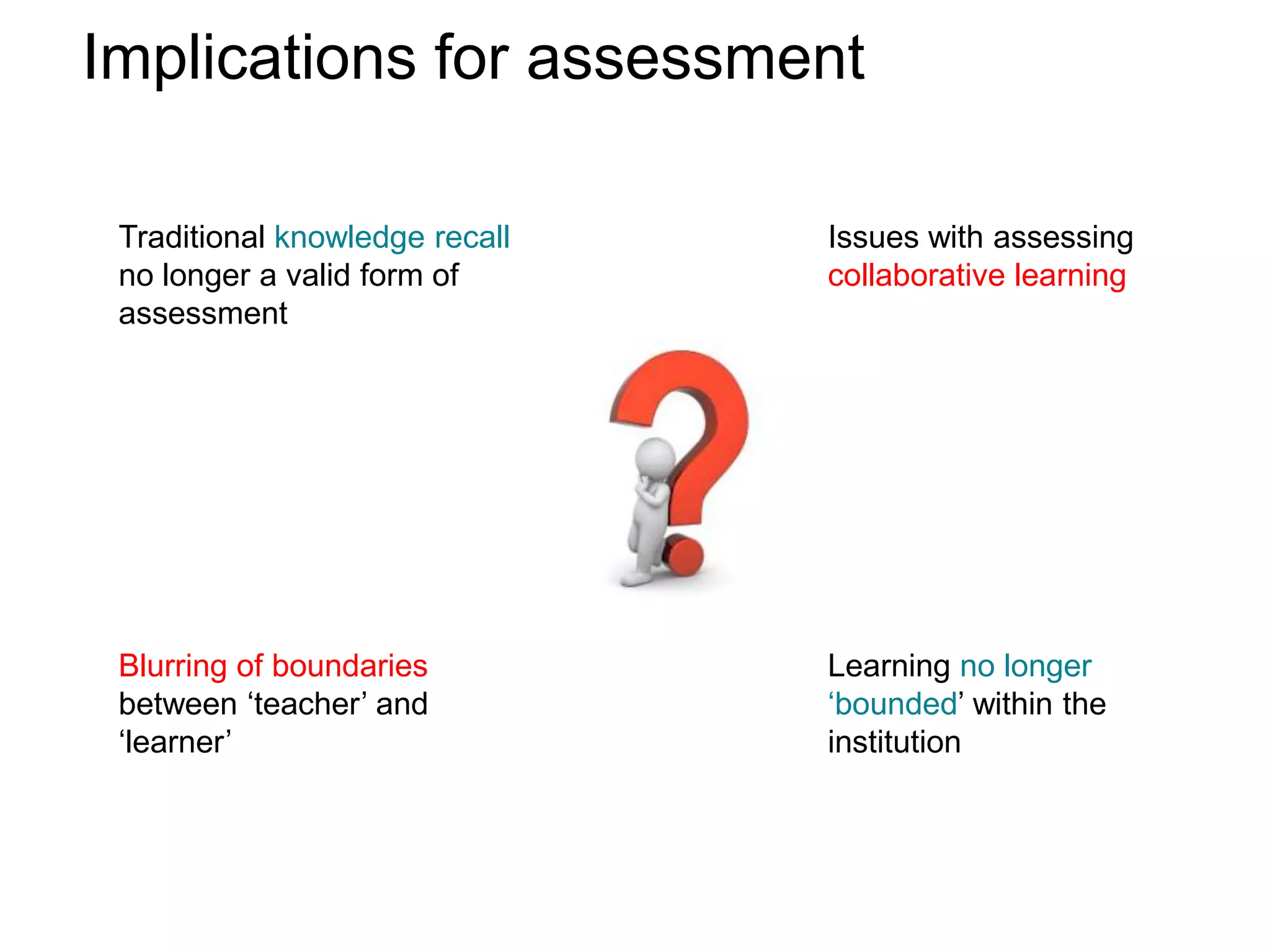
Implications for assessmentTraditional knowledge recall no longer a valid form of assessmentIssues with assessing collaborative learningBlurring of boundaries between ‘teacher’ and ‘learner’Learning no longer ‘bounded’ within the institution
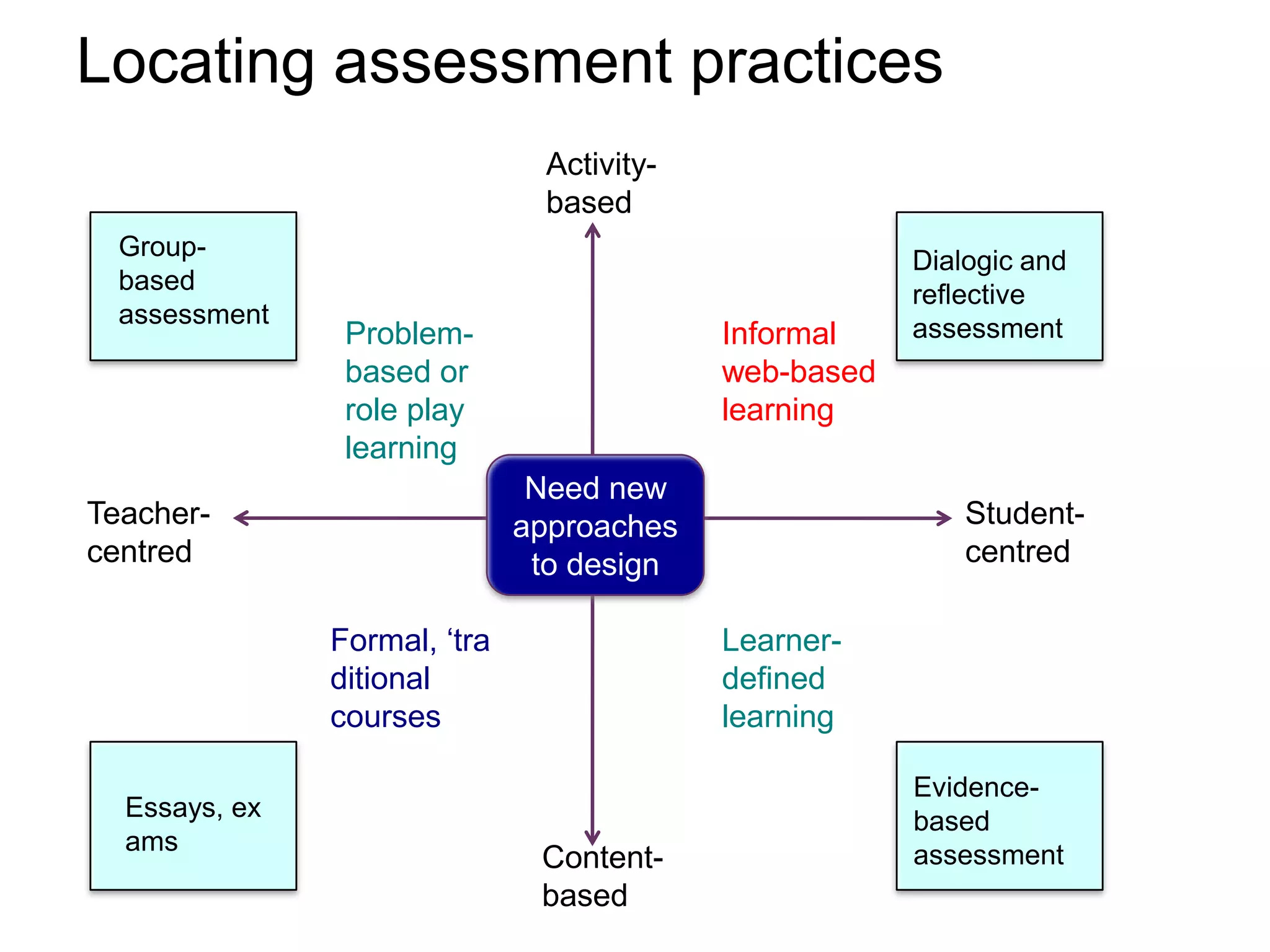
Locating assessment practicesActivity-basedGroup-based assessmentDialogic and reflective assessmentProblem-based or role play learningInformal web-based learningNeed new approaches to designTeacher-centredStudent-centredFormal, ‘traditionalcoursesLearner-definedlearningEvidence-based assessmentEssays, examsContent-based
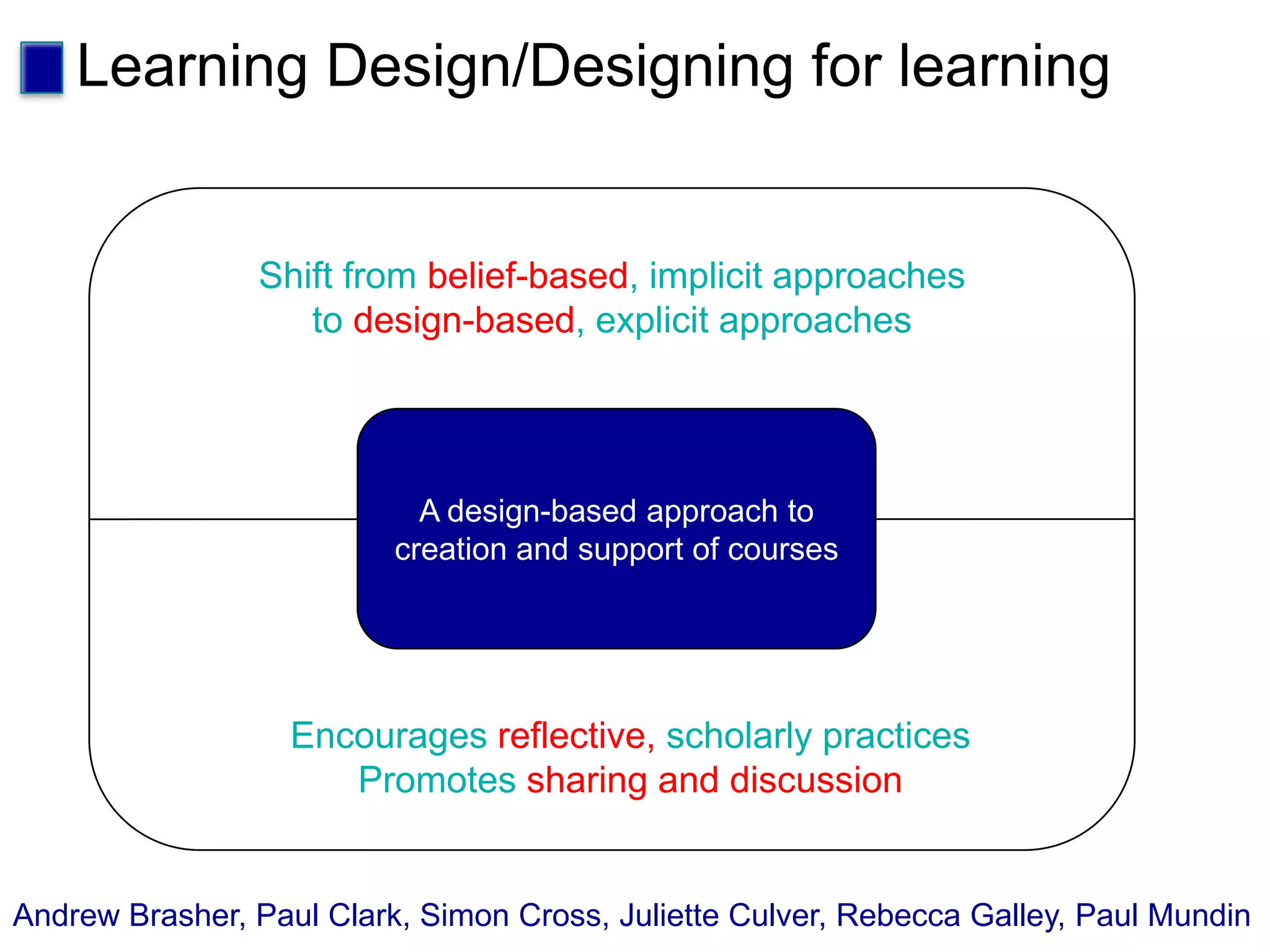
Learning Design/Designing for learningShift from belief-based, implicit approaches to design-based, explicit approachesA design-based approach to creation and support of coursesEncourages reflective, scholarly practicesPromotes sharing and discussionAndrew Brasher, Paul Clark, Simon Cross, Juliette Culver, Rebecca Galley, Paul Mundin
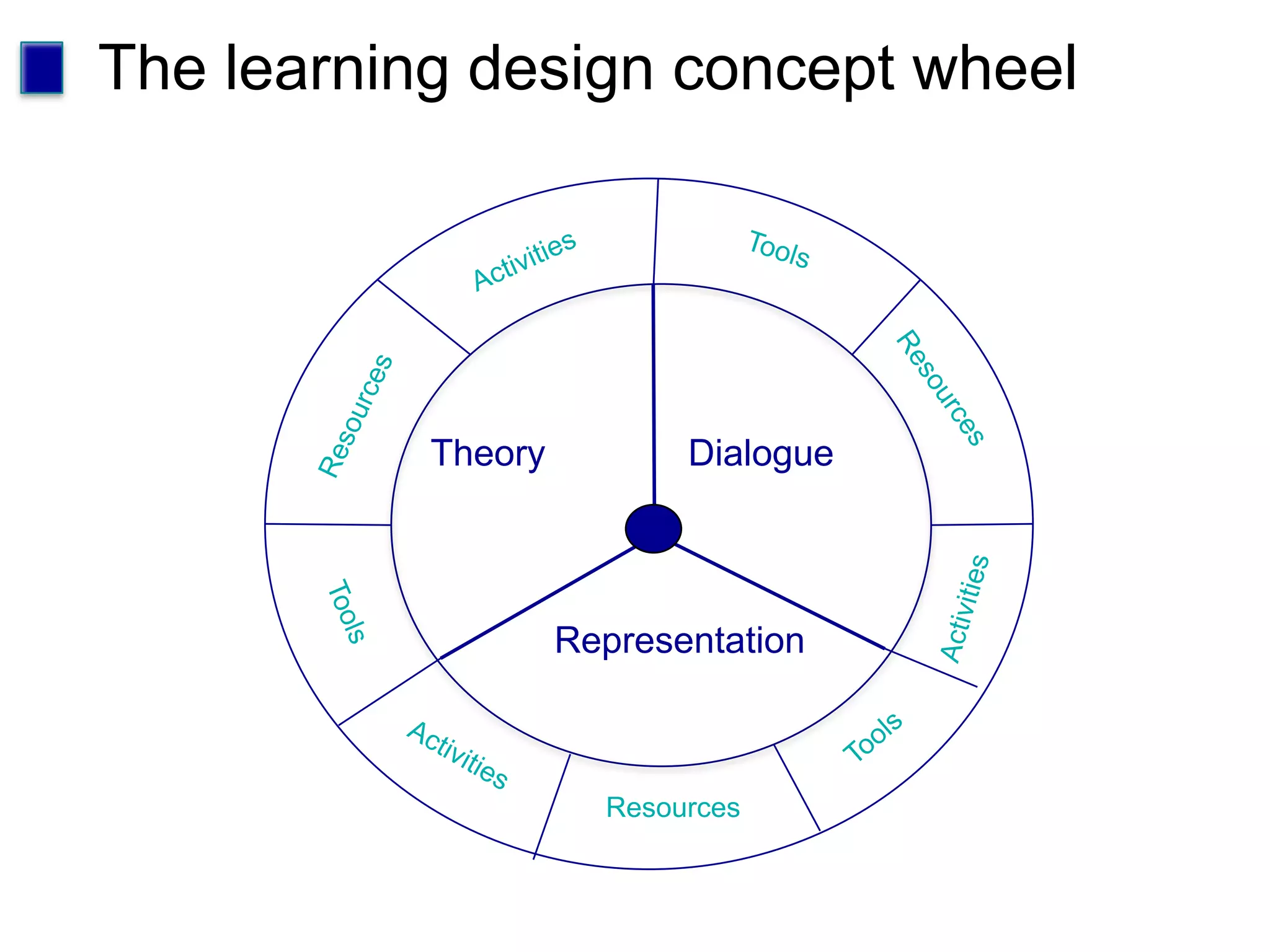
The learning design concept wheelToolsActivitiesResourcesResourcesTheoryDialogueRepresentationActivitiesToolsToolsActivitiesResources
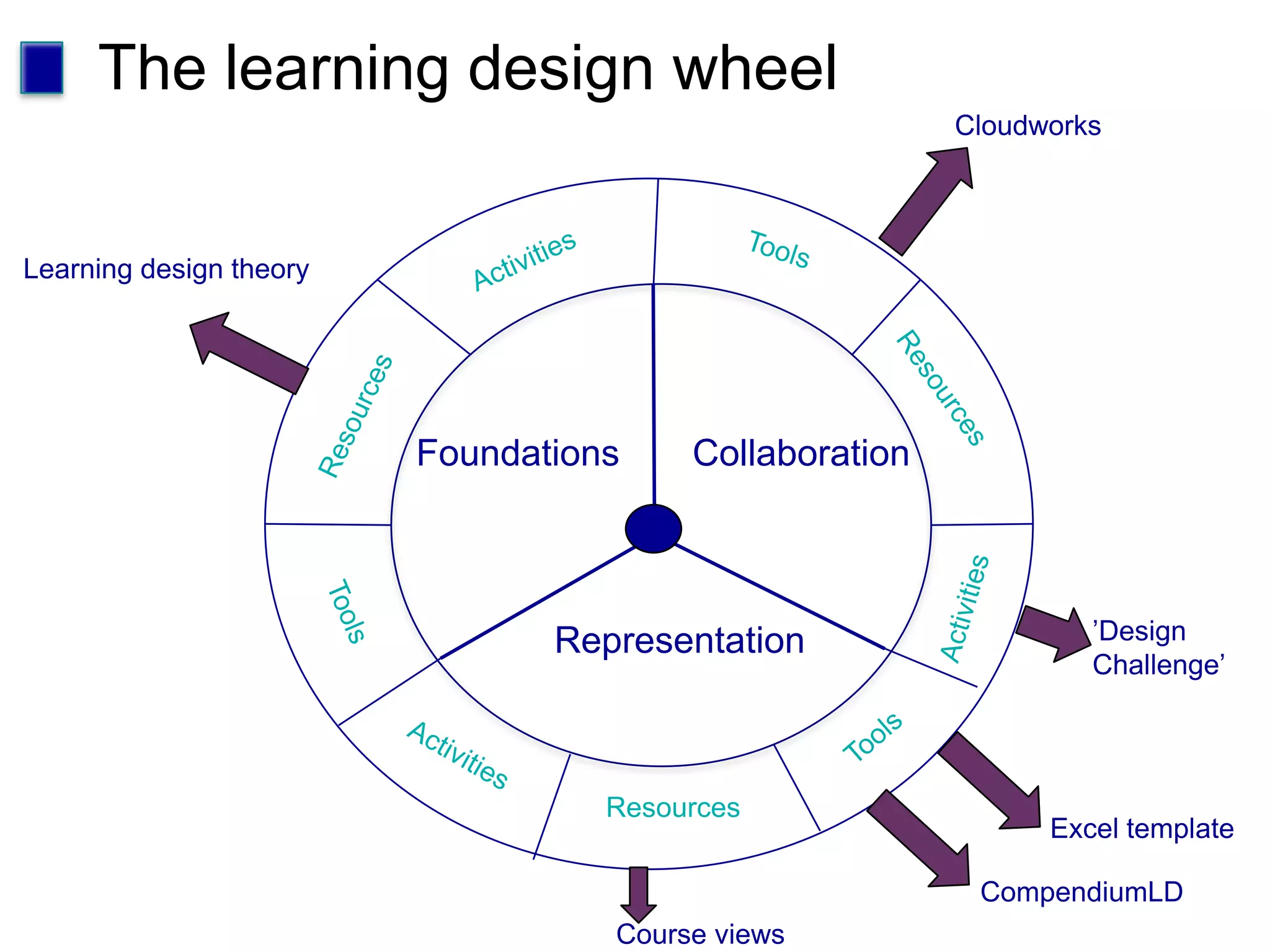
The learning design wheelToolsActivitiesLearning design theoryCloudworksResourcesResources’DesignChallenge’FoundationsCollaborationCourse viewsRepresentationActivitiesToolsToolsActivitiesResourcesExcel templateCompendiumLD
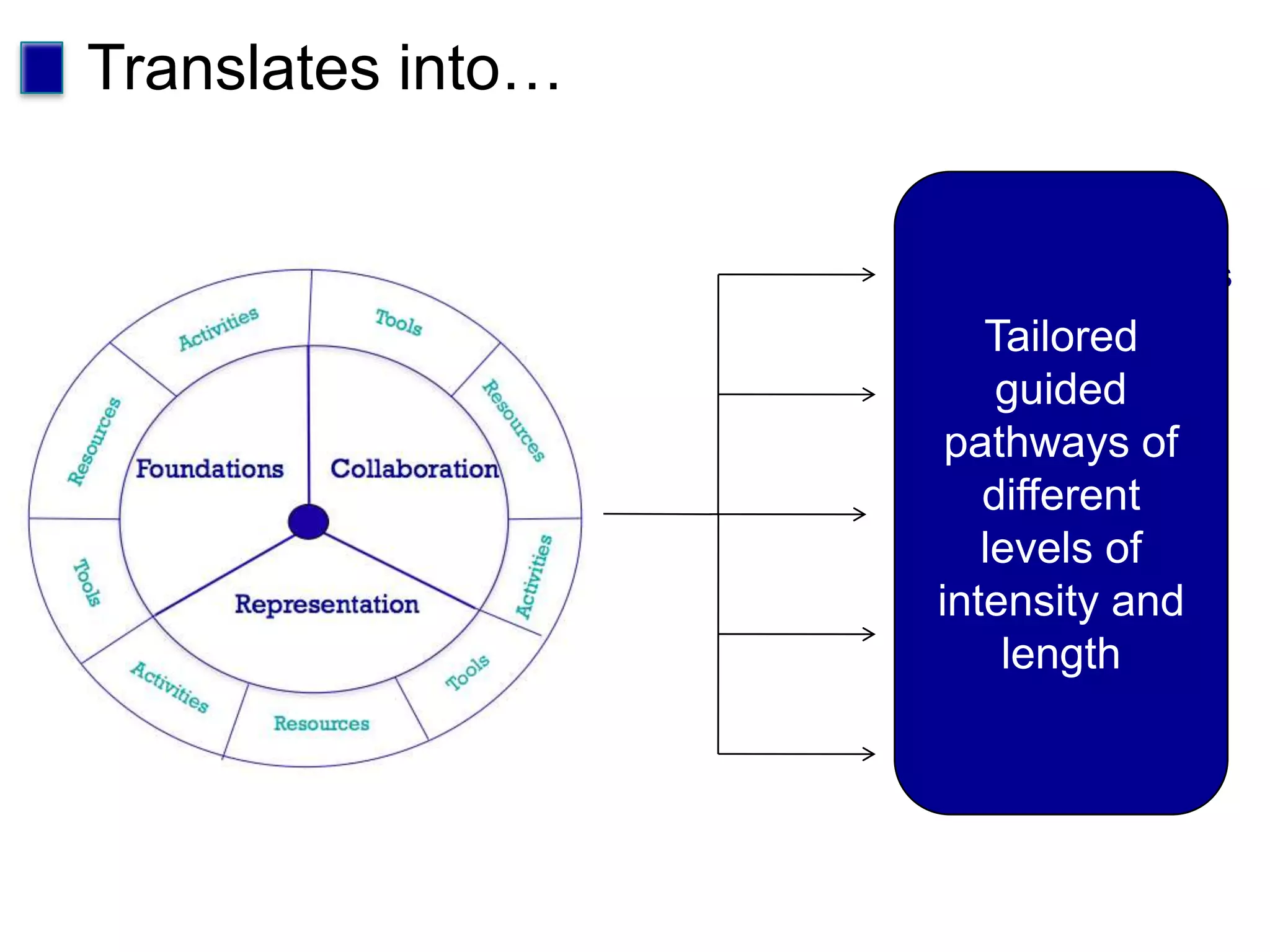
Translates into…Tailored guided pathways of different levels of intensity and lengthAwareness sessions‘LD-lite’ workshopsDesign challengesMaster’s level OERFree format
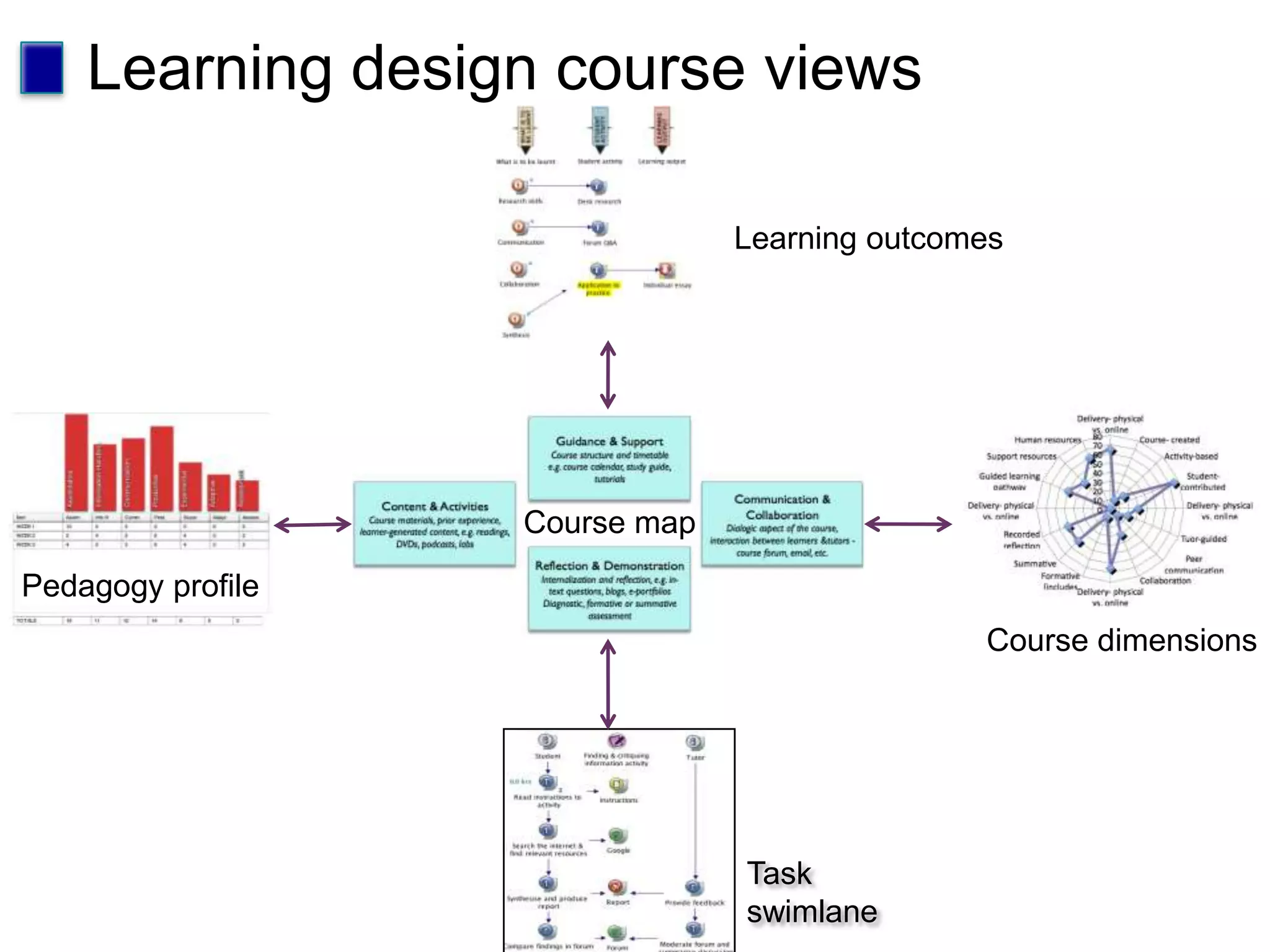
Learning design course viewsCourse mapPedagogy profileLearning outcomesCourse dimensionsTask swimlane
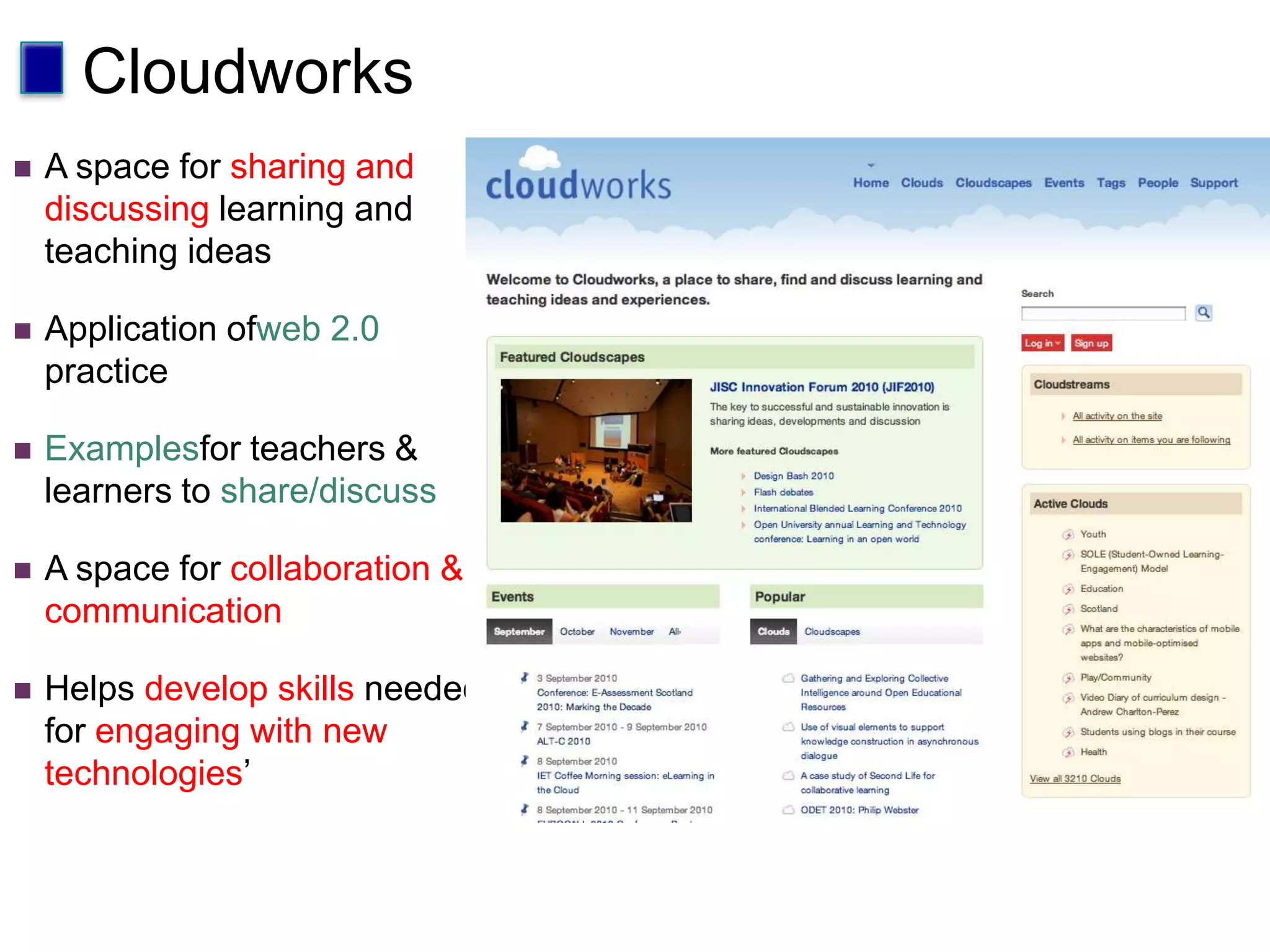
CloudworksA space for sharing and discussing learning and teaching ideasApplication ofweb 2.0 practiceExamplesfor teachers & learners to share/discussA space for collaboration & communication Helps develop skills needed for engaging with new technologies’
Final thoughtsLearning and the context of learning have changedWe need new assessment practices How can we harness increasingly sophisticated e-assessment tools?There will be an ongoing co-evolution of tools and useNew digital literacies are needed for both teachers and learnersHow do we assess beyond the individual (others plus tools)?We need to devise pathways for navigating an increasingly complex digital landscapeThe boundaries between formal and informal learning are blurringChanging learning, teaching and assessment
SourcesMash ups http://www.flickr.com/photos/richardellard/4524139966/Molecule http://www.flickr.com/photos/8272941@N07/498827420/Periodic table http://www.flickr.com/photos/chemheritage/3984920162/Music sheet http://www.flickr.com/photos/anyaka/21848267/One world http://www.flickr.com/photos/psd/2731067095/World of warcraft http://www.flickr.com/photos/shardsofblue/3981216281/Questionmarkhttp://www.flickr.com/photos/crystaljingsr/3914729343/http://suifaijohnmak.files.wordpress.com/2009/11/communication-sep08_leskovec_tdef_page_03_480.jpgYin-Yang image  http://learn4kicks.files.wordpress.com/2009/09/yinyangconceptmap.gifImperial collage second life island http://knowledgecast.wordpress.com/2009/07/10/icl-tour2/Personal Inquiry project http://www.pi-project.ac.uk/resources/E-Portfolios http://www.jiscinfonet.ac.uk/infokits/e-portfolios  
Sources	http://www.geeky-gadgets.com/samsung-galaxy-s2-android-3-0-and-a-2ghz-processor-06-07-2010/http://thehottestgadgets.com/2008/05/samsung-to-debut-3m-mini-projectors-with-new-phones-00280http://www.dontwasteyourtime.co.uk/elearning/ipad-is-it-any-good-for-the-classroom-or-learning/http://www.erwinvanlun.com/images/uploads/SmartGlasses.jpgOpenLearningInitiativehttp://distancelearn.about.com/gi/o.htm?zi=1/XJ&zTi=1&sdn=distancelearn&cdn=education&tm=6&f=00&su=p897.9.336.ip_&tt=11&bt=1&bts=1&zu=http://www.cmu.edu/oli/Molecule http://www.flickr.com/photos/8272941@N07/498827420/Periodic table http://www.flickr.com/photos/chemheritage/3984920162/Music sheet http://www.flickr.com/photos/anyaka/21848267/One world http://www.flickr.com/photos/psd/2731067095/World of warcraft http://www.flickr.com/photos/shardsofblue/3981216281/Questionmarkhttp://www.flickr.com/photos/crystaljingsr/3914729343/Crystal ball http://mashable.com/2009/08/20/ted-future/
SourcesiPhonehttp://virulentwordofmouse.files.wordpress.com/2009/12/iphone.jpgeBook readers http://wowio.files.wordpress.com/2007/07/reader-options2.jpg

Conole dundee

  • 1.
    What are theimplications of new social and participatory media on assessment practices?Gráinne Conole,The Open University, UKE-Assessment Scotland conference, Dundee3rd September 2010
  • 2.
    OrientationFocusReview of thetechnology landscape Current landmarks Future trajectoriesFocus on learningPedagogies of e-learningCase study examplesThe gap between promise and realityImplications for assessmentA new approach: learning design
  • 3.
    Changing context ofeducationChanging technologiesAbundance of free online content and toolsUbiquitous, networked accessIncrease in mobile and smart devicesNeed new approaches to understanding, designing and supporting learningChanging learnersGrown up ‘digital’ Technologically immersedTask-orientated, group-based, ‘just in time’Comfortable with multiple representations
  • 4.
    Web 2.0 landscapeof practices
  • 5.
    New social andparticipatory mediaNew tools/practices need new forms of assessmentSharingMedia sharingWeb 2.0CommunicatingBlogs & wikisNetworkingSocial networkingInteractingVirtual worldsShift from:Web 1.0 – content repository and static informationWeb 2.0 – user generated content and social mediation
  • 6.
    A typology ofnew technologies(Conole and Alevizou, 2010), Review of Web 2.0 tools in Higher Educationhttp://cloudworks.ac.uk/cloudscape/view/1895
  • 7.
    Open and participatorylearningDesignCourses design & shared openlyDeliveryUse of free tools & resourcesOpen practicesEvaluationCritical reflectionAssessmentShared; learner controlled
  • 8.
    The learner experienceGuidance& supportCollaboration & communicationContent & activitiesLearningAssessment
  • 9.
    Pedagogies of e-learningMayes& De Freitas, 2004Dyke et. al, 2007AE-assessmentDrill & practiceInquiry learningResource-basedAssociativeFocus on individualLearning through association and reinforcementConstructivistBuilding on prior knowledgeTask-orientatedSituativeLearning through social interactionLearning in contextConnectivistLearning in a networked environmentExperiential, Problem-based Role playReflective & dialogic learning, Personalised learning
  • 10.
    Some case studyexamplesInteractive materials, E-assessmentE-assessment, drill and practice Virtual worlds, Location aware devices, Online games Inquiry learning, resource-based learningGoogle, Media sharing repositories, User-generated contentExperiential, problem-based, role playBlogs, RSS feeds, E-portfolios, Wikis,Social networksReflective and dialogic learning, Personalised learning
  • 11.
  • 12.
  • 13.
    Inquiry-based learningMy communityThePersonal Inquiry projectInquiry-based learning across formal and informal settingsSharples, Scanlon et al.http://www.pi-project.ac.uk/
  • 14.
    Resource-based learningGLO MakerLearningObjectsPodcasts - iTunes UOpen Educational Resources
  • 15.
    Situated learning –virtual exhibitionsWhat can avatars do? Virtual realities in collaborative learningLi et al., 2010, Edmedia conferenceAims to develop proficient technical writing and design skillsCohort of 82 students created a movie poster of the film, AvatarVirtual exhibition in SecondLifeOther examples:Archeological digsMedical wardsArt exhibitionsCyber-lawVirtual language exchangeBeyond formal schooling
  • 16.
    Role-based learningWills etal., 2010Pheny and Shun, 2009, Ascilite conference
  • 17.
    Reflective and dialogiclearningUsesBlogs and E-portfolios for personal reflection Wikis/social bookmarking for aggregationWikis for project-based workCohort blogs for shared understandingWeb 2.0 tool to connect beyond the courseE-portfolios for aggregation and evidenceTwitter for just-in-time learning Joyes, 2009, Ascilite conference
  • 18.
    Connectivism and Connectiveknowledge Personalised learningCritical literacies online
  • 19.
    Co-evolution of toolsand practiceCharacteristics of usersAffordances of technologiesAffordances (Gibson)‘All"action possibilities" latent in an environmentt…but always in relation to the actor and therefore dependent on their capabilities.’For instance, a tall tree offers the affordances of food for a Giraffe but not a sheep.PreferencesReflectionInterestsDialogueEvolvingpracticesAggregationSkillsContextInteractivityBasic communications & gesturesSymbolic representations (words, numbers)1st wave technologies (phone, radio, fax, TV, CD/DVDs)2nd wave technologies networks, mobiles, the Internet)
  • 20.
    A Tweet issimply 140 characters…Examples of usePosting queriesCommentingBackchannelCrowdsourcingGathering opinionsSharing ideasBrainstormingSocial presenceIssuesYour ‘a-ha’ momentThe right networkYour digital voiceInappropriateness Personal/privateToo much!Use with other toolsA passing fad?
  • 21.
    Communication+A redefining ofwhat ICT meansAudio & video conferencingMedia sharingForumsGoogle waveEmailWikisBlogsInstant messagingTwitterInteractivityVirtual worlds, online games & immersive environments Web pagesSocial networkingMash ups
  • 22.
    Digital skills (Jenkins,et al., 2008)PlayPerformanceVisualisationAppropriationNegotiationMulti-taskingSimulationNetworkingDistributed cognitionCollective intelligenceTransmedia navigationJudgment
  • 23.
    Implications for assessmentTraditionalknowledge recall no longer a valid form of assessmentIssues with assessing collaborative learningBlurring of boundaries between ‘teacher’ and ‘learner’Learning no longer ‘bounded’ within the institution
  • 24.
    Locating assessment practicesActivity-basedGroup-basedassessmentDialogic and reflective assessmentProblem-based or role play learningInformal web-based learningNeed new approaches to designTeacher-centredStudent-centredFormal, ‘traditionalcoursesLearner-definedlearningEvidence-based assessmentEssays, examsContent-based
  • 25.
    Learning Design/Designing forlearningShift from belief-based, implicit approaches to design-based, explicit approachesA design-based approach to creation and support of coursesEncourages reflective, scholarly practicesPromotes sharing and discussionAndrew Brasher, Paul Clark, Simon Cross, Juliette Culver, Rebecca Galley, Paul Mundin
  • 26.
    The learning designconcept wheelToolsActivitiesResourcesResourcesTheoryDialogueRepresentationActivitiesToolsToolsActivitiesResources
  • 27.
    The learning designwheelToolsActivitiesLearning design theoryCloudworksResourcesResources’DesignChallenge’FoundationsCollaborationCourse viewsRepresentationActivitiesToolsToolsActivitiesResourcesExcel templateCompendiumLD
  • 28.
    Translates into…Tailored guidedpathways of different levels of intensity and lengthAwareness sessions‘LD-lite’ workshopsDesign challengesMaster’s level OERFree format
  • 29.
    Learning design courseviewsCourse mapPedagogy profileLearning outcomesCourse dimensionsTask swimlane
  • 30.
    CloudworksA space forsharing and discussing learning and teaching ideasApplication ofweb 2.0 practiceExamplesfor teachers & learners to share/discussA space for collaboration & communication Helps develop skills needed for engaging with new technologies’
  • 31.
    Final thoughtsLearning andthe context of learning have changedWe need new assessment practices How can we harness increasingly sophisticated e-assessment tools?There will be an ongoing co-evolution of tools and useNew digital literacies are needed for both teachers and learnersHow do we assess beyond the individual (others plus tools)?We need to devise pathways for navigating an increasingly complex digital landscapeThe boundaries between formal and informal learning are blurringChanging learning, teaching and assessment
  • 32.
    SourcesMash ups http://www.flickr.com/photos/richardellard/4524139966/Moleculehttp://www.flickr.com/photos/8272941@N07/498827420/Periodic table http://www.flickr.com/photos/chemheritage/3984920162/Music sheet http://www.flickr.com/photos/anyaka/21848267/One world http://www.flickr.com/photos/psd/2731067095/World of warcraft http://www.flickr.com/photos/shardsofblue/3981216281/Questionmarkhttp://www.flickr.com/photos/crystaljingsr/3914729343/http://suifaijohnmak.files.wordpress.com/2009/11/communication-sep08_leskovec_tdef_page_03_480.jpgYin-Yang image http://learn4kicks.files.wordpress.com/2009/09/yinyangconceptmap.gifImperial collage second life island http://knowledgecast.wordpress.com/2009/07/10/icl-tour2/Personal Inquiry project http://www.pi-project.ac.uk/resources/E-Portfolios http://www.jiscinfonet.ac.uk/infokits/e-portfolios  
  • 33.
    Sources http://www.geeky-gadgets.com/samsung-galaxy-s2-android-3-0-and-a-2ghz-processor-06-07-2010/http://thehottestgadgets.com/2008/05/samsung-to-debut-3m-mini-projectors-with-new-phones-00280http://www.dontwasteyourtime.co.uk/elearning/ipad-is-it-any-good-for-the-classroom-or-learning/http://www.erwinvanlun.com/images/uploads/SmartGlasses.jpgOpenLearningInitiativehttp://distancelearn.about.com/gi/o.htm?zi=1/XJ&zTi=1&sdn=distancelearn&cdn=education&tm=6&f=00&su=p897.9.336.ip_&tt=11&bt=1&bts=1&zu=http://www.cmu.edu/oli/Molecule http://www.flickr.com/photos/8272941@N07/498827420/Periodic tablehttp://www.flickr.com/photos/chemheritage/3984920162/Music sheet http://www.flickr.com/photos/anyaka/21848267/One world http://www.flickr.com/photos/psd/2731067095/World of warcraft http://www.flickr.com/photos/shardsofblue/3981216281/Questionmarkhttp://www.flickr.com/photos/crystaljingsr/3914729343/Crystal ball http://mashable.com/2009/08/20/ted-future/
  • 34.