Exploi'ng
the
poten'al
of
OER:
ar'cula'on
of
Open

               Educa'onal
Prac'ces
                        Gráinne
Conole,

                    Leicester
University,
UK
                   grainne.conole@le.ac.uk
            ICDE
Conference,
Bali,
4th
October
2011
From
resources
to
prac'ces
Open
Educa'onal
Prac'ces

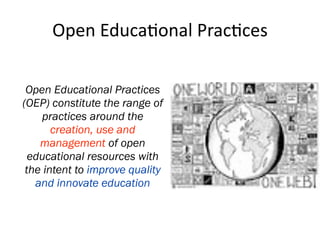
 Open Educational Practices
(OEP) constitute the range of
    practices around the
       creation, use and
    management of open
  educational resources with
 the intent to improve quality
   and innovate education
OER
‐
a
vision
of
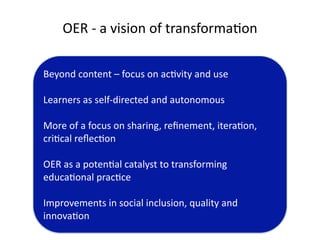
transforma'on

Beyond
content
–
focus
on
ac'vity
and
use

Learners
as
self‐directed
and
autonomous

More
of
a
focus
on
sharing,
refinement,
itera'on,

cri'cal
reflec'on

OER
as
a
poten'al
catalyst
to
transforming

educa'onal
prac'ce

Improvements
in
social
inclusion,
quality
and

innova'on
Abstrac'ng
dimensions
of
Prac'ce


              hVp://cloudworks.ac.uk/cloudscape/view/2105
Abstrac'ng
dimensions
of
Prac'ce
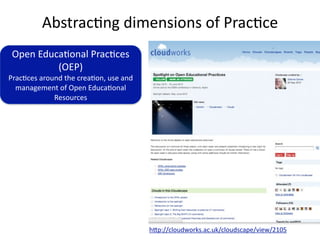
 Open
Educa'onal
Prac'ces

          (OEP)
Prac'ces
around
the
crea'on,
use
and

  management
of
Open
Educa'onal

             Resources


                                        hVp://cloudworks.ac.uk/cloudscape/view/2105
Abstrac'ng
dimensions
of
Prac'ce
 Open
Educa'onal
Prac'ces

          (OEP)
Prac'ces
around
the
crea'on,
use
and

  management
of
Open
Educa'onal

             Resources


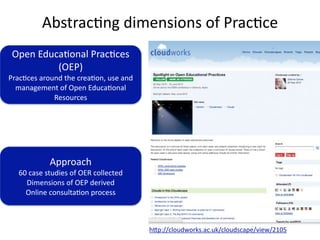
            Approach
  60
case
studies
of
OER
collected
    Dimensions
of
OEP
derived
    Online
consulta'on
process


                                        hVp://cloudworks.ac.uk/cloudscape/view/2105
OER
models
OER
models
• Level
of
granularity
   – ‘Atomis'c’:
based
around

     learning
objects

   – ‘Holis'c’:
aligned
to
course

     structures

OER
models
• Level
of
granularity
   – ‘Atomis'c’:
based
around

     learning
objects

   – ‘Holis'c’:
aligned
to
course

     structures

• Format
   – Simple,
text‐based
   – Rich
mul'media
OER
models
• Level
of
granularity
   – ‘Atomis'c’:
based
around

     learning
objects

   – ‘Holis'c’:
aligned
to
course

     structures

• Format
   – Simple,
text‐based
   – Rich
mul'media
• Pedagogy
   – Neutral
   – Embedded
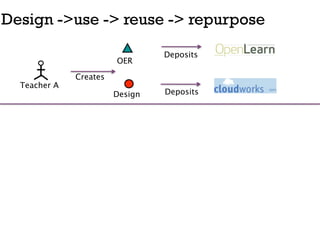
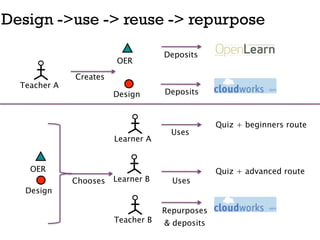
Design ->use -> reuse -> repurpose


  Teacher A
Design ->use -> reuse -> repurpose

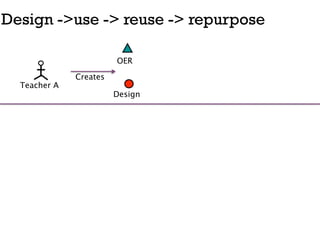
                        OER

              Creates
  Teacher A
                        Design
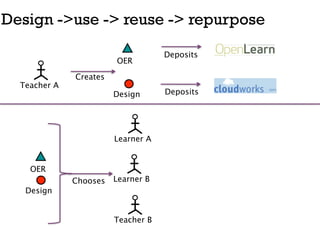
Design ->use -> reuse -> repurpose

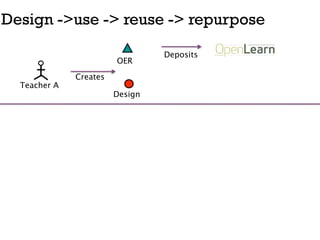
                                 Deposits
                        OER

              Creates
  Teacher A
                        Design
Design ->use -> reuse -> repurpose

                                 Deposits
                        OER

              Creates
  Teacher A
                        Design   Deposits
Design ->use -> reuse -> repurpose

                                    Deposits
                        OER

              Creates
  Teacher A
                        Design      Deposits


                        Learner A


    OER
              Chooses   Learner B
   Design


                        Teacher B
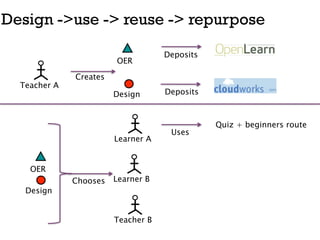
Design ->use -> reuse -> repurpose

                                    Deposits
                        OER

              Creates
  Teacher A
                        Design      Deposits


                                               Quiz + beginners route
                                     Uses
                        Learner A


    OER
              Chooses   Learner B
   Design


                        Teacher B
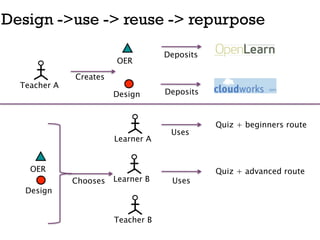
Design ->use -> reuse -> repurpose

                                    Deposits
                        OER

              Creates
  Teacher A
                        Design      Deposits


                                               Quiz + beginners route
                                     Uses
                        Learner A


    OER                                        Quiz + advanced route
              Chooses   Learner B    Uses
   Design


                        Teacher B
Design ->use -> reuse -> repurpose

                                    Deposits
                        OER

              Creates
  Teacher A
                        Design      Deposits


                                                 Quiz + beginners route
                                      Uses
                        Learner A


    OER                                          Quiz + advanced route
              Chooses   Learner B     Uses
   Design

                                    Repurposes
                        Teacher B   & deposits
Open
Educa'onal
Prac'ce
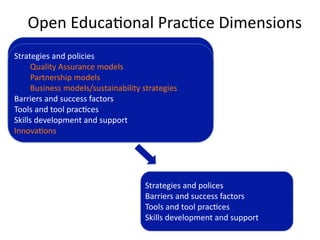
Dimensions
Open
Educa'onal
Prac'ce
Dimensions
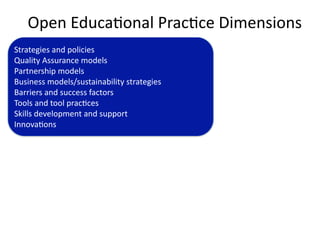
Strategies
and
policies
Quality
Assurance
models
Partnership
models
Business
models/sustainability
strategies
Barriers
and
success
factors
Tools
and
tool
prac'ces
Skills
development
and
support
Innova'ons
Open
Educa'onal
Prac'ce
Dimensions
Strategies
and
policies
Strategies
and
policies
Quality
Assurance
models
      Quality
Assurance
models
Partnership
models
      Partnership
models
Business
models/sustainability
strategies
      Business
models/sustainability
strategies
Barriers
and
success
factors
Barriers
and
success
factors
Tools
and
tool
prac'ces
Tools
and
tool
prac'ces
Skills
development
and
support
Skills
development
and
support
Innova'ons
Innova'ons
Open
Educa'onal
Prac'ce
Dimensions
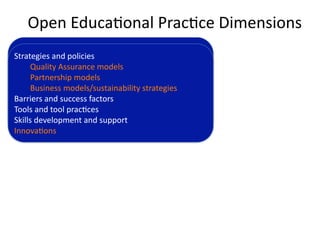
Strategies
and
policies
Strategies
and
policies
Quality
Assurance
models
      Quality
Assurance
models
Partnership
models
      Partnership
models
Business
models/sustainability
strategies
      Business
models/sustainability
strategies
Barriers
and
success
factors
Barriers
and
success
factors
Tools
and
tool
prac'ces
Tools
and
tool
prac'ces
Skills
development
and
support
Skills
development
and
support
Innova'ons
Innova'ons


                                     Strategies
and
polices
                                     Barriers
and
success
factors
                                     Tools
and
tool
prac'ces
                                     Skills
development
and
support
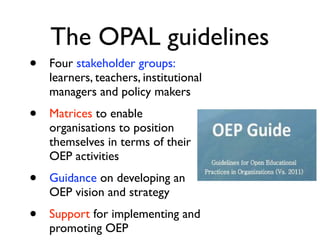
The OPAL guidelines
•   Four stakeholder groups:
    learners, teachers, institutional
    managers and policy makers
•   Matrices to enable
    organisations to position
    themselves in terms of their
    OEP activities
•   Guidance on developing an
    OEP vision and strategy
•   Support for implementing and
    promoting OEP
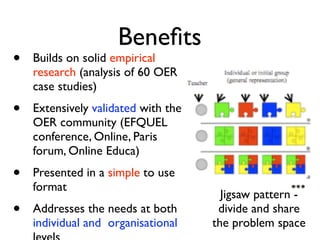
Benefits
•   Builds on solid empirical
    research (analysis of 60 OER
    case studies)
•   Extensively validated with the
    OER community (EFQUEL
    conference, Online, Paris
    forum, Online Educa)
•   Presented in a simple to use
    format
                                       Jigsaw pattern -
•   Addresses the needs at both       divide and share
    individual and organisational    the problem space
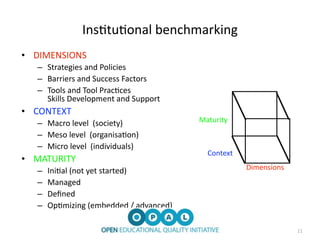
Ins'tu'onal
benchmarking
• DIMENSIONS
  – Strategies
and
Policies
  – Barriers
and
Success
Factors
  – Tools
and
Tool
Prac'ces
    Skills
Development
and
Support
• CONTEXT
  – Macro
level

(society)              Maturity
  – Meso
level

(organisa'on)
  – Micro
level

(individuals)
                                          Context
• MATURITY
  –   Ini'al
(not
yet
started)                      Dimensions
  –   Managed
  –   Defined
  –   Op'mizing
(embedded
/
advanced)

                                                                 11
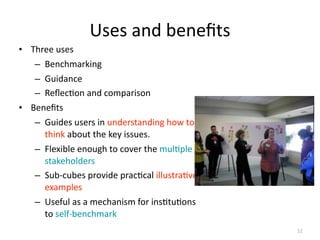
Uses
and
benefits
• Three
uses
   – Benchmarking
   – Guidance
   – Reflec'on
and
comparison
• Benefits
   – Guides
users
in
understanding
how
to

     think
about
the
key
issues.
   – Flexible
enough
to
cover
the
mul'ple

     stakeholders
   – Sub‐cubes
provide
prac'cal
illustra've

     examples
   – Useful
as
a
mechanism
for
ins'tu'ons

     to
self‐benchmark
                                               12
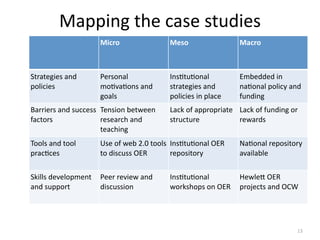
Mapping
the
case
studies
                    Micro                Meso                 Macro


Strategies
and
     Personal
            Ins'tu'onal
         Embedded
in

policies            mo'va'ons
and
       strategies
and
      na'onal
policy
and

                    goals                policies
in
place    funding
Barriers
and
success
 Tension
between
   Lack
of
appropriate
 Lack
of
funding
or

factors               research
and
      structure            rewards
                      teaching
Tools
and
tool
     Use
of
web
2.0
tools
 Ins'tu'onal
OER
    Na'onal
repository

prac'ces            to
discuss
OER        repository          available

Skills
development
 Peer
review
and
     Ins'tu'onal
         HewleV
OER

and
support         discussion           workshops
on
OER     projects
and
OCW


                                                                                13
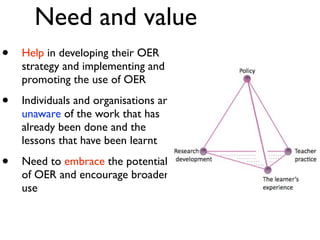
Need and value
•   Help in developing their OER
    strategy and implementing and
    promoting the use of OER

•   Individuals and organisations are
    unaware of the work that has
    already been done and the
    lessons that have been learnt

•   Need to embrace the potential
    of OER and encourage broader
    use
Use cases
•   University A wants to know where they stand:
    •   They can use the guide to assess themselves
    •   They get a review/ feedback from OPAL

•   University B wants to create a future open policy:
    •   They can see which elements would need to be
        included into that from our guideline

•   University C wants to compare themselves with
    others:
    •   They can look up other completed matrices
Impact
•   Better uptake and use of
    OER
•   A more systematic
    approach
•   Growing database of stories
•   An emergent community
    discussing learning and
    teaching ideas and the use
    of OER
Oer panel

Oer panel