Harnessing
technologies
  to foster
  creativity
                Gráinne Conole,
            Leicester University, UK
          grainne.conole@open.ac.uk
     ICDE Conference, Bali, 3rd October 2011
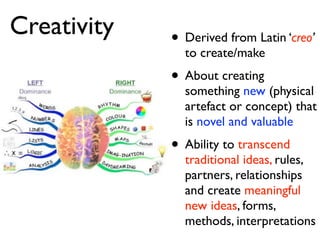
Creativity   • Derived from Latin ‘creo’
               to create/make
             • About creating
               something new (physical
               artefact or concept) that
               is novel and valuable
             • Ability to transcend
               traditional ideas, rules,
               partners, relationships
               and create meaningful
               new ideas, forms,
               methods, interpretations
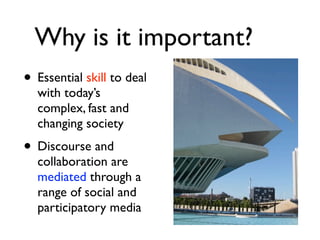
Why is it important?
• Essential skill to deal
  with today’s
  complex, fast and
  changing society
• Discourse and
  collaboration are
  mediated through a
  range of social and
  participatory media
Aspects
• Process: mechanisms needed
  for creative thinking
• Product: measuring creativity
  in people
• Person: general intellectual
  habits (openness, ideas of
  ideation, autonomy, expertise,
  exploratory and behavioural)
• Place: best circumstances to
  enable creativity to flourish
Stages
• Preparation: identifying the
  problem
• Incubation: internalisation of
  the problem
• Intimation: getting a feeling
  for a solution
• Illumination: creativity burst
  forth
• Verification: idea is
  consciously verified,
  elaborated and applied
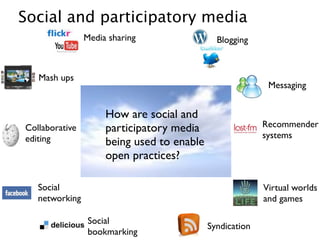
Social and participatory media                                      6


                Media sharing                 Blogging


   Mash ups
                                                           Messaging


                     How are social and
Collaborative        participatory media                  Recommender
editing                                                   systems
                     being used to enable
                     open practices?

   Social                                                 Virtual worlds
   networking                                             and games

                 Social
                                            Syndication
                 bookmarking
Technologies
• Can promote creativity in
  new and innovative ways
• Enable new forms of
  discourse, collaboration
  and cooperation
• Access and repurpose
  knowledge in different
  forms of representation
• Aggregation and scale -
  distributed and collective
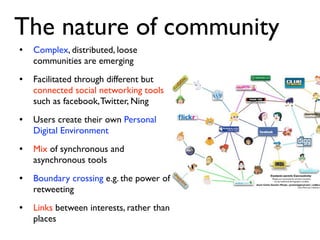
The nature of community
•   Complex, distributed, loose
    communities are emerging
•   Facilitated through different but
    connected social networking tools
    such as facebook, Twitter, Ning
•   Users create their own Personal
    Digital Environment
•   Mix of synchronous and
    asynchronous tools
•   Boundary crossing e.g. the power of
    retweeting
•   Links between interests, rather than
    places
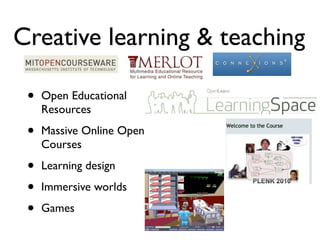
Creative learning & teaching

 •   Open Educational
     Resources

 •   Massive Online Open
     Courses

 •   Learning design

 •   Immersive worlds

 •   Games
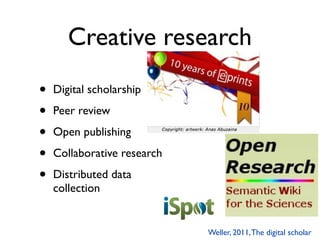
Creative research
•   Digital scholarship

•   Peer review

•   Open publishing

•   Collaborative research

•   Distributed data
    collection


                             Weller, 2011, The digital scholar
In terms of OER
• What is the relationship
  between creativity and OER?
• How can creativity be used
  in terms of the creation and
  use of OER?
• What new creative practices
  might result through effective
  use of OER?
Key questions
•   What is the nature of creativity?

•   What are its key characteristics?

•   What is the relationship between creativity and
    general intelligence?

•   How can creativity be fostered and supported?

•   What is the nature of collaborative creative
    practices?

•   How can technologies be used to promote and
    support creativity?
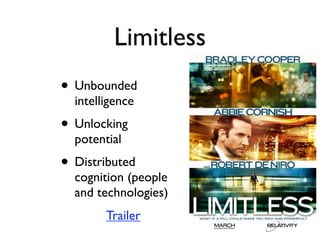
Limitless
• Unbounded
  intelligence
• Unlocking
  potential
• Distributed
  cognition (people
  and technologies)
        Trailer
References
•   Loveless, A M (2007) Creativity, technology and learning – a
    review of recent literature Futurelab, http://
    archive.futurelab.org.uk/resources/documents/lit_reviews/
    Creativity_Review_update.pdf

•   http://robwall.ca/2009/03/10/creativity-is-the-new-
    technology/

•   http://www.youtube.com/watch?v=nvIQP-EBPqc

•   http://vimeo.com/3365942

•   http://blogs.hbr.org/video/2010/05/andrew-klavan-on-
    how-21st-cent.html

Conole creativity

  • 1.
    Harnessing technologies tofoster creativity Gráinne Conole, Leicester University, UK grainne.conole@open.ac.uk ICDE Conference, Bali, 3rd October 2011
  • 2.
    Creativity • Derived from Latin ‘creo’ to create/make • About creating something new (physical artefact or concept) that is novel and valuable • Ability to transcend traditional ideas, rules, partners, relationships and create meaningful new ideas, forms, methods, interpretations
  • 3.
    Why is itimportant? • Essential skill to deal with today’s complex, fast and changing society • Discourse and collaboration are mediated through a range of social and participatory media
  • 4.
    Aspects • Process: mechanismsneeded for creative thinking • Product: measuring creativity in people • Person: general intellectual habits (openness, ideas of ideation, autonomy, expertise, exploratory and behavioural) • Place: best circumstances to enable creativity to flourish
  • 5.
    Stages • Preparation: identifyingthe problem • Incubation: internalisation of the problem • Intimation: getting a feeling for a solution • Illumination: creativity burst forth • Verification: idea is consciously verified, elaborated and applied
  • 6.
    Social and participatorymedia 6 Media sharing Blogging Mash ups Messaging How are social and Collaborative participatory media Recommender editing systems being used to enable open practices? Social Virtual worlds networking and games Social Syndication bookmarking
  • 7.
    Technologies • Can promotecreativity in new and innovative ways • Enable new forms of discourse, collaboration and cooperation • Access and repurpose knowledge in different forms of representation • Aggregation and scale - distributed and collective
  • 8.
    The nature ofcommunity • Complex, distributed, loose communities are emerging • Facilitated through different but connected social networking tools such as facebook, Twitter, Ning • Users create their own Personal Digital Environment • Mix of synchronous and asynchronous tools • Boundary crossing e.g. the power of retweeting • Links between interests, rather than places
  • 9.
    Creative learning &teaching • Open Educational Resources • Massive Online Open Courses • Learning design • Immersive worlds • Games
  • 10.
    Creative research • Digital scholarship • Peer review • Open publishing • Collaborative research • Distributed data collection Weller, 2011, The digital scholar
  • 11.
    In terms ofOER • What is the relationship between creativity and OER? • How can creativity be used in terms of the creation and use of OER? • What new creative practices might result through effective use of OER?
  • 12.
    Key questions • What is the nature of creativity? • What are its key characteristics? • What is the relationship between creativity and general intelligence? • How can creativity be fostered and supported? • What is the nature of collaborative creative practices? • How can technologies be used to promote and support creativity?
  • 13.
    Limitless • Unbounded intelligence • Unlocking potential • Distributed cognition (people and technologies) Trailer
  • 14.
    References • Loveless, A M (2007) Creativity, technology and learning – a review of recent literature Futurelab, http:// archive.futurelab.org.uk/resources/documents/lit_reviews/ Creativity_Review_update.pdf • http://robwall.ca/2009/03/10/creativity-is-the-new- technology/ • http://www.youtube.com/watch?v=nvIQP-EBPqc • http://vimeo.com/3365942 • http://blogs.hbr.org/video/2010/05/andrew-klavan-on- how-21st-cent.html

Editor's Notes