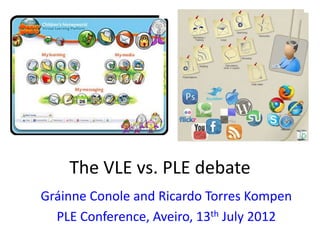
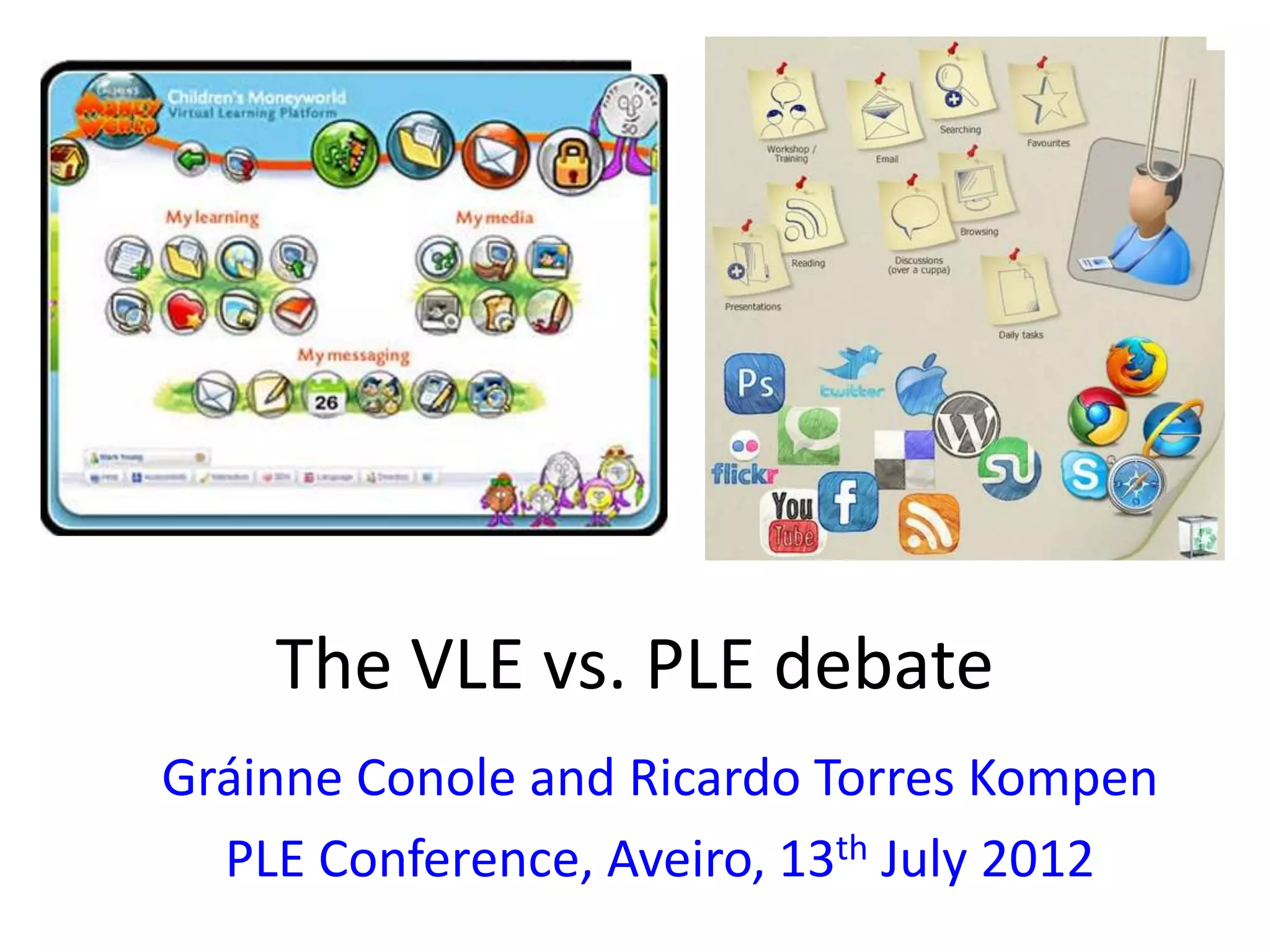


The VLE vs. PLE debate
Gráinne Conole and Ricardo Torres Kompen
  PLE Conference, Aveiro, 13th July 2012
The PLE and the VLE:
  which is which???
Outline
• Format for the unkeynote
   – Process pre-conference
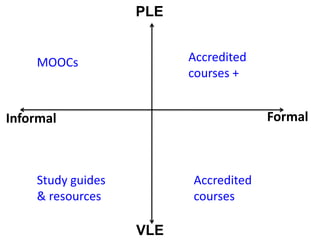
   – Downes on VLEs vs. PLEs
   – For each question:
      •   Quotes
      •   Summary
      •   Audience discussion
      •   Videos
   – Emergent themes
   – Vote!!!
• Carry on the debate on
  Cloudworks, FB and Twitter!
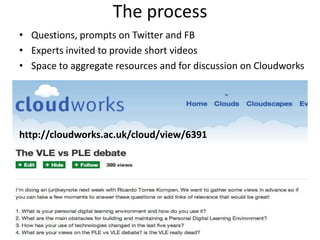
The process
• Questions, prompts on Twitter and FB
• Experts invited to provide short videos
• Space to aggregate resources and for discussion on Cloudworks


http://cloudworks.ac.uk/cloud/view/6391
Questions
1. What is your personal digital learning
   environment and how do you use it?
2. What are the main obstacles for building and
   maintaining a Personal Digital Learning
   Environment?
3. How has your use of technologies changed in
   the last five years?
4. What are your views on the PLE vs VLE
   debate? Is the VLE really dead?
Stephen Downes - @oldaily
PLE


    MOOCs                Accredited
                         courses +


Informal                              Formal


    Study guides         Accredited
    & resources          courses

                   VLE
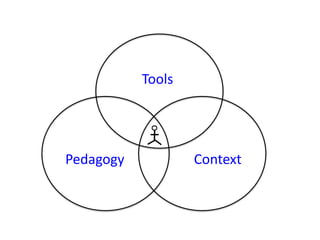
Tools


Pedagogy           Context
1. What is your personal digital learning
 environment and how do you use it?
Antonella Esposito
Twitter: I like its nature of open asymmetric social
network, which enables me to continously find new
sources of knowledge and usually
pleasant interaction, pearls of wisdom or
a mere, precious LOL ;-) It took time to build a good
network, but I increasingly appreciate the value to be
connected in a web of conversations. Especially love
'intercepting' conferences and sharing links to
reports, blog posts and published articles. But
sometimes some great chats occur, despite the 140
characters.
1. What is your personal digital learning
 environment and how do you use it?
José Mota
I see the PLE not as a technological platform or a set
of tools, but as an ecosystem or an ecology
of people, tools and resources you interact with
online. It's very dynamic and keeps changing and
adapting according to my needs and interests.

Those I rely the most on are, currently, Google
Reader, Twitter, blog (Wordpress), Google+, Diigo
(synchronized with Delicious to use the Firefox add-
on), Gmail and Google Docs. I also use Scoop.it, but
mostly for teaching and am going to focus more on
Mendeley while writing my Phd.
1. What is your personal digital learning
 environment and how do you use it?
Martin Dougiamas
A collection of feeds that I generally check
daily, carefully selected to maximise the signal to
noise ratio.

The rest are larger projects that I give myself, to learn
this or that. They are usually hands on activities
where I construct something useful for others to see
and perhaps use.
1. What is your personal digital learning
 environment and how do you use it?
David Martin Blogging and Social Media? Try digital
learning in a corporate environment. Still very last
century!

David Hopkins (1) Twitter, LinkedIn, and own blog ...
(2) time ... (3) iPhone and iPad means I'm connected
all the time, which isn't always a good thing ... (4)
want to see a working PLE before I decide, but I
prefer the ability to bring the tools I want/need into
my learning environment instead of being forced to
used prescribed VLE ones (which aren't always the
best or technically capable). Hope this helps.
1. What is your personal digital learning
 environment and how do you use it?
Alastair Creelman I have a toolbox compiled on
Symbaloo that includes Twitter, Fb etc as well as RSS
feeds from news sites, blogs and search criteria via
Netvibes

Ebba Ossiannilsson Working on it all the
time, Netvibes is on; i wished I could have a simpler
one and I wish I could have better overview of my
resourses and my social networking/media


.
Gilly Salmon - @gillysalmon
Joyce Seitzinger - @catspyjamasnz
2. Main obstacles for building and maintaining a
                      PLE?

  Antonella Esposito
  It comes to mind the necessary efforts for a
  continuing engagement in building and maintaining a
  PLE. Someone in a MOOC mentioned 'gardening' as a
  compliant metaphor. Moreover, one has to iteratively
  re-focus her own objectives in order to get the
  most from this 'hanging out and moving around'.
  However the most difficult thing it is grappling with
  two opposite but productive behaviours: 'keep
  control' and 'let the river run'. Serendipity and
  intentionality.
2. Main obstacles for building/maintaining a PLE?
 José Mota
The first obvious difficulty would be, I guess, the lack
of enough technical proficiency and enough online
experience to develop an effective and rewarding PLE.
Understanding online culture, getting familiar with modes
of communication, developing enough technical skills to
be autonomous takes time and effort, that can, often, be
minimized with some modelling or guidance. Another
difficulty is keeping the participation level and being an
active and valuable contributor, so that your PLE isn't
just a black hole that sucks everything but from
where nothing comes out :-). Being active and sharing
knowledge, ideas, artifacts, questions, resources, experien
ces, etc. is a crucial part of one's PLE, but that is not
always easy to keep up continuously.
2. Main obstacles for building/maintaining a PLE?


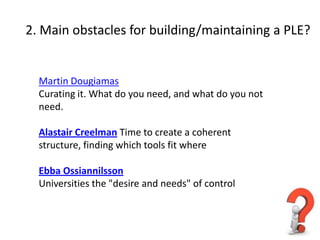
  Martin Dougiamas
  Curating it. What do you need, and what do you not
  need.

  Alastair Creelman Time to create a coherent
  structure, finding which tools fit where

  Ebba Ossiannilsson
  Universities the "desire and needs" of control
SteveWheeler - @timbuckteeth
IleneDawn Alexander - @IleneDawn
3. Change in use of technologies in the last 5
                        years?
Antonella Esposito
I think you need a 'niche of co-evolution' (eg a MOOC) to
make sense of the current plethora of social media and
understand what it is worth for you doing with them. For
me since 2009 Cloudworks has worked as a niche, in which I
imitated others' digital behaviours, progressively acquired
self-confidence and finally tried to propose my
contributions, as content curator, occasional blogger or
tireless twitterer. To tell the truth, my current digital
behaviours have been shaped by attending Cloudworks for
about two years. Now I adopt different tools and
have different objectives, but I have experimented there the
type of online engagement that I currently undertake. The
nice thing is that there are still 'traces' of these early attempts.
These traces would deserve a more careful reflection...
3. Change in use of technologies in the last 5
                       years?
José Mota
I cannot pin point major differences, apart from the tools and
services that come and go - some disappear, others become
obsolete, new ones are created, some of my interests and
needs change, etc. I guess I am using the technologies more or
less the same I did five years ago, for the purposes I stated
above.

Martin Dougiamas
It used to be mail, then iGoogle for years but now it's
Flipboard and Reeder on an iPad.
3. Change in use of technologies in the last 5
                       years?

Philip Butler Hah! massively! (and I don't even like technology
that much but some of it is life-changing). ULCC have some
very interesting statistics showing how communications and
collaborative activity decrease in a VLE when it's a component
of a digital framework (ULCC Personalised Learning model).
It's moved to student arenas like the e-Portfolio which
challenges the 'social constructivist' design we talk of when
dealing with Moodle, etc.

Alastair Creelman I've moved to cloud services almost
completely, also more mobile thanks to iPhone and iPad
3. Change in use of technologies in the last 5
                       years?
Ebba Ossiannilsson networking much more with friends and
colleagues from all over the world and even more informal
networking with colleagues. Contact here and now, faster and
more intense networking, easier with collaborative, building
on trust, The way you show with this small exercise is an
excellent example
Deeper and more close relation with people, Sharing and
connections are the key and use and reuse
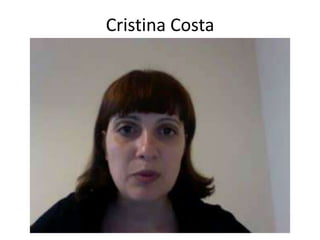
Cristina Costa
Helen Keegan - @heloukee
4. Is the VLE really dead?


Antonella Esposito
The VLE is alive and healthy, and in many cases keeps
on effectively serving institution-bounded
educational offerings. However, its importance in the
life of a learner is closely linked to the timespan of
the course/class/forum in which s/he is enrolled in.
A PLE affords data portability, it can become your
e-portfolio among the formal educational initiatives
and work tasks in which you take part.
4. Is the VLE really dead?


José Mota
This would take a while to discuss :-), but the brief
answer is no, of course not. Formal education and
institutions have requirements that need to be met….

The idea of an open, distributed environment for
learning is not equally appealing for
everyone, especially when there are assignments and
grades and certifications involved. On the other
hand, the LMS provides a secure, centralized and
practical way for formal educational contexts, despite
its many shortcomings.
4. Is the VLE really dead?


José Mota

…institutionally supported VLEs (which
are, in most cases, VLE 2.0, actually) that
provide an experience that, to some
extent, is similar to that of a PLE but with
some of the strong points of the LMS
(centralized, secure, managed by
institution, "all-in-one-place")…
4. Is the VLE really dead?

José Mota
Currently, for formal education, my favourite set up is
using an LMS like Moodle for some core course
components (information, learning contract, some
base content and resources, some of the assessment,
support forum, elements that may require privacy
within the cohort, etc.) and than the students' PLEs
for searching, managing information, publishing their
work, cooperating/collaborating/communicating with
other relevant people outside the course, etc.,
making the most of what a networked learning
experience has to offer.
4. Is the VLE really dead?

 Martin Dougiamas
Not at all. An institution has to "be" somewhere on
the web. They are also rich sources of information
like any other web sites (a lot of my feeds are RSS
from Moodle, for example), and places to get
involved in collaborative projects.

Alastair Creelman 90% are not ready for PLE and it's
hard to define. VLE will live for many years to come as
a clear administrative tool. VLE may well shrink to
become a white dwarf (secure area for identity-
sensitive information and examination material). The
rest will be PLE.
4. Is the VLE really dead?


David Cummings Btw, I think it's unhelpful to think in
Manichaean allegories. VLE vs PLE. It's like comparing
facebook to social media, ie platform vs concept.

Ebba Ossiannilsson As long as institutions cant leave
the control I think we unfortunately have to have the
VLE, I mean when people lock even OERs into a
locked VLE, something is wrong. The main thing is let
the learners take the control, and leave the control
needs and demands...I wish VLE was dead long time
ago, even worst is that still dept at universities create
their own which can’t communicate with anything
else...
ChahiraNouhira - @CosmoCat
JaneChallinor - @virtualleader
Themes
• Curation and filtration
• Digital literacy skills and
  understanding the online
  culture
• It takes time to appropriate
  these tools into your
  practice, need for learning by
  doing
• Keeping up
• Participation
• Need for structured, guided
  learning
  pathways, open/distributed
  learning environments not for
Themes
• Rich range of tools for finding
  and managing information, and
  communicating and
  collaborating – each person
  adapts and personalises
• Closed institutionally controlled
  systems vs. portable, learner-
  controlled tools
• An ecosystem or ecology or
  people, resource and tools
  online
• Blurring of boundaries between
  the VLE and the PLE
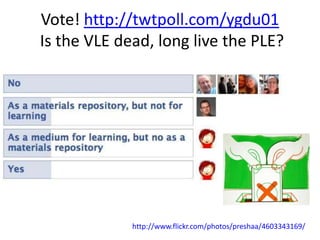
Vote! http://twtpoll.com/ygdu01
Is the VLE dead, long live the PLE?


             http://www.flickr.com/photos/preshaa/4603343169/
Crystal gazing
• Blurring of boundaries
• Mix of institutional and
  cloud-based tools
• Spectrum of formal and
  informal offerings
• More sophisticated
  learning analytics tools
• Learning design tools to
  guide practice

Grainne ricardo final_16_july

  • 1.
    The VLE vs.PLE debate Gráinne Conole and Ricardo Torres Kompen PLE Conference, Aveiro, 13th July 2012
  • 2.
    The PLE andthe VLE: which is which???
  • 3.
    Outline • Format forthe unkeynote – Process pre-conference – Downes on VLEs vs. PLEs – For each question: • Quotes • Summary • Audience discussion • Videos – Emergent themes – Vote!!! • Carry on the debate on Cloudworks, FB and Twitter!
  • 4.
    The process • Questions,prompts on Twitter and FB • Experts invited to provide short videos • Space to aggregate resources and for discussion on Cloudworks http://cloudworks.ac.uk/cloud/view/6391
  • 5.
    Questions 1. What isyour personal digital learning environment and how do you use it? 2. What are the main obstacles for building and maintaining a Personal Digital Learning Environment? 3. How has your use of technologies changed in the last five years? 4. What are your views on the PLE vs VLE debate? Is the VLE really dead?
  • 6.
  • 7.
    PLE MOOCs Accredited courses + Informal Formal Study guides Accredited & resources courses VLE
  • 8.
  • 9.
    1. What isyour personal digital learning environment and how do you use it? Antonella Esposito Twitter: I like its nature of open asymmetric social network, which enables me to continously find new sources of knowledge and usually pleasant interaction, pearls of wisdom or a mere, precious LOL ;-) It took time to build a good network, but I increasingly appreciate the value to be connected in a web of conversations. Especially love 'intercepting' conferences and sharing links to reports, blog posts and published articles. But sometimes some great chats occur, despite the 140 characters.
  • 10.
    1. What isyour personal digital learning environment and how do you use it? José Mota I see the PLE not as a technological platform or a set of tools, but as an ecosystem or an ecology of people, tools and resources you interact with online. It's very dynamic and keeps changing and adapting according to my needs and interests. Those I rely the most on are, currently, Google Reader, Twitter, blog (Wordpress), Google+, Diigo (synchronized with Delicious to use the Firefox add- on), Gmail and Google Docs. I also use Scoop.it, but mostly for teaching and am going to focus more on Mendeley while writing my Phd.
  • 11.
    1. What isyour personal digital learning environment and how do you use it? Martin Dougiamas A collection of feeds that I generally check daily, carefully selected to maximise the signal to noise ratio. The rest are larger projects that I give myself, to learn this or that. They are usually hands on activities where I construct something useful for others to see and perhaps use.
  • 12.
    1. What isyour personal digital learning environment and how do you use it? David Martin Blogging and Social Media? Try digital learning in a corporate environment. Still very last century! David Hopkins (1) Twitter, LinkedIn, and own blog ... (2) time ... (3) iPhone and iPad means I'm connected all the time, which isn't always a good thing ... (4) want to see a working PLE before I decide, but I prefer the ability to bring the tools I want/need into my learning environment instead of being forced to used prescribed VLE ones (which aren't always the best or technically capable). Hope this helps.
  • 13.
    1. What isyour personal digital learning environment and how do you use it? Alastair Creelman I have a toolbox compiled on Symbaloo that includes Twitter, Fb etc as well as RSS feeds from news sites, blogs and search criteria via Netvibes Ebba Ossiannilsson Working on it all the time, Netvibes is on; i wished I could have a simpler one and I wish I could have better overview of my resourses and my social networking/media .
  • 14.
    Gilly Salmon -@gillysalmon
  • 15.
    Joyce Seitzinger -@catspyjamasnz
  • 16.
    2. Main obstaclesfor building and maintaining a PLE? Antonella Esposito It comes to mind the necessary efforts for a continuing engagement in building and maintaining a PLE. Someone in a MOOC mentioned 'gardening' as a compliant metaphor. Moreover, one has to iteratively re-focus her own objectives in order to get the most from this 'hanging out and moving around'. However the most difficult thing it is grappling with two opposite but productive behaviours: 'keep control' and 'let the river run'. Serendipity and intentionality.
  • 17.
    2. Main obstaclesfor building/maintaining a PLE? José Mota The first obvious difficulty would be, I guess, the lack of enough technical proficiency and enough online experience to develop an effective and rewarding PLE. Understanding online culture, getting familiar with modes of communication, developing enough technical skills to be autonomous takes time and effort, that can, often, be minimized with some modelling or guidance. Another difficulty is keeping the participation level and being an active and valuable contributor, so that your PLE isn't just a black hole that sucks everything but from where nothing comes out :-). Being active and sharing knowledge, ideas, artifacts, questions, resources, experien ces, etc. is a crucial part of one's PLE, but that is not always easy to keep up continuously.
  • 18.
    2. Main obstaclesfor building/maintaining a PLE? Martin Dougiamas Curating it. What do you need, and what do you not need. Alastair Creelman Time to create a coherent structure, finding which tools fit where Ebba Ossiannilsson Universities the "desire and needs" of control
  • 19.
  • 20.
  • 21.
    3. Change inuse of technologies in the last 5 years? Antonella Esposito I think you need a 'niche of co-evolution' (eg a MOOC) to make sense of the current plethora of social media and understand what it is worth for you doing with them. For me since 2009 Cloudworks has worked as a niche, in which I imitated others' digital behaviours, progressively acquired self-confidence and finally tried to propose my contributions, as content curator, occasional blogger or tireless twitterer. To tell the truth, my current digital behaviours have been shaped by attending Cloudworks for about two years. Now I adopt different tools and have different objectives, but I have experimented there the type of online engagement that I currently undertake. The nice thing is that there are still 'traces' of these early attempts. These traces would deserve a more careful reflection...
  • 22.
    3. Change inuse of technologies in the last 5 years? José Mota I cannot pin point major differences, apart from the tools and services that come and go - some disappear, others become obsolete, new ones are created, some of my interests and needs change, etc. I guess I am using the technologies more or less the same I did five years ago, for the purposes I stated above. Martin Dougiamas It used to be mail, then iGoogle for years but now it's Flipboard and Reeder on an iPad.
  • 23.
    3. Change inuse of technologies in the last 5 years? Philip Butler Hah! massively! (and I don't even like technology that much but some of it is life-changing). ULCC have some very interesting statistics showing how communications and collaborative activity decrease in a VLE when it's a component of a digital framework (ULCC Personalised Learning model). It's moved to student arenas like the e-Portfolio which challenges the 'social constructivist' design we talk of when dealing with Moodle, etc. Alastair Creelman I've moved to cloud services almost completely, also more mobile thanks to iPhone and iPad
  • 24.
    3. Change inuse of technologies in the last 5 years? Ebba Ossiannilsson networking much more with friends and colleagues from all over the world and even more informal networking with colleagues. Contact here and now, faster and more intense networking, easier with collaborative, building on trust, The way you show with this small exercise is an excellent example Deeper and more close relation with people, Sharing and connections are the key and use and reuse
  • 25.
  • 26.
    Helen Keegan -@heloukee
  • 27.
    4. Is theVLE really dead? Antonella Esposito The VLE is alive and healthy, and in many cases keeps on effectively serving institution-bounded educational offerings. However, its importance in the life of a learner is closely linked to the timespan of the course/class/forum in which s/he is enrolled in. A PLE affords data portability, it can become your e-portfolio among the formal educational initiatives and work tasks in which you take part.
  • 28.
    4. Is theVLE really dead? José Mota This would take a while to discuss :-), but the brief answer is no, of course not. Formal education and institutions have requirements that need to be met…. The idea of an open, distributed environment for learning is not equally appealing for everyone, especially when there are assignments and grades and certifications involved. On the other hand, the LMS provides a secure, centralized and practical way for formal educational contexts, despite its many shortcomings.
  • 29.
    4. Is theVLE really dead? José Mota …institutionally supported VLEs (which are, in most cases, VLE 2.0, actually) that provide an experience that, to some extent, is similar to that of a PLE but with some of the strong points of the LMS (centralized, secure, managed by institution, "all-in-one-place")…
  • 30.
    4. Is theVLE really dead? José Mota Currently, for formal education, my favourite set up is using an LMS like Moodle for some core course components (information, learning contract, some base content and resources, some of the assessment, support forum, elements that may require privacy within the cohort, etc.) and than the students' PLEs for searching, managing information, publishing their work, cooperating/collaborating/communicating with other relevant people outside the course, etc., making the most of what a networked learning experience has to offer.
  • 31.
    4. Is theVLE really dead? Martin Dougiamas Not at all. An institution has to "be" somewhere on the web. They are also rich sources of information like any other web sites (a lot of my feeds are RSS from Moodle, for example), and places to get involved in collaborative projects. Alastair Creelman 90% are not ready for PLE and it's hard to define. VLE will live for many years to come as a clear administrative tool. VLE may well shrink to become a white dwarf (secure area for identity- sensitive information and examination material). The rest will be PLE.
  • 32.
    4. Is theVLE really dead? David Cummings Btw, I think it's unhelpful to think in Manichaean allegories. VLE vs PLE. It's like comparing facebook to social media, ie platform vs concept. Ebba Ossiannilsson As long as institutions cant leave the control I think we unfortunately have to have the VLE, I mean when people lock even OERs into a locked VLE, something is wrong. The main thing is let the learners take the control, and leave the control needs and demands...I wish VLE was dead long time ago, even worst is that still dept at universities create their own which can’t communicate with anything else...
  • 33.
  • 34.
  • 35.
    Themes • Curation andfiltration • Digital literacy skills and understanding the online culture • It takes time to appropriate these tools into your practice, need for learning by doing • Keeping up • Participation • Need for structured, guided learning pathways, open/distributed learning environments not for
  • 36.
    Themes • Rich rangeof tools for finding and managing information, and communicating and collaborating – each person adapts and personalises • Closed institutionally controlled systems vs. portable, learner- controlled tools • An ecosystem or ecology or people, resource and tools online • Blurring of boundaries between the VLE and the PLE
  • 37.
    Vote! http://twtpoll.com/ygdu01 Is theVLE dead, long live the PLE? http://www.flickr.com/photos/preshaa/4603343169/
  • 38.
    Crystal gazing • Blurringof boundaries • Mix of institutional and cloud-based tools • Spectrum of formal and informal offerings • More sophisticated learning analytics tools • Learning design tools to guide practice