
+
Connecting research with
policy and practice
Gráinne Conole, Open University, UK
EDEN research workshop
Budapest, 25th October 2010
More info, slides and references:
http://cloudworks.ac.uk/
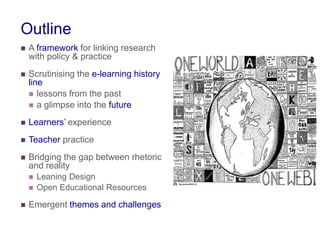
Outline
 A framework for linking research
with policy & practice
 Scrutinising the e-learning history
line
 lessons from the past
 a glimpse into the future
 Learners’ experience
 Teacher practice
 Bridging the gap between rhetoric
and reality
 Leaning Design
 Open Educational Resources
 Emergent themes and challenges
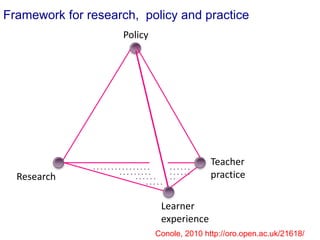
Policy
Teacher
practiceResearch
Learner
experience
Framework for research, policy and practice
Conole, 2010 http://oro.open.ac.uk/21618/
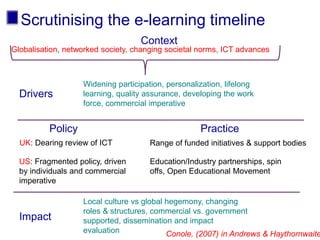
Scrutinising the e-learning timeline
Context
Globalisation, networked society, changing societal norms, ICT advances
UK: Dearing review of ICT Range of funded initiatives & support bodies
US: Fragmented policy, driven
by individuals and commercial
imperative
Education/Industry partnerships, spin
offs, Open Educational Movement
Impact
Local culture vs global hegemony, changing
roles & structures, commercial vs. government
supported, dissemination and impact
evaluation
Policy Practice
Drivers
Widening participation, personalization, lifelong
learning, quality assurance, developing the work
force, commercial imperative
Conole, (2007) in Andrews & Haythornwaite
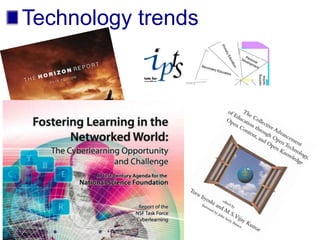
Technology trends
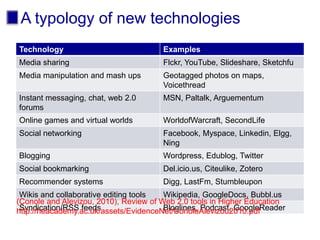
A typology of new technologies
Technology Examples
Media sharing Flckr, YouTube, Slideshare, Sketchfu
Media manipulation and mash ups Geotagged photos on maps,
Voicethread
Instant messaging, chat, web 2.0
forums
MSN, Paltalk, Arguementum
Online games and virtual worlds WorldofWarcraft, SecondLife
Social networking Facebook, Myspace, Linkedin, Elgg,
Ning
Blogging Wordpress, Edublog, Twitter
Social bookmarking Del.icio.us, Citeulike, Zotero
Recommender systems Digg, LastFm, Stumbleupon
Wikis and collaborative editing tools Wikipedia, GoogleDocs, Bubbl.us
Syndication/RSS feeds Bloglines, Podcast, GoogleReader
(Conole and Alevizou, 2010), Review of Web 2.0 tools in Higher Education
http://heacademy.ac.uk/assets/EvidenceNet/ConoleAlevizou2010.pdf
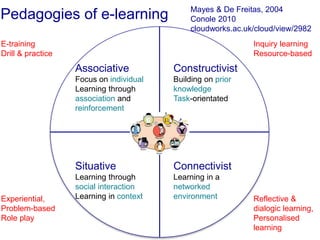
A
Associative
Focus on individual
Learning through
association and
reinforcement
Constructivist
Building on prior
knowledge
Task-orientated
Situative
Learning through
social interaction
Learning in context
Connectivist
Learning in a
networked
environment
Pedagogies of e-learning Mayes & De Freitas, 2004
Conole 2010
cloudworks.ac.uk/cloud/view/2982
E-training
Drill & practice
Inquiry learning
Resource-based
Experiential,
Problem-based
Role play
Reflective &
dialogic learning,
Personalised
learning
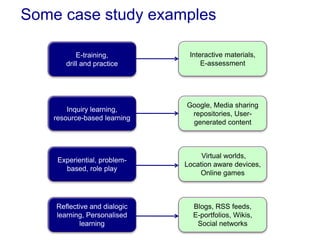
Some case study examples
E-training,
drill and practice
Experiential, problem-
based, role play
Inquiry learning,
resource-based learning
Reflective and dialogic
learning, Personalised
learning
Interactive materials,
E-assessment
Virtual worlds,
Location aware devices,
Online games
Google, Media sharing
repositories, User-
generated content
Blogs, RSS feeds,
E-portfolios, Wikis,
Social networks
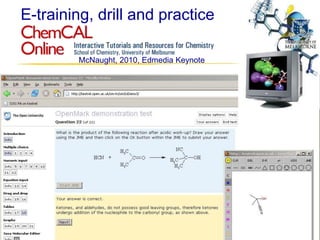
E-training, drill and practice
McNaught, 2010, Edmedia Keynote
Going mobile
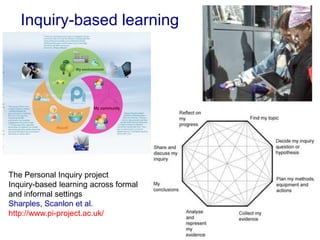
Inquiry-based learning
The Personal Inquiry project
Inquiry-based learning across formal
and informal settings
Sharples, Scanlon et al.
http://www.pi-project.ac.uk/
My community
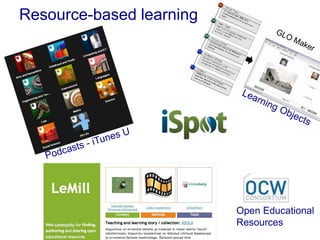
Resource-based learning
Open Educational
Resources
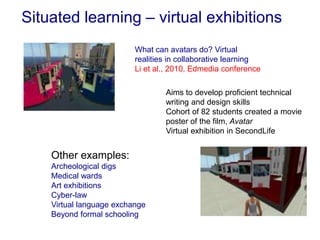
Situated learning – virtual exhibitions
Aims to develop proficient technical
writing and design skills
Cohort of 82 students created a movie
poster of the film, Avatar
Virtual exhibition in SecondLife
What can avatars do? Virtual
realities in collaborative learning
Li et al., 2010, Edmedia conference
Other examples:
Archeological digs
Medical wards
Art exhibitions
Cyber-law
Virtual language exchange
Beyond formal schooling
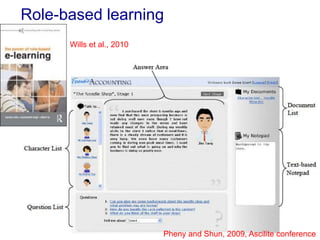
Role-based learning
Pheny and Shun, 2009, Ascilite conference
Wills et al., 2010
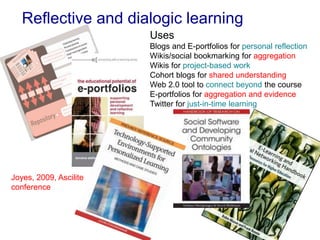
Reflective and dialogic learning
Uses
Blogs and E-portfolios for personal reflection
Wikis/social bookmarking for aggregation
Wikis for project-based work
Cohort blogs for shared understanding
Web 2.0 tool to connect beyond the course
E-portfolios for aggregation and evidence
Twitter for just-in-time learning
Joyes, 2009, Ascilite
conference
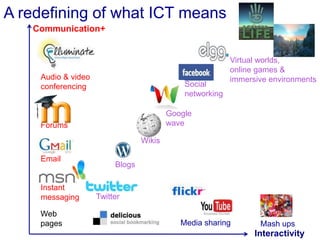
Web
pages
Communication+
Interactivity
A redefining of what ICT means
Blogs
Wikis
Virtual worlds,
online games &
immersive environments
Social
networking
Twitter
Google
wave
Media sharing Mash ups
Email
Forums
Instant
messaging
Audio & video
conferencing
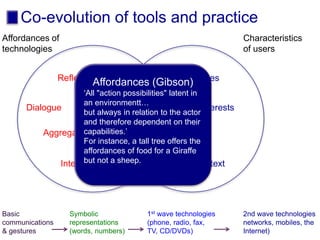
Co-evolution of tools and practice
Evolving
practices
Characteristics
of users
Preferences
Skills
Interests
Context
Affordances of
technologies
Reflection
Dialogue
Aggregation
Interactivity
Affordances (Gibson)
‘All "action possibilities" latent in
an environmentt…
but always in relation to the actor
and therefore dependent on their
capabilities.’
For instance, a tall tree offers the
affordances of food for a Giraffe
but not a sheep.
Basic
communications
& gestures
Symbolic
representations
(words, numbers)
1st wave technologies
(phone, radio, fax,
TV, CD/DVDs)
2nd wave technologies
networks, mobiles, the
Internet)
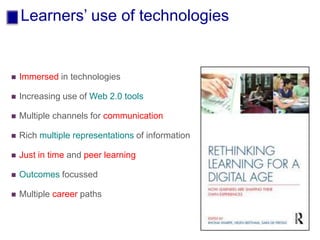
Learners’ use of technologies
 Immersed in technologies
 Increasing use of Web 2.0 tools
 Multiple channels for communication
 Rich multiple representations of information
 Just in time and peer learning
 Outcomes focussed
 Multiple career paths
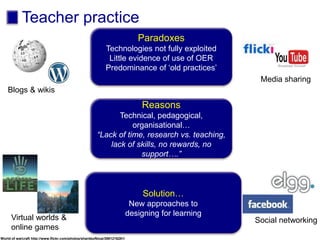
Teacher practice
Paradoxes
Technologies not fully exploited
Little evidence of use of OER
Predominance of ‘old practices’
Media sharing
Blogs & wikis
Reasons
Technical, pedagogical,
organisational…
“Lack of time, research vs. teaching,
lack of skills, no rewards, no
support….”
Solution…
New approaches to
designing for learning
Virtual worlds &
online games
Social networking
World of warcraft http://www.flickr.com/photos/shardsofblue/3981216281/
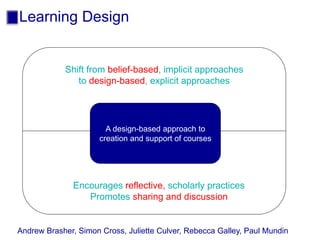
Learning Design
Shift from belief-based, implicit approaches
to design-based, explicit approaches
Encourages reflective, scholarly practices
Promotes sharing and discussion
A design-based approach to
creation and support of courses
Andrew Brasher, Simon Cross, Juliette Culver, Rebecca Galley, Paul Mundin
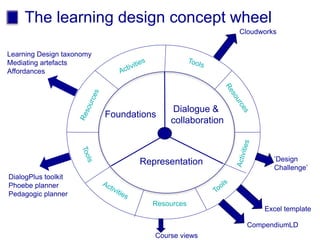
The learning design concept wheel
Resources
Foundations
Representation
Dialogue &
collaboration
Learning Design taxonomy
Mediating artefacts
Affordances
Excel template
CompendiumLD
Course views
Cloudworks
’Design
Challenge’
DialogPlus toolkit
Phoebe planner
Pedagogic planner
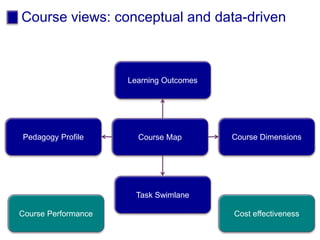
Course views: conceptual and data-driven
Course Map
Learning Outcomes
Task Swimlane
Pedagogy Profile Course Dimensions
Course Performance Cost effectiveness
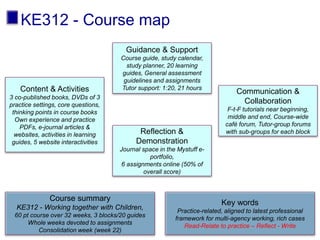
Guidance & Support
Course guide, study calendar,
study planner, 20 learning
guides, General assessment
guidelines and assignments
Tutor support: 1:20, 21 hours
Reflection &
Demonstration
Journal space in the Mystuff e-
portfolio,
6 assignments online (50% of
overall score)
Content & Activities
3 co-published books, DVDs of 3
practice settings, core questions,
thinking points in course books
Own experience and practice
PDFs, e-journal articles &
websites, activities in learning
guides, 5 website interactivities
Communication &
Collaboration
F-t-F tutorials near beginning,
middle and end, Course-wide
café forum, Tutor-group forums
with sub-groups for each block
Course summary
KE312 - Working together with Children,
60 pt course over 32 weeks, 3 blocks/20 guides
Whole weeks devoted to assignments
Consolidation week (week 22)
Key words
Practice-related, aligned to latest professional
framework for multi-agency working, rich cases
Read-Relate to practice – Reflect - Write
KE312 - Course map
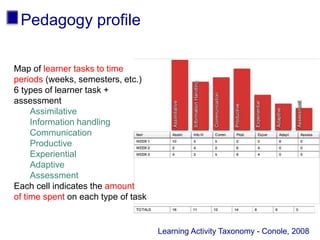
Pedagogy profile
Learning Activity Taxonomy - Conole, 2008
Map of learner tasks to time
periods (weeks, semesters, etc.)
6 types of learner task +
assessment
Assimilative
Information handling
Communication
Productive
Experiential
Adaptive
Assessment
Each cell indicates the amount
of time spent on each type of task
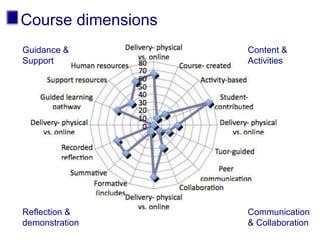
Course dimensions
Guidance &
Support
Content &
Activities
Reflection &
demonstration
Communication
& Collaboration
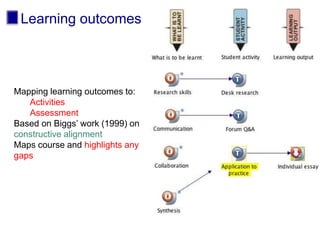
Learning outcomes
Mapping learning outcomes to:
Activities
Assessment
Based on Biggs’ work (1999) on
constructive alignment
Maps course and highlights any
gaps
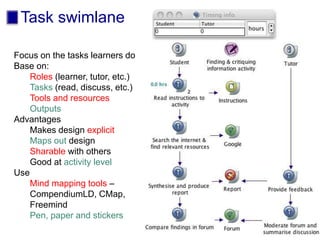
Task swimlane
Focus on the tasks learners do
Base on:
Roles (learner, tutor, etc.)
Tasks (read, discuss, etc.)
Tools and resources
Outputs
Advantages
Makes design explicit
Maps out design
Sharable with others
Good at activity level
Use
Mind mapping tools –
CompendiumLD, CMap,
Freemind
Pen, paper and stickers
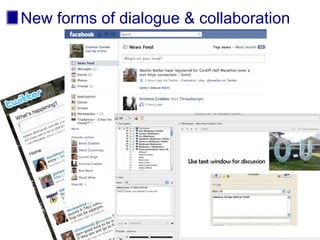
New forms of dialogue & collaboration
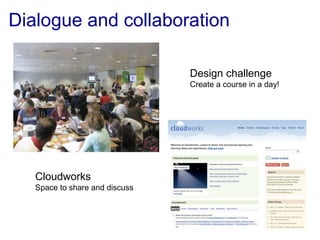
Dialogue and collaboration
Design challenge
Create a course in a day!
Cloudworks
Space to share and discuss
Cloudworks
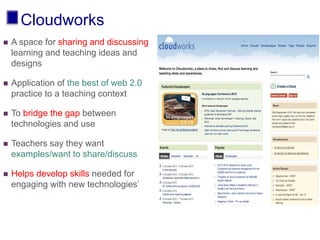
 A space for sharing and discussing
learning and teaching ideas and
designs
 Application of the best of web 2.0
practice to a teaching context
 To bridge the gap between
technologies and use
 Teachers say they want
examples/want to share/discuss
 Helps develop skills needed for
engaging with new technologies’
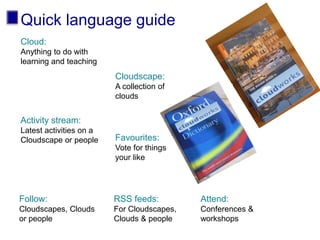
Quick language guide
Cloud:
Anything to do with
learning and teaching
Cloudscape:
A collection of
clouds
Activity stream:
Latest activities on a
Cloudscape or people Favourites:
Vote for things
your like
RSS feeds:
For Cloudscapes,
Clouds & people
Follow:
Cloudscapes, Clouds
or people
Attend:
Conferences &
workshops
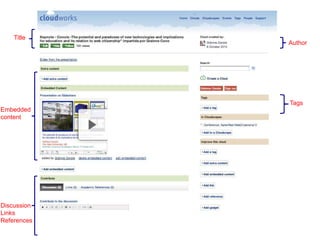
Embedded
content
Discussion
Links
References
Author
Tags
Title
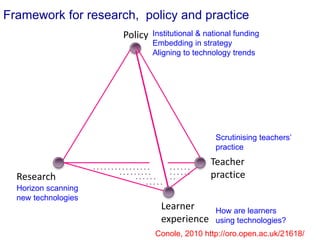
Policy
Teacher
practiceResearch
Learner
experience
Framework for research, policy and practice
Conole, 2010 http://oro.open.ac.uk/21618/
Institutional & national funding
Embedding in strategy
Aligning to technology trends
Horizon scanning
new technologies
Scrutinising teachers’
practice
How are learners
using technologies?
Final thoughts
 There will be an ongoing co-evolution of tools and use
 New digital literacies are needed for both teachers and learners
 There is a narrower but deeper digital divide
 We need to devise pathways for navigating an increasingly complex
digital landscape
 We need new language and metaphors to make sense of this
 Roles and structures are changing: learners, teachers, institutions
 We need a better link between research and policy and practice
 We need to develop a better theoretical basis for the field
We don’t know the future, but we can say this…

Connecting Research with Policy and Practice

  • 1.
    + Connecting research with policyand practice Gráinne Conole, Open University, UK EDEN research workshop Budapest, 25th October 2010 More info, slides and references: http://cloudworks.ac.uk/
  • 2.
    Outline  A frameworkfor linking research with policy & practice  Scrutinising the e-learning history line  lessons from the past  a glimpse into the future  Learners’ experience  Teacher practice  Bridging the gap between rhetoric and reality  Leaning Design  Open Educational Resources  Emergent themes and challenges
  • 3.
    Policy Teacher practiceResearch Learner experience Framework for research,policy and practice Conole, 2010 http://oro.open.ac.uk/21618/
  • 4.
    Scrutinising the e-learningtimeline Context Globalisation, networked society, changing societal norms, ICT advances UK: Dearing review of ICT Range of funded initiatives & support bodies US: Fragmented policy, driven by individuals and commercial imperative Education/Industry partnerships, spin offs, Open Educational Movement Impact Local culture vs global hegemony, changing roles & structures, commercial vs. government supported, dissemination and impact evaluation Policy Practice Drivers Widening participation, personalization, lifelong learning, quality assurance, developing the work force, commercial imperative Conole, (2007) in Andrews & Haythornwaite
  • 5.
  • 6.
    A typology ofnew technologies Technology Examples Media sharing Flckr, YouTube, Slideshare, Sketchfu Media manipulation and mash ups Geotagged photos on maps, Voicethread Instant messaging, chat, web 2.0 forums MSN, Paltalk, Arguementum Online games and virtual worlds WorldofWarcraft, SecondLife Social networking Facebook, Myspace, Linkedin, Elgg, Ning Blogging Wordpress, Edublog, Twitter Social bookmarking Del.icio.us, Citeulike, Zotero Recommender systems Digg, LastFm, Stumbleupon Wikis and collaborative editing tools Wikipedia, GoogleDocs, Bubbl.us Syndication/RSS feeds Bloglines, Podcast, GoogleReader (Conole and Alevizou, 2010), Review of Web 2.0 tools in Higher Education http://heacademy.ac.uk/assets/EvidenceNet/ConoleAlevizou2010.pdf
  • 7.
    A Associative Focus on individual Learningthrough association and reinforcement Constructivist Building on prior knowledge Task-orientated Situative Learning through social interaction Learning in context Connectivist Learning in a networked environment Pedagogies of e-learning Mayes & De Freitas, 2004 Conole 2010 cloudworks.ac.uk/cloud/view/2982 E-training Drill & practice Inquiry learning Resource-based Experiential, Problem-based Role play Reflective & dialogic learning, Personalised learning
  • 8.
    Some case studyexamples E-training, drill and practice Experiential, problem- based, role play Inquiry learning, resource-based learning Reflective and dialogic learning, Personalised learning Interactive materials, E-assessment Virtual worlds, Location aware devices, Online games Google, Media sharing repositories, User- generated content Blogs, RSS feeds, E-portfolios, Wikis, Social networks
  • 9.
    E-training, drill andpractice McNaught, 2010, Edmedia Keynote
  • 10.
  • 11.
    Inquiry-based learning The PersonalInquiry project Inquiry-based learning across formal and informal settings Sharples, Scanlon et al. http://www.pi-project.ac.uk/ My community
  • 12.
  • 13.
    Situated learning –virtual exhibitions Aims to develop proficient technical writing and design skills Cohort of 82 students created a movie poster of the film, Avatar Virtual exhibition in SecondLife What can avatars do? Virtual realities in collaborative learning Li et al., 2010, Edmedia conference Other examples: Archeological digs Medical wards Art exhibitions Cyber-law Virtual language exchange Beyond formal schooling
  • 14.
    Role-based learning Pheny andShun, 2009, Ascilite conference Wills et al., 2010
  • 15.
    Reflective and dialogiclearning Uses Blogs and E-portfolios for personal reflection Wikis/social bookmarking for aggregation Wikis for project-based work Cohort blogs for shared understanding Web 2.0 tool to connect beyond the course E-portfolios for aggregation and evidence Twitter for just-in-time learning Joyes, 2009, Ascilite conference
  • 16.
    Web pages Communication+ Interactivity A redefining ofwhat ICT means Blogs Wikis Virtual worlds, online games & immersive environments Social networking Twitter Google wave Media sharing Mash ups Email Forums Instant messaging Audio & video conferencing
  • 17.
    Co-evolution of toolsand practice Evolving practices Characteristics of users Preferences Skills Interests Context Affordances of technologies Reflection Dialogue Aggregation Interactivity Affordances (Gibson) ‘All "action possibilities" latent in an environmentt… but always in relation to the actor and therefore dependent on their capabilities.’ For instance, a tall tree offers the affordances of food for a Giraffe but not a sheep. Basic communications & gestures Symbolic representations (words, numbers) 1st wave technologies (phone, radio, fax, TV, CD/DVDs) 2nd wave technologies networks, mobiles, the Internet)
  • 18.
    Learners’ use oftechnologies  Immersed in technologies  Increasing use of Web 2.0 tools  Multiple channels for communication  Rich multiple representations of information  Just in time and peer learning  Outcomes focussed  Multiple career paths
  • 19.
    Teacher practice Paradoxes Technologies notfully exploited Little evidence of use of OER Predominance of ‘old practices’ Media sharing Blogs & wikis Reasons Technical, pedagogical, organisational… “Lack of time, research vs. teaching, lack of skills, no rewards, no support….” Solution… New approaches to designing for learning Virtual worlds & online games Social networking World of warcraft http://www.flickr.com/photos/shardsofblue/3981216281/
  • 20.
    Learning Design Shift frombelief-based, implicit approaches to design-based, explicit approaches Encourages reflective, scholarly practices Promotes sharing and discussion A design-based approach to creation and support of courses Andrew Brasher, Simon Cross, Juliette Culver, Rebecca Galley, Paul Mundin
  • 21.
    The learning designconcept wheel Resources Foundations Representation Dialogue & collaboration Learning Design taxonomy Mediating artefacts Affordances Excel template CompendiumLD Course views Cloudworks ’Design Challenge’ DialogPlus toolkit Phoebe planner Pedagogic planner
  • 22.
    Course views: conceptualand data-driven Course Map Learning Outcomes Task Swimlane Pedagogy Profile Course Dimensions Course Performance Cost effectiveness
  • 23.
    Guidance & Support Courseguide, study calendar, study planner, 20 learning guides, General assessment guidelines and assignments Tutor support: 1:20, 21 hours Reflection & Demonstration Journal space in the Mystuff e- portfolio, 6 assignments online (50% of overall score) Content & Activities 3 co-published books, DVDs of 3 practice settings, core questions, thinking points in course books Own experience and practice PDFs, e-journal articles & websites, activities in learning guides, 5 website interactivities Communication & Collaboration F-t-F tutorials near beginning, middle and end, Course-wide café forum, Tutor-group forums with sub-groups for each block Course summary KE312 - Working together with Children, 60 pt course over 32 weeks, 3 blocks/20 guides Whole weeks devoted to assignments Consolidation week (week 22) Key words Practice-related, aligned to latest professional framework for multi-agency working, rich cases Read-Relate to practice – Reflect - Write KE312 - Course map
  • 24.
    Pedagogy profile Learning ActivityTaxonomy - Conole, 2008 Map of learner tasks to time periods (weeks, semesters, etc.) 6 types of learner task + assessment Assimilative Information handling Communication Productive Experiential Adaptive Assessment Each cell indicates the amount of time spent on each type of task
  • 25.
    Course dimensions Guidance & Support Content& Activities Reflection & demonstration Communication & Collaboration
  • 26.
    Learning outcomes Mapping learningoutcomes to: Activities Assessment Based on Biggs’ work (1999) on constructive alignment Maps course and highlights any gaps
  • 27.
    Task swimlane Focus onthe tasks learners do Base on: Roles (learner, tutor, etc.) Tasks (read, discuss, etc.) Tools and resources Outputs Advantages Makes design explicit Maps out design Sharable with others Good at activity level Use Mind mapping tools – CompendiumLD, CMap, Freemind Pen, paper and stickers
  • 28.
    New forms ofdialogue & collaboration
  • 29.
    Dialogue and collaboration Designchallenge Create a course in a day! Cloudworks Space to share and discuss
  • 30.
    Cloudworks  A spacefor sharing and discussing learning and teaching ideas and designs  Application of the best of web 2.0 practice to a teaching context  To bridge the gap between technologies and use  Teachers say they want examples/want to share/discuss  Helps develop skills needed for engaging with new technologies’
  • 31.
    Quick language guide Cloud: Anythingto do with learning and teaching Cloudscape: A collection of clouds Activity stream: Latest activities on a Cloudscape or people Favourites: Vote for things your like RSS feeds: For Cloudscapes, Clouds & people Follow: Cloudscapes, Clouds or people Attend: Conferences & workshops
  • 32.
  • 33.
    Policy Teacher practiceResearch Learner experience Framework for research,policy and practice Conole, 2010 http://oro.open.ac.uk/21618/ Institutional & national funding Embedding in strategy Aligning to technology trends Horizon scanning new technologies Scrutinising teachers’ practice How are learners using technologies?
  • 34.
    Final thoughts  Therewill be an ongoing co-evolution of tools and use  New digital literacies are needed for both teachers and learners  There is a narrower but deeper digital divide  We need to devise pathways for navigating an increasingly complex digital landscape  We need new language and metaphors to make sense of this  Roles and structures are changing: learners, teachers, institutions  We need a better link between research and policy and practice  We need to develop a better theoretical basis for the field We don’t know the future, but we can say this…