
Scenarios  for Ubiquitous Cloud Learning Environments Jean-Marie Gilliot  Serge Garlatti Sylvain Laubé Find this presentation on /jm.gilliot
Few Claims
Why consider Digital Literacy ? A prerequisite …
For Creativity, Innovation,  Entrepreneurship, Leadership    in XXI th  Century Society
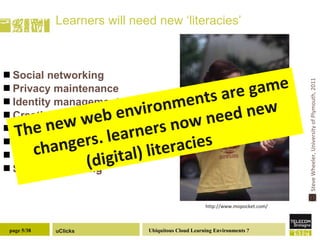
Learners will need new ‘literacies’ Social networking Privacy maintenance Identity management Creating content Organising content Reusing and repurposing Filtering and selecting Self broadcasting The new web environments are game changers. learners now need new (digital) literacies  http://www.mopocket.com/ Steve Wheeler, University of Plymouth, 2011
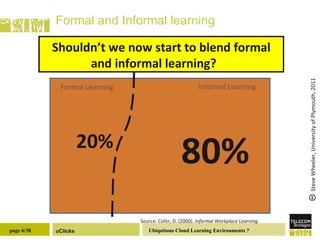
Formal and Informal learning Formal Learning Informal Learning 20% 80% Source: Cofer, D. (2000).  Informal Workplace Learning . Shouldn’t we now start to blend formal and informal learning?  Steve Wheeler, University of Plymouth, 2011
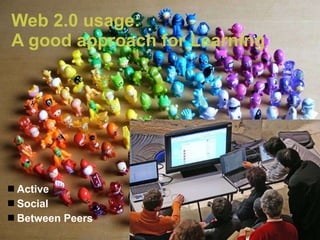
Web 2.0 usage:  A good approach for Learning   Active Social Between Peers
But … What are we doing? Yet Another Explanation: … Slideshare :  Web 2.0 Education : 8150 pages (12 pres/page) Web2 learning :  11248 pages If you want to view a good one: inquiry   based   learning   with  Web2.0
Limits … 1 Acting out : ”I’ll use technology in classroom, when I’ll master it better than my students!”   Issue: where to start?  Find the attainable activity for a specific teacher in her classroom
Limits… 2 Learn with web 2.0 Written Culture? Which basic information ? Don’t forget  Medias in the broad:  Pictures, sound, vids… What about real life? Our environment?
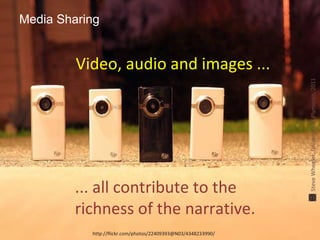
Media Sharing http://flickr.com/photos/22409393@N03/4348233990/ Video, audio and images ... ... all contribute to the richness of the narrative. Steve Wheeler, University of Plymouth, 2011
Mobile? Go-between Record its own traces, its lifestream Communicating,available, geo-localized device High equipment rate  Access to Information everywhere & at right time New interfaces:  augmented reality, QR-code, voice… Issues: Killer activities Get acceptance by teachers , and others
Limits… 3 Which tool(s)? Institutional LMS The tool I (teacher) choose, given my protocol Negociated Different tools for different activities Several tools and device Open choice (to learner)
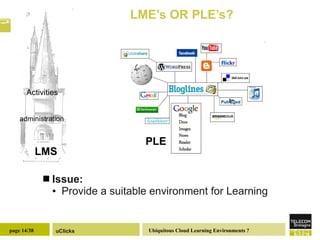
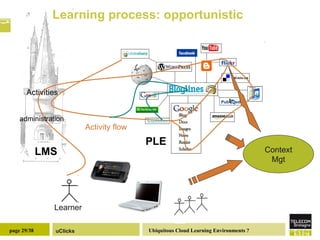
LME’s OR PLE’s? Issue: Provide a suitable environment for Learning LMS administration Activities PLE
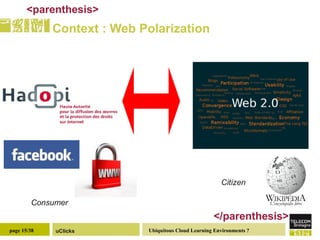
Context : Web Polarization  Consumer Citizen <parenthesis> </parenthesis>
Limits …4 Tutor’s Rôle CQFD (french reminder) To know what is happening To help learners Suggest ways, hints …  assessment Issues  Global view Recommandations  And learners as well
Issues in short… Educate teachers  Identify and disseminate the use of mobile  « Cloud » Open Environment Seamless global interactions
« scenarios » based approach
Context Teacher / researcher Communities of Practice Evolution thanks IBST Teaching practices  Digital literacy How to amplify the development of  “good” practices?
The case of  Inquiry Based Science Teaching  IBST Authentic and problem-based learning activities which are ill-defined and have several answers; A certain amount of experimental procedures, experiments and activities involving practical experience of equipment and including searching for information; Self regulated learning sequences where student autonomy is emphasized; Discursive argumentation and communication with peers (&quot;talking science&quot;).
Scenarios Not a fixed one  Paradigmatic example: Use case  Help to construct all possible Evolution hints Leave all possible degrees of freedom
Exploring rich scenario: IBST example  Vestige
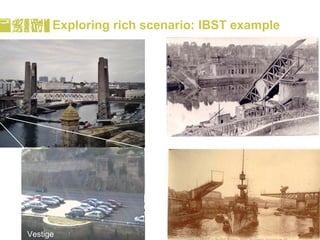
Original Scenario Historical reading and understanding of an industrial landscape  Photograph all elements of the current landscape with historical aspects about cranes and bridges of the arsenal, Locate the different elements on a current map of Brest, Identify and photograph the actual bridges and cranes linked existing bridges and cranes from previous: what continuities ? What ruptures? Store and publish information on the corresponding tools.
Problem Based Learning  Basic sequence in groups Problem analysis Activation of prior knowledge Acquire new knowledge Construct an argumented solution Solve the problem Institutionalization / discussion With options Data Sharing among groups  Peer reviews
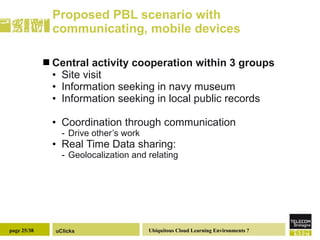
Proposed PBL scenario with  communicating, mobile devices Central activity cooperation within 3 groups  Site visit Information seeking in navy museum Information seeking in local public records Coordination through communication Drive other’s work Real Time Data sharing:  Geolocalization and relating
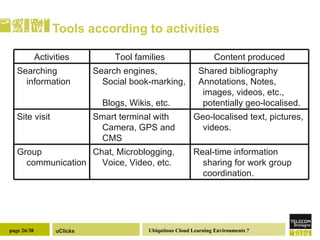
Tools according to activities Real-time information sharing for work group coordination. Chat, Microblogging, Voice, Video, etc. Group communication Geo-localised text, pictures, videos. Smart terminal with Camera, GPS and CMS Site visit Shared bibliography Annotations, Notes, images, videos, etc., potentially geo-localised. Search engines,  Social book-marking,  Blogs, Wikis, etc. Searching information Content produced Tool families Activities
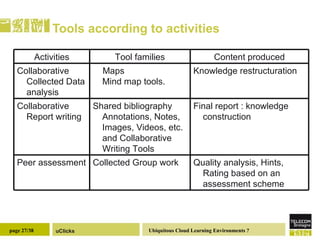
Tools according to activities Quality analysis, Hints, Rating based on an assessment scheme Collected Group work Peer assessment Final report : knowledge construction Shared bibliography Annotations, Notes, Images, Videos, etc. and Collaborative Writing Tools Collaborative Report writing Knowledge restructuration Maps  Mind map tools. Collaborative Collected Data analysis Content produced Tool families Activities
Cloud Learning Environment
Learning process: opportunistic LMS Activity flow administration Activities PLE Context Mgt Learner
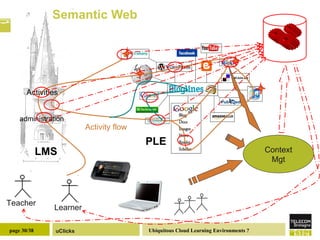
Semantic Web LMS Activity flow administration Activities PLE Context Mgt Learner Teacher
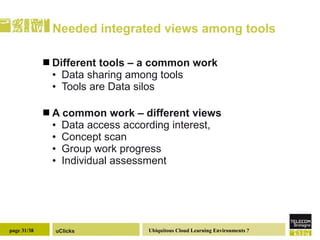
Needed integrated views among tools  Different tools – a common work Data sharing among tools Tools are Data silos A common work – different views Data access according interest,  Concept scan Group work progress  Individual assessment
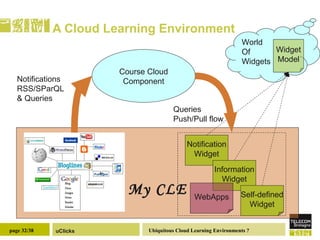
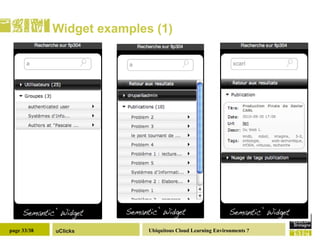
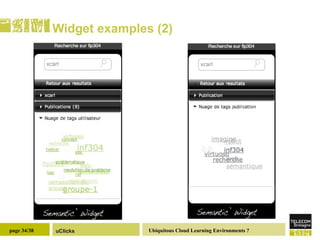
A Cloud Learning Environment My CLE Course Cloud Component Notifications RSS/SParQL & Queries Notification Widget Information Widget Self-defined Widget World Of Widgets Widget Model Queries Push/Pull flow WebApps
Widget examples (1)
Widget examples (2)
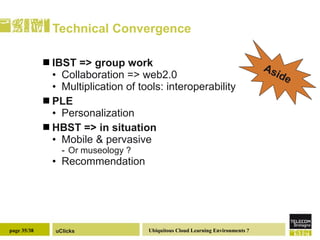
Technical Convergence IBST => group work  Collaboration => web2.0 Multiplication of tools: interoperability  PLE Personalization HBST => in situation  Mobile & pervasive Or museology ? Recommendation  Aside
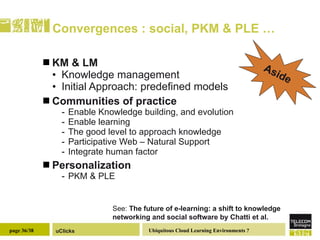
Convergences : social, PKM & PLE … KM & LM Knowledge management  Initial Approach: predefined models Communities of practice Enable Knowledge building, and evolution Enable learning  The good level to approach knowledge Participative Web – Natural Support  Integrate human factor Personalization PKM & PLE See:  The future of e-learning: a shift to knowledge networking and social software by Chatti et al. Aside
Conclusions  How to learn changes How to teach has to change Environnements have to be  the most flexible as possible
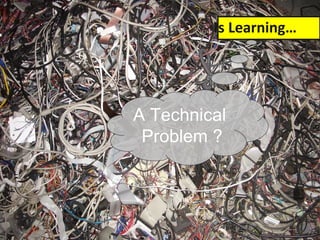
Is Learning…  A Technical  Problem ?
Credits Licence Creative Commons for all pictures, except Brest landscapes : Wires and cables..  jACK  TWO   http://www.flickr.com/photos/jacktwo/36511525/   Arguin penguins.  Adam Arroyo  :  http://www.flickr.com/photos/nouqraz/200049988/ Legos. Huladancer  http://www.flickr.com/photos/huladancer22/530743543/ Lego Speeder. Ella's Dad / Andy  http://www.flickr.com/photos/ellasdad/373339245/ …

ubiquitous Cloud Learning Environments

  • 1.
    Scenarios forUbiquitous Cloud Learning Environments Jean-Marie Gilliot Serge Garlatti Sylvain Laubé Find this presentation on /jm.gilliot
  • 2.
  • 3.
    Why consider DigitalLiteracy ? A prerequisite …
  • 4.
    For Creativity, Innovation, Entrepreneurship, Leadership in XXI th Century Society
  • 5.
    Learners will neednew ‘literacies’ Social networking Privacy maintenance Identity management Creating content Organising content Reusing and repurposing Filtering and selecting Self broadcasting The new web environments are game changers. learners now need new (digital) literacies http://www.mopocket.com/ Steve Wheeler, University of Plymouth, 2011
  • 6.
    Formal and Informallearning Formal Learning Informal Learning 20% 80% Source: Cofer, D. (2000). Informal Workplace Learning . Shouldn’t we now start to blend formal and informal learning? Steve Wheeler, University of Plymouth, 2011
  • 7.
    Web 2.0 usage: A good approach for Learning Active Social Between Peers
  • 8.
    But … Whatare we doing? Yet Another Explanation: … Slideshare : Web 2.0 Education : 8150 pages (12 pres/page) Web2 learning : 11248 pages If you want to view a good one: inquiry based learning with Web2.0
  • 9.
    Limits … 1Acting out : ”I’ll use technology in classroom, when I’ll master it better than my students!” Issue: where to start? Find the attainable activity for a specific teacher in her classroom
  • 10.
    Limits… 2 Learnwith web 2.0 Written Culture? Which basic information ? Don’t forget Medias in the broad: Pictures, sound, vids… What about real life? Our environment?
  • 11.
    Media Sharing http://flickr.com/photos/22409393@N03/4348233990/Video, audio and images ... ... all contribute to the richness of the narrative. Steve Wheeler, University of Plymouth, 2011
  • 12.
    Mobile? Go-between Recordits own traces, its lifestream Communicating,available, geo-localized device High equipment rate Access to Information everywhere & at right time New interfaces: augmented reality, QR-code, voice… Issues: Killer activities Get acceptance by teachers , and others
  • 13.
    Limits… 3 Whichtool(s)? Institutional LMS The tool I (teacher) choose, given my protocol Negociated Different tools for different activities Several tools and device Open choice (to learner)
  • 14.
    LME’s OR PLE’s?Issue: Provide a suitable environment for Learning LMS administration Activities PLE
  • 15.
    Context : WebPolarization Consumer Citizen <parenthesis> </parenthesis>
  • 16.
    Limits …4 Tutor’sRôle CQFD (french reminder) To know what is happening To help learners Suggest ways, hints … assessment Issues Global view Recommandations And learners as well
  • 17.
    Issues in short…Educate teachers Identify and disseminate the use of mobile « Cloud » Open Environment Seamless global interactions
  • 18.
  • 19.
    Context Teacher /researcher Communities of Practice Evolution thanks IBST Teaching practices Digital literacy How to amplify the development of “good” practices?
  • 20.
    The case of Inquiry Based Science Teaching IBST Authentic and problem-based learning activities which are ill-defined and have several answers; A certain amount of experimental procedures, experiments and activities involving practical experience of equipment and including searching for information; Self regulated learning sequences where student autonomy is emphasized; Discursive argumentation and communication with peers (&quot;talking science&quot;).
  • 21.
    Scenarios Not afixed one Paradigmatic example: Use case Help to construct all possible Evolution hints Leave all possible degrees of freedom
  • 22.
    Exploring rich scenario:IBST example Vestige
  • 23.
    Original Scenario Historicalreading and understanding of an industrial landscape Photograph all elements of the current landscape with historical aspects about cranes and bridges of the arsenal, Locate the different elements on a current map of Brest, Identify and photograph the actual bridges and cranes linked existing bridges and cranes from previous: what continuities ? What ruptures? Store and publish information on the corresponding tools.
  • 24.
    Problem Based Learning Basic sequence in groups Problem analysis Activation of prior knowledge Acquire new knowledge Construct an argumented solution Solve the problem Institutionalization / discussion With options Data Sharing among groups Peer reviews
  • 25.
    Proposed PBL scenariowith communicating, mobile devices Central activity cooperation within 3 groups Site visit Information seeking in navy museum Information seeking in local public records Coordination through communication Drive other’s work Real Time Data sharing: Geolocalization and relating
  • 26.
    Tools according toactivities Real-time information sharing for work group coordination. Chat, Microblogging, Voice, Video, etc. Group communication Geo-localised text, pictures, videos. Smart terminal with Camera, GPS and CMS Site visit Shared bibliography Annotations, Notes, images, videos, etc., potentially geo-localised. Search engines, Social book-marking, Blogs, Wikis, etc. Searching information Content produced Tool families Activities
  • 27.
    Tools according toactivities Quality analysis, Hints, Rating based on an assessment scheme Collected Group work Peer assessment Final report : knowledge construction Shared bibliography Annotations, Notes, Images, Videos, etc. and Collaborative Writing Tools Collaborative Report writing Knowledge restructuration Maps Mind map tools. Collaborative Collected Data analysis Content produced Tool families Activities
  • 28.
  • 29.
    Learning process: opportunisticLMS Activity flow administration Activities PLE Context Mgt Learner
  • 30.
    Semantic Web LMSActivity flow administration Activities PLE Context Mgt Learner Teacher
  • 31.
    Needed integrated viewsamong tools Different tools – a common work Data sharing among tools Tools are Data silos A common work – different views Data access according interest, Concept scan Group work progress Individual assessment
  • 32.
    A Cloud LearningEnvironment My CLE Course Cloud Component Notifications RSS/SParQL & Queries Notification Widget Information Widget Self-defined Widget World Of Widgets Widget Model Queries Push/Pull flow WebApps
  • 33.
  • 34.
  • 35.
    Technical Convergence IBST=> group work Collaboration => web2.0 Multiplication of tools: interoperability PLE Personalization HBST => in situation Mobile & pervasive Or museology ? Recommendation Aside
  • 36.
    Convergences : social,PKM & PLE … KM & LM Knowledge management Initial Approach: predefined models Communities of practice Enable Knowledge building, and evolution Enable learning The good level to approach knowledge Participative Web – Natural Support Integrate human factor Personalization PKM & PLE See: The future of e-learning: a shift to knowledge networking and social software by Chatti et al. Aside
  • 37.
    Conclusions Howto learn changes How to teach has to change Environnements have to be the most flexible as possible
  • 38.
    Is Learning… A Technical Problem ?
  • 39.
    Credits Licence CreativeCommons for all pictures, except Brest landscapes : Wires and cables.. jACK TWO http://www.flickr.com/photos/jacktwo/36511525/ Arguin penguins. Adam Arroyo : http://www.flickr.com/photos/nouqraz/200049988/ Legos. Huladancer http://www.flickr.com/photos/huladancer22/530743543/ Lego Speeder. Ella's Dad / Andy http://www.flickr.com/photos/ellasdad/373339245/ …

Editor's Notes

  • #5 First, we think it has to be taken into account a the syllabus level. The Web is a set of community spaces and communication tools that enable collaborative activities like discovering, exchanging, commenting, criticizing and building information. All that skills are prerequisite Image de soutien au discours DL is a now a fundamental component for …
  • #6 For Creativity, innovation, entrepreneurship All those skills exist in the CDIO list, but managing it in a digital environment is slightly different and has to be taken into account, as it is the pervasive environment of our XXIth Century society. As CAD, simulation and visualization tools have changed the way we design systems, Wikis and other social tools will change the way we imagine and conceive systems. Innovation is based on knowledge and collaboration. Internet is by no doubt the infrastructure for knowledge. So is Web2.0, or read write web, is the architecture of participation Slide suivant : Lego a plusieurs team group / project
  • #9 Secondly, we have noticed that the use of web tools like blogs, wikis and others helps students to engage themselves in learning. Use of such tools encourage exchange between students, going up to collaboration. You can see here an exercise where students have to present web 2.0 tools and usage to all people crossing the main hall of our school. We call it ExplorCamp ! pbe : passer de digital literacy à digital tools L’un renforce l’autre : 2 flèches
  • #16 Activities suggested But also: Chosen actvities Learner should be able to chose whether he includes or not some activities in his learning track E-portfolio Access through many devices – during different situations Context management shoudl help the student and propose some document, tool, activitiy, alternatives. Teacher may want to follow and asses some parts of learning process
  • #23 Vestige, remainder
  • #30 Activities proposed : -inscription – course space - resources reading – comments – additional resarch – discussion – data production Activities suggested Chosen actvities Access through many devices Context Teacher want to follow and asses some parts of way of learning
  • #31 Activities proposed : -inscription – course space - resources reading – comments – additional resarch – discussion – data production Activities suggested Chosen actvities Access through many devices Context Teacher want to follow and asses some parts of way of learning