The student experience How does it align with policy directives? Gráinne Conole [email_address] Eden Conference, Naples 15 th  June 2007
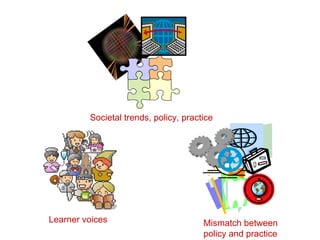
Mismatch between  policy and practice Societal trends, policy, practice Learner voices
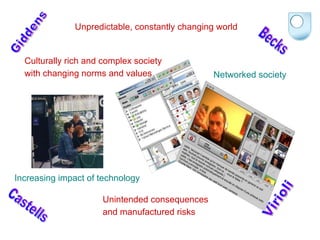
Culturally rich and complex society  with changing norms and values Unpredictable, constantly changing world Giddens Unintended consequences  and manufactured risks   Becks Virioli Increasing impact of technology Castells Networked society
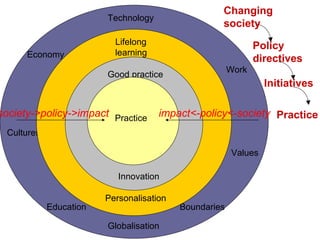
Work Education Technology Globalisation Cultures Economy Values Boundaries Changing society Personalisation Lifelong  learning Policy directives Good practice Innovation Initiatives Practice Practice society->policy->impact impact<-policy<-society
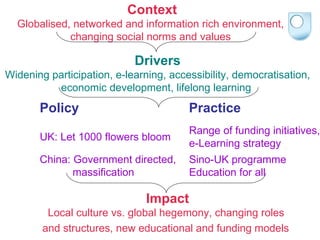
Context Globalised, networked and information rich environment,  changing social norms and values  Drivers Widening participation, e-learning, accessibility, democratisation, economic development, lifelong learning  Policy Practice UK: Let 1000 flowers bloom Range of funding initiatives,  e-Learning strategy China: Government directed,  massification Sino-UK programme Education for all Impact Local culture vs. global hegemony, changing roles  and structures, new educational and funding models
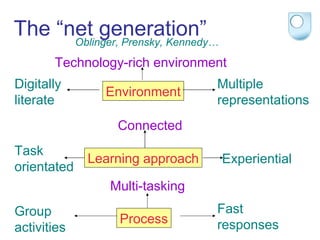
The “net generation” Oblinger, Prensky, Kennedy… Multi-tasking Technology-rich environment Multiple representations Group  activities Task  orientated Experiential   Fast  responses Digitally  literate Connected Environment Learning approach Process
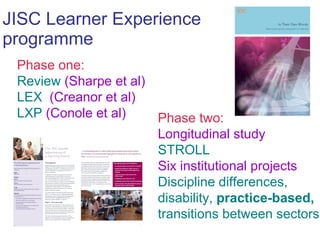
JISC Learner Experience  programme Phase one:  Review  (Sharpe et al) LEX  (Creanor et al) LXP  (Conole et al) Phase two: Longitudinal study STROLL  Six institutional projects Discipline differences,  disability,  practice-based,  transitions between sectors
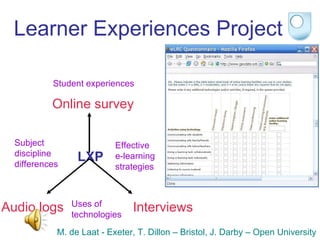
Learner Experiences Project LXP Student experiences Subject  discipline  differences Uses of  technologies Effective  e-learning  strategies M. de Laat - Exeter, T. Dillon – Bristol, J. Darby – Open University Online survey Audio logs Interviews
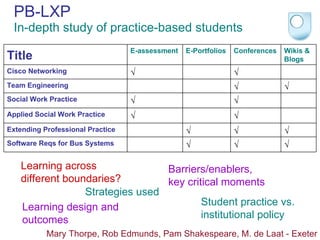
PB-LXP In-depth study of practice-based students Learning across  different boundaries? Strategies used  Barriers/enablers,  key critical moments Student practice vs.  institutional policy Mary Thorpe, Rob Edmunds, Pam Shakespeare, M. de Laat - Exeter Learning design and  outcomes √ √ √ Software Reqs for Bus Systems √ √ √ Extending Professional Practice √ √ Applied Social Work Practice √ √ Social Work Practice √ √ Team Engineering √ √ Cisco Networking Wikis & Blogs Conferences E-Portfolios E-assessment Title
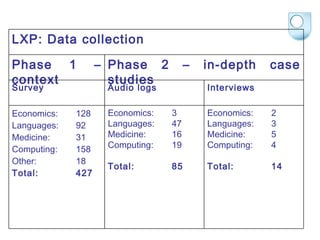
LXP: Data collection Economics:     2  Languages:     3 Medicine:        5  Computing: 4 Total: 14 Economics:     3 Languages:     47 Medicine:    16 Computing: 19 Total: 85 Economics: 128 Languages: 92 Medicine: 31 Computing: 158 Other: 18 Total: 427 Interviews Audio logs Survey Phase 2 – in-depth case studies Phase 1 – context
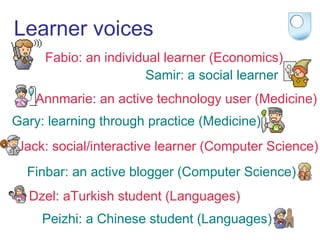
Learner voices Fabio: an individual learner (Economics) Samir: a social learner Annmarie: an active technology user (Medicine) Gary: learning through practice (Medicine) Jack: social/interactive learner (Computer Science) Finbar: an active blogger (Computer Science) Dzel: aTurkish student (Languages) Peizhi: a Chinese student (Languages)
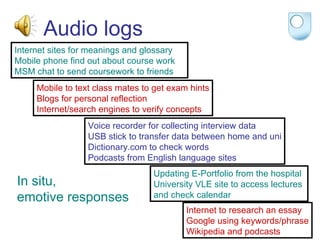
Audio logs Internet sites for meanings and glossary Mobile phone find out about course work MSM chat to send coursework to friends Mobile to text class mates to get exam hints Blogs for personal reflection Internet/search engines to verify concepts Internet to research an essay Google using keywords/phrase Wikipedia and podcasts Voice recorder for collecting interview data USB stick to transfer data between home and uni Dictionary.com to check words Podcasts from English language sites Updating E-Portfolio from the hospital University VLE site to access lectures  and check calendar In situ,  emotive responses
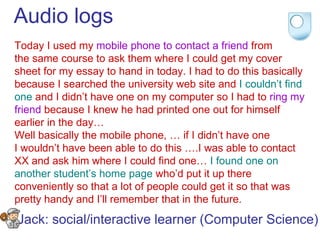
Audio logs Today I used my  mobile phone to contact a friend  from the same course to ask them where I could get my cover sheet for my essay to hand in today. I had to do this basically because I searched the university web site and  I couldn’t find one  and I didn’t have one on my computer so I had to  ring my friend  because I knew he had printed one out for himself earlier in the day…  Well basically the mobile phone, … if I didn’t have one  I wouldn’t have been able to do this ….I was able to contact  XX and ask him where I could find one…  I found one on  another student’s home page  who’d put it up there  conveniently so that a lot of people could get it so that was  pretty handy and I’ll remember that in the future.  Jack: social/interactive learner (Computer Science)
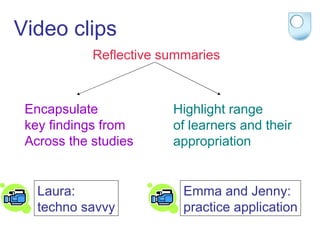
Video clips Reflective summaries Encapsulate  key findings from  Across the studies Highlight range  of learners and their  appropriation Laura:  techno savvy Emma and Jenny:  practice application
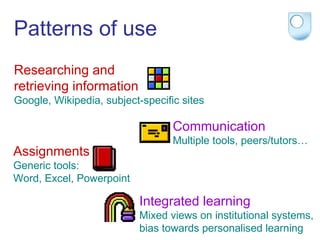
Patterns of use Researching and  retrieving information Google, Wikipedia, subject-specific sites Communication Multiple tools, peers/tutors… Assignments Generic tools:  Word, Excel, Powerpoint Integrated learning Mixed views on institutional systems,  bias towards personalised learning
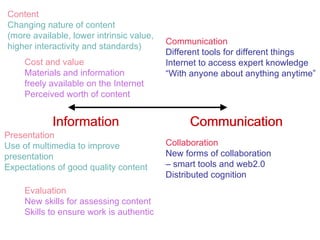
Content Changing nature of content  (more available, lower intrinsic value,  higher interactivity and standards) Cost and value Materials and information  freely available on the Internet Perceived worth of content Presentation Use of multimedia to improve presentation  Expectations of good quality content Evaluation New skills for assessing content  Skills to ensure work is authentic Communication Different tools for different things Internet to access expert knowledge  “ With anyone about anything anytime”   Collaboration New forms of collaboration  –  smart tools and web2.0 Distributed cognition Information Communication Information Communication
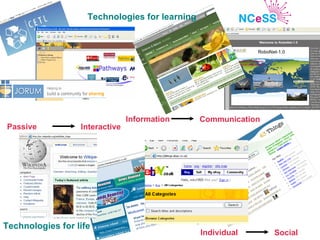
Technologies for learning Technologies for life Information   Communication Passive Interactive Individual Social
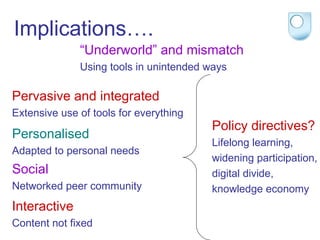
Implications…. Pervasive and integrated Extensive use of tools for everything Personalised Adapted to personal needs Social Networked peer community Interactive Content not fixed “ Underworld” and mismatch Using tools in unintended ways Policy directives? Lifelong learning,  widening participation,  digital divide,  knowledge economy
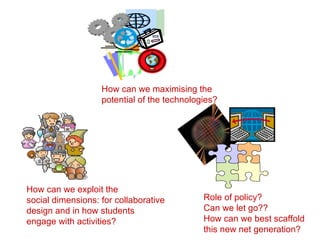
The macro and micro context How can we maximising the  potential of the technologies? Role of policy? Can we let go?? How can we best scaffold  this new net generation? How can we exploit the  social dimensions: for collaborative  design and in how students  engage with activities?
Further information JISC learner experiences programme www.jisc.ac.uk/elp_learneroutcomes.html  (phase one) www.jisc.ac.uk/whatwedo/programmes/elearning_pedagogy/elp_learnerexperience.aspx  (phase two) Conole, G. (forthcoming), ‘Relationship between policy and practice – the gap between rhetoric and reality’, in  The Sage Handbook of e-Learning Research,   E-learning Research Handbook,  pp 286-310, R. Andrews and C. Haythornthwaite (eds), London: Sage  Beetham, H., and Sharpe, R. (2007),  Rethinking pedagogy for a digital  age, H. Beetham and R. Sharpe (Eds), Oxford: RoutledgeFalmer. Conole, G. and Oliver, M. (eds.) (2007) Contemporary Perspectives in e-Learning Research: Themes, Tensions and Impact on Practice, Oxford: RoutledgeFalmer Oblinger, D. and Oblinger, J. (2005), Educating the Net Generation, Educause e-book

The student experience: How does it align with policy directives?

  • 1.
    The student experienceHow does it align with policy directives? Gráinne Conole [email_address] Eden Conference, Naples 15 th June 2007
  • 2.
    Mismatch between policy and practice Societal trends, policy, practice Learner voices
  • 3.
    Culturally rich andcomplex society with changing norms and values Unpredictable, constantly changing world Giddens Unintended consequences and manufactured risks Becks Virioli Increasing impact of technology Castells Networked society
  • 4.
    Work Education TechnologyGlobalisation Cultures Economy Values Boundaries Changing society Personalisation Lifelong learning Policy directives Good practice Innovation Initiatives Practice Practice society->policy->impact impact<-policy<-society
  • 5.
    Context Globalised, networkedand information rich environment, changing social norms and values Drivers Widening participation, e-learning, accessibility, democratisation, economic development, lifelong learning Policy Practice UK: Let 1000 flowers bloom Range of funding initiatives, e-Learning strategy China: Government directed, massification Sino-UK programme Education for all Impact Local culture vs. global hegemony, changing roles and structures, new educational and funding models
  • 6.
    The “net generation”Oblinger, Prensky, Kennedy… Multi-tasking Technology-rich environment Multiple representations Group activities Task orientated Experiential Fast responses Digitally literate Connected Environment Learning approach Process
  • 7.
    JISC Learner Experience programme Phase one: Review (Sharpe et al) LEX (Creanor et al) LXP (Conole et al) Phase two: Longitudinal study STROLL Six institutional projects Discipline differences, disability, practice-based, transitions between sectors
  • 8.
    Learner Experiences ProjectLXP Student experiences Subject discipline differences Uses of technologies Effective e-learning strategies M. de Laat - Exeter, T. Dillon – Bristol, J. Darby – Open University Online survey Audio logs Interviews
  • 9.
    PB-LXP In-depth studyof practice-based students Learning across different boundaries? Strategies used Barriers/enablers, key critical moments Student practice vs. institutional policy Mary Thorpe, Rob Edmunds, Pam Shakespeare, M. de Laat - Exeter Learning design and outcomes √ √ √ Software Reqs for Bus Systems √ √ √ Extending Professional Practice √ √ Applied Social Work Practice √ √ Social Work Practice √ √ Team Engineering √ √ Cisco Networking Wikis & Blogs Conferences E-Portfolios E-assessment Title
  • 10.
    LXP: Data collectionEconomics:    2 Languages:     3 Medicine:       5 Computing: 4 Total: 14 Economics:    3 Languages:     47 Medicine:    16 Computing: 19 Total: 85 Economics: 128 Languages: 92 Medicine: 31 Computing: 158 Other: 18 Total: 427 Interviews Audio logs Survey Phase 2 – in-depth case studies Phase 1 – context
  • 11.
    Learner voices Fabio:an individual learner (Economics) Samir: a social learner Annmarie: an active technology user (Medicine) Gary: learning through practice (Medicine) Jack: social/interactive learner (Computer Science) Finbar: an active blogger (Computer Science) Dzel: aTurkish student (Languages) Peizhi: a Chinese student (Languages)
  • 12.
    Audio logs Internetsites for meanings and glossary Mobile phone find out about course work MSM chat to send coursework to friends Mobile to text class mates to get exam hints Blogs for personal reflection Internet/search engines to verify concepts Internet to research an essay Google using keywords/phrase Wikipedia and podcasts Voice recorder for collecting interview data USB stick to transfer data between home and uni Dictionary.com to check words Podcasts from English language sites Updating E-Portfolio from the hospital University VLE site to access lectures and check calendar In situ, emotive responses
  • 13.
    Audio logs TodayI used my mobile phone to contact a friend from the same course to ask them where I could get my cover sheet for my essay to hand in today. I had to do this basically because I searched the university web site and I couldn’t find one and I didn’t have one on my computer so I had to ring my friend because I knew he had printed one out for himself earlier in the day… Well basically the mobile phone, … if I didn’t have one I wouldn’t have been able to do this ….I was able to contact XX and ask him where I could find one… I found one on another student’s home page who’d put it up there conveniently so that a lot of people could get it so that was pretty handy and I’ll remember that in the future. Jack: social/interactive learner (Computer Science)
  • 14.
    Video clips Reflectivesummaries Encapsulate key findings from Across the studies Highlight range of learners and their appropriation Laura: techno savvy Emma and Jenny: practice application
  • 15.
    Patterns of useResearching and retrieving information Google, Wikipedia, subject-specific sites Communication Multiple tools, peers/tutors… Assignments Generic tools: Word, Excel, Powerpoint Integrated learning Mixed views on institutional systems, bias towards personalised learning
  • 16.
    Content Changing natureof content (more available, lower intrinsic value, higher interactivity and standards) Cost and value Materials and information freely available on the Internet Perceived worth of content Presentation Use of multimedia to improve presentation Expectations of good quality content Evaluation New skills for assessing content Skills to ensure work is authentic Communication Different tools for different things Internet to access expert knowledge “ With anyone about anything anytime” Collaboration New forms of collaboration – smart tools and web2.0 Distributed cognition Information Communication Information Communication
  • 17.
    Technologies for learningTechnologies for life Information Communication Passive Interactive Individual Social
  • 18.
    Implications…. Pervasive andintegrated Extensive use of tools for everything Personalised Adapted to personal needs Social Networked peer community Interactive Content not fixed “ Underworld” and mismatch Using tools in unintended ways Policy directives? Lifelong learning, widening participation, digital divide, knowledge economy
  • 19.
    The macro andmicro context How can we maximising the potential of the technologies? Role of policy? Can we let go?? How can we best scaffold this new net generation? How can we exploit the social dimensions: for collaborative design and in how students engage with activities?
  • 20.
    Further information JISClearner experiences programme www.jisc.ac.uk/elp_learneroutcomes.html (phase one) www.jisc.ac.uk/whatwedo/programmes/elearning_pedagogy/elp_learnerexperience.aspx (phase two) Conole, G. (forthcoming), ‘Relationship between policy and practice – the gap between rhetoric and reality’, in The Sage Handbook of e-Learning Research, E-learning Research Handbook, pp 286-310, R. Andrews and C. Haythornthwaite (eds), London: Sage Beetham, H., and Sharpe, R. (2007), Rethinking pedagogy for a digital age, H. Beetham and R. Sharpe (Eds), Oxford: RoutledgeFalmer. Conole, G. and Oliver, M. (eds.) (2007) Contemporary Perspectives in e-Learning Research: Themes, Tensions and Impact on Practice, Oxford: RoutledgeFalmer Oblinger, D. and Oblinger, J. (2005), Educating the Net Generation, Educause e-book

Editor's Notes

  • #2 It’s a rather a daunting proposition having to do an inaugural as it is difficult to know how to pitch it and it feels as if you are leaving your research philosophy very much bear. Also should one describe some in depth research or a broad overview? I have decided to opt for the latter. What I hope to do in this talk is three things. Firstly, I hope I can share with you my passion for this area of research and show you why I think it is such an exciting area to be working in. Secondly, I hope to be able to demonstrate why this is an important area, highlighting ways in which it is impacting on policy and practice. Thirdly, I would like to give you a snapshot of some of my current research interests.