Digital experiences in
technical higher education
Using remote and virtual labs in technical higher education
INSTITUTO SUPERIOR DE ENGENHARIA DO PORTO
Polytechnic of Porto – School of Engineering
• Hands-on, Virtual Labs and Remote Labs
• Trends in Engineering Education
• The Fundamental Objectives of Engineering Instructional Laboratories
• Remote and Virtual Labs as Teaching and Learning Environments
• Virtual Instrument Systems in Reality (VISIR)
• Example: supporting teaching & learning activities in the area of
electrical and electronic circuits with a remote and a virtual lab
Outline
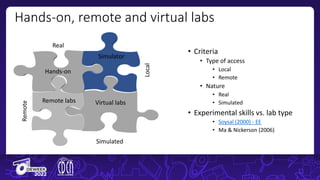
Hands-on, remote and virtual labs
• Criteria
• Type of access
• Local
• Remote
• Nature
• Real
• Simulated
• Experimental skills vs. lab type
• Soysal (2000) - EE
• Ma & Nickerson (2006)
Simulator
Remote labs
Hands-on
Virtual labs
Real
Local
Simulated
• Froyd, J.E.; Wankat, P.C., Smith, K.A.; Five Major Shifts in 100 Years of Engineering
Education, Proceedings of the IEEE, Vol. 100, pp. 1344-1360, May 13th, 2012
• Adams Becker, S., Cummins, M., Davis, A., Freeman, A., Hall Giesinger, C., and
Ananthanarayanan, V. (2017). NMC Horizon Report: 2017 Higher Education
Edition. Austin, Texas: The New Media Consortium. [online]
http://cdn.nmc.org/media/2017-nmc-horizon-report-he-EN.pdf
• Ruth Graham, The Global State of the Art in Engineering Education, MIT, March
2018. ISBN 13: 9780692089200
Trends in Engineering Education
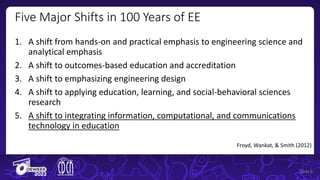
Five Major Shifts in 100 Years of EE
1. A shift from hands-on and practical emphasis to engineering science and
analytical emphasis
2. A shift to outcomes-based education and accreditation
3. A shift to emphasizing engineering design
4. A shift to applying education, learning, and social-behavioral sciences
research
5. A shift to integrating information, computational, and communications
technology in education
Froyd, Wankat, & Smith (2012)
Slide 6
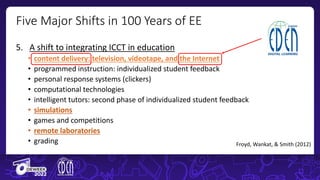
Five Major Shifts in 100 Years of EE
5. A shift to integrating ICCT in education
• content delivery: television, videotape, and the Internet
• programmed instruction: individualized student feedback
• personal response systems (clickers)
• computational technologies
• intelligent tutors: second phase of individualized student feedback
• simulations
• games and competitions
• remote laboratories
• grading Froyd, Wankat, & Smith (2012)
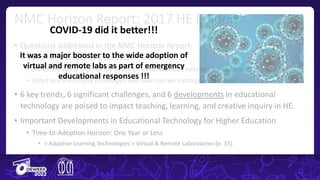
• Questions addressed in the NMC Horizon Report:
• What is on the five-year horizon for HEIs?
• Which trends & technology developments will drive educational change?
• What are the critical challenges and how can we strategize solutions?
• 6 key trends, 6 significant challenges, and 6 developments in educational
technology are poised to impact teaching, learning, and creative inquiry in HE
• Important Developments in Educational Technology for Higher Education
• Time-to-Adoption Horizon: One Year or Less
• > Adaptive Learning Technologies > Virtual & Remote Laboratories (p. 37).
NMC Horizon Report: 2017 HE Edition
• Questions addressed in the NMC Horizon Report:
• What is on the five-year horizon for HEIs?
• Which trends & technology developments will drive educational change?
• What are the critical challenges and how can we strategize solutions?
• 6 key trends, 6 significant challenges, and 6 developments in educational
technology are poised to impact teaching, learning, and creative inquiry in HE.
• Important Developments in Educational Technology for Higher Education
• Time-to-Adoption Horizon: One Year or Less
• > Adaptive Learning Technologies > Virtual & Remote Laboratories (p. 37).
NMC Horizon Report: 2017 HE Edition
COVID-19 did it better!!!
It was a major booster to the wide adoption of
virtual and remote labs as part of emergency
educational responses !!!
The Fundamental Objectives of
Engineering Instructional Laboratories
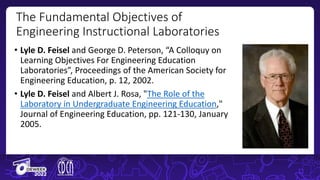
• Lyle D. Feisel and George D. Peterson, “A Colloquy on
Learning Objectives For Engineering Education
Laboratories”, Proceedings of the American Society for
Engineering Education, p. 12, 2002.
• Lyle D. Feisel and Albert J. Rosa, "The Role of the
Laboratory in Undergraduate Engineering Education,"
Journal of Engineering Education, pp. 121-130, January
2005.
Objective 1: Instrumentation
Apply appropriate sensors, instrumentation, and/or software tools to make
measurements of physical quantities.
Objective 2: Models
Identify the strengths and limitations of theoretical models as predictors of real-world
behaviours. This may include evaluating whether a theory adequately describes a
physical event and establishing or validating a relationship between measured data
and underlying physical principles.
The (thirteen) Fundamental Objectives of
Engineering Instructional Laboratories
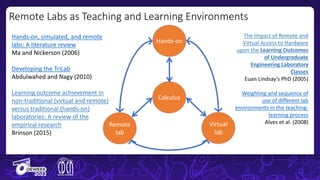
Calculus
Virtual
lab
Remote
lab
Hands-on
Hands-on, simulated, and remote
labs: A literature review
Ma and Nickerson (2006)
Developing the TriLab
Abdulwahed and Nagy (2010)
Learning outcome achievement in
non-traditional (virtual and remote)
versus traditional (hands-on)
laboratories: A review of the
empirical research
Brinson (2015)
The Impact of Remote and
Virtual Access to Hardware
upon the Learning Outcomes
of Undergraduate
Engineering Laboratory
Classes
Euan Lindsay’s PhD (2005)
Weighting and sequence of
use of different lab
environments in the teaching-
learning process
Alves et al. (2008)
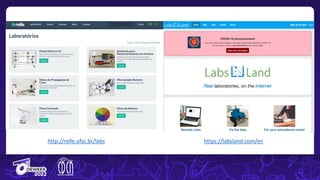
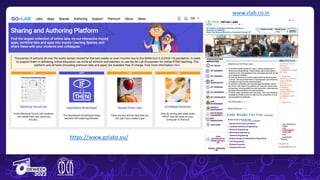
Remote Labs as Teaching and Learning Environments
http://relle.ufsc.br/labs https://labsland.com/en
https://www.golabz.eu/
www.vlab.co.in
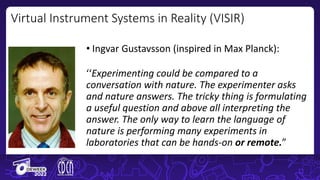
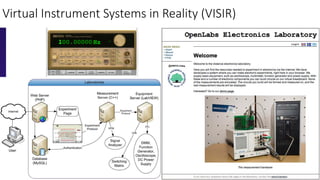
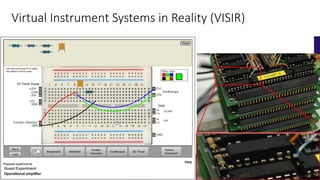
Virtual Instrument Systems in Reality (VISIR)
• Ingvar Gustavsson (inspired in Max Planck):
‘‘Experimenting could be compared to a
conversation with nature. The experimenter asks
and nature answers. The tricky thing is formulating
a useful question and above all interpreting the
answer. The only way to learn the language of
nature is performing many experiments in
laboratories that can be hands-on or remote.”
Virtual Instrument Systems in Reality (VISIR)
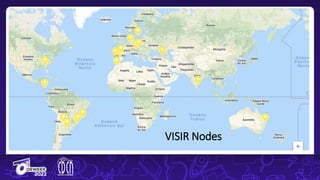
VISIR Nodes
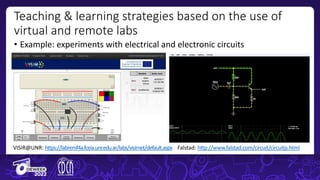
Teaching & learning strategies based on the use of
virtual and remote labs
• Example: experiments with electrical and electronic circuits
VISIR@UNR: https://labremf4a.fceia.unr.edu.ar/labs/visirnet/default.aspx Falstad: http://www.falstad.com/circuit/circuitjs.html
www.isep.ipp.pt
Thanks for
your
attention !

Digital experiences in technical higher education

  • 1.
    Digital experiences in technicalhigher education Using remote and virtual labs in technical higher education
  • 2.
    INSTITUTO SUPERIOR DEENGENHARIA DO PORTO Polytechnic of Porto – School of Engineering
  • 3.
    • Hands-on, VirtualLabs and Remote Labs • Trends in Engineering Education • The Fundamental Objectives of Engineering Instructional Laboratories • Remote and Virtual Labs as Teaching and Learning Environments • Virtual Instrument Systems in Reality (VISIR) • Example: supporting teaching & learning activities in the area of electrical and electronic circuits with a remote and a virtual lab Outline
  • 4.
    Hands-on, remote andvirtual labs • Criteria • Type of access • Local • Remote • Nature • Real • Simulated • Experimental skills vs. lab type • Soysal (2000) - EE • Ma & Nickerson (2006) Simulator Remote labs Hands-on Virtual labs Real Local Simulated
  • 5.
    • Froyd, J.E.;Wankat, P.C., Smith, K.A.; Five Major Shifts in 100 Years of Engineering Education, Proceedings of the IEEE, Vol. 100, pp. 1344-1360, May 13th, 2012 • Adams Becker, S., Cummins, M., Davis, A., Freeman, A., Hall Giesinger, C., and Ananthanarayanan, V. (2017). NMC Horizon Report: 2017 Higher Education Edition. Austin, Texas: The New Media Consortium. [online] http://cdn.nmc.org/media/2017-nmc-horizon-report-he-EN.pdf • Ruth Graham, The Global State of the Art in Engineering Education, MIT, March 2018. ISBN 13: 9780692089200 Trends in Engineering Education
  • 6.
    Five Major Shiftsin 100 Years of EE 1. A shift from hands-on and practical emphasis to engineering science and analytical emphasis 2. A shift to outcomes-based education and accreditation 3. A shift to emphasizing engineering design 4. A shift to applying education, learning, and social-behavioral sciences research 5. A shift to integrating information, computational, and communications technology in education Froyd, Wankat, & Smith (2012) Slide 6
  • 7.
    Five Major Shiftsin 100 Years of EE 5. A shift to integrating ICCT in education • content delivery: television, videotape, and the Internet • programmed instruction: individualized student feedback • personal response systems (clickers) • computational technologies • intelligent tutors: second phase of individualized student feedback • simulations • games and competitions • remote laboratories • grading Froyd, Wankat, & Smith (2012)
  • 8.
    • Questions addressedin the NMC Horizon Report: • What is on the five-year horizon for HEIs? • Which trends & technology developments will drive educational change? • What are the critical challenges and how can we strategize solutions? • 6 key trends, 6 significant challenges, and 6 developments in educational technology are poised to impact teaching, learning, and creative inquiry in HE • Important Developments in Educational Technology for Higher Education • Time-to-Adoption Horizon: One Year or Less • > Adaptive Learning Technologies > Virtual & Remote Laboratories (p. 37). NMC Horizon Report: 2017 HE Edition
  • 9.
    • Questions addressedin the NMC Horizon Report: • What is on the five-year horizon for HEIs? • Which trends & technology developments will drive educational change? • What are the critical challenges and how can we strategize solutions? • 6 key trends, 6 significant challenges, and 6 developments in educational technology are poised to impact teaching, learning, and creative inquiry in HE. • Important Developments in Educational Technology for Higher Education • Time-to-Adoption Horizon: One Year or Less • > Adaptive Learning Technologies > Virtual & Remote Laboratories (p. 37). NMC Horizon Report: 2017 HE Edition COVID-19 did it better!!! It was a major booster to the wide adoption of virtual and remote labs as part of emergency educational responses !!!
  • 10.
    The Fundamental Objectivesof Engineering Instructional Laboratories • Lyle D. Feisel and George D. Peterson, “A Colloquy on Learning Objectives For Engineering Education Laboratories”, Proceedings of the American Society for Engineering Education, p. 12, 2002. • Lyle D. Feisel and Albert J. Rosa, "The Role of the Laboratory in Undergraduate Engineering Education," Journal of Engineering Education, pp. 121-130, January 2005.
  • 11.
    Objective 1: Instrumentation Applyappropriate sensors, instrumentation, and/or software tools to make measurements of physical quantities. Objective 2: Models Identify the strengths and limitations of theoretical models as predictors of real-world behaviours. This may include evaluating whether a theory adequately describes a physical event and establishing or validating a relationship between measured data and underlying physical principles. The (thirteen) Fundamental Objectives of Engineering Instructional Laboratories
  • 12.
    Calculus Virtual lab Remote lab Hands-on Hands-on, simulated, andremote labs: A literature review Ma and Nickerson (2006) Developing the TriLab Abdulwahed and Nagy (2010) Learning outcome achievement in non-traditional (virtual and remote) versus traditional (hands-on) laboratories: A review of the empirical research Brinson (2015) The Impact of Remote and Virtual Access to Hardware upon the Learning Outcomes of Undergraduate Engineering Laboratory Classes Euan Lindsay’s PhD (2005) Weighting and sequence of use of different lab environments in the teaching- learning process Alves et al. (2008) Remote Labs as Teaching and Learning Environments
  • 13.
  • 14.
  • 15.
    Virtual Instrument Systemsin Reality (VISIR) • Ingvar Gustavsson (inspired in Max Planck): ‘‘Experimenting could be compared to a conversation with nature. The experimenter asks and nature answers. The tricky thing is formulating a useful question and above all interpreting the answer. The only way to learn the language of nature is performing many experiments in laboratories that can be hands-on or remote.”
  • 16.
    Virtual Instrument Systemsin Reality (VISIR)
  • 17.
    Virtual Instrument Systemsin Reality (VISIR)
  • 18.
  • 19.
    Teaching & learningstrategies based on the use of virtual and remote labs • Example: experiments with electrical and electronic circuits VISIR@UNR: https://labremf4a.fceia.unr.edu.ar/labs/visirnet/default.aspx Falstad: http://www.falstad.com/circuit/circuitjs.html
  • 20.