+
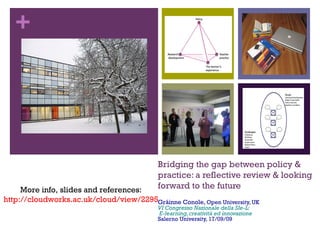
Bridging the gap between policy &
practice: a reflective review & looking
forward to the future
Gráinne Conole, Open University, UK
VI Congresso Nazionale della SIe-L:
E-learning,creatività ed innovazione
Salerno University, 17/09/09
More info, slides and references:
http://cloudworks.ac.uk/cloud/view/2295
+ Outline
 Scrutinising the e-learning history line
 lessons from the past
 a glimpse into the future
 Emergent themes and challenges
 A framework for making policy work
 Illustrative case studies
 Reflections and questions for the future
+Key focus
 Is there a gap between e-learning policy and
actual practice?
 How can we bridge the gap?
 Does e-learning policy adequate reflect current
technological advances
 If not how can we ensure it does?
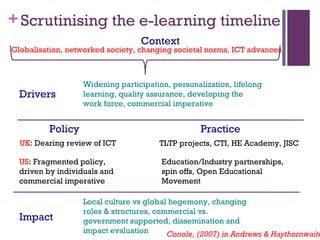
+Scrutinising the e-learning timeline
Context
Globalisation, networked society, changing societal norms, ICT advances
UK: Dearing review of ICT TLTP projects, CTI, HE Academy, JISC
US: Fragmented policy,
driven by individuals and
commercial imperative
Education/Industry partnerships,
spin offs, Open Educational
Movement
Impact
Local culture vs global hegemony, changing
roles & structures, commercial vs.
government supported, dissemination and
impact evaluation
Policy Practice
Drivers
Widening participation, personalization, lifelong
learning, quality assurance, developing the
work force, commercial imperative
Conole, (2007) in Andrews & Haythornwaite
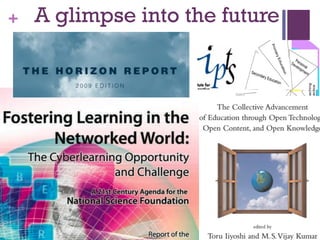
+ A glimpse into the future
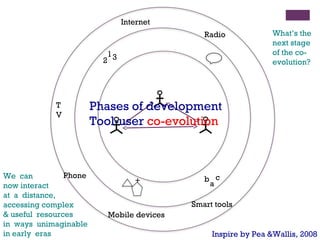
1
2 3
b
a
c+
Inspire by Pea &Wallis, 2008
We can
now interact
at a distance,
accessing complex
& useful resources
in ways unimaginable
in early eras
What’s the
next stage
of the co-
evolution?
Phases of development
Tool-user co-evolution
Internet
Mobile devices
T
V
Radio
Smart tools
Phone
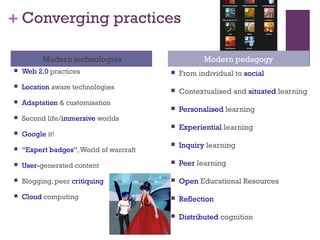
+ Converging practices
Modern technologies Modern pedagogy
 Web 2.0 practices
 Location aware technologies
 Adaptation & customisation
 Second life/immersive worlds
 Google it!
 “Expert badges”,World of warcraft
 User-generated content
 Blogging, peer critiquing
 Cloud computing
 From individual to social
 Contextualised and situated learning
 Personalised learning
 Experiential learning
 Inquiry learning
 Peer learning
 Open Educational Resources
 Reflection
 Distributed cognition
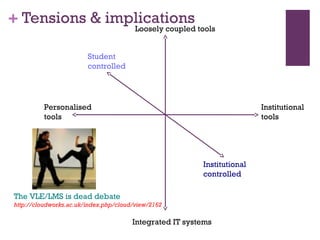
+ Loosely coupled tools
Integrated IT systems
Personalised
tools
Institutional
tools
Student
controlled
Institutional
controlled
Tensions & implications
The VLE/LMS is dead debate
http://cloudworks.ac.uk/index.php/cloud/view/2162
+
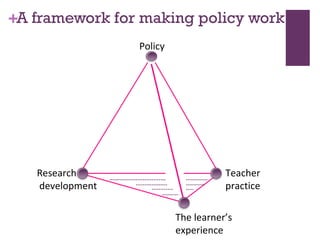
Policy
Teacher
practice
Research &
development
The learner’s
experience
A framework for making policy work
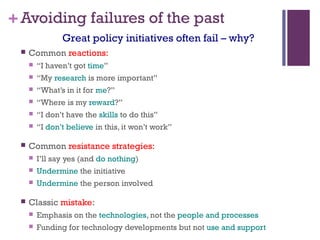
+Avoiding failures of the past
 Common reactions:
 “I haven’t got time”
 “My research is more important”
 “What’s in it for me?”
 “Where is my reward?”
 “I don’t have the skills to do this”
 “I don’t believe in this, it won’t work”
 Common resistance strategies:
 I’ll say yes (and do nothing)
 Undermine the initiative
 Undermine the person involved
 Classic mistake:
 Emphasis on the technologies, not the people and processes
 Funding for technology developments but not use and support
Great policy initiatives often fail – why?
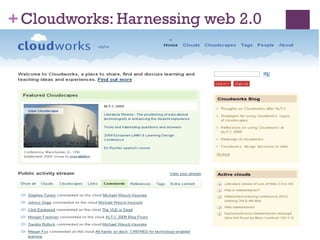
+Cloudworks: Harnessing web 2.0
+
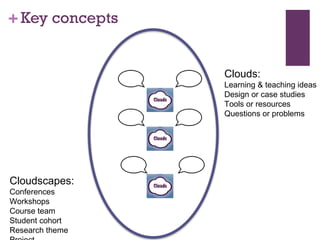
Clouds:
Learning & teaching ideas
Design or case studies
Tools or resources
Questions or problems
Cloudscapes:
Conferences
Workshops
Course team
Student cohort
Research theme
Key concepts
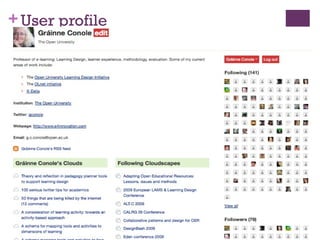
+User profile
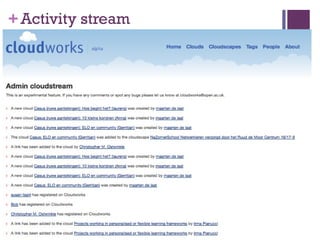
+Activity stream
+
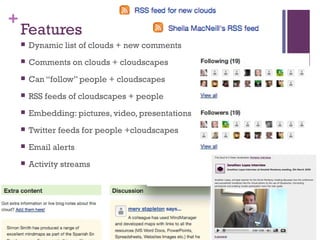
Features
 Dynamic list of clouds + new comments
 Comments on clouds + cloudscapes
 Can “follow” people + cloudscapes
 RSS feeds of cloudscapes + people
 Embedding: pictures, video, presentations
 Twitter feeds for people +cloudscapes
 Email alerts
 Activity streams
+Emergent patterns of use
 Events: conferences and workshops
 ALT-C conference, 8-11th
September 2009
 http://cloudworks.ac.uk/index.php/cloudscape/view/1870
 Discussions: Flash debates
 Is Twitter killing blogging?
 http://cloudworks.ac.uk/index.php/cloud/view/2266
 Eliciting expertise
 Literature review of educational technologist
 http://cloudworks.ac.uk/index.php/cloudscape/view/1872
 Aggregating resources
 En Rumbo Spanish course
 http://cloudworks.ac.uk/index.php/cloudscape/view/776
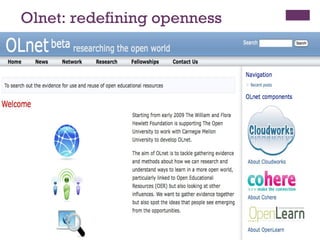
Olnet: redefining openness
+
A definition
The open provision of educational
resources, enabled by information and
communication technologies, for
consultation, use and adaptation by a
community of users for non-commercial
purposes
(UNESCO 2002)
+
A broader definition of OER
Learning resources
Courseware, content modules, learning objects, learner support
& assessment tools, online learning communities
Resources to support teachers
Tools for teachers and support materials to enable them to
create, adapt and use OER; training materials for teachers
Resources to assure the quality of education and educational
practices
(UNESCO 2004)
+
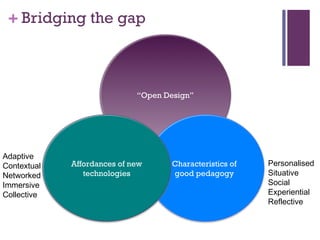
“Open Design”
Characteristics of
good pedagogy
Affordances of new
technologies
Bridging the gap
Personalised
Situative
Social
Experiential
Reflective
Adaptive
Contextual
Networked
Immersive
Collective
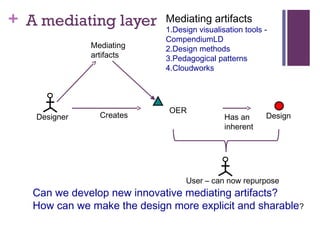
+ A mediating layer
Designer DesignHas an
inherent
OER
Creates
Mediating
artifacts
Mediating artifacts
1.Design visualisation tools -
CompendiumLD
2.Design methods
3.Pedagogical patterns
4.Cloudworks
Can we develop new innovative mediating artifacts?
How can we make the design more explicit and sharable?
User – can now repurpose
+
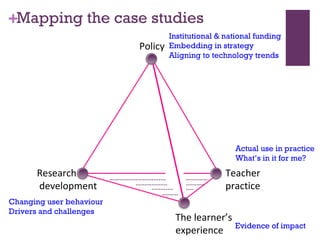
Policy
Research &
development
Teacher
practice
The learner’s
experience
Mapping the case studies
Institutional & national funding
Embedding in strategy
Aligning to technology trends
Changing user behaviour
Drivers and challenges
Actual use in practice
What’s in it for me?
Evidence of impact
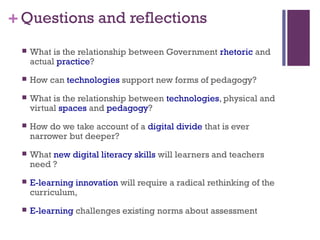
+Questions and reflections
 What is the relationship between Government rhetoric and
actual practice?
 How can technologies support new forms of pedagogy?
 What is the relationship between technologies, physical and
virtual spaces and pedagogy?
 How do we take account of a digital divide that is ever
narrower but deeper?
 What new digital literacy skills will learners and teachers
need ?
 E-learning innovation will require a radical rethinking of the
curriculum,
 E-learning challenges existing norms about assessment
+
Bridging the gap between policy &
practice: a reflective review & looking
forward to the future
Gráinne Conole, Open University, UK
VI Congresso Nazionale della SIe-L:
E-learning,creatività ed innovazione
Salerno University, 17/09/09
More info, slides and references:
http://cloudworks.ac.uk/cloud/view/2295

Conole Salerno

  • 1.
    + Bridging the gapbetween policy & practice: a reflective review & looking forward to the future Gráinne Conole, Open University, UK VI Congresso Nazionale della SIe-L: E-learning,creatività ed innovazione Salerno University, 17/09/09 More info, slides and references: http://cloudworks.ac.uk/cloud/view/2295
  • 2.
    + Outline  Scrutinisingthe e-learning history line  lessons from the past  a glimpse into the future  Emergent themes and challenges  A framework for making policy work  Illustrative case studies  Reflections and questions for the future
  • 3.
    +Key focus  Isthere a gap between e-learning policy and actual practice?  How can we bridge the gap?  Does e-learning policy adequate reflect current technological advances  If not how can we ensure it does?
  • 4.
    +Scrutinising the e-learningtimeline Context Globalisation, networked society, changing societal norms, ICT advances UK: Dearing review of ICT TLTP projects, CTI, HE Academy, JISC US: Fragmented policy, driven by individuals and commercial imperative Education/Industry partnerships, spin offs, Open Educational Movement Impact Local culture vs global hegemony, changing roles & structures, commercial vs. government supported, dissemination and impact evaluation Policy Practice Drivers Widening participation, personalization, lifelong learning, quality assurance, developing the work force, commercial imperative Conole, (2007) in Andrews & Haythornwaite
  • 5.
    + A glimpseinto the future
  • 6.
    1 2 3 b a c+ Inspire byPea &Wallis, 2008 We can now interact at a distance, accessing complex & useful resources in ways unimaginable in early eras What’s the next stage of the co- evolution? Phases of development Tool-user co-evolution Internet Mobile devices T V Radio Smart tools Phone
  • 7.
    + Converging practices Moderntechnologies Modern pedagogy  Web 2.0 practices  Location aware technologies  Adaptation & customisation  Second life/immersive worlds  Google it!  “Expert badges”,World of warcraft  User-generated content  Blogging, peer critiquing  Cloud computing  From individual to social  Contextualised and situated learning  Personalised learning  Experiential learning  Inquiry learning  Peer learning  Open Educational Resources  Reflection  Distributed cognition
  • 8.
    + Loosely coupledtools Integrated IT systems Personalised tools Institutional tools Student controlled Institutional controlled Tensions & implications The VLE/LMS is dead debate http://cloudworks.ac.uk/index.php/cloud/view/2162
  • 9.
  • 10.
    +Avoiding failures ofthe past  Common reactions:  “I haven’t got time”  “My research is more important”  “What’s in it for me?”  “Where is my reward?”  “I don’t have the skills to do this”  “I don’t believe in this, it won’t work”  Common resistance strategies:  I’ll say yes (and do nothing)  Undermine the initiative  Undermine the person involved  Classic mistake:  Emphasis on the technologies, not the people and processes  Funding for technology developments but not use and support Great policy initiatives often fail – why?
  • 11.
  • 12.
    + Clouds: Learning & teachingideas Design or case studies Tools or resources Questions or problems Cloudscapes: Conferences Workshops Course team Student cohort Research theme Key concepts
  • 13.
  • 14.
  • 15.
    + Features  Dynamic listof clouds + new comments  Comments on clouds + cloudscapes  Can “follow” people + cloudscapes  RSS feeds of cloudscapes + people  Embedding: pictures, video, presentations  Twitter feeds for people +cloudscapes  Email alerts  Activity streams
  • 16.
    +Emergent patterns ofuse  Events: conferences and workshops  ALT-C conference, 8-11th September 2009  http://cloudworks.ac.uk/index.php/cloudscape/view/1870  Discussions: Flash debates  Is Twitter killing blogging?  http://cloudworks.ac.uk/index.php/cloud/view/2266  Eliciting expertise  Literature review of educational technologist  http://cloudworks.ac.uk/index.php/cloudscape/view/1872  Aggregating resources  En Rumbo Spanish course  http://cloudworks.ac.uk/index.php/cloudscape/view/776
  • 17.
  • 18.
    + A definition The openprovision of educational resources, enabled by information and communication technologies, for consultation, use and adaptation by a community of users for non-commercial purposes (UNESCO 2002)
  • 19.
    + A broader definitionof OER Learning resources Courseware, content modules, learning objects, learner support & assessment tools, online learning communities Resources to support teachers Tools for teachers and support materials to enable them to create, adapt and use OER; training materials for teachers Resources to assure the quality of education and educational practices (UNESCO 2004)
  • 20.
    + “Open Design” Characteristics of goodpedagogy Affordances of new technologies Bridging the gap Personalised Situative Social Experiential Reflective Adaptive Contextual Networked Immersive Collective
  • 21.
    + A mediatinglayer Designer DesignHas an inherent OER Creates Mediating artifacts Mediating artifacts 1.Design visualisation tools - CompendiumLD 2.Design methods 3.Pedagogical patterns 4.Cloudworks Can we develop new innovative mediating artifacts? How can we make the design more explicit and sharable? User – can now repurpose
  • 22.
    + Policy Research & development Teacher practice The learner’s experience Mappingthe case studies Institutional & national funding Embedding in strategy Aligning to technology trends Changing user behaviour Drivers and challenges Actual use in practice What’s in it for me? Evidence of impact
  • 23.
    +Questions and reflections What is the relationship between Government rhetoric and actual practice?  How can technologies support new forms of pedagogy?  What is the relationship between technologies, physical and virtual spaces and pedagogy?  How do we take account of a digital divide that is ever narrower but deeper?  What new digital literacy skills will learners and teachers need ?  E-learning innovation will require a radical rethinking of the curriculum,  E-learning challenges existing norms about assessment
  • 24.
    + Bridging the gapbetween policy & practice: a reflective review & looking forward to the future Gráinne Conole, Open University, UK VI Congresso Nazionale della SIe-L: E-learning,creatività ed innovazione Salerno University, 17/09/09 More info, slides and references: http://cloudworks.ac.uk/cloud/view/2295