How professional 
learners self-regulate 
their learning 
Professor Allison Littlejohn 
Caledonian Academy 
Glasgow Caledonian University, UK 
@allisonl 
Dr Colin Milligan, Dr Anoush Margaryan, 
Dr Pia Fontana 
www.gcu.ac.uk/academy
MOOCs and the broader digital disruption 
that they represent are definitely going 
to transform the ability of an individual 
student or learner to tailor their learning 
to their own needs and to 
fit it [learning] around their life rather 
than their life fitting around the learning 
Simon Nelson, Chief Executive Futurelearn (FT, October 2014) 
http://www.ft.com/reports/future-of-university
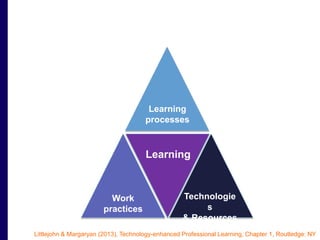
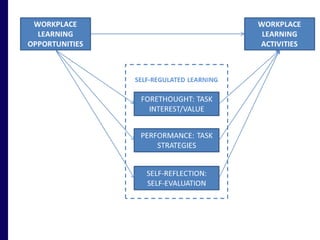
Learning 
Technologie 
s 
& Resources 
Work 
practices 
Learning 
processes 
Littlejohn & Margaryan (2013), Technology-enhanced Professional Learning, Chapter 1, Routledge: NY
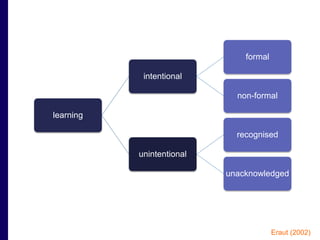
learning 
intentional 
formal 
non-formal 
unintentional 
recognised 
unacknowledged 
Eraut (2002)
Scenario 4 
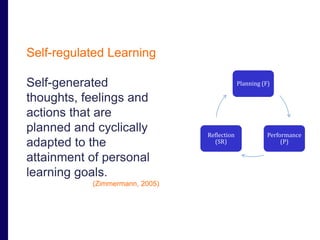
Self-regulated Learning 
Self-generated 
thoughts, feelings and 
actions that are 
planned and cyclically 
adapted to the 
attainment of personal 
learning goals. 
(Zimmermann, 2005) 
Planning (F) 
Performance 
(P) 
Reflection 
(SR)
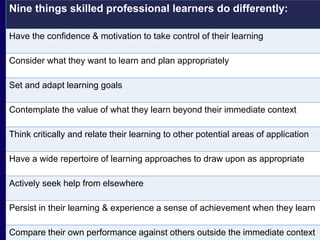
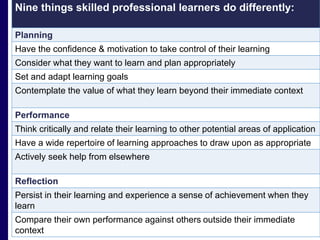
Nine things skilled professional learners do differently: 
Have the confidence & motivation to take control of their learning 
Consider what they want to learn and plan appropriately 
Set and adapt learning goals 
Contemplate the value of what they learn beyond their immediate context 
Think critically and relate their learning to other potential areas of application 
Have a wide repertoire of learning approaches to draw upon as appropriate 
Actively seek help from elsewhere 
Persist in their learning & experience a sense of achievement when they learn 
Compare their own performance against others outside the immediate context
Case 1
Scenario 4 
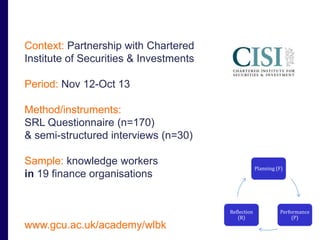
Context: Partnership with Chartered 
Institute of Securities & Investments 
Period: Nov 12-Oct 13 
Method/instruments: 
SRL Questionnaire (n=170) 
& semi-structured interviews (n=30) 
Sample: knowledge workers 
in 19 finance organisations 
www.gcu.ac.uk/academy/wlbk 
Planning (F) 
Performance 
(P) 
Reflection 
(R)
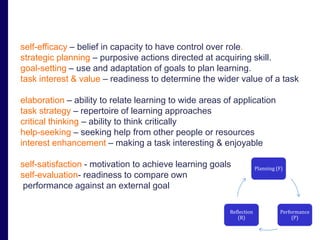
self-efficacy – belief in capacity to have control over role. 
strategic planning – purposive actions directed at acquiring skill. 
goal-setting – use and adaptation of goals to plan learning. 
task interest & value – readiness to determine the wider value of a task 
elaboration – ability to relate learning to wide areas of application 
task strategy – repertoire of learning approaches 
critical thinking – ability to think critically 
help-seeking – seeking help from other people or resources 
interest enhancement – making a task interesting & enjoyable 
self-satisfaction - motivation to achieve learning goals 
self-evaluation- readiness to compare own 
performance against an external goal 
Planning (F) 
Performance 
(P) 
Reflection 
(R)
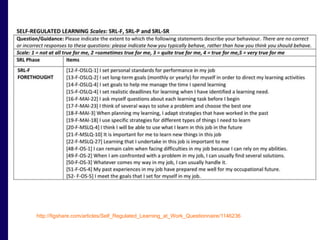
http://figshare.com/articles/Self_Regulated_Learning_at_Work_Questionnaire/1146236
0 
5 
10 
15 
20 
25 
30 
35 
40 
45 
80 
90 
100 
110 
120 
130 
140 
150 
160 
170 
180 
190 
200 
210 
More 
Frequency 
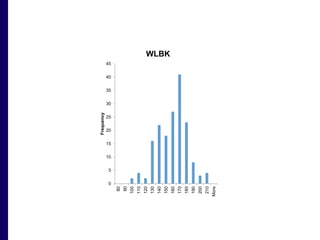
WLBK
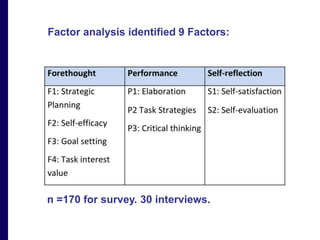
Factor analysis identified 9 Factors: 
n =170 for survey. 30 interviews.
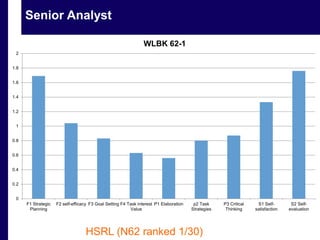
Senior Analyst 
HSRL (N62 ranked 1/30) 
2 
1.8 
1.6 
1.4 
1.2 
1 
0.8 
0.6 
0.4 
0.2 
0 
F1 Strategic 
Planning 
F2 self-efficacy F3 Goal Setting F4 Task interest 
Value 
P1 Elaboration p2 Task 
Strategies 
P3 Critical 
Thinking 
S1 Self-satisfaction 
S2 Self-evaluation 
WLBK 62-1
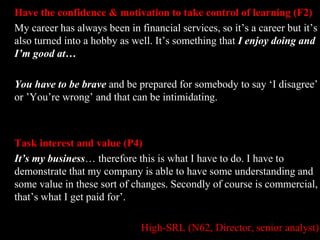
Have the confidence & motivation to take control of learning (F2) 
My career has always been in financial services, so it’s a career but it’s 
also turned into a hobby as well. It’s something that I enjoy doing and 
I’m good at… 
You have to be brave and be prepared for somebody to say ‘I disagree’ 
or ’You’re wrong’ and that can be intimidating. 
Task interest and value (P4) 
It’s my business… therefore this is what I have to do. I have to 
demonstrate that my company is able to have some understanding and 
some value in these sort of changes. Secondly of course is commercial, 
that’s what I get paid for’. 
High-SRL (N62, Director, senior analyst)
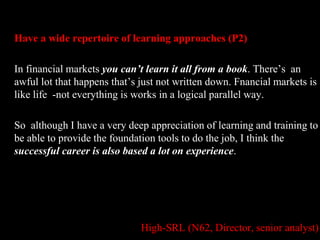
Have a wide repertoire of learning approaches (P2) 
In financial markets you can’t learn it all from a book. There’s an 
awful lot that happens that’s just not written down. Fnancial markets is 
like life -not everything is works in a logical parallel way. 
So although I have a very deep appreciation of learning and training to 
be able to provide the foundation tools to do the job, I think the 
successful career is also based a lot on experience. 
High-SRL (N62, Director, senior analyst)
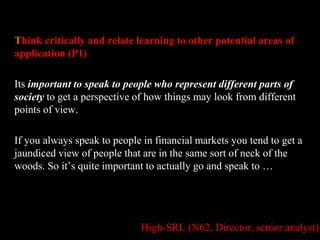
Think critically and relate learning to other potential areas of 
application (P1) 
Its important to speak to people who represent different parts of 
society to get a perspective of how things may look from different 
points of view. 
If you always speak to people in financial markets you tend to get a 
jaundiced view of people that are in the same sort of neck of the 
woods. So it’s quite important to actually go and speak to … 
High-SRL (N62, Director, senior analyst)
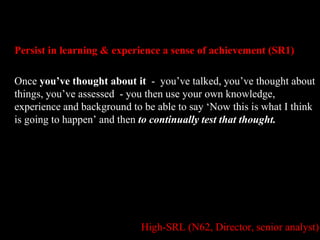
Persist in learning & experience a sense of achievement (SR1) 
Once you’ve thought about it - you’ve talked, you’ve thought about 
things, you’ve assessed - you then use your own knowledge, 
experience and background to be able to say ‘Now this is what I think 
is going to happen’ and then to continually test that thought. 
High-SRL (N62, Director, senior analyst)
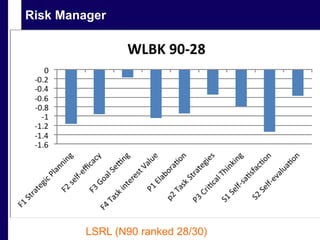
Risk Manager 
LSRL (N90 ranked 28/30)
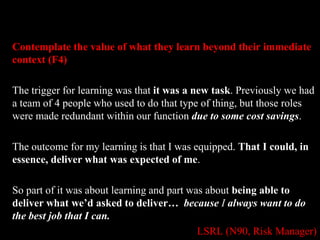
Contemplate the value of what they learn beyond their immediate 
context (F4) 
The trigger for learning was that it was a new task. Previously we had 
a team of 4 people who used to do that type of thing, but those roles 
were made redundant within our function due to some cost savings. 
The outcome for my learning is that I was equipped. That I could, in 
essence, deliver what was expected of me. 
So part of it was about learning and part was about being able to 
deliver what we’d asked to deliver… because I always want to do 
the best job that I can. 
LSRL (N90, Risk Manager)
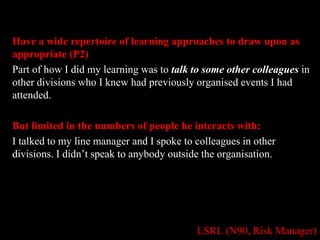
Have a wide repertoire of learning approaches to draw upon as 
appropriate (P2) 
Part of how I did my learning was to talk to some other colleagues in 
other divisions who I knew had previously organised events I had 
attended. 
But limited in the numbers of people he interacts with: 
I talked to my line manager and I spoke to colleagues in other 
divisions. I didn’t speak to anybody outside the organisation. 
LSRL (N90, Risk Manager)
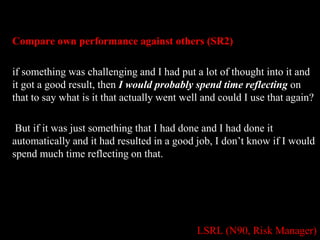
Compare own performance against others (SR2) 
if something was challenging and I had put a lot of thought into it and 
it got a good result, then I would probably spend time reflecting on 
that to say what is it that actually went well and could I use that again? 
But if it was just something that I had done and I had done it 
automatically and it had resulted in a good job, I don’t know if I would 
spend much time reflecting on that. 
LSRL (N90, Risk Manager)
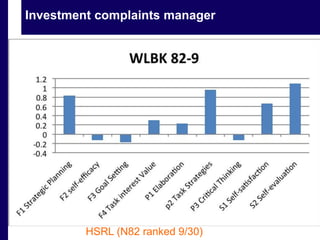
Investment complaints manager 
HSRL (N82 ranked 9/30)
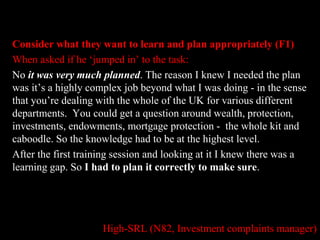
Consider what they want to learn and plan appropriately (F1) 
When asked if he ‘jumped in’ to the task: 
No it was very much planned. The reason I knew I needed the plan 
was it’s a highly complex job beyond what I was doing - in the sense 
that you’re dealing with the whole of the UK for various different 
departments. You could get a question around wealth, protection, 
investments, endowments, mortgage protection - the whole kit and 
caboodle. So the knowledge had to be at the highest level. 
After the first training session and looking at it I knew there was a 
learning gap. So I had to plan it correctly to make sure. 
High-SRL (N82, Investment complaints manager)
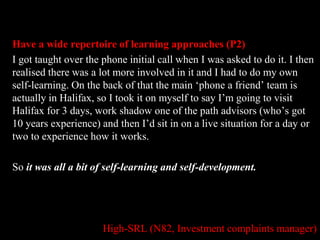
Have a wide repertoire of learning approaches (P2) 
I got taught over the phone initial call when I was asked to do it. I then 
realised there was a lot more involved in it and I had to do my own 
self-learning. On the back of that the main ‘phone a friend’ team is 
actually in Halifax, so I took it on myself to say I’m going to visit 
Halifax for 3 days, work shadow one of the path advisors (who’s got 
10 years experience) and then I’d sit in on a live situation for a day or 
two to experience how it works. 
So it was all a bit of self-learning and self-development. 
High-SRL (N82, Investment complaints manager)
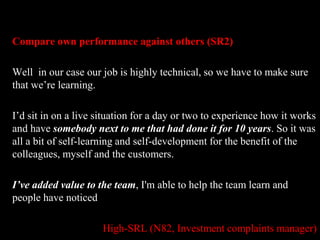
Compare own performance against others (SR2) 
Well in our case our job is highly technical, so we have to make sure 
that we’re learning. 
I’d sit in on a live situation for a day or two to experience how it works 
and have somebody next to me that had done it for 10 years. So it was 
all a bit of self-learning and self-development for the benefit of the 
colleagues, myself and the customers. 
I’ve added value to the team, I'm able to help the team learn and 
people have noticed 
High-SRL (N82, Investment complaints manager)
Nine things skilled professional learners do differently: 
Planning 
Have the confidence & motivation to take control of their learning 
Consider what they want to learn and plan appropriately 
Set and adapt learning goals 
Contemplate the value of what they learn beyond their immediate context 
Performance 
Think critically and relate their learning to other potential areas of application 
Have a wide repertoire of learning approaches to draw upon as appropriate 
Actively seek help from elsewhere 
Reflection 
Persist in their learning and experience a sense of achievement when they 
learn 
Compare their own performance against others outside their immediate 
context
Case 2
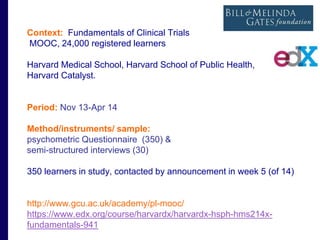
Context: Fundamentals of Clinical Trials 
MOOC, 24,000 registered learners 
Harvard Medical School, Harvard School of Public Health, 
Harvard Catalyst. 
Period: Nov 13-Apr 14 
Method/instruments/ sample: 
psychometric Questionnaire (350) & 
semi-structured interviews (30) 
350 learners in study, contacted by announcement in week 5 (of 14) 
http://www.gcu.ac.uk/academy/pl-mooc/ 
https://www.edx.org/course/harvardx/harvardx-hsph-hms214x-fundamentals- 
941
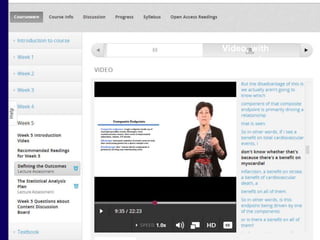
22k participants 
174 countries
Video, with 
commentary...
Discussion 
forum, 
encourages in-depth 
discussion
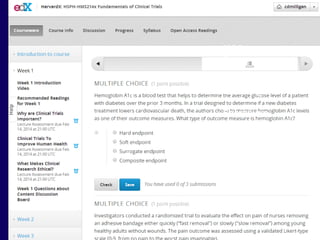
MCQ assessment 
items. 
Limited number 
of attempts 
Scores are 
recorded in the 
progress tab.
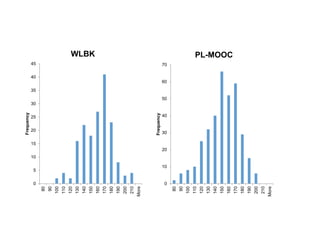
0 
5 
10 
15 
20 
25 
30 
35 
40 
45 
80 
90 
100 
110 
120 
130 
140 
150 
160 
170 
180 
190 
200 
210 
More 
Frequency 
WLBK 
0 
10 
20 
30 
40 
50 
60 
70 
80 
90 
100 
110 
120 
130 
140 
150 
160 
170 
180 
190 
200 
210 
More 
Frequency 
PL-MOOC
• 5 
• 
•2 
• 6 
• 
• 
• 
• 
• 
• 
• 
• 
• 
• 
• 
• 
•3 
• 
• 
• 
• 
• 
•
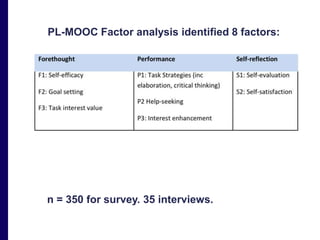
PL-MOOC Factor analysis identified 8 factors: 
n = 350 for survey. 35 interviews.
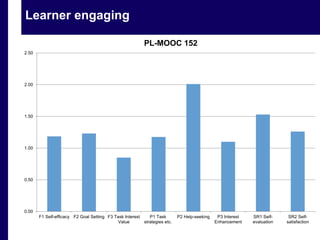
Learner engaging 
2.50 
2.00 
1.50 
1.00 
0.50 
0.00 
F1 Self-efficacy F2 Goal Setting F3 Task Interest 
Value 
P1 Task 
strategies etc. 
P2 Help-seeking P3 Interest 
Enhancement 
SR1 Self-evaluation 
SR2 Self-satisfaction 
PL-MOOC 152
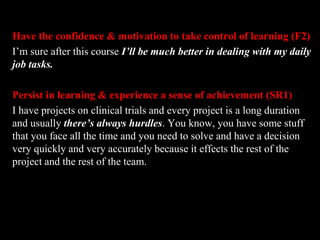
Have the confidence & motivation to take control of learning (F2) 
I’m sure after this course I’ll be much better in dealing with my daily 
job tasks. 
Persist in learning & experience a sense of achievement (SR1) 
I have projects on clinical trials and every project is a long duration 
and usually there’s always hurdles. You know, you have some stuff 
that you face all the time and you need to solve and have a decision 
very quickly and very accurately because it effects the rest of the 
project and the rest of the team.
Actively seek help from other people (P2) 
So if something is not clear for me or something I need to understand I 
check the ongoing discussion related to this issue. 
When I’m studying in the MOOC I get very concentrated on the video 
content and the homework content and the assignments and whatever 
resource is needed to provide these assignments. 
I don’t distract myself much more because of the time constraints. 
Contrasts with learning in unstructured environment…
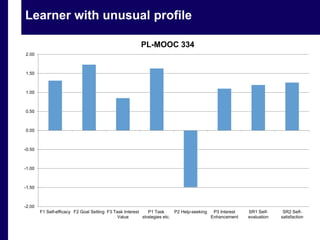
Learner with unusual profile 
2.00 
1.50 
1.00 
0.50 
0.00 
-0.50 
-1.00 
-1.50 
-2.00 
F1 Self-efficacy F2 Goal Setting F3 Task Interest 
Value 
P1 Task 
strategies etc. 
P2 Help-seeking P3 Interest 
Enhancement 
SR1 Self-evaluation 
SR2 Self-satisfaction 
PL-MOOC 334
‘Actively seek help from other people (P2) 
I’ve never really been a study group person, I’ve always been a study 
group person leader, I’ve always kind of worked with them to help 
them. So it’s hard for me to…I haven’t made any friends in class! 
About the discussion board: 
If you learn from other people who don’t know what they’re talking 
about you could teach yourself the wrong thing. … 
I read them but I take them with a grain of salt, I’m like ‘I don’t know 
if this person knows what they’re talking about’. 
I don’t interact probably as much as I could.
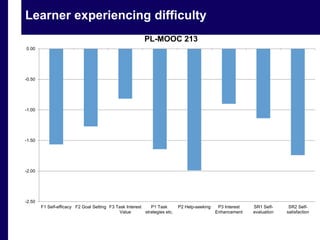
Learner experiencing difficulty 
0.00 
-0.50 
-1.00 
-1.50 
-2.00 
-2.50 
F1 Self-efficacy F2 Goal Setting F3 Task Interest 
Value 
P1 Task 
strategies etc. 
P2 Help-seeking P3 Interest 
Enhancement 
SR1 Self-evaluation 
SR2 Self-satisfaction 
PL-MOOC 213
‘ 
Have the confidence & motivation to take control of learning (F2) 
I hoped I can get the certificate, but I found it quite difficult for me. 
Difficulty engaging with the course: 
I tried to get through the course. Well because of my work I don’t have 
very much time and so I may not achieve my original goal. 
When asked whether she takes notes (key sensemaking strategy) 
Not in this course. Sometimes I will consult my text book that I have.
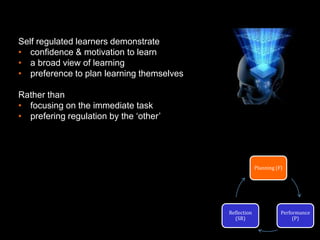
Self regulated learners demonstrate 
• confidence & motivation to learn 
• a broad view of learning 
• preference to plan learning themselves 
Rather than 
• focusing on the immediate task 
• prefering regulation by the ‘other’ 
Planning (F) 
Performance 
(P) 
Reflection 
(SR)
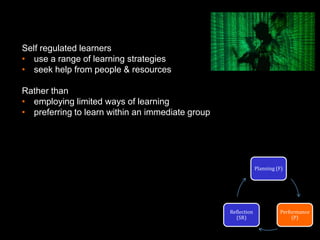
Self regulated learners 
• use a range of learning strategies 
• seek help from people & resources 
Rather than 
• employing limited ways of learning 
• preferring to learn within an immediate group 
Planning (F) 
Performance 
(P) 
Reflection 
(SR)
Planning (F) 
Performance 
(P) 
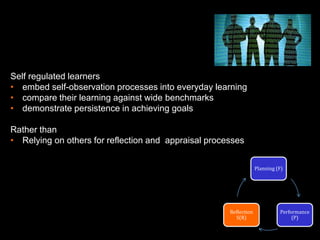
Self regulated learners 
• embed self-observation processes into everyday learning 
• compare their learning against wide benchmarks 
• demonstrate persistence in achieving goals 
Rather than 
• Relying on others for reflection and appraisal processes 
Reflection 
S(R)
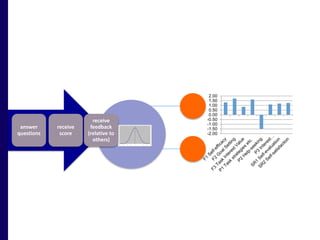
answer 
questions 
receive 
score 
receive 
feedback 
(relative to 
others) 
2.00 
1.50 
1.00 
0.50 
0.00 
-0.50 
-1.00 
-1.50 
-2.00
Research considerations 
 Theory 
 Sub-factor selection 
 Data measurement 
 Access 
 Sampling 
 Context 
 Interpretation
Scenario 4 
Want to read more? 
Littlejohn, A. and Margaryan, A. (Eds) (2013) Technology-enhanced Professional 
Learning: processes, practices and tools, Routledge: New York. 
Littlejohn, A. and Pegler, C. (Eds) (2014) Reusing Open Resources: learning in open 
networks for work, life and education Routledge: New York. 
Milligan, C., Fontana, P., Littlejohn, A. and Margaryan, A. (2014). Self-regulated learning 
behaviour in the finance industry, Journal of Workplace Learning 
Milligan, C. and Littlejohn, A. (2014) Supporting professional learning in a massive open 
online course, The International Review of Research in Open and Distance Learning 
Fontana, P., Milligan, C., Littlejohn, A. and Margaryan, A. (2014) Measuring self-regulated 
learning in the workplace, International Journal of Training and Development 
Milligan, C., Margaryan, A., and Littlejohn, A. (2014) Workplace learning in informal 
nnetworls Journal of Interactive Media Environments 
Milligan, C., Margaryan, A., and Littlejohn, A. (2013). Patterns of engagement in 
connectivist MOOCs. Journal of Online Learning & Teaching, 9 (2) 
Littlejohn, A. and Margaryan, A. (2014) Technology-enhanced Professional Learning, 
International Handbook on Research in Professional and Practice-based Learning, 
(Eds. Billiet, S, Hartels, C & Gruber, H.) Springer Verlag.
WaSncte tnoa rrieoa 4d more?

Preparing Lifelong Learners - Allison Littlejohn

  • 1.
    How professional learnersself-regulate their learning Professor Allison Littlejohn Caledonian Academy Glasgow Caledonian University, UK @allisonl Dr Colin Milligan, Dr Anoush Margaryan, Dr Pia Fontana www.gcu.ac.uk/academy
  • 2.
    MOOCs and thebroader digital disruption that they represent are definitely going to transform the ability of an individual student or learner to tailor their learning to their own needs and to fit it [learning] around their life rather than their life fitting around the learning Simon Nelson, Chief Executive Futurelearn (FT, October 2014) http://www.ft.com/reports/future-of-university
  • 3.
    Learning Technologie s & Resources Work practices Learning processes Littlejohn & Margaryan (2013), Technology-enhanced Professional Learning, Chapter 1, Routledge: NY
  • 4.
    learning intentional formal non-formal unintentional recognised unacknowledged Eraut (2002)
  • 5.
    Scenario 4 Self-regulatedLearning Self-generated thoughts, feelings and actions that are planned and cyclically adapted to the attainment of personal learning goals. (Zimmermann, 2005) Planning (F) Performance (P) Reflection (SR)
  • 6.
    Nine things skilledprofessional learners do differently: Have the confidence & motivation to take control of their learning Consider what they want to learn and plan appropriately Set and adapt learning goals Contemplate the value of what they learn beyond their immediate context Think critically and relate their learning to other potential areas of application Have a wide repertoire of learning approaches to draw upon as appropriate Actively seek help from elsewhere Persist in their learning & experience a sense of achievement when they learn Compare their own performance against others outside the immediate context
  • 7.
  • 8.
    Scenario 4 Context:Partnership with Chartered Institute of Securities & Investments Period: Nov 12-Oct 13 Method/instruments: SRL Questionnaire (n=170) & semi-structured interviews (n=30) Sample: knowledge workers in 19 finance organisations www.gcu.ac.uk/academy/wlbk Planning (F) Performance (P) Reflection (R)
  • 9.
    self-efficacy – beliefin capacity to have control over role. strategic planning – purposive actions directed at acquiring skill. goal-setting – use and adaptation of goals to plan learning. task interest & value – readiness to determine the wider value of a task elaboration – ability to relate learning to wide areas of application task strategy – repertoire of learning approaches critical thinking – ability to think critically help-seeking – seeking help from other people or resources interest enhancement – making a task interesting & enjoyable self-satisfaction - motivation to achieve learning goals self-evaluation- readiness to compare own performance against an external goal Planning (F) Performance (P) Reflection (R)
  • 10.
  • 11.
    0 5 10 15 20 25 30 35 40 45 80 90 100 110 120 130 140 150 160 170 180 190 200 210 More Frequency WLBK
  • 12.
    Factor analysis identified9 Factors: n =170 for survey. 30 interviews.
  • 14.
    Senior Analyst HSRL(N62 ranked 1/30) 2 1.8 1.6 1.4 1.2 1 0.8 0.6 0.4 0.2 0 F1 Strategic Planning F2 self-efficacy F3 Goal Setting F4 Task interest Value P1 Elaboration p2 Task Strategies P3 Critical Thinking S1 Self-satisfaction S2 Self-evaluation WLBK 62-1
  • 15.
    Have the confidence& motivation to take control of learning (F2) My career has always been in financial services, so it’s a career but it’s also turned into a hobby as well. It’s something that I enjoy doing and I’m good at… You have to be brave and be prepared for somebody to say ‘I disagree’ or ’You’re wrong’ and that can be intimidating. Task interest and value (P4) It’s my business… therefore this is what I have to do. I have to demonstrate that my company is able to have some understanding and some value in these sort of changes. Secondly of course is commercial, that’s what I get paid for’. High-SRL (N62, Director, senior analyst)
  • 16.
    Have a widerepertoire of learning approaches (P2) In financial markets you can’t learn it all from a book. There’s an awful lot that happens that’s just not written down. Fnancial markets is like life -not everything is works in a logical parallel way. So although I have a very deep appreciation of learning and training to be able to provide the foundation tools to do the job, I think the successful career is also based a lot on experience. High-SRL (N62, Director, senior analyst)
  • 17.
    Think critically andrelate learning to other potential areas of application (P1) Its important to speak to people who represent different parts of society to get a perspective of how things may look from different points of view. If you always speak to people in financial markets you tend to get a jaundiced view of people that are in the same sort of neck of the woods. So it’s quite important to actually go and speak to … High-SRL (N62, Director, senior analyst)
  • 18.
    Persist in learning& experience a sense of achievement (SR1) Once you’ve thought about it - you’ve talked, you’ve thought about things, you’ve assessed - you then use your own knowledge, experience and background to be able to say ‘Now this is what I think is going to happen’ and then to continually test that thought. High-SRL (N62, Director, senior analyst)
  • 19.
    Risk Manager LSRL(N90 ranked 28/30)
  • 20.
    Contemplate the valueof what they learn beyond their immediate context (F4) The trigger for learning was that it was a new task. Previously we had a team of 4 people who used to do that type of thing, but those roles were made redundant within our function due to some cost savings. The outcome for my learning is that I was equipped. That I could, in essence, deliver what was expected of me. So part of it was about learning and part was about being able to deliver what we’d asked to deliver… because I always want to do the best job that I can. LSRL (N90, Risk Manager)
  • 21.
    Have a widerepertoire of learning approaches to draw upon as appropriate (P2) Part of how I did my learning was to talk to some other colleagues in other divisions who I knew had previously organised events I had attended. But limited in the numbers of people he interacts with: I talked to my line manager and I spoke to colleagues in other divisions. I didn’t speak to anybody outside the organisation. LSRL (N90, Risk Manager)
  • 22.
    Compare own performanceagainst others (SR2) if something was challenging and I had put a lot of thought into it and it got a good result, then I would probably spend time reflecting on that to say what is it that actually went well and could I use that again? But if it was just something that I had done and I had done it automatically and it had resulted in a good job, I don’t know if I would spend much time reflecting on that. LSRL (N90, Risk Manager)
  • 23.
    Investment complaints manager HSRL (N82 ranked 9/30)
  • 24.
    Consider what theywant to learn and plan appropriately (F1) When asked if he ‘jumped in’ to the task: No it was very much planned. The reason I knew I needed the plan was it’s a highly complex job beyond what I was doing - in the sense that you’re dealing with the whole of the UK for various different departments. You could get a question around wealth, protection, investments, endowments, mortgage protection - the whole kit and caboodle. So the knowledge had to be at the highest level. After the first training session and looking at it I knew there was a learning gap. So I had to plan it correctly to make sure. High-SRL (N82, Investment complaints manager)
  • 25.
    Have a widerepertoire of learning approaches (P2) I got taught over the phone initial call when I was asked to do it. I then realised there was a lot more involved in it and I had to do my own self-learning. On the back of that the main ‘phone a friend’ team is actually in Halifax, so I took it on myself to say I’m going to visit Halifax for 3 days, work shadow one of the path advisors (who’s got 10 years experience) and then I’d sit in on a live situation for a day or two to experience how it works. So it was all a bit of self-learning and self-development. High-SRL (N82, Investment complaints manager)
  • 26.
    Compare own performanceagainst others (SR2) Well in our case our job is highly technical, so we have to make sure that we’re learning. I’d sit in on a live situation for a day or two to experience how it works and have somebody next to me that had done it for 10 years. So it was all a bit of self-learning and self-development for the benefit of the colleagues, myself and the customers. I’ve added value to the team, I'm able to help the team learn and people have noticed High-SRL (N82, Investment complaints manager)
  • 27.
    Nine things skilledprofessional learners do differently: Planning Have the confidence & motivation to take control of their learning Consider what they want to learn and plan appropriately Set and adapt learning goals Contemplate the value of what they learn beyond their immediate context Performance Think critically and relate their learning to other potential areas of application Have a wide repertoire of learning approaches to draw upon as appropriate Actively seek help from elsewhere Reflection Persist in their learning and experience a sense of achievement when they learn Compare their own performance against others outside their immediate context
  • 28.
  • 29.
    Context: Fundamentals ofClinical Trials MOOC, 24,000 registered learners Harvard Medical School, Harvard School of Public Health, Harvard Catalyst. Period: Nov 13-Apr 14 Method/instruments/ sample: psychometric Questionnaire (350) & semi-structured interviews (30) 350 learners in study, contacted by announcement in week 5 (of 14) http://www.gcu.ac.uk/academy/pl-mooc/ https://www.edx.org/course/harvardx/harvardx-hsph-hms214x-fundamentals- 941
  • 30.
  • 31.
  • 33.
    Discussion forum, encouragesin-depth discussion
  • 34.
    MCQ assessment items. Limited number of attempts Scores are recorded in the progress tab.
  • 35.
    0 5 10 15 20 25 30 35 40 45 80 90 100 110 120 130 140 150 160 170 180 190 200 210 More Frequency WLBK 0 10 20 30 40 50 60 70 80 90 100 110 120 130 140 150 160 170 180 190 200 210 More Frequency PL-MOOC
  • 36.
    • 5 • •2 • 6 • • • • • • • • • • • • •3 • • • • • •
  • 37.
    PL-MOOC Factor analysisidentified 8 factors: n = 350 for survey. 35 interviews.
  • 38.
    Learner engaging 2.50 2.00 1.50 1.00 0.50 0.00 F1 Self-efficacy F2 Goal Setting F3 Task Interest Value P1 Task strategies etc. P2 Help-seeking P3 Interest Enhancement SR1 Self-evaluation SR2 Self-satisfaction PL-MOOC 152
  • 39.
    Have the confidence& motivation to take control of learning (F2) I’m sure after this course I’ll be much better in dealing with my daily job tasks. Persist in learning & experience a sense of achievement (SR1) I have projects on clinical trials and every project is a long duration and usually there’s always hurdles. You know, you have some stuff that you face all the time and you need to solve and have a decision very quickly and very accurately because it effects the rest of the project and the rest of the team.
  • 40.
    Actively seek helpfrom other people (P2) So if something is not clear for me or something I need to understand I check the ongoing discussion related to this issue. When I’m studying in the MOOC I get very concentrated on the video content and the homework content and the assignments and whatever resource is needed to provide these assignments. I don’t distract myself much more because of the time constraints. Contrasts with learning in unstructured environment…
  • 41.
    Learner with unusualprofile 2.00 1.50 1.00 0.50 0.00 -0.50 -1.00 -1.50 -2.00 F1 Self-efficacy F2 Goal Setting F3 Task Interest Value P1 Task strategies etc. P2 Help-seeking P3 Interest Enhancement SR1 Self-evaluation SR2 Self-satisfaction PL-MOOC 334
  • 42.
    ‘Actively seek helpfrom other people (P2) I’ve never really been a study group person, I’ve always been a study group person leader, I’ve always kind of worked with them to help them. So it’s hard for me to…I haven’t made any friends in class! About the discussion board: If you learn from other people who don’t know what they’re talking about you could teach yourself the wrong thing. … I read them but I take them with a grain of salt, I’m like ‘I don’t know if this person knows what they’re talking about’. I don’t interact probably as much as I could.
  • 43.
    Learner experiencing difficulty 0.00 -0.50 -1.00 -1.50 -2.00 -2.50 F1 Self-efficacy F2 Goal Setting F3 Task Interest Value P1 Task strategies etc. P2 Help-seeking P3 Interest Enhancement SR1 Self-evaluation SR2 Self-satisfaction PL-MOOC 213
  • 44.
    ‘ Have theconfidence & motivation to take control of learning (F2) I hoped I can get the certificate, but I found it quite difficult for me. Difficulty engaging with the course: I tried to get through the course. Well because of my work I don’t have very much time and so I may not achieve my original goal. When asked whether she takes notes (key sensemaking strategy) Not in this course. Sometimes I will consult my text book that I have.
  • 45.
    Self regulated learnersdemonstrate • confidence & motivation to learn • a broad view of learning • preference to plan learning themselves Rather than • focusing on the immediate task • prefering regulation by the ‘other’ Planning (F) Performance (P) Reflection (SR)
  • 46.
    Self regulated learners • use a range of learning strategies • seek help from people & resources Rather than • employing limited ways of learning • preferring to learn within an immediate group Planning (F) Performance (P) Reflection (SR)
  • 47.
    Planning (F) Performance (P) Self regulated learners • embed self-observation processes into everyday learning • compare their learning against wide benchmarks • demonstrate persistence in achieving goals Rather than • Relying on others for reflection and appraisal processes Reflection S(R)
  • 48.
    answer questions receive score receive feedback (relative to others) 2.00 1.50 1.00 0.50 0.00 -0.50 -1.00 -1.50 -2.00
  • 49.
    Research considerations Theory  Sub-factor selection  Data measurement  Access  Sampling  Context  Interpretation
  • 50.
    Scenario 4 Wantto read more? Littlejohn, A. and Margaryan, A. (Eds) (2013) Technology-enhanced Professional Learning: processes, practices and tools, Routledge: New York. Littlejohn, A. and Pegler, C. (Eds) (2014) Reusing Open Resources: learning in open networks for work, life and education Routledge: New York. Milligan, C., Fontana, P., Littlejohn, A. and Margaryan, A. (2014). Self-regulated learning behaviour in the finance industry, Journal of Workplace Learning Milligan, C. and Littlejohn, A. (2014) Supporting professional learning in a massive open online course, The International Review of Research in Open and Distance Learning Fontana, P., Milligan, C., Littlejohn, A. and Margaryan, A. (2014) Measuring self-regulated learning in the workplace, International Journal of Training and Development Milligan, C., Margaryan, A., and Littlejohn, A. (2014) Workplace learning in informal nnetworls Journal of Interactive Media Environments Milligan, C., Margaryan, A., and Littlejohn, A. (2013). Patterns of engagement in connectivist MOOCs. Journal of Online Learning & Teaching, 9 (2) Littlejohn, A. and Margaryan, A. (2014) Technology-enhanced Professional Learning, International Handbook on Research in Professional and Practice-based Learning, (Eds. Billiet, S, Hartels, C & Gruber, H.) Springer Verlag.
  • 51.