• The Hfr strain was first characterized by Luca Cavalli-Sforza. William Hayes also isolated another Hfr strain
independently.
• The F factor is an episome and can integrate into the bacterial chromosome at several different locations by
recombination between homologous insertion sequences present on both the plasmid and host chromosomes.
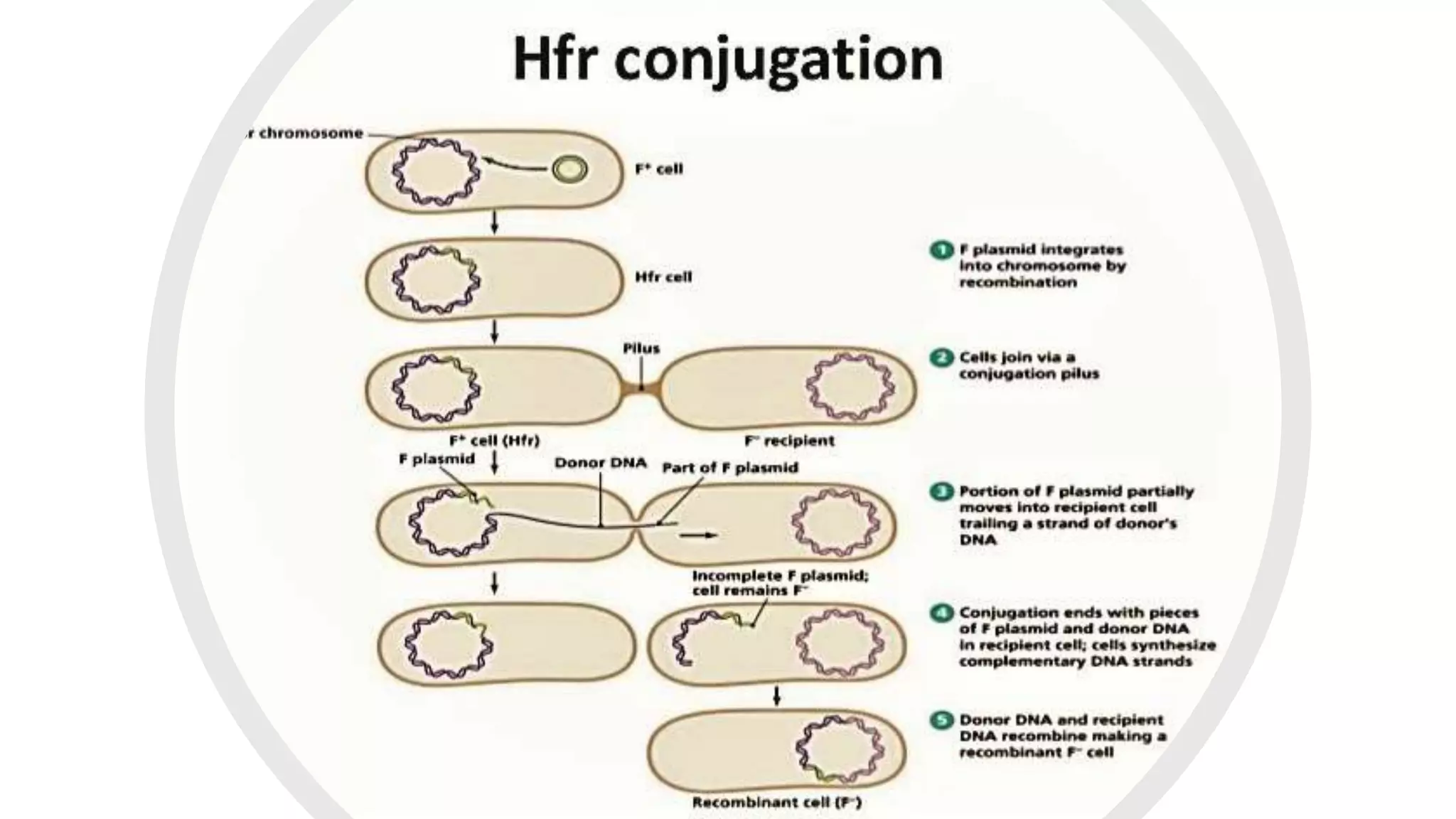
• When F-plasmid (sex factor) integrates with chromosomal DNA then such bacteria is known as high frequency
recombination (Hfr) bacteria
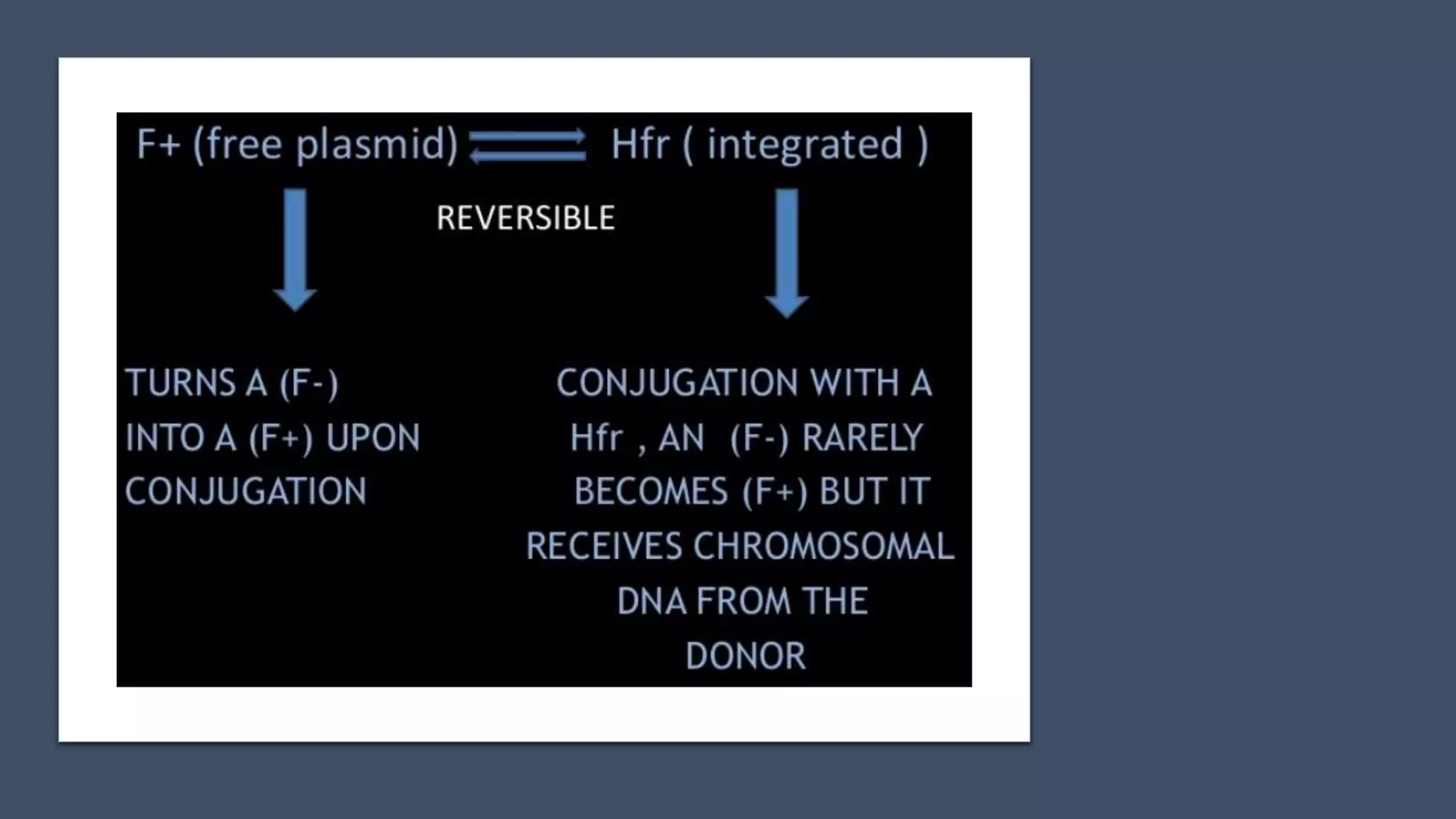
• In the cross (conjugation) between Hfr cell and F- cell, frequency of recombination is very high but frequency of
transfer of whole F factor is very low. Hfr cell acts as donor while F- cell acts as recipient.
• When integrated, the F plasmid can direct the synthesis of pili, carry out rolling-circle replication, and transfer genetic
material to an F- recipient cell.
• As it is replicated, the chromosome moves through the pilus or conjugation bridge
connecting the donor and recipient. Because only part of the F factor is transferred
at the start, the F recipient does not become F+ unless the whole chromosome is
transferred.
• To transfer whole chromosomal DNA, it takes 100 minutes in E. coli. In most of the
cases, sex pilus (conjugation tube) breaks before transfer of whole chromosomal
DNA takes place. So, frequency of transfer of whole F factor is very low. After the
cross between Hfr cell and F- cell, recipient cell remains recipient.
• As mentioned earlier, when an Hfr strain participates in conjugation, bacterial
genes are frequently transferred to the recipient.
• After the replicated donor chromosome enters the recipient cell, it may be
degraded or incorporated into the F genome by recombination.
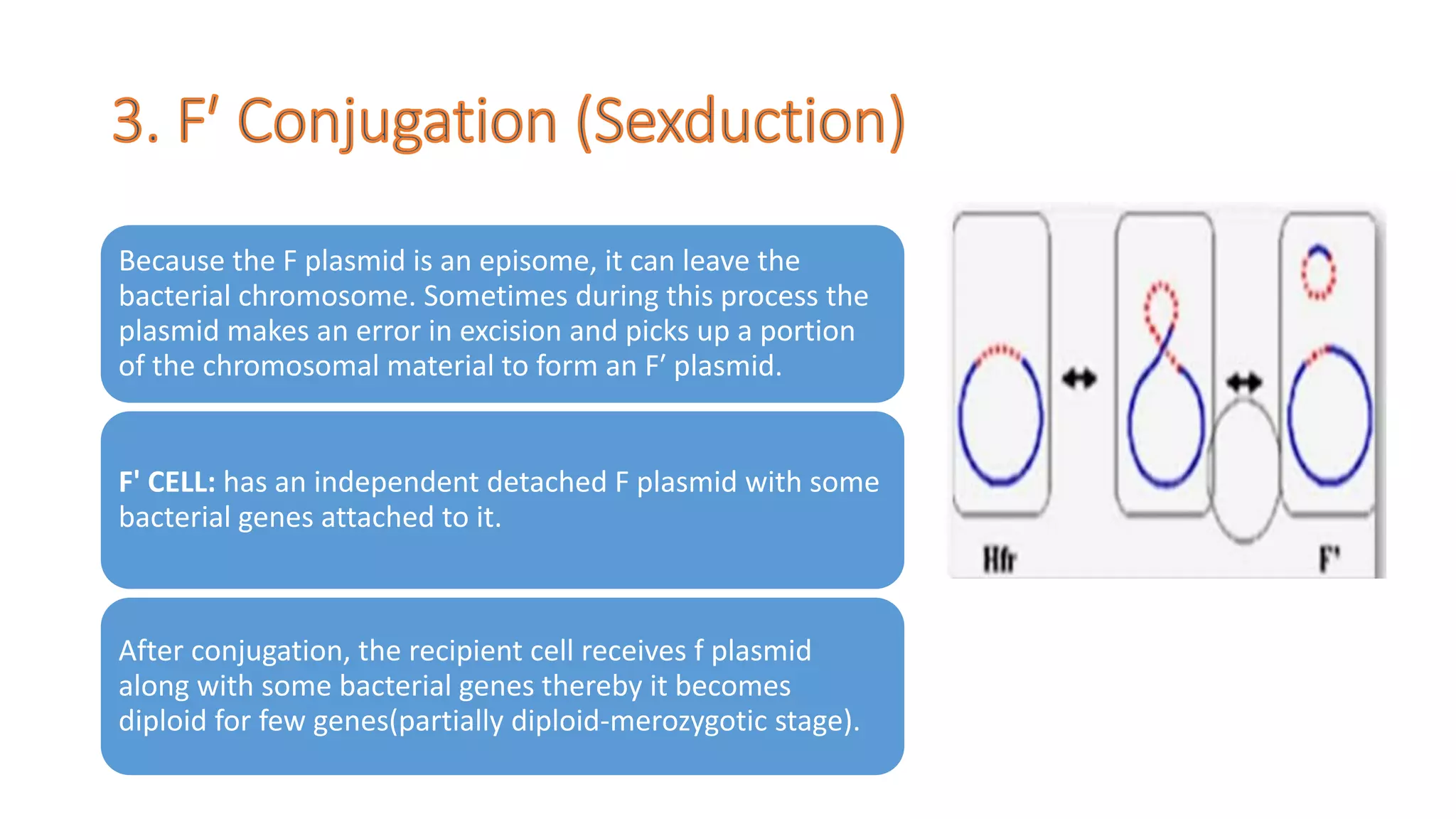
Because the F plasmid is an episome, it can leave the
bacterial chromosome. Sometimes during this process the
plasmid makes an error in excision and picks up a portion
of the chromosomal material to form an F′ plasmid.
F' CELL: has an independent detached F plasmid with some
bacterial genes attached to it.
After conjugation, the recipient cell receives f plasmid
along with some bacterial genes thereby it becomes
diploid for few genes(partially diploid-merozygotic stage).
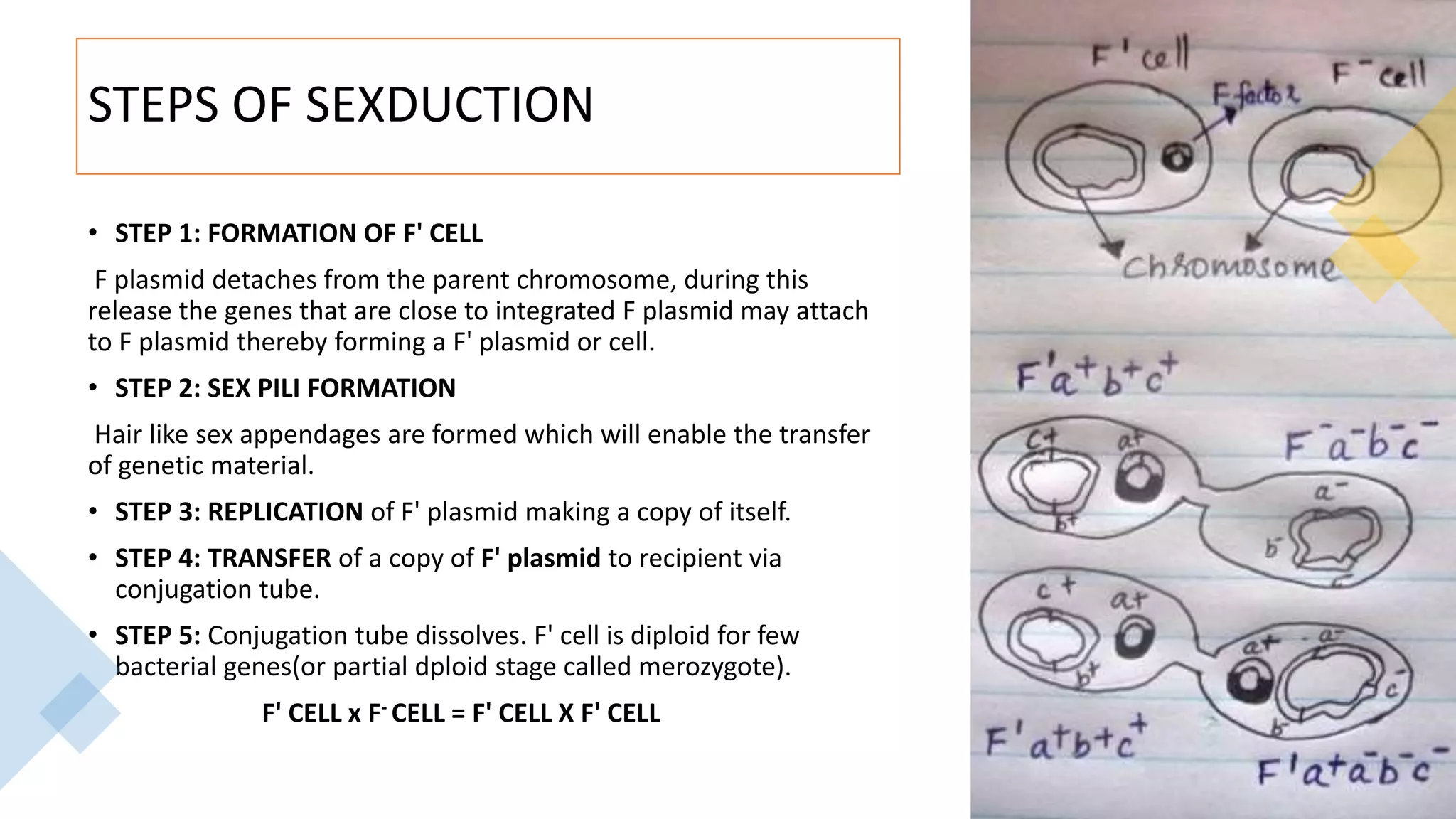
STEPS OF SEXDUCTION
• STEP 1: FORMATION OF F' CELL
F plasmid detaches from the parent chromosome, during this
release the genes that are close to integrated F plasmid may attach
to F plasmid thereby forming a F' plasmid or cell.
• STEP 2: SEX PILI FORMATION
Hair like sex appendages are formed which will enable the transfer
of genetic material.
• STEP 3: REPLICATION of F' plasmid making a copy of itself.
• STEP 4: TRANSFER of a copy of F' plasmid to recipient via
conjugation tube.
• STEP 5: Conjugation tube dissolves. F' cell is diploid for few
bacterial genes(or partial dploid stage called merozygote).
F' CELL x F- CELL = F' CELL X F' CELL
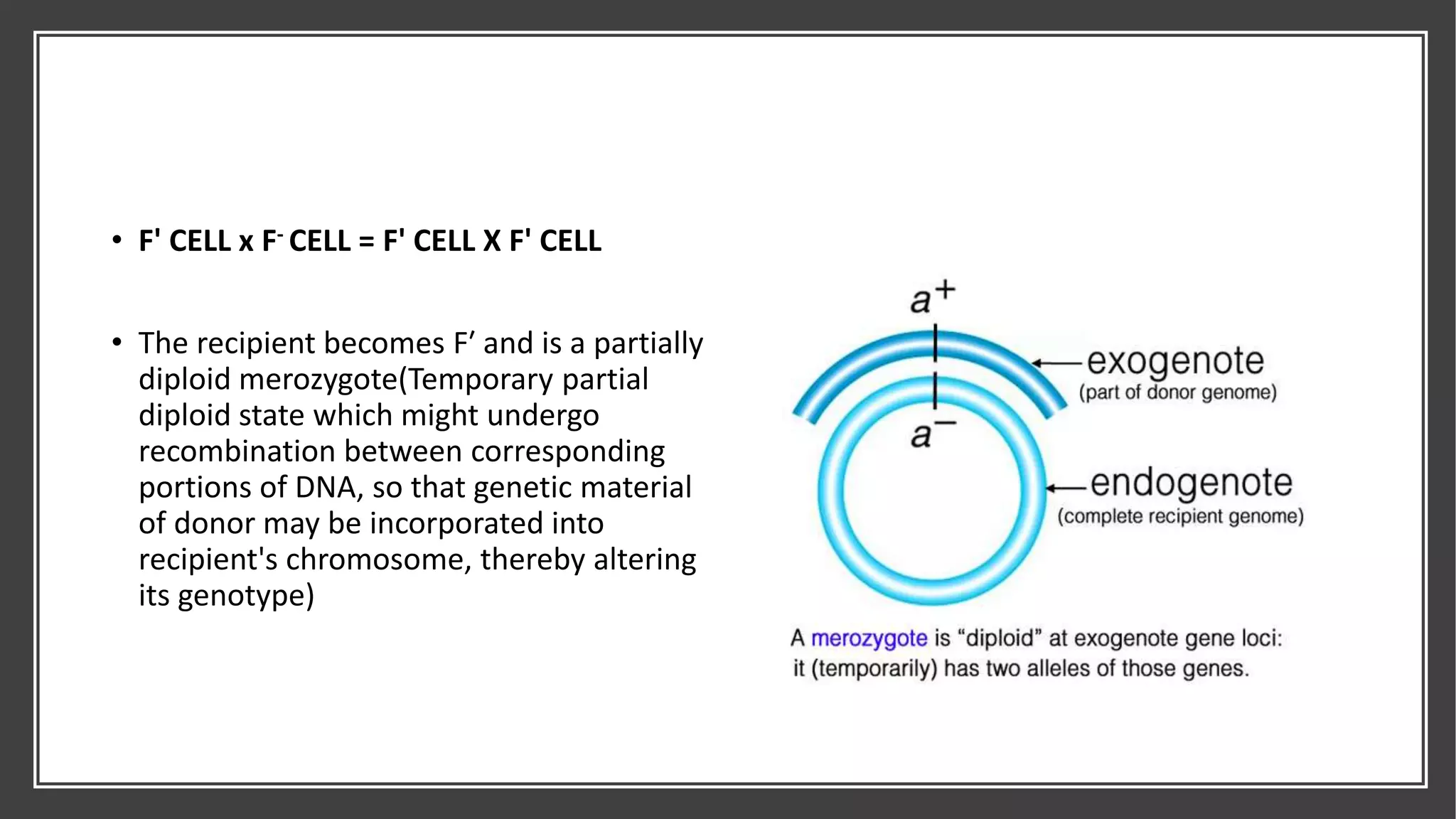
• F' CELL x F- CELL = F' CELL X F' CELL
• The recipient becomes F′ and is a partially
diploid merozygote(Temporary partial
diploid state which might undergo
recombination between corresponding
portions of DNA, so that genetic material
of donor may be incorporated into
recipient's chromosome, thereby altering
its genotype)
SIGNIFICANCE
OF
CONJUGATION
• ANTIBIOTIC RESISTANCE
Gene transfer can occur between different species of
bacteria, transfer of multiple antibiotic resistance by
conjugation has become a major problem in treatment
of certain bacterial diseases. Since the recipient cell
becomes donor after transfer of a plasmid, it is easy to
see why an antibiotic resistance gene carried on a
plasmid can quickly convert a sensitive population of
cells to resistant ones.
• GENE MAPPING
Finding the location of genes in any organism’s
genome is called gene mapping. All three modes of
gene transfer and recombination have been used in
mapping.
• GENETIC ENGINEERING
Conjugation is a convenient means for transferring genetic material to a
variety of targets.
In laboratories, successful transfers have been reported from bacteria
to yeast, plants and mammalian cells
Conjugation has advantages over other forms of genetic transfer
including minimal disruption of the target's cellular envelope and the
ability to transfer genetic material.
Thank you

Conjuagtion types and application

  • 1.
    • The Hfrstrain was first characterized by Luca Cavalli-Sforza. William Hayes also isolated another Hfr strain independently. • The F factor is an episome and can integrate into the bacterial chromosome at several different locations by recombination between homologous insertion sequences present on both the plasmid and host chromosomes. • When F-plasmid (sex factor) integrates with chromosomal DNA then such bacteria is known as high frequency recombination (Hfr) bacteria • In the cross (conjugation) between Hfr cell and F- cell, frequency of recombination is very high but frequency of transfer of whole F factor is very low. Hfr cell acts as donor while F- cell acts as recipient. • When integrated, the F plasmid can direct the synthesis of pili, carry out rolling-circle replication, and transfer genetic material to an F- recipient cell.
  • 2.
    • As itis replicated, the chromosome moves through the pilus or conjugation bridge connecting the donor and recipient. Because only part of the F factor is transferred at the start, the F recipient does not become F+ unless the whole chromosome is transferred. • To transfer whole chromosomal DNA, it takes 100 minutes in E. coli. In most of the cases, sex pilus (conjugation tube) breaks before transfer of whole chromosomal DNA takes place. So, frequency of transfer of whole F factor is very low. After the cross between Hfr cell and F- cell, recipient cell remains recipient. • As mentioned earlier, when an Hfr strain participates in conjugation, bacterial genes are frequently transferred to the recipient. • After the replicated donor chromosome enters the recipient cell, it may be degraded or incorporated into the F genome by recombination.
  • 5.
    Because the Fplasmid is an episome, it can leave the bacterial chromosome. Sometimes during this process the plasmid makes an error in excision and picks up a portion of the chromosomal material to form an F′ plasmid. F' CELL: has an independent detached F plasmid with some bacterial genes attached to it. After conjugation, the recipient cell receives f plasmid along with some bacterial genes thereby it becomes diploid for few genes(partially diploid-merozygotic stage).
  • 6.
    STEPS OF SEXDUCTION •STEP 1: FORMATION OF F' CELL F plasmid detaches from the parent chromosome, during this release the genes that are close to integrated F plasmid may attach to F plasmid thereby forming a F' plasmid or cell. • STEP 2: SEX PILI FORMATION Hair like sex appendages are formed which will enable the transfer of genetic material. • STEP 3: REPLICATION of F' plasmid making a copy of itself. • STEP 4: TRANSFER of a copy of F' plasmid to recipient via conjugation tube. • STEP 5: Conjugation tube dissolves. F' cell is diploid for few bacterial genes(or partial dploid stage called merozygote). F' CELL x F- CELL = F' CELL X F' CELL
  • 7.
    • F' CELLx F- CELL = F' CELL X F' CELL • The recipient becomes F′ and is a partially diploid merozygote(Temporary partial diploid state which might undergo recombination between corresponding portions of DNA, so that genetic material of donor may be incorporated into recipient's chromosome, thereby altering its genotype)
  • 8.
    SIGNIFICANCE OF CONJUGATION • ANTIBIOTIC RESISTANCE Genetransfer can occur between different species of bacteria, transfer of multiple antibiotic resistance by conjugation has become a major problem in treatment of certain bacterial diseases. Since the recipient cell becomes donor after transfer of a plasmid, it is easy to see why an antibiotic resistance gene carried on a plasmid can quickly convert a sensitive population of cells to resistant ones. • GENE MAPPING Finding the location of genes in any organism’s genome is called gene mapping. All three modes of gene transfer and recombination have been used in mapping.
  • 9.
    • GENETIC ENGINEERING Conjugationis a convenient means for transferring genetic material to a variety of targets. In laboratories, successful transfers have been reported from bacteria to yeast, plants and mammalian cells Conjugation has advantages over other forms of genetic transfer including minimal disruption of the target's cellular envelope and the ability to transfer genetic material.
  • 10.