Electroporation
• Electroporation is a method of transformation via direct gene
transfer.
• In this technique mixture containing cells and DNA is exposed to very
high voltage electrical pulses (4000 – 8000 V/cm) for very brief time
periods (few milliseconds).
• It results in formation of transient pores in the plasma membrane,
thorough which DNA seems to enter inside the cell.
• Electroporation is highly efficient for the introduction of foreign
genes into tissue culture cells, to transform bacteria, yeast, or plant
protoplasts by introducing new coding DNA.
• The process of introducing foreign DNA into eukaryotic cells is
known as transfection.
Process of electroporation in plant cell
• Plant cell electroporation generally utilizes the protoplast
because thick plant cell walls restrict macromolecule
movement.
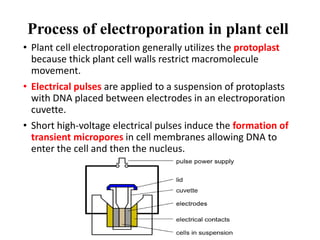
• Electrical pulses are applied to a suspension of protoplasts
with DNA placed between electrodes in an electroporation
cuvette.
• Short high-voltage electrical pulses induce the formation of
transient micropores in cell membranes allowing DNA to
enter the cell and then the nucleus.
Contd…
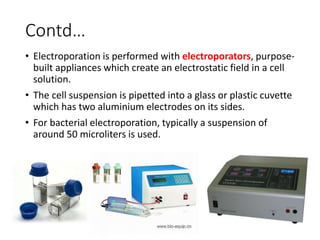
• Electroporation is performed with electroporators, purpose-
built appliances which create an electrostatic field in a cell
solution.
• The cell suspension is pipetted into a glass or plastic cuvette
which has two aluminium electrodes on its sides.
• For bacterial electroporation, typically a suspension of
around 50 microliters is used.
This process involves several variables.
i. Field strength
ii. Pulse length
• In general, field strength is the voltage required to
induce membrane breakdown, expressed as kV/cm,
which can be adjusted by varying the voltage applied or
by changing the distance of the gap between electrodes.
• The pulse length in general, is the duration of time the
sample is exposed to the electrical field and is measured
in microsecond to milliseconds.
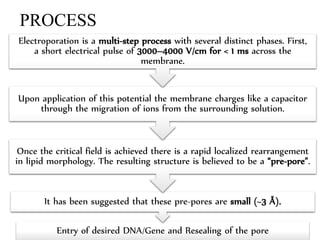
PROCESS
Entry of desired DNA/Gene and Resealing of the pore
It has been suggested that these pre-pores are small (~3 Å).
Once the critical field is achieved there is a rapid localized rearrangement
in lipid morphology. The resulting structure is believed to be a “pre-pore”.
Upon application of this potential the membrane charges like a capacitor
through the migration of ions from the surrounding solution.
Electroporation is a multi-step process with several distinct phases. First,
a short electrical pulse of 3000–4000 V/cm for < 1 ms across the
membrane.
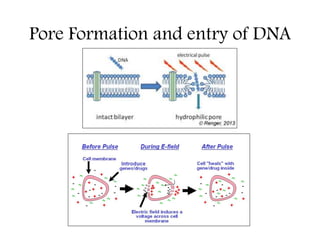
Pore Formation and entry of DNA
Factors Influencing Electroporation
• Cell growth
• DNA – purity and concentration
• Media
• The success of the electroporation depends greatly on the
purity of the plasmid solution, especially on its salt content.
• Solutions with high salt concentrations might cause an
electrical discharge (known as arcing), which often reduces
the viability.
• Cells which are arrested at metaphase stage of cell cycle are
especially suitable for electroporation as these cells have
absence of nuclear envelope and an unusual permeability of
the plasma membrane.
• Protoplasts are used for electroporation of plant cells
as thick plant cell walls restrict movement of DNA.
• The electroporation method was originally developed
for protoplasts, but has given equally good results
with cells and even tissues with easy recovery of
regenerated plantlets.
• Immature zygotic embryos and embryogenic calli
have also been used for electroporation to produce
transgenics e.g. transgenic maize.
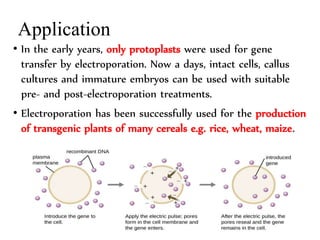
Application
• In the early years, only protoplasts were used for gene
transfer by electroporation. Now a days, intact cells, callus
cultures and immature embryos can be used with suitable
pre- and post-electroporation treatments.
• Electroporation has been successfully used for the production
of transgenic plants of many cereals e.g. rice, wheat, maize.
• Electroporation is highly efficient for the
introduction of foreign genes into tissue culture cells
to transform bacteria, yeast, or plant protoplasts by
introducing new coding DNA.
• Transformation of bacteria, yeasts, etc.
• Chemotherapy
• Gene Therapy
• Diagnostics
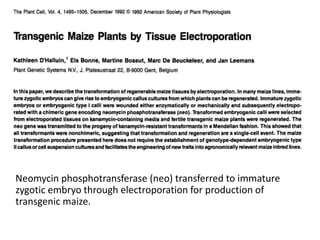
Neomycin phosphotransferase (neo) transferred to immature
zygotic embryo through electroporation for production of
transgenic maize.
Example
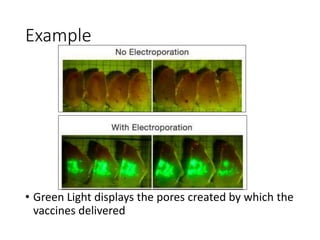
• Green Light displays the pores created by which the
vaccines delivered
Electroporation of bacteria
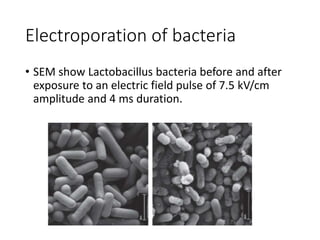
• SEM show Lactobacillus bacteria before and after
exposure to an electric field pulse of 7.5 kV/cm
amplitude and 4 ms duration.
Advantages of electroporation
• This technique is simple, convenient and rapid, besides being cost-
effective.
• It is a non-invasive, non-chemical method, and does not alter target cell
structure or function.
• The transformed cells are at the same physiological state after
electroporation.
• This method is fast and easy to perform and unlike other chemical or
biological methods it is relatively non-toxic.
• Efficiency of transformation can be improved by optimising the
electrical field strength.
• The electroporation technique can be applied to a much wider selection
of cell types because it is a physical method.
Limitations of electroporation
• Under normal conditions, the amount of DNA delivered
into plant cells is very low.
• Efficiency of electroporation is highly variable depending
on the plant material and the treatment conditions.
• Regeneration of plants is not very easy, particularly when
protoplasts are used.
THANK YOU
Reference
• Narusaka,Y.,Narusaka,M.,Yamasaki,S. and Iwabuchi,M.(2012) Methods to
Transfer Foreign Genes to Plants ISBN 978-953-51-0181-9.
• Rashid,A.H.A., Lateef,D.D.(2016)Novel Techniques for Gene Delivery into Plants
and Its Applications for Disease Resistance in Crops
• Sukharev, S.I., Klenchin, V.A., Serov, S.M., Chernomordik, L.V. & Chizmadzhev,
Y.A. (1992). Electroporation and electrophoretic DNA transfer into cells. The
effect of DNA interaction with electropores. Biophys. J., 63 (5): 1320-1327.
• Kotnik,T., Wolfgang,F., Martin,S., Meglic,S., Peterka,M. and
Miklavc,D.(2015)Electroporation-based applications in biotechnology

Electroporation

  • 2.
    Electroporation • Electroporation isa method of transformation via direct gene transfer. • In this technique mixture containing cells and DNA is exposed to very high voltage electrical pulses (4000 – 8000 V/cm) for very brief time periods (few milliseconds). • It results in formation of transient pores in the plasma membrane, thorough which DNA seems to enter inside the cell. • Electroporation is highly efficient for the introduction of foreign genes into tissue culture cells, to transform bacteria, yeast, or plant protoplasts by introducing new coding DNA. • The process of introducing foreign DNA into eukaryotic cells is known as transfection.
  • 3.
    Process of electroporationin plant cell • Plant cell electroporation generally utilizes the protoplast because thick plant cell walls restrict macromolecule movement. • Electrical pulses are applied to a suspension of protoplasts with DNA placed between electrodes in an electroporation cuvette. • Short high-voltage electrical pulses induce the formation of transient micropores in cell membranes allowing DNA to enter the cell and then the nucleus.
  • 4.
    Contd… • Electroporation isperformed with electroporators, purpose- built appliances which create an electrostatic field in a cell solution. • The cell suspension is pipetted into a glass or plastic cuvette which has two aluminium electrodes on its sides. • For bacterial electroporation, typically a suspension of around 50 microliters is used.
  • 5.
    This process involvesseveral variables. i. Field strength ii. Pulse length • In general, field strength is the voltage required to induce membrane breakdown, expressed as kV/cm, which can be adjusted by varying the voltage applied or by changing the distance of the gap between electrodes. • The pulse length in general, is the duration of time the sample is exposed to the electrical field and is measured in microsecond to milliseconds.
  • 6.
    PROCESS Entry of desiredDNA/Gene and Resealing of the pore It has been suggested that these pre-pores are small (~3 Å). Once the critical field is achieved there is a rapid localized rearrangement in lipid morphology. The resulting structure is believed to be a “pre-pore”. Upon application of this potential the membrane charges like a capacitor through the migration of ions from the surrounding solution. Electroporation is a multi-step process with several distinct phases. First, a short electrical pulse of 3000–4000 V/cm for < 1 ms across the membrane.
  • 7.
    Pore Formation andentry of DNA
  • 8.
    Factors Influencing Electroporation •Cell growth • DNA – purity and concentration • Media
  • 9.
    • The successof the electroporation depends greatly on the purity of the plasmid solution, especially on its salt content. • Solutions with high salt concentrations might cause an electrical discharge (known as arcing), which often reduces the viability. • Cells which are arrested at metaphase stage of cell cycle are especially suitable for electroporation as these cells have absence of nuclear envelope and an unusual permeability of the plasma membrane.
  • 10.
    • Protoplasts areused for electroporation of plant cells as thick plant cell walls restrict movement of DNA. • The electroporation method was originally developed for protoplasts, but has given equally good results with cells and even tissues with easy recovery of regenerated plantlets. • Immature zygotic embryos and embryogenic calli have also been used for electroporation to produce transgenics e.g. transgenic maize.
  • 11.
    Application • In theearly years, only protoplasts were used for gene transfer by electroporation. Now a days, intact cells, callus cultures and immature embryos can be used with suitable pre- and post-electroporation treatments. • Electroporation has been successfully used for the production of transgenic plants of many cereals e.g. rice, wheat, maize.
  • 12.
    • Electroporation ishighly efficient for the introduction of foreign genes into tissue culture cells to transform bacteria, yeast, or plant protoplasts by introducing new coding DNA. • Transformation of bacteria, yeasts, etc. • Chemotherapy • Gene Therapy • Diagnostics
  • 13.
    Neomycin phosphotransferase (neo)transferred to immature zygotic embryo through electroporation for production of transgenic maize.
  • 14.
    Example • Green Lightdisplays the pores created by which the vaccines delivered
  • 15.
    Electroporation of bacteria •SEM show Lactobacillus bacteria before and after exposure to an electric field pulse of 7.5 kV/cm amplitude and 4 ms duration.
  • 16.
    Advantages of electroporation •This technique is simple, convenient and rapid, besides being cost- effective. • It is a non-invasive, non-chemical method, and does not alter target cell structure or function. • The transformed cells are at the same physiological state after electroporation. • This method is fast and easy to perform and unlike other chemical or biological methods it is relatively non-toxic. • Efficiency of transformation can be improved by optimising the electrical field strength. • The electroporation technique can be applied to a much wider selection of cell types because it is a physical method.
  • 17.
    Limitations of electroporation •Under normal conditions, the amount of DNA delivered into plant cells is very low. • Efficiency of electroporation is highly variable depending on the plant material and the treatment conditions. • Regeneration of plants is not very easy, particularly when protoplasts are used.
  • 18.
  • 19.
    Reference • Narusaka,Y.,Narusaka,M.,Yamasaki,S. andIwabuchi,M.(2012) Methods to Transfer Foreign Genes to Plants ISBN 978-953-51-0181-9. • Rashid,A.H.A., Lateef,D.D.(2016)Novel Techniques for Gene Delivery into Plants and Its Applications for Disease Resistance in Crops • Sukharev, S.I., Klenchin, V.A., Serov, S.M., Chernomordik, L.V. & Chizmadzhev, Y.A. (1992). Electroporation and electrophoretic DNA transfer into cells. The effect of DNA interaction with electropores. Biophys. J., 63 (5): 1320-1327. • Kotnik,T., Wolfgang,F., Martin,S., Meglic,S., Peterka,M. and Miklavc,D.(2015)Electroporation-based applications in biotechnology

Editor's Notes

  • #6 The pulse length is related to the size and how long the pores are open during the pulse and can be varied in order to increase efficiency.