Genetic
Genetic
Transformation
Transformation
In Bacteria
In Bacteria
Prof. A. B. Das
Dept. of Botany, Utkal University
Bh b 751004
Bhubaneswar 751004
E-mail: abdas.uubot@gmail.com
Mutations in Bacteria
• Mutations arise in bacterial populations
Mutations arise in bacterial populations
– Induced
Spontaneous
– Spontaneous
• Rare mutations are expressed
– Bacteria are haploid
– Rapid growth rate
• Selective advantage enriches for
mutants
• Gene transfer occurs in bacteria
General Features of
Gene Transfer in Bacteria
• Unidirectional
– Donor to recipient
• Donor does not give an entire
chromosome
– Merozygotes
yg
• Gene transfer can occur between
species
species
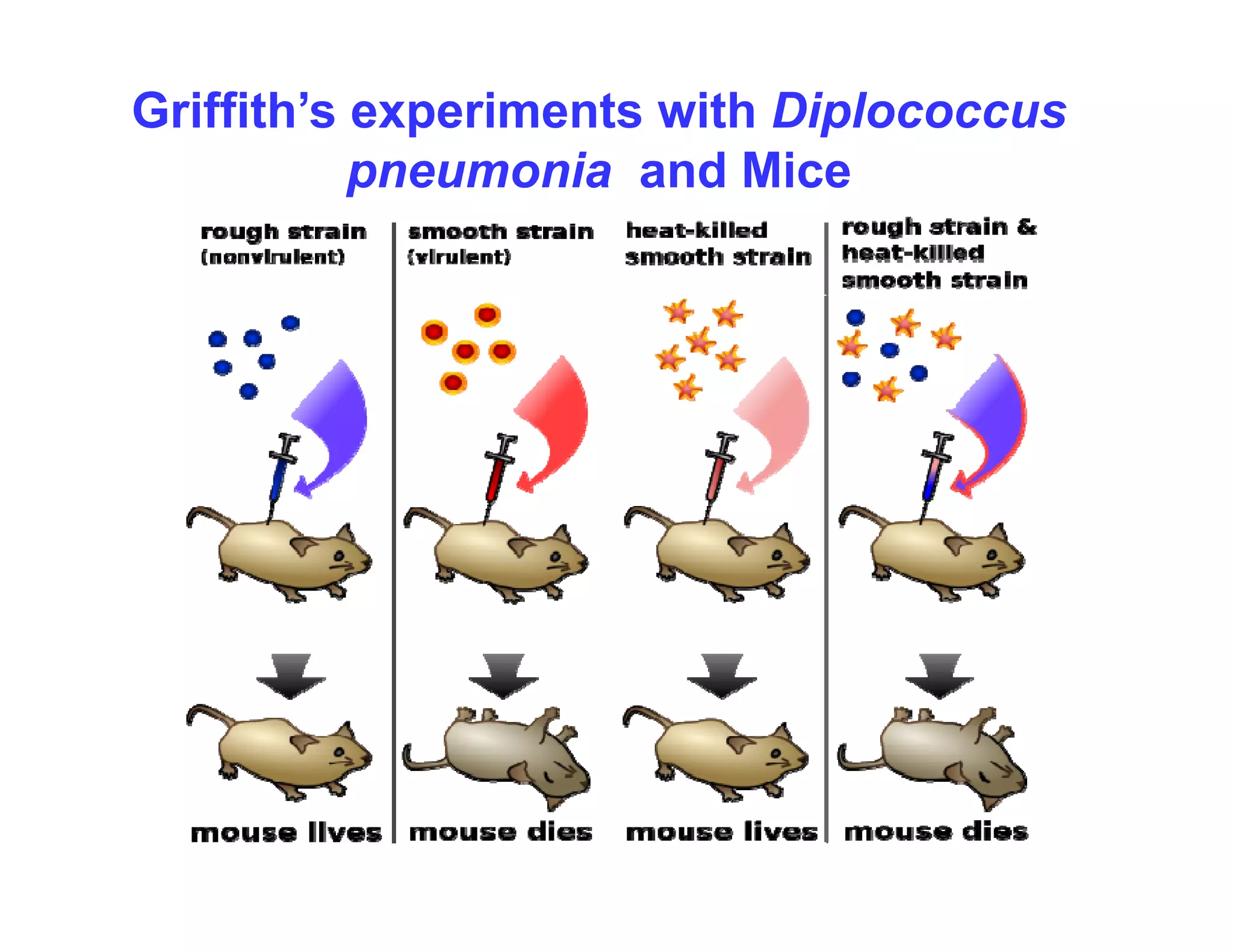
Griffith's experiment, reported in
1928 b F d i k G iffith
1928 by Frederick Griffith, was
the first experiment suggesting
p gg g
that bacteria are capable of
transferring genetic information
through a process known as
transformation.
Griffith’s experiments with Diplococcus
pneumonia and Mice
pneumonia and Mice
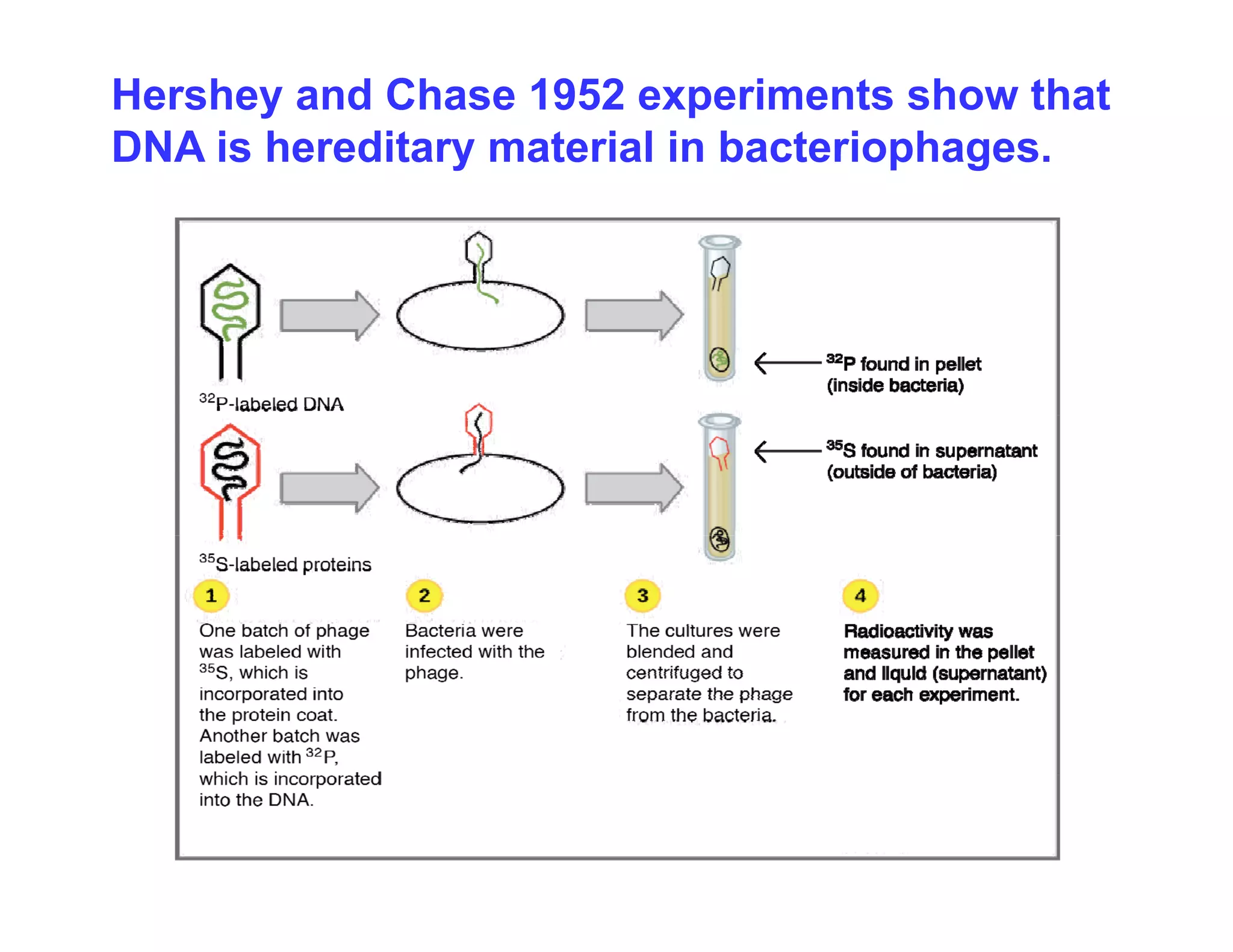
Hershey and Chase 1952 experiments show that
DNA is hereditary material in bacteriophages.
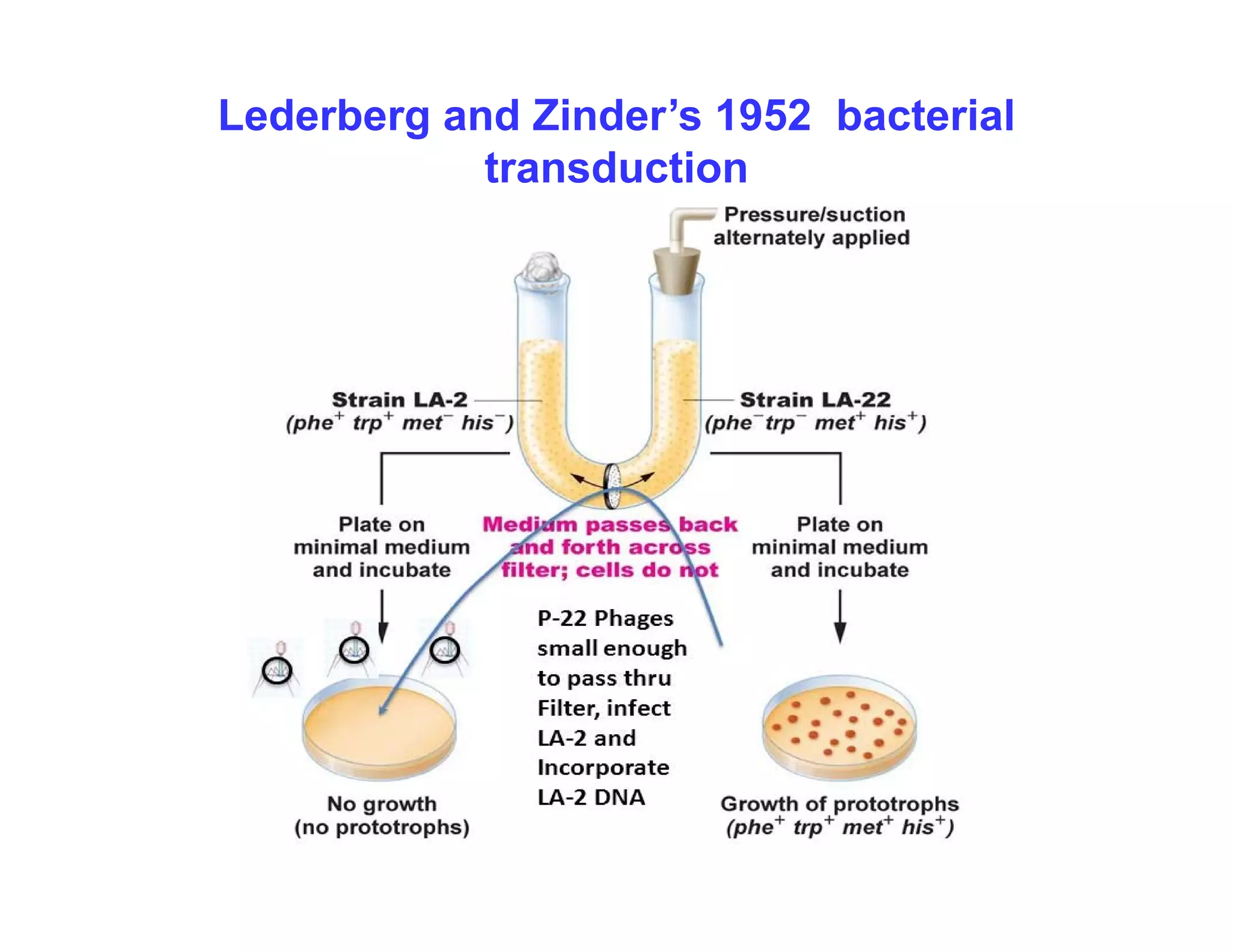
Lederberg and Zinder’s 1952 bacterial
transduction
transduction
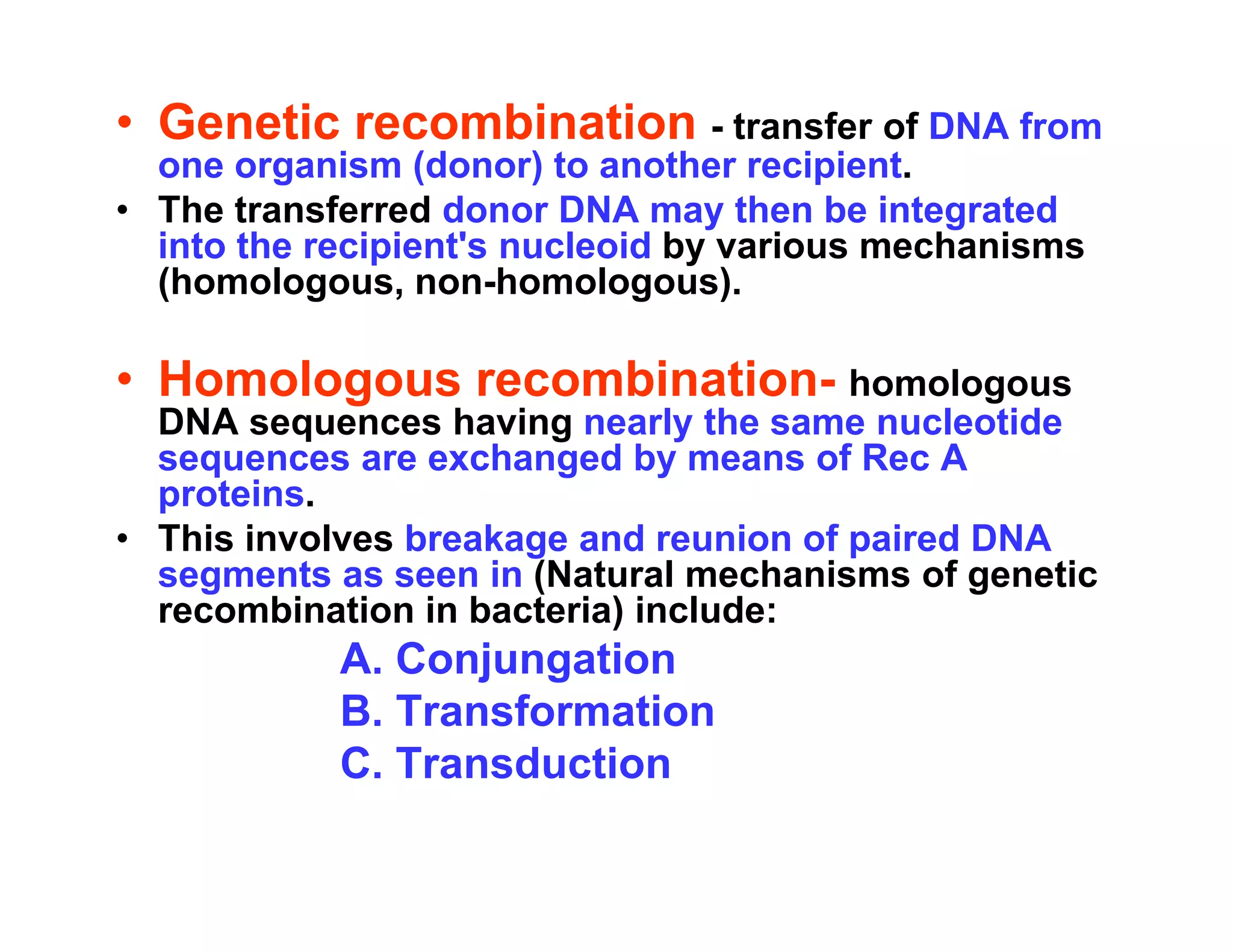
• Genetic recombination - transfer of DNA from
one organism (donor) to another recipient.
• The transferred donor DNA may then be integrated
into the recipient's nucleoid by various mechanisms
(homologous, non-homologous).
( g , g )
• Homologous recombination- homologous
DNA sequences having nearly the same nucleotide
sequences are exchanged by means of Rec A
proteins.
• This involves breakage and reunion of paired DNA
segments as seen in (Natural mechanisms of genetic
recombination in bacteria) include:
A Conjungation
A. Conjungation
B. Transformation
C. Transduction
C. Transduction
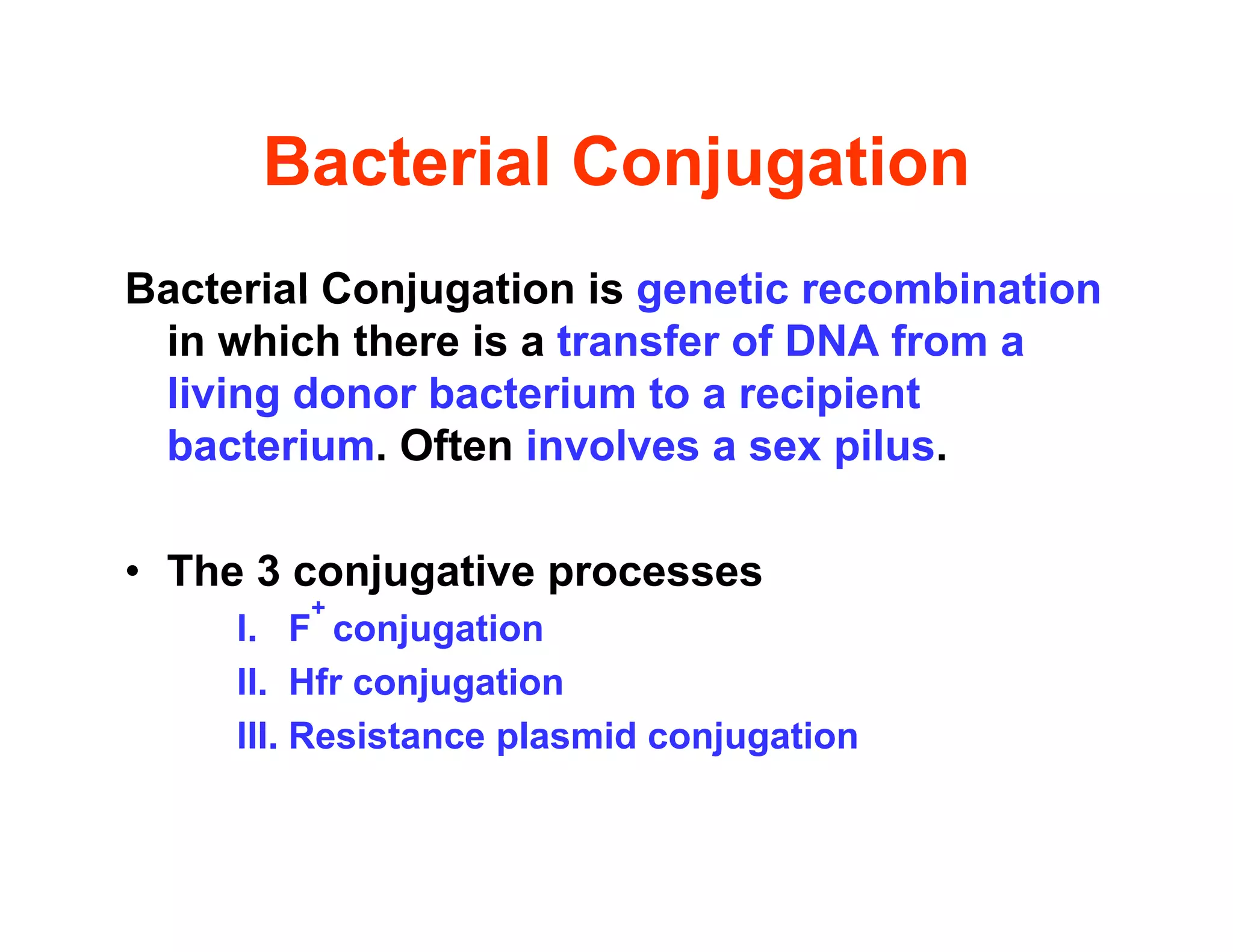
Bacterial Conjugation
Bacterial Conjugation is genetic recombination
in which there is a transfer of DNA from a
living donor bacterium to a recipient
g p
bacterium. Often involves a sex pilus.
• The 3 conjugative processes
I. F
+
conjugation
II. Hfr conjugation
III. Resistance plasmid conjugation
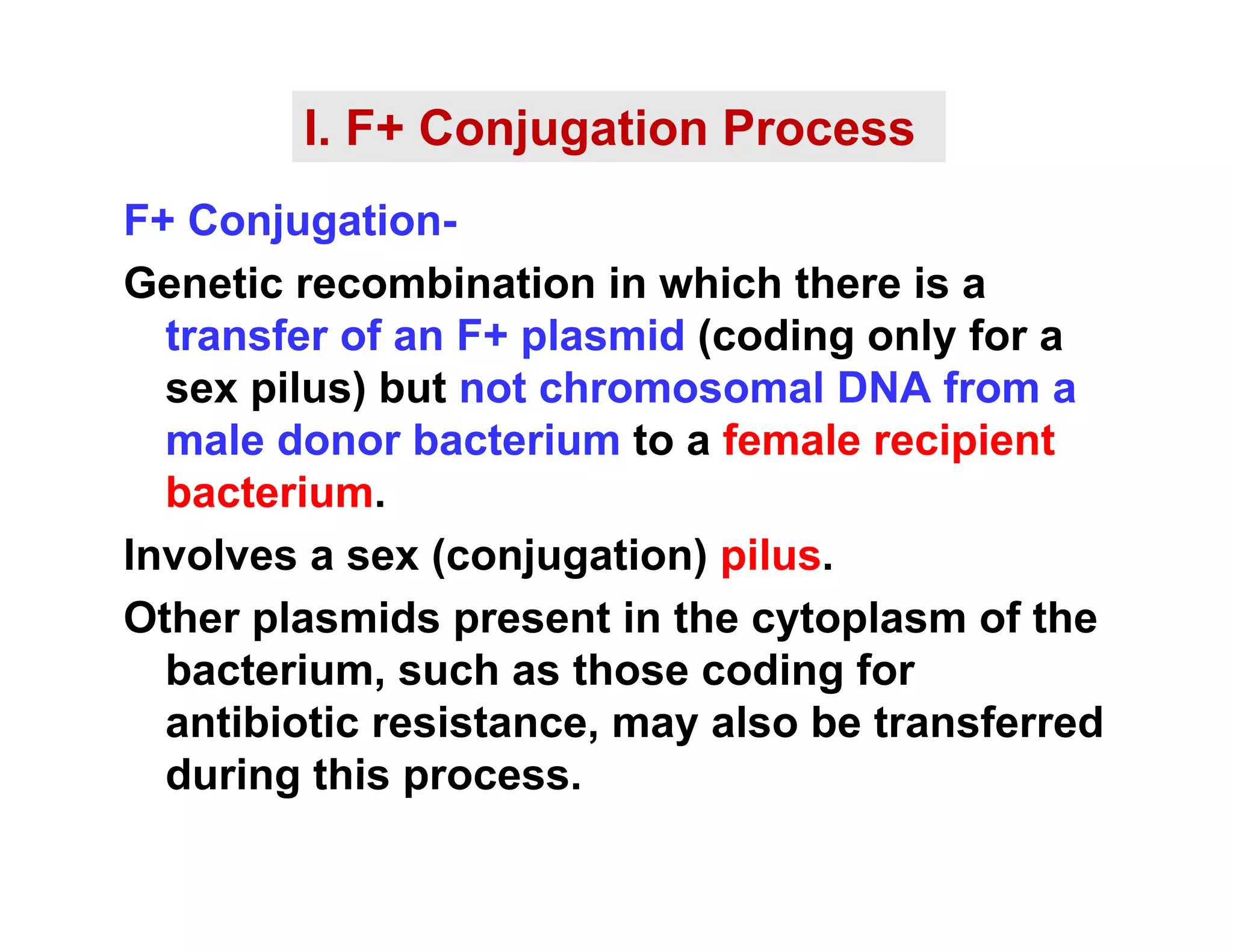
I. F+ Conjugation Process
F+ Conjugation-
Genetic recombination in which there is a
transfer of an F+ plasmid (coding only for a
sex pilus) but not chromosomal DNA from a
male donor bacterium to a female recipient
bacterium.
Involves a sex (conjugation) pilus.
Other plasmids present in the cytoplasm of the
b t i h th di f
bacterium, such as those coding for
antibiotic resistance, may also be transferred
during this process
during this process.
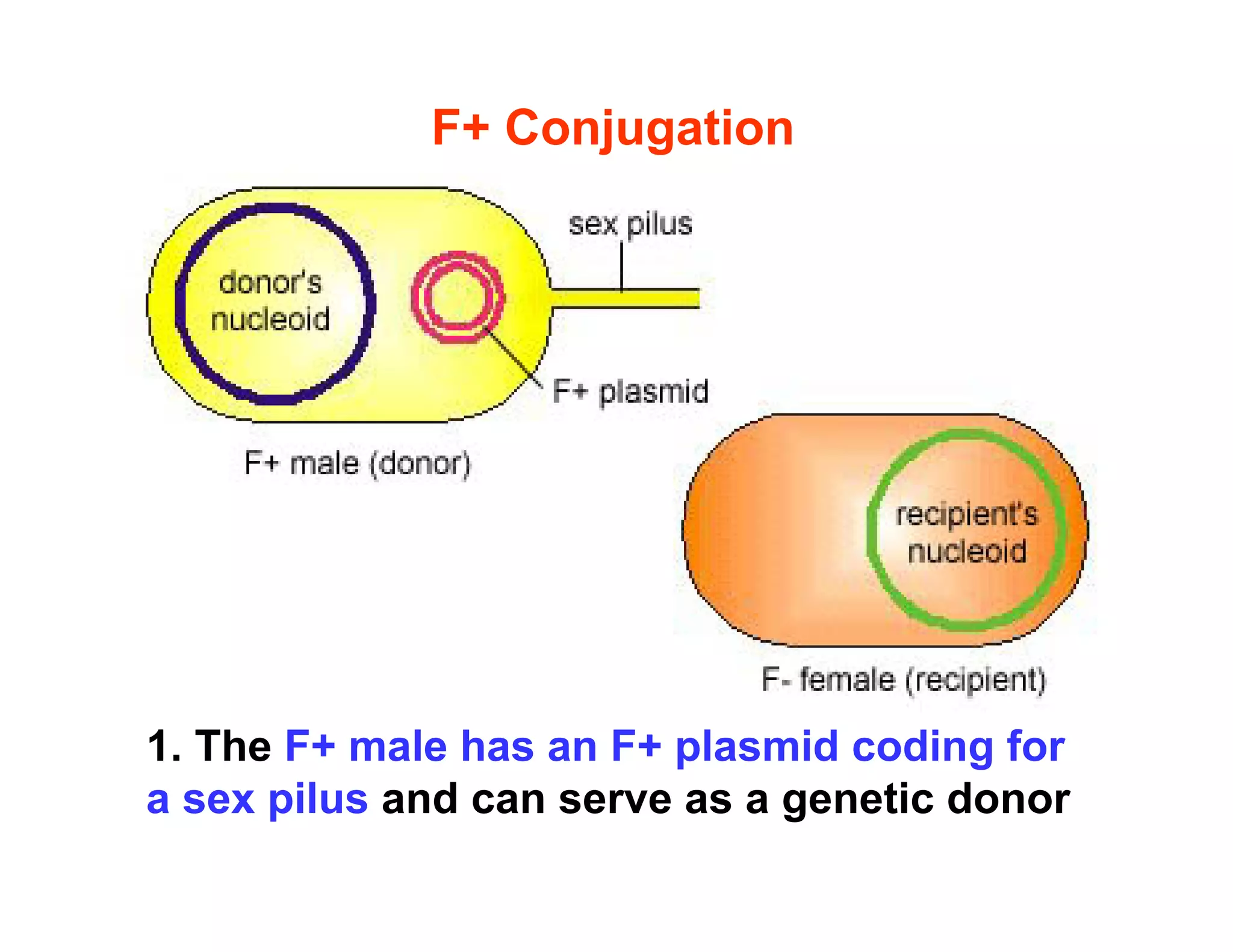
F+ Conjugation
1. The F+ male has an F+ plasmid coding for
a sex pilus and can serve as a genetic donor
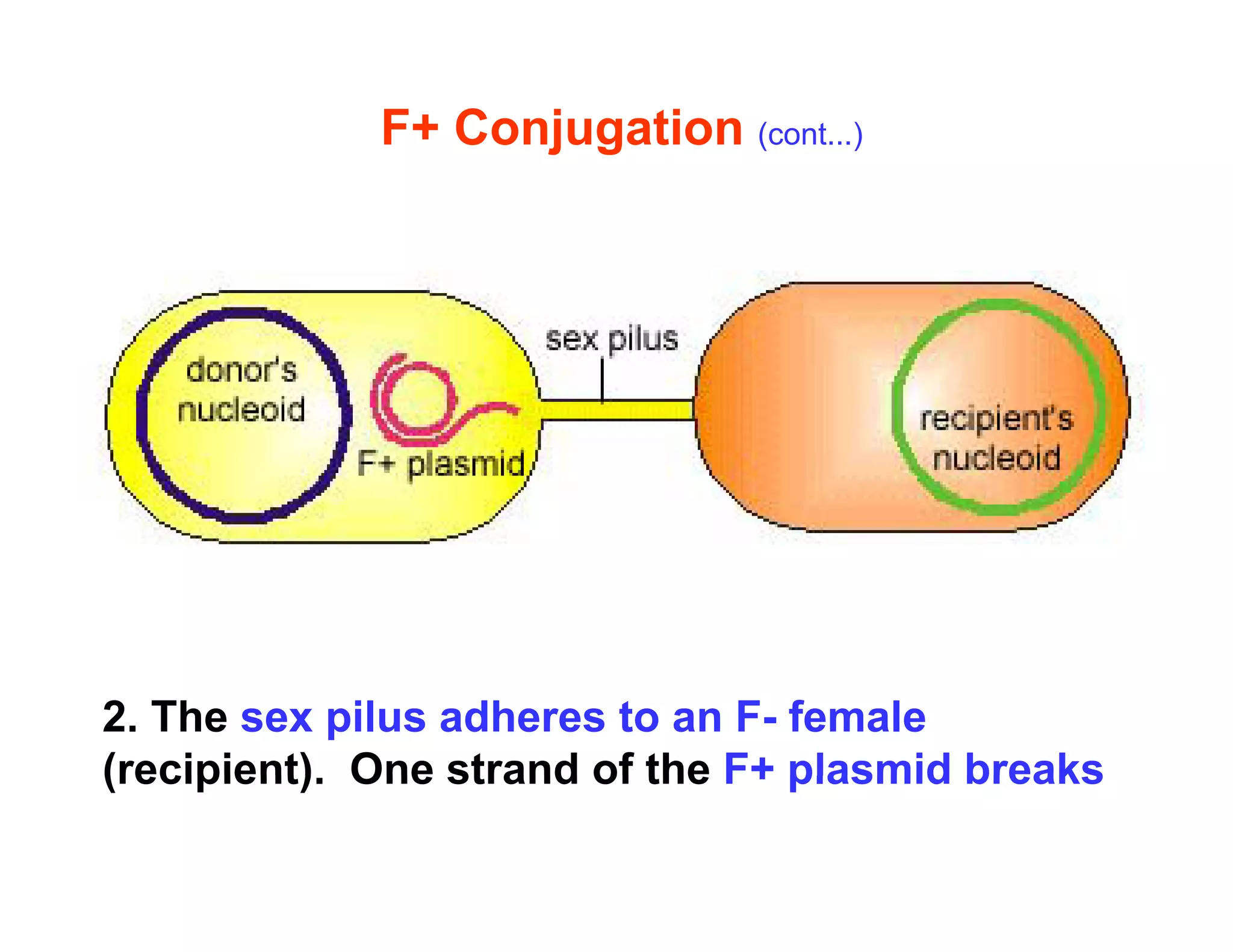
F+ Conjugation (cont...)
2. The sex pilus adheres to an F- female
(recipient) One strand of the F+ plasmid breaks
(recipient). One strand of the F+ plasmid breaks
F+ Conjugation (cont...)
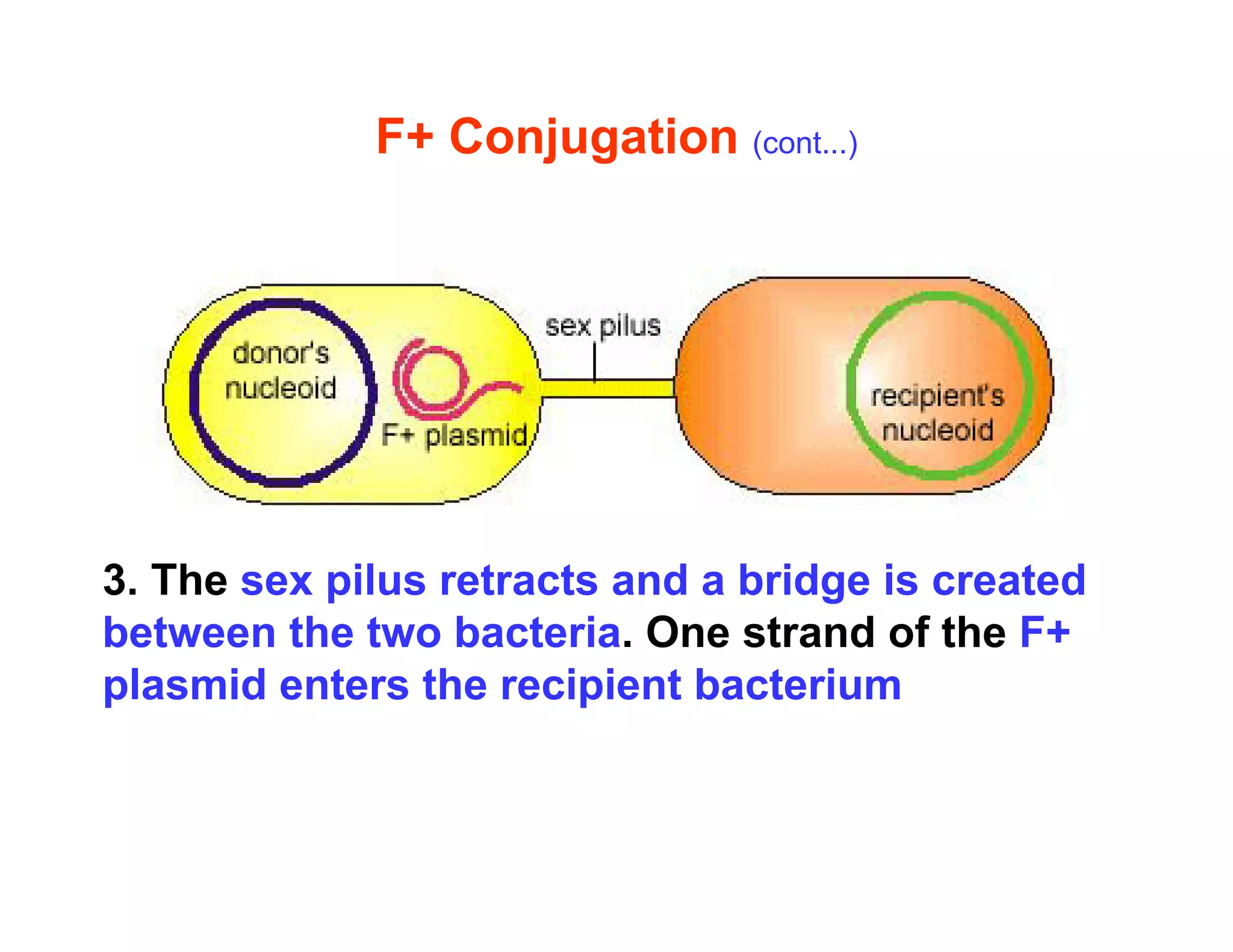
3. The sex pilus retracts and a bridge is created
between the two bacteria. One strand of the F+
plasmid enters the recipient bacterium
F+ Conjugation (cont...)
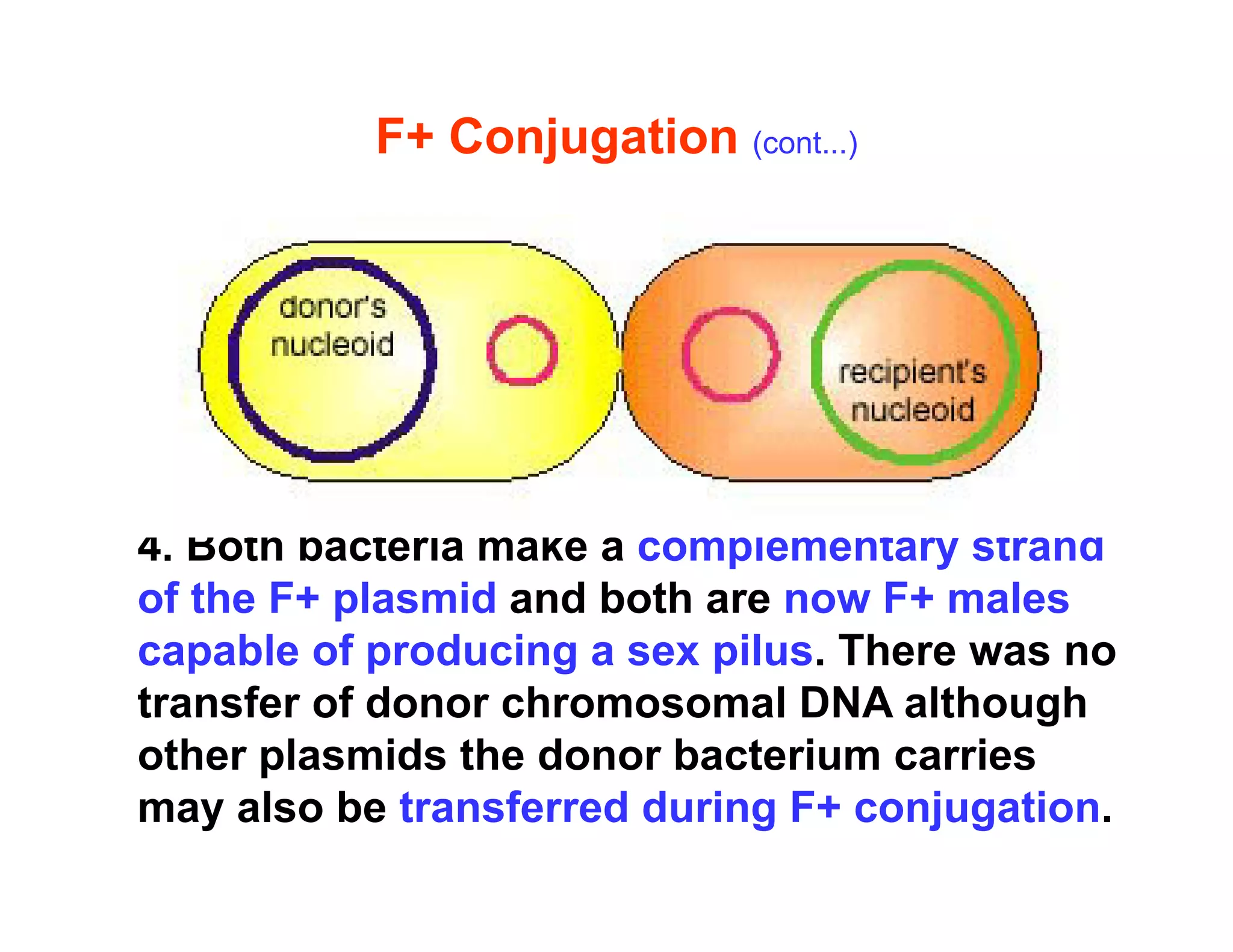
4 B th b t i k l t t d
4. Both bacteria make a complementary strand
of the F+ plasmid and both are now F+ males
capable of producing a sex pilus There was no
capable of producing a sex pilus. There was no
transfer of donor chromosomal DNA although
other plasmids the donor bacterium carries
p
may also be transferred during F+ conjugation.
II. Hfr Conjugation
Genetic recombination in which
fragments of chromosomal DNA from a
male donor bacterium are transferred to
a female recipient bacterium following
insertion of an F+ plasmid into the
nucleoid of the donor bacterium
nucleoid of the donor bacterium.
Involves a sex (conjugation) pilus.
Hfr Conjugation
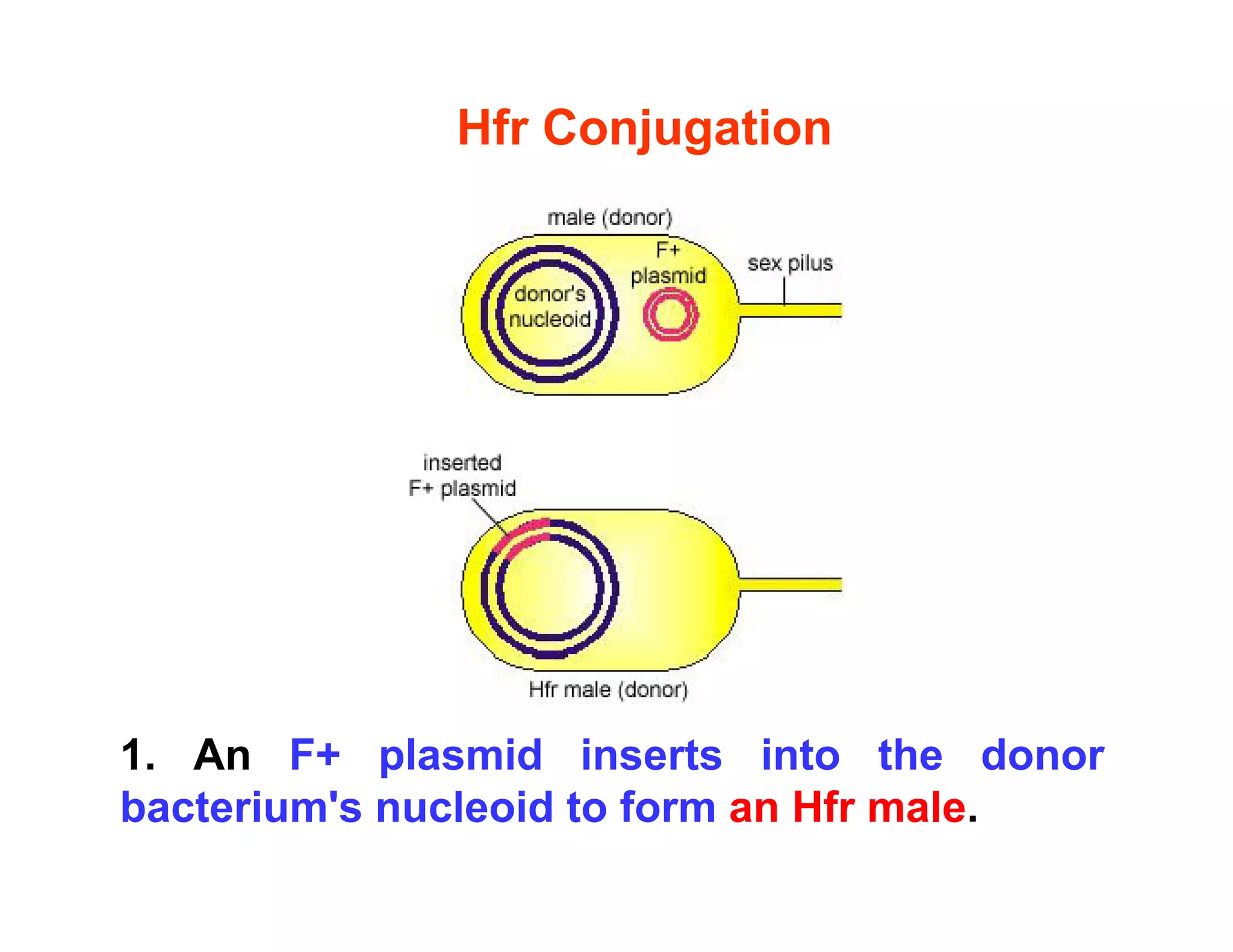
1. An F+ plasmid inserts into the donor
p
bacterium's nucleoid to form an Hfr male.
Hfr Conjugation (cont....)
j g
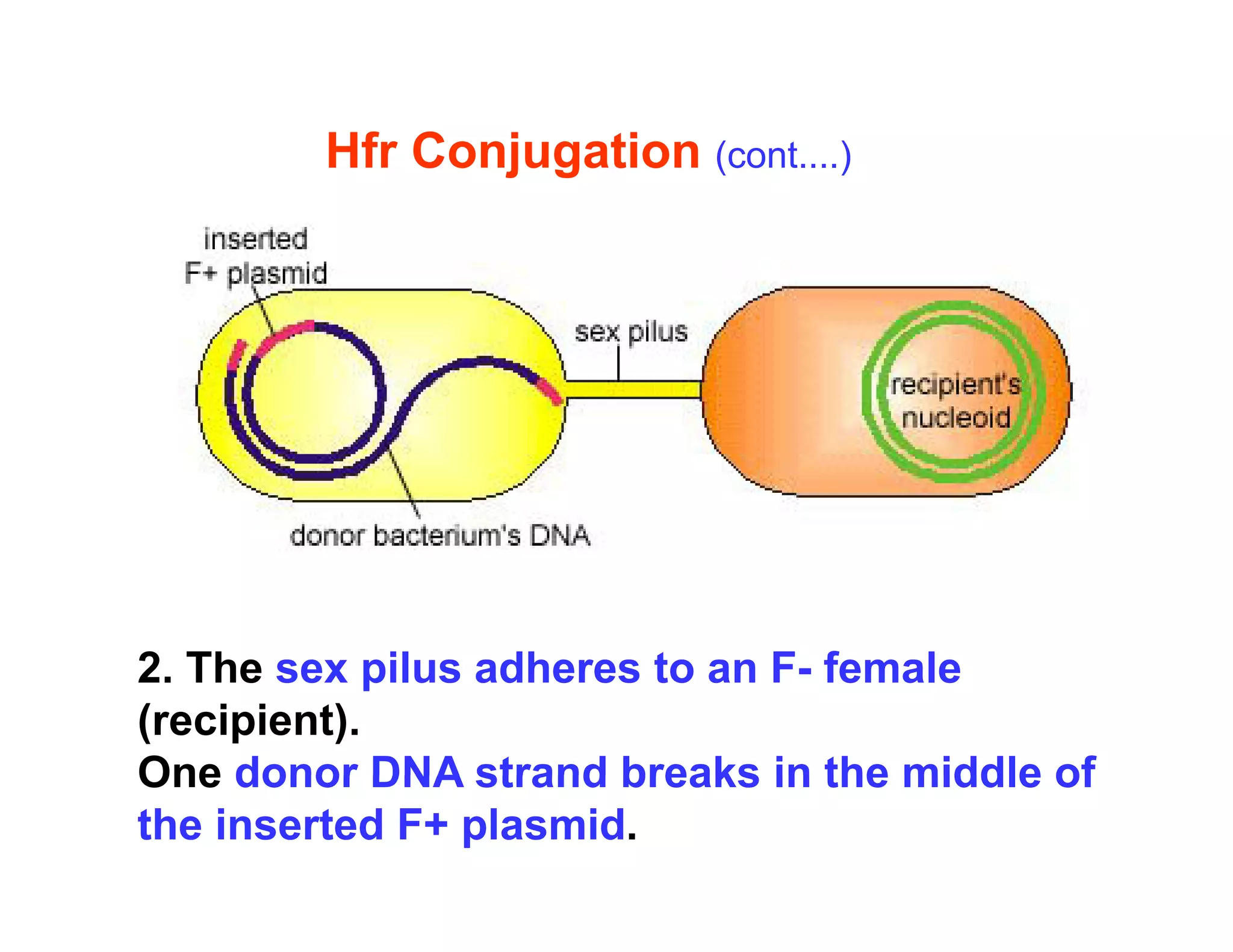
2 Th il dh t F f l
2. The sex pilus adheres to an F- female
(recipient).
One donor DNA strand breaks in the middle of
the inserted F+ plasmid.
Hfr Conjugation (cont...)
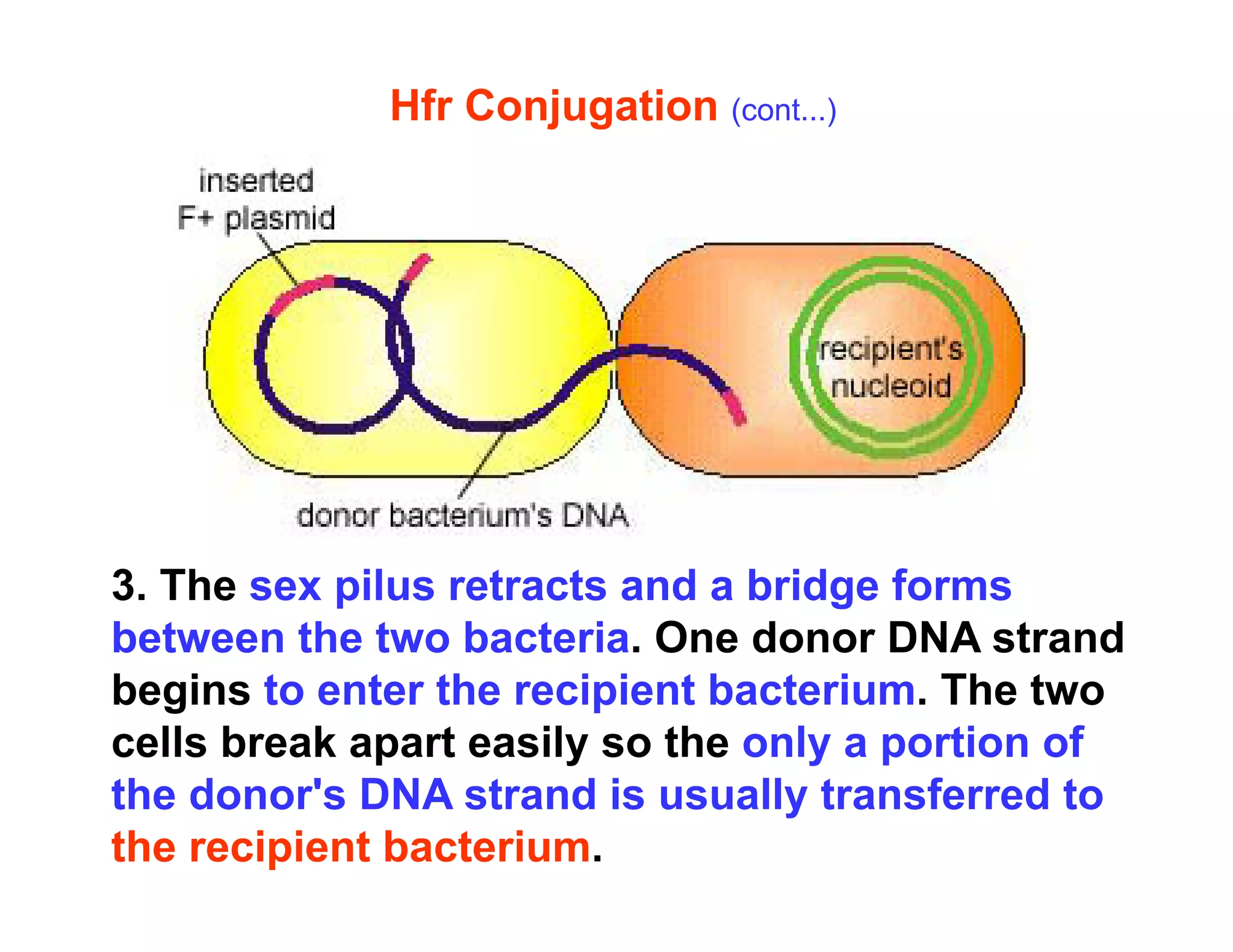
3. The sex pilus retracts and a bridge forms
between the two bacteria. One donor DNA strand
begins to enter the recipient bacterium. The two
cells break apart easily so the only a portion of
the donor's DNA strand is usually transferred to
the recipient bacterium.
Hfr Conjugation (cont...)
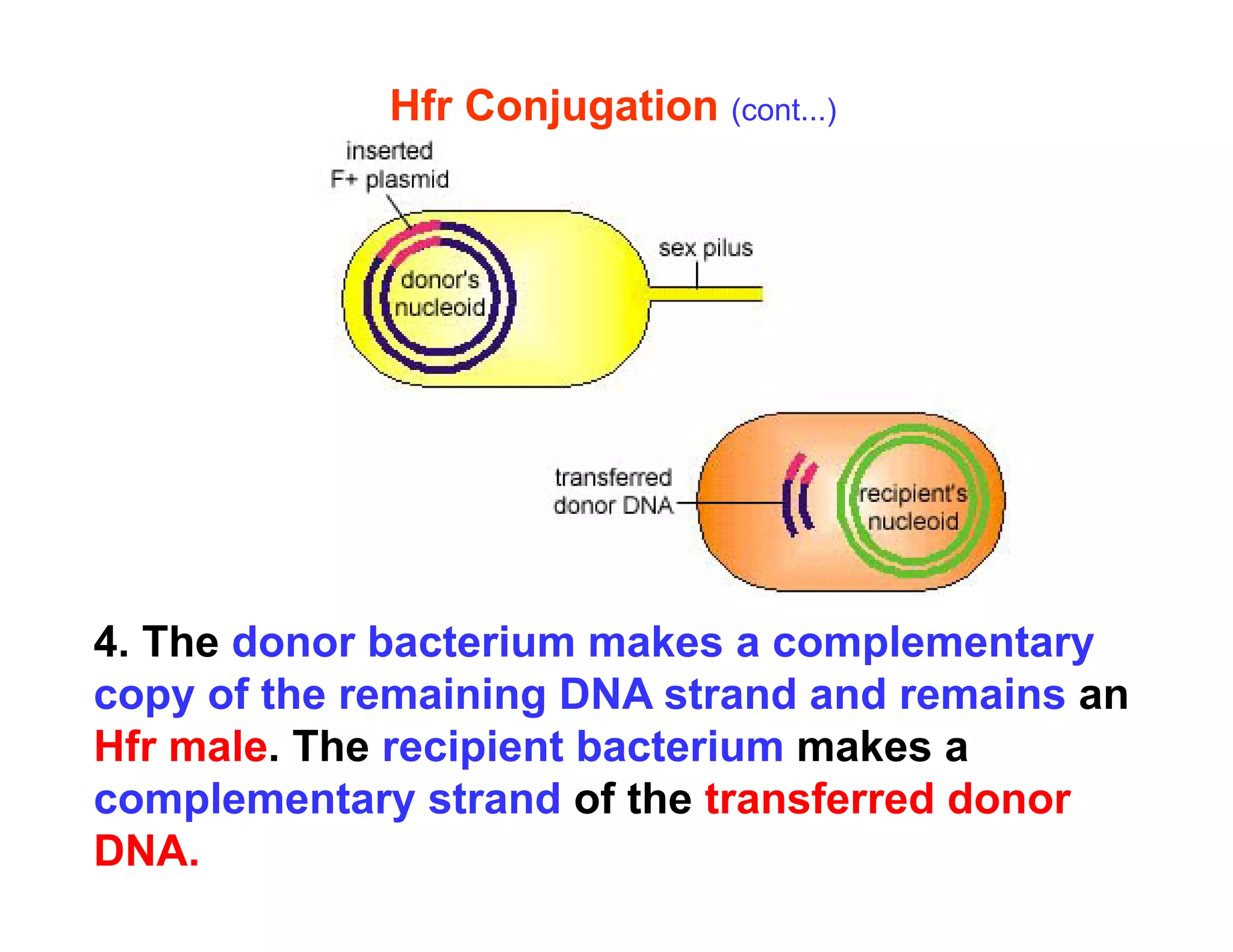
4. The donor bacterium makes a complementary
copy of the remaining DNA strand and remains an
Hfr male. The recipient bacterium makes a
complementary strand of the transferred donor
DNA.
Hfr Conjugation (cont’d)
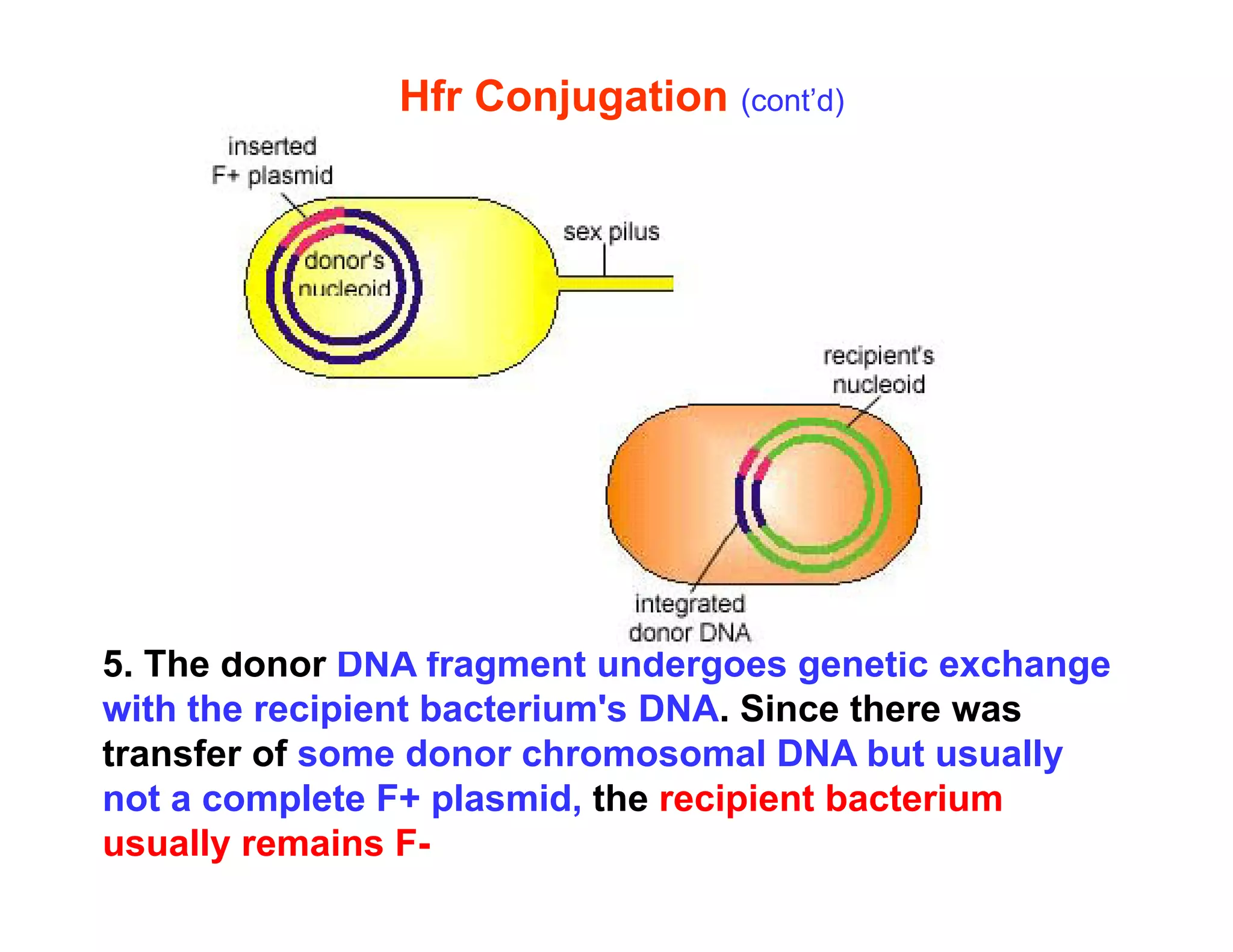
5 Th d DNA f t d ti h
5. The donor DNA fragment undergoes genetic exchange
with the recipient bacterium's DNA. Since there was
transfer of some donor chromosomal DNA but usually
not a complete F+ plasmid, the recipient bacterium
usually remains F-
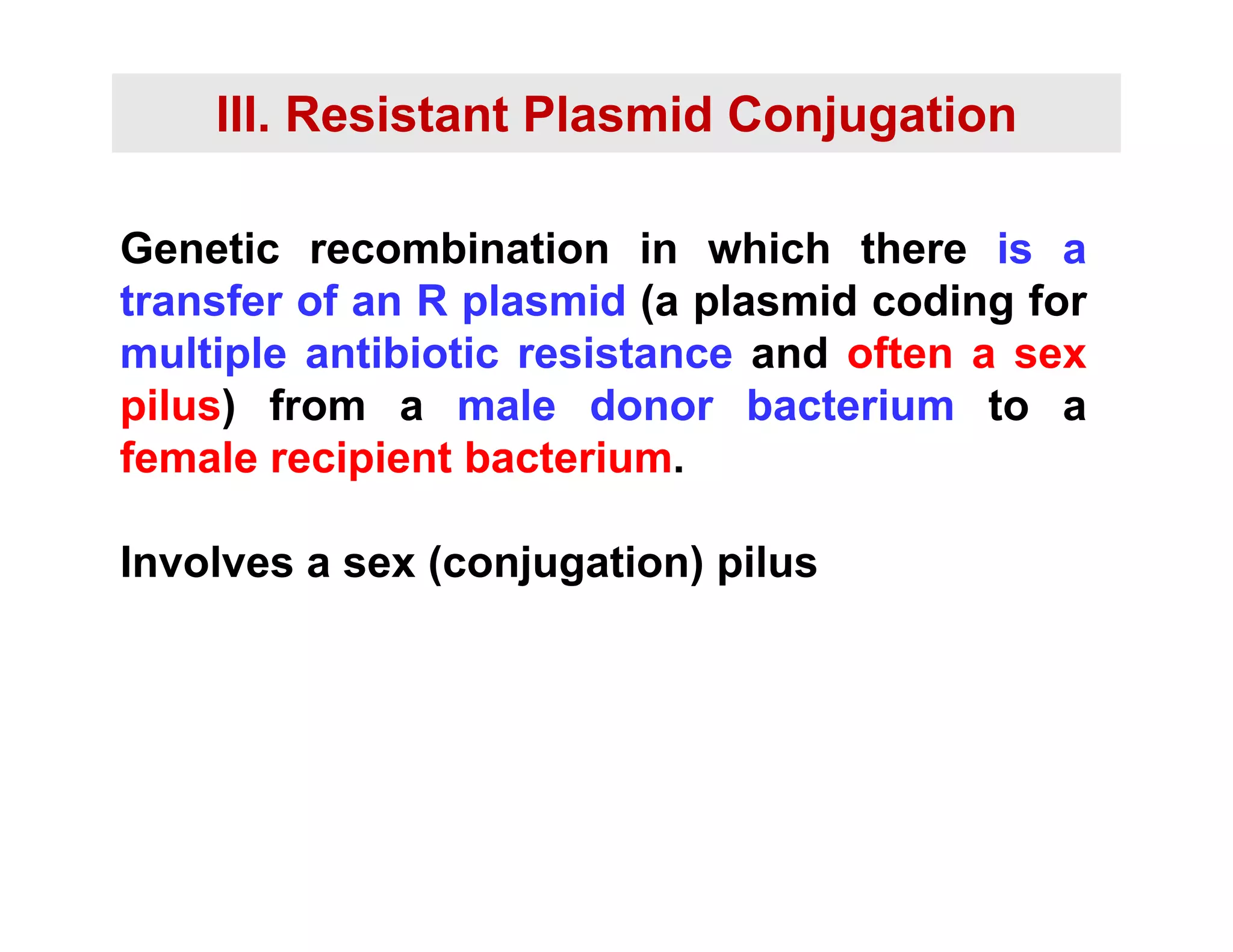
III. Resistant Plasmid Conjugation
Genetic recombination in which there is a
transfer of an R plasmid (a plasmid coding for
multiple antibiotic resistance and often a sex
pilus) from a male donor bacterium to a
female recipient bacterium.
Involves a sex (conjugation) pilus
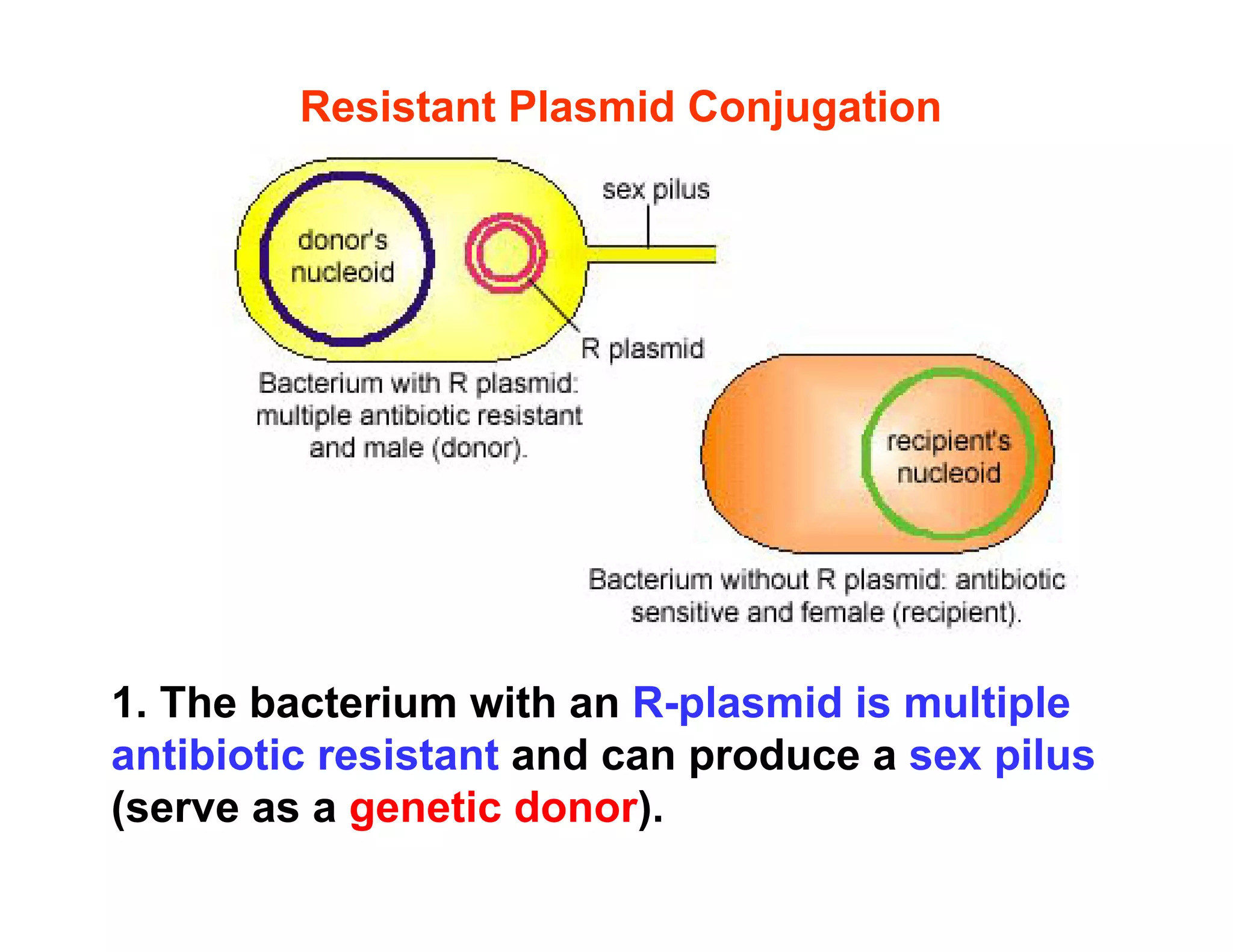
Resistant Plasmid Conjugation
1. The bacterium with an R-plasmid is multiple
antibiotic resistant and can produce a sex pilus
p p
(serve as a genetic donor).
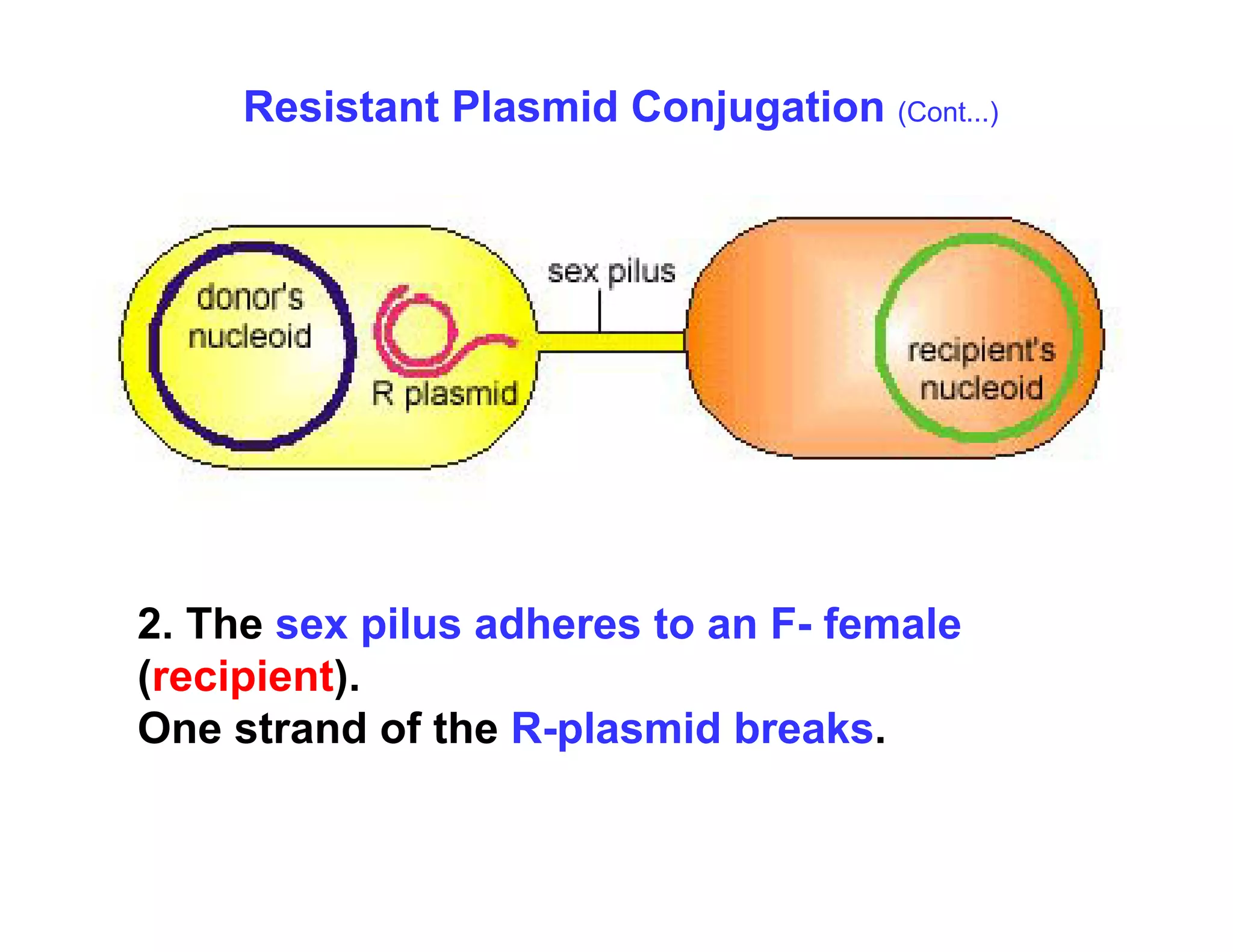
Resistant Plasmid Conjugation (Cont...)
2. The sex pilus adheres to an F- female
(recipient).
One strand of the R-plasmid breaks.
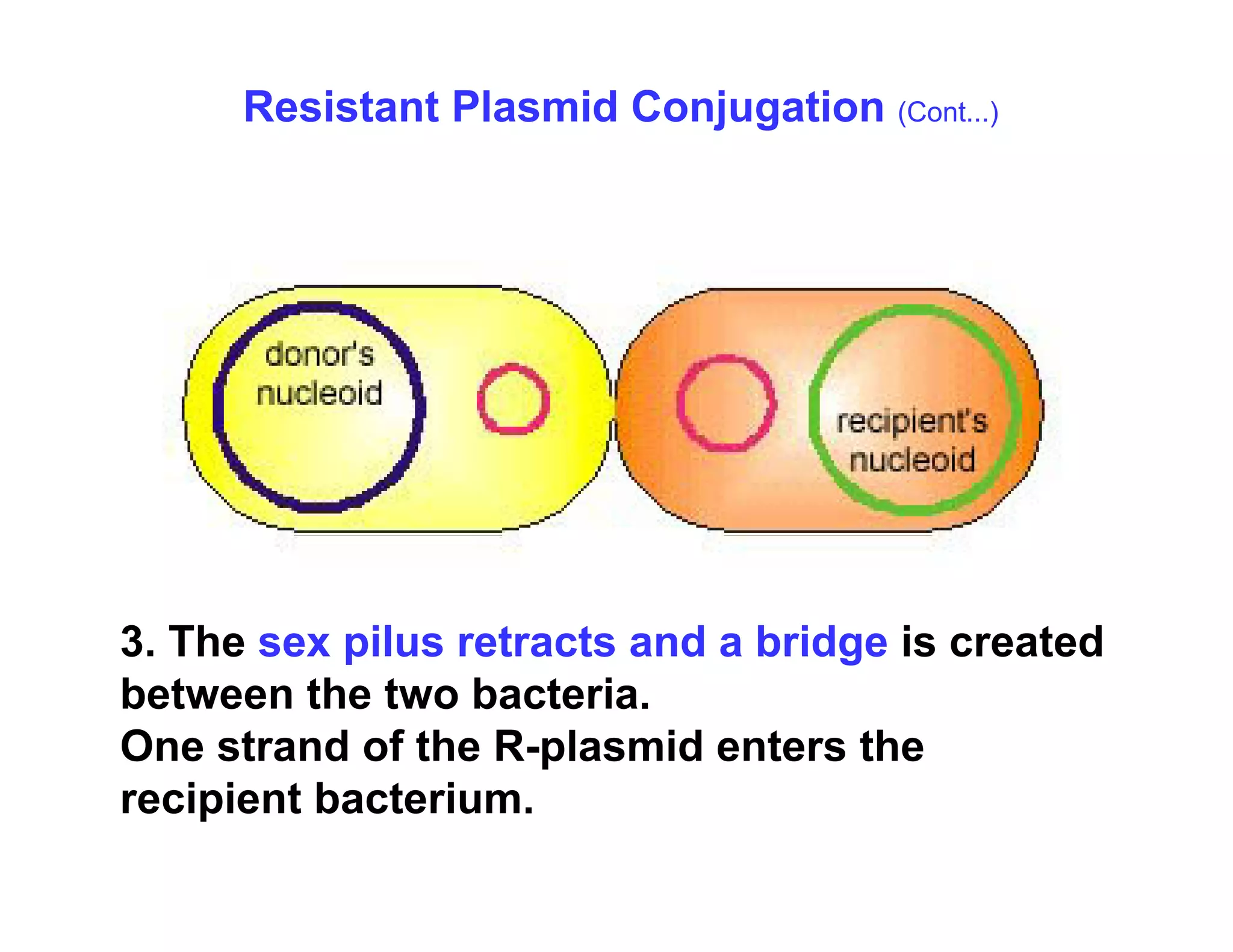
Resistant Plasmid Conjugation (Cont...)
3. The sex pilus retracts and a bridge is created
between the two bacteria.
One strand of the R-plasmid enters the
recipient bacterium.
Resistant Plasmid Conjugation (Cont...)
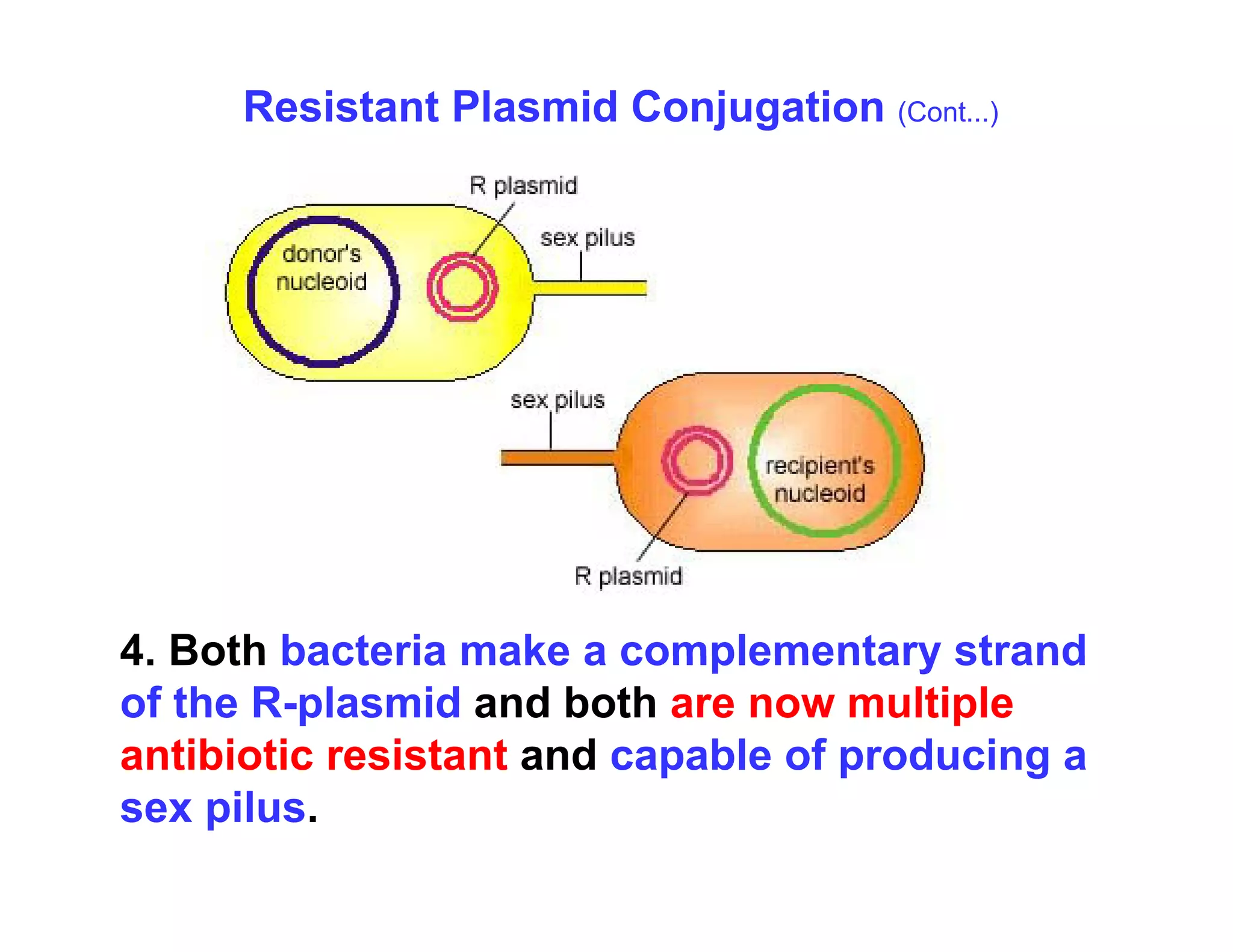
4 Both bacteria make a complementary strand
4. Both bacteria make a complementary strand
of the R-plasmid and both are now multiple
antibiotic resistant and capable of producing a
p p g
sex pilus.
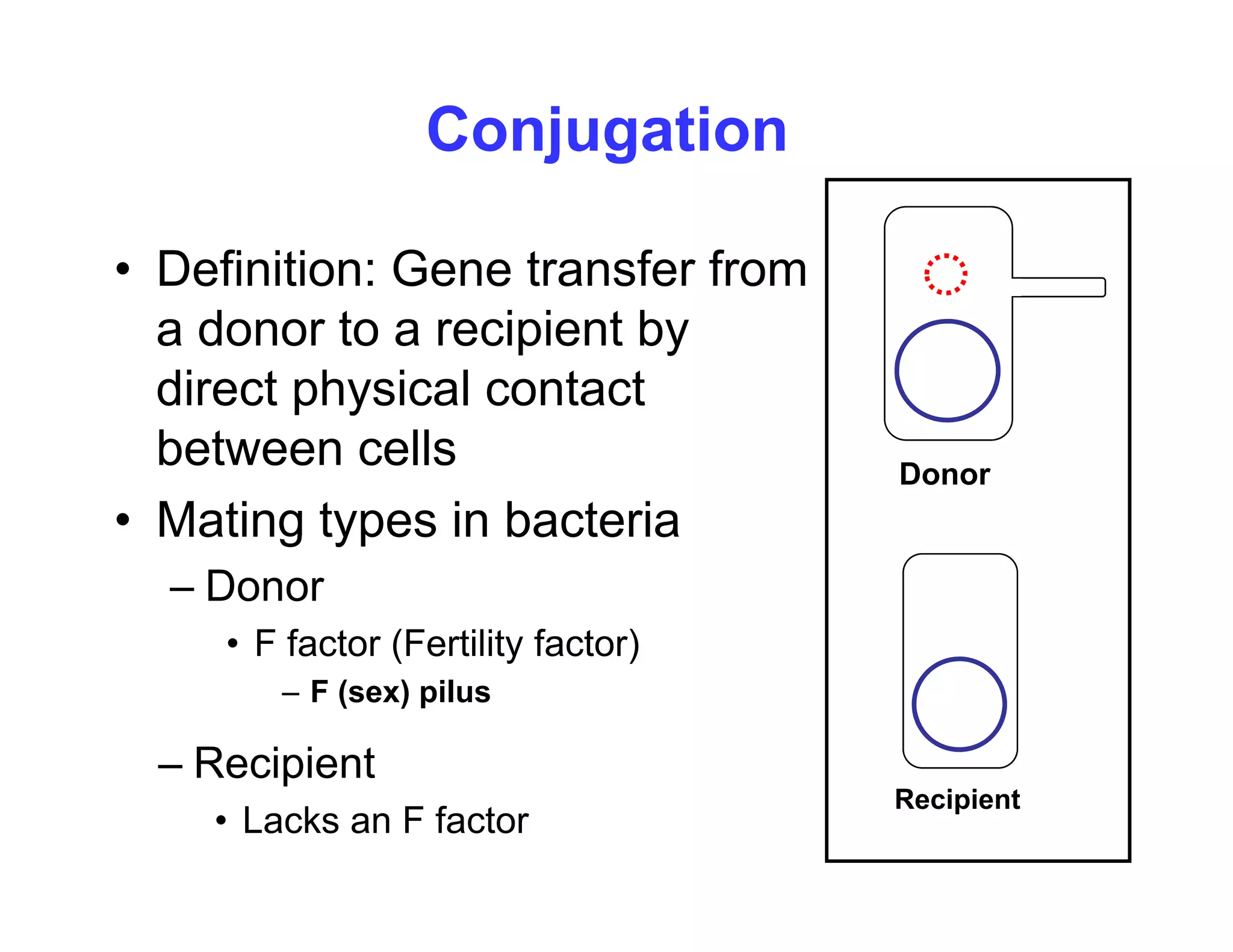
Conjugation
• Definition: Gene transfer from
a donor to a recipient by
direct physical contact
between cells
• Mating types in bacteria
Donor
Mating types in bacteria
– Donor
• F factor (Fertility factor)
F factor (Fertility factor)
– F (sex) pilus
– Recipient
Recipient
Recipient
• Lacks an F factor
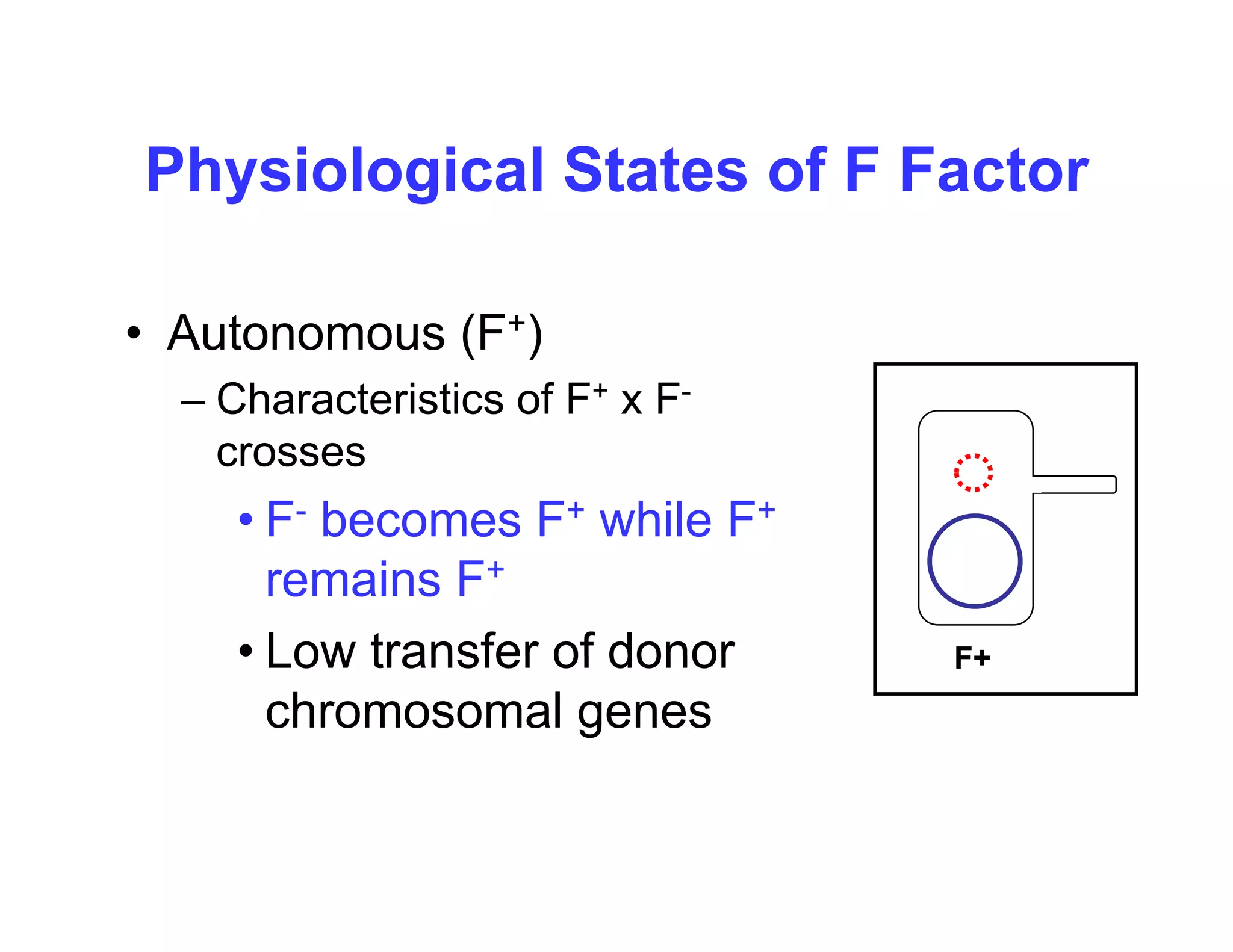
Physiological States of F Factor
• Autonomous (F+)
– Characteristics of F+ x F-
crosses
• F- becomes F+ while F+
F becomes F while F
remains F+
• Low transfer of donor F+
• Low transfer of donor
chromosomal genes
F+
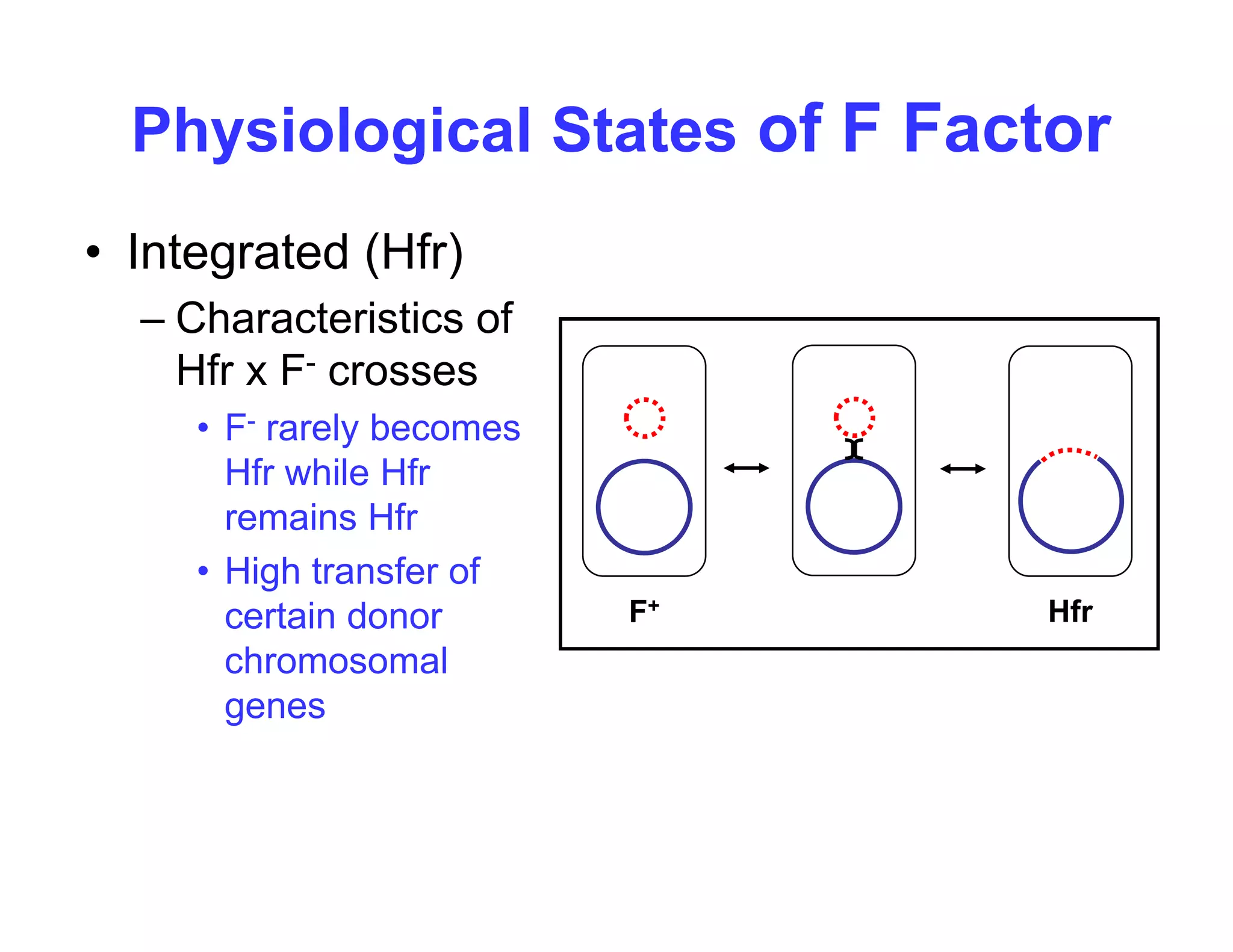
Physiological States of F Factor
• Integrated (Hfr)
– Characteristics of
Hfr x F- crosses
F l b
• F- rarely becomes
Hfr while Hfr
remains Hfr
• High transfer of
certain donor
chromosomal
F+ Hfr
chromosomal
genes
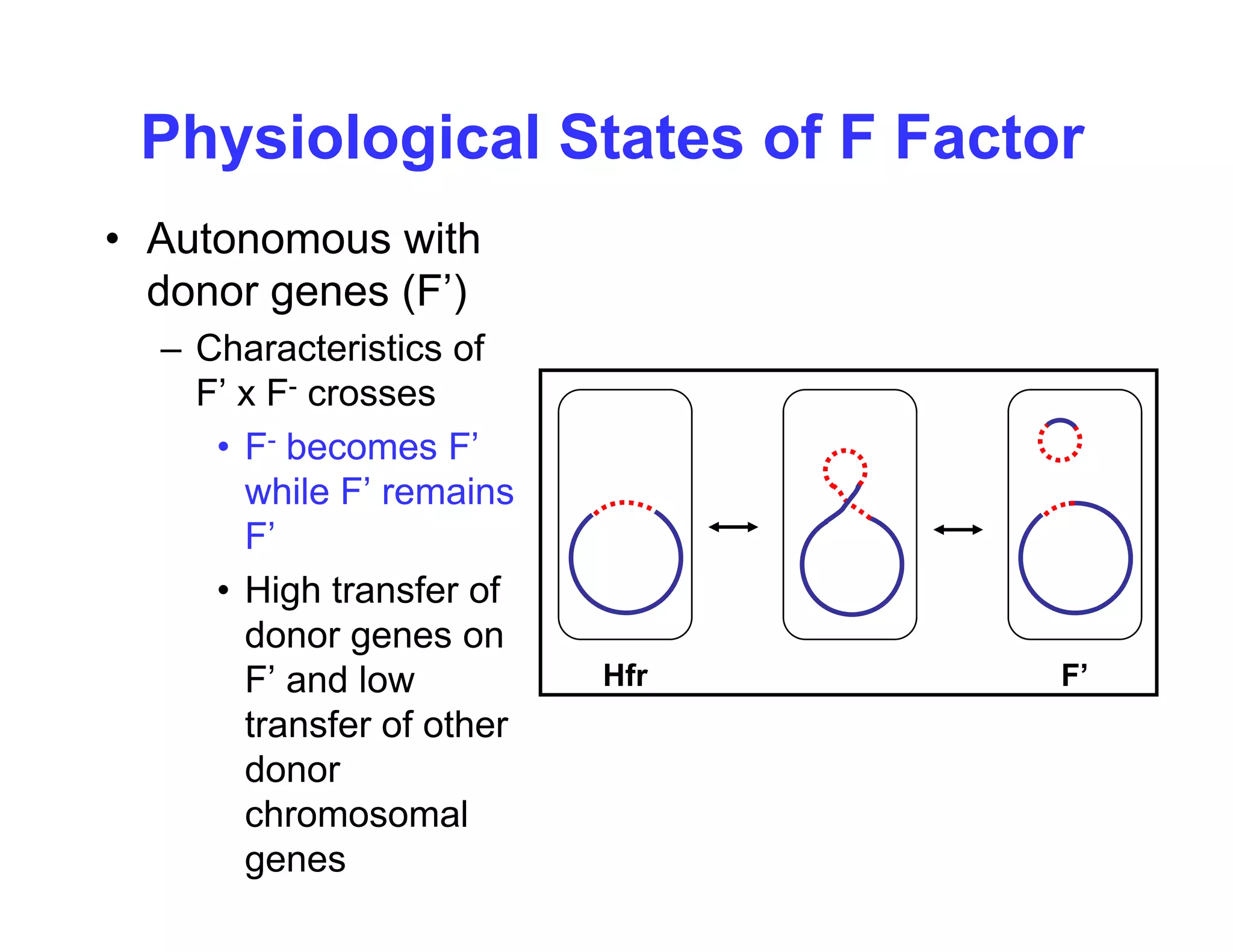
Physiological States of F Factor
• Autonomous with
donor genes (F’)
donor genes (F )
– Characteristics of
F’ x F- crosses
• F- becomes F’
while F’ remains
F’
F
• High transfer of
donor genes on
F’ and low
transfer of other
donor
Hfr F’
donor
chromosomal
genes
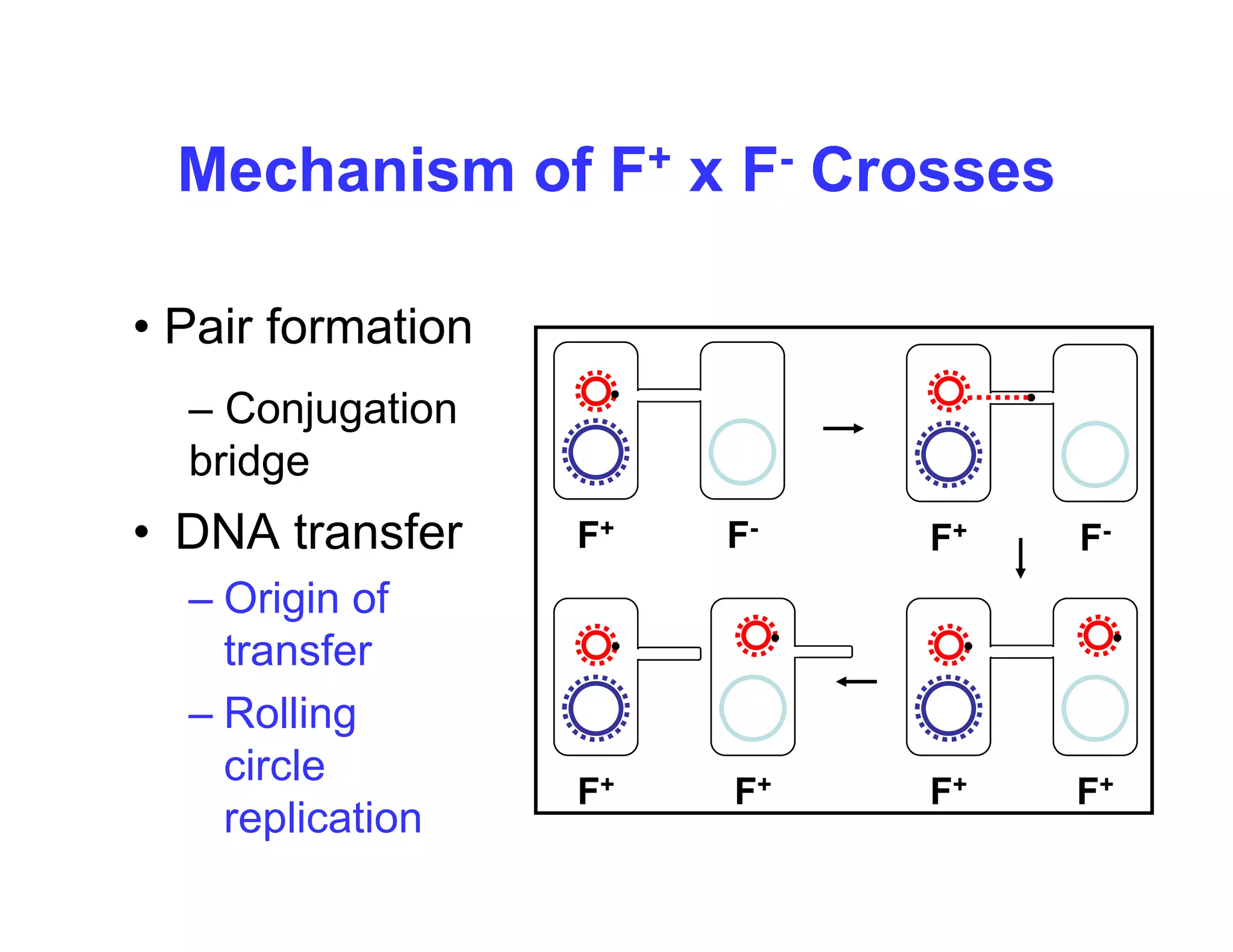
Mechanism of F+ x F- Crosses
Mechanism of F x F Crosses
• Pair formation
– Conjugation
• DNA transfer
Conjugation
bridge
F+ F-
F+ F-
• DNA transfer
– Origin of
transfer
F F F+ F
transfer
– Rolling
circle
circle
replication
F+ F+
F+ F+
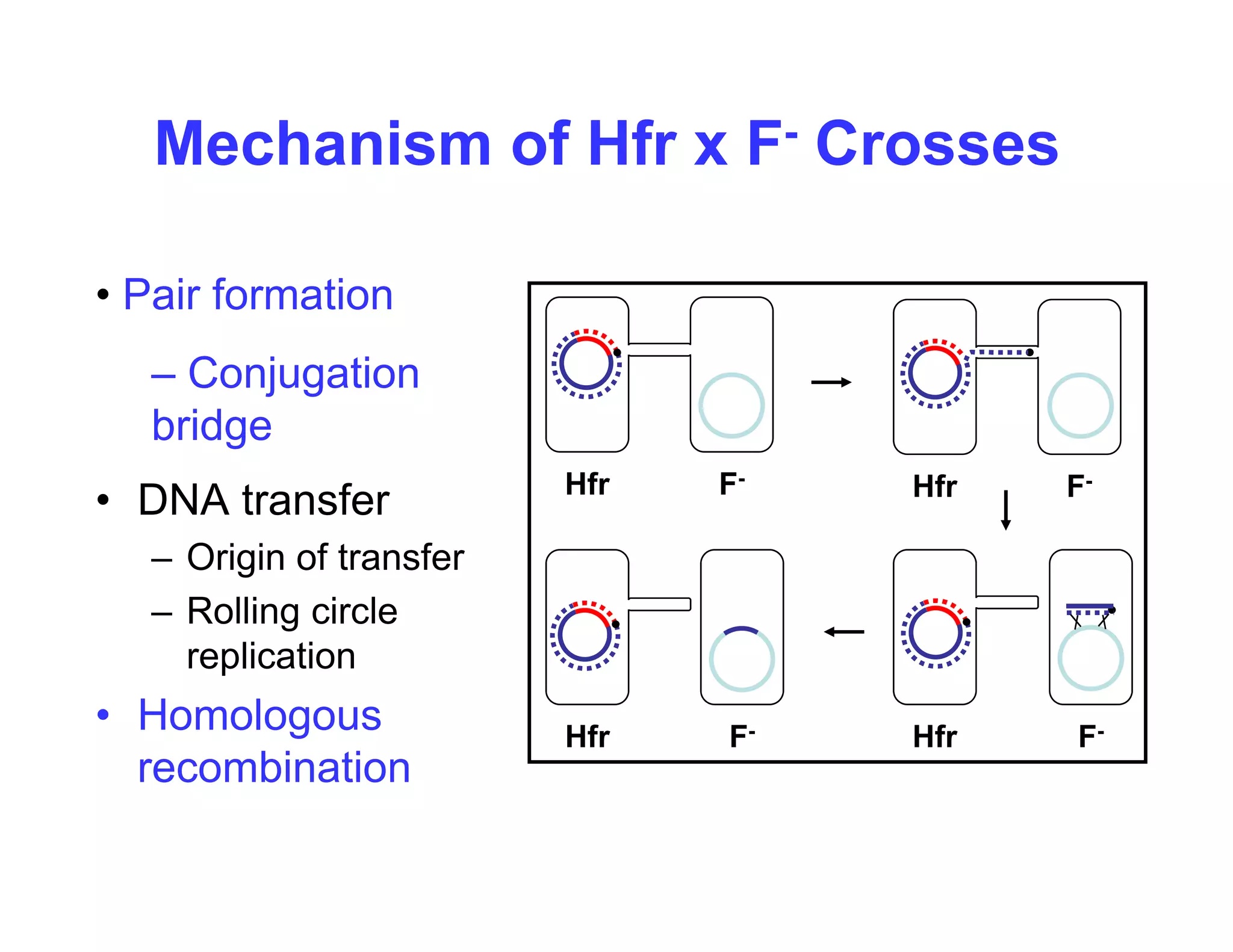
Mechanism of Hfr x F- Crosses
• Pair formation
• Pair formation
– Conjugation
b id
• DNA transfer
bridge
Hfr F-
Hfr F-
– Origin of transfer
– Rolling circle
replication
replication
• Homologous
recombination
Hfr F-
Hfr F-
recombination
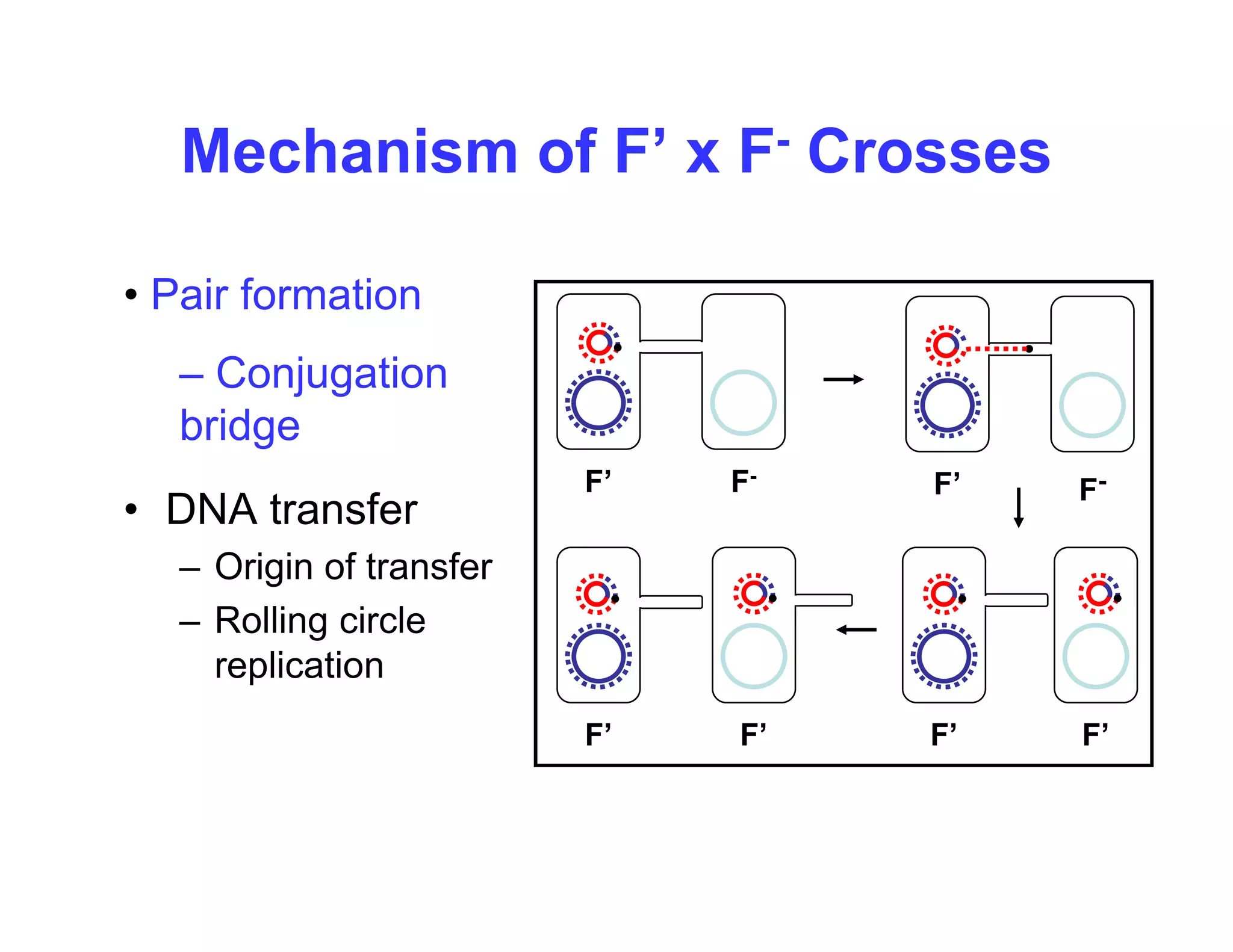
Mechanism of F’ x F- Crosses
• Pair formation
• Pair formation
– Conjugation
b id
• DNA transfer
bridge
F’ F-
F’ F-
– Origin of transfer
– Rolling circle
li ti
replication
F’ F’
F’ F’
Conjugation
Conjugation
• Significance
• Significance
–Gram - bacteria
• Antibiotic resistance
• Rapid spread
–Gram + bacteria
• Production of adhesive material by donor
cells
Transposable Genetic Elements
• Definition: Segments of DNA that are able
Definition: Segments of DNA that are able
to move from one location to another
• Properties
– “Random” movement
– Not capable of self replication
Transposition mediated by site specific recombination
– Transposition mediated by site-specific recombination
• Transposase
– Transposition may be accompanied by duplication
Transposition may be accompanied by duplication
Types of Transposable Genetic
Elements
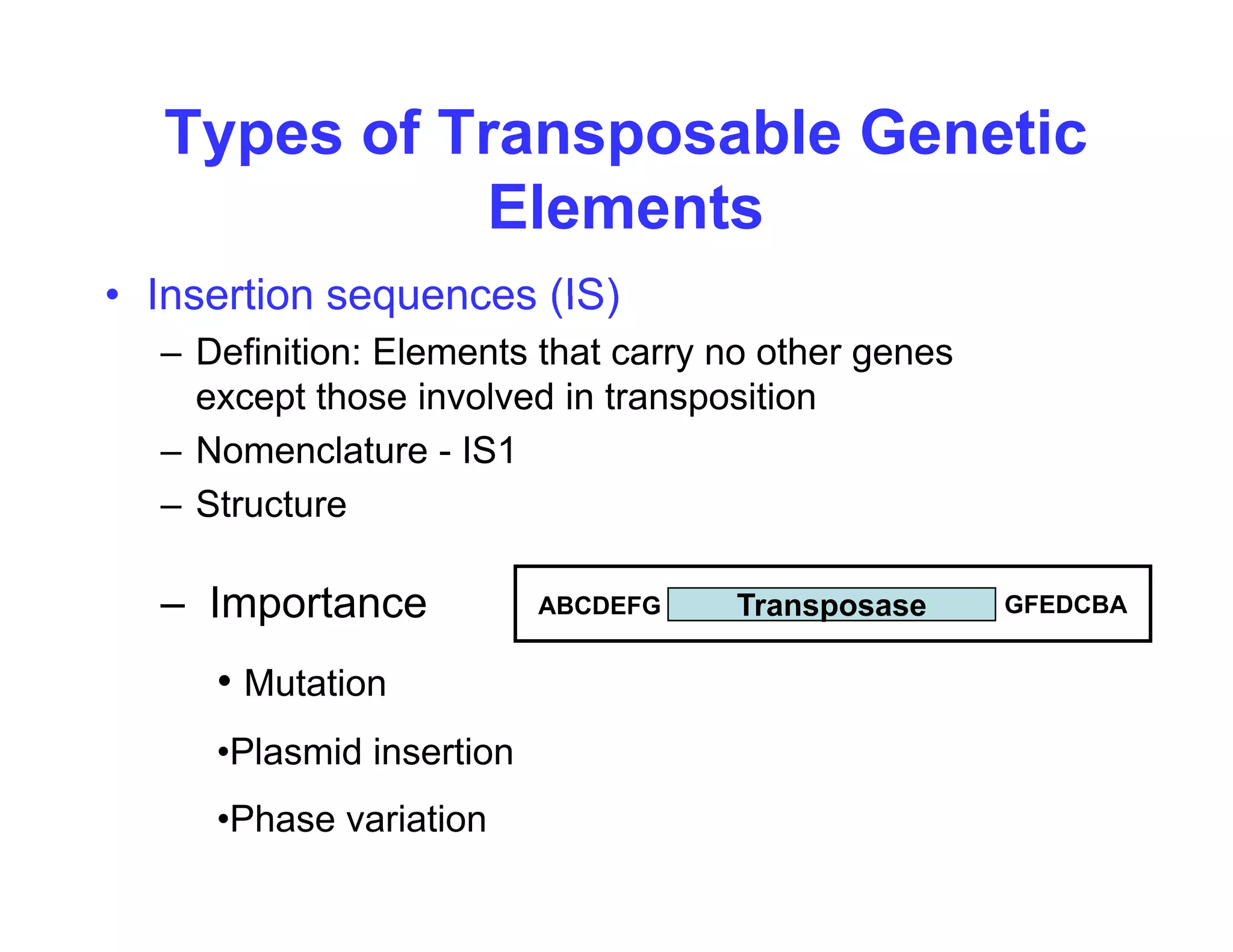
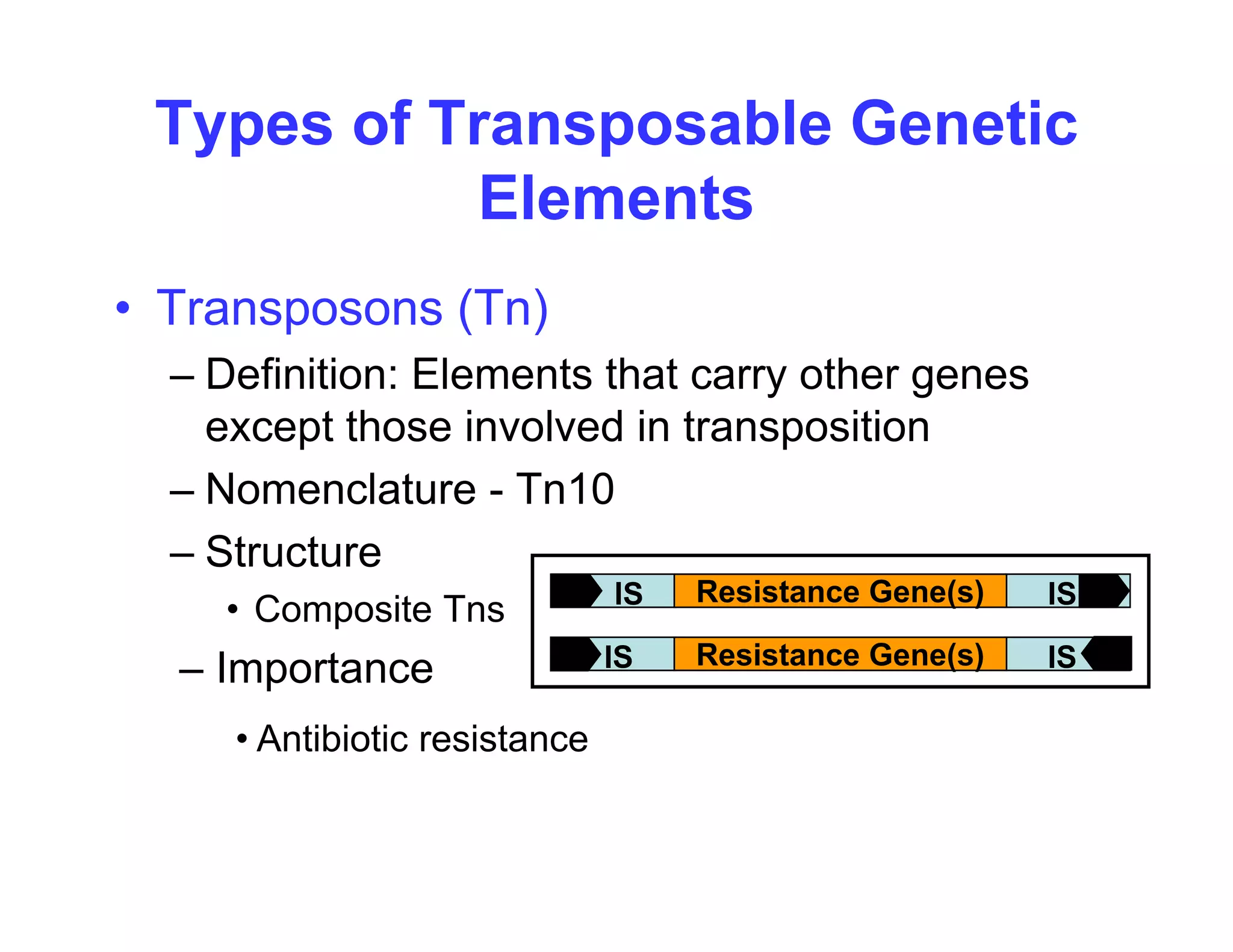
• Insertion sequences (IS)
– Definition: Elements that carry no other genes
except those involved in transposition
p p
– Nomenclature - IS1
– Structure
– Importance Transposase
ABCDEFG GFEDCBA
• Mutation
•Plasmid insertion
•Phase variation
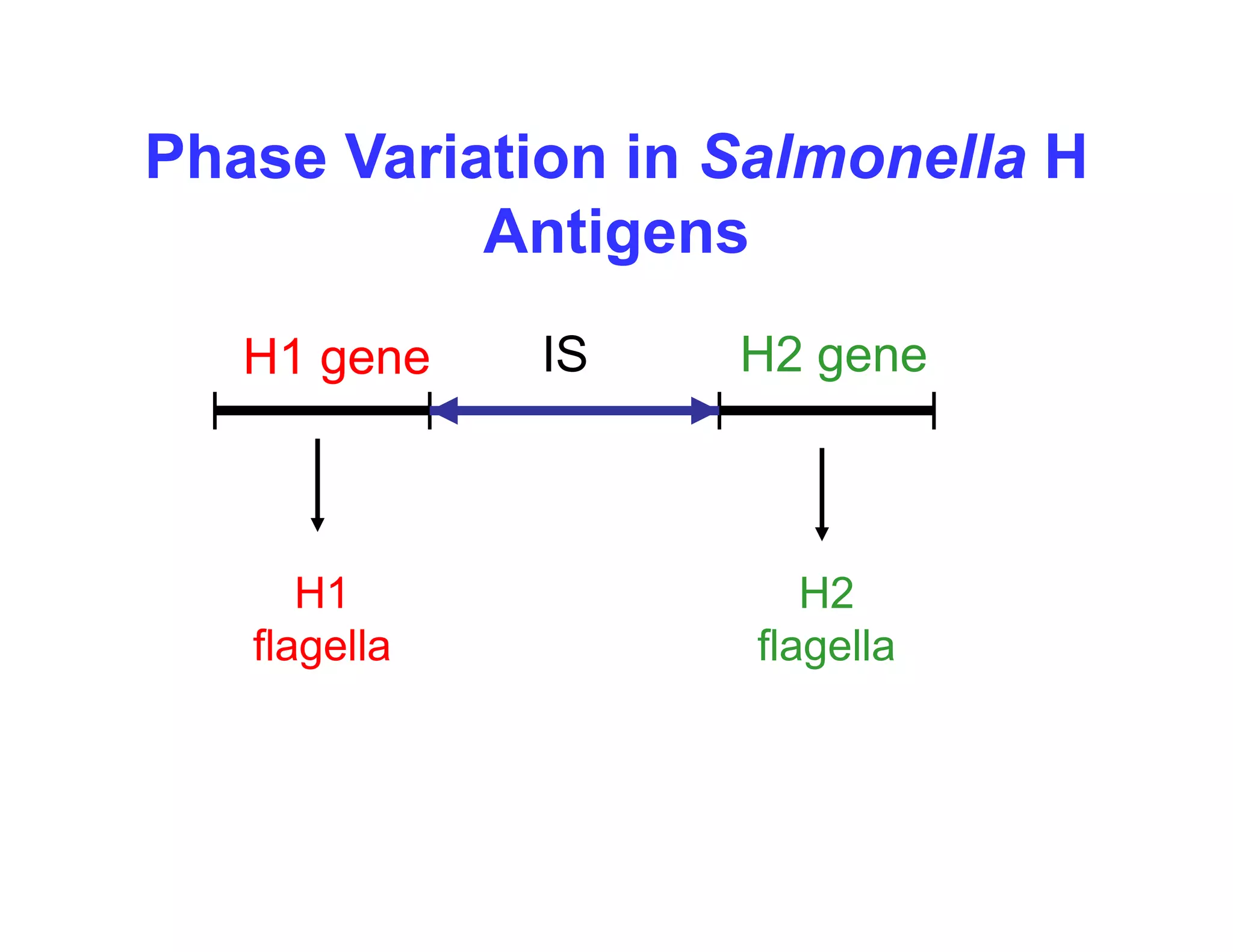
Phase Variation in Salmonella H
Antigens
IS
H1 gene H2 gene
H1
flagella
H2
flagella
flagella flagella
Types of Transposable Genetic
El t
Elements
T (T )
• Transposons (Tn)
– Definition: Elements that carry other genes
t th i l d i t iti
except those involved in transposition
– Nomenclature - Tn10
S
– Structure
• Composite Tns
I t
IS IS
Resistance Gene(s)
IS IS
Resistance Gene(s)
– Importance
• Antibiotic resistance
IS IS
Resistance Gene(s)
Plasmids
Plasmids
• Definition: Extra-chromosomal genetic
Definition: Extra chromosomal genetic
elements that are capable of autonomous
replication (replicon)
E i l id th t i t t
• Episome - a plasmid that can integrate
into the chromosome
Classification of Plasmids
• Transfer properties
Transfer properties
– Conjugative
Nonconjugative
– Nonconjugative
• Phenotypic effects
– Fertility
– Bacteriocinogenic plasmid
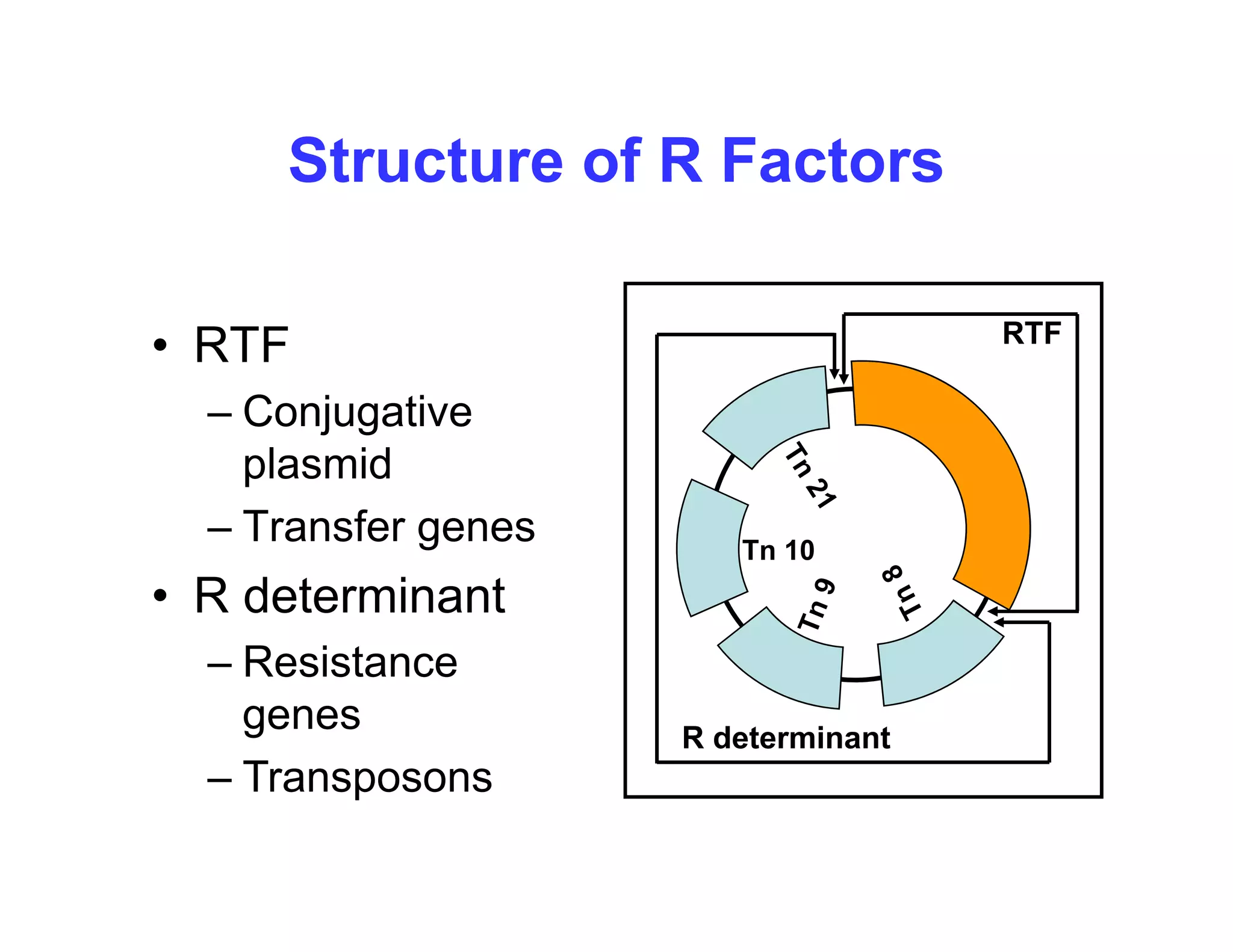
– Resistance plasmid (R factors)
Structure of R Factors
• RTF
– Conjugative
RTF
– Conjugative
plasmid
– Transfer genes
Transfer genes
• R determinant
Resistance
Tn 10
R determinant
– Resistance
genes
Transposons
– Transposons
Transformation
Transformation
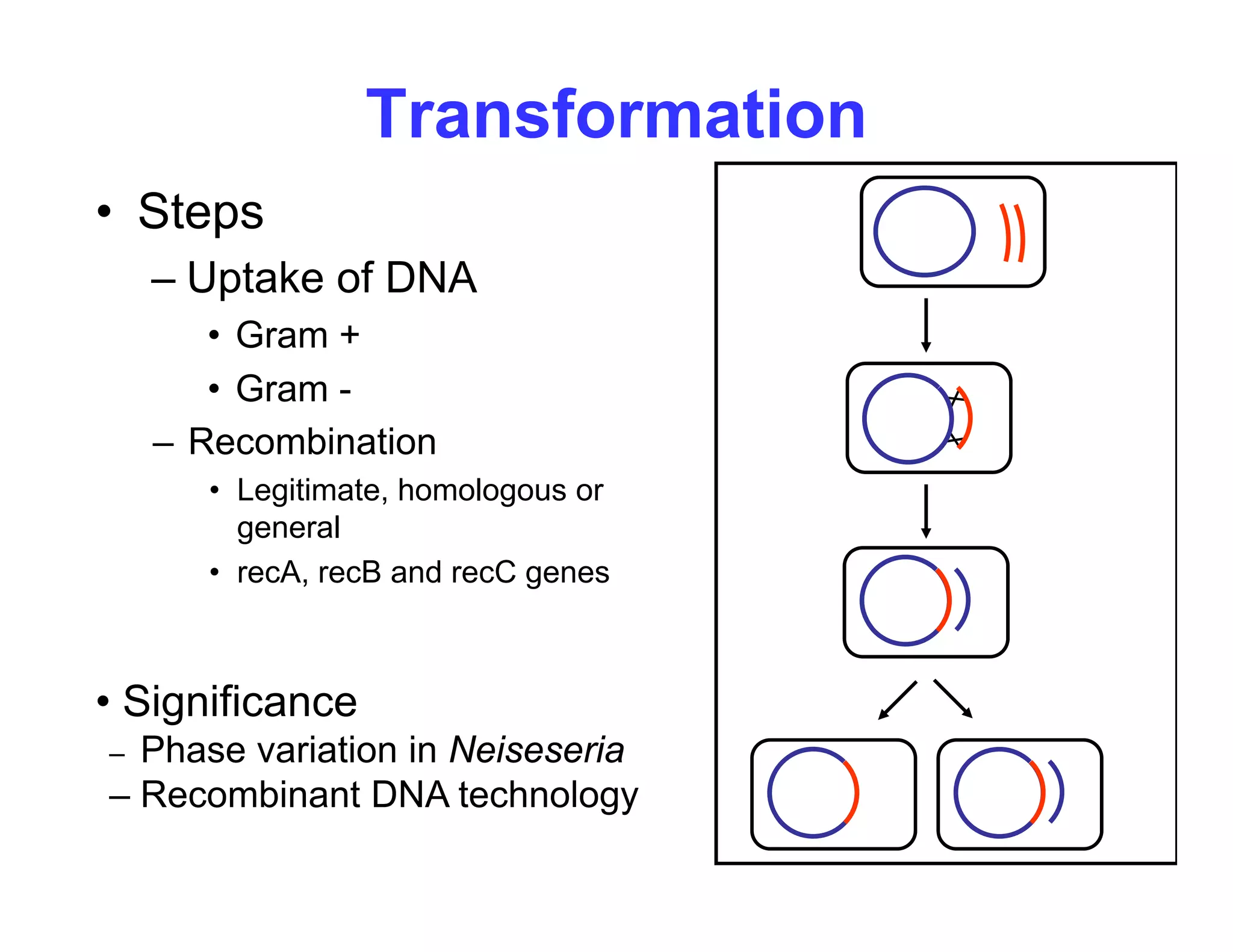
• Genetic recombination in which a
DNA fragment from a dead,
degraded bacterium enters a
competent recipient bacterium
and it is exchanged for a piece of
th i i t' DNA
the recipient's DNA.
Transformation
Transformation
• Definition: Gene transfer resulting
from the uptake of DNA from a donor.
• Factors affecting transformation
Factors affecting transformation
–DNA size and state
Sensiti e to n cleases
• Sensitive to nucleases
–Competence of the recipient (Bacillus,
H hil N i i St t )
Haemophilus, Neisseria, Streptococcus)
• Competence factor
• Induced competence
Transformation
• Steps
– Uptake of DNA
p
• Gram +
• Gram -
– Recombination
• Legitimate, homologous or
general
general
• recA, recB and recC genes
• Significance
– Phase variation in Neiseseria
– Recombinant DNA technology
Transformation
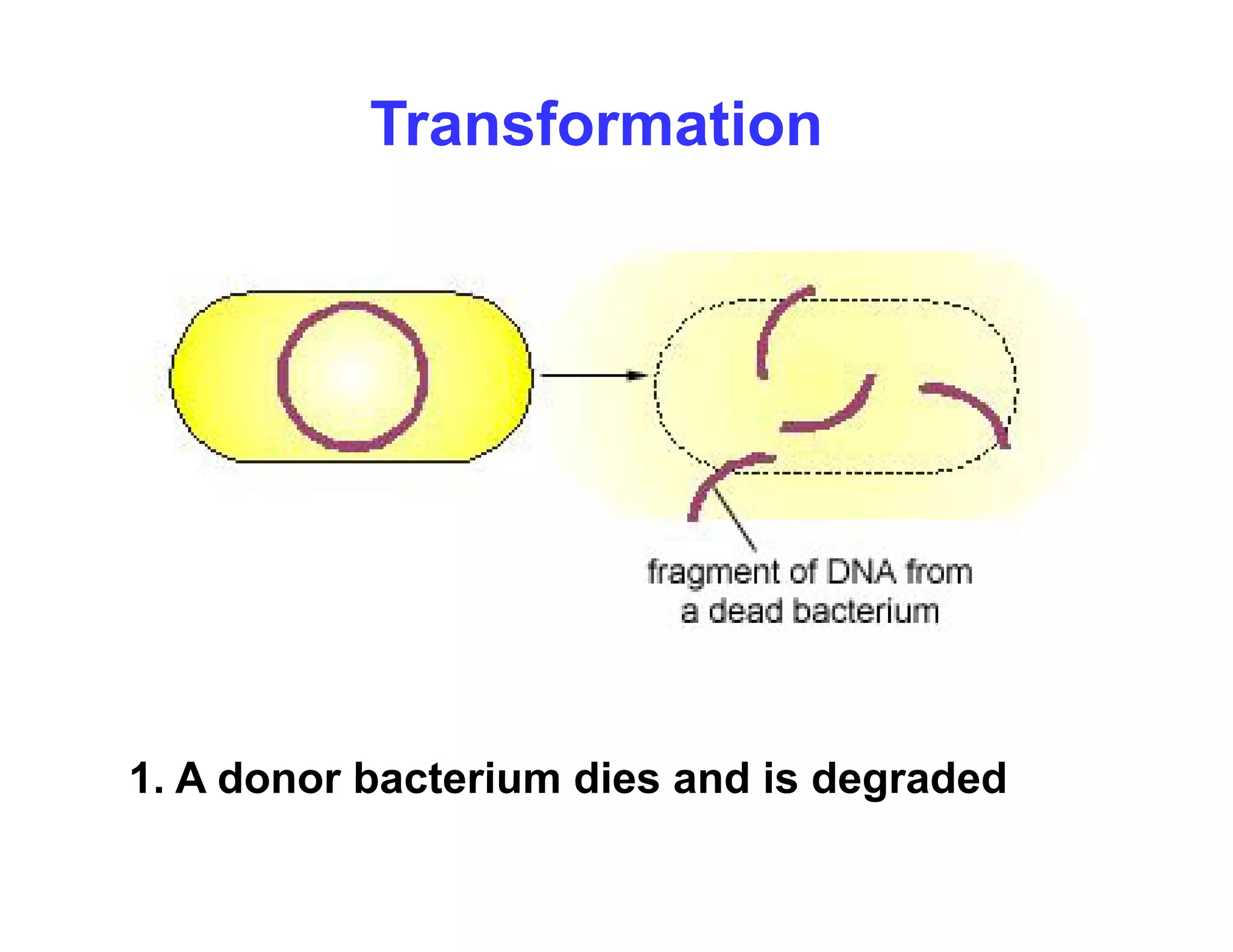
1 A donor bacterium dies and is degraded
1. A donor bacterium dies and is degraded
Transformation
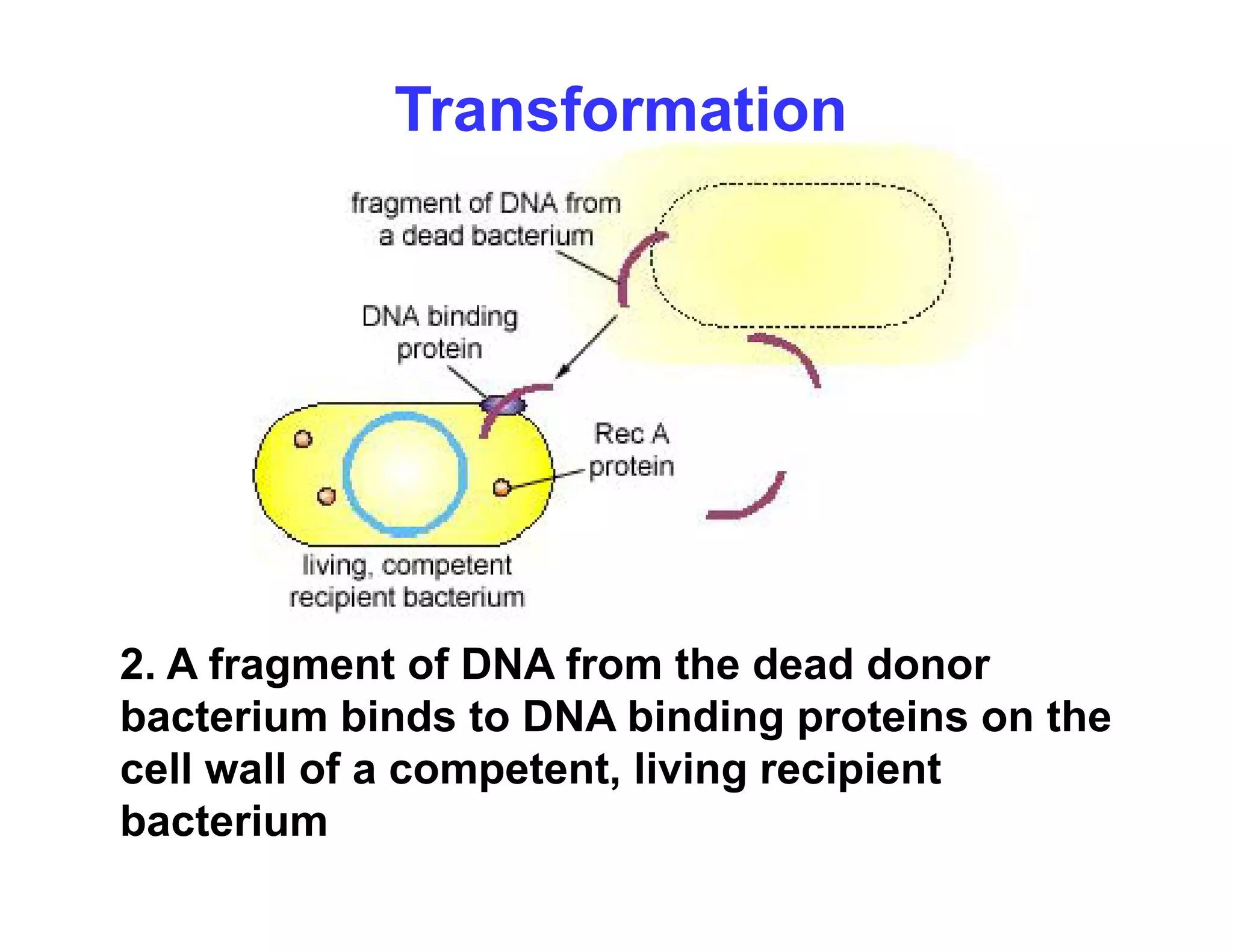
2 A f t f DNA f th d d d
2. A fragment of DNA from the dead donor
bacterium binds to DNA binding proteins on the
cell wall of a competent living recipient
cell wall of a competent, living recipient
bacterium
Transformation
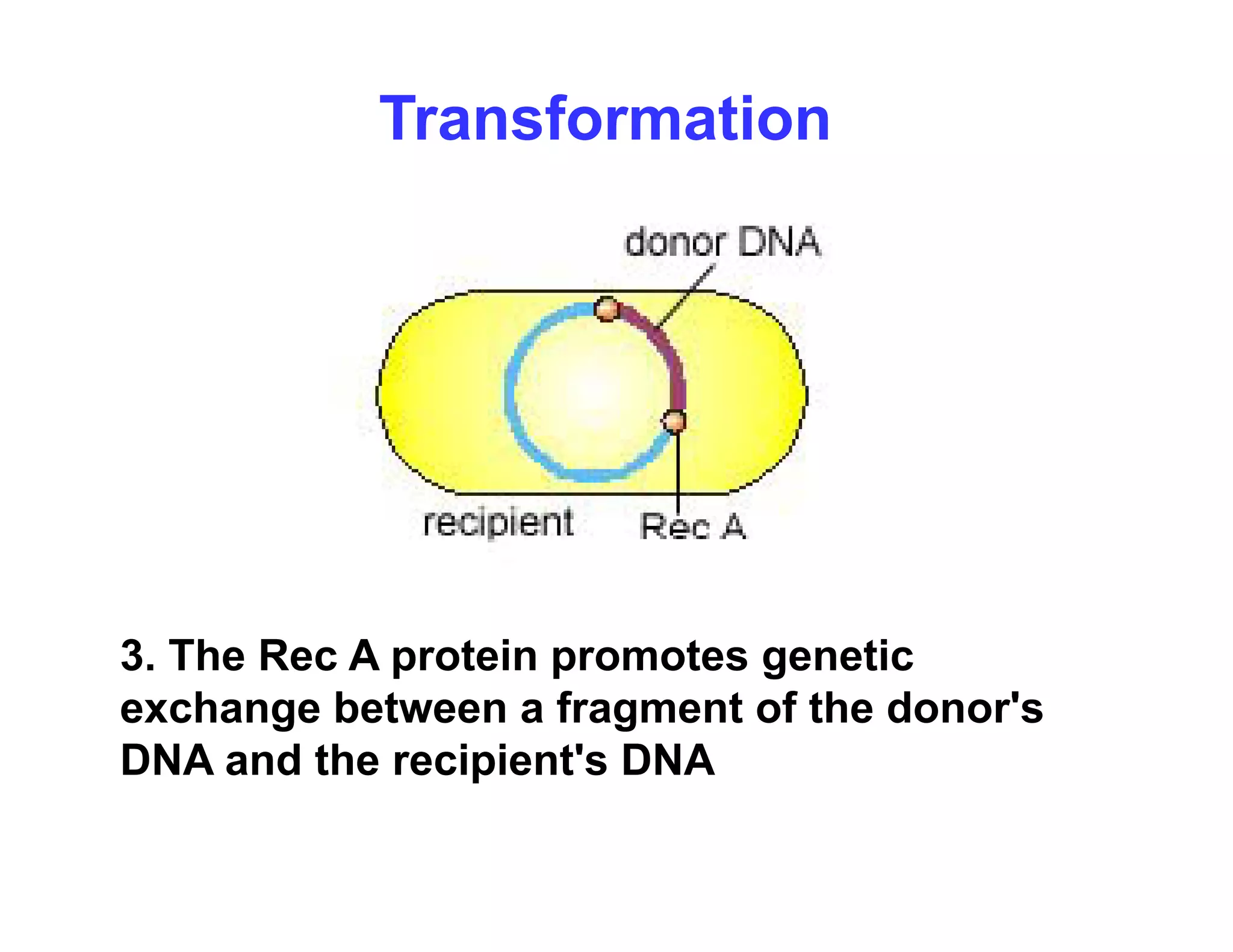
3 The Rec A protein promotes genetic
3. The Rec A protein promotes genetic
exchange between a fragment of the donor's
DNA and the recipient's DNA
p
Transformation
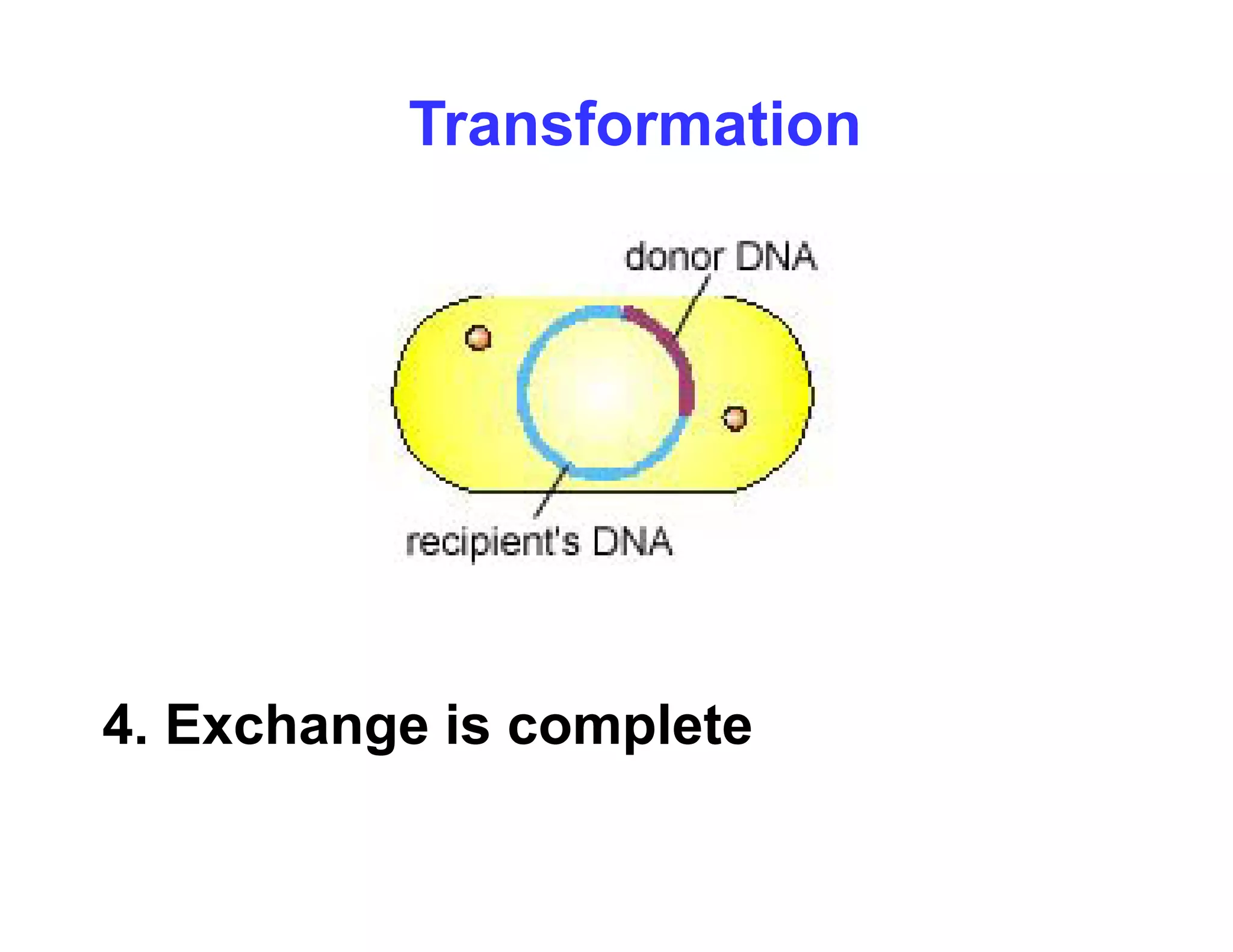
4. Exchange is complete
Transduction
Transduction
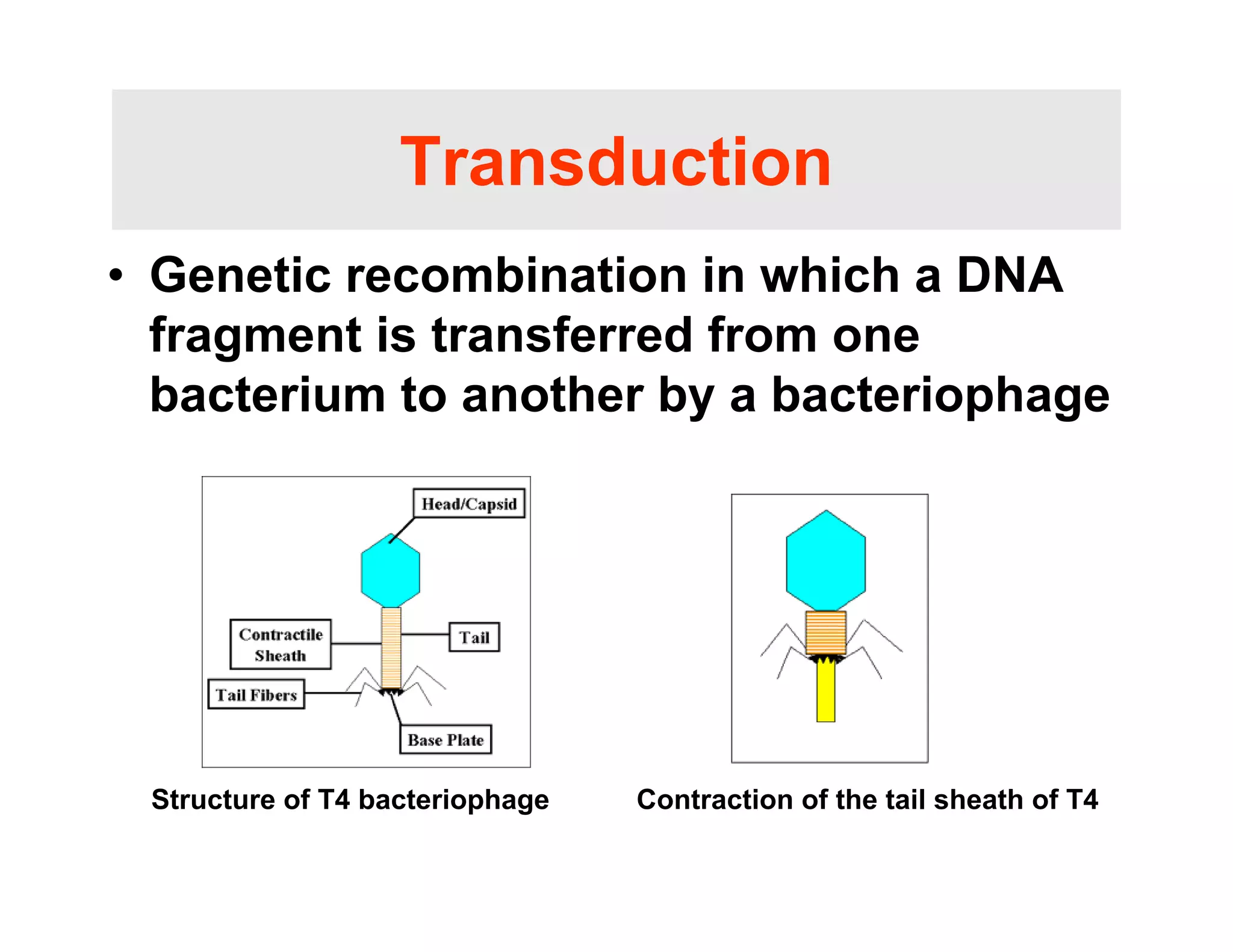
• Genetic recombination in which a DNA
fragment is transferred from one
bacterium to another by a bacteriophage
y p g
Structure of T4 bacteriophage Contraction of the tail sheath of T4
What are Bacteriophages?
Bacteriophage (phage) are obligate
intracellular parasites that multiply
i id b t i b ki f
inside bacteria by making use of
some or all of the host biosynthetic
machinery (i.e., viruses that infect
bacteria
Transduction (cont...)
• There are two types of transduction:
generalized transduction: A DNA fragment is
– generalized transduction: A DNA fragment is
transferred from one bacterium to another by
a lytic bacteriophage that is now carrying
d b t i l DNA d t i
donor bacterial DNA due to an error in
maturation during the lytic life cycle.
f
– specialized transduction: A DNA fragment is
transferred from one bacterium to another by
a temperate bacteriophage that is now
p p g
carrying donor bacterial DNA due to an error
in spontaneous induction during the
lysogenic life cycle
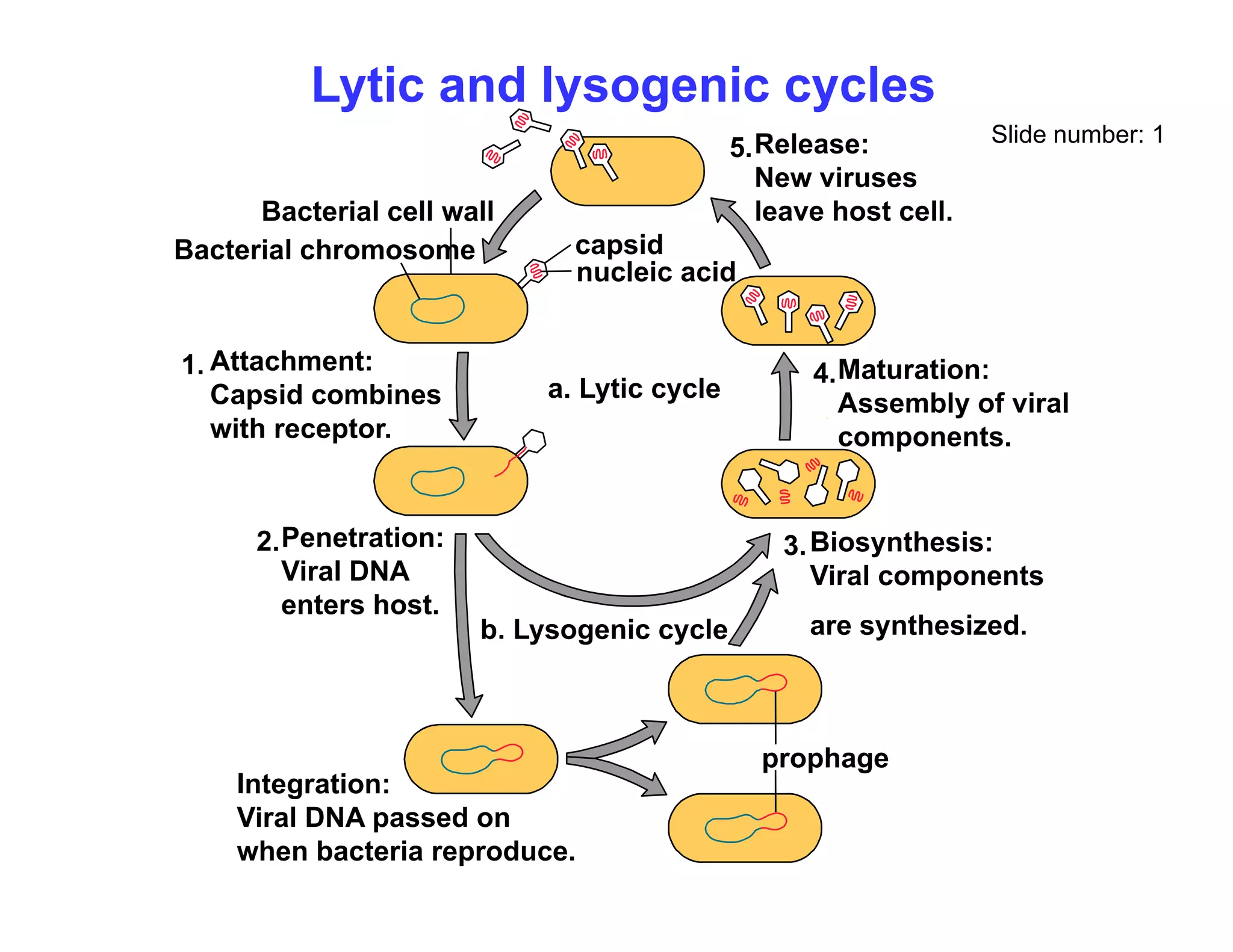
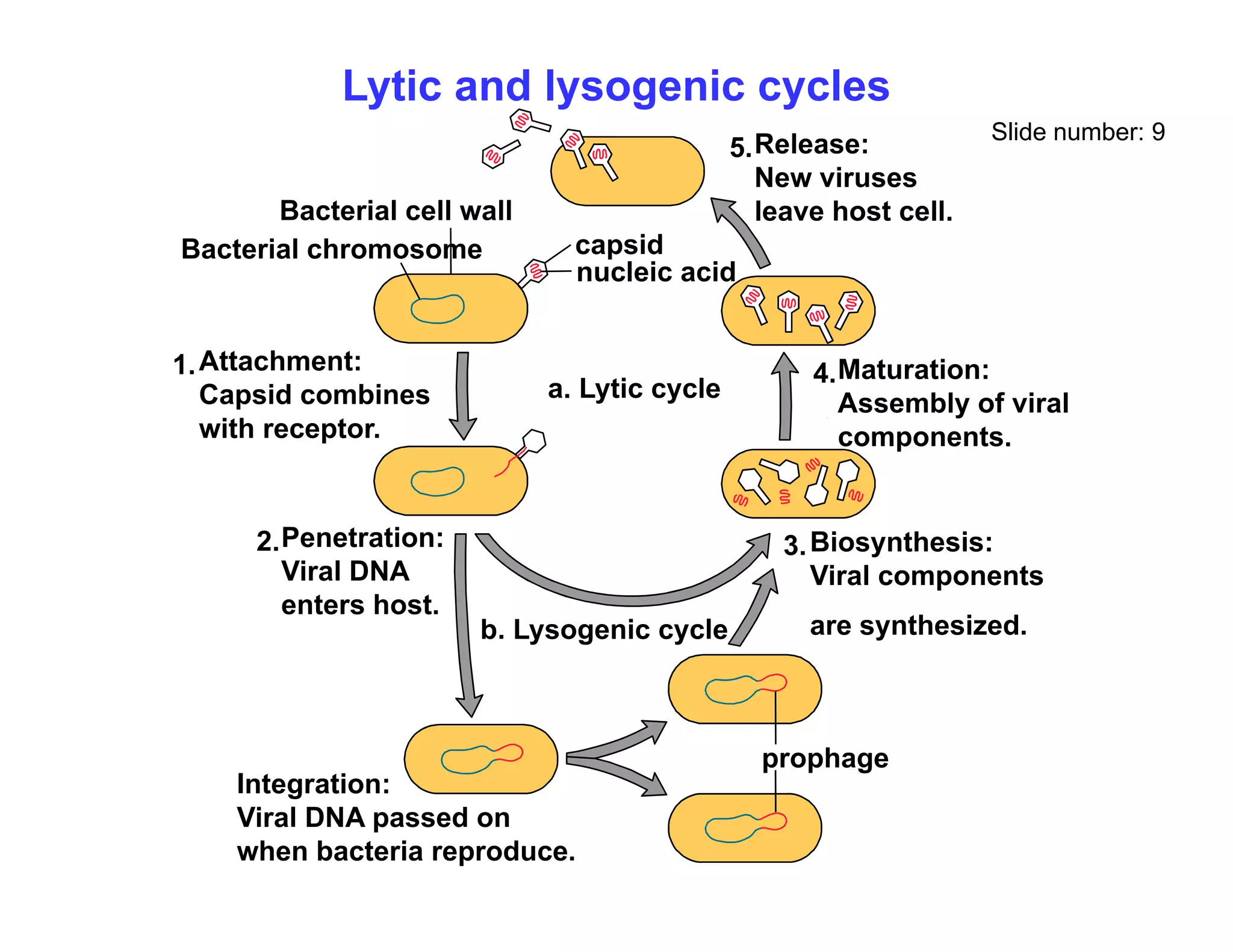
Lytic and lysogenic cycles
Slide number: 1
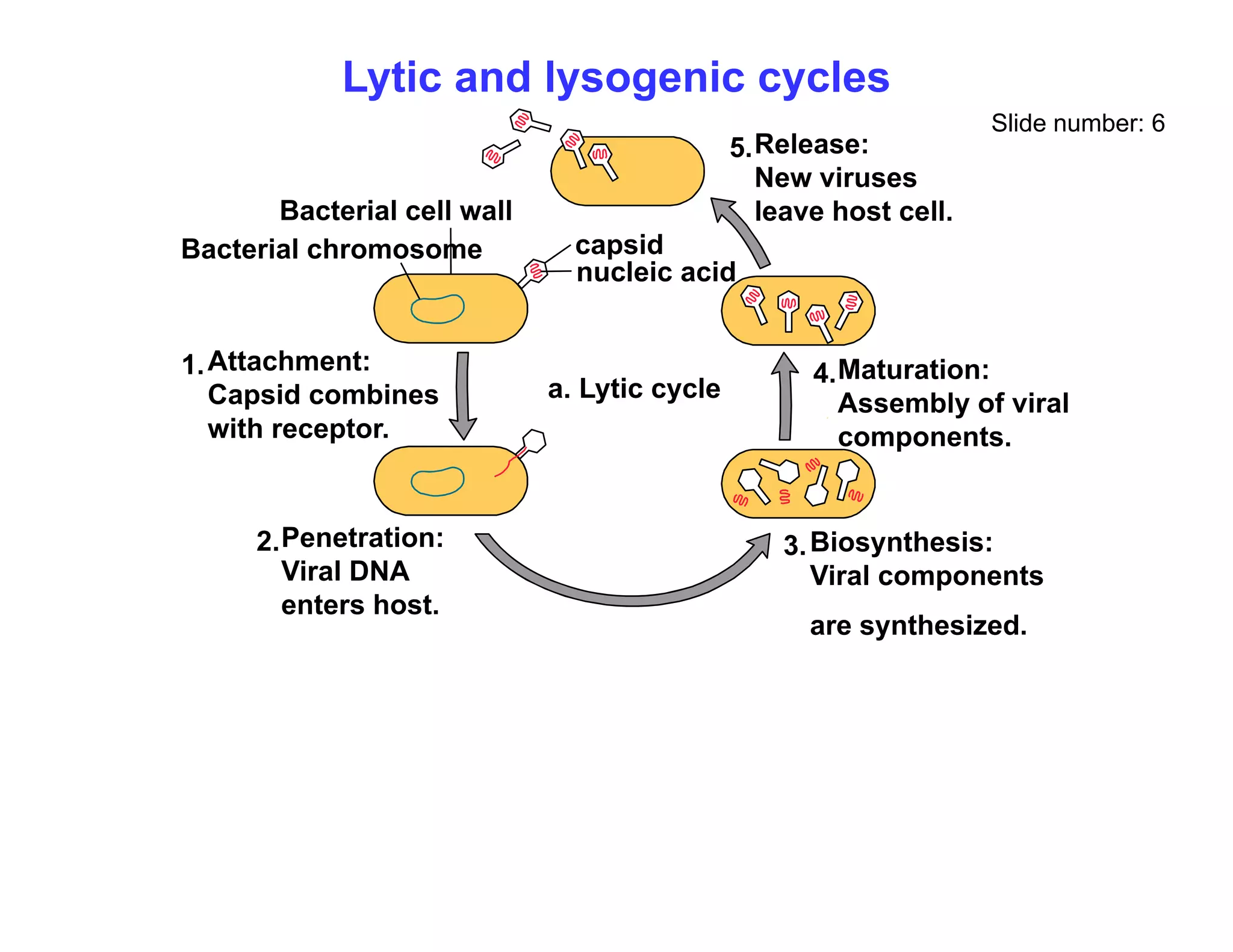
Release:
New viruses
5.
capsid
nucleic acid
Bacterial cell wall
Bacterial chromosome
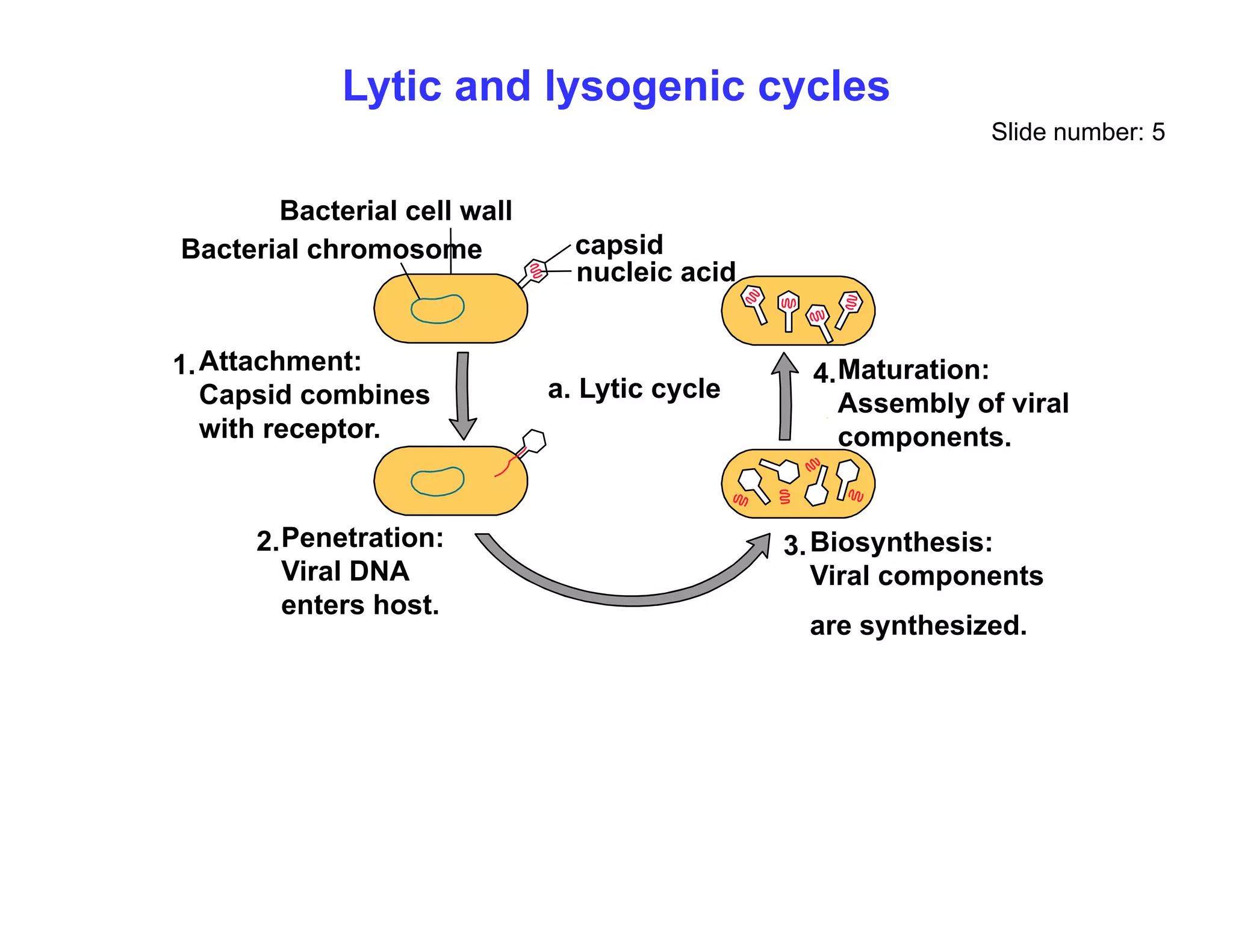
New viruses
leave host cell.
a. Lytic cycle
Attachment:
Capsid combines
1. Maturation:
Assembly of viral
4.
with receptor.
Penetration:
2 Bi th i
3
y
components.
Penetration:
Viral DNA
enters host.
2.
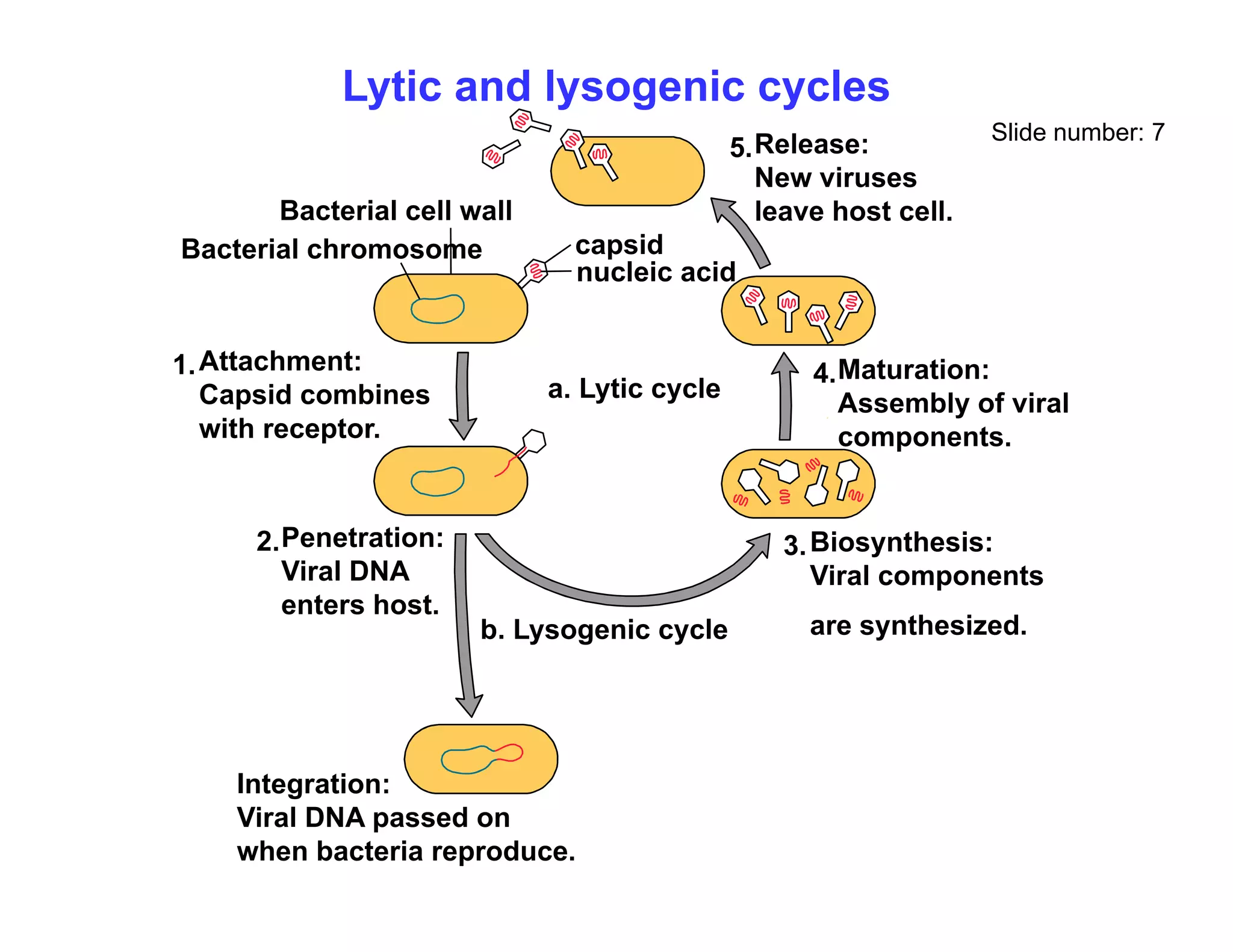
b. Lysogenic cycle
Biosynthesis:
Viral components
are synthesized.
3.
I t ti
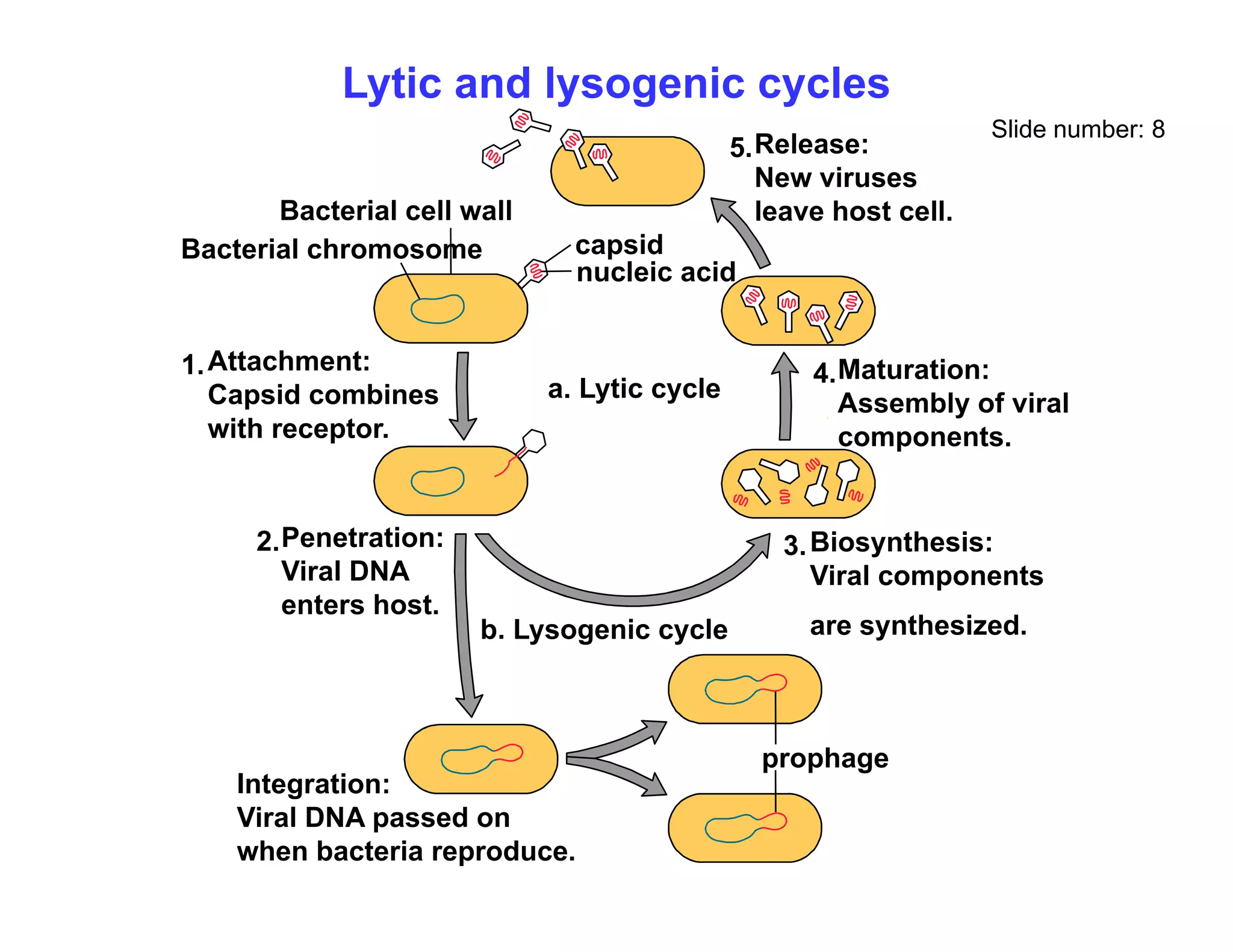
prophage
Integration:
Viral DNA passed on
when bacteria reproduce.
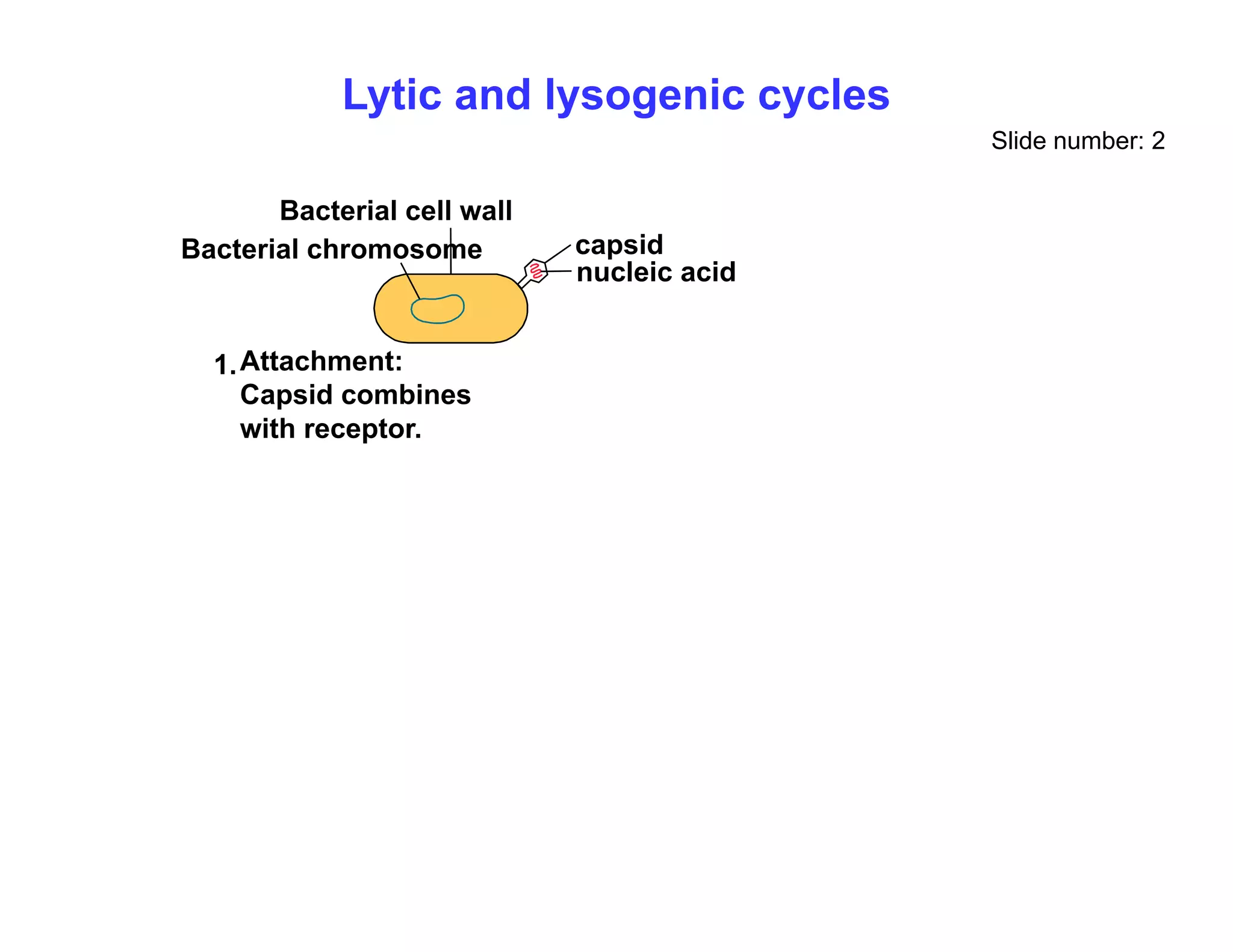
Lytic and lysogenic cycles
Slide number: 2
capsid
nucleic acid
Bacterial cell wall
Bacterial chromosome
Attachment:
Capsid combines
1.
with receptor.
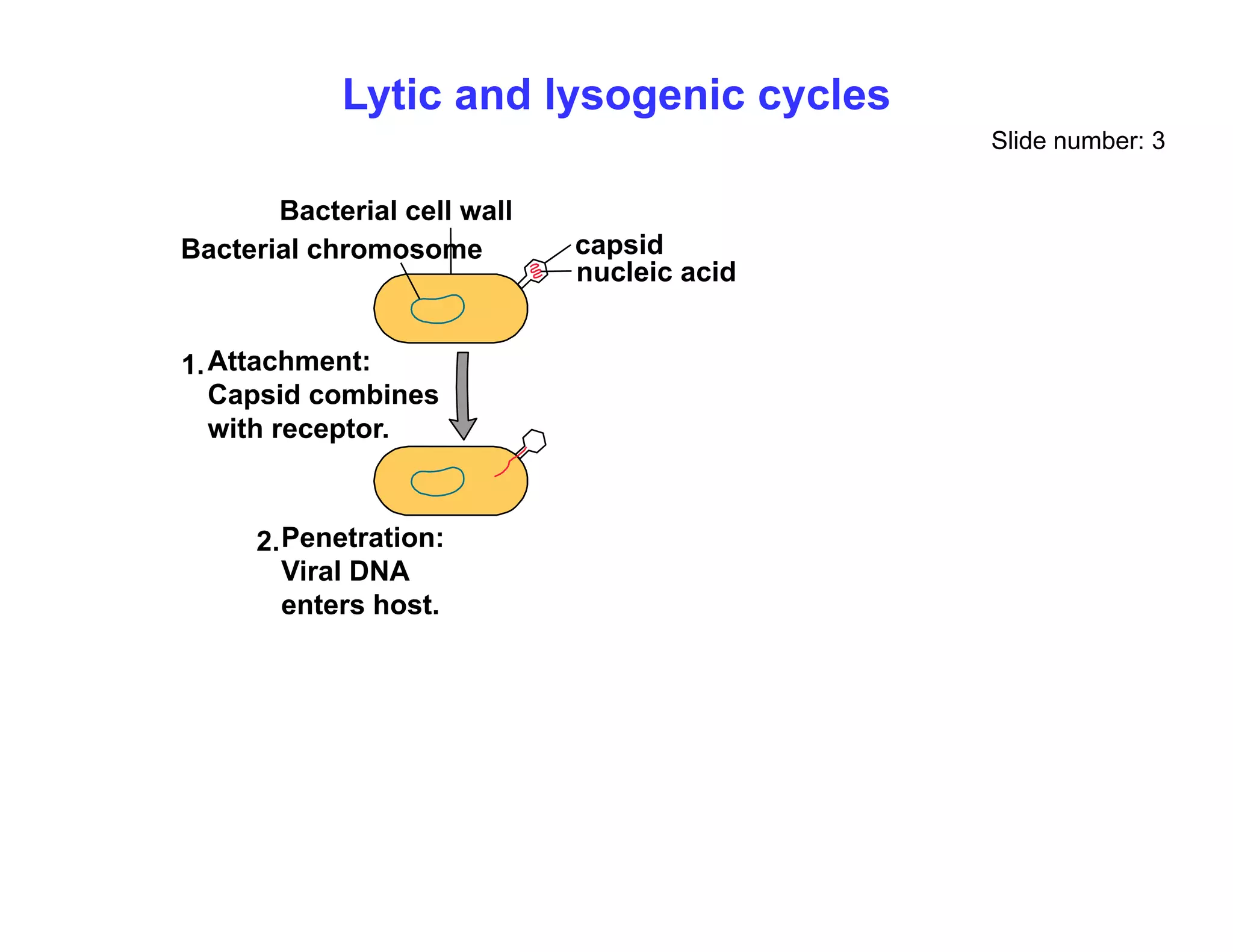
Lytic and lysogenic cycles
Slide number: 3
capsid
nucleic acid
Bacterial cell wall
Bacterial chromosome
Attachment:
Capsid combines
1.
with receptor.
Penetration:
2 Penetration:
Viral DNA
enters host.
2.
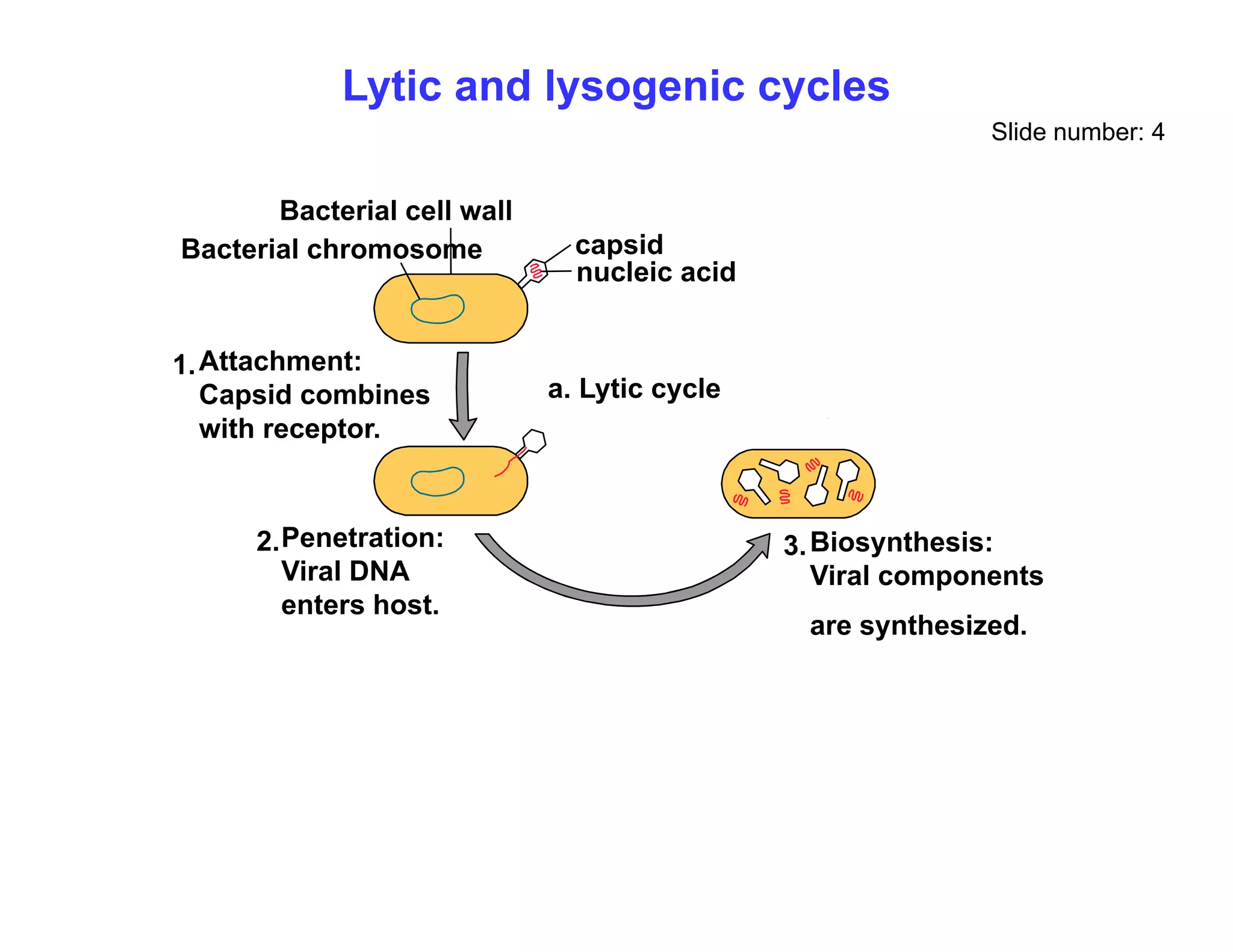
Lytic and lysogenic cycles
Slide number: 4
capsid
nucleic acid
Bacterial cell wall
Bacterial chromosome
a. Lytic cycle
Attachment:
Capsid combines
1.
with receptor.
Penetration:
2 Bi th i
3
Penetration:
Viral DNA
enters host.
2. Biosynthesis:
Viral components
are synthesized.
3.
Lytic and lysogenic cycles
Slide number: 5
capsid
nucleic acid
Bacterial cell wall
Bacterial chromosome
a. Lytic cycle
Attachment:
Capsid combines
1. Maturation:
Assembly of viral
4.
with receptor.
Penetration:
2 Bi th i
3
y
components.
Penetration:
Viral DNA
enters host.
2. Biosynthesis:
Viral components
are synthesized.
3.
Lytic and lysogenic cycles
Slide number: 6
Release:
New viruses
5.
capsid
nucleic acid
Bacterial cell wall
Bacterial chromosome
New viruses
leave host cell.
a. Lytic cycle
Attachment:
Capsid combines
1. Maturation:
Assembly of viral
4.
with receptor.
Penetration:
2 Bi th i
3
y
components.
Penetration:
Viral DNA
enters host.
2. Biosynthesis:
Viral components
are synthesized.
3.
Lytic and lysogenic cycles
Slide number: 7
Release:
New viruses
5.
capsid
nucleic acid
Bacterial cell wall
Bacterial chromosome
New viruses
leave host cell.
a. Lytic cycle
Attachment:
Capsid combines
1. Maturation:
Assembly of viral
4.
with receptor.
Penetration:
2 Bi th i
3
y
components.
Penetration:
Viral DNA
enters host.
2.
b. Lysogenic cycle
Biosynthesis:
Viral components
are synthesized.
3.
I t ti
Integration:
Viral DNA passed on
when bacteria reproduce.
Lytic and lysogenic cycles
Slide number: 8
Release:
New viruses
5.
capsid
nucleic acid
Bacterial cell wall
Bacterial chromosome
New viruses
leave host cell.
a. Lytic cycle
Attachment:
Capsid combines
1. Maturation:
Assembly of viral
4.
with receptor.
Penetration:
2 Bi th i
3
y
components.
Penetration:
Viral DNA
enters host.
2.
b. Lysogenic cycle
Biosynthesis:
Viral components
are synthesized.
3.
I t ti
prophage
Integration:
Viral DNA passed on
when bacteria reproduce.
Lytic and lysogenic cycles
Slide number: 9
Release:
New viruses
5.
capsid
nucleic acid
Bacterial cell wall
Bacterial chromosome
New viruses
leave host cell.
a. Lytic cycle
Attachment:
Capsid combines
1. Maturation:
Assembly of viral
4.
with receptor.
Penetration:
2 Bi th i
3
y
components.
Penetration:
Viral DNA
enters host.
2.
b. Lysogenic cycle
Biosynthesis:
Viral components
are synthesized.
3.
I t ti
prophage
Integration:
Viral DNA passed on
when bacteria reproduce.
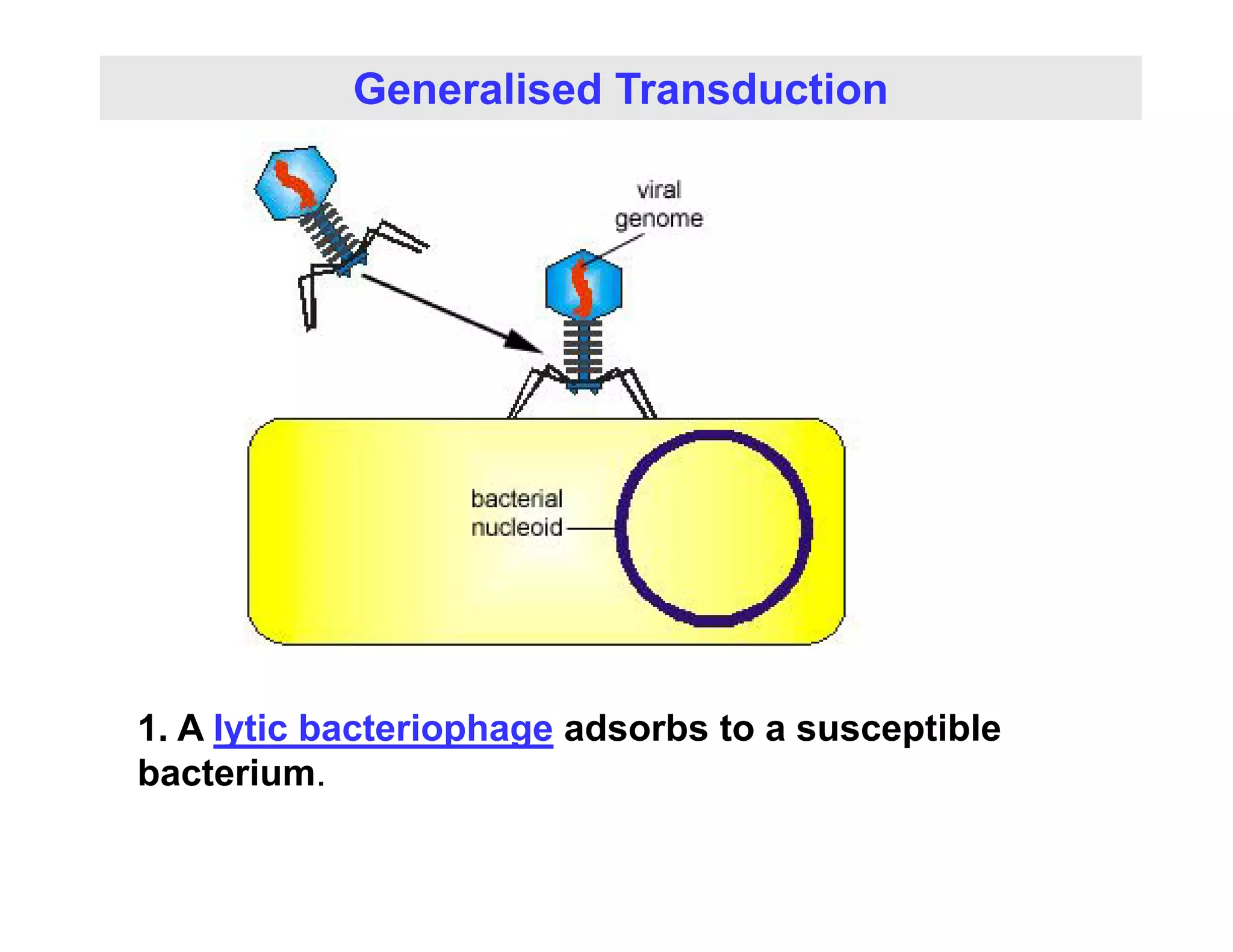
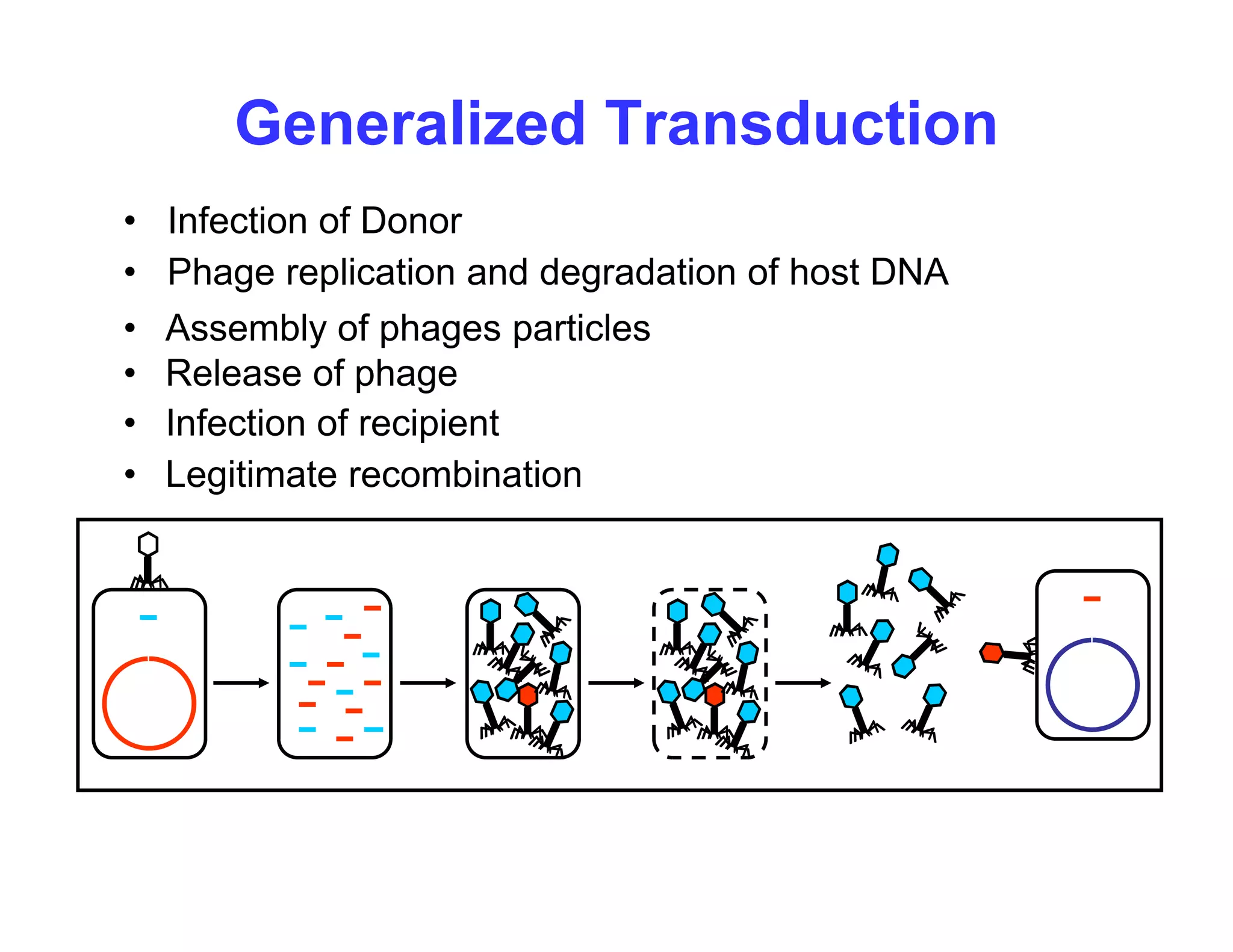
Generalised Transduction
1. A lytic bacteriophage adsorbs to a susceptible
bacterium
bacterium.
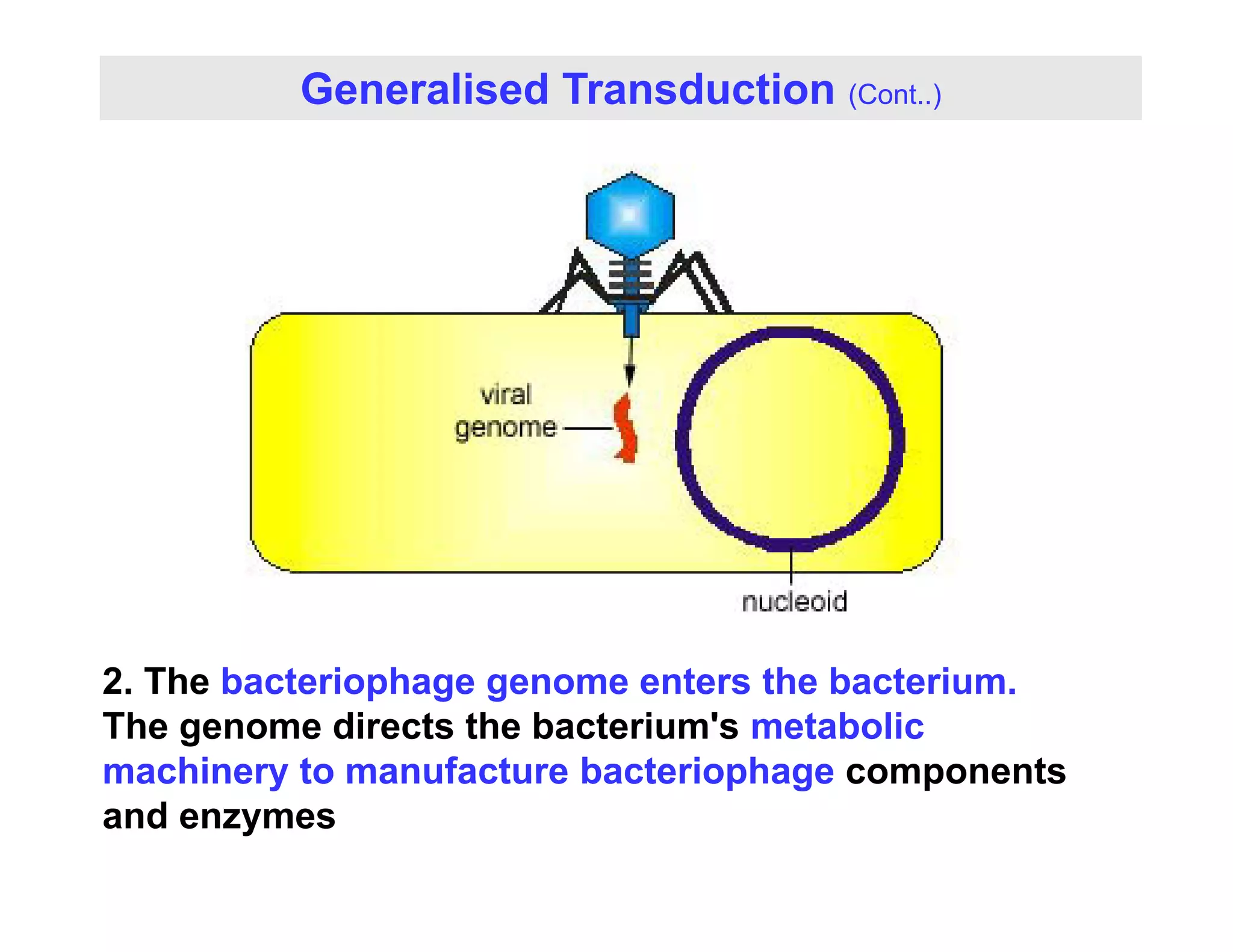
Generalised Transduction (Cont..)
2. The bacteriophage genome enters the bacterium.
The genome directs the bacterium's metabolic
machinery to manufacture bacteriophage components
and enzymes
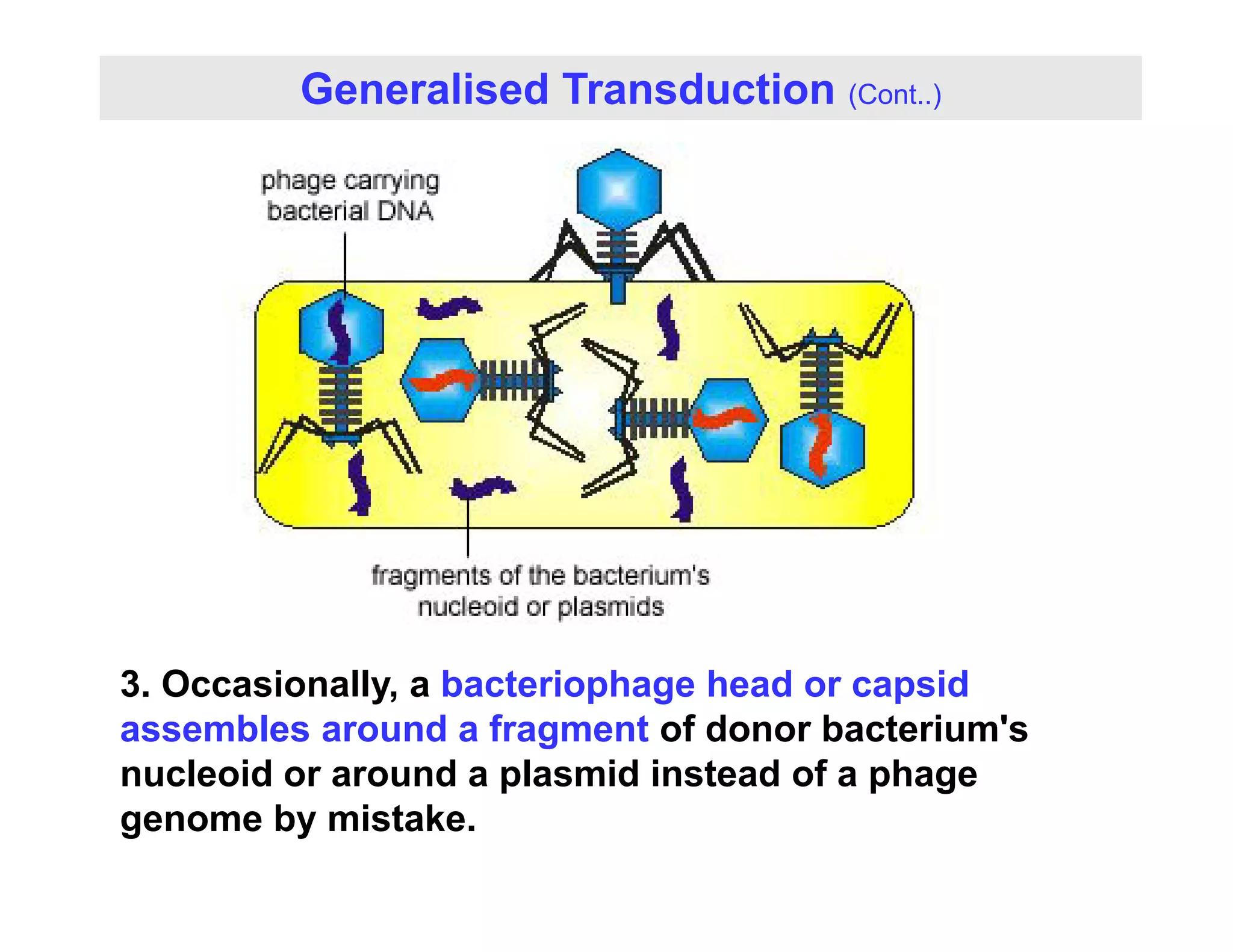
Generalised Transduction (Cont..)
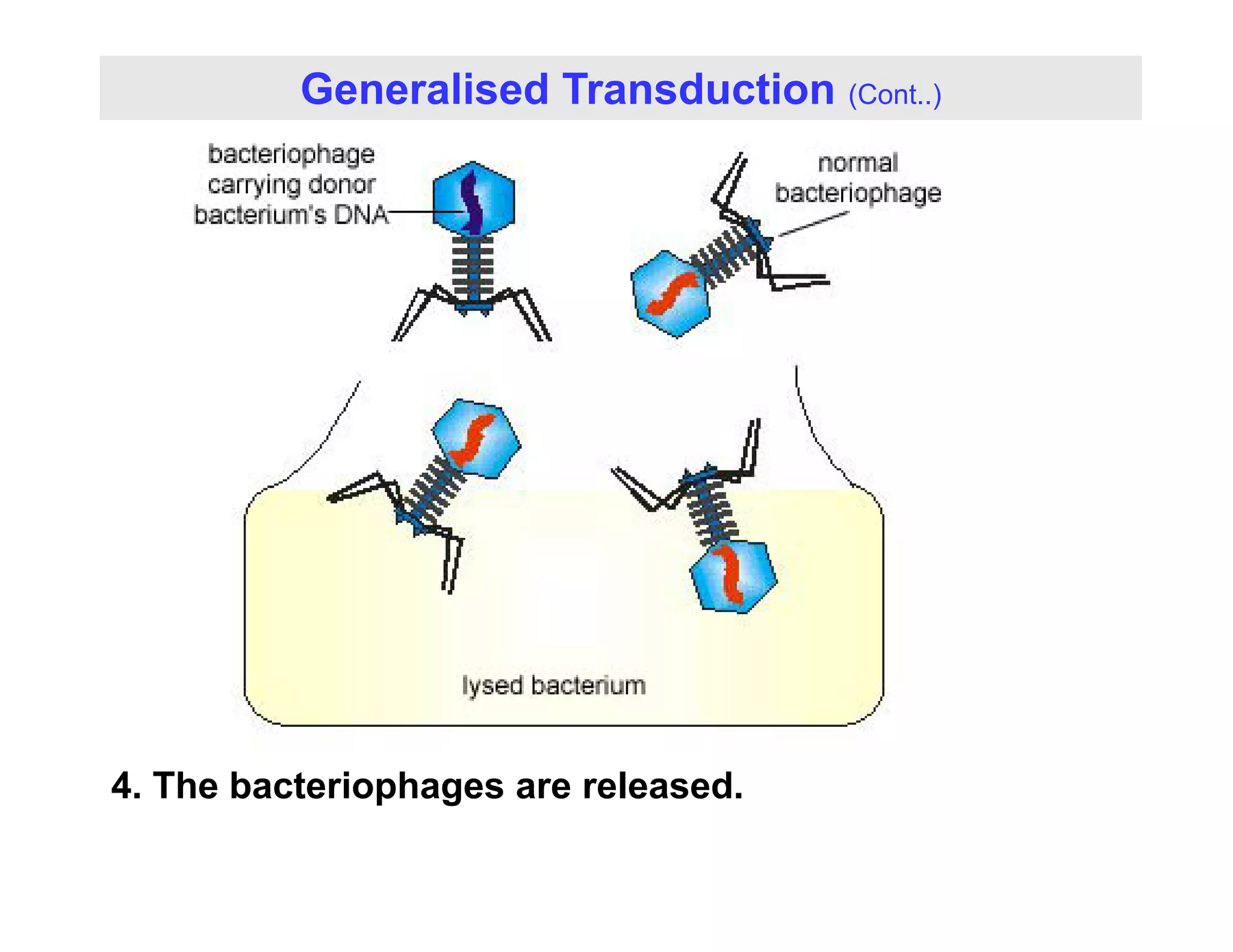
3. Occasionally, a bacteriophage head or capsid
assembles around a fragment of donor bacterium's
nucleoid or around a plasmid instead of a phage
genome by mistake.
Generalised Transduction (Cont..)
4 Th b t i h l d
4. The bacteriophages are released.
Generalised Transduction (Cont..)
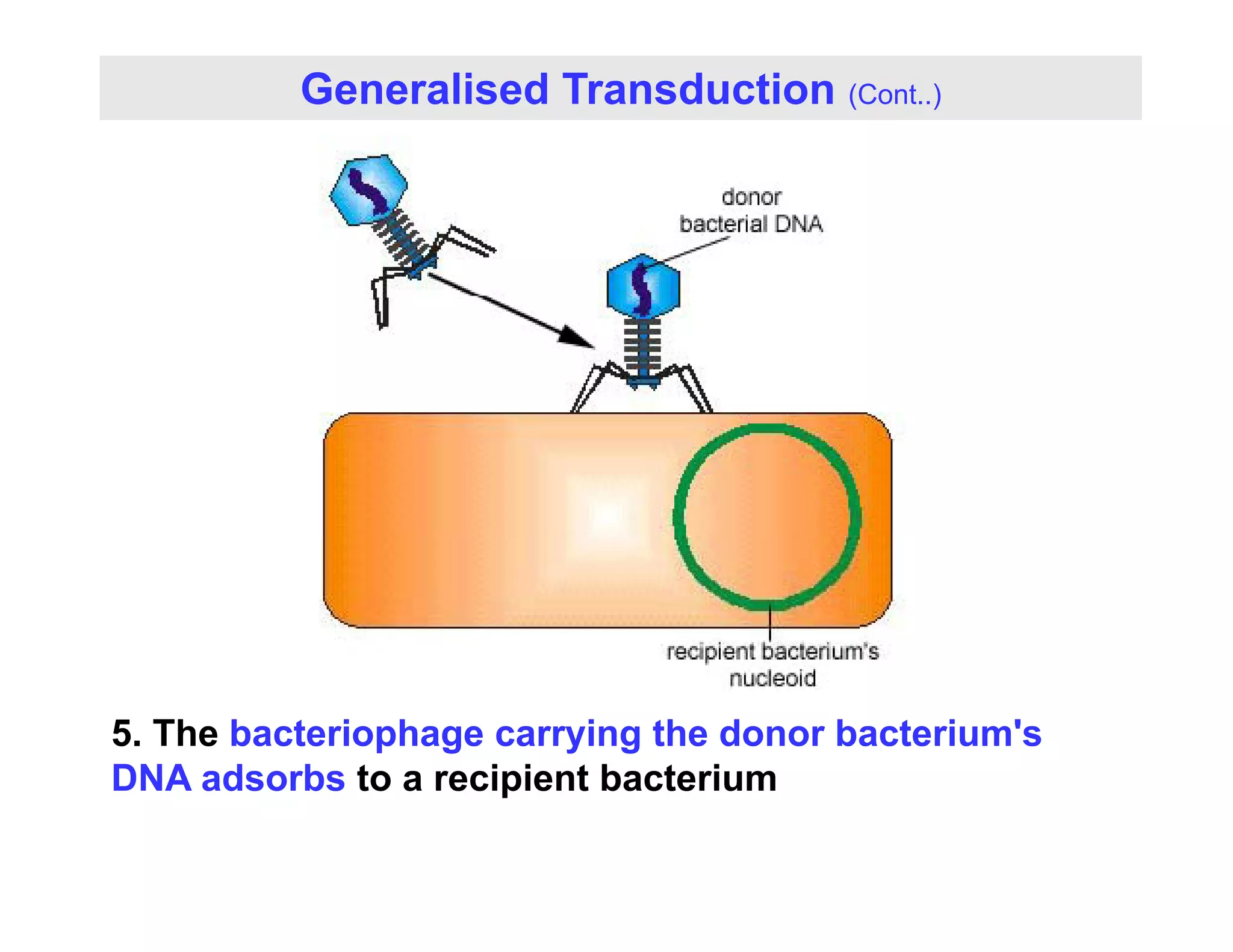
5. The bacteriophage carrying the donor bacterium's
DNA adsorbs to a recipient bacterium
Generalised Transduction (Cont..)
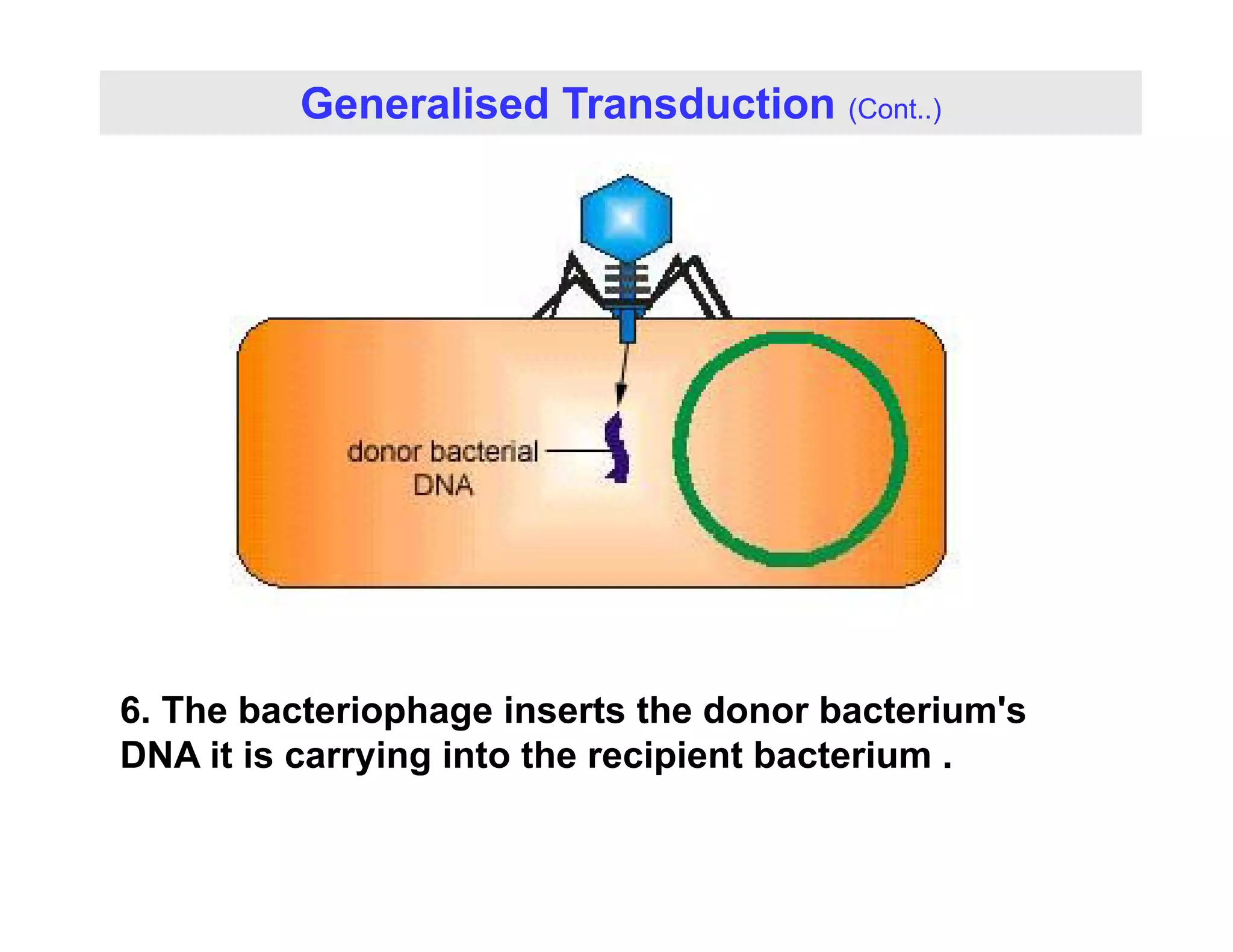
6. The bacteriophage inserts the donor bacterium's
DNA it is carrying into the recipient bacterium .
Generalised Transduction (Cont..)
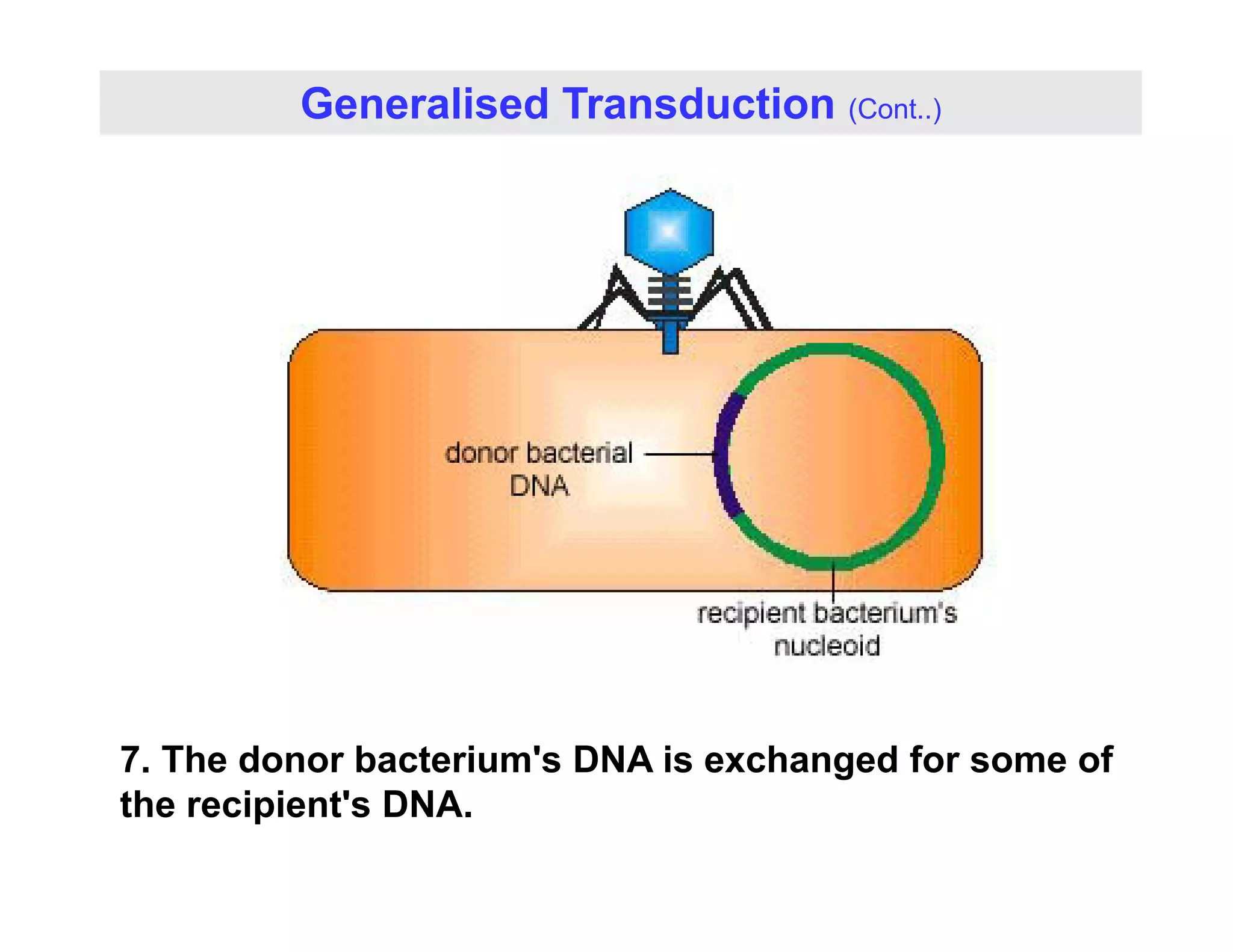
7. The donor bacterium's DNA is exchanged for some of
g
the recipient's DNA.
Specialized Transduction (Cont..)
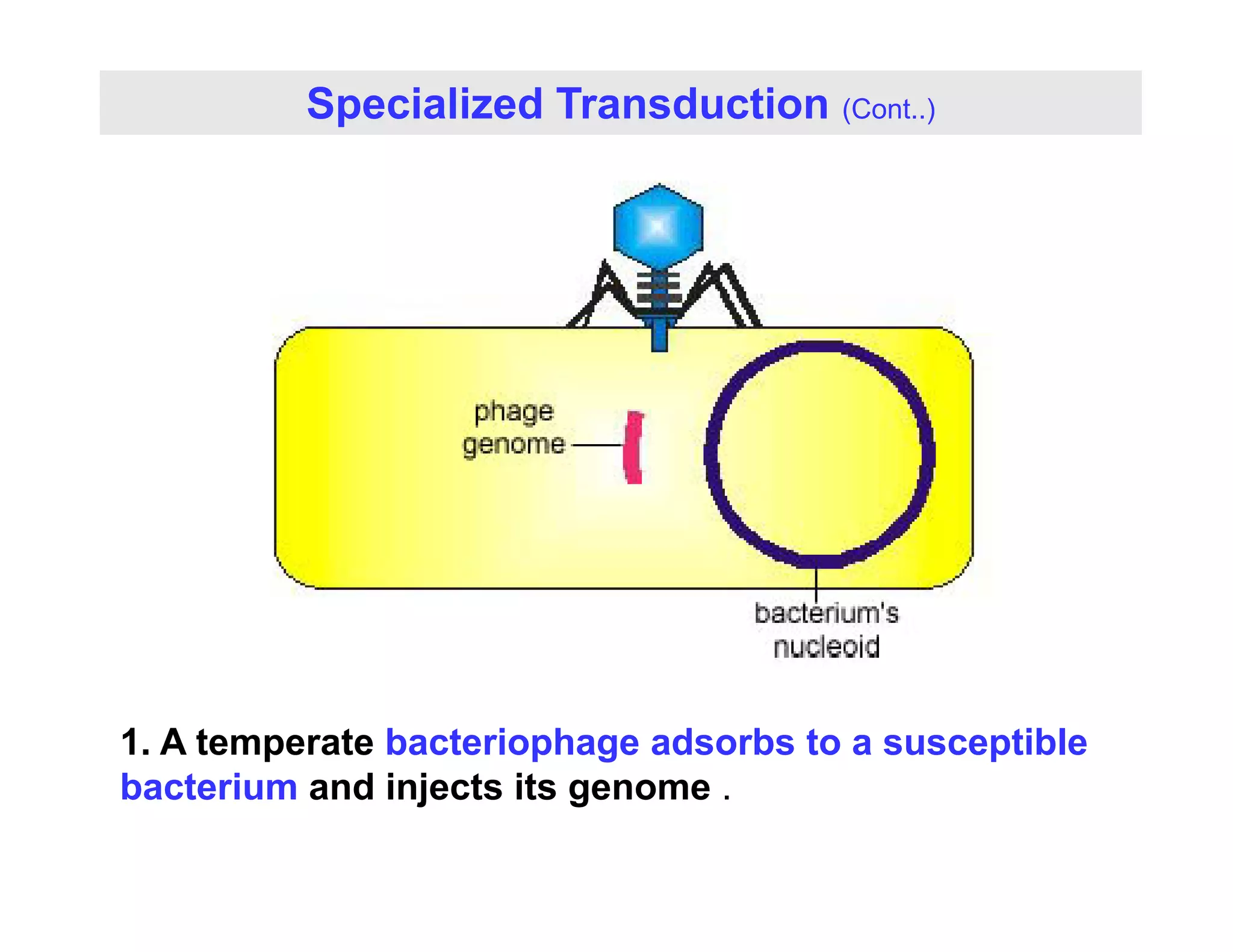
1. A temperate bacteriophage adsorbs to a susceptible
b t i d i j t it
bacterium and injects its genome .
Specialized Transduction (Cont..)
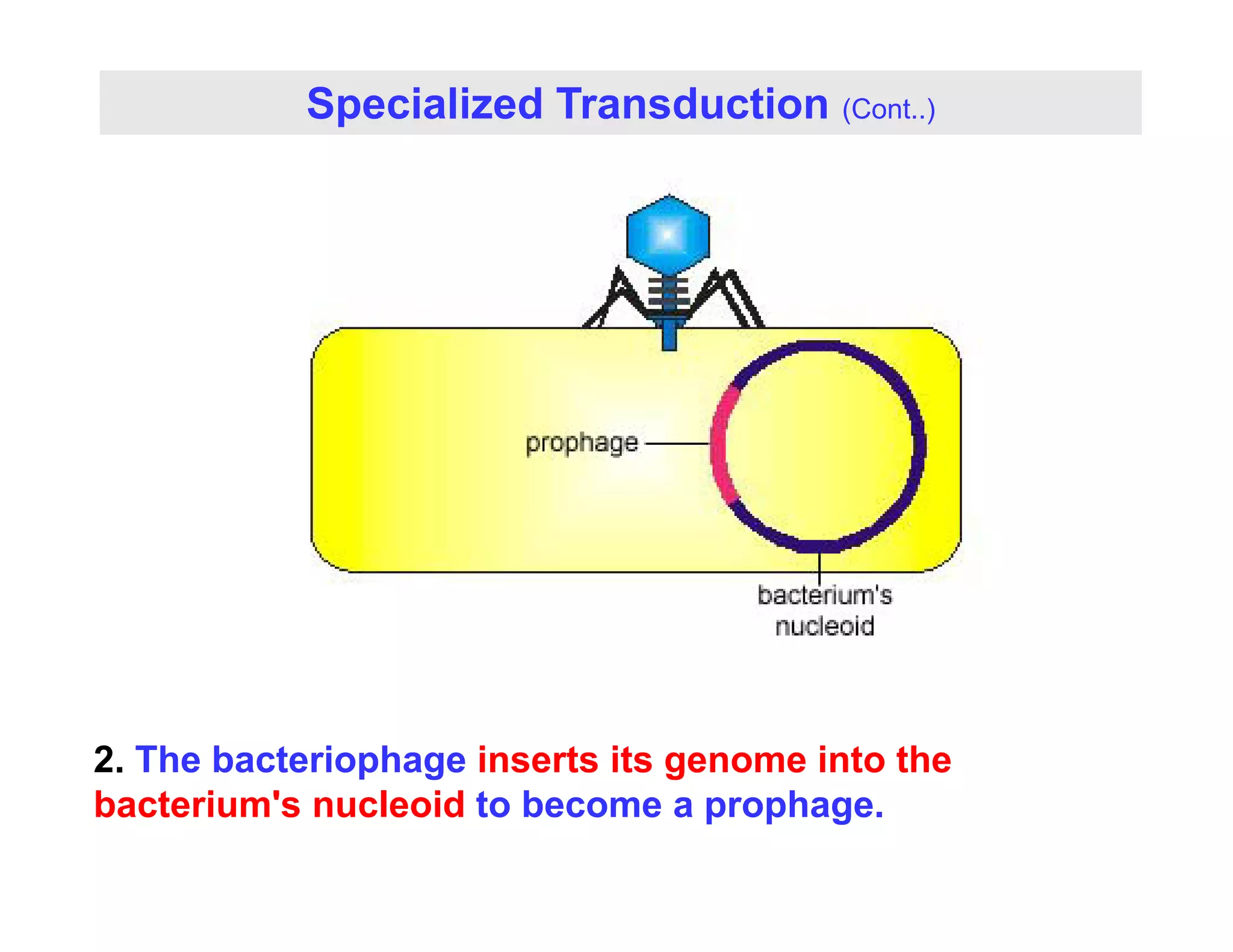
2. The bacteriophage inserts its genome into the
p g g
bacterium's nucleoid to become a prophage.
Specialized Transduction (Cont..)
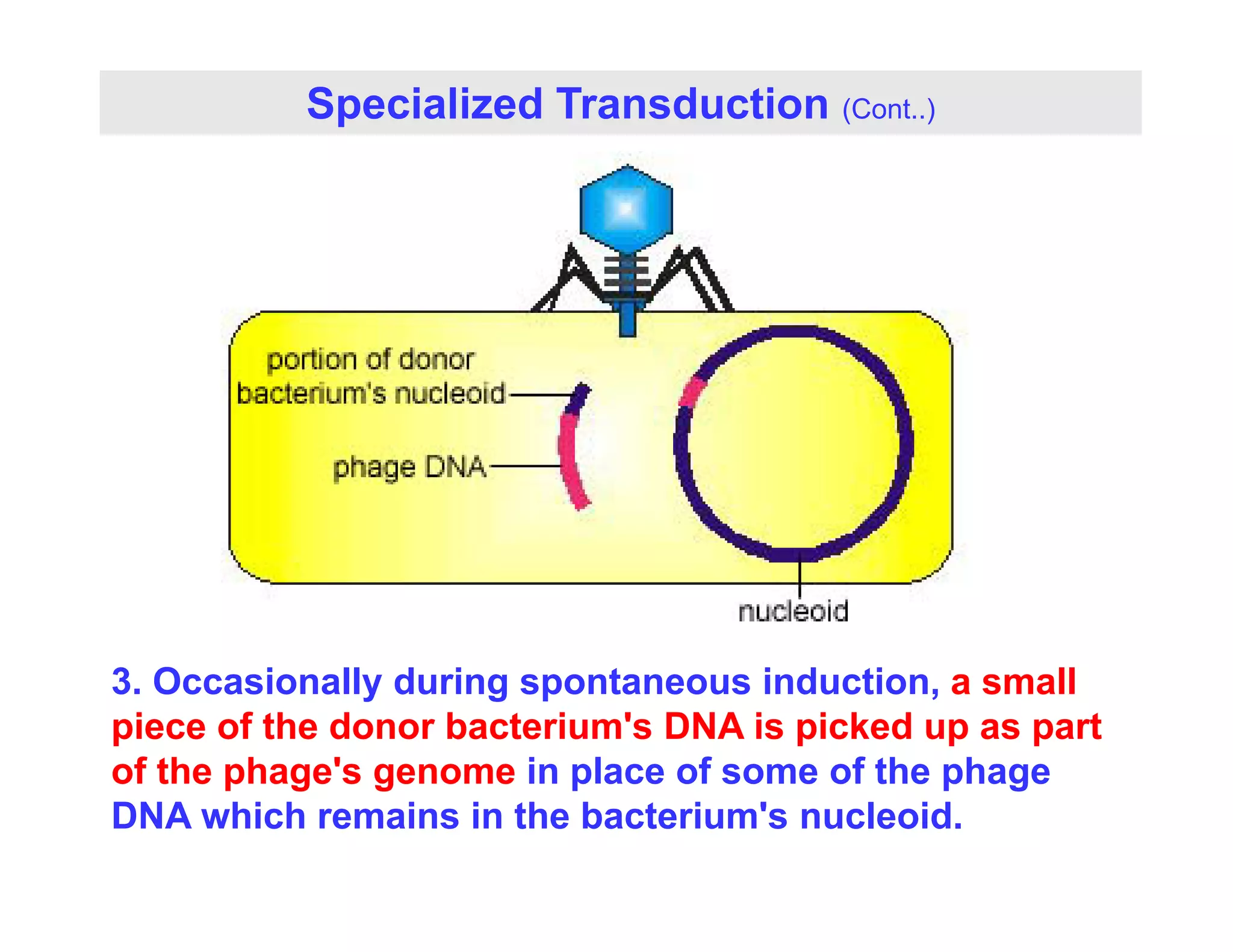
3. Occasionally during spontaneous induction, a small
piece of the donor bacterium's DNA is picked up as part
of the phage's genome in place of some of the phage
of the phage s genome in place of some of the phage
DNA which remains in the bacterium's nucleoid.
Specialized Transduction (Cont..)
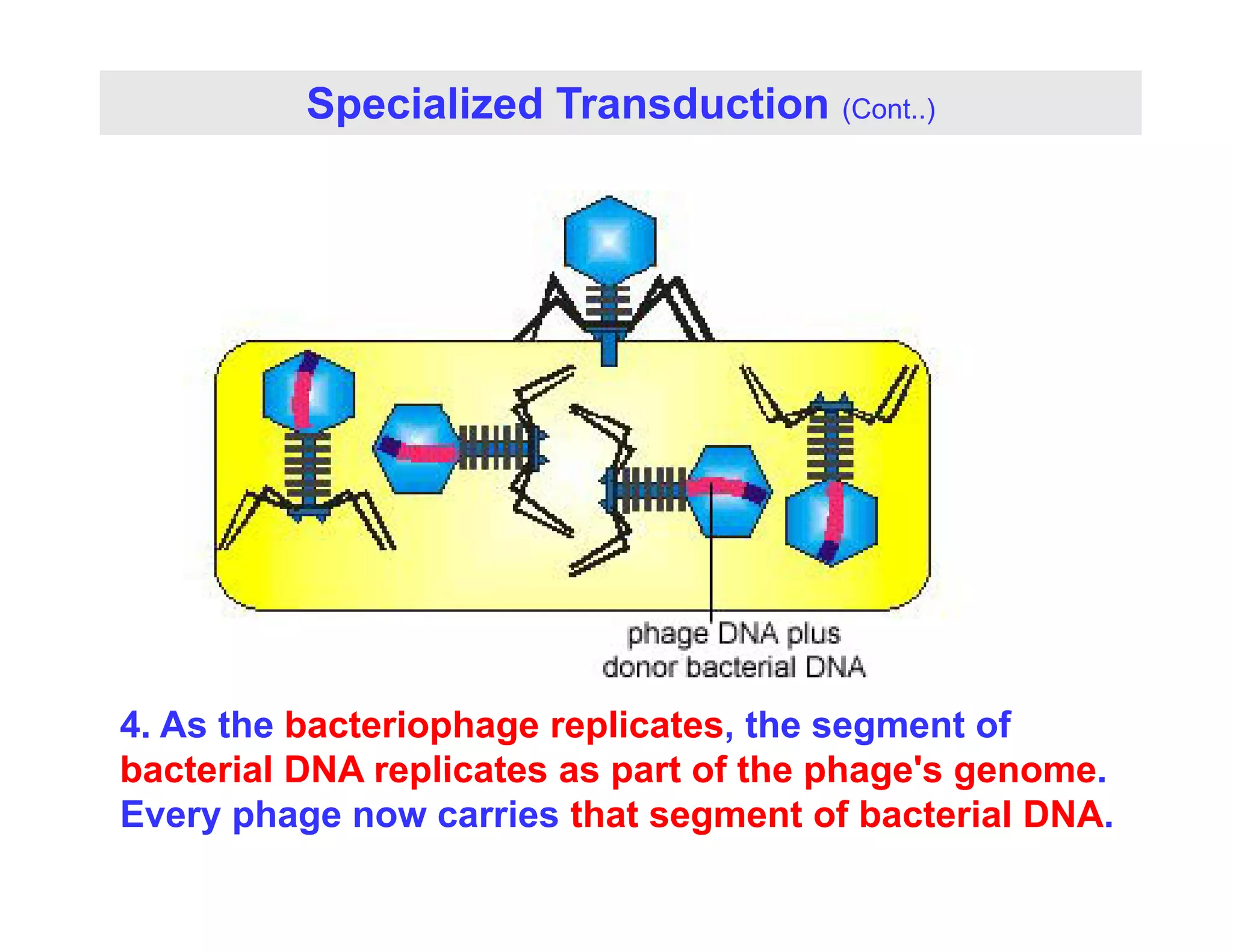
4. As the bacteriophage replicates, the segment of
bacterial DNA replicates as part of the phage's genome
bacterial DNA replicates as part of the phage s genome.
Every phage now carries that segment of bacterial DNA.
Specialized Transduction (Cont..)
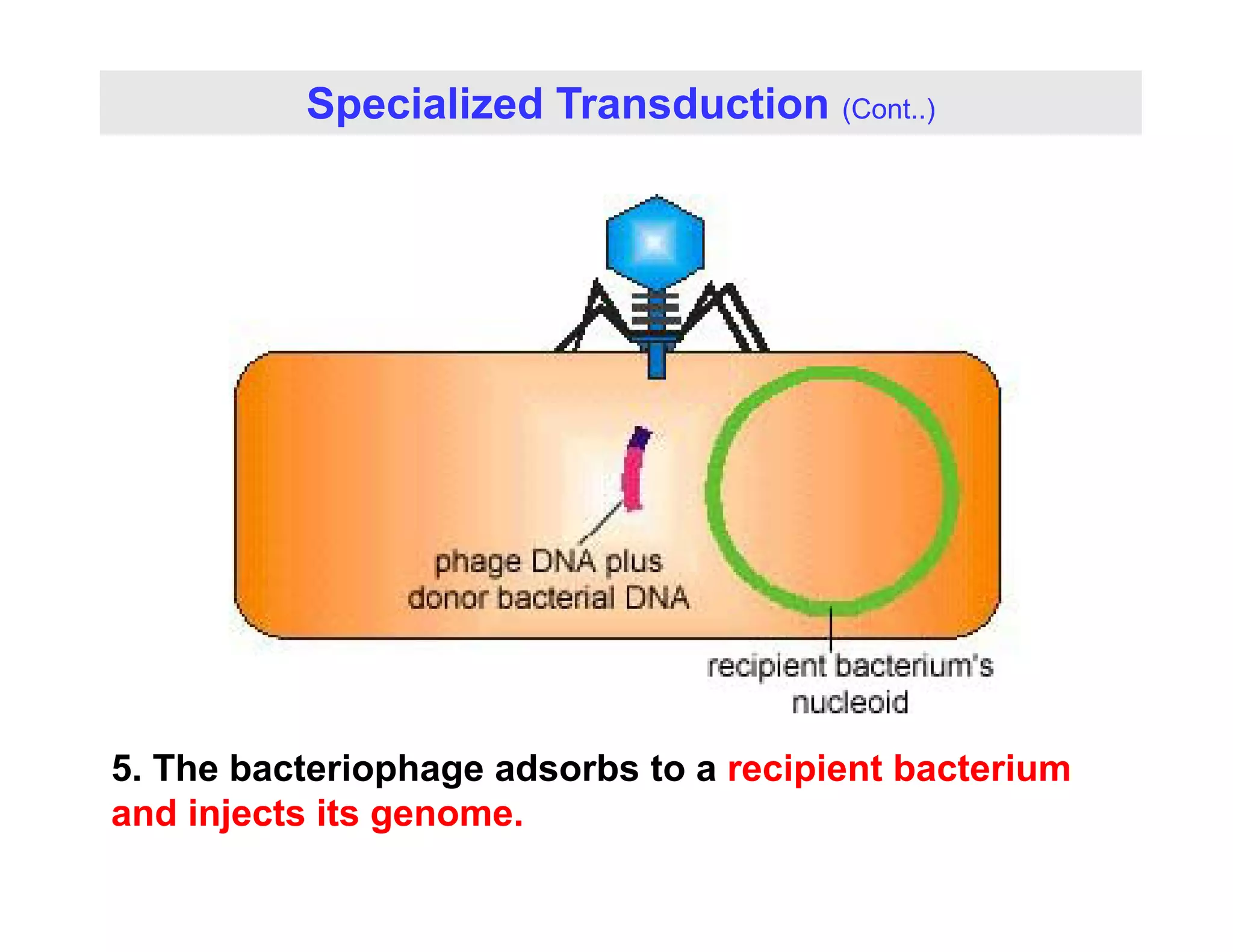
5 The bacteriophage adsorbs to a recipient bacterium
5. The bacteriophage adsorbs to a recipient bacterium
and injects its genome.
Specialized Transduction (Cont..)
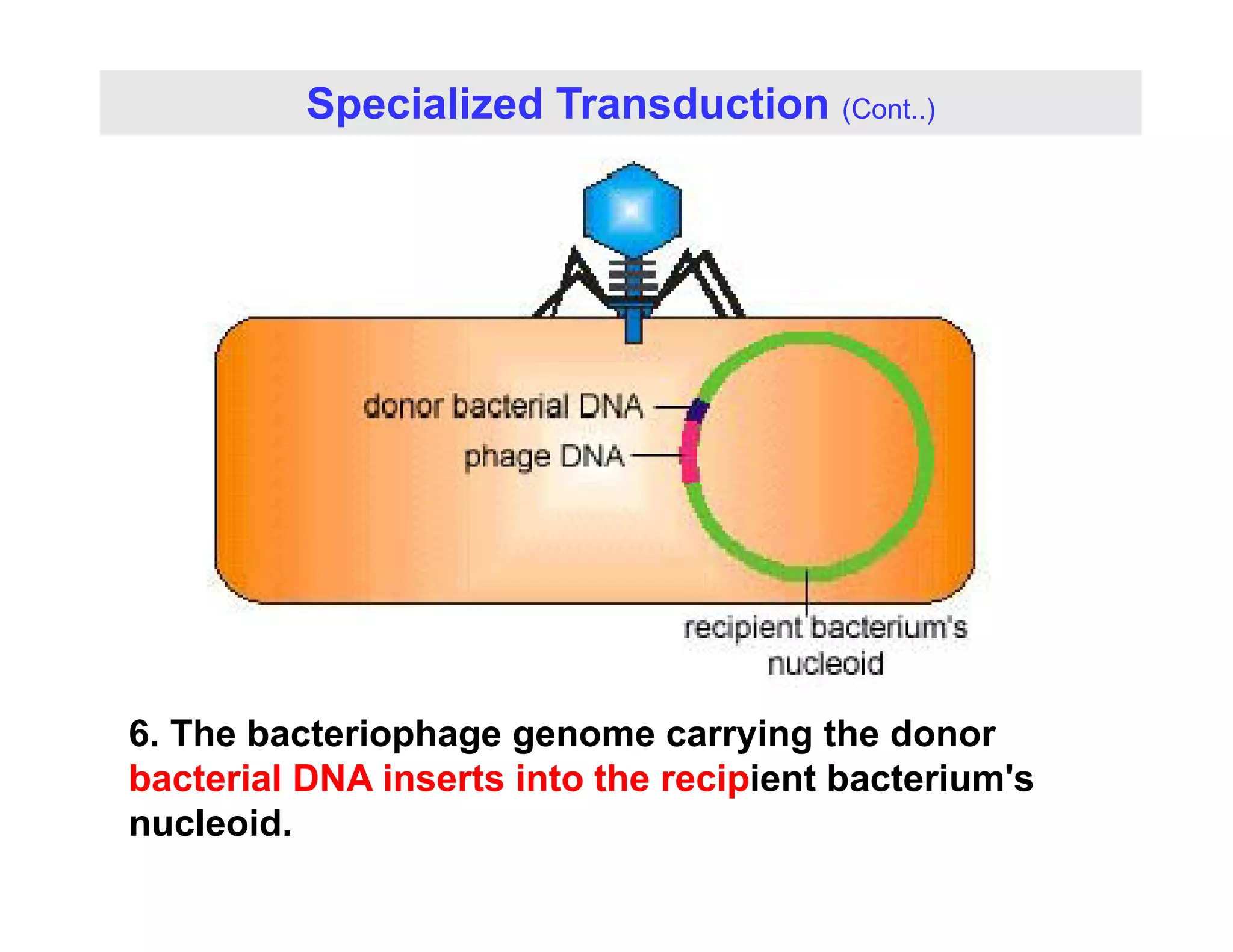
6. The bacteriophage genome carrying the donor
bacterial DNA inserts into the recipient bacterium's
bacterial DNA inserts into the recipient bacterium s
nucleoid.
Transduction
D fi iti G t f f
• Definition: Gene transfer from a
donor to a recipient by way of a
p y y
bacteriophage
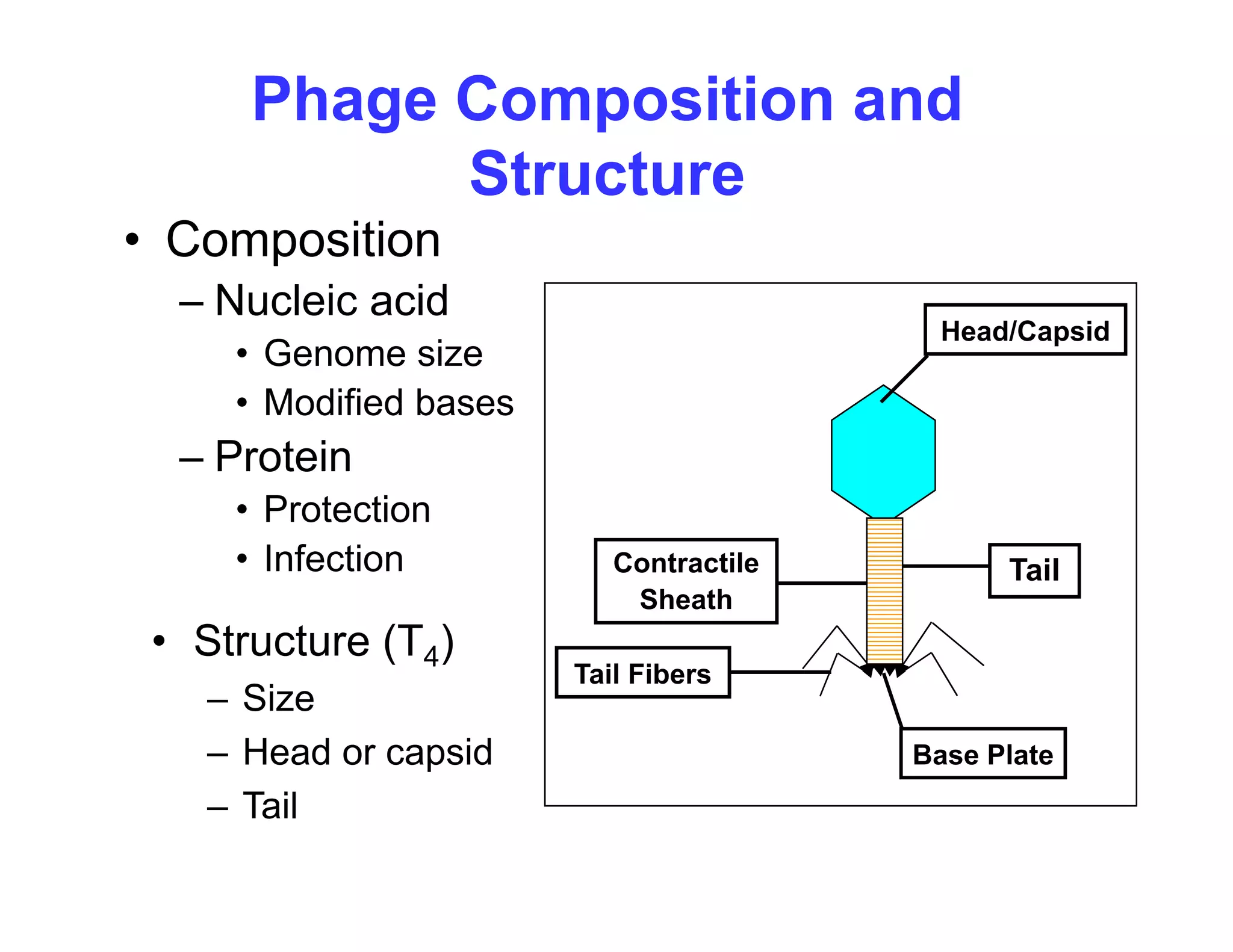
Phage Composition and
Structure
Structure
• Composition
Nucleic acid
– Nucleic acid
• Genome size
• Modified bases
Head/Capsid
– Protein
• Protection
• Infection
• Structure (T4)
Tail
Contractile
Sheath
St uctu e ( 4)
– Size
– Head or capsid
Tail Fibers
Base Plate
– Tail
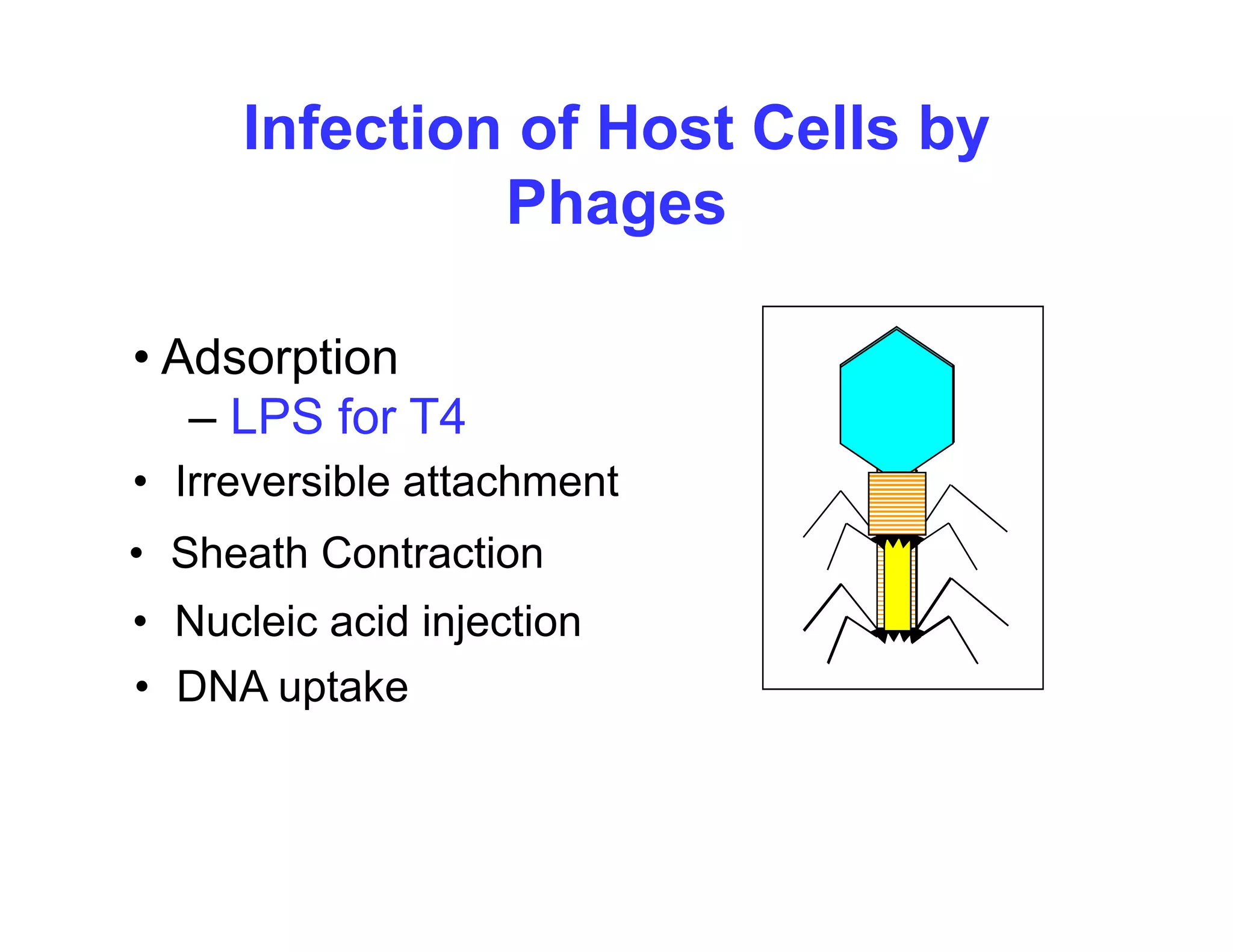
Infection of Host Cells by
Phages
• Adsorption
LPS for T4
• Irreversible attachment
– LPS for T4
• Nucleic acid injection
• Sheath Contraction
• DNA uptake
Types of Bacteriophage
• Lytic or virulent – Phage that multiply within the
Lytic or virulent Phage that multiply within the
host cell, lyse the cell and release progeny
phage (e.g. T4)
• Lysogenic or temperate phage: Phage that can
y g p p g g
either multiply via the lytic cycle or enter a
quiescent state in the bacterial cell. (e.g.)
– Expression of most phage genes repressed
– Prophage
L
– Lysogen
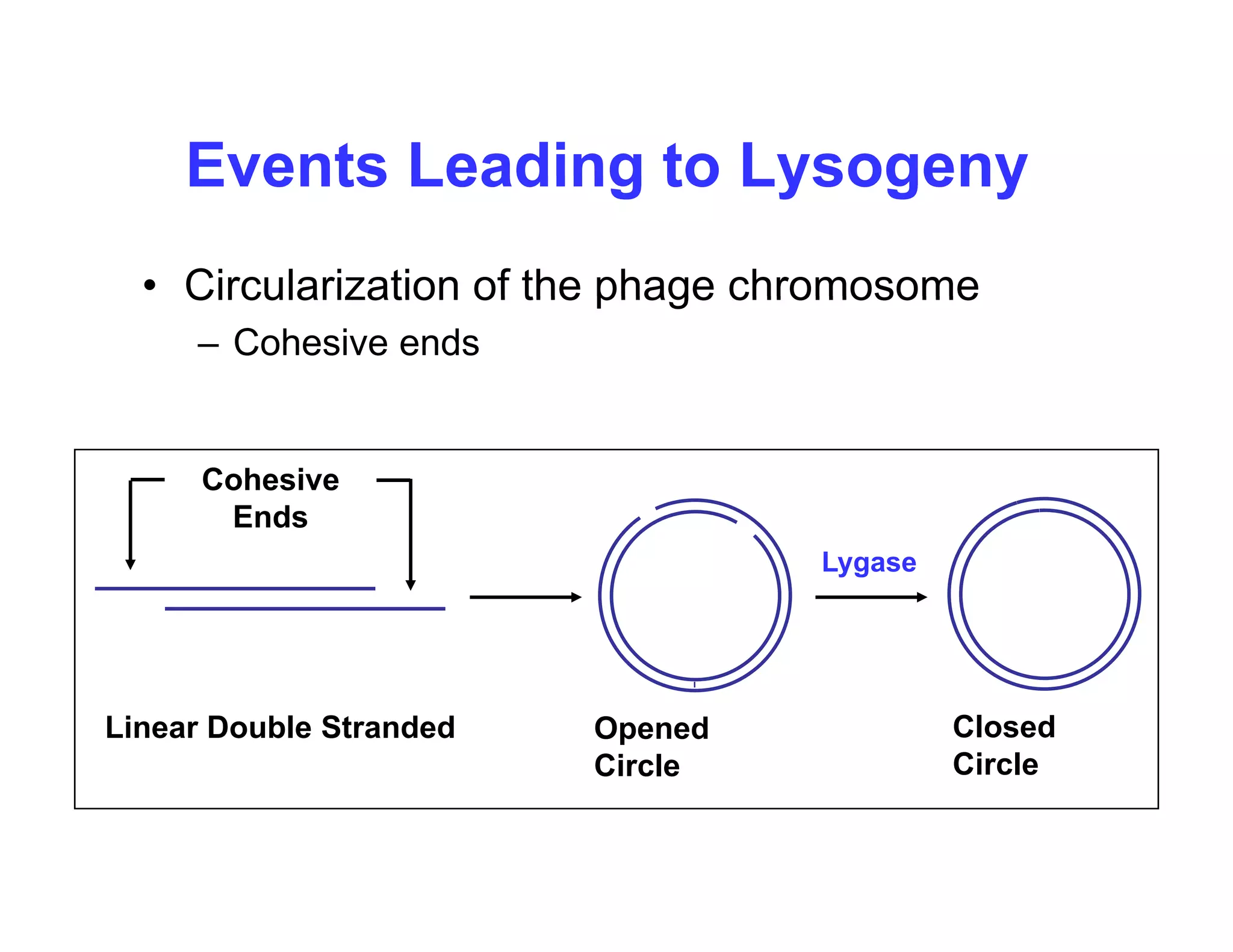
Events Leading to Lysogeny
• Circularization of the phage chromosome
Circularization of the phage chromosome
– Cohesive ends
Cohesive
Ends
Lygase
Closed
Circle
Linear Double Stranded Opened
Circle
Circle
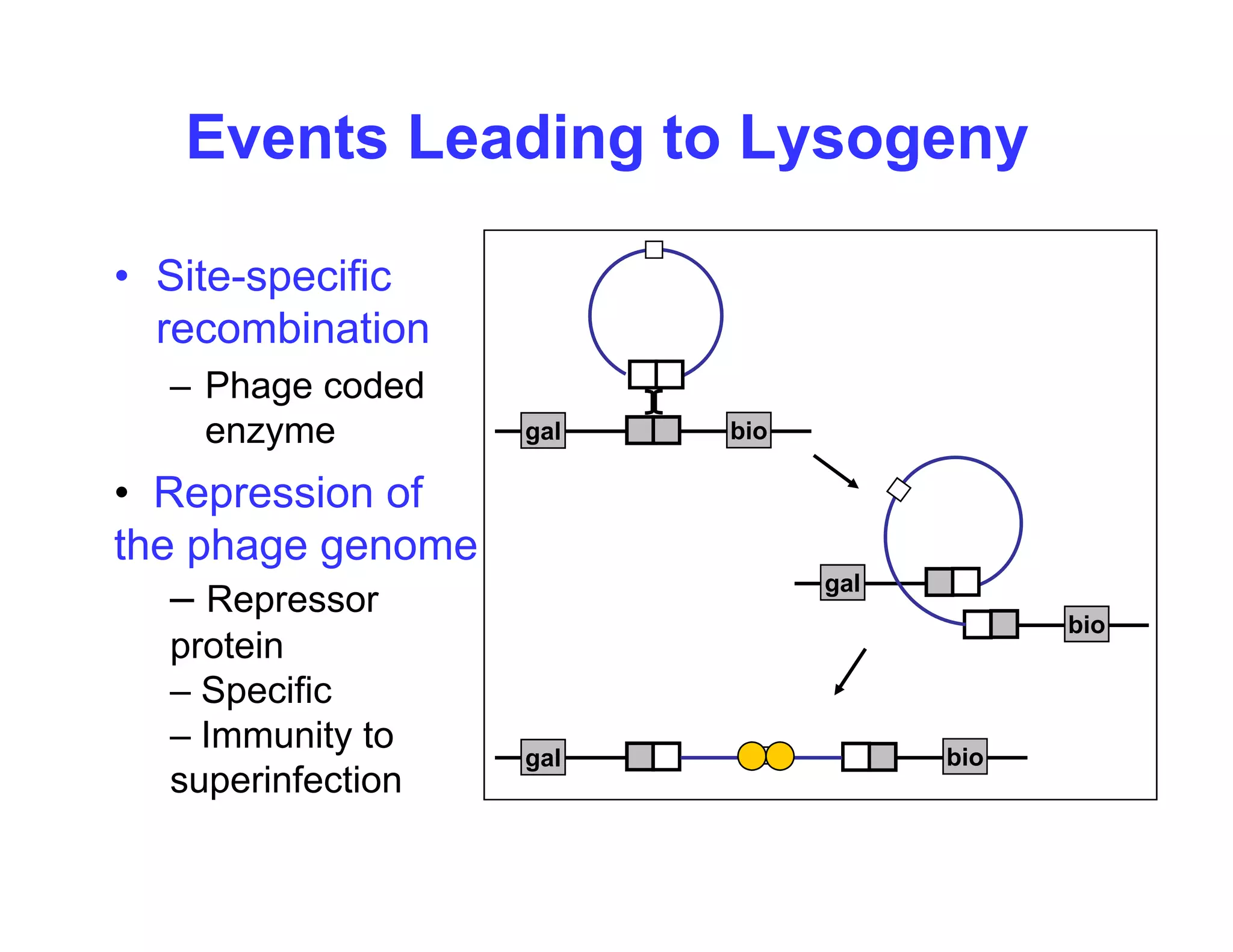
Events Leading to Lysogeny
• Site-specific
p
recombination
– Phage coded
enzyme
• Repression of
th h
gal bio
the phage genome
– Repressor
protein
gal
bio
protein
– Specific
– Immunity to
superinfection
gal bio
superinfection
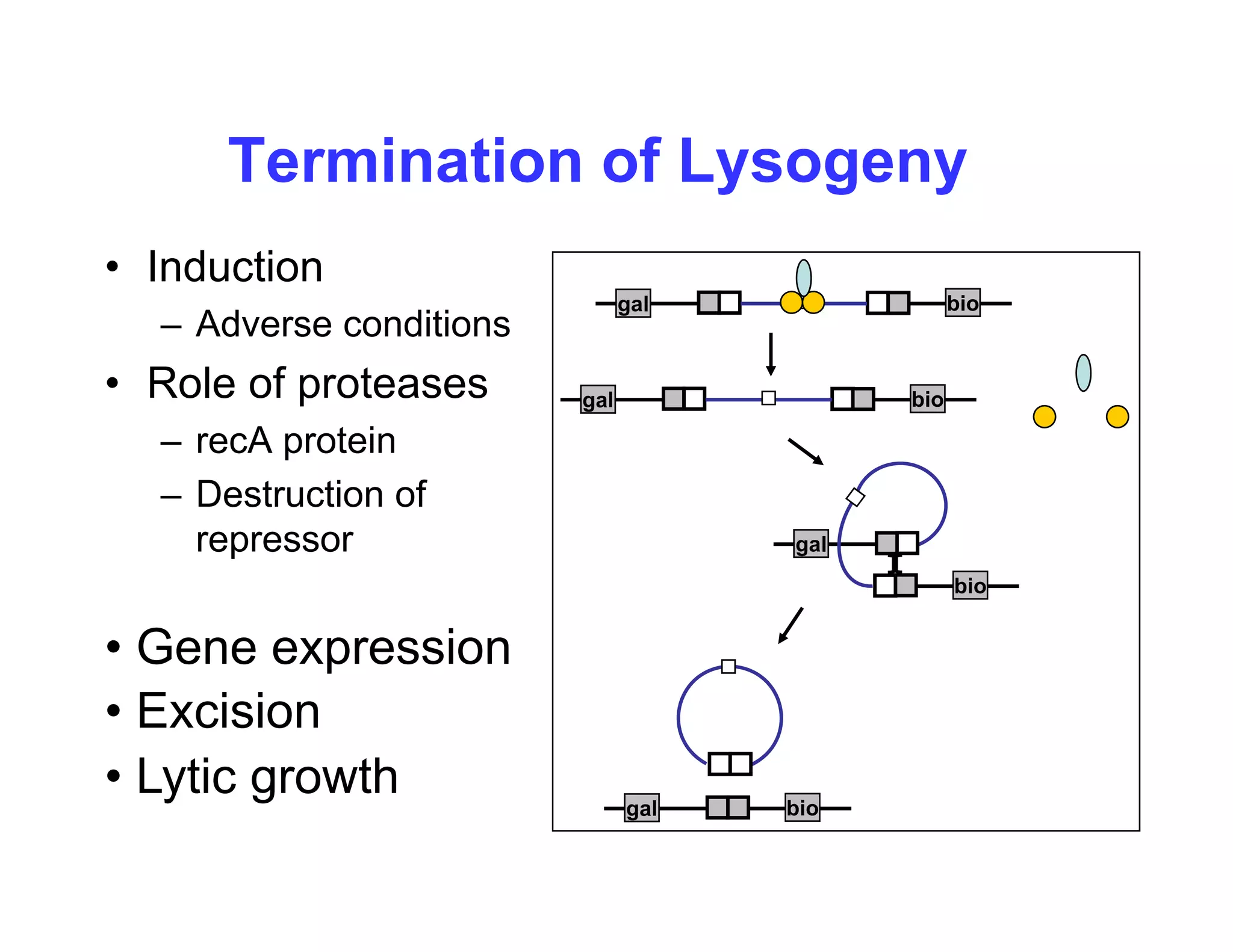
Termination of Lysogeny
• Induction
l bi
– Adverse conditions
• Role of proteases
gal bio
gal bio
– recA protein
– Destruction of
repressor
repressor gal
bio
• Gene expression
• Excision
• Lytic growth
Gene expression
• Lytic growth gal bio
Transduction
D fi iti G t f f
• Definition: Gene transfer from a
donor to a recipient by way of a
bacteriophage
• Resistant to environmental
Resistant to environmental
nucleases
Transduction
• Types of transduction
yp
–Generalized - Transduction in which
potentially any donor bacterial gene
can be transferred
Generalized Transduction
• Phage replication and degradation of host DNA
• Infection of Donor
• Release of phage
• Assembly of phages particles
Infection of recipient
• Infection of recipient
• Legitimate recombination
Transduction
Transduction
• Types of transduction
Types of transduction
– Generalized - Transduction in which
potentially any dornor bacterial gene can
p y y g
be transferred.
Specialized Transduction in which only
– Specialized - Transduction in which only
certain donor genes can be transferred
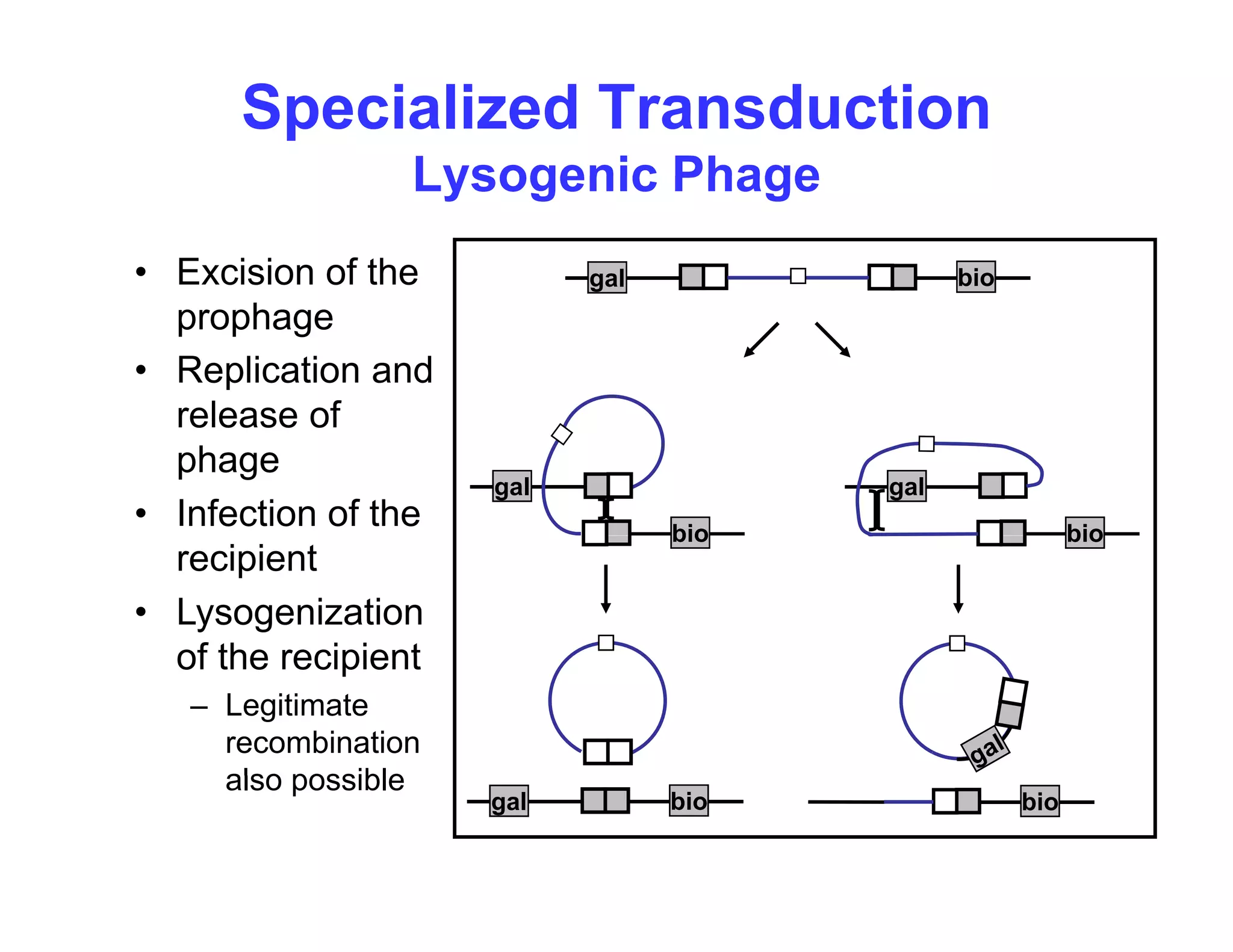
Specialized Transduction
Lysogenic Phage
Lysogenic Phage
• Excision of the gal bio
prophage
• Replication and
release of
gal
bio
gal
bio
release of
phage
• Infection of the bio bio
recipient
• Lysogenization
of the recipient
of the recipient
– Legitimate
recombination
also possible
gal bio bio
also possible
Transduction
Transduction
• Definition
Definition
• Types of transduction
Si ifi
• Significance
– Common in Gram+ bacteria
– Lysogenic (phage) conversion
https://www.youtube.com/watch?v=0QjVnJ7H198
Griffith’s experiments
https://www.youtube.com/watch?v 0QjVnJ7H198
https://www.youtube.com/watch?v=7Ul9RVYG5CM
Transformation
https://www.youtube.com/watch?v=E7eqc4r2iwI
PCR cloning
Thank You!!!
Thank You!!!

genetic-recombination-1 [Compatibility Mode].pdf

  • 1.
    Genetic Genetic Transformation Transformation In Bacteria In Bacteria Prof.A. B. Das Dept. of Botany, Utkal University Bh b 751004 Bhubaneswar 751004 E-mail: abdas.uubot@gmail.com
  • 2.
    Mutations in Bacteria Mutationsin Bacteria • Mutations arise in bacterial populations Mutations arise in bacterial populations – Induced Spontaneous – Spontaneous • Rare mutations are expressed – Bacteria are haploid – Rapid growth rate • Selective advantage enriches for mutants • Gene transfer occurs in bacteria
  • 3.
    General Features of GeneTransfer in Bacteria • Unidirectional – Donor to recipient • Donor does not give an entire chromosome – Merozygotes yg • Gene transfer can occur between species species
  • 4.
    Griffith's experiment, reportedin 1928 b F d i k G iffith 1928 by Frederick Griffith, was the first experiment suggesting p gg g that bacteria are capable of transferring genetic information transferring genetic information through a process known as transformation.
  • 5.
    Griffith’s experiments withDiplococcus pneumonia and Mice pneumonia and Mice
  • 6.
    Hershey and Chase1952 experiments show that DNA is hereditary material in bacteriophages.
  • 7.
    Lederberg and Zinder’s1952 bacterial transduction transduction
  • 8.
    • Genetic recombination- transfer of DNA from one organism (donor) to another recipient. one organism (donor) to another recipient. • The transferred donor DNA may then be integrated into the recipient's nucleoid by various mechanisms (homologous, non-homologous). ( g , g ) • Homologous recombination- homologous DNA sequences having nearly the same nucleotide DNA sequences having nearly the same nucleotide sequences are exchanged by means of Rec A proteins. • This involves breakage and reunion of paired DNA • This involves breakage and reunion of paired DNA segments as seen in (Natural mechanisms of genetic recombination in bacteria) include: A Conjungation A. Conjungation B. Transformation C. Transduction C. Transduction
  • 9.
    Bacterial Conjugation Bacterial Conjugation BacterialConjugation is genetic recombination Bacterial Conjugation is genetic recombination in which there is a transfer of DNA from a living donor bacterium to a recipient g p bacterium. Often involves a sex pilus. • The 3 conjugative processes I. F + conjugation II. Hfr conjugation III. Resistance plasmid conjugation
  • 10.
    I. F+ ConjugationProcess F+ Conjugation- Genetic recombination in which there is a Genetic recombination in which there is a transfer of an F+ plasmid (coding only for a sex pilus) but not chromosomal DNA from a male donor bacterium to a female recipient bacterium. Involves a sex (conjugation) pilus. Other plasmids present in the cytoplasm of the b t i h th di f bacterium, such as those coding for antibiotic resistance, may also be transferred during this process during this process.
  • 11.
    F+ Conjugation 1. TheF+ male has an F+ plasmid coding for a sex pilus and can serve as a genetic donor
  • 12.
    F+ Conjugation (cont...) 2.The sex pilus adheres to an F- female (recipient) One strand of the F+ plasmid breaks (recipient). One strand of the F+ plasmid breaks
  • 13.
    F+ Conjugation (cont...) 3.The sex pilus retracts and a bridge is created between the two bacteria. One strand of the F+ plasmid enters the recipient bacterium
  • 14.
    F+ Conjugation (cont...) 4B th b t i k l t t d 4. Both bacteria make a complementary strand of the F+ plasmid and both are now F+ males capable of producing a sex pilus There was no capable of producing a sex pilus. There was no transfer of donor chromosomal DNA although other plasmids the donor bacterium carries p may also be transferred during F+ conjugation.
  • 15.
    II. Hfr Conjugation Geneticrecombination in which fragments of chromosomal DNA from a fragments of chromosomal DNA from a male donor bacterium are transferred to a female recipient bacterium following a female recipient bacterium following insertion of an F+ plasmid into the nucleoid of the donor bacterium nucleoid of the donor bacterium. Involves a sex (conjugation) pilus.
  • 16.
    Hfr Conjugation 1. AnF+ plasmid inserts into the donor p bacterium's nucleoid to form an Hfr male.
  • 17.
    Hfr Conjugation (cont....) jg 2 Th il dh t F f l 2. The sex pilus adheres to an F- female (recipient). One donor DNA strand breaks in the middle of One donor DNA strand breaks in the middle of the inserted F+ plasmid.
  • 18.
    Hfr Conjugation (cont...) 3.The sex pilus retracts and a bridge forms between the two bacteria. One donor DNA strand begins to enter the recipient bacterium. The two cells break apart easily so the only a portion of the donor's DNA strand is usually transferred to the recipient bacterium.
  • 19.
    Hfr Conjugation (cont...) 4.The donor bacterium makes a complementary 4. The donor bacterium makes a complementary copy of the remaining DNA strand and remains an Hfr male. The recipient bacterium makes a complementary strand of the transferred donor DNA.
  • 20.
    Hfr Conjugation (cont’d) 5Th d DNA f t d ti h 5. The donor DNA fragment undergoes genetic exchange with the recipient bacterium's DNA. Since there was transfer of some donor chromosomal DNA but usually not a complete F+ plasmid, the recipient bacterium usually remains F-
  • 21.
    III. Resistant PlasmidConjugation Genetic recombination in which there is a transfer of an R plasmid (a plasmid coding for transfer of an R plasmid (a plasmid coding for multiple antibiotic resistance and often a sex pilus) from a male donor bacterium to a pilus) from a male donor bacterium to a female recipient bacterium. Involves a sex (conjugation) pilus
  • 22.
    Resistant Plasmid Conjugation 1.The bacterium with an R-plasmid is multiple antibiotic resistant and can produce a sex pilus p p (serve as a genetic donor).
  • 23.
    Resistant Plasmid Conjugation(Cont...) 2. The sex pilus adheres to an F- female (recipient). One strand of the R-plasmid breaks.
  • 24.
    Resistant Plasmid Conjugation(Cont...) 3. The sex pilus retracts and a bridge is created 3. The sex pilus retracts and a bridge is created between the two bacteria. One strand of the R-plasmid enters the recipient bacterium.
  • 25.
    Resistant Plasmid Conjugation(Cont...) 4 Both bacteria make a complementary strand 4. Both bacteria make a complementary strand of the R-plasmid and both are now multiple antibiotic resistant and capable of producing a p p g sex pilus.
  • 26.
    Conjugation • Definition: Genetransfer from a donor to a recipient by direct physical contact between cells • Mating types in bacteria Donor Mating types in bacteria – Donor • F factor (Fertility factor) F factor (Fertility factor) – F (sex) pilus – Recipient Recipient Recipient • Lacks an F factor
  • 27.
    Physiological States ofF Factor Physiological States of F Factor • Autonomous (F+) – Characteristics of F+ x F- crosses • F- becomes F+ while F+ F becomes F while F remains F+ • Low transfer of donor F+ • Low transfer of donor chromosomal genes F+
  • 28.
    Physiological States ofF Factor • Integrated (Hfr) – Characteristics of Hfr x F- crosses F l b • F- rarely becomes Hfr while Hfr remains Hfr • High transfer of certain donor chromosomal F+ Hfr chromosomal genes
  • 29.
    Physiological States ofF Factor • Autonomous with donor genes (F’) donor genes (F ) – Characteristics of F’ x F- crosses • F- becomes F’ while F’ remains F’ F • High transfer of donor genes on F’ and low transfer of other donor Hfr F’ donor chromosomal genes
  • 30.
    Mechanism of F+x F- Crosses Mechanism of F x F Crosses • Pair formation – Conjugation • DNA transfer Conjugation bridge F+ F- F+ F- • DNA transfer – Origin of transfer F F F+ F transfer – Rolling circle circle replication F+ F+ F+ F+
  • 31.
    Mechanism of Hfrx F- Crosses • Pair formation • Pair formation – Conjugation b id • DNA transfer bridge Hfr F- Hfr F- – Origin of transfer – Rolling circle replication replication • Homologous recombination Hfr F- Hfr F- recombination
  • 32.
    Mechanism of F’x F- Crosses • Pair formation • Pair formation – Conjugation b id • DNA transfer bridge F’ F- F’ F- – Origin of transfer – Rolling circle li ti replication F’ F’ F’ F’
  • 33.
    Conjugation Conjugation • Significance • Significance –Gram- bacteria • Antibiotic resistance • Rapid spread –Gram + bacteria • Production of adhesive material by donor cells
  • 34.
    Transposable Genetic Elements TransposableGenetic Elements • Definition: Segments of DNA that are able Definition: Segments of DNA that are able to move from one location to another • Properties – “Random” movement – Not capable of self replication Transposition mediated by site specific recombination – Transposition mediated by site-specific recombination • Transposase – Transposition may be accompanied by duplication Transposition may be accompanied by duplication
  • 35.
    Types of TransposableGenetic Elements • Insertion sequences (IS) • Insertion sequences (IS) – Definition: Elements that carry no other genes except those involved in transposition p p – Nomenclature - IS1 – Structure – Importance Transposase ABCDEFG GFEDCBA • Mutation •Plasmid insertion •Phase variation
  • 36.
    Phase Variation inSalmonella H Phase Variation in Salmonella H Antigens IS H1 gene H2 gene H1 flagella H2 flagella flagella flagella
  • 37.
    Types of TransposableGenetic El t Elements T (T ) • Transposons (Tn) – Definition: Elements that carry other genes t th i l d i t iti except those involved in transposition – Nomenclature - Tn10 S – Structure • Composite Tns I t IS IS Resistance Gene(s) IS IS Resistance Gene(s) – Importance • Antibiotic resistance IS IS Resistance Gene(s)
  • 38.
    Plasmids Plasmids • Definition: Extra-chromosomalgenetic Definition: Extra chromosomal genetic elements that are capable of autonomous replication (replicon) replication (replicon) E i l id th t i t t • Episome - a plasmid that can integrate into the chromosome
  • 39.
    Classification of Plasmids Classificationof Plasmids • Transfer properties Transfer properties – Conjugative Nonconjugative – Nonconjugative • Phenotypic effects – Fertility – Bacteriocinogenic plasmid – Resistance plasmid (R factors)
  • 40.
    Structure of RFactors Structure of R Factors • RTF – Conjugative RTF – Conjugative plasmid – Transfer genes Transfer genes • R determinant Resistance Tn 10 R determinant – Resistance genes Transposons – Transposons
  • 41.
    Transformation Transformation • Genetic recombinationin which a • Genetic recombination in which a DNA fragment from a dead, degraded bacterium enters a competent recipient bacterium competent recipient bacterium and it is exchanged for a piece of th i i t' DNA the recipient's DNA.
  • 42.
    Transformation Transformation • Definition: Genetransfer resulting from the uptake of DNA from a donor. • Factors affecting transformation Factors affecting transformation –DNA size and state Sensiti e to n cleases • Sensitive to nucleases –Competence of the recipient (Bacillus, H hil N i i St t ) Haemophilus, Neisseria, Streptococcus) • Competence factor • Induced competence
  • 43.
    Transformation • Steps – Uptakeof DNA p • Gram + • Gram - – Recombination • Legitimate, homologous or general general • recA, recB and recC genes • Significance – Phase variation in Neiseseria – Recombinant DNA technology
  • 44.
    Transformation 1 A donorbacterium dies and is degraded 1. A donor bacterium dies and is degraded
  • 45.
    Transformation 2 A ft f DNA f th d d d 2. A fragment of DNA from the dead donor bacterium binds to DNA binding proteins on the cell wall of a competent living recipient cell wall of a competent, living recipient bacterium
  • 46.
    Transformation 3 The RecA protein promotes genetic 3. The Rec A protein promotes genetic exchange between a fragment of the donor's DNA and the recipient's DNA p
  • 47.
  • 48.
    Transduction Transduction • Genetic recombinationin which a DNA fragment is transferred from one bacterium to another by a bacteriophage y p g Structure of T4 bacteriophage Contraction of the tail sheath of T4
  • 49.
    What are Bacteriophages? Whatare Bacteriophages? Bacteriophage (phage) are obligate Bacteriophage (phage) are obligate intracellular parasites that multiply i id b t i b ki f inside bacteria by making use of some or all of the host biosynthetic machinery (i.e., viruses that infect bacteria
  • 50.
    Transduction (cont...) • Thereare two types of transduction: generalized transduction: A DNA fragment is – generalized transduction: A DNA fragment is transferred from one bacterium to another by a lytic bacteriophage that is now carrying d b t i l DNA d t i donor bacterial DNA due to an error in maturation during the lytic life cycle. f – specialized transduction: A DNA fragment is transferred from one bacterium to another by a temperate bacteriophage that is now p p g carrying donor bacterial DNA due to an error in spontaneous induction during the lysogenic life cycle lysogenic life cycle
  • 51.
    Lytic and lysogeniccycles Slide number: 1 Release: New viruses 5. capsid nucleic acid Bacterial cell wall Bacterial chromosome New viruses leave host cell. a. Lytic cycle Attachment: Capsid combines 1. Maturation: Assembly of viral 4. with receptor. Penetration: 2 Bi th i 3 y components. Penetration: Viral DNA enters host. 2. b. Lysogenic cycle Biosynthesis: Viral components are synthesized. 3. I t ti prophage Integration: Viral DNA passed on when bacteria reproduce.
  • 52.
    Lytic and lysogeniccycles Slide number: 2 capsid nucleic acid Bacterial cell wall Bacterial chromosome Attachment: Capsid combines 1. with receptor.
  • 53.
    Lytic and lysogeniccycles Slide number: 3 capsid nucleic acid Bacterial cell wall Bacterial chromosome Attachment: Capsid combines 1. with receptor. Penetration: 2 Penetration: Viral DNA enters host. 2.
  • 54.
    Lytic and lysogeniccycles Slide number: 4 capsid nucleic acid Bacterial cell wall Bacterial chromosome a. Lytic cycle Attachment: Capsid combines 1. with receptor. Penetration: 2 Bi th i 3 Penetration: Viral DNA enters host. 2. Biosynthesis: Viral components are synthesized. 3.
  • 55.
    Lytic and lysogeniccycles Slide number: 5 capsid nucleic acid Bacterial cell wall Bacterial chromosome a. Lytic cycle Attachment: Capsid combines 1. Maturation: Assembly of viral 4. with receptor. Penetration: 2 Bi th i 3 y components. Penetration: Viral DNA enters host. 2. Biosynthesis: Viral components are synthesized. 3.
  • 56.
    Lytic and lysogeniccycles Slide number: 6 Release: New viruses 5. capsid nucleic acid Bacterial cell wall Bacterial chromosome New viruses leave host cell. a. Lytic cycle Attachment: Capsid combines 1. Maturation: Assembly of viral 4. with receptor. Penetration: 2 Bi th i 3 y components. Penetration: Viral DNA enters host. 2. Biosynthesis: Viral components are synthesized. 3.
  • 57.
    Lytic and lysogeniccycles Slide number: 7 Release: New viruses 5. capsid nucleic acid Bacterial cell wall Bacterial chromosome New viruses leave host cell. a. Lytic cycle Attachment: Capsid combines 1. Maturation: Assembly of viral 4. with receptor. Penetration: 2 Bi th i 3 y components. Penetration: Viral DNA enters host. 2. b. Lysogenic cycle Biosynthesis: Viral components are synthesized. 3. I t ti Integration: Viral DNA passed on when bacteria reproduce.
  • 58.
    Lytic and lysogeniccycles Slide number: 8 Release: New viruses 5. capsid nucleic acid Bacterial cell wall Bacterial chromosome New viruses leave host cell. a. Lytic cycle Attachment: Capsid combines 1. Maturation: Assembly of viral 4. with receptor. Penetration: 2 Bi th i 3 y components. Penetration: Viral DNA enters host. 2. b. Lysogenic cycle Biosynthesis: Viral components are synthesized. 3. I t ti prophage Integration: Viral DNA passed on when bacteria reproduce.
  • 59.
    Lytic and lysogeniccycles Slide number: 9 Release: New viruses 5. capsid nucleic acid Bacterial cell wall Bacterial chromosome New viruses leave host cell. a. Lytic cycle Attachment: Capsid combines 1. Maturation: Assembly of viral 4. with receptor. Penetration: 2 Bi th i 3 y components. Penetration: Viral DNA enters host. 2. b. Lysogenic cycle Biosynthesis: Viral components are synthesized. 3. I t ti prophage Integration: Viral DNA passed on when bacteria reproduce.
  • 60.
    Generalised Transduction 1. Alytic bacteriophage adsorbs to a susceptible bacterium bacterium.
  • 61.
    Generalised Transduction (Cont..) 2.The bacteriophage genome enters the bacterium. The genome directs the bacterium's metabolic machinery to manufacture bacteriophage components machinery to manufacture bacteriophage components and enzymes
  • 62.
    Generalised Transduction (Cont..) 3.Occasionally, a bacteriophage head or capsid assembles around a fragment of donor bacterium's nucleoid or around a plasmid instead of a phage nucleoid or around a plasmid instead of a phage genome by mistake.
  • 63.
    Generalised Transduction (Cont..) 4Th b t i h l d 4. The bacteriophages are released.
  • 64.
    Generalised Transduction (Cont..) 5.The bacteriophage carrying the donor bacterium's DNA adsorbs to a recipient bacterium DNA adsorbs to a recipient bacterium
  • 65.
    Generalised Transduction (Cont..) 6.The bacteriophage inserts the donor bacterium's DNA it is carrying into the recipient bacterium .
  • 66.
    Generalised Transduction (Cont..) 7.The donor bacterium's DNA is exchanged for some of g the recipient's DNA.
  • 67.
    Specialized Transduction (Cont..) 1.A temperate bacteriophage adsorbs to a susceptible b t i d i j t it bacterium and injects its genome .
  • 68.
    Specialized Transduction (Cont..) 2.The bacteriophage inserts its genome into the p g g bacterium's nucleoid to become a prophage.
  • 69.
    Specialized Transduction (Cont..) 3.Occasionally during spontaneous induction, a small piece of the donor bacterium's DNA is picked up as part of the phage's genome in place of some of the phage of the phage s genome in place of some of the phage DNA which remains in the bacterium's nucleoid.
  • 70.
    Specialized Transduction (Cont..) 4.As the bacteriophage replicates, the segment of bacterial DNA replicates as part of the phage's genome bacterial DNA replicates as part of the phage s genome. Every phage now carries that segment of bacterial DNA.
  • 71.
    Specialized Transduction (Cont..) 5The bacteriophage adsorbs to a recipient bacterium 5. The bacteriophage adsorbs to a recipient bacterium and injects its genome.
  • 72.
    Specialized Transduction (Cont..) 6.The bacteriophage genome carrying the donor bacterial DNA inserts into the recipient bacterium's bacterial DNA inserts into the recipient bacterium s nucleoid.
  • 73.
    Transduction D fi itiG t f f • Definition: Gene transfer from a donor to a recipient by way of a p y y bacteriophage
  • 74.
    Phage Composition and Structure Structure •Composition Nucleic acid – Nucleic acid • Genome size • Modified bases Head/Capsid – Protein • Protection • Infection • Structure (T4) Tail Contractile Sheath St uctu e ( 4) – Size – Head or capsid Tail Fibers Base Plate – Tail
  • 75.
    Infection of HostCells by Phages • Adsorption LPS for T4 • Irreversible attachment – LPS for T4 • Nucleic acid injection • Sheath Contraction • DNA uptake
  • 76.
    Types of Bacteriophage •Lytic or virulent – Phage that multiply within the Lytic or virulent Phage that multiply within the host cell, lyse the cell and release progeny phage (e.g. T4) • Lysogenic or temperate phage: Phage that can y g p p g g either multiply via the lytic cycle or enter a quiescent state in the bacterial cell. (e.g.) – Expression of most phage genes repressed – Prophage L – Lysogen
  • 77.
    Events Leading toLysogeny Events Leading to Lysogeny • Circularization of the phage chromosome Circularization of the phage chromosome – Cohesive ends Cohesive Ends Lygase Closed Circle Linear Double Stranded Opened Circle Circle
  • 78.
    Events Leading toLysogeny • Site-specific p recombination – Phage coded enzyme • Repression of th h gal bio the phage genome – Repressor protein gal bio protein – Specific – Immunity to superinfection gal bio superinfection
  • 79.
    Termination of Lysogeny Terminationof Lysogeny • Induction l bi – Adverse conditions • Role of proteases gal bio gal bio – recA protein – Destruction of repressor repressor gal bio • Gene expression • Excision • Lytic growth Gene expression • Lytic growth gal bio
  • 80.
    Transduction D fi itiG t f f • Definition: Gene transfer from a donor to a recipient by way of a bacteriophage • Resistant to environmental Resistant to environmental nucleases
  • 81.
    Transduction • Types oftransduction yp –Generalized - Transduction in which potentially any donor bacterial gene potentially any donor bacterial gene can be transferred
  • 82.
    Generalized Transduction • Phagereplication and degradation of host DNA • Infection of Donor • Release of phage • Assembly of phages particles Infection of recipient • Infection of recipient • Legitimate recombination
  • 83.
    Transduction Transduction • Types oftransduction Types of transduction – Generalized - Transduction in which potentially any dornor bacterial gene can p y y g be transferred. Specialized Transduction in which only – Specialized - Transduction in which only certain donor genes can be transferred
  • 84.
    Specialized Transduction Lysogenic Phage LysogenicPhage • Excision of the gal bio prophage • Replication and release of gal bio gal bio release of phage • Infection of the bio bio recipient • Lysogenization of the recipient of the recipient – Legitimate recombination also possible gal bio bio also possible
  • 85.
    Transduction Transduction • Definition Definition • Typesof transduction Si ifi • Significance – Common in Gram+ bacteria – Lysogenic (phage) conversion
  • 86.