Conjugation
Subhananthini jeyamurugan
18PY17
I M.Sc., Microbiology
ANJA college , Sivakasi.
Transfer of
Genetic material
from Bacteria A
to Bacteria B by
Matting or
contact is called
conjugation.
What is conjugation?
History
 Discovery: Joshua Leaderberg & Edward Tatum in
1946.
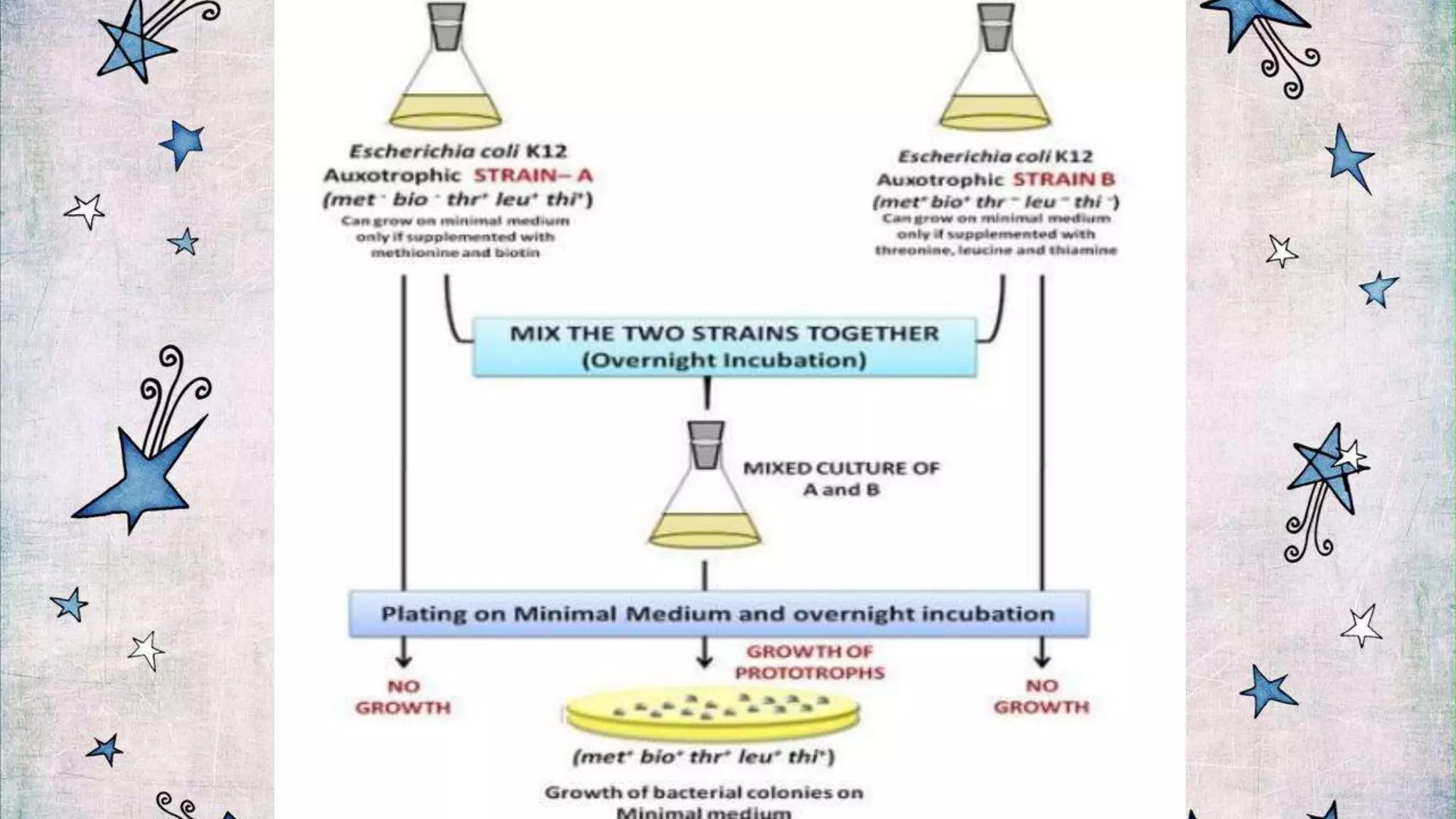
 They experimented with two Auxotropic strain of
E.coli K12 denoted by Strain A and Strain B.
 Strain A ( met- bio- thr+ leu+ thi+) Strain B ( met+
bio+ thr- leu- thi-) were plated on minimal medium
and incubated overnight( control), no growth
observed. Also Strain A and B were mixed together
and when plated on minimal medium resulted in
prototrophs.
Conjugation requires physical contact
• The evidence for cell to cell contact was provides by Bernard
Davis in 1950.
• The to arms of the U tube are separated by a filter.
• On the right side is medium containing auxotrophic strain A
while on the left side is medium containing auxotrophic strain
B.
• The filter allows only the medium to move but not the cells
on either side.
• When culture was plated from both sides on minimal
medium, no prototroph growth was observed as in Lederberg
and Tatum’s experiment.
Who is donor?
Terminology
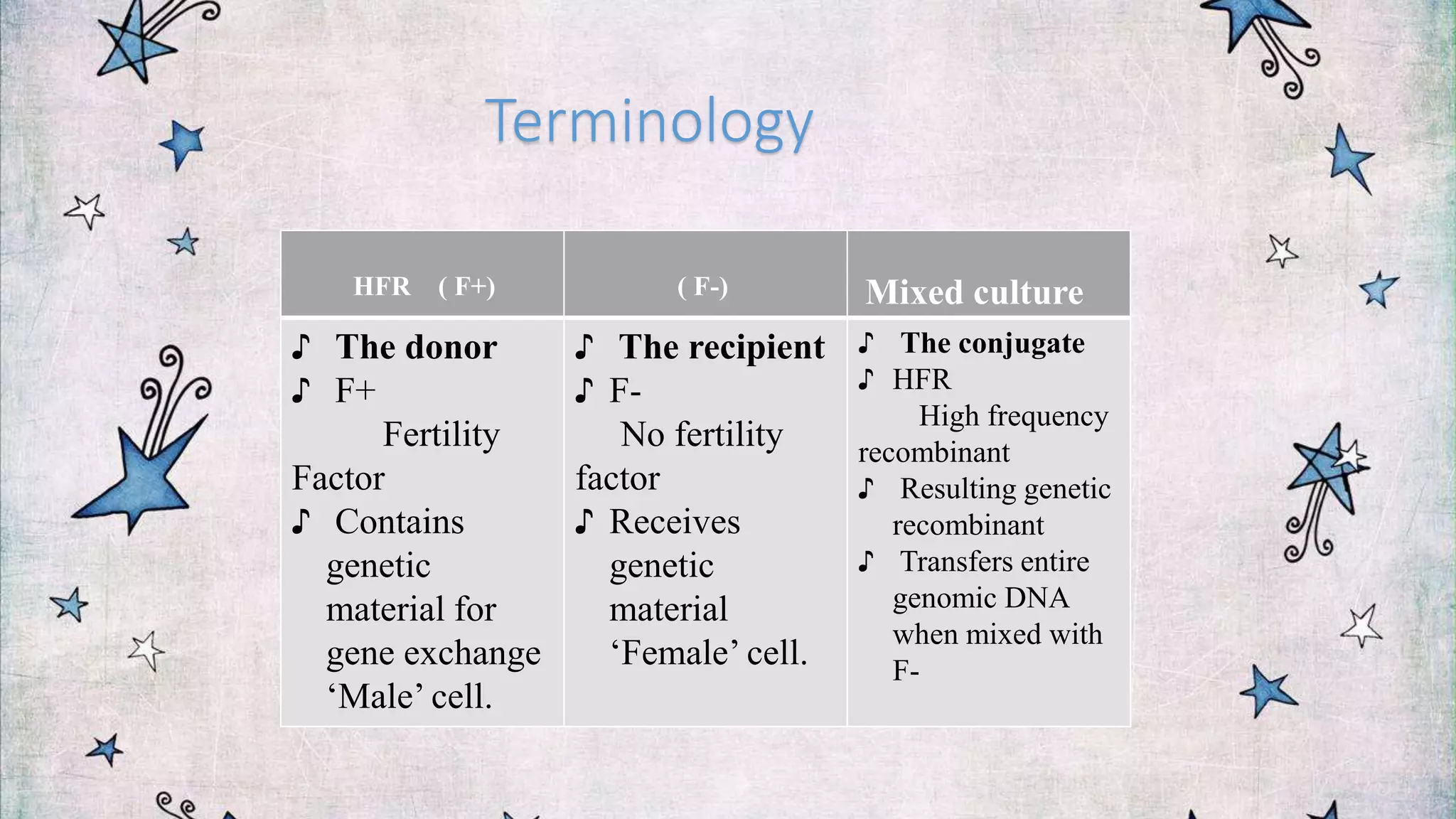
HFR ( F+) ( F-) Mixed culture
♪ The donor
♪ F+
Fertility
Factor
♪ Contains
genetic
material for
gene exchange
‘Male’ cell.
♪ The recipient
♪ F-
No fertility
factor
♪ Receives
genetic
material
‘Female’ cell.
♪ The conjugate
♪ HFR
High frequency
recombinant
♪ Resulting genetic
recombinant
♪ Transfers entire
genomic DNA
when mixed with
F-
What happens during conjugation?
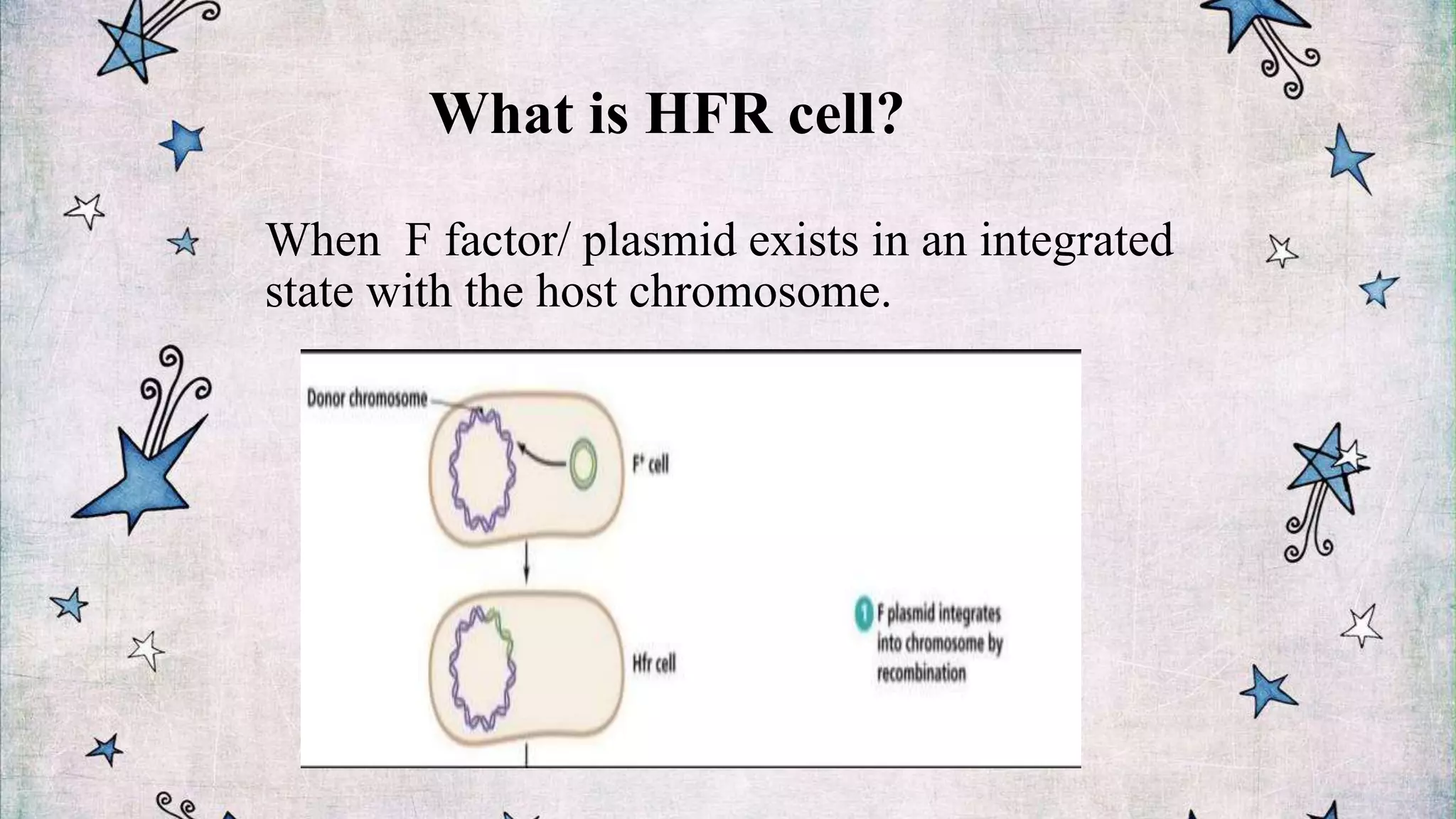
What is HFR cell?
When F factor/ plasmid exists in an integrated
state with the host chromosome.
HFR conjugation
Stages during conjugation
1. cell to cell contact
2. Mobilization
3. DNA synthesis
4. Separation
1. cell to cell contact
Formation of “sex pilus” or F- bridge between cells.
2. Mobilization
• Target DNA is replicated in F+
• Genetic transfer of ssDNA to F-
3. DNA synthesis
• complementary strands of DNA are replicates in both
F+ and F- cells.
• Targeted DNA incorporated into F- genome.
4. Separation
• Cells separate.
• Form two F+ cells with complete recombinant plasmids
• Both severe as donor cells for further conjugation.
Bacterial conjugation
in E.coli strains
HFR ( F+) ( F-) Mixed culture
 Able to produce
amino acids
Thr, Leu, Thi
 Sensitive to
Streptomycin
 HFR strain used
for experimental
purposes
 Requires amino
acids
Thr, Leu, Thi
 Resistant to
streptomycin.
 Able to produce
Thr and Leu
 Thi not produce
 Resistant to
streptomycin
conjugation
conjugation

conjugation

  • 2.
    Conjugation Subhananthini jeyamurugan 18PY17 I M.Sc.,Microbiology ANJA college , Sivakasi.
  • 3.
    Transfer of Genetic material fromBacteria A to Bacteria B by Matting or contact is called conjugation. What is conjugation?
  • 4.
    History  Discovery: JoshuaLeaderberg & Edward Tatum in 1946.  They experimented with two Auxotropic strain of E.coli K12 denoted by Strain A and Strain B.  Strain A ( met- bio- thr+ leu+ thi+) Strain B ( met+ bio+ thr- leu- thi-) were plated on minimal medium and incubated overnight( control), no growth observed. Also Strain A and B were mixed together and when plated on minimal medium resulted in prototrophs.
  • 6.
    Conjugation requires physicalcontact • The evidence for cell to cell contact was provides by Bernard Davis in 1950. • The to arms of the U tube are separated by a filter. • On the right side is medium containing auxotrophic strain A while on the left side is medium containing auxotrophic strain B. • The filter allows only the medium to move but not the cells on either side. • When culture was plated from both sides on minimal medium, no prototroph growth was observed as in Lederberg and Tatum’s experiment.
  • 8.
  • 9.
    Terminology HFR ( F+)( F-) Mixed culture ♪ The donor ♪ F+ Fertility Factor ♪ Contains genetic material for gene exchange ‘Male’ cell. ♪ The recipient ♪ F- No fertility factor ♪ Receives genetic material ‘Female’ cell. ♪ The conjugate ♪ HFR High frequency recombinant ♪ Resulting genetic recombinant ♪ Transfers entire genomic DNA when mixed with F-
  • 10.
    What happens duringconjugation?
  • 11.
    What is HFRcell? When F factor/ plasmid exists in an integrated state with the host chromosome.
  • 12.
  • 13.
    Stages during conjugation 1.cell to cell contact 2. Mobilization 3. DNA synthesis 4. Separation
  • 14.
    1. cell tocell contact Formation of “sex pilus” or F- bridge between cells.
  • 15.
    2. Mobilization • TargetDNA is replicated in F+ • Genetic transfer of ssDNA to F-
  • 16.
    3. DNA synthesis •complementary strands of DNA are replicates in both F+ and F- cells. • Targeted DNA incorporated into F- genome.
  • 17.
    4. Separation • Cellsseparate. • Form two F+ cells with complete recombinant plasmids • Both severe as donor cells for further conjugation.
  • 18.
    Bacterial conjugation in E.colistrains HFR ( F+) ( F-) Mixed culture  Able to produce amino acids Thr, Leu, Thi  Sensitive to Streptomycin  HFR strain used for experimental purposes  Requires amino acids Thr, Leu, Thi  Resistant to streptomycin.  Able to produce Thr and Leu  Thi not produce  Resistant to streptomycin