SYNTHESIS OF QUINOLINE
DERIVATIVES AND THEIR
APPLICATIONS
PRESENTED BY
ANURAG PRAJAPATI
M.Sc. CHEMISTRY
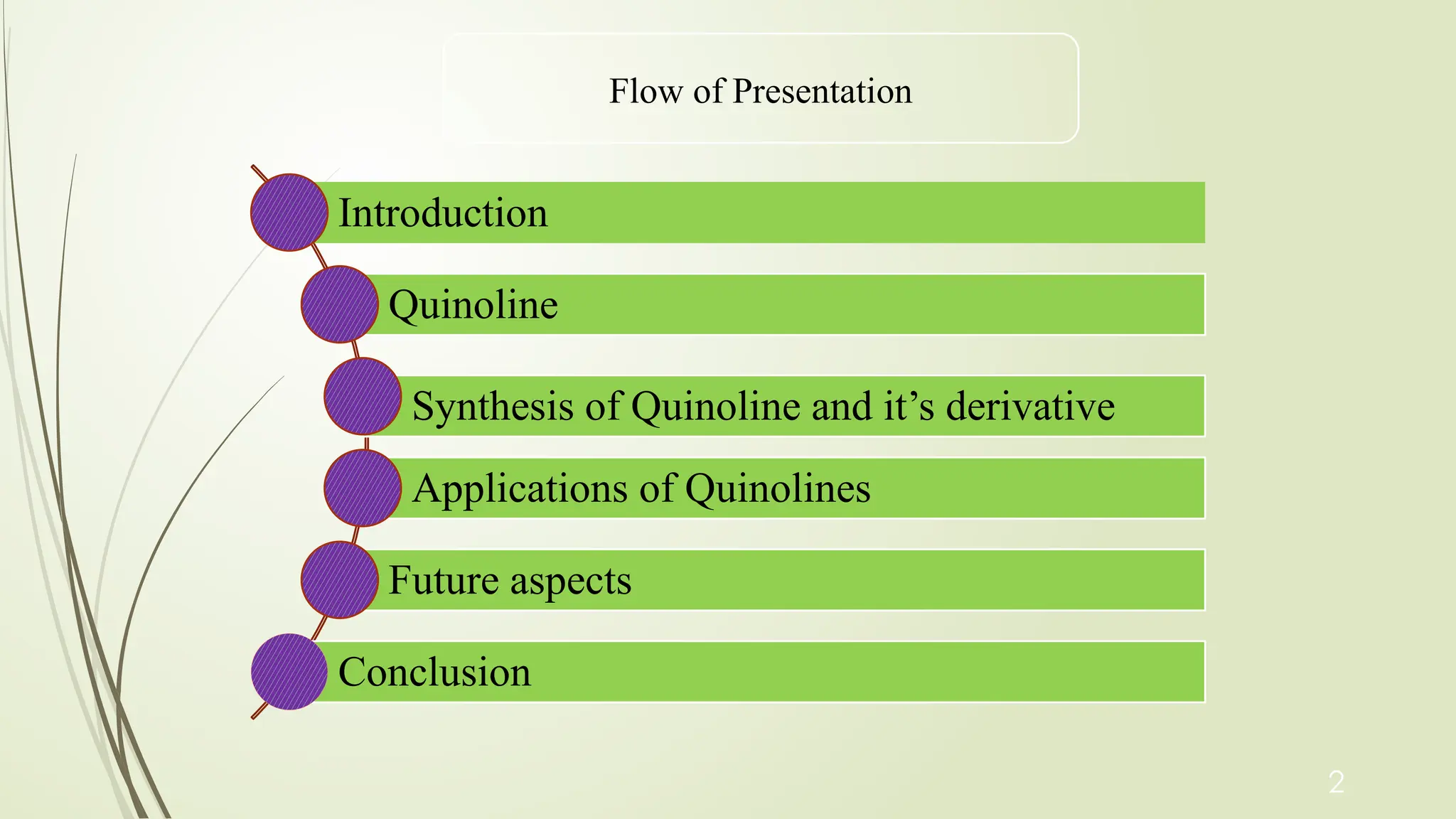
Introduction
Quinoline
Synthesis of Quinoline and it’s derivative
Applications of Quinolines
Future aspects
Conclusion
Flow of Presentation
2
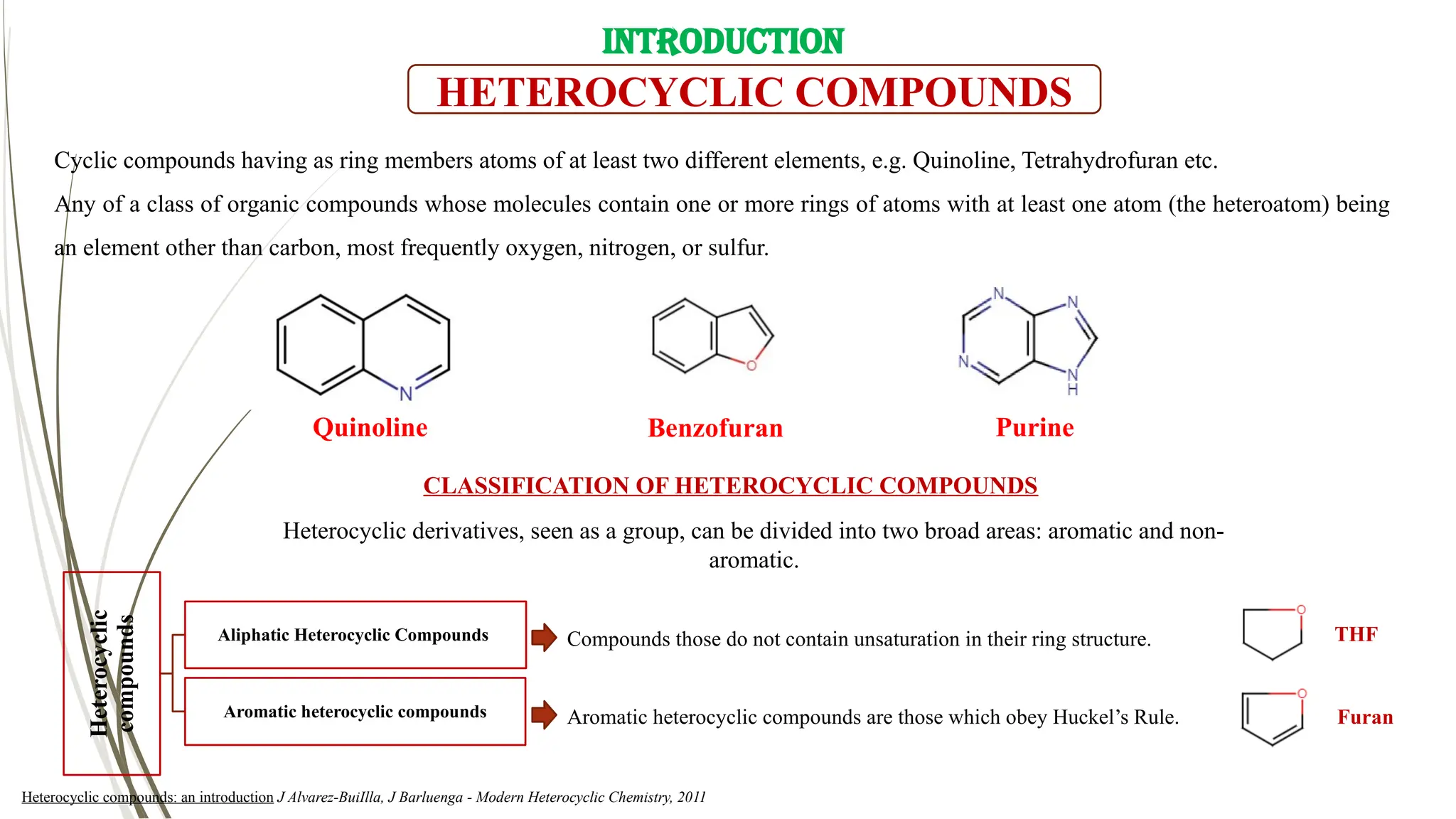
HETEROCYCLIC COMPOUNDS
Cyclic compounds having as ring members atoms of at least two different elements, e.g. Quinoline, Tetrahydrofuran etc.
Any of a class of organic compounds whose molecules contain one or more rings of atoms with at least one atom (the heteroatom) being
“
an element other than carbon, most frequently oxygen, nitrogen, or sulfur.
Quinoline Benzofuran Purine
CLASSIFICATION OF HETEROCYCLIC COMPOUNDS
Heterocyclic
compounds
Aliphatic Heterocyclic Compounds
Aromatic heterocyclic compounds
Compounds those do not contain unsaturation in their ring structure.
Aromatic heterocyclic compounds are those which obey Huckel’s Rule.
THF
Furan
Heterocyclic compounds: an introduction J Alvarez BuiIlla, J Barluenga - Modern Heterocyclic Chemistry, 2011
‐
Heterocyclic derivatives, seen as a group, can be divided into two broad areas: aromatic and non-
aromatic.
INTRODUCTION
QUINOLINE
Quinoline or 1-aza-naphthalene or benzo[b]pyridine is a planner hetero-aromatic compound
in which 10π electrons move throughout the structure and having a molecular formula of C9H7N.
Quinoline reported as an important building block in the field of medicinal chemistry.
QUINOLINE
Properties of Quinoline
 Quinoline is colorless liquid and having a peculiar odor.
 It is a hygroscopic liquid .
 It is soluble in water and completely miscible in ether, alcohol and acetone.
 Chemically it gives every reaction of pyridine .
 Quinoline readily gives electrophilic substitution reactions of benzene ring.
The Chemistry of Quinolines. RH Manske - Chemical Reviews, 1942 - ACS Publications
Quinoline was first discovered by Friedlieb Rouge in 1834, obtained by the distillation of coal tar.
However, its structure, comprised of a rigid heterocyclic core of benzene ortho-fused with a pyridine
ring , was only unveiled in 1871 as Dewar observed the chemical similarity between pyridine and
quinoline
Skraup, Z.H. (1880). Ber. Dtsch. Chem. Ges. 13: 2086–2087
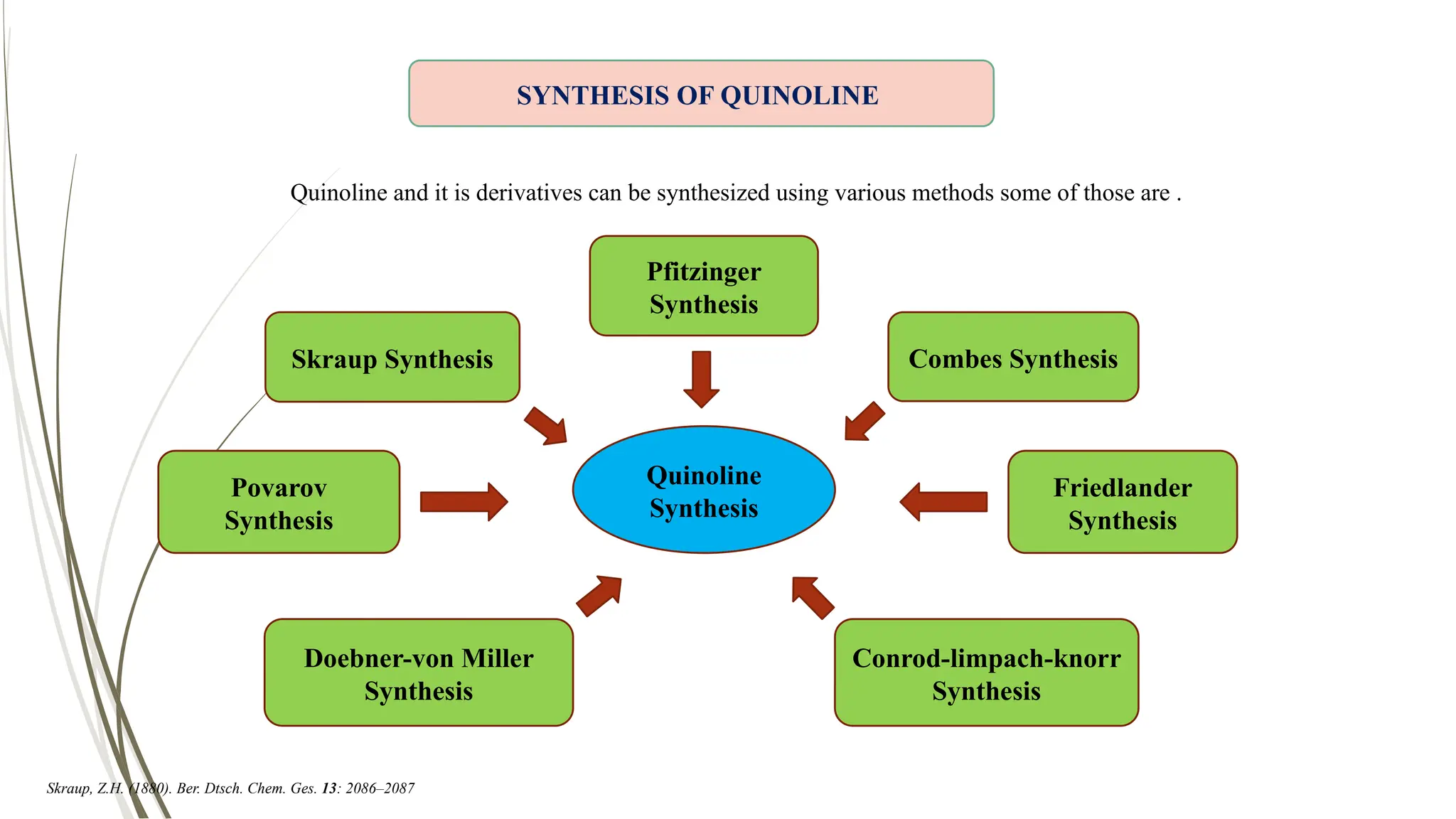
SYNTHESIS OF QUINOLINE
Quinoline and it is derivatives can be synthesized using various methods some of those are .
Quinoline
Synthesis
Pfitzinger
Synthesis
Combes Synthesis
Friedlander
Synthesis
Doebner-von Miller
Synthesis
Skraup Synthesis
Povarov
Synthesis
Conrod-limpach-knorr
Synthesis
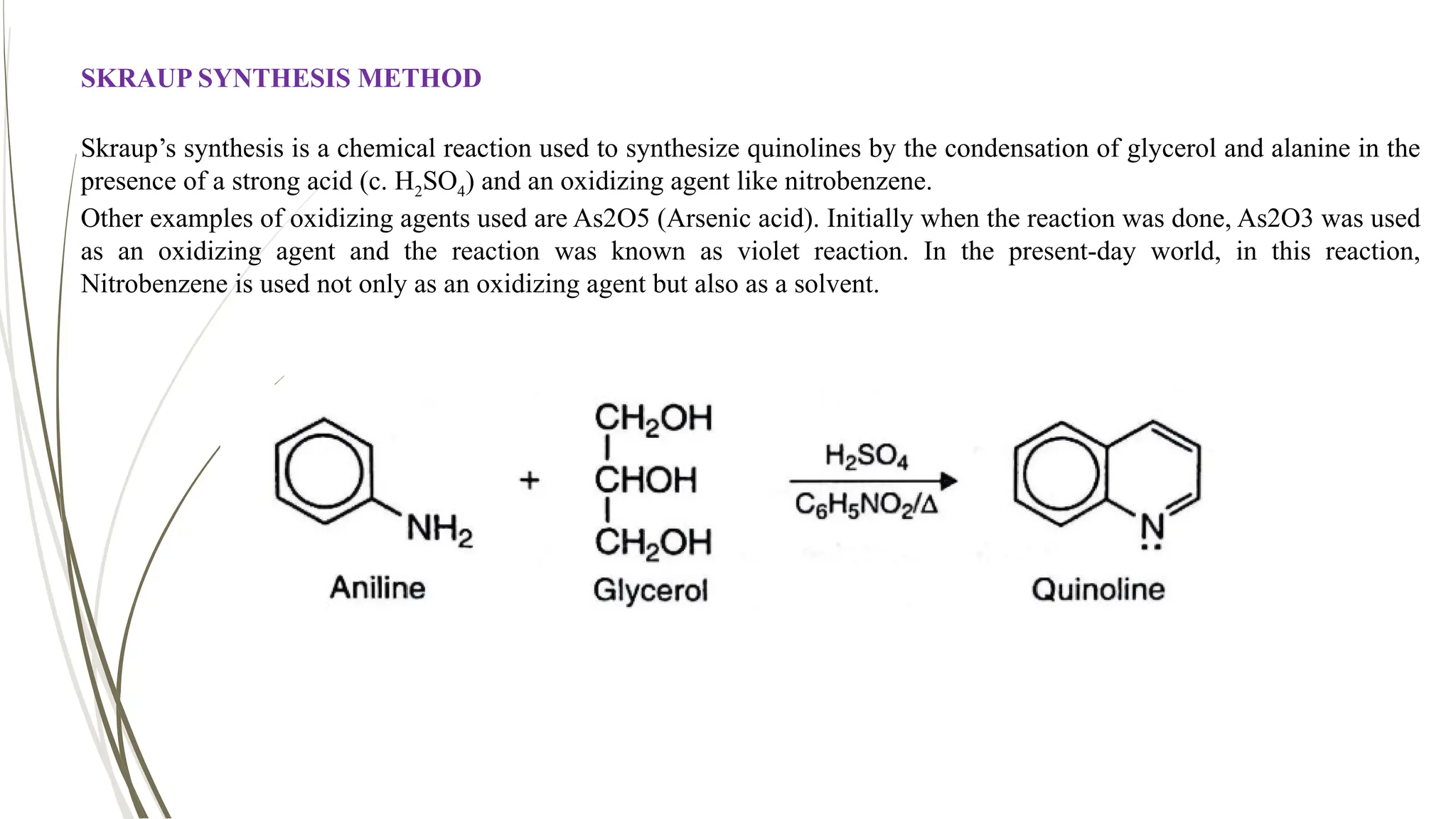
SKRAUP SYNTHESIS METHOD
Skraup’s synthesis is a chemical reaction used to synthesize quinolines by the condensation of glycerol and alanine in the
presence of a strong acid (c. H2SO4) and an oxidizing agent like nitrobenzene.
Other examples of oxidizing agents used are As2O5 (Arsenic acid). Initially when the reaction was done, As2O3 was used
as an oxidizing agent and the reaction was known as violet reaction. In the present-day world, in this reaction,
Nitrobenzene is used not only as an oxidizing agent but also as a solvent.
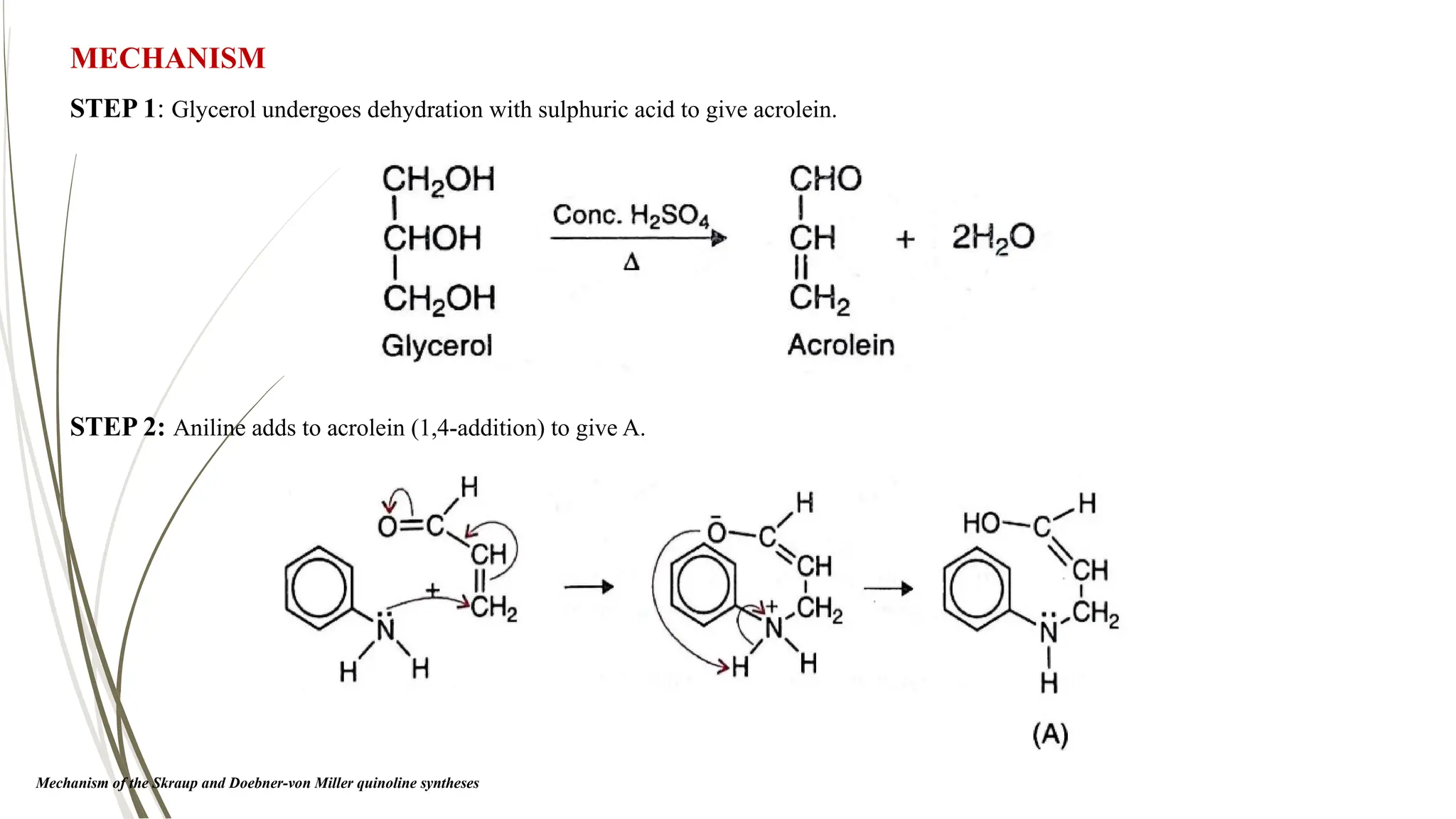
STEP 2: Aniline adds to acrolein (1,4-addition) to give A.
STEP 1: Glycerol undergoes dehydration with sulphuric acid to give acrolein.
MECHANISM
Mechanism of the Skraup and Doebner-von Miller quinoline syntheses
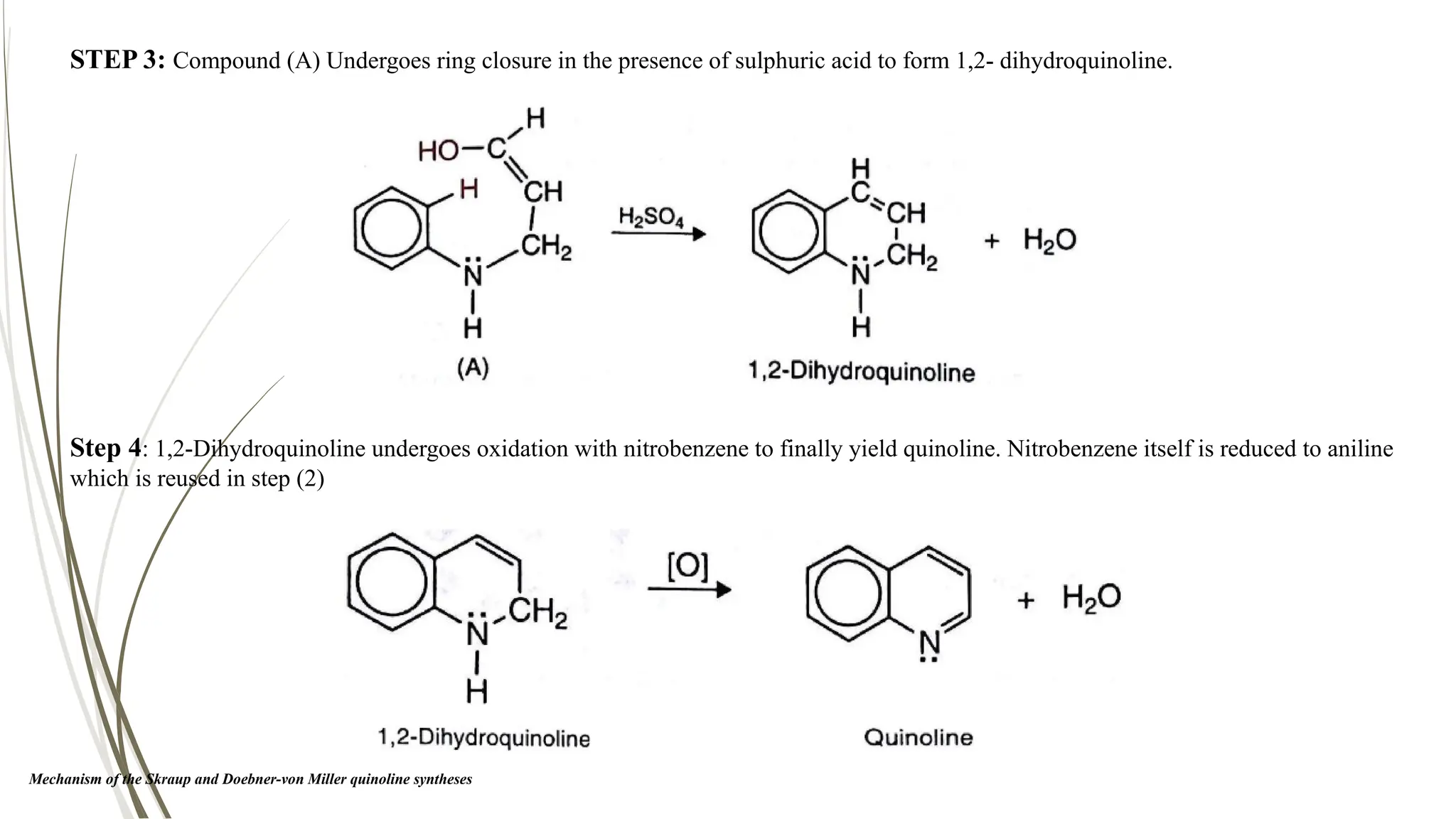
Step 4: 1,2-Dihydroquinoline undergoes oxidation with nitrobenzene to finally yield quinoline. Nitrobenzene itself is reduced to aniline
which is reused in step (2)
STEP 3: Compound (A) Undergoes ring closure in the presence of sulphuric acid to form 1,2- dihydroquinoline.
Mechanism of the Skraup and Doebner-von Miller quinoline syntheses
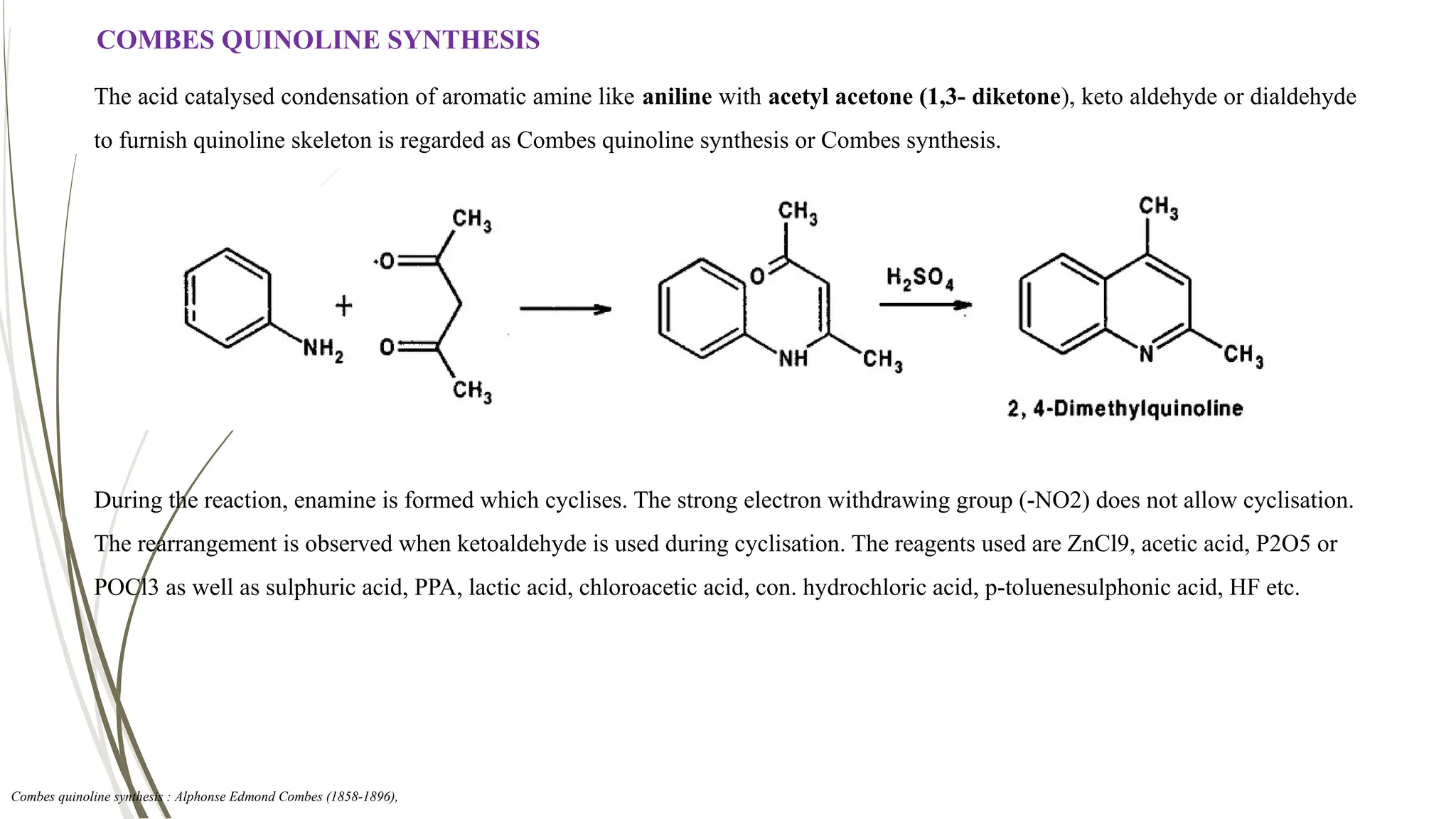
COMBES QUINOLINE SYNTHESIS
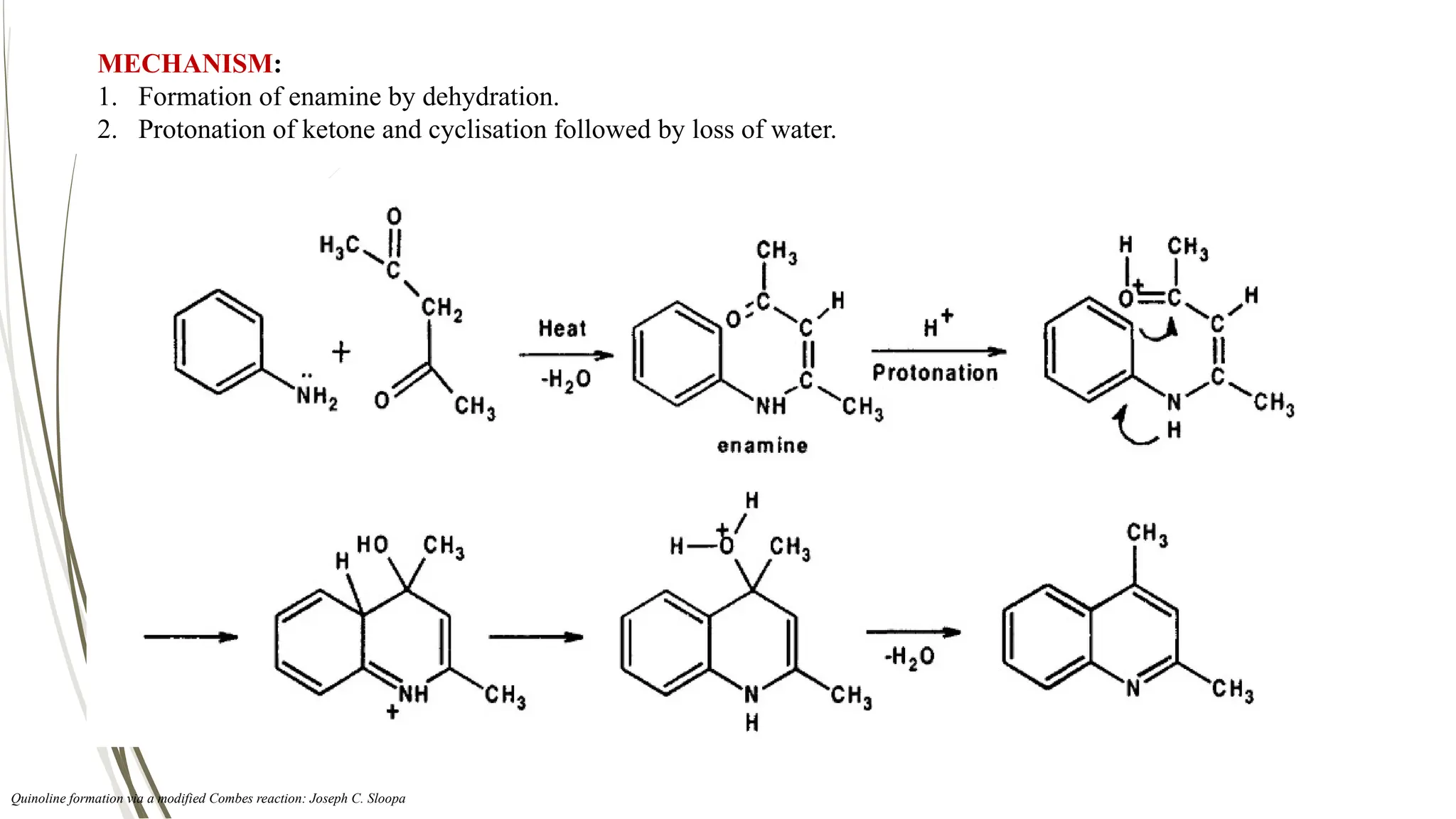
The acid catalysed condensation of aromatic amine like aniline with acetyl acetone (1,3- diketone), keto aldehyde or dialdehyde
to furnish quinoline skeleton is regarded as Combes quinoline synthesis or Combes synthesis.
During the reaction, enamine is formed which cyclises. The strong electron withdrawing group (-NO2) does not allow cyclisation.
The rearrangement is observed when ketoaldehyde is used during cyclisation. The reagents used are ZnCl9, acetic acid, P2O5 or
POCl3 as well as sulphuric acid, PPA, lactic acid, chloroacetic acid, con. hydrochloric acid, p-toluenesulphonic acid, HF etc.
Combes quinoline synthesis : Alphonse Edmond Combes (1858-1896),
MECHANISM:
1. Formation of enamine by dehydration.
2. Protonation of ketone and cyclisation followed by loss of water.
Quinoline formation via a modified Combes reaction: Joseph C. Sloopa
APPLICATIONS OF QUINOLINES
Heterocyclic compounds have been regarded as a key constituent in medicinal chemistry because they are also abundant in
macromolecules such as enzymes, vitamins, natural products, and biological active chemicals. E.g.
 Antifungal activity: A number of quinoline based antibiotic are inactive against pathologic fungi, but they can be successfully
incorporated into multidrug therapy. e.g 4-Quinolone scaffold is present in sitafloxacin.
Antibacterial activity: Antibiotics’ chemical structure includes aromatic heterocyclic compounds, like –Quinoline derivative
compounds. e.g. Mefloquine.
 Antiviral activity: Quinoline derivatives were found potent against various strains of viruses like zika virus, enterovirus, herpes virus,
human immunodeficiency virus, ebola virus, hepatitis C virus, SARS virus and MERS virus etc. e.g. 50 ,70 -dichloro-80 -quinolinol
derivatives active against ZIKV
Antimalarial activity: The major classes of approved antimalarial drugs administered as a first-line treatment include quinolines, 8-
aminoquinolines.
A review on biological and medicinal impact of heterocyclic compounds Emranul Kabir a,b,* , Monir Uzzaman
 Based on interest on medicinal and organic Chemistry , different quinoline derivatives exhibiting broad spectrum anti-
viral activity although quinolines are versatile molecules emerging out to be potent for different diseases.
 Numerous outstanding achievement exposed that quinoline based compounds have extensive potential as an
anticancer, antibacterial, anti-inflammatory and other activities.
 Various classical methods have been developed for synthesis of quinolines and related scaffolds such as Skraup
synthesis, but still there is a need to develop better, efficient and versatile synthetic protocol.
 It can be ensured that it will emerge as a potent skeleton against several microorganisms.
 If the use of quinolones in clinical medicine is to continue, the emergence of bacterial resistance to the quinolones
should remain of primary importance as an area of current and future research.
 Typical metal-free, solvent-free, aqueous media and ionic liquid catalyzed reactions are green protocol and there is so
many possibilities of getting this sort of synthesis as many researchers are achieving it.
FUTURE ASPECTS
Quinolines, a perpetual, multipurpose scaffold in medicinal chemistry Pratibha Yadav, Kamal Shah *
CONCLUSION
 Heterocyclic chemistry is the most interesting branch of organic chemistry and of utmost practical and theoretical
importance. Heterocycles are widely distributed in nature. As a result of this a great deal of research conducted in chemistry
is devoted to heterocyclic chemistry.
 Quinoline is the most ubiquitous heterocyclic aromatic compound with a potential for industrial and medicinal applications,
it is one of the broad-spectrum heterocyclic compounds.
 Quinoline derivatives possess tremendous medicinal properties as anticancer, antibacterial, antimalarial, anti-inflammatory
or antifungal.
 Some of the known quinolines have already been clinically used for the treatment of various diseases.
 Some of the quinoline derivatives had formed complexes with metal like platinum, rhodanine, ruthenium is the most active
and showed therapeutic application
Synthetic and medicinal perspective of quinolines as antiviral agents Ramandeep Kaur a , Kapil Kumar b, *
T H A N K
Y O U

synthesis of quinoline derivatives and its applications

  • 1.
    SYNTHESIS OF QUINOLINE DERIVATIVESAND THEIR APPLICATIONS PRESENTED BY ANURAG PRAJAPATI M.Sc. CHEMISTRY
  • 2.
    Introduction Quinoline Synthesis of Quinolineand it’s derivative Applications of Quinolines Future aspects Conclusion Flow of Presentation 2
  • 3.
    HETEROCYCLIC COMPOUNDS Cyclic compoundshaving as ring members atoms of at least two different elements, e.g. Quinoline, Tetrahydrofuran etc. Any of a class of organic compounds whose molecules contain one or more rings of atoms with at least one atom (the heteroatom) being “ an element other than carbon, most frequently oxygen, nitrogen, or sulfur. Quinoline Benzofuran Purine CLASSIFICATION OF HETEROCYCLIC COMPOUNDS Heterocyclic compounds Aliphatic Heterocyclic Compounds Aromatic heterocyclic compounds Compounds those do not contain unsaturation in their ring structure. Aromatic heterocyclic compounds are those which obey Huckel’s Rule. THF Furan Heterocyclic compounds: an introduction J Alvarez BuiIlla, J Barluenga - Modern Heterocyclic Chemistry, 2011 ‐ Heterocyclic derivatives, seen as a group, can be divided into two broad areas: aromatic and non- aromatic. INTRODUCTION
  • 4.
    QUINOLINE Quinoline or 1-aza-naphthaleneor benzo[b]pyridine is a planner hetero-aromatic compound in which 10π electrons move throughout the structure and having a molecular formula of C9H7N. Quinoline reported as an important building block in the field of medicinal chemistry. QUINOLINE Properties of Quinoline  Quinoline is colorless liquid and having a peculiar odor.  It is a hygroscopic liquid .  It is soluble in water and completely miscible in ether, alcohol and acetone.  Chemically it gives every reaction of pyridine .  Quinoline readily gives electrophilic substitution reactions of benzene ring. The Chemistry of Quinolines. RH Manske - Chemical Reviews, 1942 - ACS Publications Quinoline was first discovered by Friedlieb Rouge in 1834, obtained by the distillation of coal tar. However, its structure, comprised of a rigid heterocyclic core of benzene ortho-fused with a pyridine ring , was only unveiled in 1871 as Dewar observed the chemical similarity between pyridine and quinoline
  • 5.
    Skraup, Z.H. (1880).Ber. Dtsch. Chem. Ges. 13: 2086–2087 SYNTHESIS OF QUINOLINE Quinoline and it is derivatives can be synthesized using various methods some of those are . Quinoline Synthesis Pfitzinger Synthesis Combes Synthesis Friedlander Synthesis Doebner-von Miller Synthesis Skraup Synthesis Povarov Synthesis Conrod-limpach-knorr Synthesis
  • 6.
    SKRAUP SYNTHESIS METHOD Skraup’ssynthesis is a chemical reaction used to synthesize quinolines by the condensation of glycerol and alanine in the presence of a strong acid (c. H2SO4) and an oxidizing agent like nitrobenzene. Other examples of oxidizing agents used are As2O5 (Arsenic acid). Initially when the reaction was done, As2O3 was used as an oxidizing agent and the reaction was known as violet reaction. In the present-day world, in this reaction, Nitrobenzene is used not only as an oxidizing agent but also as a solvent.
  • 7.
    STEP 2: Anilineadds to acrolein (1,4-addition) to give A. STEP 1: Glycerol undergoes dehydration with sulphuric acid to give acrolein. MECHANISM Mechanism of the Skraup and Doebner-von Miller quinoline syntheses
  • 8.
    Step 4: 1,2-Dihydroquinolineundergoes oxidation with nitrobenzene to finally yield quinoline. Nitrobenzene itself is reduced to aniline which is reused in step (2) STEP 3: Compound (A) Undergoes ring closure in the presence of sulphuric acid to form 1,2- dihydroquinoline. Mechanism of the Skraup and Doebner-von Miller quinoline syntheses
  • 9.
    COMBES QUINOLINE SYNTHESIS Theacid catalysed condensation of aromatic amine like aniline with acetyl acetone (1,3- diketone), keto aldehyde or dialdehyde to furnish quinoline skeleton is regarded as Combes quinoline synthesis or Combes synthesis. During the reaction, enamine is formed which cyclises. The strong electron withdrawing group (-NO2) does not allow cyclisation. The rearrangement is observed when ketoaldehyde is used during cyclisation. The reagents used are ZnCl9, acetic acid, P2O5 or POCl3 as well as sulphuric acid, PPA, lactic acid, chloroacetic acid, con. hydrochloric acid, p-toluenesulphonic acid, HF etc. Combes quinoline synthesis : Alphonse Edmond Combes (1858-1896),
  • 10.
    MECHANISM: 1. Formation ofenamine by dehydration. 2. Protonation of ketone and cyclisation followed by loss of water. Quinoline formation via a modified Combes reaction: Joseph C. Sloopa
  • 11.
    APPLICATIONS OF QUINOLINES Heterocycliccompounds have been regarded as a key constituent in medicinal chemistry because they are also abundant in macromolecules such as enzymes, vitamins, natural products, and biological active chemicals. E.g.  Antifungal activity: A number of quinoline based antibiotic are inactive against pathologic fungi, but they can be successfully incorporated into multidrug therapy. e.g 4-Quinolone scaffold is present in sitafloxacin. Antibacterial activity: Antibiotics’ chemical structure includes aromatic heterocyclic compounds, like –Quinoline derivative compounds. e.g. Mefloquine.  Antiviral activity: Quinoline derivatives were found potent against various strains of viruses like zika virus, enterovirus, herpes virus, human immunodeficiency virus, ebola virus, hepatitis C virus, SARS virus and MERS virus etc. e.g. 50 ,70 -dichloro-80 -quinolinol derivatives active against ZIKV Antimalarial activity: The major classes of approved antimalarial drugs administered as a first-line treatment include quinolines, 8- aminoquinolines. A review on biological and medicinal impact of heterocyclic compounds Emranul Kabir a,b,* , Monir Uzzaman
  • 12.
     Based oninterest on medicinal and organic Chemistry , different quinoline derivatives exhibiting broad spectrum anti- viral activity although quinolines are versatile molecules emerging out to be potent for different diseases.  Numerous outstanding achievement exposed that quinoline based compounds have extensive potential as an anticancer, antibacterial, anti-inflammatory and other activities.  Various classical methods have been developed for synthesis of quinolines and related scaffolds such as Skraup synthesis, but still there is a need to develop better, efficient and versatile synthetic protocol.  It can be ensured that it will emerge as a potent skeleton against several microorganisms.  If the use of quinolones in clinical medicine is to continue, the emergence of bacterial resistance to the quinolones should remain of primary importance as an area of current and future research.  Typical metal-free, solvent-free, aqueous media and ionic liquid catalyzed reactions are green protocol and there is so many possibilities of getting this sort of synthesis as many researchers are achieving it. FUTURE ASPECTS Quinolines, a perpetual, multipurpose scaffold in medicinal chemistry Pratibha Yadav, Kamal Shah *
  • 13.
    CONCLUSION  Heterocyclic chemistryis the most interesting branch of organic chemistry and of utmost practical and theoretical importance. Heterocycles are widely distributed in nature. As a result of this a great deal of research conducted in chemistry is devoted to heterocyclic chemistry.  Quinoline is the most ubiquitous heterocyclic aromatic compound with a potential for industrial and medicinal applications, it is one of the broad-spectrum heterocyclic compounds.  Quinoline derivatives possess tremendous medicinal properties as anticancer, antibacterial, antimalarial, anti-inflammatory or antifungal.  Some of the known quinolines have already been clinically used for the treatment of various diseases.  Some of the quinoline derivatives had formed complexes with metal like platinum, rhodanine, ruthenium is the most active and showed therapeutic application Synthetic and medicinal perspective of quinolines as antiviral agents Ramandeep Kaur a , Kapil Kumar b, *
  • 14.
    T H AN K Y O U