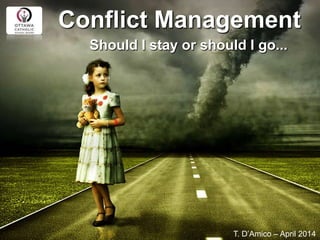
Conflict Management
Should I stay or should I go...
T. D’Amico – April 2014
Our Schools are
Happy places...
Conflict Management
But not all the time!
Share examples of conflicts between
adults in a school...
School adult
Interactions
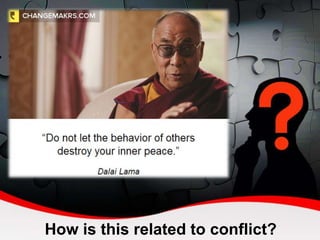
How is this related to conflict?
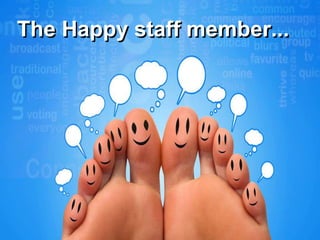
The Happy staff member...
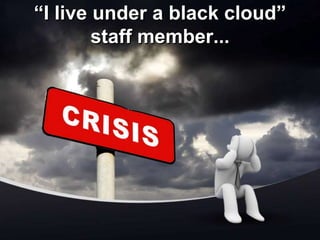
“I live under a black cloud”
staff member...
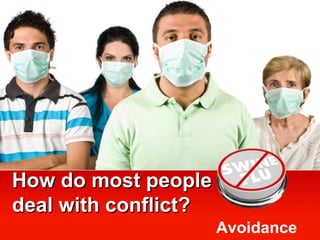
How do most people
deal with conflict?
Avoidance
Others –
make a quick decision!
How do you deal with
Conflict?
Crash and
burn
strategies
Pray that an Angel
Will
make it
go
away!
Is Conflict always a bad thing?
Discuss:
“Is Conflict always a bad thing?”
Your Answers
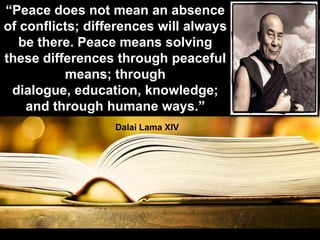
“Peace does not mean an absence
of conflicts; differences will always
be there. Peace means solving
these differences through peaceful
means; through
dialogue, education, knowledge;
and through humane ways.”
Dalai Lama XIV
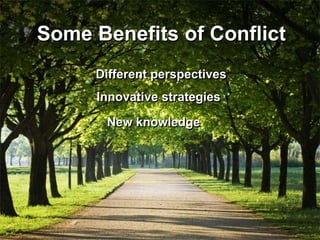
Some Benefits of Conflict
Innovative strategies
New knowledge
Different perspectives
Discuss:
“What are some causes of conflict?”
Your Answers
Causes of Conflict
Resolving Conflict
In your school / workplace
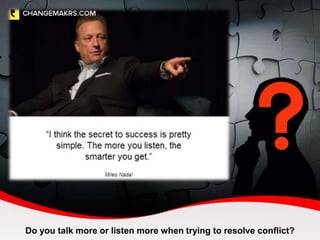
Do you talk more or listen more when trying to resolve conflict?
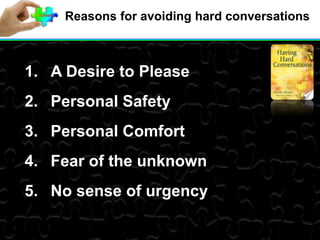
Reasons for avoiding hard conversations
1. A Desire to Please
2. Personal Safety
3. Personal Comfort
4. Fear of the unknown
5. No sense of urgency
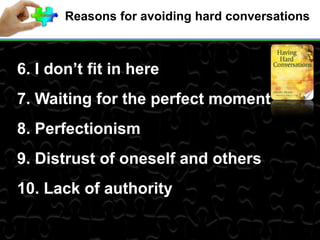
Reasons for avoiding hard conversations
6. I don’t fit in here
7. Waiting for the perfect moment
8. Perfectionism
9. Distrust of oneself and others
10. Lack of authority
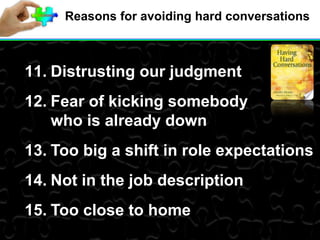
Reasons for avoiding hard conversations
11. Distrusting our judgment
12. Fear of kicking somebody
who is already down
13. Too big a shift in role expectations
14. Not in the job description
15. Too close to home
Reasons for avoiding hard conversations
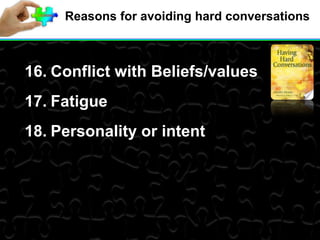
16. Conflict with Beliefs/values
17. Fatigue
18. Personality or intent
Don’t sweat the small stuff!
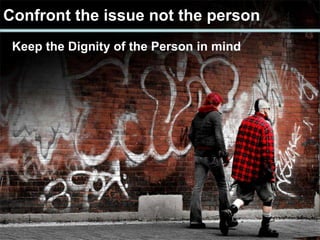
Confront the issue not the person
Keep the Dignity of the Person in mind
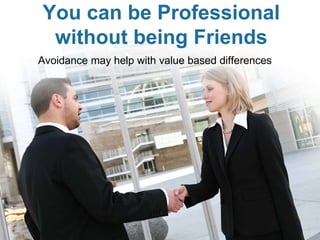
You can be Professional
without being Friends
Avoidance may help with value based differences
Compromise
Look for win – win solutions
Collaborate
See each other’s side in a conflict to come to an agreement on
how to proceed
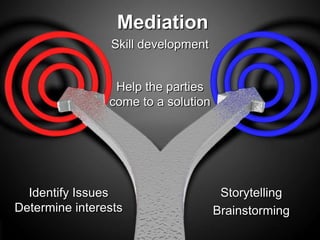
Mediation
Skill development
Help the parties
come to a solution
Identify Issues
Determine interests
Storytelling
Brainstorming
Keep Learning
Leadership
courses
Coaching
courses
Mediation
workshops
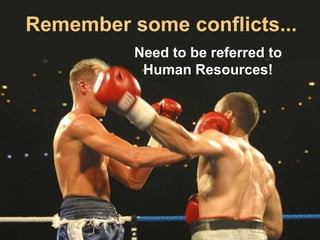
Remember some conflicts...
Need to be referred to
Human Resources!
Questions

Conflict Management in a school environment

Editor's Notes

  • #2 Presentation April 23rd to Ottawa Catholic School Board staff taking Leadership Part 1
  • #3 We all know that our schools are happy places for adults to work
  • #4 However, when you have adults working side by side, conflict is inevitable
  • #5 Key part of the definition is two or more people don’t agree on something – and this happens all the time
  • #6 2 minutes to discuss at tables
  • #7 Review the many possible interactions and relationships between adults that take place in a school
  • #8 Review this quote – discuss how the issue is really not the behaviour of the other person but how we react to what they say or to their actions
  • #9 Ask people to stand if they know someone on their staff that is always happy no matter what is going on
  • #10 Ask people to stand if they know someone on their staff that is always living under a “black cloud” no matter what is going on
  • #11 Ask how most people deal with conflict – the answer is avoidance
  • #12 Mention that the opposite of avoidance is the person who quickly resolves conflicts and chooses who is right and who is wrong and then moves on
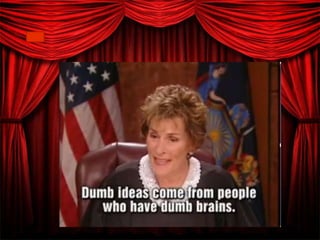
  • #13 Give example of Judge Judy who makes decisions all the time as to who is right and who is wrongAsk what the problem might be with this type of approach – relationship ends up damaged even more because there is a winner and a loser
  • #14 Mention that everyone handles conflict differently and some strategies are better than others
  • #15 Some people turn to prayer hoping the conflict will go away
  • #16 Pause – Is conflict always a bad thing?
  • #17 Give two minutes to discuss at tables
  • #18 Large group review of responses
  • #19 Review this quote – focus is that peace comes from resolving issues, challenges, and conflicts
  • #20 Discuss the benefits of conflict
  • #21 Pause – what are some causes of conflict
  • #22 2 minutes at table to review and discuss
  • #23 Large group review answers
  • #24 Watch video clip – give credit to the Center for Work Life and encourage participants to visit their site
  • #25 Mention the roles to resolving conflict, their own role, the formal vs informal role
  • #26 Review this quote and the need to listen more than we talk when trying to resolve a conflict so that we understand all sides and perceptions
  • #27 Refer to book – Having hard conversations and mention the reasons that most people avoid this type of conversationA Desire to PleasePersonal SafetyPersonal ComfortFear of the unknownNo sense of urgency
  • #28 I don’t fit in here7. Waiting for the perfect moment8. Perfectionism9. Distrust of oneself and others10. Lack of authority
  • #29 Distrusting our judgmentFear of kicking somebodywho is already downToo big a shift in role expectationsNot in the job descriptionToo close to home
  • #30 Conflict with Beliefs/valuesFatiguePersonality or intent
  • #31 Mention how many conflicts can be avoided if we learn to “not sweat the small stuff”
  • #32 Confront the issue not the person – key focus
  • #33 Mention that sometimes because of value differences, you will not get along, but agree to be professional in the workplace, and act respectfully
  • #34 It is best to try and find a compromise so that both sides feel they have benefited in a joint solution
  • #35 To collaborate both sides need to understand each perspective and agree on how to proceed
  • #36 Review the key steps in mediation and that the role of the mediator is not to resolve the problem with their solution but rather to help the parties to come to a solution that they both can agree to
  • #37 Encourage participants to keep learning by continuing with our Board leadership courses, our coaching courses, and mention that we will be working on mediation workshops and courses
  • #38 In some cases we are dealing with harassment as opposed to workplace conflict, and when that happens, it is best to contact HR