Sense of failure, rejection,
threat
   To avoid these feelings
    ◦   Clarify types of behaviour
    ◦   Understand some causes
    ◦   Generate solutions
    ◦   Separate behaviour from person
    ◦   Take ourselves out
Certain behaviours are
expected
 Punctuality
 Regular attendance
 Performance of required tasks
 Paying attention
 Coming prepared
 Dressing appropriately
 Being polite
 Being respectful
If students break these rules .
    ..
 Poses a problem to instructor trying to
  manage a group so that it is functional
 First thing to do—rank those
  behaviours in order of importance.
   Now categorize each type of
    behaviour by what
    ◦   Makes you angry
    ◦   Seems senseless
    ◦   Embarrasses you
    ◦   Amuses you
    ◦   Can you deal with easily
    ◦   Can you understand
   Now select the types of behaviour that
    make you angry and think about the
    last time you had to deal with it

   Analyze what happened
    ◦ What led up to it?
    ◦ How did other students react?
    ◦ How did you intervene?
    ◦ What were the activities in the
      classroom at the time?
    ◦ What was the outcome?
What are the factors that make
learning successful?

 Having fun
 Being involved
 Discovering
 Achieving goals
 Understanding the purpose of tasks
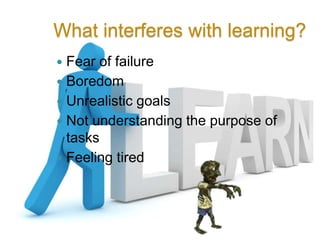
What interferes with learning?
 Fear of failure
 Boredom
 Unrealistic goals
 Not understanding the purpose of
  tasks
 Feeling tired
Prevention is better than
Prescription……………….

 Impossible   to avoid all
  difficulties
 Clear outline of expectations
  and evaluative criteria are
  critical.
 Leave you less vulnerable.
PREVENTION!
 Clearly state expectations concerning
  class attendance, participation, and
  the timely completion of assignments
  UP FRONT.
 Hand out a document that outlines
  these criteria.
Tell them Where You are Coming
 From
 Communicate your biases so they
 know what type of work you
 expect.

 Explain
        your own critical
 methodology and interests to give
 them an idea as to what
 approaches you prefer.
   Be an ally, not an adversary.

   Be accessible.

   Be warm and supportive in
    encouraging your students'
    participation in class.
   Be careful when correcting students in
    class—don’t embarrass them or put them
    on the defensive.

   Point out mistakes in a positive and
    constructive manner that is not
    discouraging.

   Help students recognize for themselves
    flaws in their argument or response.
 Befair and ethical.
 Students talk to each other
 and compare notes.

 Interveneearly when a
 problem arises,
 documenting and saving
 copies of all your efforts to
 reach out to a given student.
Make sure that your
attitude in class
serves as a model

of how you expect your
 students to behave and
 participate in your class.
Grading
 Making your grading
 policies and expectations as
 transparent as possible.

 This will help but will not
 totally preclude difficulties.
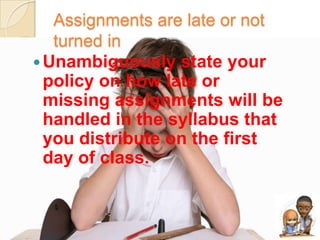
Assignments are late or not
   turned in
 Unambiguously state your
  policy on how late or
  missing assignments will be
  handled in the syllabus that
  you distribute on the first
  day of class.
   Speak to student in private to
    determine the cause of their failure
    to complete the assignments in an
    appropriate manner.


   Make the student aware of negative
    impact on grade. Remind the
    student that ultimately they are in
    control of their coursework.
Document  the
interaction that you
have with your student
concerning the missed
assignment(s).
 Communicate   by email or
follow up an in-person
discussion with an email
reiterating the pertinent
aspects of the
conversation.
Missed Exam
   Discuss how you'll handle missed
    exams and quizzes at the beginning of
    the semester.

   What will be your policy on making up
    missed exams?

   Stick to your policy so as to maintain
    total fairness with all students.
Student Argues Grade
 Make grading criteria clear
  from the outset of the course.
 Use a grading/point system
 that is clear and
 straightforward so that it is
 easily defendable and easy for
 your students to understand.
 Furnish students with the criteria
  necessary for success so that they know
  how to meet your expectations.
 If possible, hand out guidelines for a good
  essay or examples of a superior exam
  answer.
 When   you grade, give
  detailed explanations of why
  you found a given point
  weak or strong and offer
  suggestions as to how the
  work might be improved.
 Give the students ideas
  about how to study or
  organize their ideas more
  effectively.
 Offer the option of handing in an
  initial draft of their work that you
  will comment on but not grade.
 Ask the student to explain to you in
  specific terms why his or her work
  deserved a better grade.
 Consider a re-grade policy
 whose details you spell out
 in your syllabus. Or
 formulate a policy for
 yourself in advance of
 having to implement it.
   If you agree to re-evaluate student work,
    make it clear that you retain the right to
    adjust the grade either up or down.


   Warn the student that you may find
    mistakes or problems that you hadn't
    noticed the first time around, which
    could adversely affect their grade.
 Always keep an open
 mind to the possibility
 that you may have made
 a mistake in evaluating
 student work and that re-
 evaluation might indeed
 be in order.
Student offers to do extra credit
to compensate

   List all of the assignments that will
    accrue towards the final grade on your
    first-day syllabus, making it clear that
    supplemental work will not be factored
    into the grade.
   Remind the student that the concept
    of "extra credit" has currency in the
    arena of secondary education but is
    no longer operative at the university
    level.
Classroom Behaviours
   The late student
    ◦ Speak to the student in private
    ◦ Ask that they enter unobtrusively if
      necessary
    ◦ Always start class on time.
◦ Give quizzes at beginning of class

◦ Address the class as a whole, insist on
  the importance of punctuality as a mark of
  respect not only towards the instructor
  and course material but also towards the
  other students in the class.

◦ Emphasize that you respect your students
  and that such respect should be
  reciprocal.
   Excessive absence

    ◦ Make sure that you state your
      policy on attendance in your
      syllabus, indicating whether a
      certain number of absences will
      result in the lowering of a grade.


    ◦ Contact the student individually to
      find out what the circumstances
      of their absence are.
◦ Warn the student that their grade
  will probably suffer as a result of
  their chronic absences.


◦ If attendance is not required and
  the student is doing well, you may
  be better off not addressing the
  issue with that student.
   Chronically hostile or disruptive


    ◦ Contact the student. Document
      and keep records.
    ◦ Ask for, listen to, and try to
      understand the student's
      perspective.


    ◦ Sometimes disruptive behavior
      reflects a desperate need for
      attention. Listening may help.
◦You may often discover
 that the attitude has
 nothing to do with you
◦ or your class and that
 the student is not even
 aware that they seem
 hostile
◦If the student has a
 specific problem, ask
 them to suggest
 possible solutions.

◦ Try to think of ways that
 you could help, within
 the limits of your role as
 an instructor.
◦ Frame your comments on the
  student's behavior in terms of
  "stress" so as to keep them
  from feeling judged or
  attacked.

◦ Stress provides a neutral and
  safe context within which to
  discuss disruptive behavior
  and attitudes.
 If
   the problem persists, talk
 to other faculty members
 who have had the student in
 their classes.

  ◦ Talk to a dean or to
    someone at Student
    Services to get further
    input and support.
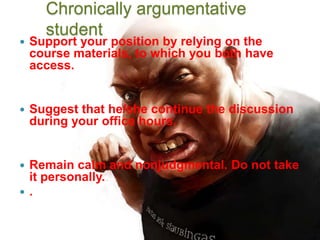
Chronically argumentative
      student
   Support your position by relying on the
    course materials, to which you both have
    access.


   Suggest that he/she continue the discussion
    during your office hours.


 Remain calm and nonjudgmental. Do not take
  it personally.
 .
   Listen to and try to understand the
    student's perspective.

   Don't assert your authority as the
    professor. Avoid introducing your
    statements with "I."

   If a student is stubborn and refuses to
    postpone a disagreement until after
    class or office hours and completely
    disrupts a class, remain calm
◦If the student is agitated to
 the point of being
 unreasonable,
◦ ask them to carry the
 grievance to a higher
 authority (e.g., the
 department head or dean).
◦ Make apparent your willingness to
  discuss the issue calmly,

◦ but do not continue trying to reason
 with a student who is highly
 agitated.


◦ If you remain calm in the presence
  of the group, the student may soon
  become cooperative again.
   In an extreme case, you may have to
    ask the student to leave the
    classroom, or even dismiss the class.

 Try to respond as calmly as possible.
  Avoid making an issue out of a small
  incident.
 The hardest part of such a situation is
  to maintain your professionalism, and
  not to respond as if you feel
  personally attacked.
Dealing with difficult students

Dealing with difficult students

  • 2.
    Sense of failure,rejection, threat  To avoid these feelings ◦ Clarify types of behaviour ◦ Understand some causes ◦ Generate solutions ◦ Separate behaviour from person ◦ Take ourselves out
  • 3.
    Certain behaviours are expected Punctuality  Regular attendance  Performance of required tasks  Paying attention  Coming prepared  Dressing appropriately  Being polite  Being respectful
  • 4.
    If students breakthese rules . ..  Poses a problem to instructor trying to manage a group so that it is functional  First thing to do—rank those behaviours in order of importance.
  • 5.
    Now categorize each type of behaviour by what ◦ Makes you angry ◦ Seems senseless ◦ Embarrasses you ◦ Amuses you ◦ Can you deal with easily ◦ Can you understand
  • 6.
    Now select the types of behaviour that make you angry and think about the last time you had to deal with it  Analyze what happened ◦ What led up to it? ◦ How did other students react? ◦ How did you intervene? ◦ What were the activities in the classroom at the time? ◦ What was the outcome?
  • 7.
    What are thefactors that make learning successful?  Having fun  Being involved  Discovering  Achieving goals  Understanding the purpose of tasks
  • 8.
    What interferes withlearning?  Fear of failure  Boredom  Unrealistic goals  Not understanding the purpose of tasks  Feeling tired
  • 9.
    Prevention is betterthan Prescription……………….  Impossible to avoid all difficulties  Clear outline of expectations and evaluative criteria are critical.  Leave you less vulnerable.
  • 10.
    PREVENTION!  Clearly stateexpectations concerning class attendance, participation, and the timely completion of assignments UP FRONT.  Hand out a document that outlines these criteria.
  • 11.
    Tell them WhereYou are Coming From  Communicate your biases so they know what type of work you expect.  Explain your own critical methodology and interests to give them an idea as to what approaches you prefer.
  • 12.
    Be an ally, not an adversary.  Be accessible.  Be warm and supportive in encouraging your students' participation in class.
  • 13.
    Be careful when correcting students in class—don’t embarrass them or put them on the defensive.  Point out mistakes in a positive and constructive manner that is not discouraging.  Help students recognize for themselves flaws in their argument or response.
  • 14.
     Befair andethical. Students talk to each other and compare notes.  Interveneearly when a problem arises, documenting and saving copies of all your efforts to reach out to a given student.
  • 15.
    Make sure thatyour attitude in class serves as a model of how you expect your students to behave and participate in your class.
  • 16.
    Grading  Making yourgrading policies and expectations as transparent as possible.  This will help but will not totally preclude difficulties.
  • 17.
    Assignments are lateor not turned in  Unambiguously state your policy on how late or missing assignments will be handled in the syllabus that you distribute on the first day of class.
  • 18.
    Speak to student in private to determine the cause of their failure to complete the assignments in an appropriate manner.  Make the student aware of negative impact on grade. Remind the student that ultimately they are in control of their coursework.
  • 19.
    Document the interactionthat you have with your student concerning the missed assignment(s).
  • 20.
     Communicate by email or follow up an in-person discussion with an email reiterating the pertinent aspects of the conversation.
  • 21.
    Missed Exam  Discuss how you'll handle missed exams and quizzes at the beginning of the semester.  What will be your policy on making up missed exams?  Stick to your policy so as to maintain total fairness with all students.
  • 22.
    Student Argues Grade Make grading criteria clear from the outset of the course.  Use a grading/point system that is clear and straightforward so that it is easily defendable and easy for your students to understand.
  • 23.
     Furnish studentswith the criteria necessary for success so that they know how to meet your expectations.  If possible, hand out guidelines for a good essay or examples of a superior exam answer.
  • 24.
     When you grade, give detailed explanations of why you found a given point weak or strong and offer suggestions as to how the work might be improved.  Give the students ideas about how to study or organize their ideas more effectively.
  • 25.
     Offer theoption of handing in an initial draft of their work that you will comment on but not grade.  Ask the student to explain to you in specific terms why his or her work deserved a better grade.
  • 26.
     Consider are-grade policy whose details you spell out in your syllabus. Or formulate a policy for yourself in advance of having to implement it.
  • 27.
    If you agree to re-evaluate student work, make it clear that you retain the right to adjust the grade either up or down.  Warn the student that you may find mistakes or problems that you hadn't noticed the first time around, which could adversely affect their grade.
  • 28.
     Always keepan open mind to the possibility that you may have made a mistake in evaluating student work and that re- evaluation might indeed be in order.
  • 29.
    Student offers todo extra credit to compensate  List all of the assignments that will accrue towards the final grade on your first-day syllabus, making it clear that supplemental work will not be factored into the grade.
  • 30.
    Remind the student that the concept of "extra credit" has currency in the arena of secondary education but is no longer operative at the university level.
  • 31.
    Classroom Behaviours  The late student ◦ Speak to the student in private ◦ Ask that they enter unobtrusively if necessary ◦ Always start class on time.
  • 32.
    ◦ Give quizzesat beginning of class ◦ Address the class as a whole, insist on the importance of punctuality as a mark of respect not only towards the instructor and course material but also towards the other students in the class. ◦ Emphasize that you respect your students and that such respect should be reciprocal.
  • 33.
    Excessive absence ◦ Make sure that you state your policy on attendance in your syllabus, indicating whether a certain number of absences will result in the lowering of a grade. ◦ Contact the student individually to find out what the circumstances of their absence are.
  • 34.
    ◦ Warn thestudent that their grade will probably suffer as a result of their chronic absences. ◦ If attendance is not required and the student is doing well, you may be better off not addressing the issue with that student.
  • 35.
    Chronically hostile or disruptive ◦ Contact the student. Document and keep records. ◦ Ask for, listen to, and try to understand the student's perspective. ◦ Sometimes disruptive behavior reflects a desperate need for attention. Listening may help.
  • 36.
    ◦You may oftendiscover that the attitude has nothing to do with you ◦ or your class and that the student is not even aware that they seem hostile
  • 37.
    ◦If the studenthas a specific problem, ask them to suggest possible solutions. ◦ Try to think of ways that you could help, within the limits of your role as an instructor.
  • 38.
    ◦ Frame yourcomments on the student's behavior in terms of "stress" so as to keep them from feeling judged or attacked. ◦ Stress provides a neutral and safe context within which to discuss disruptive behavior and attitudes.
  • 39.
     If the problem persists, talk to other faculty members who have had the student in their classes. ◦ Talk to a dean or to someone at Student Services to get further input and support.
  • 40.
    Chronically argumentative student  Support your position by relying on the course materials, to which you both have access.  Suggest that he/she continue the discussion during your office hours.  Remain calm and nonjudgmental. Do not take it personally.  .
  • 41.
    Listen to and try to understand the student's perspective.  Don't assert your authority as the professor. Avoid introducing your statements with "I."  If a student is stubborn and refuses to postpone a disagreement until after class or office hours and completely disrupts a class, remain calm
  • 42.
    ◦If the studentis agitated to the point of being unreasonable, ◦ ask them to carry the grievance to a higher authority (e.g., the department head or dean).
  • 43.
    ◦ Make apparentyour willingness to discuss the issue calmly, ◦ but do not continue trying to reason with a student who is highly agitated. ◦ If you remain calm in the presence of the group, the student may soon become cooperative again.
  • 44.
    In an extreme case, you may have to ask the student to leave the classroom, or even dismiss the class.   Try to respond as calmly as possible. Avoid making an issue out of a small incident.  The hardest part of such a situation is to maintain your professionalism, and not to respond as if you feel personally attacked.