
























Learning and Teaching in the
21st Century
T. D’Amico, 2013
K-12 District
Transformation
Learning Goals
By the end of this presentation you
should have a better understanding of:
• One district’s change process
• The connection between pedagogy,
technology, and change knowledge
• The important role of leadership in the
change process
Looking back… 3 years ago
Where
do
we
start
Information
Technology Silo
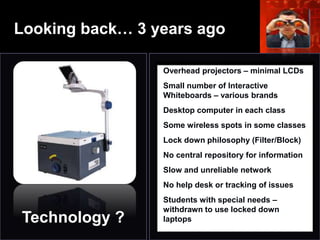
Overhead projectors – minimal LCDs
Small number of Interactive
Whiteboards – various brands
Desktop computer in each class
Some wireless spots in some classes
Lock down philosophy (Filter/Block)
No central repository for information
Slow and unreliable network
No help desk or tracking of issues
Students with special needs –
withdrawn to use locked down
laptops
Information Technology Silo
Technology ?
Systemic Review in 2010
•
The world has
changed and there
is no turning back
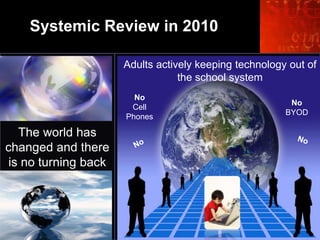
Adults actively keeping technology out of
the school system
No
Cell
Phones
No
BYOD
Fear and Caution or
Curiosity and Exploration
Which approach
reflects your District?
Trivia Time!
Get Ready…
The world has changed!
•
How
many
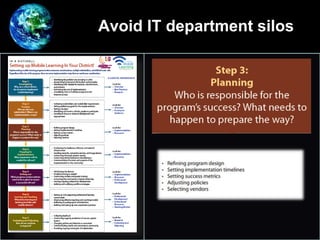
Internet
users
are there
world
wide?
Source:
http://www.techi.com/2013/05
/in-an-internet-day/
The world has changed!
•
How
many
emails
are sent
each
day?
Source:
http://www.techi.com/2013/05
/in-an-internet-day/
The world has changed!
•
How
many
Google
searches
occur
every
day?
Source:
http://www.techi.com/2013/05
/in-an-internet-day/
The world has changed!
•
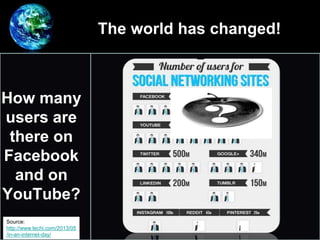
How many
users are
there on
Facebook
and on
YouTube?
Source:
http://www.techi.com/2013/05
/in-an-internet-day/
The world has changed!
•
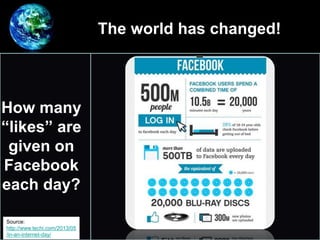
How many
“likes” are
given on
Facebook
each day?
Source:
http://www.techi.com/2013/05
/in-an-internet-day/
The world has changed!
•
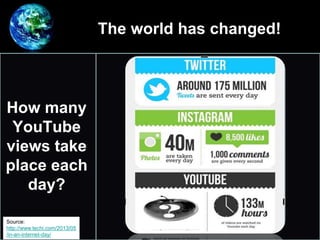
How many
YouTube
views take
place each
day?
Source:
http://www.techi.com/2013/05
/in-an-internet-day/
The world has changed!
•
Do you have a moral obligation to
ensure that every student, in every
class, in every school has access to
the learning opportunities and
resources that are accessible on the
Internet?
Source: http://www.changemakrs.com/
Our Initial Steps…
Where
do
we go
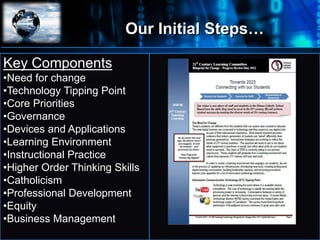
next?
21st
Century
Learning
School
Board
Key Components
•Need for change
•Technology Tipping Point
•Core Priorities
•Governance
•Devices and Applications
•Learning Environment
•Instructional Practice
•Higher Order Thinking Skills
•Catholicism
•Professional Development
•Equity
•Business Management
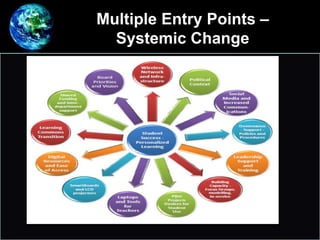
Multiple Entry Points –
Systemic Change
2.
Source: http://www.changemakrs.com/
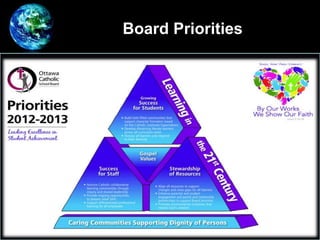
Board Priorities
1.
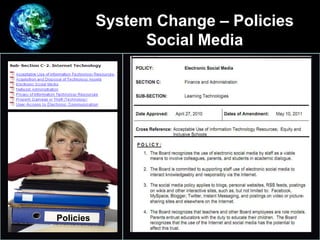
System Change – Policies
Social Media
•
Policies
WiFi has had a major impact
on Equity
Infrastructure decisions have an impact on Technology
and Pedagogy – System Impacts (Change Knowledge)
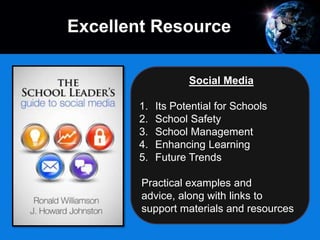
Excellent Resource
Social Media
1. Its Potential for Schools
2. School Safety
3. School Management
4. Enhancing Learning
5. Future Trends
Practical examples and
advice, along with links to
support materials and resources
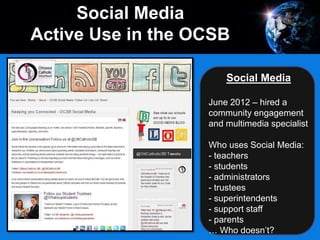
Social Media
June 2012 – hired a
community engagement
and multimedia specialist
Who uses Social Media:
- teachers
- students
- administrators
- trustees
- superintendents
- support staff
- parents
… Who doesn’t?
Social Media
Active Use in the OCSB
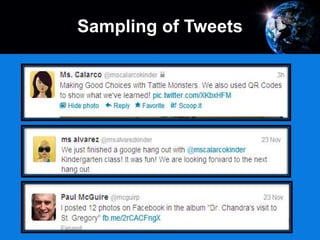
Sampling of Tweets
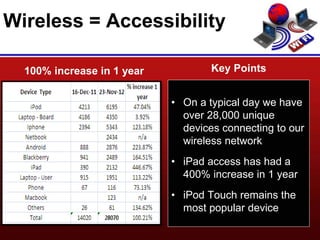
Wireless = Accessibility
100% increase in 1 year Key Points
• On a typical day we have
over 28,000 unique
devices connecting to our
wireless network
• iPad access has had a
400% increase in 1 year
• iPod Touch remains the
most popular device
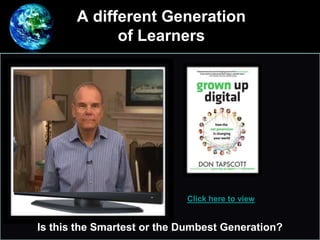
A different Generation
of Learners
Is this the Smartest or the Dumbest Generation?
Click here to view
Fullan’s Impact - Ontario
•
Integrating Technology, Pedagogy,
and Change Knowledge
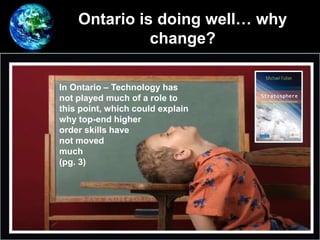
Ontario is doing well… why
change?
In Ontario – Technology has
not played much of a role to
this point, which could explain
why top-end higher
order skills have
not moved
much
(pg. 3)
Canadian Education Association Study
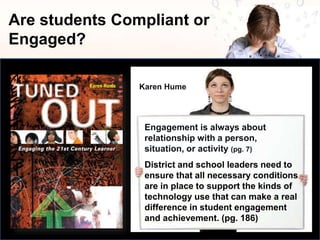
Are students Compliant or
Engaged?
Engagement is always about
relationship with a person,
situation, or activity (pg. 7)
Karen Hume
District and school leaders need to
ensure that all necessary conditions
are in place to support the kinds of
technology use that can make a real
difference in student engagement
and achievement. (pg. 186)
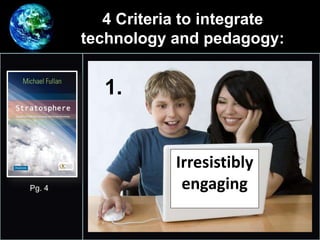
4 Criteria to integrate
technology and pedagogy:
•
1.
Pg. 4
Irresistibly
engaging
4 Criteria to integrate
technology and pedagogy:
•
2.
Pg. 4
Elegantly
efficient and
easy to use
4 Criteria to integrate
technology and pedagogy:
•
3.
Pg. 4
Technologically
ubiquitous
24/7
4 Criteria to integrate
technology and pedagogy:
•
4.
Pg. 4
Steeped in
real-life
problem solving
Think Back to the last
decade of teaching…
2000 - 2010
Irresistibly
engaging
Think Back to the last
decade of teaching…
2000 - 2010
Elegantly
efficient
and easy
to use
Think Back to the last
decade of teaching…
2000 - 2010
Technologically
ubiquitous
24/7
Think Back to the last
decade of teaching…
2000 - 2010
Steeped in
real-life
problem
solving
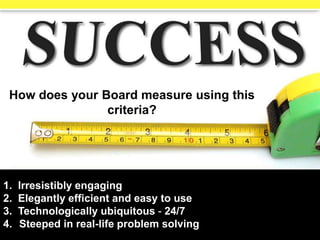
1. Irresistibly engaging
2. Elegantly efficient and easy to use
3. Technologically ubiquitous - 24/7
4. Steeped in real-life problem solving
How does your Board measure using this
criteria?
Technology is Dangerous
•
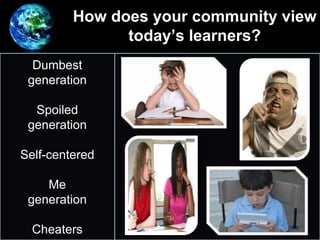
How does your community view
today’s learners?
• Dumbest
generation
Spoiled
generation
Self-centered
Me
generation
Cheaters
Discussion Time
Perspectives of Education Community?
Parents? Teachers? Trustees? Administration? Board staff?
Are today’s students the
Dumbest Generation?
Chapter Three: Pedagogy and
Change
•
Stratosphere will make the lives of
both students and teachers
exciting (pg. 17)
Create conditions for deep
engagement of both students and
teachers (pg. 30)
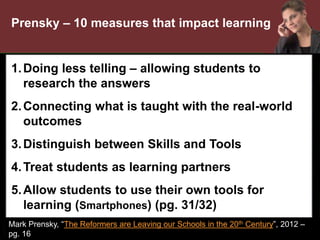
•
1.Doing less telling – allowing students to
research the answers
2.Connecting what is taught with the real-world
outcomes
3.Distinguish between Skills and Tools
4.Treat students as learning partners
5.Allow students to use their own tools for
learning (Smartphones) (pg. 31/32)
Mark Prensky, “The Reformers are Leaving our Schools in the 20th Century”, 2012 –
pg. 16
Prensky – 10 measures that impact learning
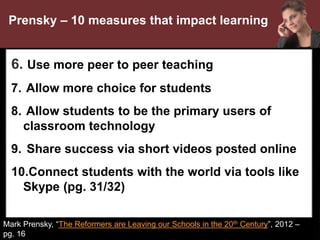
•
Mark Prensky, “The Reformers are Leaving our Schools in the 20th Century”, 2012 –
pg. 16
Prensky – 10 measures that impact learning
6. Use more peer to peer teaching
7. Allow more choice for students
8. Allow students to be the primary users of
classroom technology
9. Share success via short videos posted online
10.Connect students with the world via tools like
Skype (pg. 31/32)
•
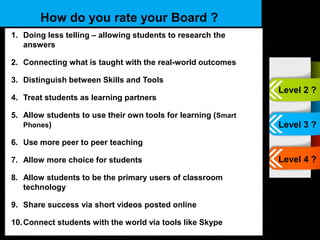
How do you rate your Board ?
1. Doing less telling – allowing students to research the
answers
2. Connecting what is taught with the real-world outcomes
3. Distinguish between Skills and Tools
4. Treat students as learning partners
5. Allow students to use their own tools for learning (Smart
Phones)
6. Use more peer to peer teaching
7. Allow more choice for students
8. Allow students to be the primary users of classroom
technology
9. Share success via short videos posted online
10.Connect students with the world via tools like Skype
Level 2 ?
Level 3 ?
Level 4 ?
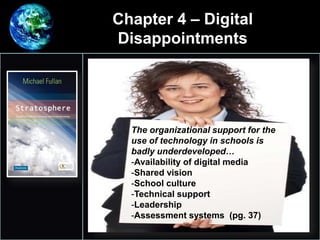
Chapter 4 – Digital
Disappointments
•
1.
The organizational support for the
use of technology in schools is
badly underdeveloped…
-Availability of digital media
-Shared vision
-School culture
-Technical support
-Leadership
-Assessment systems (pg. 37)
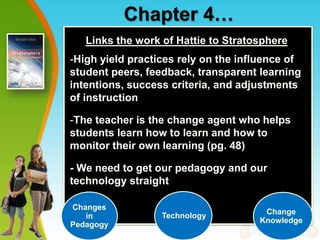
Chapter 4…
Links the work of Hattie to Stratosphere
-High yield practices rely on the influence of
student peers, feedback, transparent learning
intentions, success criteria, and adjustments
of instruction
-The teacher is the change agent who helps
students learn how to learn and how to
monitor their own learning (pg. 48)
- We need to get our pedagogy and our
technology straight
Changes
in
Pedagogy
Technology Change
Knowledge
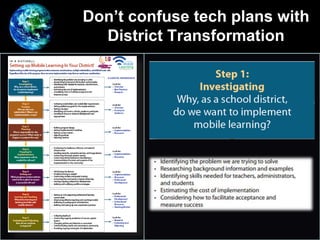
Don’t confuse tech plans with
District Transformation
•
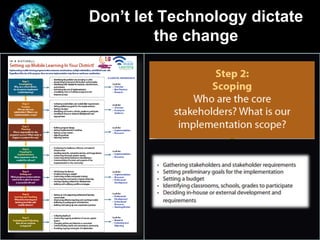
Don’t let Technology dictate
the change
•
Avoid IT department silos
•
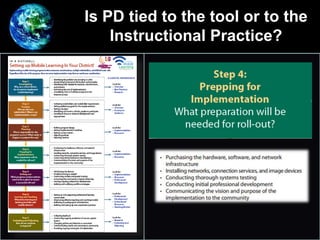
Is PD tied to the tool or to the
Instructional Practice?
•
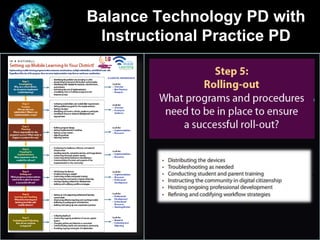
Balance Technology PD with
Instructional Practice PD
•
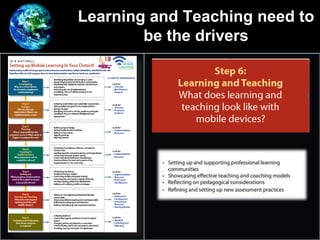
Learning and Teaching need to
be the drivers
•
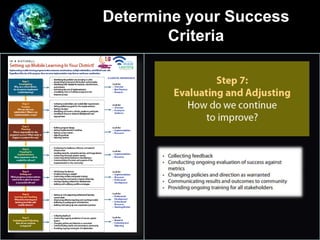
Determine your Success
Criteria
•
One of our first mistakes
Laptop Program
• Focus wasn’t on teaching
and learning
•Focus was on buying and
implementing devices
• PD was focused on
using devices
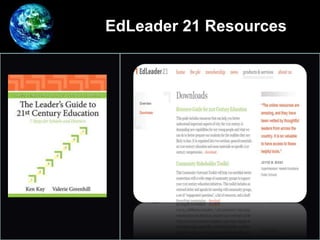
EdLeader 21 Resources
•
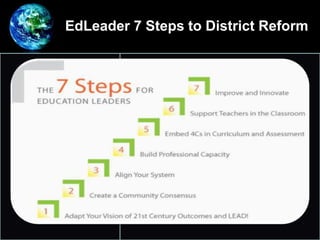
EdLeader 7 Steps to District Reform
•
Source: http://www.changemakrs.com/
Superintendents:
Change Knowledge
•
“Motion Leadership –
leadership that causes
positive movement
forward for individuals,
organizations, and
entire systems”
- pg. 66
---------
-“Our challenge is to
combine the best of
change knowledge with the
best of technology and
pedagogy” – pg. 70
Normal to fear change
“Pedagogy and technology
provide the directional vision;
change knowledge helps us
achieve it, learning while we
go - pg. 66
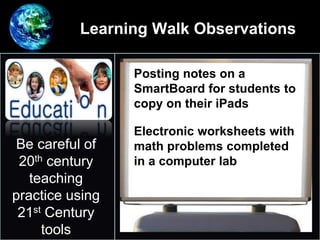
Learning Walk Observations
•
Be careful of
20th century
teaching
practice using
21st Century
tools
Posting notes on a
SmartBoard for students to
copy on their iPads
Electronic worksheets with
math problems completed
in a computer lab
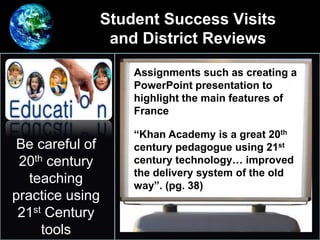
Student Success Visits
and District Reviews
•
Be careful of
20th century
teaching
practice using
21st Century
tools
Assignments such as creating a
PowerPoint presentation to
highlight the main features of
France
“Khan Academy is a great 20th
century pedagogue using 21st
century technology… improved
the delivery system of the old
way”. (pg. 38)
Are you asking the
right questions?
Is this the right
question?
What is the computer to
student ratio in our school?
Are you asking the
right questions?
How many iPads do I have
in my class?
Is this the right
question?
Are you asking the
right questions?
Do you show digital movies
from YouTube?
Is this the right
question?
Are you asking the
right questions?
How many SmartBoards do
we have in our school?
Is this the right
question?
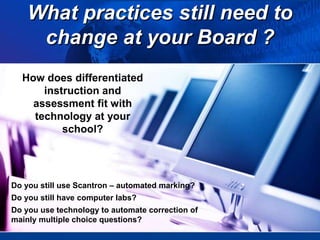
What practices still need to
change at your Board ?
How does differentiated
instruction and
assessment fit with
technology at your
school?
Do you still use Scantron – automated marking?
Do you still have computer labs?
Do you use technology to automate correction of
mainly multiple choice questions?
Why did we change
our email system?
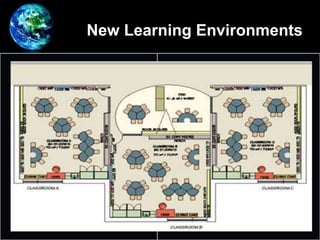
New Learning Environments
•
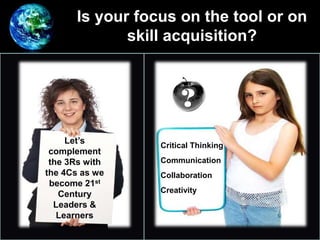
Is your focus on the tool or on
skill acquisition?
•
Let’s
complement
the 3Rs with
the 4Cs as we
become 21st
Century
Leaders &
Learners
Critical Thinking
Communication
Collaboration
Creativity
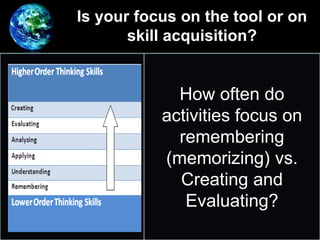
Is your focus on the tool or on
skill acquisition?
•
How often do
activities focus on
remembering
(memorizing) vs.
Creating and
Evaluating?
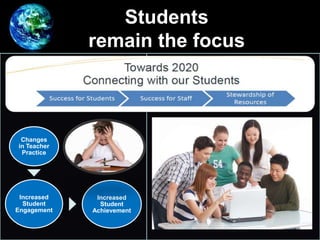
Students
remain the focus
Changes
in Teacher
Practice
Increased
Student
Engagement
Increased
Student
Achievement
What’s needed to change this
practice?
Pedagogy – Technology – Change Knowledge
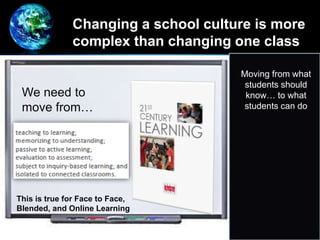
Changing a school culture is more
complex than changing one class
Moving from what
students should
know… to what
students can do
We need to
move from…
This is true for Face to Face,
Blended, and Online Learning
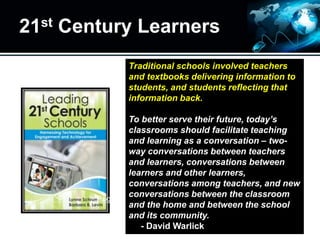
21st Century Learners
Traditional schools involved teachers
and textbooks delivering information to
students, and students reflecting that
information back.
To better serve their future, today’s
classrooms should facilitate teaching
and learning as a conversation – two-
way conversations between teachers
and learners, conversations between
learners and other learners,
conversations among teachers, and new
conversations between the classroom
and the home and between the school
and its community.
- David Warlick
Page 3
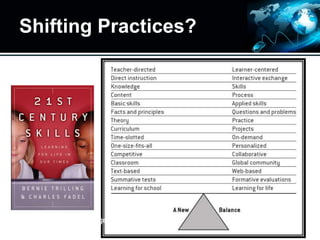
Shifting Practices?
Page 38
21st Century Learning ≠ Computers
Pg. 59
“Electronic classroom tools such as PowerPoint
presentations, online videos, and high-tech
presentation equipment were still tied to the same
material in the same school environment.
Certainly these tools made education more
interesting and allowed for opportunities to
present content in new and different ways, but
they were still tied to static material presented in
a static learning environment.
Today’s learners need something more attuned
to their daily lifestyles – connected, and often
virtual. That’s where mobile learning comes into
play.”
Teaching Practice… it’s not about
the tools!
Pg. 95
“Stop Talking… and Start Doing!”
“Even though this research has been around for
decades, many educators continue to depend
completely on the “stand and deliver; sit and
learn” full-frontal lecture method. If we were to
be really honest with ourselves, we know
intuitively that this isn’t working”.
(2011 – Ian Jukes, Lee Crockett, Andrew Churches)
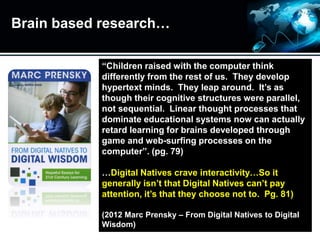
Brain based research…
“Children raised with the computer think
differently from the rest of us. They develop
hypertext minds. They leap around. It’s as
though their cognitive structures were parallel,
not sequential. Linear thought processes that
dominate educational systems now can actually
retard learning for brains developed through
game and web-surfing processes on the
computer”. (pg. 79)
…Digital Natives crave interactivity…So it
generally isn’t that Digital Natives can’t pay
attention, it’s that they choose not to. Pg. 81)
(2012 Marc Prensky – From Digital Natives to Digital
Wisdom)
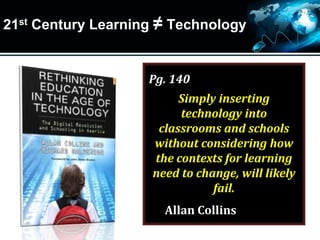
21st Century Learning ≠ Technology
Pg. 140
Simply inserting
technology into
classrooms and schools
without considering how
the contexts for learning
need to change, will likely
fail.
Allan Collins
What lies ahead?
We can’t predict the device of the future… and that’s ok
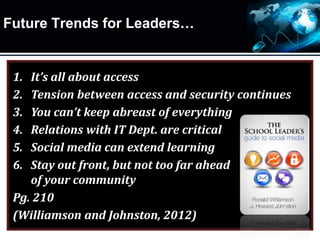
Future Trends for Leaders…
1. It’s all about access
2. Tension between access and security continues
3. You can’t keep abreast of everything
4. Relations with IT Dept. are critical
5. Social media can extend learning
6. Stay out front, but not too far ahead
of your community
Pg. 210
(Williamson and Johnston, 2012)
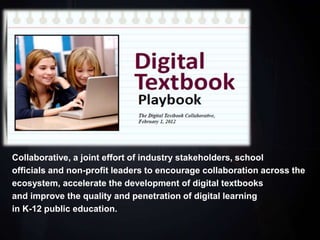
Collaborative, a joint effort of industry stakeholders, school
officials and non-profit leaders to encourage collaboration across the
ecosystem, accelerate the development of digital textbooks
and improve the quality and penetration of digital learning
in K-12 public education.
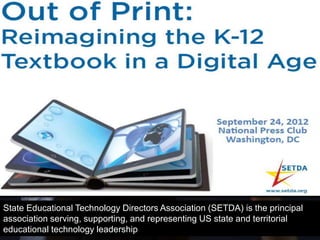
State Educational Technology Directors Association (SETDA) is the principal
association serving, supporting, and representing US state and territorial
educational technology leadership
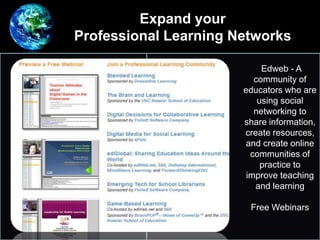
Edweb - A
community of
educators who are
using social
networking to
share information,
create resources,
and create online
communities of
practice to
improve teaching
and learning
Free Webinars
Expand your
Professional Learning Networks
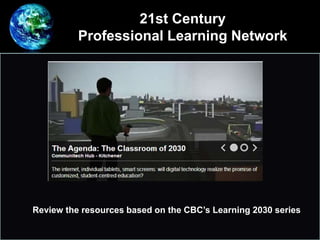
21st Century
Professional Learning Network
Review the resources based on the CBC’s Learning 2030 series
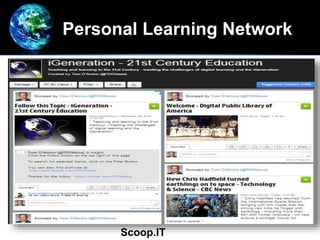
Personal Learning Network
Scoop.IT
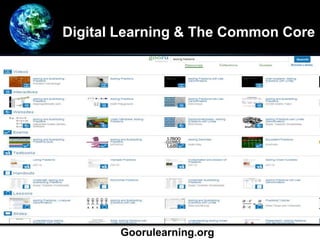
Digital Learning & The Common Core
Goorulearning.org
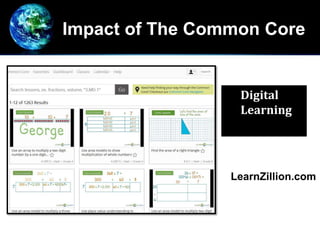
Impact of The Common Core
Digital
Learning
LearnZillion.com
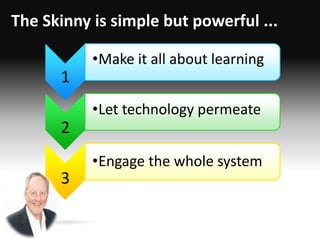
The Skinny is simple but powerful ...
•Make it all about learning
•Let technology permeate
•Engage the whole system
1
2
3
Superintendents look into the
future… and then make it happen
Teacher’s Matter Most!
“ I had a lot of great teachers,
and they were great because
they knew how to personalize
learning for all of their students,
not because they stuck us in
front of a computer screen”
Krista Moroder, (Learning and Leading with Technology ISTE, April 2013, pg.40)
Whether you
believe you can,
or you believe
you can’t –
you’re right.
Henry Ford
@TDOttawa

District transformation region two may 2013

  • 1.
    Learning and Teachingin the 21st Century T. D’Amico, 2013 K-12 District Transformation
  • 2.
    Learning Goals By theend of this presentation you should have a better understanding of: • One district’s change process • The connection between pedagogy, technology, and change knowledge • The important role of leadership in the change process
  • 3.
    Looking back… 3years ago Where do we start Information Technology Silo Overhead projectors – minimal LCDs Small number of Interactive Whiteboards – various brands Desktop computer in each class Some wireless spots in some classes Lock down philosophy (Filter/Block) No central repository for information Slow and unreliable network No help desk or tracking of issues Students with special needs – withdrawn to use locked down laptops Information Technology Silo Technology ?
  • 4.
    Systemic Review in2010 • The world has changed and there is no turning back Adults actively keeping technology out of the school system No Cell Phones No BYOD
  • 5.
    Fear and Cautionor Curiosity and Exploration Which approach reflects your District?
  • 6.
  • 7.
    The world haschanged! • How many Internet users are there world wide? Source: http://www.techi.com/2013/05 /in-an-internet-day/
  • 8.
    The world haschanged! • How many emails are sent each day? Source: http://www.techi.com/2013/05 /in-an-internet-day/
  • 9.
    The world haschanged! • How many Google searches occur every day? Source: http://www.techi.com/2013/05 /in-an-internet-day/
  • 10.
    The world haschanged! • How many users are there on Facebook and on YouTube? Source: http://www.techi.com/2013/05 /in-an-internet-day/
  • 11.
    The world haschanged! • How many “likes” are given on Facebook each day? Source: http://www.techi.com/2013/05 /in-an-internet-day/
  • 12.
    The world haschanged! • How many YouTube views take place each day? Source: http://www.techi.com/2013/05 /in-an-internet-day/
  • 13.
    The world haschanged! • Do you have a moral obligation to ensure that every student, in every class, in every school has access to the learning opportunities and resources that are accessible on the Internet?
  • 14.
  • 15.
    Our Initial Steps… Where do wego next? 21st Century Learning School Board Key Components •Need for change •Technology Tipping Point •Core Priorities •Governance •Devices and Applications •Learning Environment •Instructional Practice •Higher Order Thinking Skills •Catholicism •Professional Development •Equity •Business Management
  • 16.
    Multiple Entry Points– Systemic Change 2.
  • 17.
  • 18.
  • 19.
    System Change –Policies Social Media • Policies
  • 20.
    WiFi has hada major impact on Equity Infrastructure decisions have an impact on Technology and Pedagogy – System Impacts (Change Knowledge)
  • 21.
    Excellent Resource Social Media 1.Its Potential for Schools 2. School Safety 3. School Management 4. Enhancing Learning 5. Future Trends Practical examples and advice, along with links to support materials and resources
  • 22.
    Social Media June 2012– hired a community engagement and multimedia specialist Who uses Social Media: - teachers - students - administrators - trustees - superintendents - support staff - parents … Who doesn’t? Social Media Active Use in the OCSB
  • 23.
  • 24.
    Wireless = Accessibility 100%increase in 1 year Key Points • On a typical day we have over 28,000 unique devices connecting to our wireless network • iPad access has had a 400% increase in 1 year • iPod Touch remains the most popular device
  • 25.
    A different Generation ofLearners Is this the Smartest or the Dumbest Generation? Click here to view
  • 26.
    Fullan’s Impact -Ontario • Integrating Technology, Pedagogy, and Change Knowledge
  • 27.
    Ontario is doingwell… why change? In Ontario – Technology has not played much of a role to this point, which could explain why top-end higher order skills have not moved much (pg. 3)
  • 28.
  • 29.
    Are students Compliantor Engaged? Engagement is always about relationship with a person, situation, or activity (pg. 7) Karen Hume District and school leaders need to ensure that all necessary conditions are in place to support the kinds of technology use that can make a real difference in student engagement and achievement. (pg. 186)
  • 30.
    4 Criteria tointegrate technology and pedagogy: • 1. Pg. 4 Irresistibly engaging
  • 31.
    4 Criteria tointegrate technology and pedagogy: • 2. Pg. 4 Elegantly efficient and easy to use
  • 32.
    4 Criteria tointegrate technology and pedagogy: • 3. Pg. 4 Technologically ubiquitous 24/7
  • 33.
    4 Criteria tointegrate technology and pedagogy: • 4. Pg. 4 Steeped in real-life problem solving
  • 34.
    Think Back tothe last decade of teaching… 2000 - 2010 Irresistibly engaging
  • 35.
    Think Back tothe last decade of teaching… 2000 - 2010 Elegantly efficient and easy to use
  • 36.
    Think Back tothe last decade of teaching… 2000 - 2010 Technologically ubiquitous 24/7
  • 37.
    Think Back tothe last decade of teaching… 2000 - 2010 Steeped in real-life problem solving
  • 38.
    1. Irresistibly engaging 2.Elegantly efficient and easy to use 3. Technologically ubiquitous - 24/7 4. Steeped in real-life problem solving How does your Board measure using this criteria?
  • 39.
  • 40.
    How does yourcommunity view today’s learners? • Dumbest generation Spoiled generation Self-centered Me generation Cheaters
  • 41.
    Discussion Time Perspectives ofEducation Community? Parents? Teachers? Trustees? Administration? Board staff? Are today’s students the Dumbest Generation?
  • 42.
    Chapter Three: Pedagogyand Change • Stratosphere will make the lives of both students and teachers exciting (pg. 17) Create conditions for deep engagement of both students and teachers (pg. 30)
  • 43.
    • 1.Doing less telling– allowing students to research the answers 2.Connecting what is taught with the real-world outcomes 3.Distinguish between Skills and Tools 4.Treat students as learning partners 5.Allow students to use their own tools for learning (Smartphones) (pg. 31/32) Mark Prensky, “The Reformers are Leaving our Schools in the 20th Century”, 2012 – pg. 16 Prensky – 10 measures that impact learning
  • 44.
    • Mark Prensky, “TheReformers are Leaving our Schools in the 20th Century”, 2012 – pg. 16 Prensky – 10 measures that impact learning 6. Use more peer to peer teaching 7. Allow more choice for students 8. Allow students to be the primary users of classroom technology 9. Share success via short videos posted online 10.Connect students with the world via tools like Skype (pg. 31/32)
  • 45.
    • How do yourate your Board ? 1. Doing less telling – allowing students to research the answers 2. Connecting what is taught with the real-world outcomes 3. Distinguish between Skills and Tools 4. Treat students as learning partners 5. Allow students to use their own tools for learning (Smart Phones) 6. Use more peer to peer teaching 7. Allow more choice for students 8. Allow students to be the primary users of classroom technology 9. Share success via short videos posted online 10.Connect students with the world via tools like Skype Level 2 ? Level 3 ? Level 4 ?
  • 46.
    Chapter 4 –Digital Disappointments • 1. The organizational support for the use of technology in schools is badly underdeveloped… -Availability of digital media -Shared vision -School culture -Technical support -Leadership -Assessment systems (pg. 37)
  • 47.
    Chapter 4… Links thework of Hattie to Stratosphere -High yield practices rely on the influence of student peers, feedback, transparent learning intentions, success criteria, and adjustments of instruction -The teacher is the change agent who helps students learn how to learn and how to monitor their own learning (pg. 48) - We need to get our pedagogy and our technology straight Changes in Pedagogy Technology Change Knowledge
  • 48.
    Don’t confuse techplans with District Transformation •
  • 49.
    Don’t let Technologydictate the change •
  • 50.
  • 51.
    Is PD tiedto the tool or to the Instructional Practice? •
  • 52.
    Balance Technology PDwith Instructional Practice PD •
  • 53.
    Learning and Teachingneed to be the drivers •
  • 54.
  • 55.
    One of ourfirst mistakes Laptop Program • Focus wasn’t on teaching and learning •Focus was on buying and implementing devices • PD was focused on using devices
  • 56.
  • 57.
    EdLeader 7 Stepsto District Reform •
  • 58.
  • 59.
    Superintendents: Change Knowledge • “Motion Leadership– leadership that causes positive movement forward for individuals, organizations, and entire systems” - pg. 66 --------- -“Our challenge is to combine the best of change knowledge with the best of technology and pedagogy” – pg. 70 Normal to fear change “Pedagogy and technology provide the directional vision; change knowledge helps us achieve it, learning while we go - pg. 66
  • 60.
    Learning Walk Observations • Becareful of 20th century teaching practice using 21st Century tools Posting notes on a SmartBoard for students to copy on their iPads Electronic worksheets with math problems completed in a computer lab
  • 61.
    Student Success Visits andDistrict Reviews • Be careful of 20th century teaching practice using 21st Century tools Assignments such as creating a PowerPoint presentation to highlight the main features of France “Khan Academy is a great 20th century pedagogue using 21st century technology… improved the delivery system of the old way”. (pg. 38)
  • 62.
    Are you askingthe right questions? Is this the right question? What is the computer to student ratio in our school?
  • 63.
    Are you askingthe right questions? How many iPads do I have in my class? Is this the right question?
  • 64.
    Are you askingthe right questions? Do you show digital movies from YouTube? Is this the right question?
  • 65.
    Are you askingthe right questions? How many SmartBoards do we have in our school? Is this the right question?
  • 66.
    What practices stillneed to change at your Board ? How does differentiated instruction and assessment fit with technology at your school? Do you still use Scantron – automated marking? Do you still have computer labs? Do you use technology to automate correction of mainly multiple choice questions?
  • 67.
    Why did wechange our email system?
  • 69.
  • 70.
    Is your focuson the tool or on skill acquisition? • Let’s complement the 3Rs with the 4Cs as we become 21st Century Leaders & Learners Critical Thinking Communication Collaboration Creativity
  • 71.
    Is your focuson the tool or on skill acquisition? • How often do activities focus on remembering (memorizing) vs. Creating and Evaluating?
  • 72.
    Students remain the focus Changes inTeacher Practice Increased Student Engagement Increased Student Achievement
  • 73.
    What’s needed tochange this practice? Pedagogy – Technology – Change Knowledge
  • 74.
    Changing a schoolculture is more complex than changing one class Moving from what students should know… to what students can do We need to move from… This is true for Face to Face, Blended, and Online Learning
  • 75.
    21st Century Learners Traditionalschools involved teachers and textbooks delivering information to students, and students reflecting that information back. To better serve their future, today’s classrooms should facilitate teaching and learning as a conversation – two- way conversations between teachers and learners, conversations between learners and other learners, conversations among teachers, and new conversations between the classroom and the home and between the school and its community. - David Warlick Page 3
  • 76.
  • 77.
    21st Century Learning≠ Computers Pg. 59 “Electronic classroom tools such as PowerPoint presentations, online videos, and high-tech presentation equipment were still tied to the same material in the same school environment. Certainly these tools made education more interesting and allowed for opportunities to present content in new and different ways, but they were still tied to static material presented in a static learning environment. Today’s learners need something more attuned to their daily lifestyles – connected, and often virtual. That’s where mobile learning comes into play.”
  • 78.
    Teaching Practice… it’snot about the tools! Pg. 95 “Stop Talking… and Start Doing!” “Even though this research has been around for decades, many educators continue to depend completely on the “stand and deliver; sit and learn” full-frontal lecture method. If we were to be really honest with ourselves, we know intuitively that this isn’t working”. (2011 – Ian Jukes, Lee Crockett, Andrew Churches)
  • 79.
    Brain based research… “Childrenraised with the computer think differently from the rest of us. They develop hypertext minds. They leap around. It’s as though their cognitive structures were parallel, not sequential. Linear thought processes that dominate educational systems now can actually retard learning for brains developed through game and web-surfing processes on the computer”. (pg. 79) …Digital Natives crave interactivity…So it generally isn’t that Digital Natives can’t pay attention, it’s that they choose not to. Pg. 81) (2012 Marc Prensky – From Digital Natives to Digital Wisdom)
  • 80.
    21st Century Learning≠ Technology Pg. 140 Simply inserting technology into classrooms and schools without considering how the contexts for learning need to change, will likely fail. Allan Collins
  • 81.
    What lies ahead? Wecan’t predict the device of the future… and that’s ok
  • 82.
    Future Trends forLeaders… 1. It’s all about access 2. Tension between access and security continues 3. You can’t keep abreast of everything 4. Relations with IT Dept. are critical 5. Social media can extend learning 6. Stay out front, but not too far ahead of your community Pg. 210 (Williamson and Johnston, 2012)
  • 83.
    Collaborative, a jointeffort of industry stakeholders, school officials and non-profit leaders to encourage collaboration across the ecosystem, accelerate the development of digital textbooks and improve the quality and penetration of digital learning in K-12 public education.
  • 84.
    State Educational TechnologyDirectors Association (SETDA) is the principal association serving, supporting, and representing US state and territorial educational technology leadership
  • 85.
    Edweb - A communityof educators who are using social networking to share information, create resources, and create online communities of practice to improve teaching and learning Free Webinars Expand your Professional Learning Networks
  • 86.
    21st Century Professional LearningNetwork Review the resources based on the CBC’s Learning 2030 series
  • 87.
  • 88.
    Digital Learning &The Common Core Goorulearning.org
  • 89.
    Impact of TheCommon Core Digital Learning LearnZillion.com
  • 90.
    The Skinny issimple but powerful ... •Make it all about learning •Let technology permeate •Engage the whole system 1 2 3
  • 91.
    Superintendents look intothe future… and then make it happen
  • 92.
    Teacher’s Matter Most! “I had a lot of great teachers, and they were great because they knew how to personalize learning for all of their students, not because they stuck us in front of a computer screen” Krista Moroder, (Learning and Leading with Technology ISTE, April 2013, pg.40)
  • 93.
    Whether you believe youcan, or you believe you can’t – you’re right. Henry Ford @TDOttawa

Editor's Notes

  • #2 A presentation shared with OCSOA region two – May 2013. The focus is to look at the role of leadership and system change along with the impact of technology and pedagogy for increased student achievement.
  • #4 Look back on where we were as a Board 3 years ago – similar to many Boards
  • #5 Our process began 3 years ago with a systemic review of the department and the technological needs of our schools and an environmental scan of what was happening in the community.We realized that while the world around us had changed drastically, it was “us” adults that were creating conditions to keep technology out of our schools
  • #6 What is your mode of operation – one of fear and caution or one of curiosity and exploration?We were focused on safety and security and working out of Fear “What if something went wrong” as opposed to a focus on innovation and encouraging creativity
  • #7 Trivia time
  • #8 Trivia
  • #9 Trivia
  • #10 Trivia
  • #11 Trivia
  • #12 Trivia
  • #13 Trivia
  • #14 Trivia
  • #15 Trivia
  • #16 Trivia
  • #17 Trivia
  • #18 Trivia
  • #19 Trivia
  • #20 Discuss this quote – reflect on our role
  • #21 Mention that the tasks seemed huge, but we began with some basic first steps
  • #22 We now annually review our planning document, Towards 2020 – Connecting with Our Students
  • #23 Our view was to provide multiple entry points for all staff in order to have system change, as opposed to a linear “step” approach to district transformation
  • #24 We realized that if the leaders of the Board did not take intentional actions then nothing would change
  • #25 We kept our focus on three key priorities:Success for StudentsSuccess for StaffStewardship of ResourcesBut – we added Learning in the 21st Century as a support and framework for all that we are doing
  • #26 Social media as a key communication channel – relationships and communication are key and that the framework for change must also be part of the discussion, not separate from it. If we want teachers and students to be involved in social learning then we need to create a framework that allows them to do thisMention that this is one Board’s sample of a social media policy to encourage students and staff to use online technologies for social learningAs leaders if we don’t create the conditions to allow for social learning, we shouldn’t expect it to happen automatically
  • #27 WiFi impact – outline the importance of the IT department working with curriculum hand in hand to find a balance between lockdown and access, between filtering and the impact on learningIf it is a key component then it must work otherwise it now impacts learning
  • #28 I wish I had this book 2 years ago – it covers all of the questions that we had, and includes excellent resources and samples
  • #29 Examples of our use of social mediaOur student trustees – facebook, youtube, twitter, - We hired a social media specialist last year-
  • #30 Some examples – Twitter in the system – just a few of the hundreds of examples that could be used
  • #31 Go through stats from the Ottawa Catholic School Board (37,000 students) and mention that we need to go deeper since access does not equate with learning so we need to think about how we interpret the data
  • #32 How do you view today’s generation of learners?Mention that this is an older clip but it is a good one for anyone who hasn’t seen it since it shows both perspectives about today’s youthNeed to base assumptions about the new generation based on research Play clip first with the negative notations from Tapscott and then stop the clipAsk why we would bother introducing technology if it is so bad for kids… don’t take answers, then play the remaining clip that shows that the research does not support that view
  • #33 On Page 1 of his book Michael Fullan explains that the title is in reference to three key forces: Technology, Pedagogy, and Change knowledge do not necessarily seek each other outHe also explains that the Stratosphere is meant to imply, mystery, intrigue, and unknowns, since research on the brain may change how we approach learning in the future.
  • #34 If Ontario is doing so well why are we worried about making more changes with technology?One area where we need to continue to improve is on higher order thinking skills
  • #35 Say This:The Canadian Education Association surveyed over 67,000 grade 5 to 12 students in Canadian schools and they foundDo This:Click to advance to next points on the slideSay This:While 82% of grade 5 students reported that they were engaged in their learning, by grade 11 only 41% reported that they are engaged in their learning. The number increases slightly by grade 12, probably because of the focus on getting into College or University.Do This:Click to advance to the next slideNote:If you are asked specific questions about the study, you can direct the staff member to visit the Canadian Education Association web site and search for the study called “What did you do in school today”.
  • #36 Say This:The Canadian Education Association surveyed over 67,000 grade 5 to 12 students in Canadian schools and they foundDo This:Click to advance to next points on the slideSay This:While 82% of grade 5 students reported that they were engaged in their learning, by grade 11 only 41% reported that they are engaged in their learning. The number increases slightly by grade 12, probably because of the focus on getting into College or University.Do This:Click to advance to the next slideNote:If you are asked specific questions about the study, you can direct the staff member to visit the Canadian Education Association web site and search for the study called “What did you do in school today”.
  • #37 Say this:Karen Hume in her book “Tuned Out” explains that there is a difference between Engagement and CompliantIn some classes, students are quiet and doing the work, but as educators do we know if they are just being compliant or are they engaged in the learning process?Do this:Advance to the next slide
  • #38 Mention that page 4 outlines 4 Criteria to think about when it comes to technology having an impact on teaching and learning
  • #39 2nd Criteria to think about when it comes to technology having an impact on teaching and learning
  • #40 3rd Criteria to think about when it comes to technology having an impact on teaching and learning
  • #41 4th Criteria to think about when it comes to technology having an impact on teaching and learning
  • #42 Think back to the years 2000 – 2010 and how computers, and mainly computer labs were used in schoolReview each of the 4 criteria with a critical view of how these were achieved in that setting
  • #43 Think back to the years 2000 – 2010 and how computers, and mainly computer labs were used in schoolReview each of the 4 criteria with a critical view of how these were achieved in that setting
  • #44 Think back to the years 2000 – 2010 and how computers, and mainly computer labs were used in schoolReview each of the 4 criteria with a critical view of how these were achieved in that setting
  • #45 Think back to the years 2000 – 2010 and how computers, and mainly computer labs were used in schoolReview each of the 4 criteria with a critical view of how these were achieved in that setting
  • #46 Discussion timeGive groups time to think and discuss their own school or Board and how they are doing on these 4 criteria today
  • #47 How do you view today’s generation of learners?Ask for a show of hands if the audience feels that some teachers or parents take this view as represented by these two photosEven if we don’t agree with this perception we must recognize that some people do have this view and unless we start to create a culture to address these perceptions we will have difficulty achieving our goals of having the technology impact student achievementNeed to base assumptions about the new generation based on research
  • #48 How do you view today’s generation of learners?Not everyone will see the Internet as full of danger, but some will see the Internet as having a negative impact on learning.Need to base assumptions about the new generation based on research
  • #49 Discussion at tables regarding the different perspectives in their school and how they think about today’s generation of students
  • #50 Outline the key concepts from Chapter 3We are seeing that technology is not only a positive impact on student learning it is also a positive impact on teacher practice, regardless of the age of the teacher, many veteran teachers have become re-energized as they continue to learn and teach with new technologies
  • #51 Mention that Fullan in his book makes reference to Prensky’s essay, “The Reformers are leaving our schools in the 20th Century” and that this is in reference to the USA; and the strategies that politicians are trying to change educationIndicate agreement with his 10 measures that impact learning- Review each of the 10 measures and focus on pedagogy
  • #52 Indicate agreement with his 10 measures that impact learning- Review each of the 10 measures and focus on pedagogy
  • #53 Activity:At tables, ask groups to rate their own school or Board based on levels 2 – 3 or 4 and the 10 measures outlined by Prensky
  • #54 Mention that chapter 4 is about more disappointments and some of the conditions that are not present in schools or Boards to help teachers and students meet with successThese are the areas that Superintendents, Directors of Education, Coordinators, Principals, Vice-Principals, and other leaders in the system can have a major impact on teachers and student learning
  • #55 Review the work of Hattie- Indicate that we need to take into context that some of his meta studies that show that technology had no impact are precisely because the focus was on the device and not on changes in pedagogy – for example, if we had a study on using computers to impact math achievement and the practice was to bring a class to the lab to work on electronic math worksheets, we would not see a huge correlation on student achievement
  • #56 Review the CoSN steps for setting up mobile learning in your district, but outline that we have to be careful to not see the implementation of devices as impacting learning, this is one component but it is not the key focus on learning or teaching
  • #57 Review this step
  • #58 Review this step
  • #59 Review this step
  • #60 Review this step
  • #61 Review this step
  • #62 Review this step
  • #63 Mention one of key mistakes early on was focusing on equipment and having a laptop plan = we now realize that the focus needed to be on learning and teaching and not on devices
  • #64 Mention this is an organization (U.S.) created by Ken Kay who was the lead for Partnership for 21st Century Learning (P21) the group that pushed the 4Cs. He has now created an organization for Superintendents and Directors.
  • #65 Mention that he has 7 steps to district transformation Although his steps are good, it is important to have multiple entry points for all staff so that you don’t have to wait for everyone to progress in a linear manner
  • #66 Discuss this quote and the need to do things differently because our environment has changed
  • #67 Outline the link between Chapter 5 and the change process and change knowledge
  • #68 Give examples of poor practices that currently use technology and should not be considered as appropriate use of the tools
  • #69 Discuss the lower order thinking activities of cut and paste and make a poster and the same lower order activity of cut and paste on PowerpointA much better assignment for using technology would be for the same teacher to ask the students to find 3 pre-made presentations on the Internet that outline the main tourist features of France, and then compare and contrast the three presentations in order to select the one that would be best suited to persuade our class to pick France as the location for a field trip if we had won $3,000 per student to travel anywhere in the world on a field trip.Mention that Khan Academy has some benefits but it is not taking advantage of all of the advances in technology- Khan Academy is basically recording of a lecture based instruction that students can watch over and over at their own pace. While this helps some students it may not help all students and it doesn’t currently take advantage of the many features of technology that could create a more engaging learning activity for students
  • #70 Go through the various quotes and asking if we are looking at the correct questions
  • #71 Go through the various quotes and asking if we are looking at the correct questions
  • #72 Go through the various quotes and asking if we are looking at the correct questions
  • #73 Go through the various quotes and asking if we are looking at the correct questions
  • #74 Discussion activity at tablesLook at DI and Assessment and how does it fit with technologyAsk about some of the older assessment practices and is the problem the tool or the practice of multiple choice questions?
  • #75 Mention the reason we changed to Gmail was not to save money, it was to change our focus from static communication, to one that focused on collaboration and communication along with creative problem solving and critical thinking – something that lends itself well to Google Apps for Education
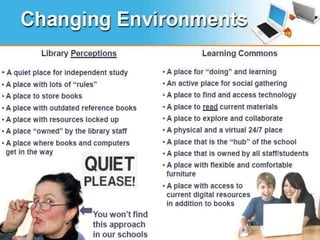
  • #76 Discuss the change from libraries to learning commons to go along with our system change and a focus on what a 21st Century learning space should look and sound like
  • #77 New learning spaces – discuss that the conversation needs to be across the whole system, and not just the technology departmentThis is an example of the design for a new elementary school – the highlighted “POD” is a learning area outside of three classrooms. The area will have flexible furniture and a SmartBoard on the outside wall between the three classes. This recognizes that in a school learning takes place everywhere, not just inside a classroom. What is important is that the ideas and design come from an interdepartmental approach to learning, with input from planning and facilities, learning technologies, Curriculum, Special education, and so on, everyone should be aware of the changes that technology can have on learning
  • #78 Need to focus on higher order thinking skills, not technology
  • #79 Need to focus on higher order thinking skills, not technology
  • #80 In the Ottawa Catholic School Board, our view has been that we focus on changes in teacher practice to have the biggest influence on student achievementYou’ll see from this slide that our belief is that by changing teacher practice we will have increased student engagement and this will result in increased student achievement. Technology can assist in this process, but it is not the driving force.
  • #81 We need to realize that some practices won’t change unless we decide to make them change and we provide the conditions for success We also need to realize that sometimes direct instruction is the best approach, but it is the skill of the teacher to know which practice and which tool to use at the right time and for the right student
  • #82 Move from passive recipients of facts to socially active in the creation of knowledgeReview the key areas mentioned in this report (as they appear on the slide)Mentioned that this is good teaching, whether it is face to face, online, or blended learning
  • #83 Say this:This is a definition from page 3 of Leading 21st Century Schools - The change is from static memorization to more of a constructivist and inquiry based approach to education
  • #84 Say this:This chart shows how we are looking for a balance from traditional approaches of teaching – on the left side of the chart, to new approaches on the right. We are not looking for solely the right hand side but a balanced approach.Reflect on your own teaching practice, where do you fall on the continuum – left side – right side, in between?
  • #89 Mention that the device is going to keep changing, whether it is an iPad, or Google Glasses, or a wearable device that looks like a traditional watch - we need to focus on the use of the device and how it can provide access to the right resources, not a focus on the device
  • #91 Outline this resource for planning to move away from traditional textbook to other multi-modal resources
  • #92 Another resource to look at a plan to move to digital
  • #93 Increase your PLN – suggest joining an EdWEB group of interest for free
  • #94 Increase your PLNThe Agenda has a series that focuses on the changes in learning
  • #95 Mention ScoopIT as a great site for networking and staying current with resources
  • #96 Mention the impact of the Common Core on Ontario with the development of multi-modal resources for teachers and students like GoogruLearning.org
  • #97 Mention the impact of the Common Core on Ontario with the development of multi-modal resources for teachers and students like Learn Zillion.com
  • #98 3 Skinny notes to summarize the book
  • #99 we are all part of the changes and we will provide support to staff and to students as we continue to transition to a 21st Century Learning and Teaching Environment
  • #100 Review quote from Krista Moroder
  • #101 Do this:we are all part of the changes as we continue to transition to a 21st Century Learning and Teaching Environment