Review: CENTRAL LIMIT THEOREM!
• QUANTITATIVE VARIABLES  MEAN
• If the underlying data are normally distributed, the sample size CAN BE
ANYTHING
• Even if the underlying population is not normal, sample means from the
population will be approximately normal as long as the sample size is large
enough
(Large enough (for means) is 30)
• Properties of distribution of values: and
• Calculation of normal probabilities are determined in the same way using the
Normal Probability Table (E2)
• CATEGORICAL VARIABLES  PROPORTIONS
• p = proportion of the population (parameter) having some characteristic
• = = sample proportion, , is an estimate of parameter, p
• Distribution of values for all possible samples of size n is approximately normal
when n is large (n is assumed to be “large” if
• Properties of distribution of values: and
where p is the population proportion
• Calculation of normal probabilities are determined in the same way using the
Normal Probability Table (E2)
• 39 STAT 201 students randomly selected and asked whether took STAT 110. 60%
of STAT 201 students have taken STAT 110.
A. Quantitative  use and to calculate probabilities
B. Categorical  use and to calculate probabilities
• The 2006 AAPA survey of 100 physicians’ assistants who were working full time
reported an average annual income of $84,396 and standard deviation of
$21,975. (Source: Data from 2006 AAPA survey [ www.aapa.org])
A. Quantitative  use and to calculate probabilities
B. Categorical  use and to calculate probabilities
• The following question was asked on a StatCrunch survey administered to STAT
201 students in Spring 2011: “How many hours did you sleep last night?” 90
students responded.
A. Quantitative  use and to calculate probabilities
B. Categorical  use and to calculate probabilities
• According to a Boston Globe story, only about 1 in 6 Americans have blue eyes,
whereas a 1900 about half had blue eyes (Source: Data from The Boston Globe,
October 17, 2006) For a random sample of 100 living Americans, find the mean
and standard deviation.
A. Quantitative  use and to calculate probabilities
B. Categorical  use and to calculate probabilities
STAT 206:
Chapter 8
Confidence Interval Estimation
Ideas in Chapter 8
• Construct and interpret confidence interval estimates
• Population proportion, p (or if you prefer), using
and standard deviation of the values,
• Population mean, µ, using the point estimate,
and the standard error of the mean,
• To determine the sample size necessary to develop a
confidence interval for the population mean or
population proportion
• How confident do we need to be? And what are the
effects of higher confidence?
Confidence Intervals – General discussion
• Point estimate
• Statistic used to estimate a parameter
• “Best guess” of the true value based on a sample
• Single number – that’s a problem…
• P()? _OR_ P()?
• Probability of a single point is ZERO!
• Doesn’t show “how close” the estimate is to the parameter
• Confidence interval
• Provides additional information about the variability of the
estimate
• Takes into account Margin of Error (MOE), or sampling error
i.e., error due to chance
So… What is a Confidence Interval?
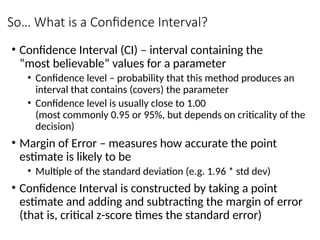
• Confidence Interval (CI) – interval containing the
“most believable” values for a parameter
• Confidence level – probability that this method produces an
interval that contains (covers) the parameter
• Confidence level is usually close to 1.00
(most commonly 0.95 or 95%, but depends on criticality of the
decision)
• Margin of Error – measures how accurate the point
estimate is likely to be
• Multiple of the standard deviation (e.g. 1.96 * std dev)
• Confidence Interval is constructed by taking a point
estimate and adding and subtracting the margin of error
(that is, critical z-score times the standard error)
• That is, CI = point estimate ± (Critical Value)(Std Error)
• Where:
• Point Estimate is the sample statistic estimating the population parameter of interest
• Critical Value is a table value based on the sampling distribution of the point
estimate and the desired confidence level
• Standard Error is the standard deviation of the point estimate
• How confident are we that the interval covers the unknown
population parameter?
• Some percentage (less than 100%)
• 95% confident (probably most common), 99%, 90%
• Desired level of confidence defines the “critical value” or z-score
• But that means, we are NEVER sure…
Point Estimate
Lower
Confidence Limit
Upper
Confidence Limit
Width of
confidence interval
Understanding
Confidence
Intervals
CI = point estimate ±
(Critical Value)(Std Error)
**A 95% confidence
interval is formed under the
knowledge:
• 95% of all the possible
intervals based on every
possible sample from the
population
• Would cover the
parameter and the other
5% would miss
Figure 21.4 Twenty-five samples from the
same population give these 95% confidence
intervals. In the long run, 95% of all such
intervals cover the true population
proportion, marked by the vertical line.
(Statistics: Concepts and Controversies (8th
Edition), by Moore and Notz, W.H. Freeman
and Company, 2013 p. 495 )
Confidence Level, (1-)
• Suppose confidence level = 95%
• Also written (1 - ) = 0.95, (so  = 0.05)
• A relative frequency interpretation:
• 95% of all the confidence intervals that can be constructed
will contain the unknown true parameter
• A specific interval
either will contain
or will not contain
the true parameter
• No probability
involved in a
specific interval
Pearson slides
(Chapter 8, slides 14&18)
Confidence
Level
Confidence
Coefficient,
Zα/2 value
1.28
1.645
1.96
2.33
2.58
3.08
3.27
0.80
0.90
0.95
0.98
0.99
0.998
0.999
80%
90%
95%
98%
99%
99.8%
99.9%


1
Central Limit Theorem: Proportions AND Means
RULE: If many samples or repetitions of the SAME SIZE are taken,
the frequency curve made from STATISTICS from the SAMPLES will
be approximately normally distributed
Categorical (2 outcomes)
PROPORTIONS (’s):
• Assumptions:
1. Population w/fixed proportion
2. Random sample from population
3. np5 and n(1-p)5 (“large” samples)
• MEAN of samples ’s will be
population proportion (p)
• STANDARD DEVIATION of the
sample proportions (s) will be:
Quantitative (Measurement)
MEANS (’s ):
• Conditions/Assumptions
1. If population bell-shaped
(normal), random sample of any
size
2. If population not bell-shaped, a
large random sample ( 30)
• MEAN of sample means’s) will
be population mean ()
• STANDARD DEVIATION of the
sample means ’s) will be:
^
𝒑
 
• CI for population proportion:
• What are usual values of z?
• Assumption: Sampling distribution of is bell-shaped
• To ensure assumption is met, need and
8.3 CIs for the Population Proportion,
n
p
p
z
p
)
ˆ
1
(
ˆ
ˆ


Confidence
Level
Error
Probability
Z
.9 .10 1.645
.95 .05 1.96
.99 .01 2.58
5
ˆ 
p
n 5
)
ˆ
1
( 
 p
n
• What affects the margin of error?
• The level of confidence which determines the value of z
• the standard error which is a function of sample size
• How can we achieve a narrower confidence interval?
1. Decrease the level of confidence OR
2. Increase the sample size
Standard Error
or
Standard Deviation
of the Sampling Distribution
Margin
of Error
Question:
• What are two (2) ways to reduce the width of a
confidence interval?
A. Larger sample size and higher level of confidence
B. Smaller sample size and lower level of confidence
C. Larger sample size and lower level of confidence
D. Unable to determine without seeing the data
Question:
Two different researchers measured the weight of two separate
samples of ruby-throated hummingbirds from the same population.
Each calculated a 95% confidence interval for the mean weight of
these birds. (Source:_http
://www.biology.ucsd.edu/labs/rifkin/courses/bieb100/win2012/PracticeProblemCollection/NormalInferen
cePracticeProblems_ch11.pdf
)
• Researcher 1 found the 95% CI to be (3.12 g , 3.48 g), while
• Researcher 2 found the 95% CI to be (3.05 g , 3.62 g).
If we assume similar means and sample standard deviations, which of
the researchers probably had the larger sample?
A. Researcher 1
B. Researcher 2
CI interval width = upper limit – lower limit
Width1 = 3.48 – 3.12 = 0.36
Width2 = 3.62 – 3.05 = 0.57
Larger sample  Narrower CI
 Research 1 probably had the larger sample.
• Interpretation: We are x% confident that the true <statistic>
<description of problem> is between a and b.
• Confidence interval interpretations talk about PARAMETERS
• Although the true population values (i.e., parameters) may or may
not be in the calculated interval, x% of intervals formed in an
appropriate manner will contain the true value. HOWEVER, (100 – x)
% percent will NOT contain the true value  a mistake due to
chance.
Example 1:
• A random sample of 100 people shows that 25 are left-handed. Form a 95%
confidence interval for the true proportion of left-handers
What do we know?
• Left handed/Not left handed  categorical
(success is left handed)
25 left-handed  25 successes
• n = 100
• = # successes/# trials = 25/100 = 0.25
• n = 0.25(100)=25 and n(1-)=0.75(100)=75
Interpretation:
We are 95% confident that the true
proportion of people in the
population who are left-handed is
between 0.1651 and 0.3349.
_OR_
We are 95% confident that the true
percentage of left-handers in the
population is between 16.51% and
33.49%.
Although the interval from 0.1651 to 0.3349 may or may not contain the true proportion,
95% of intervals formed from samples of size 100 in this manner will cover the true value.
• What is the standard error?
• 95% CI = 0.25 ± 1.96(0.0433)
= 0.25 ± 0.0849
= (0.1651 , 0.3349)
• 95% confidence  z = 1.96
Example 2:
A planning committee needs to estimate the percentage of students at a large
university who will attend an upcoming event so that they can determine an
appropriate location for the event. 80 students are randomly selected, and 15 say that
they will come to the event.
• What is a 95% confidence interval for the proportion of all the university’s students
who will attend the event? Interpret the interval. Is the confidence interval a valid
method for this problem?
What do we know?
Attend/not attend (success is ATTEND)
15 say they will attend  15 successes
n = 80
= # successes/# trials = 15/80 = 0.1875
n=0.1875(80)=15 and n(1-)=0.8125(80)=65
Standard error== 0.0436
95% confidence  z = 1.96
95% CI = 0.1875 ± 1.96(0.0436) =
0.1875 ± 0.085456 =
(0.102044 , 0.272956)
90% confidence  z = 1.645
90% CI = 0.1875 ± 1.645(0.0436) =
0.1875 ± 0.071722 =
(0.115778, 0.259222)
99% confidence  z = 2.58
99% CI = 0.1875 ± 2.58(0.0436) =
0.1875 ± 0.112488 =
(0.075012 , 0.299988)
.05 .10 .15 .20 .25 .30 .35
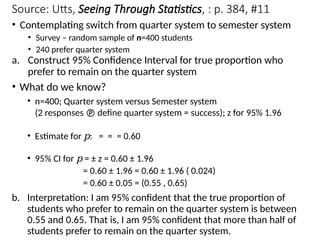
Source: Utts, Seeing Through Statistics, : p. 384, #11
• What do we know?
• n=400; Quarter system versus Semester system
(2 responses  define quarter system = success); z for 95% 1.96
• Estimate for p: = = = 0.60
• 95% CI for p = ± z = 0.60 ± 1.96
= 0.60 ± 1.96 = 0.60 ± 1.96 ( 0.024)
= 0.60 ± 0.05 = (0.55 , 0.65)
b. Interpretation: I am 95% confident that the true proportion of
students who prefer to remain on the quarter system is between
0.55 and 0.65. That is, I am 95% confident that more than half of
students prefer to remain on the quarter system.
• Contemplating switch from quarter system to semester system
• Survey – random sample of n=400 students
• 240 prefer quarter system
a. Construct 95% Confidence Interval for true proportion who
prefer to remain on the quarter system
Why can I say that more than half of the students prefer to
stay on the quarter system versus semester?
• Look at the number line
0.45 0.50 0.55 0.60 0.65 0.70 0.75
• Where does ½ appear?
• Where is the Confidence Interval?
• Does it cover ½?
NO! Completely above 0.50.
0.45 0.50 0.55 0.60 0.65 0.70 0.75
• Thus, we are able to say that we are 95% confident
that more than half of the students prefer to stay
on the quarter system.
Source: Utts, Seeing Through Statistics, : p. 384, #11 (cont)
c. But what if only 50 students had been surveyed and 30 preferred
the quarter system?
That is, n=50 and #successes=30
• Estimate for p: = = = 0.60
• 95% CI = ± z = 0.60 ± 1.96
= 0.60 ± 1.96 ( 0.069)
= 0.60 ± 0.14 = (0.46 , 0.74)
• Interpretation: I am 95% confident that the true proportion of students who
prefer the quarter system is between 0.46 and 0.74.
• Because the CI for sample size n=50 covers 0.50, we cannot say that we are
confident that the majority of students prefer the quarter system.
• Contemplating switch from quarter system to semester system
8.1 CI Estimate for the Mean ( Known)
• Calculate Confidence Interval for the MEAN, µ, for
quantitative variables
• Remember: Confidence Interval = statistic ± MOE
• Categorical (proportions) • Quantitative (means)
n
p
p
z
p
)
ˆ
1
(
ˆ
ˆ


Standard Deviation
for distribution of values
Or
Standard Error
Margin
of Error
Margin
of Error
Standard Deviation of
distribution of
X values or
Standard Error
Notice that our CI
formula uses the
population standard
deviation, σ.
Example:
A sample of 11 circuits from a large normal population has a mean
resistance of 2.20 ohms. We know from past testing that the
population standard deviation is 0.35 ohms. Determine a 95%
confidence interval for the true mean resistance of the population.
• What do we know?
• Mean resistance  quantitative
• n = 11
• and
• Standard error =
• 95% confidence  z = 1.96
• 95% CI = ± 1.96()
= 2.20 ± 1.96(0.1055)
=2.20 ±0.2068
= (1.9932 , 2.4068)
Interpretation: We are
95% confident that the
true mean resistance is
between 1.9932 and
2.4068 ohms
Although the true mean may or may not be in
this interval, 95% of intervals formed in this
manner will contain the true mean
Can we ever know σ?
• To know σ implies that you know all the values in the
population
• If you know all the values in the population, why
calculate instead of µ?
• In real world situations, you would never know the
standard deviation of the population…
Central Limit Theorem: Proportions AND Means
RULE: If many samples or repetitions of the SAME SIZE are taken, the
frequency curve made from STATISTICS from the SAMPLES will be
approximately normally distributed
Categorical (2 outcomes)
PROPORTIONS (’s):
• Assumptions:
1. Population w/fixed proportion
2. Random sample from population
3. np5 and n(1-p)5 (“large” samples)
• MEAN of samples ’s will be
population proportion (p)
• STANDARD DEVIATION of the sample
proportions (s) will be:
Quantitative (Measurement)
MEANS (’s ):
• Conditions/Assumptions
1. If population bell-shaped (normal),
random sample of any size
2. If population not bell-shaped, a large
random sample ( 30)
• MEAN of sample means’s) will be
population mean ()
• STANDARD DEVIATION of the
sample means ’s) will be:
^
𝒑
 
8.1 CI Estimate for the Mean ( Known)
• Calculate Confidence Interval for the MEAN, µ, for
quantitative variables
• Remember: Confidence Interval = statistic ± MOE
• Categorical (proportions) • Quantitative (means)
n
p
p
z
p
)
ˆ
1
(
ˆ
ˆ


Standard Deviation
for distribution of values
Or
Standard Error
Margin
of Error
Margin
of Error
Standard Deviation of
distribution of
X values or
Standard Error
Notice that our CI
formula uses the
population standard
deviation, σ.
Can we ever know σ?
• To know σ implies that you know all the values in the
population
• If you know all the values in the population, why
calculate instead of µ?
• In real world situations, you would never know the
standard deviation of the population…
8.2 CI Estimate for the Mean ( UNKnown)
• Student’s t Distribution
• William S. Gosset (under his pen name “Student”)
• Working for Guinness in Ireland
• Trying to help brew better beer less expensively
• Needed to make inferences about means without knowing σ
• Substitute the sample standard deviation, S
• Introduces extra uncertainty, since S is variable from
sample to sample
• Use the t distribution instead of the normal distribution
t- distribution
• Similar to normal distribution
• Bell-shaped
• Symmetric
• Centered at mean/median/mode
• BUT… tails are “heavier”  more probability in the tails
• Multiply by a little higher value (t-score) than z-score to get margin of error
if n is small
• Very close to z if n is large
• DISADVANTAGES:
• To use the t-distribution, we must assume normality of the underlying
population
• Degrees of freedom (associated with sample size) = n-1
• t-score times standard error estimate gives the margin of
error for a confidence interval for the mean
http://ci.columbia.edu/ci/premba_test/c0331/s7/s7_4.html
Confidence Level, (1-)
• Suppose confidence level = 95%
• Also written (1 - ) = 0.95, (so  = 0.05)
• Probability in the tails? (assuming two-tailed CI)
• (need for reading t-table)
Student’s t Table (Table E.3, p. 746)
Upper Tail Area
df .10 .05 .025
1 3.078 6.314 12.706
2 1.886
3 1.638 2.353 3.182
t
0 2.920
The body of the table
contains t values, not
probabilities
Let: n = 3
df = n - 1 = 2
 = 0.10
/2 = 0.05
/2 =
0.05
4.303
2.920
Pearson slide (Chapter 8, #30)
Selected t distribution values
With comparison to the Z value
Confidence t t t Z
Level (10 d.f.) (20 d.f.) (30 d.f.) (∞ d.f.)
0.80 1.372 1.325 1.310 1.28
0.90 1.812 1.725 1.697 1.645
0.95 2.228 2.086 2.042 1.96
0.99 3.169 2.845 2.750 2.58
Note: t Z as n increases
Pearson slide (Chapter 8, #31)
Confidence Interval for a Population Mean
• When the standard deviation of the population is unknown, the
confidence interval for the population mean µ is
CI =
• “t-score” is based on the t-distribution
• Determined from the level of confidence (α) and
• Degrees of freedom (df = n–1), where n is the sample size
• To use this method, you need:
• Data obtained by randomization
• Approximately normal population distribution
• Especially important for small sample sizes (if non-normal, use large
sample, i.e., n>30)
• Make a graphical display of the data and check for extreme outlier
• t-distribution is a robust method in terms of the normality assumption
)
(
t
n
s
x 
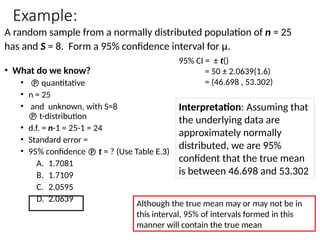
Example:
A random sample from a normally distributed population of n = 25
has and S = 8. Form a 95% confidence interval for μ.
• What do we know?
•  quantitative
• n = 25
• and unknown, with S=8
 t-distribution
• d.f. = n-1 = 25-1 = 24
• Standard error =
• 95% confidence  t = ? (Use Table E.3)
A. 1.7081
B. 1.7109
C. 2.0595
D. 2.0639
Interpretation: Assuming that
the underlying data are
approximately normally
distributed, we are 95%
confident that the true mean
is between 46.698 and 53.302
Although the true mean may or may not be in
this interval, 95% of intervals formed in this
manner will contain the true mean
95% CI = ± t()
= 50 ± 2.0639(1.6)
= (46.698 , 53.302)
8.4 Determining Sample Size
• Sometimes given sample size reported with results for a sample
already executed
• BUT… determination of sample size is a part of the business world
• We’ve already looked at Margin of Error (MOE) when we created
confidence intervals
• Develop sample size estimator (ne) using our estimates for MOE
Standard Error
or
Standard Deviation
of the Sampling Distribution
Margin
of Error
Margin
of Error
Standard Deviation of
distribution of
values or
Standard Error
Sample size for means
• MOE is half the width of the interval (that is, we subtract and add the
MOE to the point estimate to get the CI)
• How wide do we want our interval to be? That is, what is the
“appropriate” amount of sampling error?
• What is our confidence level? 95%? 90? 99%? Other?
• What is the estimate for , population standard deviation?
• (Remember, haven’t chosen the sample or calculated the point estimate yet…)
• Use knowledge of the process or possibly a “pilot” study
• ()
• ) (square both side of the equation)
• (multiply both sides by )
• (divide both sides by )
Example
• If =45, what sample size is needed to estimate the mean
within ±5 with 90% confidence?
• What do we know?
• Means estimate
• =45
• MOE=5
• Z=1.645
•  required sample size n=220 (ALWAYS round up)
If is unknown
• Use the estimate for expected to be at least as large as
the actual value
• Select a pilot sample to calculate a value, S, to use as an
estimate
Sample size for proportions
• MOE is half the width of the interval (that is, we subtract and add the
MOE to the point estimate to get the CI)
• How wide do we want our interval to be? That is, what is the
“appropriate” amount of sampling error?
• What is our confidence level? 95%? 90? 99%? Other?
• What is the estimate for
• (Remember, haven’t chosen the sample or calculated the point estimate yet…)
• Use knowledge of the process or possibly a “pilot” study
• ) (square both side of the equation)
• (multiply both sides by )
• (divide both sides by )
Example
• How large a sample would be necessary to estimate the
true proportion of defective items in a large population
within ±3%, with 95% confidence? (Assume a pilot
sample yields = 0.12)
• What do we know?
• Proportions estimate
• Use = 0.12
• MOE=0.03
• Z=1.96
•
 use 451 (i.e., ALWAYS round up)
8.5 CI Estimation and Ethical Issues
• A confidence interval estimate (reflecting sampling error)
should always be included when reporting a point
estimate
• The level of confidence should always be reported
• The sample size should be reported
• An interpretation of the confidence interval estimate
should also be provided

STAT 206 - Chapter 8 (Confidence Interval Estimation).pptx

  • 1.
    Review: CENTRAL LIMITTHEOREM! • QUANTITATIVE VARIABLES  MEAN • If the underlying data are normally distributed, the sample size CAN BE ANYTHING • Even if the underlying population is not normal, sample means from the population will be approximately normal as long as the sample size is large enough (Large enough (for means) is 30) • Properties of distribution of values: and • Calculation of normal probabilities are determined in the same way using the Normal Probability Table (E2) • CATEGORICAL VARIABLES  PROPORTIONS • p = proportion of the population (parameter) having some characteristic • = = sample proportion, , is an estimate of parameter, p • Distribution of values for all possible samples of size n is approximately normal when n is large (n is assumed to be “large” if • Properties of distribution of values: and where p is the population proportion • Calculation of normal probabilities are determined in the same way using the Normal Probability Table (E2)
  • 2.
    • 39 STAT201 students randomly selected and asked whether took STAT 110. 60% of STAT 201 students have taken STAT 110. A. Quantitative  use and to calculate probabilities B. Categorical  use and to calculate probabilities • The 2006 AAPA survey of 100 physicians’ assistants who were working full time reported an average annual income of $84,396 and standard deviation of $21,975. (Source: Data from 2006 AAPA survey [ www.aapa.org]) A. Quantitative  use and to calculate probabilities B. Categorical  use and to calculate probabilities • The following question was asked on a StatCrunch survey administered to STAT 201 students in Spring 2011: “How many hours did you sleep last night?” 90 students responded. A. Quantitative  use and to calculate probabilities B. Categorical  use and to calculate probabilities • According to a Boston Globe story, only about 1 in 6 Americans have blue eyes, whereas a 1900 about half had blue eyes (Source: Data from The Boston Globe, October 17, 2006) For a random sample of 100 living Americans, find the mean and standard deviation. A. Quantitative  use and to calculate probabilities B. Categorical  use and to calculate probabilities
  • 3.
    STAT 206: Chapter 8 ConfidenceInterval Estimation
  • 4.
    Ideas in Chapter8 • Construct and interpret confidence interval estimates • Population proportion, p (or if you prefer), using and standard deviation of the values, • Population mean, µ, using the point estimate, and the standard error of the mean, • To determine the sample size necessary to develop a confidence interval for the population mean or population proportion • How confident do we need to be? And what are the effects of higher confidence?
  • 5.
    Confidence Intervals –General discussion • Point estimate • Statistic used to estimate a parameter • “Best guess” of the true value based on a sample • Single number – that’s a problem… • P()? _OR_ P()? • Probability of a single point is ZERO! • Doesn’t show “how close” the estimate is to the parameter • Confidence interval • Provides additional information about the variability of the estimate • Takes into account Margin of Error (MOE), or sampling error i.e., error due to chance
  • 6.
    So… What isa Confidence Interval? • Confidence Interval (CI) – interval containing the “most believable” values for a parameter • Confidence level – probability that this method produces an interval that contains (covers) the parameter • Confidence level is usually close to 1.00 (most commonly 0.95 or 95%, but depends on criticality of the decision) • Margin of Error – measures how accurate the point estimate is likely to be • Multiple of the standard deviation (e.g. 1.96 * std dev) • Confidence Interval is constructed by taking a point estimate and adding and subtracting the margin of error (that is, critical z-score times the standard error)
  • 7.
    • That is,CI = point estimate ± (Critical Value)(Std Error) • Where: • Point Estimate is the sample statistic estimating the population parameter of interest • Critical Value is a table value based on the sampling distribution of the point estimate and the desired confidence level • Standard Error is the standard deviation of the point estimate • How confident are we that the interval covers the unknown population parameter? • Some percentage (less than 100%) • 95% confident (probably most common), 99%, 90% • Desired level of confidence defines the “critical value” or z-score • But that means, we are NEVER sure… Point Estimate Lower Confidence Limit Upper Confidence Limit Width of confidence interval
  • 8.
    Understanding Confidence Intervals CI = pointestimate ± (Critical Value)(Std Error) **A 95% confidence interval is formed under the knowledge: • 95% of all the possible intervals based on every possible sample from the population • Would cover the parameter and the other 5% would miss Figure 21.4 Twenty-five samples from the same population give these 95% confidence intervals. In the long run, 95% of all such intervals cover the true population proportion, marked by the vertical line. (Statistics: Concepts and Controversies (8th Edition), by Moore and Notz, W.H. Freeman and Company, 2013 p. 495 )
  • 9.
    Confidence Level, (1-) •Suppose confidence level = 95% • Also written (1 - ) = 0.95, (so  = 0.05) • A relative frequency interpretation: • 95% of all the confidence intervals that can be constructed will contain the unknown true parameter • A specific interval either will contain or will not contain the true parameter • No probability involved in a specific interval Pearson slides (Chapter 8, slides 14&18) Confidence Level Confidence Coefficient, Zα/2 value 1.28 1.645 1.96 2.33 2.58 3.08 3.27 0.80 0.90 0.95 0.98 0.99 0.998 0.999 80% 90% 95% 98% 99% 99.8% 99.9%   1
  • 10.
    Central Limit Theorem:Proportions AND Means RULE: If many samples or repetitions of the SAME SIZE are taken, the frequency curve made from STATISTICS from the SAMPLES will be approximately normally distributed Categorical (2 outcomes) PROPORTIONS (’s): • Assumptions: 1. Population w/fixed proportion 2. Random sample from population 3. np5 and n(1-p)5 (“large” samples) • MEAN of samples ’s will be population proportion (p) • STANDARD DEVIATION of the sample proportions (s) will be: Quantitative (Measurement) MEANS (’s ): • Conditions/Assumptions 1. If population bell-shaped (normal), random sample of any size 2. If population not bell-shaped, a large random sample ( 30) • MEAN of sample means’s) will be population mean () • STANDARD DEVIATION of the sample means ’s) will be: ^ 𝒑  
  • 11.
    • CI forpopulation proportion: • What are usual values of z? • Assumption: Sampling distribution of is bell-shaped • To ensure assumption is met, need and 8.3 CIs for the Population Proportion, n p p z p ) ˆ 1 ( ˆ ˆ   Confidence Level Error Probability Z .9 .10 1.645 .95 .05 1.96 .99 .01 2.58 5 ˆ  p n 5 ) ˆ 1 (   p n • What affects the margin of error? • The level of confidence which determines the value of z • the standard error which is a function of sample size • How can we achieve a narrower confidence interval? 1. Decrease the level of confidence OR 2. Increase the sample size Standard Error or Standard Deviation of the Sampling Distribution Margin of Error
  • 12.
    Question: • What aretwo (2) ways to reduce the width of a confidence interval? A. Larger sample size and higher level of confidence B. Smaller sample size and lower level of confidence C. Larger sample size and lower level of confidence D. Unable to determine without seeing the data
  • 13.
    Question: Two different researchersmeasured the weight of two separate samples of ruby-throated hummingbirds from the same population. Each calculated a 95% confidence interval for the mean weight of these birds. (Source:_http ://www.biology.ucsd.edu/labs/rifkin/courses/bieb100/win2012/PracticeProblemCollection/NormalInferen cePracticeProblems_ch11.pdf ) • Researcher 1 found the 95% CI to be (3.12 g , 3.48 g), while • Researcher 2 found the 95% CI to be (3.05 g , 3.62 g). If we assume similar means and sample standard deviations, which of the researchers probably had the larger sample? A. Researcher 1 B. Researcher 2 CI interval width = upper limit – lower limit Width1 = 3.48 – 3.12 = 0.36 Width2 = 3.62 – 3.05 = 0.57 Larger sample  Narrower CI  Research 1 probably had the larger sample.
  • 14.
    • Interpretation: Weare x% confident that the true <statistic> <description of problem> is between a and b. • Confidence interval interpretations talk about PARAMETERS • Although the true population values (i.e., parameters) may or may not be in the calculated interval, x% of intervals formed in an appropriate manner will contain the true value. HOWEVER, (100 – x) % percent will NOT contain the true value  a mistake due to chance.
  • 15.
    Example 1: • Arandom sample of 100 people shows that 25 are left-handed. Form a 95% confidence interval for the true proportion of left-handers What do we know? • Left handed/Not left handed  categorical (success is left handed) 25 left-handed  25 successes • n = 100 • = # successes/# trials = 25/100 = 0.25 • n = 0.25(100)=25 and n(1-)=0.75(100)=75 Interpretation: We are 95% confident that the true proportion of people in the population who are left-handed is between 0.1651 and 0.3349. _OR_ We are 95% confident that the true percentage of left-handers in the population is between 16.51% and 33.49%. Although the interval from 0.1651 to 0.3349 may or may not contain the true proportion, 95% of intervals formed from samples of size 100 in this manner will cover the true value. • What is the standard error? • 95% CI = 0.25 ± 1.96(0.0433) = 0.25 ± 0.0849 = (0.1651 , 0.3349) • 95% confidence  z = 1.96
  • 16.
    Example 2: A planningcommittee needs to estimate the percentage of students at a large university who will attend an upcoming event so that they can determine an appropriate location for the event. 80 students are randomly selected, and 15 say that they will come to the event. • What is a 95% confidence interval for the proportion of all the university’s students who will attend the event? Interpret the interval. Is the confidence interval a valid method for this problem? What do we know? Attend/not attend (success is ATTEND) 15 say they will attend  15 successes n = 80 = # successes/# trials = 15/80 = 0.1875 n=0.1875(80)=15 and n(1-)=0.8125(80)=65 Standard error== 0.0436 95% confidence  z = 1.96 95% CI = 0.1875 ± 1.96(0.0436) = 0.1875 ± 0.085456 = (0.102044 , 0.272956) 90% confidence  z = 1.645 90% CI = 0.1875 ± 1.645(0.0436) = 0.1875 ± 0.071722 = (0.115778, 0.259222) 99% confidence  z = 2.58 99% CI = 0.1875 ± 2.58(0.0436) = 0.1875 ± 0.112488 = (0.075012 , 0.299988) .05 .10 .15 .20 .25 .30 .35
  • 17.
    Source: Utts, SeeingThrough Statistics, : p. 384, #11 • What do we know? • n=400; Quarter system versus Semester system (2 responses  define quarter system = success); z for 95% 1.96 • Estimate for p: = = = 0.60 • 95% CI for p = ± z = 0.60 ± 1.96 = 0.60 ± 1.96 = 0.60 ± 1.96 ( 0.024) = 0.60 ± 0.05 = (0.55 , 0.65) b. Interpretation: I am 95% confident that the true proportion of students who prefer to remain on the quarter system is between 0.55 and 0.65. That is, I am 95% confident that more than half of students prefer to remain on the quarter system. • Contemplating switch from quarter system to semester system • Survey – random sample of n=400 students • 240 prefer quarter system a. Construct 95% Confidence Interval for true proportion who prefer to remain on the quarter system
  • 18.
    Why can Isay that more than half of the students prefer to stay on the quarter system versus semester? • Look at the number line 0.45 0.50 0.55 0.60 0.65 0.70 0.75 • Where does ½ appear? • Where is the Confidence Interval? • Does it cover ½? NO! Completely above 0.50. 0.45 0.50 0.55 0.60 0.65 0.70 0.75 • Thus, we are able to say that we are 95% confident that more than half of the students prefer to stay on the quarter system.
  • 19.
    Source: Utts, SeeingThrough Statistics, : p. 384, #11 (cont) c. But what if only 50 students had been surveyed and 30 preferred the quarter system? That is, n=50 and #successes=30 • Estimate for p: = = = 0.60 • 95% CI = ± z = 0.60 ± 1.96 = 0.60 ± 1.96 ( 0.069) = 0.60 ± 0.14 = (0.46 , 0.74) • Interpretation: I am 95% confident that the true proportion of students who prefer the quarter system is between 0.46 and 0.74. • Because the CI for sample size n=50 covers 0.50, we cannot say that we are confident that the majority of students prefer the quarter system. • Contemplating switch from quarter system to semester system
  • 20.
    8.1 CI Estimatefor the Mean ( Known) • Calculate Confidence Interval for the MEAN, µ, for quantitative variables • Remember: Confidence Interval = statistic ± MOE • Categorical (proportions) • Quantitative (means) n p p z p ) ˆ 1 ( ˆ ˆ   Standard Deviation for distribution of values Or Standard Error Margin of Error Margin of Error Standard Deviation of distribution of X values or Standard Error Notice that our CI formula uses the population standard deviation, σ.
  • 21.
    Example: A sample of11 circuits from a large normal population has a mean resistance of 2.20 ohms. We know from past testing that the population standard deviation is 0.35 ohms. Determine a 95% confidence interval for the true mean resistance of the population. • What do we know? • Mean resistance  quantitative • n = 11 • and • Standard error = • 95% confidence  z = 1.96 • 95% CI = ± 1.96() = 2.20 ± 1.96(0.1055) =2.20 ±0.2068 = (1.9932 , 2.4068) Interpretation: We are 95% confident that the true mean resistance is between 1.9932 and 2.4068 ohms Although the true mean may or may not be in this interval, 95% of intervals formed in this manner will contain the true mean
  • 22.
    Can we everknow σ? • To know σ implies that you know all the values in the population • If you know all the values in the population, why calculate instead of µ? • In real world situations, you would never know the standard deviation of the population…
  • 23.
    Central Limit Theorem:Proportions AND Means RULE: If many samples or repetitions of the SAME SIZE are taken, the frequency curve made from STATISTICS from the SAMPLES will be approximately normally distributed Categorical (2 outcomes) PROPORTIONS (’s): • Assumptions: 1. Population w/fixed proportion 2. Random sample from population 3. np5 and n(1-p)5 (“large” samples) • MEAN of samples ’s will be population proportion (p) • STANDARD DEVIATION of the sample proportions (s) will be: Quantitative (Measurement) MEANS (’s ): • Conditions/Assumptions 1. If population bell-shaped (normal), random sample of any size 2. If population not bell-shaped, a large random sample ( 30) • MEAN of sample means’s) will be population mean () • STANDARD DEVIATION of the sample means ’s) will be: ^ 𝒑  
  • 24.
    8.1 CI Estimatefor the Mean ( Known) • Calculate Confidence Interval for the MEAN, µ, for quantitative variables • Remember: Confidence Interval = statistic ± MOE • Categorical (proportions) • Quantitative (means) n p p z p ) ˆ 1 ( ˆ ˆ   Standard Deviation for distribution of values Or Standard Error Margin of Error Margin of Error Standard Deviation of distribution of X values or Standard Error Notice that our CI formula uses the population standard deviation, σ.
  • 25.
    Can we everknow σ? • To know σ implies that you know all the values in the population • If you know all the values in the population, why calculate instead of µ? • In real world situations, you would never know the standard deviation of the population…
  • 26.
    8.2 CI Estimatefor the Mean ( UNKnown) • Student’s t Distribution • William S. Gosset (under his pen name “Student”) • Working for Guinness in Ireland • Trying to help brew better beer less expensively • Needed to make inferences about means without knowing σ • Substitute the sample standard deviation, S • Introduces extra uncertainty, since S is variable from sample to sample • Use the t distribution instead of the normal distribution
  • 27.
    t- distribution • Similarto normal distribution • Bell-shaped • Symmetric • Centered at mean/median/mode • BUT… tails are “heavier”  more probability in the tails • Multiply by a little higher value (t-score) than z-score to get margin of error if n is small • Very close to z if n is large • DISADVANTAGES: • To use the t-distribution, we must assume normality of the underlying population • Degrees of freedom (associated with sample size) = n-1 • t-score times standard error estimate gives the margin of error for a confidence interval for the mean
  • 28.
  • 29.
    Confidence Level, (1-) •Suppose confidence level = 95% • Also written (1 - ) = 0.95, (so  = 0.05) • Probability in the tails? (assuming two-tailed CI) • (need for reading t-table)
  • 30.
    Student’s t Table(Table E.3, p. 746) Upper Tail Area df .10 .05 .025 1 3.078 6.314 12.706 2 1.886 3 1.638 2.353 3.182 t 0 2.920 The body of the table contains t values, not probabilities Let: n = 3 df = n - 1 = 2  = 0.10 /2 = 0.05 /2 = 0.05 4.303 2.920 Pearson slide (Chapter 8, #30)
  • 31.
    Selected t distributionvalues With comparison to the Z value Confidence t t t Z Level (10 d.f.) (20 d.f.) (30 d.f.) (∞ d.f.) 0.80 1.372 1.325 1.310 1.28 0.90 1.812 1.725 1.697 1.645 0.95 2.228 2.086 2.042 1.96 0.99 3.169 2.845 2.750 2.58 Note: t Z as n increases Pearson slide (Chapter 8, #31)
  • 32.
    Confidence Interval fora Population Mean • When the standard deviation of the population is unknown, the confidence interval for the population mean µ is CI = • “t-score” is based on the t-distribution • Determined from the level of confidence (α) and • Degrees of freedom (df = n–1), where n is the sample size • To use this method, you need: • Data obtained by randomization • Approximately normal population distribution • Especially important for small sample sizes (if non-normal, use large sample, i.e., n>30) • Make a graphical display of the data and check for extreme outlier • t-distribution is a robust method in terms of the normality assumption ) ( t n s x 
  • 33.
    Example: A random samplefrom a normally distributed population of n = 25 has and S = 8. Form a 95% confidence interval for μ. • What do we know? •  quantitative • n = 25 • and unknown, with S=8  t-distribution • d.f. = n-1 = 25-1 = 24 • Standard error = • 95% confidence  t = ? (Use Table E.3) A. 1.7081 B. 1.7109 C. 2.0595 D. 2.0639 Interpretation: Assuming that the underlying data are approximately normally distributed, we are 95% confident that the true mean is between 46.698 and 53.302 Although the true mean may or may not be in this interval, 95% of intervals formed in this manner will contain the true mean 95% CI = ± t() = 50 ± 2.0639(1.6) = (46.698 , 53.302)
  • 34.
    8.4 Determining SampleSize • Sometimes given sample size reported with results for a sample already executed • BUT… determination of sample size is a part of the business world • We’ve already looked at Margin of Error (MOE) when we created confidence intervals • Develop sample size estimator (ne) using our estimates for MOE Standard Error or Standard Deviation of the Sampling Distribution Margin of Error Margin of Error Standard Deviation of distribution of values or Standard Error
  • 35.
    Sample size formeans • MOE is half the width of the interval (that is, we subtract and add the MOE to the point estimate to get the CI) • How wide do we want our interval to be? That is, what is the “appropriate” amount of sampling error? • What is our confidence level? 95%? 90? 99%? Other? • What is the estimate for , population standard deviation? • (Remember, haven’t chosen the sample or calculated the point estimate yet…) • Use knowledge of the process or possibly a “pilot” study • () • ) (square both side of the equation) • (multiply both sides by ) • (divide both sides by )
  • 36.
    Example • If =45,what sample size is needed to estimate the mean within ±5 with 90% confidence? • What do we know? • Means estimate • =45 • MOE=5 • Z=1.645 •  required sample size n=220 (ALWAYS round up)
  • 37.
    If is unknown •Use the estimate for expected to be at least as large as the actual value • Select a pilot sample to calculate a value, S, to use as an estimate
  • 38.
    Sample size forproportions • MOE is half the width of the interval (that is, we subtract and add the MOE to the point estimate to get the CI) • How wide do we want our interval to be? That is, what is the “appropriate” amount of sampling error? • What is our confidence level? 95%? 90? 99%? Other? • What is the estimate for • (Remember, haven’t chosen the sample or calculated the point estimate yet…) • Use knowledge of the process or possibly a “pilot” study • ) (square both side of the equation) • (multiply both sides by ) • (divide both sides by )
  • 39.
    Example • How largea sample would be necessary to estimate the true proportion of defective items in a large population within ±3%, with 95% confidence? (Assume a pilot sample yields = 0.12) • What do we know? • Proportions estimate • Use = 0.12 • MOE=0.03 • Z=1.96 •  use 451 (i.e., ALWAYS round up)
  • 40.
    8.5 CI Estimationand Ethical Issues • A confidence interval estimate (reflecting sampling error) should always be included when reporting a point estimate • The level of confidence should always be reported • The sample size should be reported • An interpretation of the confidence interval estimate should also be provided