DIAZOTIZATION TITRATIONS
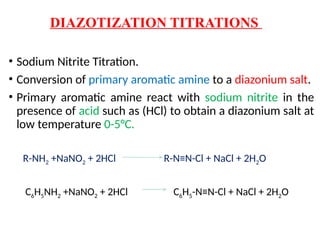
• SodiumNitrite Titration.
• Conversion of primary aromatic amine to a diazonium salt.
• Primary aromatic amine react with sodium nitrite in the
presence of acid such as (HCl) to obtain a diazonium salt at
low temperature 0-5°C.
R-NH2 +NaNO2 + 2HCl R-N≡N-Cl + NaCl + 2H2O
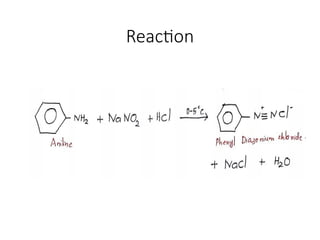
C6H5NH2 +NaNO2 + 2HCl C6H5-N≡N-Cl + NaCl + 2H2O
3.
Principle
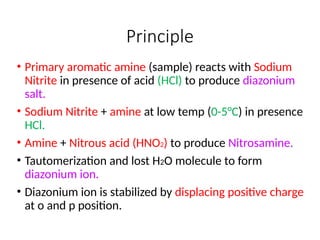
• Primary aromaticamine (sample) reacts with Sodium
Nitrite in presence of acid (HCl) to produce diazonium
salt.
• Sodium Nitrite + amine at low temp (0-5°C) in presence
HCl.
• Amine + Nitrous acid (HNO2) to produce Nitrosamine.
• Tautomerization and lost H2O molecule to form
diazonium ion.
• Diazonium ion is stabilized by displacing positive charge
at o and p position.
Theory
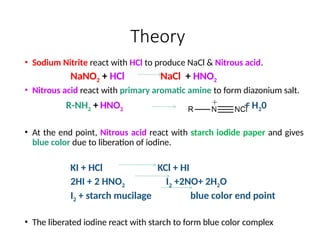
• Sodium Nitritereact with HCl to produce NaCl & Nitrous acid.
NaNO2 + HCl NaCl + HNO2
• Nitrous acid react with primary aromatic amine to form diazonium salt.
R-NH2 + HNO2 + H20
• At the end point, Nitrous acid react with starch iodide paper and gives
blue color due to liberation of iodine.
KI + HCl KCl + HI
2HI + 2 HNO2 I2 +2NO+ 2H2O
I2 + starch mucilage blue color end point
• The liberated iodine react with starch to form blue color complex
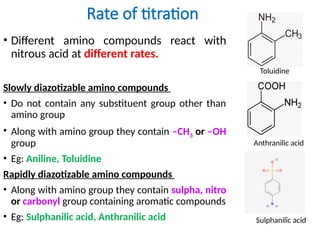
Rate of titration
•Different amino compounds react with
nitrous acid at different rates.
Slowly diazotizable amino compounds
• Do not contain any substituent group other than
amino group
• Along with amino group they contain –CH3 or –OH
group
• Eg: Aniline, Toluidine
Rapidly diazotizable amino compounds
• Along with amino group they contain sulpha, nitro
or carbonyl group containing aromatic compounds
• Eg: Sulphanilic acid, Anthranilic acid
Toluidine
Anthranilic acid
Sulphanilic acid
8.
Temperature
• 0-5°C
• Notstable at high temperature.
• Diazonium salts are readily decomposable at
elevated temperature
9.
End point Detection
•Visual end point determination method
• Electrometric end point determination method
• Colorimetric end point determination method
10.
Visual end pointdetermination method
• When aromatic primary amines react with sodium
nitrite in acid solution at low temperature (0-5°C),
diazonium salts are formed.
• Under controlled condition reaction is quantitative.
• Observation of end point depends upon the detection
of small amount of nitrous acid which is present in
excess.
• Starch iodide as external indicator
• After diazotization, one drop of resulting solution is
placed on the starch iodide paper which changes into
dark color
11.
Electrometric end point
determinationmethod
• Immersing the platinum electrodes in the solution
• Dead stop end point method
• Electrode polarization occurs when a small voltage of
30-50 mV is applied across the electrode
• Liberation of excess of nitrous acid at the end point
depolarizes the electrode
• Current flows in the galvanometer and permanent
deflection of galvanometer needle is observed
12.
• Cleaning ofelectrode is necessary
• Cleaning is done by immersing the electrode in
boiling nitric acid containing a little ferric chloride for
about 30 seconds and then washing in water
13.
Colorimetric end pointdetermination
method
• Primary amine is diazotised followed by coupling with
second component to give strong coloured diazo
compound
• N-(1-napthyl) ethylenediamine (Brathon- Marshal
reagent)
• The absorbance of the solution is then measured
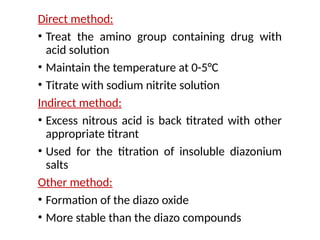
Direct method:
• Treatthe amino group containing drug with
acid solution
• Maintain the temperature at 0-5°C
• Titrate with sodium nitrite solution
Indirect method:
• Excess nitrous acid is back titrated with other
appropriate titrant
• Used for the titration of insoluble diazonium
salts
Other method:
• Formation of the diazo oxide
• More stable than the diazo compounds
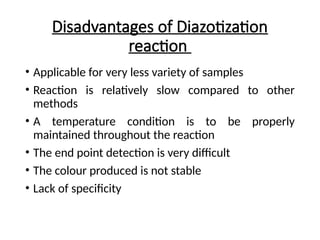
Disadvantages of Diazotization
reaction
•Applicable for very less variety of samples
• Reaction is relatively slow compared to other
methods
• A temperature condition is to be properly
maintained throughout the reaction
• The end point detection is very difficult
• The colour produced is not stable
• Lack of specificity
18.
Applications of Diazotizationreaction
• Used in the determination of dyes
• Preparation of pure amino acids and industrial azo dyes
• Convenient, one step process for the preparation of
aromatic and heterocyclic iodides with high yields
• Diazotization reactions are used in the preparation of
various compounds
P-amino benzoic acid
Dopamine
Procaine
Benzocaine
Amphetamine
ephedrine
Sulphapyridine
Sulphadiazine
sulphamethizole