REDOX TITRATION
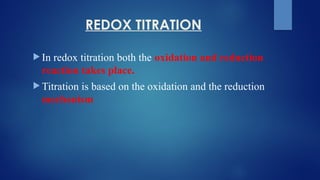
Inredox titration both the oxidation and reduction
reaction takes place.
Titration is based on the oxidation and the reduction
mechanism
3.
OXIDATION
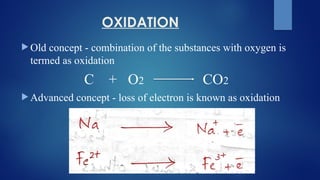
Old concept- combination of the substances with oxygen is
termed as oxidation
C + O2 CO2
Advanced concept - loss of electron is known as oxidation
4.
REDUCTION
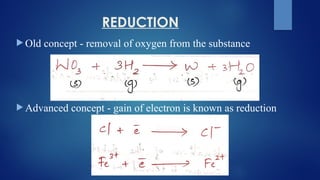
Old concept- removal of oxygen from the substance
Advanced concept - gain of electron is known as reduction
5.
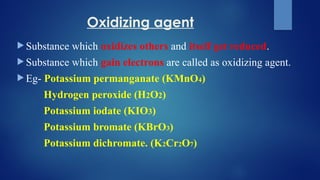
Oxidizing agent
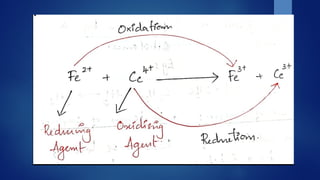
Substancewhich oxidizes others and itself get reduced.
Substance which gain electrons are called as oxidizing agent.
Eg- Potassium permanganate (KMnO4)
Hydrogen peroxide (H2O2)
Potassium iodate (KIO3)
Potassium bromate (KBrO3)
Potassium dichromate. (K2Cr2O7)
6.
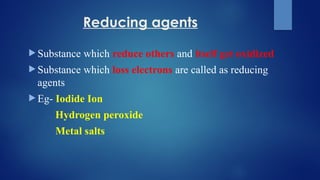
Reducing agents
Substancewhich reduce others and itself get oxidized
Substance which loss electrons are called as reducing
agents
Eg- Iodide Ion
Hydrogen peroxide
Metal salts
8.
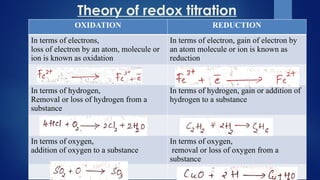
Theory of redoxtitration
OXIDATION REDUCTION
In terms of electrons,
loss of electron by an atom, molecule or
ion is known as oxidation
In terms of electron, gain of electron by
an atom molecule or ion is known as
reduction
In terms of hydrogen,
Removal or loss of hydrogen from a
substance
In terms of hydrogen, gain or addition of
hydrogen to a substance
In terms of oxygen,
addition of oxygen to a substance
In terms of oxygen,
removal or loss of oxygen from a
substance
9.
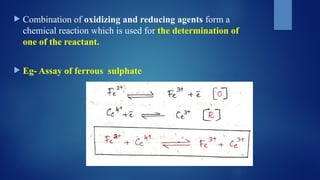
Combination ofoxidizing and reducing agents form a
chemical reaction which is used for the determination of
one of the reactant.
Eg- Assay of ferrous sulphate
Nernst Equation
Thepotential E (half cell potential) of any electron is given by equation
where;
E= electrode potential of half cell
Eo= standard electrode potential
R= universal gas constant
T= temperature
F= Faradey's constant
n =number of electron transferred into the half reaction
[oxidation] = concentration of oxidized species
[reduction] = concentration of reduced species
12.
By combiningnumerical constants [R, T, F] and
converting to logarithm
13.
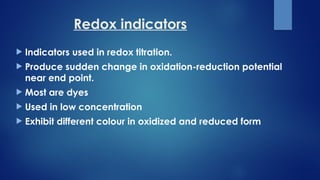
Redox indicators
Indicatorsused in redox titration.
Produce sudden change in oxidation-reduction potential
near end point.
Most are dyes
Used in low concentration
Exhibit different colour in oxidized and reduced form
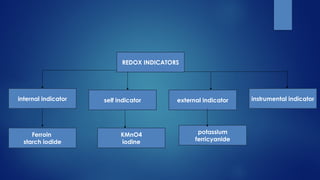
Internal indicator
Compoundswhich have characteristic colour in
oxidized and reduced state
[O] & [R] is reversible
Eg- ferroin sulphate – used in cerimetry
16.
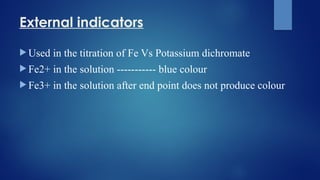
External indicators
Usedin the titration of Fe Vs Potassium dichromate
Fe2+ in the solution ----------- blue colour
Fe3+ in the solution after end point does not produce colour
17.
Self indicator
Titrantitself acts as indicator
Colorant titrant-------------------sharp colour change
Eg- KMnO4, PURPLE COLOUR OF MnO4- ions
disappears on reduction.
KMnO4 solution is coloured.
Reduced form is colourless
After the end point, single drop will produce pink colour.
R
-
18.
TYPES OF REDOXTITRATION
CERIMETRY
IODIMETRY
IODOMETRY
BROMATOMETRY
DICHROMETRY
TITRATION WITH POTASSIUM IODATE
CERIMETRY/CERIOMETRIC TITRATION
PRINCIPLE
Cericammonium sulphate acts as oxidizing agent.
It can exist in +4 and +3 oxidation state
Cerium atom in +4 oxidation state acts as better oxidant than +3
oxidation state
Intense yellow colored solution is formed
It is a self indicator
Ceric ammonium sulphate is a powerful oxidant reduce yellow colored
Ce4+ ions into Ce3+ ion.
21.
PRINCIPLE
Ceric ammoniumsulphate acts as self indicator only in strong
solutions
In dilute solution, additional indicator is added.
Ce4+ + e Ce3+
It cannot be used as an oxidizing agent in either basic/neutral
solution due to precipitation of ceric hydroxide
Ceric ammonium solution act as oxidant in only acidic solution
It is a better oxidizing agent.
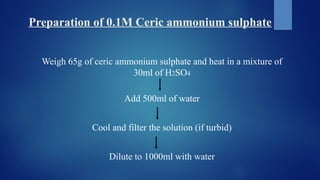
Preparation of 0.1MCeric ammonium sulphate
Weigh 65g of ceric ammonium sulphate and heat in a mixture of
30ml of H2SO4
Add 500ml of water
Cool and filter the solution (if turbid)
Dilute to 1000ml with water
25.
Standardization of 0.1MCeric ammonium sulphate
Weigh 3.92g of ferrous ammonium sulphate
Dissolve in a mixture of 4ml of 1M H2SO4
Add 20ml of water and makeup to 100ml with water in a standard flask
Pipette out 10ml solution from it
Add 2 drops of ferroin indicator
Titrate the contents in flask with 0.1 M ceric ammonium sulphate
Endpoint [ORANGE-----------GREEN]
26.
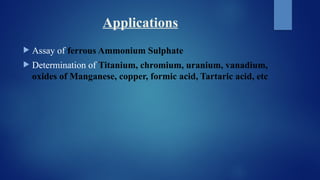
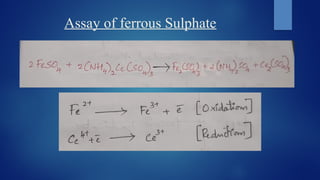
Assay of ferroussulphate
Weigh 0.5g ferrous sulphate
Dissolve in a mixture of 30ml of water and 20ml of 1M
H2SO4
Titrate with 0.1M ceric ammonium sulphate using ferroin
as indicator
Endpoint [orange--------green]
27.
IODINE TITRATIONS
Titrationthat involves iodine.
Iodine acts as mild or weak oxidizing agent
2 TYPES:-
IODIMETRY
IODOMETRY
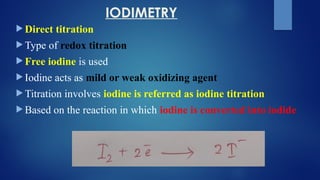
IODIMETRY
Direct titration
Type of redox titration
Free iodine is used
Iodine acts as mild or weak oxidizing agent
Titration involves iodine is referred as iodine titration
Based on the reaction in which iodine is converted into iodide
30.
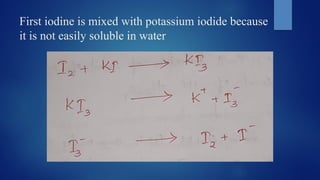
First iodine ismixed with potassium iodide because
it is not easily soluble in water
31.
Starch solutionis used as indicator
Iodine will react with starch
It forms IODINE-STARCH COMPLEX
32.
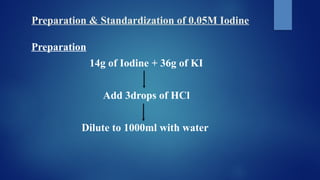
Preparation & Standardizationof 0.05M Iodine
Preparation
14g of Iodine + 36g of KI
Add 3drops of HCl
Dilute to 1000ml with water
33.
Standardization
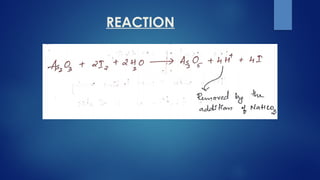
0.15g of Arsenictrioxide [As2O3]
Add 2ml of NaOH Solution
Add 40ml water & dil. HCl
2g of NaHCO3 [Sodium bicarbonate]
Dilute with 50ml of water & add 3ml starch solution until
permanent blue color is produced
IODOMETRY
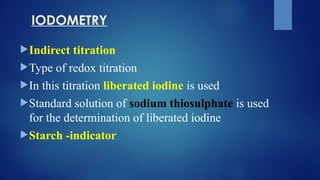
Indirect titration
Type ofredox titration
In this titration liberated iodine is used
Standard solution of sodium thiosulphate is used
for the determination of liberated iodine
Starch -indicator
40.
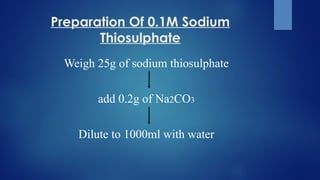
Preparation Of 0.1MSodium
Thiosulphate
Weigh 25g of sodium thiosulphate
add 0.2g of Na2CO3
Dilute to 1000ml with water
41.
Standardization of sodiumthiosulphate
Weigh 0.2g KBr
Makeup to 250ml with water
Pipette out 25ml from it
Add 1g KI and 1.5ml 2M HCl
Titrate with sodium thiosulphate
Indicator---starch [endpoint- blue to colorless]
42.
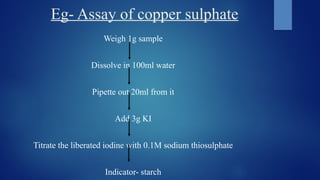
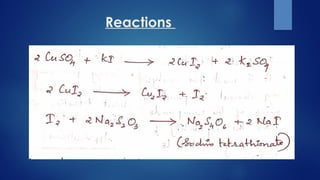
Eg- Assay ofcopper sulphate
Weigh 1g sample
Dissolve in 100ml water
Pipette out 20ml from it
Add 3g KI
Titrate the liberated iodine with 0.1M sodium thiosulphate
Indicator- starch
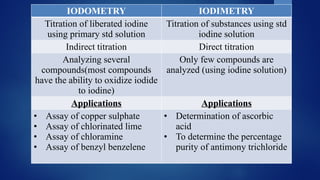
IODOMETRY IODIMETRY
Titration ofliberated iodine
using primary std solution
Titration of substances using std
iodine solution
Indirect titration Direct titration
Analyzing several
compounds(most compounds
have the ability to oxidize iodide
to iodine)
Only few compounds are
analyzed (using iodine solution)
Applications Applications
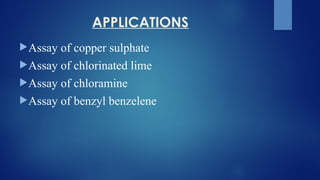
• Assay of copper sulphate
• Assay of chlorinated lime
• Assay of chloramine
• Assay of benzyl benzelene
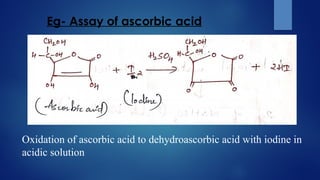
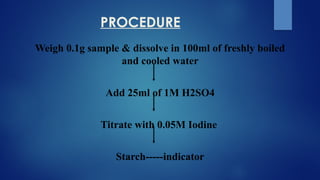
• Determination of ascorbic
acid
• To determine the percentage
purity of antimony trichloride


![Nernst Equation
The potential E (half cell potential) of any electron is given by equation
where;
E= electrode potential of half cell
Eo= standard electrode potential
R= universal gas constant
T= temperature
F= Faradey's constant
n =number of electron transferred into the half reaction
[oxidation] = concentration of oxidized species
[reduction] = concentration of reduced species](https://image.slidesharecdn.com/redoxtitration-250416164159-69350516/85/REDOX-TITRATION-pharmaceutical-analysis-11-320.jpg)
![ By combining numerical constants [R, T, F] and
converting to logarithm](https://image.slidesharecdn.com/redoxtitration-250416164159-69350516/85/REDOX-TITRATION-pharmaceutical-analysis-12-320.jpg)
![Internal indicator
Compounds which have characteristic colour in
oxidized and reduced state
[O] & [R] is reversible
Eg- ferroin sulphate – used in cerimetry](https://image.slidesharecdn.com/redoxtitration-250416164159-69350516/85/REDOX-TITRATION-pharmaceutical-analysis-15-320.jpg)
![Standardization of 0.1M Ceric ammonium sulphate
Weigh 3.92g of ferrous ammonium sulphate
Dissolve in a mixture of 4ml of 1M H2SO4
Add 20ml of water and makeup to 100ml with water in a standard flask
Pipette out 10ml solution from it
Add 2 drops of ferroin indicator
Titrate the contents in flask with 0.1 M ceric ammonium sulphate
Endpoint [ORANGE-----------GREEN]](https://image.slidesharecdn.com/redoxtitration-250416164159-69350516/85/REDOX-TITRATION-pharmaceutical-analysis-25-320.jpg)
![Assay of ferrous sulphate
Weigh 0.5g ferrous sulphate
Dissolve in a mixture of 30ml of water and 20ml of 1M
H2SO4
Titrate with 0.1M ceric ammonium sulphate using ferroin
as indicator
Endpoint [orange--------green]](https://image.slidesharecdn.com/redoxtitration-250416164159-69350516/85/REDOX-TITRATION-pharmaceutical-analysis-26-320.jpg)

![Standardization
0.15g of Arsenic trioxide [As2O3]
Add 2ml of NaOH Solution
Add 40ml water & dil. HCl
2g of NaHCO3 [Sodium bicarbonate]
Dilute with 50ml of water & add 3ml starch solution until
permanent blue color is produced](https://image.slidesharecdn.com/redoxtitration-250416164159-69350516/85/REDOX-TITRATION-pharmaceutical-analysis-33-320.jpg)

![Standardization of sodium thiosulphate
Weigh 0.2g KBr
Makeup to 250ml with water
Pipette out 25ml from it
Add 1g KI and 1.5ml 2M HCl
Titrate with sodium thiosulphate
Indicator---starch [endpoint- blue to colorless]](https://image.slidesharecdn.com/redoxtitration-250416164159-69350516/85/REDOX-TITRATION-pharmaceutical-analysis-41-320.jpg)


![Pharmaceutical Analysis [Autosaved].pptx](https://cdn.slidesharecdn.com/ss_thumbnails/pharmaceuticalanalysisautosaved-230207090543-99729ff1-thumbnail.jpg?width=640&height=640&fit=bounds)


