Mrs. Poonam Sunil Aher discusses different analytical techniques including quantitative methods like solubility, melting point, and boiling point as well as qualitative methods like color, odor, and identification tests. She focuses on titrimetric techniques like acid-base titration using indicators, redox titration, iodimetry titration using starch, and precipitation titration. She also covers gravimetric analysis techniques like volatilization and precipitation, and discusses aqueous versus non-aqueous titration.
Different Techniques of
analysis
Mrs.PoonamSunil Aher (M.Pharm, PhD)
Assistant Professor
Sanjivani College of Pharmaceutical Education and Research
(Autonomous),
Kopargaon, Ahmednagar-423603 (M.S.), INDIA
Mobile: +91-9689942854
• 1. TitrimetricTechniques of Analysis:
• Titration which is also known as titrimetry is a chemical qualitative analysis
technique that is used to calculate the concentration of a given analyte in a
mixture. Titration is an important technique in the field of analytical chemistry
and is sometimes referred to as volumetric analysis also.
6.
• Types ofTitration:
• Acid-Base Titration
• Redox Titration
• Iodimetry Titration
• Iodometry Titration
• Gravimetric Analysis
• Aqueous and Non Aqueous type of titration
• Precipitation Titration
7.
Difference Between Titrantand Titrate
• The titrate is the analyte of interest whose identity is known, but
its concentration is not.
• The titrant is the reagent whose identity and concentration are
both known and is added incrementally to the titrate to
determine its concentration.
• Titrate or Titrand: Unknown concentration and it is present in
conical flask
• Titrant: Known concentration and it is present in Burette
8.
Acid Base Titration
•An acid–base titration is a method of quantitative analysis for determining
the concentration of an acid or base by exactly neutralizing it with
a standard solution of base or acid having known concentration. A pH
indicator is used to monitor the progress of the acid–base reaction. If
the acid dissociation constant (pKa) of the acid or base dissociation constant
(pKb) of base in the analyte solution is known, its solution concentration
(molarity) can be determined. Alternately, the pKa can be determined if the
analyte solution has a known solution concentration by constructing
a titration curve.
9.
Indicator choice
• Asuitable pH indicator must be chosen in order to detect the end point of the titration. The colour
change or other effect should occur close to the equivalence point of the reaction so that the
experimenter can accurately determine when that point is reached. The pH of the equivalence point
can be estimated using the following rules:
• A strong acid will react with a strong base to form a neutral (pH = 7) solution.
• A strong acid will react with a weak base to form an acidic (pH < 7) solution.
• A weak acid will react with a strong base to form a basic (pH > 7) solution.
• When a weak acid reacts with a weak base, the equivalence point solution will be basic if the base
is stronger and acidic if the acid is stronger. If both are of equal strength, then the equivalence pH
will be neutral. However, weak acids are not often titrated against weak bases because the colour
change shown with the indicator is often quick, and therefore very difficult for the observer to see
the change of colour.
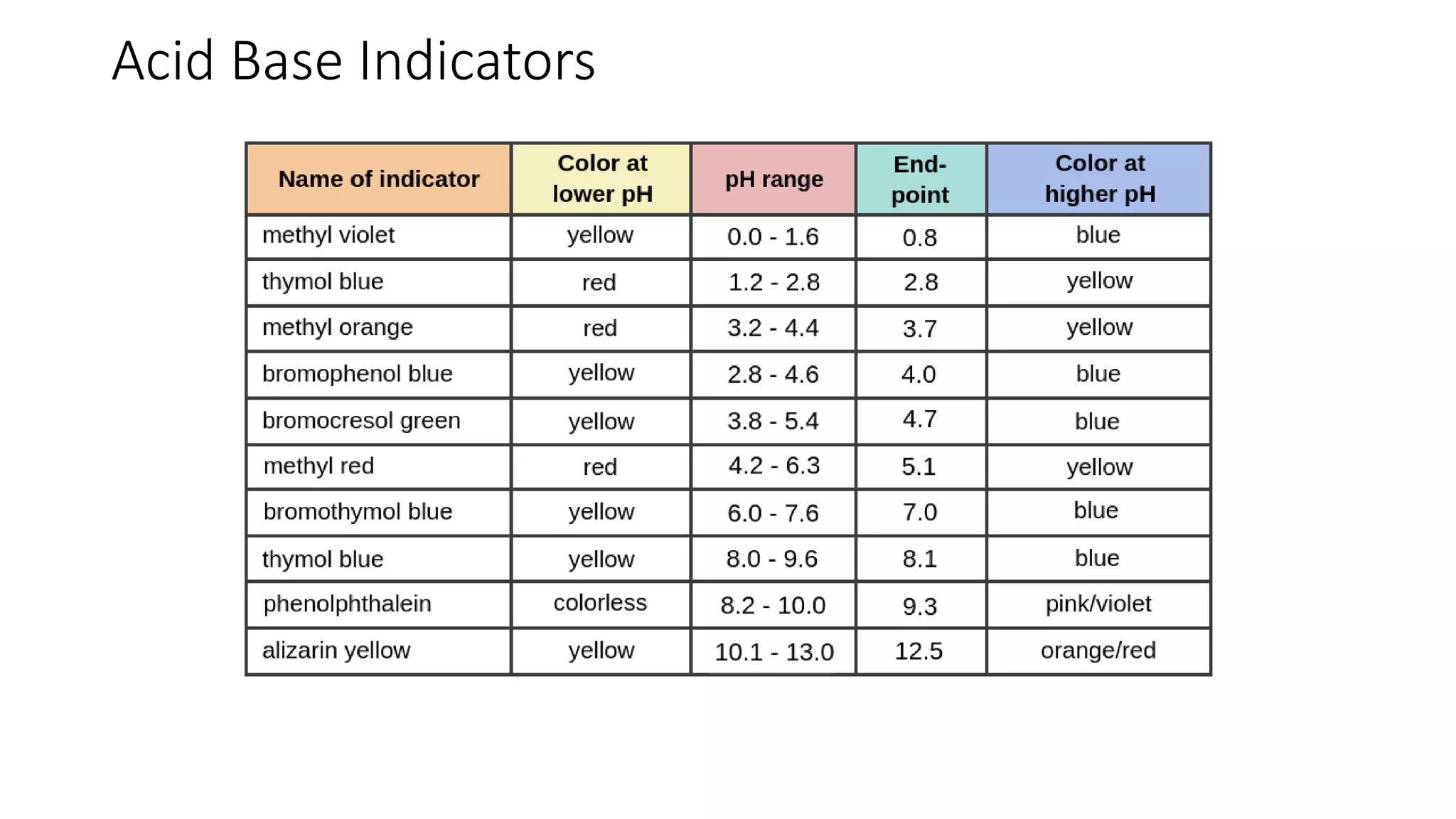
• The point at which the indicator changes colour is called the end point. A suitable indicator should
be chosen, preferably one that will experience a change in colour (an end point) close to the
equivalence point of the reaction
Example of AcidBase Titration
• 1. Standardization of NaOH with Oxalic Acid
• Oxalic acid-0.1 M solution
• Indicator- Phenolphthalein
• End Point- Colorless to pink
• 2. Standardization of 0.1 M HCl
• HCl: 0.1.M
• Indicator: Methyl Red
• End Point: Colorless to pink
12.
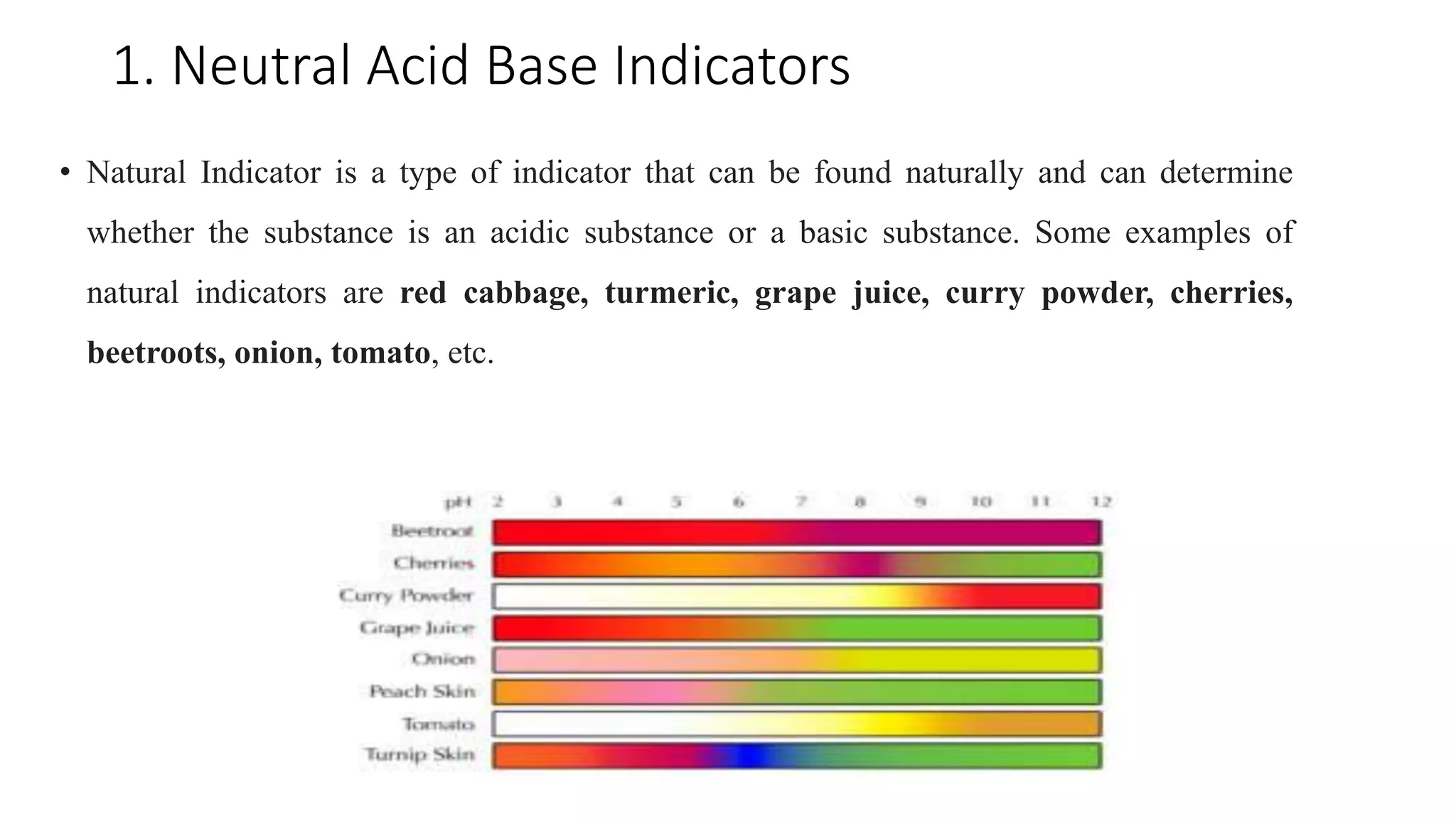
1. Neutral AcidBase Indicators
• Natural Indicator is a type of indicator that can be found naturally and can determine
whether the substance is an acidic substance or a basic substance. Some examples of
natural indicators are red cabbage, turmeric, grape juice, curry powder, cherries,
beetroots, onion, tomato, etc.
13.
Redox titration
• Redoxtitration is based on an oxidation-reduction reaction between the titrant
and the analyte. It is one of the most common laboratory methods to identify
the concentration of unknown analytes.
• In order to evaluate redox titrations, the shape of the corresponding titration
curve must be obtained. In these types of titration, it proves convenient to
monitor the reaction potential instead of monitoring the concentration of a
reacting species.
14.
• Reduction
• Asubstance can undergo reduction can occur via:
• The addition of hydrogen.
• The removal of oxygen.
• The acceptance of electrons.
• A reduction in the overall oxidation state.
• Oxidation
• The following points describe a substance that has undergone oxidation.
• The addition of oxygen.
• Removal of hydrogen which was attached to the species.
• The donation/loss of electrons.
• An increase in the oxidation state exhibited by the substance.
• Thus, it can be understood that redox titrations involve a transfer of electrons between the
given analyte and the titrant. An example of redox titration is the treatment of an iodine
solution with a reducing agent. The endpoint of this titration is detected with the help of a
starch indicator.
15.
Iodometry Titration
• Redoxtitration using sodium thiosulphate, Na2S2O3 (usually) as a reducing agent
is known as iodometric titration since it is used specifically to titrate iodine. The
iodometric titration is a general method to determine the concentration of an
oxidising agent in solution. In an iodometric titration, a starch solution is used as
an indicator since it can absorb the I2 that is released. This absorption will cause
the solution to change its color from deep blue to light yellow when titrated with
standardized thiosulfate solution. This indicates the end point of the titration.
Iodometry is commonly used to analyze the concentration of oxidizing agents in
water samples, such as oxygen saturation in ecological studies or active
chlorine in swimming pool water analysis.
16.
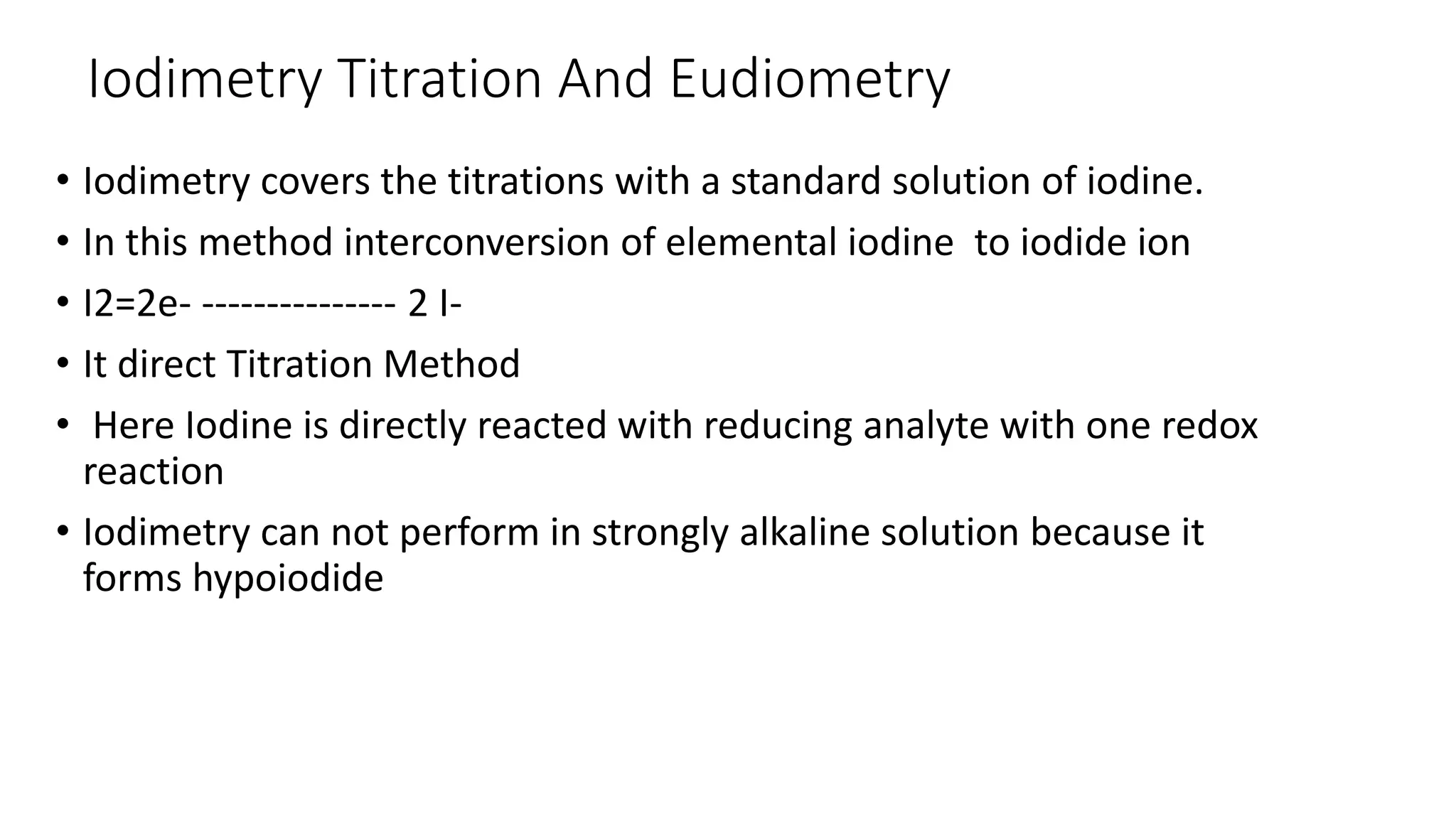
Iodimetry Titration AndEudiometry
• Iodimetry covers the titrations with a standard solution of iodine.
• In this method interconversion of elemental iodine to iodide ion
• I2=2e- --------------- 2 I-
• It direct Titration Method
• Here Iodine is directly reacted with reducing analyte with one redox
reaction
• Iodimetry can not perform in strongly alkaline solution because it
forms hypoiodide
17.
Gravimetric Analysis
• Gravimetricanalysis is a method in analytical chemistry to determine
the quantity of an analyte based on the mass of a solid. Example:
Measuring the solids suspended in the water sample – Once a known
volume of water is filtered, the collected solids are weighed.
• The principle of Gravimetric Analysis:
• The principle behind the gravimetric analysis is that the mass of an ion
in a pure compound and can be determined. Later, used to find the
mass percent of the same ion in a known quantity of an impure
compound.
18.
• Steps followedin the Gravimetric Analysis
1. Preparation of a solution containing a known weight of the sample.
2. Separation of the desired constituent.
3. Weighing the isolated constituent.
4. Computation of the amount of the particular constituent in the sample from the observed weight of the
isolated substance.
• Types of Gravimetric Analysis
• There are 4 fundamental types of gravimetric analysis. Of which, there are 2 common types involving
changes in the phase of the analyte to separate it from the rest of a mixture, resulting in a change in mass.
• Volatilisation gravimetry
• Volatilisation Gravimetry involves separating components of our mixture by heating or chemically
decomposing the sample.
• Precipitation gravimetry
• Precipitation Gravimetry uses a precipitation reaction to separate one or more parts of a solution by
incorporating it into a solid.
• Electrogravimetry
• Electrogravimetry is a method used to separate and quantify ions of a substance, usually a metal.
• Thermogravimetry
• Thermogravimetry is a method of thermal analysis in which changes in physical and chemical properties of
materials are measured as a function of increasing temperature or as a function of time.
19.
• Advantages ofGravimetric Analysis
• If the methods are followed carefully, it provides exceedingly precise analysis.
It is used to determine the atomic masses of many elements to six-figure
accuracy. It provides little room for instrumental error and does not require a
series of standards for calculation of an unknown.
• Disadvantages of Gravimetric Analysis
• It usually provides only for the analysis of a single element, or a limited group
of elements, at a time. Comparing modern dynamic flash combustion coupled
with gas chromatography with traditional combustion analysis.
20.
Aqueous titration
• Thisis also called neutralization type of titration.
• Here strong acid or base react with strong base or acid.
Simultaneously weak acid or base react with weak base or acid.
• Neutralization Indicators are used.
• In case of weak acid and strong base titration Indicators used in
alkaline range.
• Examples are: Thymol blue, Phelphthalein, Thymolphthalein
• In case of weak base and strong acid titration Indicators used in acidic
range.
• Examples are: Methyl orange, Methyl red, Bromocresol Green
21.
Non Aqueous Titration
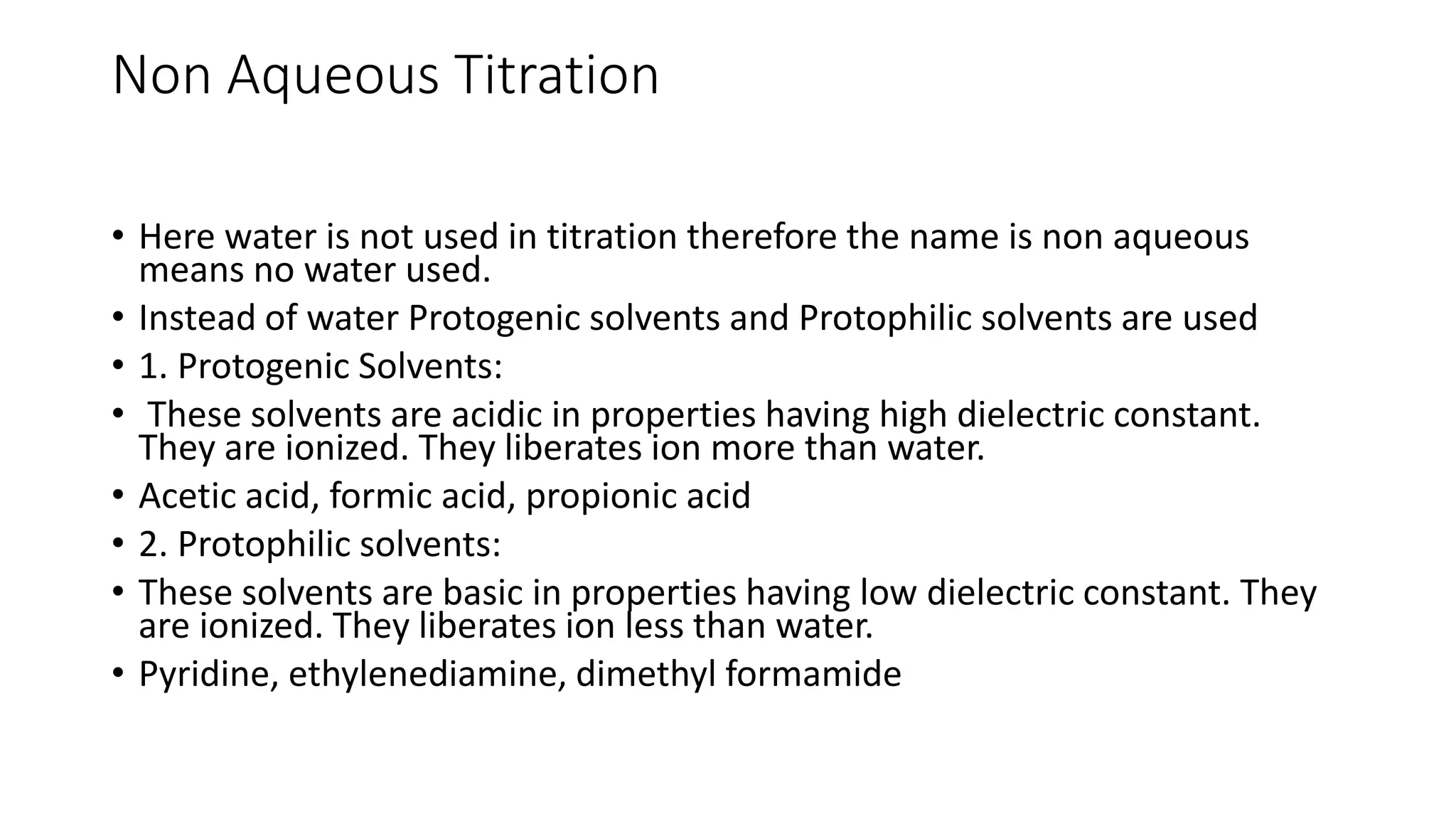
•Here water is not used in titration therefore the name is non aqueous
means no water used.
• Instead of water Protogenic solvents and Protophilic solvents are used
• 1. Protogenic Solvents:
• These solvents are acidic in properties having high dielectric constant.
They are ionized. They liberates ion more than water.
• Acetic acid, formic acid, propionic acid
• 2. Protophilic solvents:
• These solvents are basic in properties having low dielectric constant. They
are ionized. They liberates ion less than water.
• Pyridine, ethylenediamine, dimethyl formamide
22.
Precipitation Titration
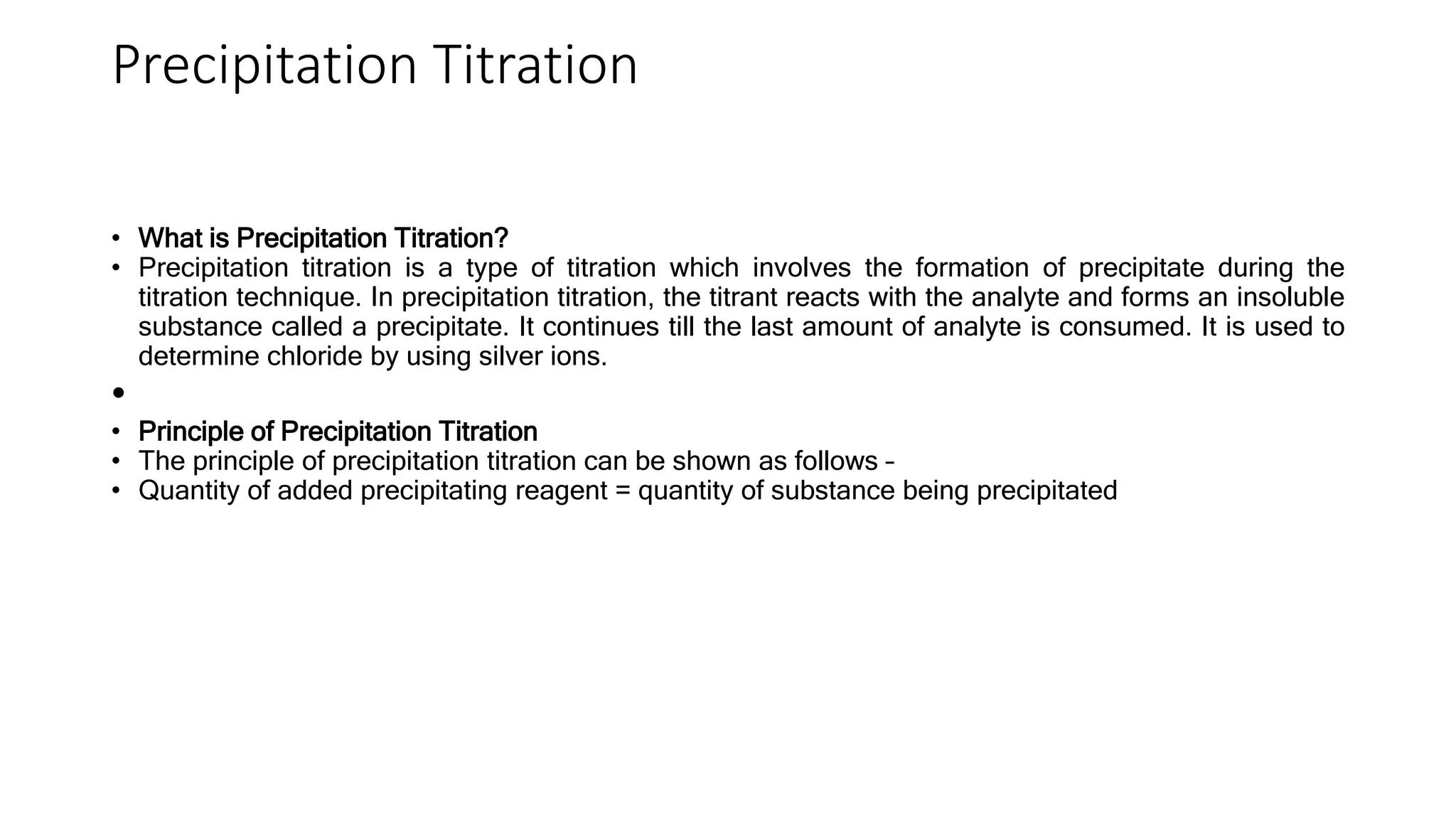
• Whatis Precipitation Titration?
• Precipitation titration is a type of titration which involves the formation of precipitate during the
titration technique. In precipitation titration, the titrant reacts with the analyte and forms an insoluble
substance called a precipitate. It continues till the last amount of analyte is consumed. It is used to
determine chloride by using silver ions.
•
• Principle of Precipitation Titration
• The principle of precipitation titration can be shown as follows –
• Quantity of added precipitating reagent = quantity of substance being precipitated
23.
• Precipitation TitrationExample
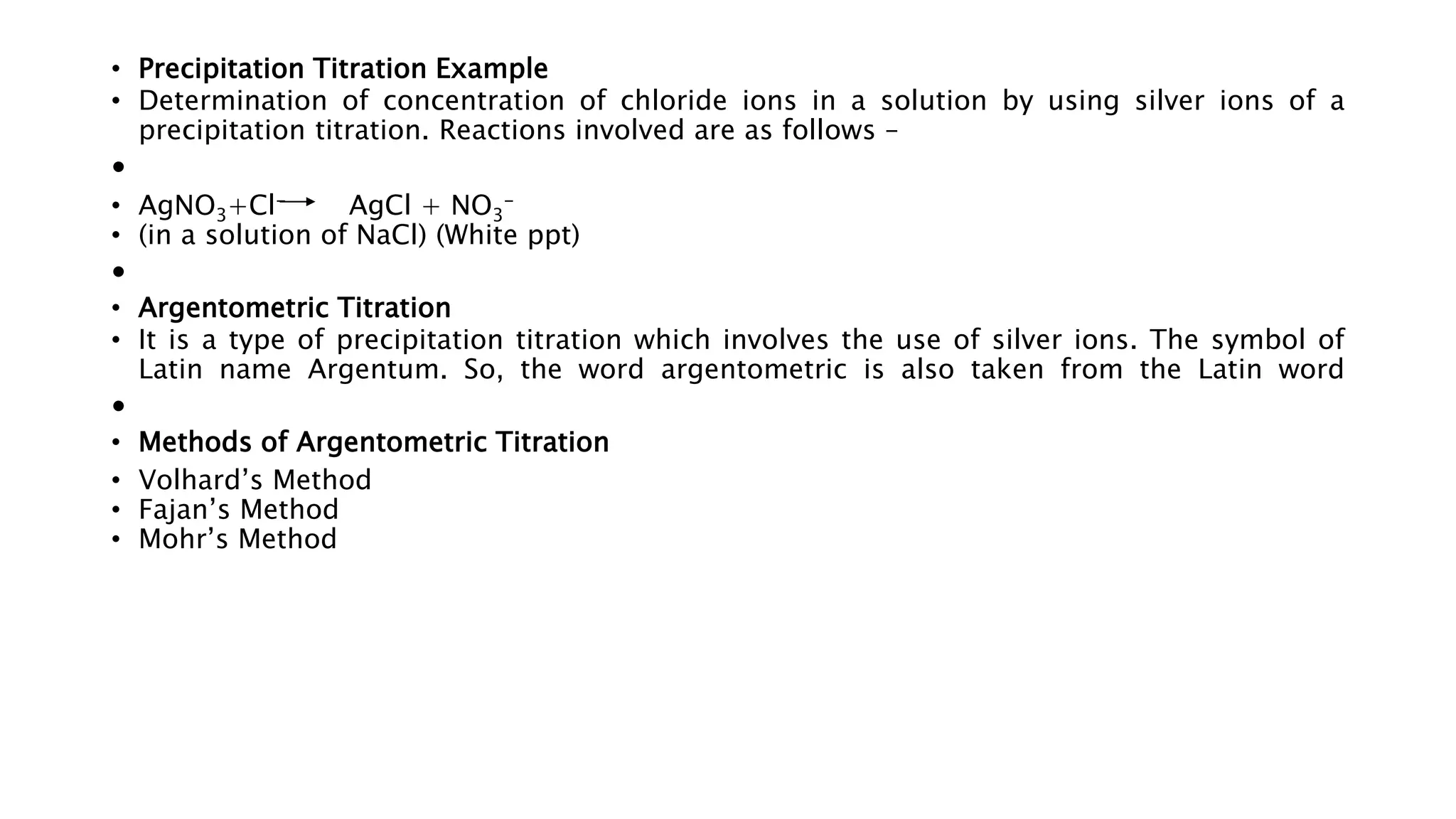
• Determination of concentration of chloride ions in a solution by using silver ions of a
precipitation titration. Reactions involved are as follows –
•
• AgNO3+Cl- AgCl + NO3
-
• (in a solution of NaCl) (White ppt)
•
• Argentometric Titration
• It is a type of precipitation titration which involves the use of silver ions. The symbol of
Latin name Argentum. So, the word argentometric is also taken from the Latin word
•
• Methods of Argentometric Titration
• Volhard’s Method
• Fajan’s Method
• Mohr’s Method
24.
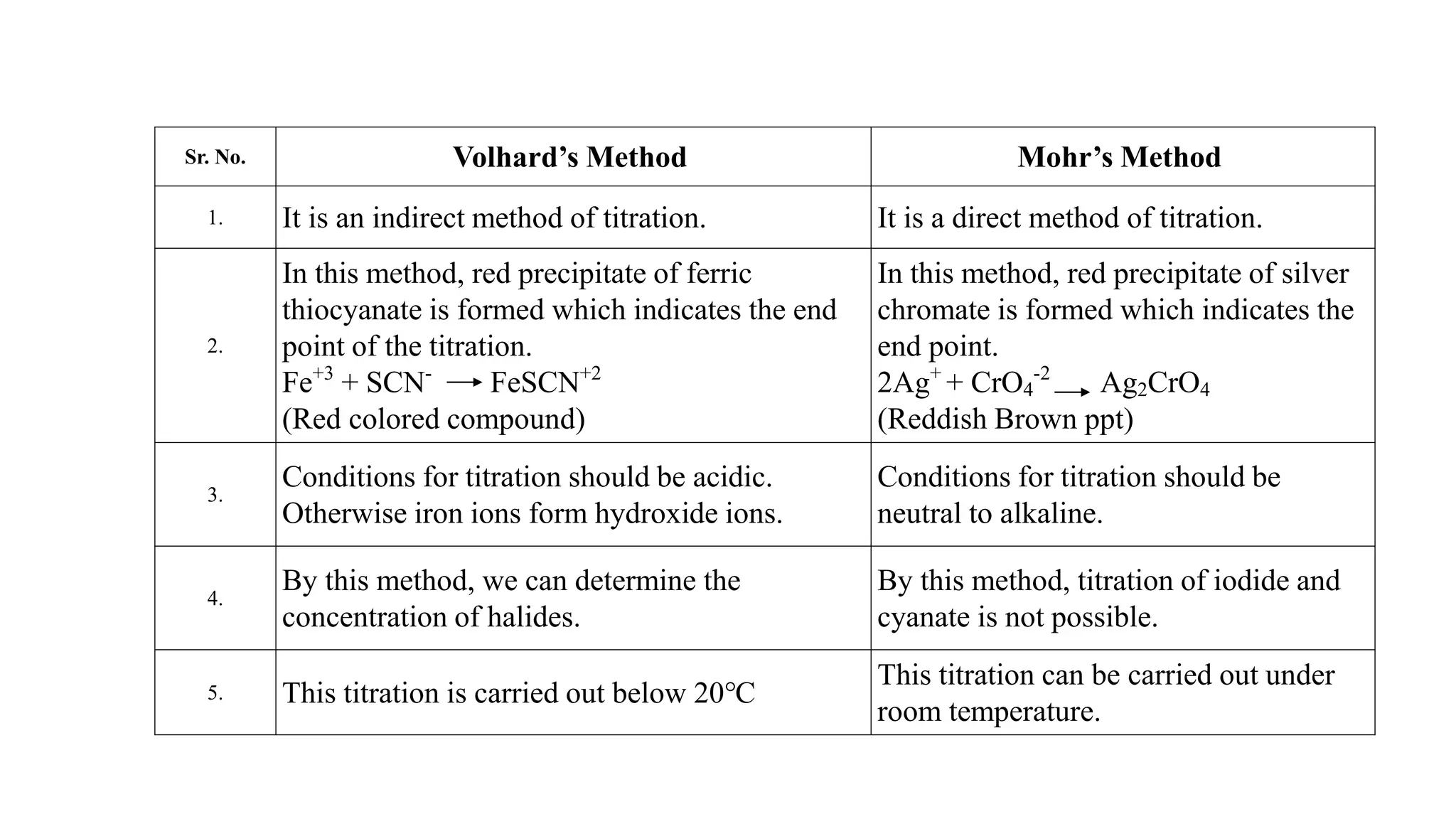
Sr. No. Volhard’sMethod Mohr’s Method
1. It is an indirect method of titration. It is a direct method of titration.
2.
In this method, red precipitate of ferric
thiocyanate is formed which indicates the end
point of the titration.
Fe+3
+ SCN-
FeSCN+2
(Red colored compound)
In this method, red precipitate of silver
chromate is formed which indicates the
end point.
2Ag+
+ CrO4
-2
Ag2CrO4
(Reddish Brown ppt)
3.
Conditions for titration should be acidic.
Otherwise iron ions form hydroxide ions.
Conditions for titration should be
neutral to alkaline.
4.
By this method, we can determine the
concentration of halides.
By this method, titration of iodide and
cyanate is not possible.
5. This titration is carried out below 20℃
This titration can be carried out under
room temperature.