Conduction system of
heart
Part1
DR.SRUTHI MEENAXSHI
PDF IN VMCRH
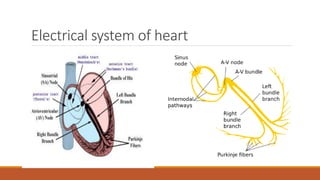
Electrical system of heart
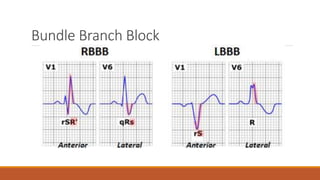
Bundle Branch Block
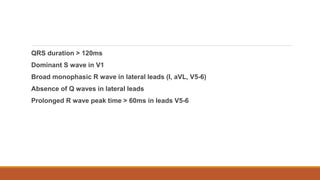
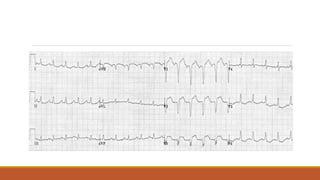
QRS duration > 120ms
Dominant S wave in V1
Broad monophasic R wave in lateral leads (I, aVL, V5-6)
Absence of Q waves in lateral leads
Prolonged R wave peak time > 60ms in leads V5-6
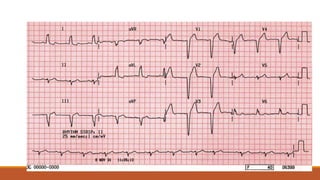
The heart rhythm must be supraventricular in origin
The QRS duration must be ≥ 120 ms[2]
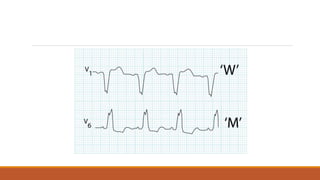
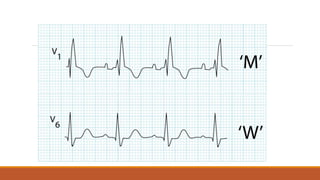
There should be a QS or rS complex in lead V1
There should be a notched ('M'-shaped) R wave in lead V6.
QRS duration > 120ms
Dominant S wave in V1
Broad monophasic R wave in lateral leads (I, aVL, V5-6)
Absence of Q waves in lateral leads
Prolonged R wave peak time > 60ms in leads V5-6
CAUSES
Aortic stenosis
Dilated cardiomyopathy
Acute myocardial infarction
Extensive coronary artery disease
Primary disease of the cardiac electrical conduction system
Long standing hypertension leading to aortic root dilatation and subsequent aortic regurgitation
Lyme disease
Side effect of some cardiac surgeries (e.g., aortic root reconstruction)
In LBBB, conduction delay means that impulses travel first via the right bundle branch to the RV,
and then to the LV via the septum
Septal activation is thus reversed eliminating lateral Q waves
The overall depolarisation vector from the right to left ventricle produces tall R waves in lateral
leads (I, V5-6) and deep S waves in the right precordial leads (V1-3). The delay between activation
of the RV and LV produces the characteristic “M-shaped” R wave seen in lateral leads
Delayed overall conduction time to the LV extends the QRS duration to > 120 ms
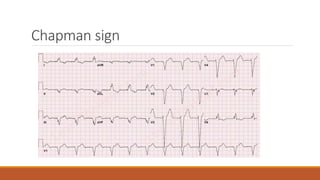
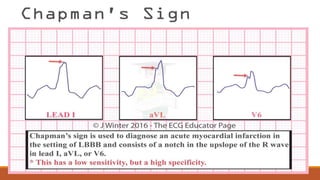
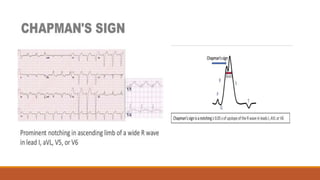
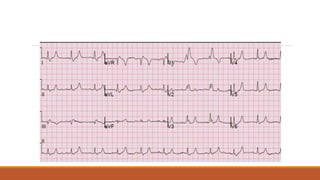
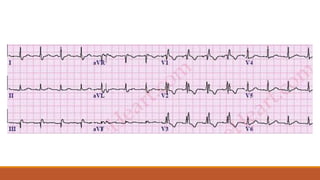
Chapman sign
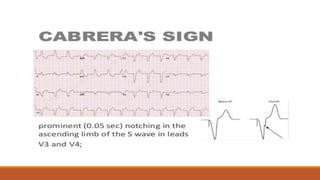
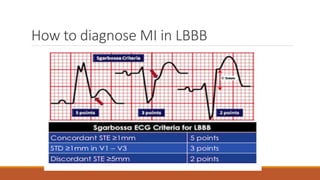
How to diagnose MI in LBBB
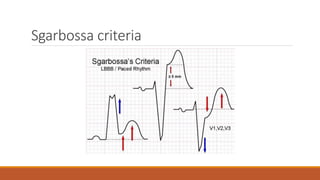
Sgarbossa criteria
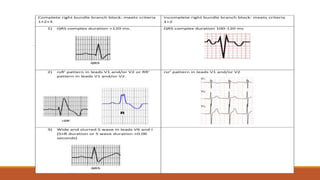
Diagnostic criteria
QRS duration > 120ms
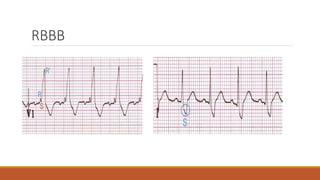
RSR’ pattern in V1-3 (“M-shaped” QRS complex)
Wide, slurred S wave in lateral leads (I, aVL, V5-6)
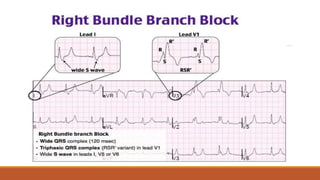
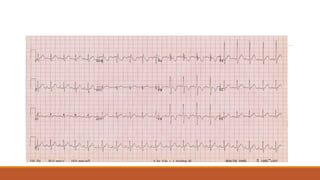
RBBB
causes
Right ventricular hypertrophy / cor pulmonale
Pulmonary embolus
Ischaemic heart disease
Rheumatic heart disease
Congenital heart disease (e.g. atrial septal defect)
Myocarditis
Cardiomyopathy
Lenègre-Lev disease: primary degenerative disease (fibrosis) of the conducting system
Thankyou

Conduction abnormalities

  • 1.
  • 2.
  • 3.
  • 4.
    QRS duration >120ms Dominant S wave in V1 Broad monophasic R wave in lateral leads (I, aVL, V5-6) Absence of Q waves in lateral leads Prolonged R wave peak time > 60ms in leads V5-6
  • 5.
    The heart rhythmmust be supraventricular in origin The QRS duration must be ≥ 120 ms[2] There should be a QS or rS complex in lead V1 There should be a notched ('M'-shaped) R wave in lead V6.
  • 7.
    QRS duration >120ms Dominant S wave in V1 Broad monophasic R wave in lateral leads (I, aVL, V5-6) Absence of Q waves in lateral leads Prolonged R wave peak time > 60ms in leads V5-6
  • 8.
    CAUSES Aortic stenosis Dilated cardiomyopathy Acutemyocardial infarction Extensive coronary artery disease Primary disease of the cardiac electrical conduction system Long standing hypertension leading to aortic root dilatation and subsequent aortic regurgitation Lyme disease Side effect of some cardiac surgeries (e.g., aortic root reconstruction)
  • 11.
    In LBBB, conductiondelay means that impulses travel first via the right bundle branch to the RV, and then to the LV via the septum Septal activation is thus reversed eliminating lateral Q waves The overall depolarisation vector from the right to left ventricle produces tall R waves in lateral leads (I, V5-6) and deep S waves in the right precordial leads (V1-3). The delay between activation of the RV and LV produces the characteristic “M-shaped” R wave seen in lateral leads Delayed overall conduction time to the LV extends the QRS duration to > 120 ms
  • 12.
  • 16.
    How to diagnoseMI in LBBB
  • 17.
  • 19.
    Diagnostic criteria QRS duration> 120ms RSR’ pattern in V1-3 (“M-shaped” QRS complex) Wide, slurred S wave in lateral leads (I, aVL, V5-6)
  • 21.
  • 26.
    causes Right ventricular hypertrophy/ cor pulmonale Pulmonary embolus Ischaemic heart disease Rheumatic heart disease Congenital heart disease (e.g. atrial septal defect) Myocarditis Cardiomyopathy Lenègre-Lev disease: primary degenerative disease (fibrosis) of the conducting system
  • 27.