


Zero, First and Second
Conditionals
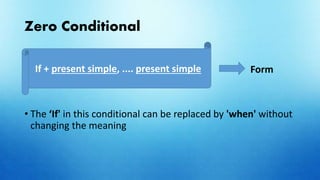
Zero Conditional
• Form
• The ‘If' in this conditional can be replaced by 'when' without
changing the meaning
If + present simple, .... present simple
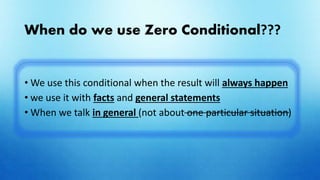
When do we use Zero Conditional???
• We use this conditional when the result will always happen
• we use it with facts and general statements
• When we talk in general (not about one particular situation)
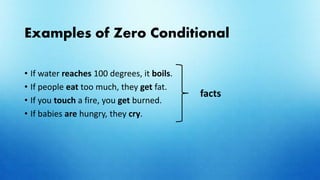
Examples of Zero Conditional
• If water reaches 100 degrees, it boils.
• If people eat too much, they get fat.
• If you touch a fire, you get burned.
• If babies are hungry, they cry.
facts
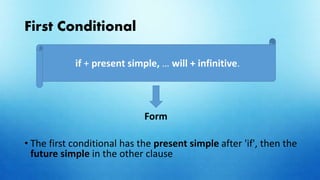
First Conditional
Form
• The first conditional has the present simple after 'if', then the
future simple in the other clause
if + present simple, … will + infinitive.
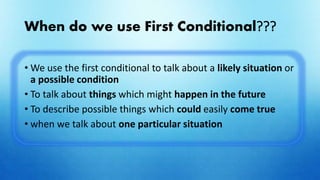
When do we use First Conditional???
• We use the first conditional to talk about a likely situation or
a possible condition
• To talk about things which might happen in the future
• To describe possible things which could easily come true
• when we talk about one particular situation
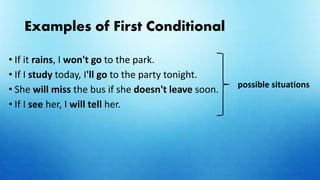
Examples of First Conditional
• If it rains, I won't go to the park.
• If I study today, I'll go to the party tonight.
• She will miss the bus if she doesn't leave soon.
• If I see her, I will tell her.
possible situations
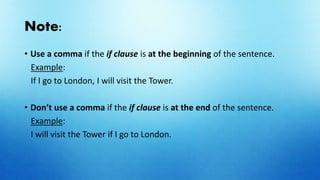
Note:
• Use a comma if the if clause is at the beginning of the sentence.
Example:
If I go to London, I will visit the Tower.
• Don’t use a comma if the if clause is at the end of the sentence.
Example:
I will visit the Tower if I go to London.
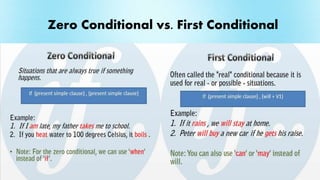
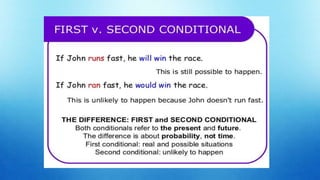
Zero Conditional vs. First Conditional
Second Conditional
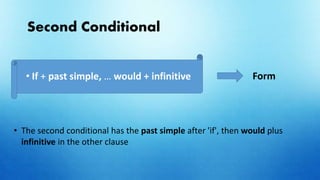
• If + past simple, … would + infinitive Form
• The second conditional has the past simple after 'if', then would plus
infinitive in the other clause
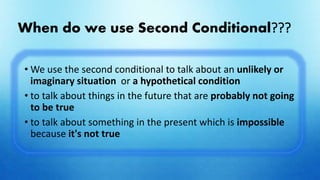
When do we use Second Conditional???
• We use the second conditional to talk about an unlikely or
imaginary situation or a hypothetical condition
• to talk about things in the future that are probably not going
to be true
• to talk about something in the present which is impossible
because it's not true
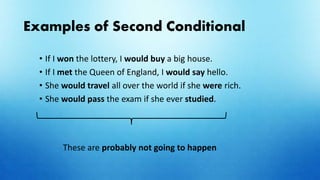
Examples of Second Conditional
• If I won the lottery, I would buy a big house.
• If I met the Queen of England, I would say hello.
• She would travel all over the world if she were rich.
• She would pass the exam if she ever studied.
These are probably not going to happen
Conditionals (revision)

Conditionals (revision)

  • 2.
    Zero, First andSecond Conditionals
  • 3.
    Zero Conditional • Form •The ‘If' in this conditional can be replaced by 'when' without changing the meaning If + present simple, .... present simple
  • 4.
    When do weuse Zero Conditional??? • We use this conditional when the result will always happen • we use it with facts and general statements • When we talk in general (not about one particular situation)
  • 5.
    Examples of ZeroConditional • If water reaches 100 degrees, it boils. • If people eat too much, they get fat. • If you touch a fire, you get burned. • If babies are hungry, they cry. facts
  • 6.
    First Conditional Form • Thefirst conditional has the present simple after 'if', then the future simple in the other clause if + present simple, … will + infinitive.
  • 7.
    When do weuse First Conditional??? • We use the first conditional to talk about a likely situation or a possible condition • To talk about things which might happen in the future • To describe possible things which could easily come true • when we talk about one particular situation
  • 8.
    Examples of FirstConditional • If it rains, I won't go to the park. • If I study today, I'll go to the party tonight. • She will miss the bus if she doesn't leave soon. • If I see her, I will tell her. possible situations
  • 9.
    Note: • Use acomma if the if clause is at the beginning of the sentence. Example: If I go to London, I will visit the Tower. • Don’t use a comma if the if clause is at the end of the sentence. Example: I will visit the Tower if I go to London.
  • 10.
    Zero Conditional vs.First Conditional
  • 11.
    Second Conditional • If+ past simple, … would + infinitive Form • The second conditional has the past simple after 'if', then would plus infinitive in the other clause
  • 12.
    When do weuse Second Conditional??? • We use the second conditional to talk about an unlikely or imaginary situation or a hypothetical condition • to talk about things in the future that are probably not going to be true • to talk about something in the present which is impossible because it's not true
  • 13.
    Examples of SecondConditional • If I won the lottery, I would buy a big house. • If I met the Queen of England, I would say hello. • She would travel all over the world if she were rich. • She would pass the exam if she ever studied. These are probably not going to happen