by Miss Stefanie Herzberg
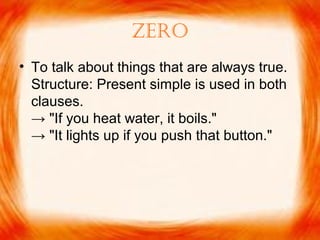
Zero
• To talk about things that are always true.
Structure: Present simple is used in both
clauses.
→ "If you heat water, it boils."
→ "It lights up if you push that button."
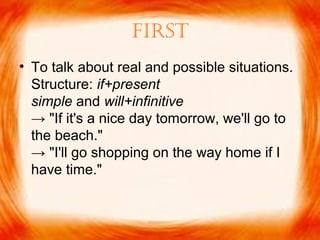
First
• To talk about real and possible situations.
Structure: if+present
simple and will+infinitive
→ "If it's a nice day tomorrow, we'll go to
the beach."
→ "I'll go shopping on the way home if I
have time."
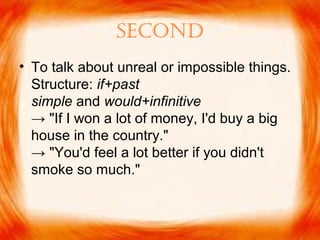
second
• To talk about unreal or impossible things.
Structure: if+past
simple and would+infinitive
→ "If I won a lot of money, I'd buy a big
house in the country."
→ "You'd feel a lot better if you didn't
smoke so much."
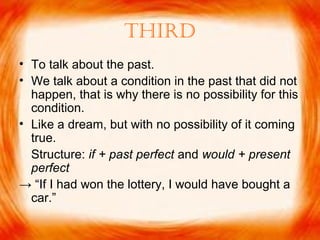
Third
• To talk about the past.
• We talk about a condition in the past that did not
happen, that is why there is no possibility for this
condition.
• Like a dream, but with no possibility of it coming
true.
Structure: if + past perfect and would + present
perfect
→ “If I had won the lottery, I would have bought a
car.”
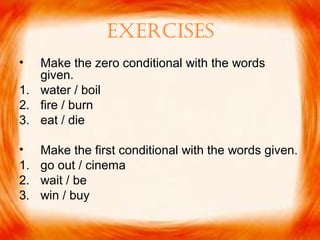
ExErcisEs
• Make the zero conditional with the words
given.
1. water / boil
2. fire / burn
3. eat / die
• Make the first conditional with the words given.
1. go out / cinema
2. wait / be
3. win / buy
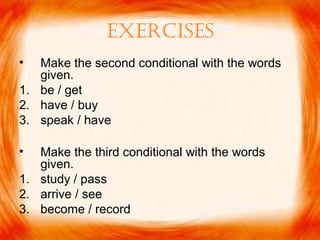
ExErcisEs
• Make the second conditional with the words
given.
1. be / get
2. have / buy
3. speak / have
• Make the third conditional with the words
given.
1. study / pass
2. arrive / see
3. become / record
rEfErEncEs
• British Council. (2013). Conditionals.
Retrieved from http://
learnenglish.britishcouncil.org/en/grammar
-reference/conditionals-1
• EnglishClub. (2013). Third Conditional: no
possibility. Retrieved from http://
www.englishclub.com/grammar/verbs-
conditional_4.htm

Conditionals: Zero, First, Second, Third

  • 1.
  • 2.
    Zero • To talkabout things that are always true. Structure: Present simple is used in both clauses. → "If you heat water, it boils." → "It lights up if you push that button."
  • 3.
    First • To talkabout real and possible situations. Structure: if+present simple and will+infinitive → "If it's a nice day tomorrow, we'll go to the beach." → "I'll go shopping on the way home if I have time."
  • 4.
    second • To talkabout unreal or impossible things. Structure: if+past simple and would+infinitive → "If I won a lot of money, I'd buy a big house in the country." → "You'd feel a lot better if you didn't smoke so much."
  • 5.
    Third • To talkabout the past. • We talk about a condition in the past that did not happen, that is why there is no possibility for this condition. • Like a dream, but with no possibility of it coming true. Structure: if + past perfect and would + present perfect → “If I had won the lottery, I would have bought a car.”
  • 6.
    ExErcisEs • Make thezero conditional with the words given. 1. water / boil 2. fire / burn 3. eat / die • Make the first conditional with the words given. 1. go out / cinema 2. wait / be 3. win / buy
  • 7.
    ExErcisEs • Make thesecond conditional with the words given. 1. be / get 2. have / buy 3. speak / have • Make the third conditional with the words given. 1. study / pass 2. arrive / see 3. become / record
  • 8.
    rEfErEncEs • British Council.(2013). Conditionals. Retrieved from http:// learnenglish.britishcouncil.org/en/grammar -reference/conditionals-1 • EnglishClub. (2013). Third Conditional: no possibility. Retrieved from http:// www.englishclub.com/grammar/verbs- conditional_4.htm