THE CONDITIONALS
ZERO CONDITIONAL
• We can make a zero
conditional sentence with
two present simple verbs
(one in the 'if clause' and
one in the 'main clause’):
• If + present simple, ....
present simple.
If babies are hungry, they cry.
If people eat too much, they get fat.
FUNCTION
This conditional is used when the
result will always happen:
If water reaches 100 degrees, it
boils.
It's a fact. I'm talking in general, not
about one particular situation.
The result of the 'if clause' is always
the main clause.
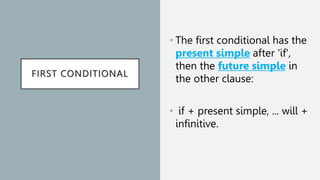
FIRST CONDITIONAL
• The first conditional has the
present simple after 'if',
then the future simple in
the other clause:
• if + present simple, ... will +
infinitive.
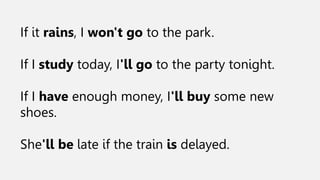
If it rains, I won't go to the park.
If I study today, I'll go to the party tonight.
If I have enough money, I'll buy some new
shoes.
She'll be late if the train is delayed.
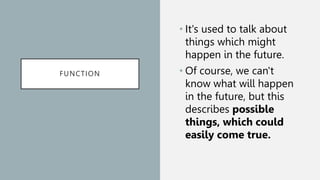
FUNCTION
• It's used to talk about
things which might
happen in the future.
• Of course, we can't
know what will happen
in the future, but this
describes possible
things, which could
easily come true.
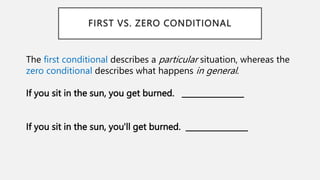
FIRST VS. ZERO CONDITIONAL
The first conditional describes a particular situation, whereas the
zero conditional describes what happens in general.
If you sit in the sun, you get burned. ________________
If you sit in the sun, you'll get burned. ________________
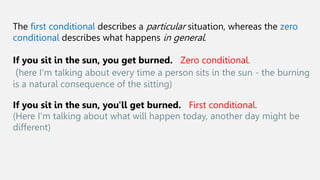
The first conditional describes a particular situation, whereas the zero
conditional describes what happens in general.
If you sit in the sun, you get burned. Zero conditional.
(here I'm talking about every time a person sits in the sun - the burning
is a natural consequence of the sitting)
If you sit in the sun, you'll get burned. First conditional.
(Here I'm talking about what will happen today, another day might be
different)
SECOND
CONDITIONAL
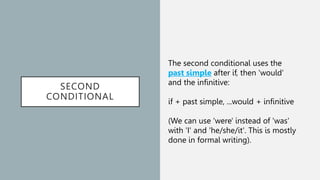
The second conditional uses the
past simple after if, then 'would'
and the infinitive:
if + past simple, ...would + infinitive
(We can use 'were' instead of 'was'
with 'I' and 'he/she/it'. This is mostly
done in formal writing).
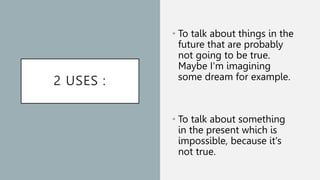
2 USES :
• To talk about things in the
future that are probably
not going to be true.
Maybe I'm imagining
some dream for example.
• To talk about something
in the present which is
impossible, because it's
not true.
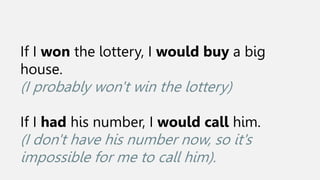
If I won the lottery, I would buy a big
house.
(I probably won't win the lottery)
If I had his number, I would call him.
(I don't have his number now, so it's
impossible for me to call him).
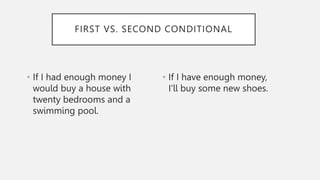
• If I had enough money I
would buy a house with
twenty bedrooms and a
swimming pool.
• If I have enough money,
I'll buy some new shoes.
FIRST VS. SECOND CONDITIONAL
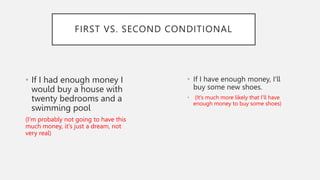
• If I had enough money I
would buy a house with
twenty bedrooms and a
swimming pool
(I'm probably not going to have this
much money, it's just a dream, not
very real)
• If I have enough money, I'll
buy some new shoes.
• (It's much more likely that I'll have
enough money to buy some shoes)
FIRST VS. SECOND CONDITIONAL
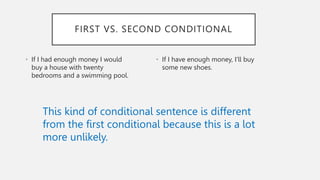
• If I had enough money I would
buy a house with twenty
bedrooms and a swimming pool.
• If I have enough money, I'll buy
some new shoes.
FIRST VS. SECOND CONDITIONAL
This kind of conditional sentence is different
from the first conditional because this is a lot
more unlikely.

zero-first-and-second-conditional-grammar-guides.pptx

  • 1.
  • 2.
    ZERO CONDITIONAL • Wecan make a zero conditional sentence with two present simple verbs (one in the 'if clause' and one in the 'main clause’): • If + present simple, .... present simple.
  • 3.
    If babies arehungry, they cry. If people eat too much, they get fat.
  • 4.
    FUNCTION This conditional isused when the result will always happen: If water reaches 100 degrees, it boils. It's a fact. I'm talking in general, not about one particular situation. The result of the 'if clause' is always the main clause.
  • 5.
    FIRST CONDITIONAL • Thefirst conditional has the present simple after 'if', then the future simple in the other clause: • if + present simple, ... will + infinitive.
  • 6.
    If it rains,I won't go to the park. If I study today, I'll go to the party tonight. If I have enough money, I'll buy some new shoes. She'll be late if the train is delayed.
  • 7.
    FUNCTION • It's usedto talk about things which might happen in the future. • Of course, we can't know what will happen in the future, but this describes possible things, which could easily come true.
  • 8.
    FIRST VS. ZEROCONDITIONAL The first conditional describes a particular situation, whereas the zero conditional describes what happens in general. If you sit in the sun, you get burned. ________________ If you sit in the sun, you'll get burned. ________________
  • 9.
    The first conditionaldescribes a particular situation, whereas the zero conditional describes what happens in general. If you sit in the sun, you get burned. Zero conditional. (here I'm talking about every time a person sits in the sun - the burning is a natural consequence of the sitting) If you sit in the sun, you'll get burned. First conditional. (Here I'm talking about what will happen today, another day might be different)
  • 10.
    SECOND CONDITIONAL The second conditionaluses the past simple after if, then 'would' and the infinitive: if + past simple, ...would + infinitive (We can use 'were' instead of 'was' with 'I' and 'he/she/it'. This is mostly done in formal writing).
  • 11.
    2 USES : •To talk about things in the future that are probably not going to be true. Maybe I'm imagining some dream for example. • To talk about something in the present which is impossible, because it's not true.
  • 12.
    If I wonthe lottery, I would buy a big house. (I probably won't win the lottery) If I had his number, I would call him. (I don't have his number now, so it's impossible for me to call him).
  • 13.
    • If Ihad enough money I would buy a house with twenty bedrooms and a swimming pool. • If I have enough money, I'll buy some new shoes. FIRST VS. SECOND CONDITIONAL
  • 14.
    • If Ihad enough money I would buy a house with twenty bedrooms and a swimming pool (I'm probably not going to have this much money, it's just a dream, not very real) • If I have enough money, I'll buy some new shoes. • (It's much more likely that I'll have enough money to buy some shoes) FIRST VS. SECOND CONDITIONAL
  • 15.
    • If Ihad enough money I would buy a house with twenty bedrooms and a swimming pool. • If I have enough money, I'll buy some new shoes. FIRST VS. SECOND CONDITIONAL This kind of conditional sentence is different from the first conditional because this is a lot more unlikely.