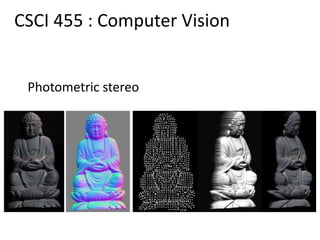
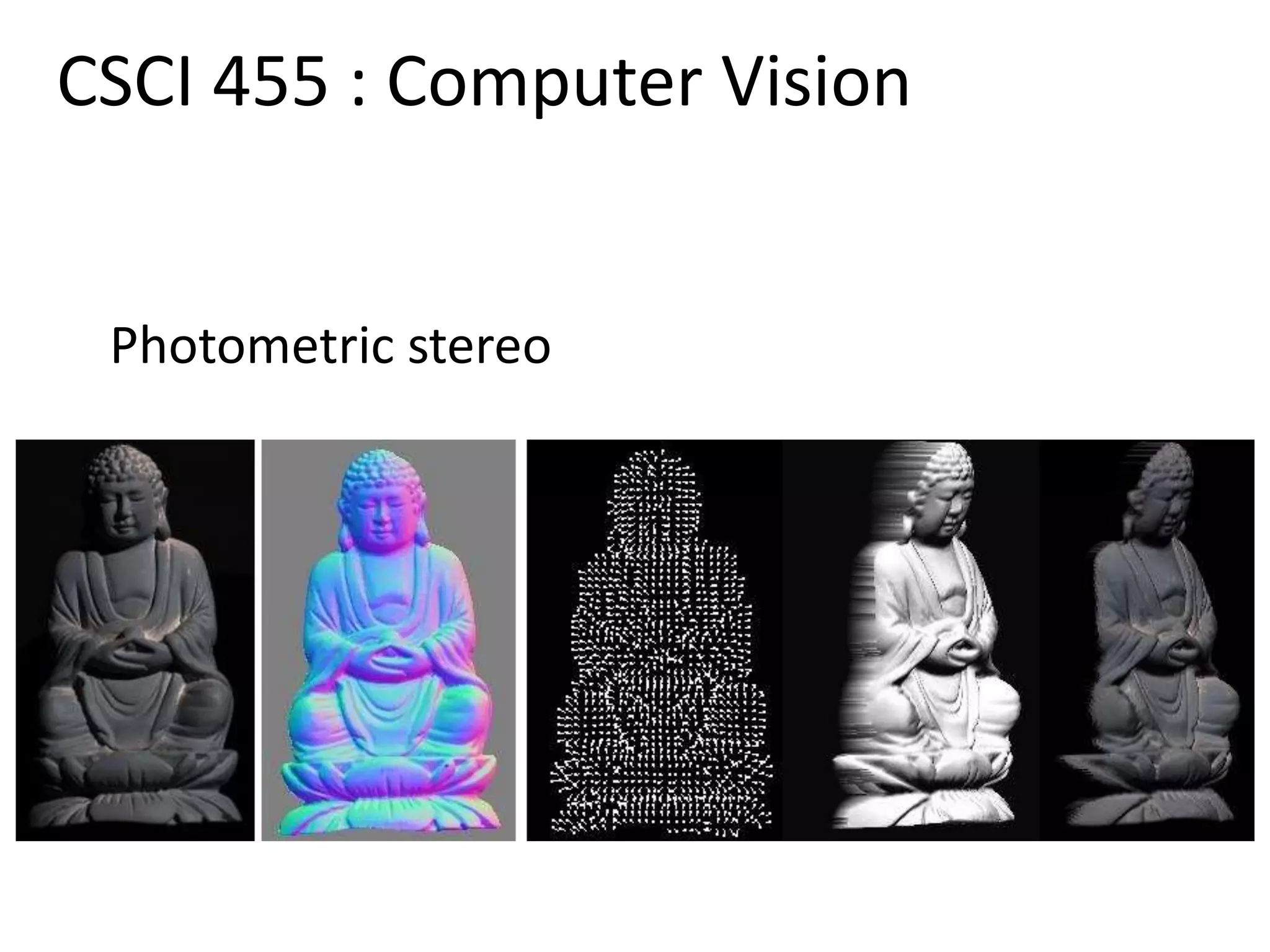
Photometric stereo
CSCI 455 : Computer Vision
Recap:
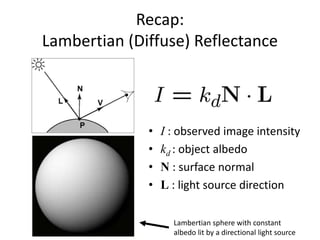
Lambertian (Diffuse) Reflectance
• I : observed image intensity
• kd : object albedo
• N : surface normal
• L : light source direction
Lambertian sphere with constant
albedo lit by a directional light source
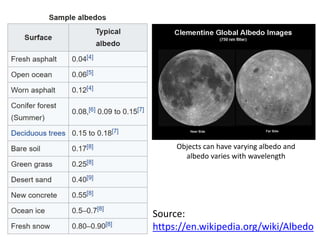
Source:
https://en.wikipedia.org/wiki/Albedo
Objects can have varying albedo and
albedo varies with wavelength
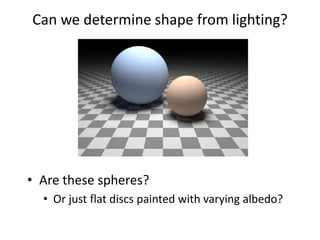
Can we determine shape from lighting?
• Are these spheres?
• Or just flat discs painted with varying albedo?
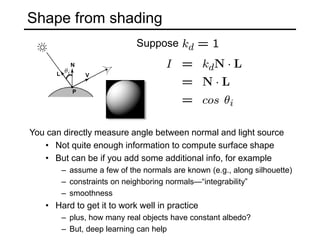
Shape from shading
Suppose
You can directly measure angle between normal and light source
• Not quite enough information to compute surface shape
• But can be if you add some additional info, for example
– assume a few of the normals are known (e.g., along silhouette)
– constraints on neighboring normals—“integrability”
– smoothness
• Hard to get it to work well in practice
– plus, how many real objects have constant albedo?
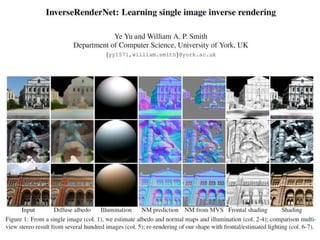
– But, deep learning can help
Let’s take more than one photo!
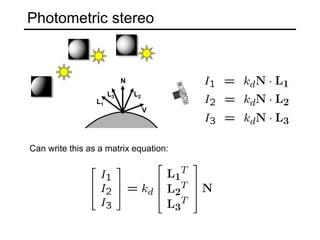
Photometric stereo
N
L1
L2
V
L3
Can write this as a matrix equation:
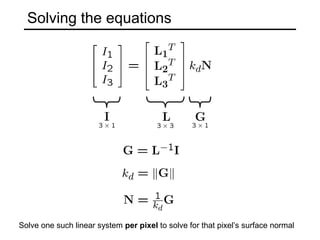
Solving the equations
Solve one such linear system per pixel to solve for that pixel’s surface normal
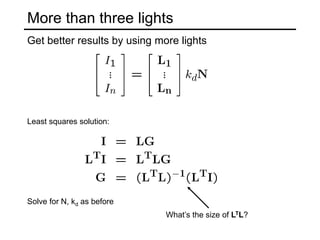
More than three lights
Get better results by using more lights
What’s the size of LTL?
Least squares solution:
Solve for N, kd as before
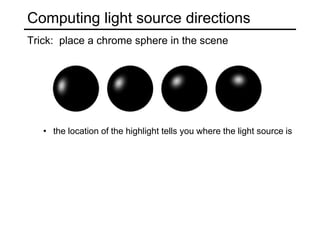
Computing light source directions
Trick: place a chrome sphere in the scene
• the location of the highlight tells you where the light source is
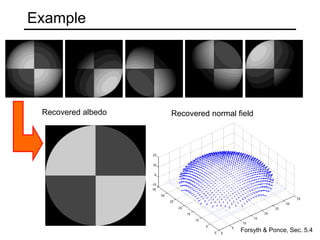
Example
Recovered albedo Recovered normal field
Forsyth & Ponce, Sec. 5.4
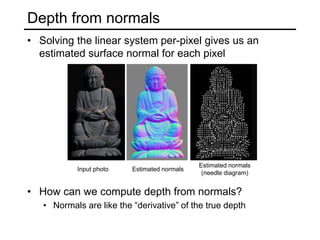
Depth from normals
• Solving the linear system per-pixel gives us an
estimated surface normal for each pixel
• How can we compute depth from normals?
• Normals are like the “derivative” of the true depth
Input photo Estimated normals
Estimated normals
(needle diagram)
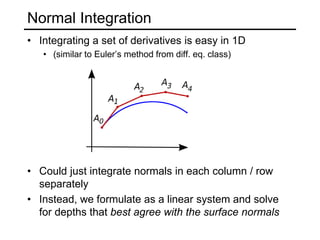
Normal Integration
• Integrating a set of derivatives is easy in 1D
• (similar to Euler’s method from diff. eq. class)
• Could just integrate normals in each column / row
separately
• Instead, we formulate as a linear system and solve
for depths that best agree with the surface normals
Depth from normals
Get a similar equation for V2
• Each normal gives us two linear constraints on z
• compute z values by solving a matrix equation
V1
V2
N
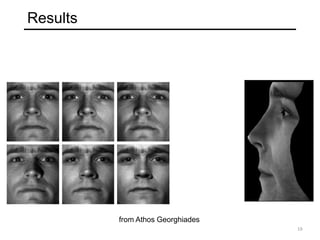
Results
19
from Athos Georghiades
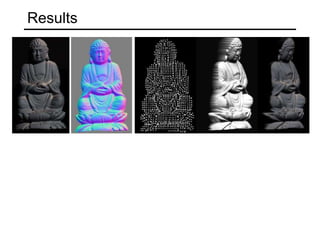
Results
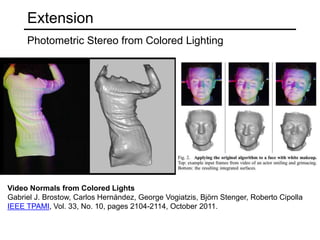
Extension
Photometric Stereo from Colored Lighting
Video Normals from Colored Lights
Gabriel J. Brostow, Carlos Hernández, George Vogiatzis, Björn Stenger, Roberto Cipolla
IEEE TPAMI, Vol. 33, No. 10, pages 2104-2114, October 2011.
Questions?
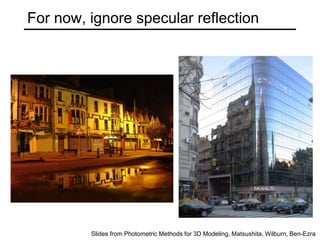
For now, ignore specular reflection
Slides from Photometric Methods for 3D Modeling, Matsushita, Wilburn, Ben-Ezra
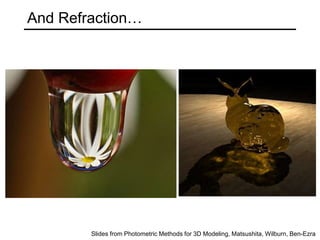
And Refraction…
Slides from Photometric Methods for 3D Modeling, Matsushita, Wilburn, Ben-Ezra
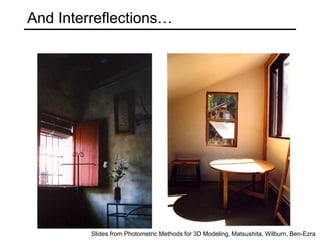
And Interreflections…
Slides from Photometric Methods for 3D Modeling, Matsushita, Wilburn, Ben-Ezra
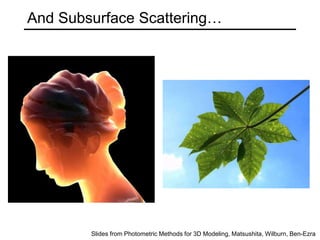
And Subsurface Scattering…
Slides from Photometric Methods for 3D Modeling, Matsushita, Wilburn, Ben-Ezra
Limitations
Bigger problems
• doesn’t work for shiny things, semi-translucent things
• shadows, inter-reflections
Smaller problems
• camera and lights have to be distant
• calibration requirements
– measure light source directions, intensities
– camera response function
Newer work addresses some of these issues
Some pointers for further reading:
• Zickler, Belhumeur, and Kriegman, "Helmholtz Stereopsis: Exploiting
Reciprocity for Surface Reconstruction." IJCV, Vol. 49 No. 2/3, pp 215-227.
• Hertzmann & Seitz, “Example-Based Photometric Stereo: Shape
Reconstruction with General, Varying BRDFs.” IEEE Trans. PAMI 2005
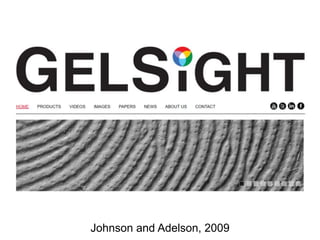
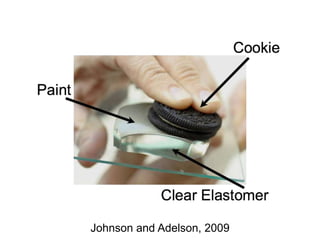
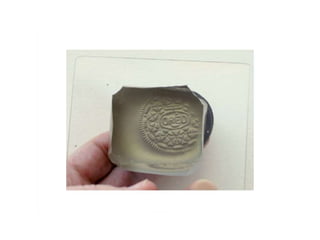
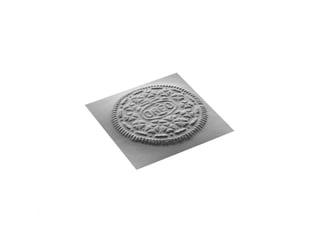
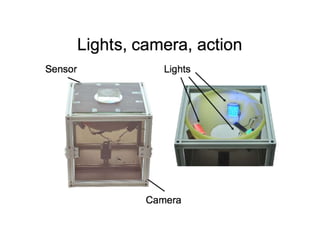
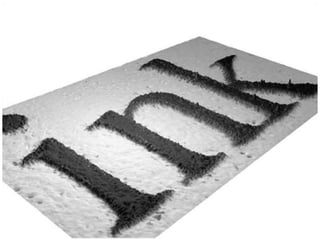
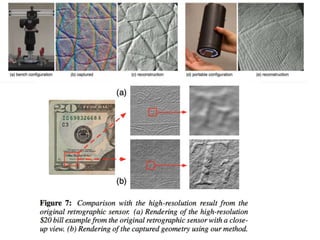
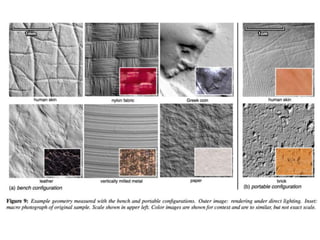
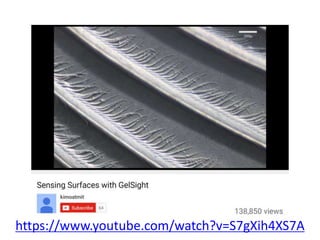
Johnson and Adelson, 2009
https://www.youtube.com/watch?v=S7gXih4XS7A
Questions?

Computer vision - photometric

  • 1.
    Photometric stereo CSCI 455: Computer Vision
  • 2.
    Recap: Lambertian (Diffuse) Reflectance •I : observed image intensity • kd : object albedo • N : surface normal • L : light source direction Lambertian sphere with constant albedo lit by a directional light source
  • 3.
    Source: https://en.wikipedia.org/wiki/Albedo Objects can havevarying albedo and albedo varies with wavelength
  • 4.
    Can we determineshape from lighting? • Are these spheres? • Or just flat discs painted with varying albedo?
  • 5.
    Shape from shading Suppose Youcan directly measure angle between normal and light source • Not quite enough information to compute surface shape • But can be if you add some additional info, for example – assume a few of the normals are known (e.g., along silhouette) – constraints on neighboring normals—“integrability” – smoothness • Hard to get it to work well in practice – plus, how many real objects have constant albedo? – But, deep learning can help
  • 6.
    Let’s take morethan one photo!
  • 7.
  • 8.
    Solving the equations Solveone such linear system per pixel to solve for that pixel’s surface normal
  • 9.
    More than threelights Get better results by using more lights What’s the size of LTL? Least squares solution: Solve for N, kd as before
  • 10.
    Computing light sourcedirections Trick: place a chrome sphere in the scene • the location of the highlight tells you where the light source is
  • 11.
    Example Recovered albedo Recoverednormal field Forsyth & Ponce, Sec. 5.4
  • 12.
    Depth from normals •Solving the linear system per-pixel gives us an estimated surface normal for each pixel • How can we compute depth from normals? • Normals are like the “derivative” of the true depth Input photo Estimated normals Estimated normals (needle diagram)
  • 13.
    Normal Integration • Integratinga set of derivatives is easy in 1D • (similar to Euler’s method from diff. eq. class) • Could just integrate normals in each column / row separately • Instead, we formulate as a linear system and solve for depths that best agree with the surface normals
  • 14.
    Depth from normals Geta similar equation for V2 • Each normal gives us two linear constraints on z • compute z values by solving a matrix equation V1 V2 N
  • 15.
  • 16.
  • 17.
    Extension Photometric Stereo fromColored Lighting Video Normals from Colored Lights Gabriel J. Brostow, Carlos Hernández, George Vogiatzis, Björn Stenger, Roberto Cipolla IEEE TPAMI, Vol. 33, No. 10, pages 2104-2114, October 2011.
  • 18.
  • 19.
    For now, ignorespecular reflection Slides from Photometric Methods for 3D Modeling, Matsushita, Wilburn, Ben-Ezra
  • 20.
    And Refraction… Slides fromPhotometric Methods for 3D Modeling, Matsushita, Wilburn, Ben-Ezra
  • 21.
    And Interreflections… Slides fromPhotometric Methods for 3D Modeling, Matsushita, Wilburn, Ben-Ezra
  • 22.
    And Subsurface Scattering… Slidesfrom Photometric Methods for 3D Modeling, Matsushita, Wilburn, Ben-Ezra
  • 23.
    Limitations Bigger problems • doesn’twork for shiny things, semi-translucent things • shadows, inter-reflections Smaller problems • camera and lights have to be distant • calibration requirements – measure light source directions, intensities – camera response function Newer work addresses some of these issues Some pointers for further reading: • Zickler, Belhumeur, and Kriegman, "Helmholtz Stereopsis: Exploiting Reciprocity for Surface Reconstruction." IJCV, Vol. 49 No. 2/3, pp 215-227. • Hertzmann & Seitz, “Example-Based Photometric Stereo: Shape Reconstruction with General, Varying BRDFs.” IEEE Trans. PAMI 2005
  • 24.
  • 25.
  • 32.
  • 34.