© 2020 Wael Badawy
1
Turing’s Thesis
1
DISCLAIMER:
This video is optimized for HD large display using
patented and patent-pending “Nile Codec”, the first
Egyptian Video Codec for more information,
PLEASE check https://NileCodec.com
Also available as a PodCast
© 2020 Wael Badawy
Copyright © 2020 Wael Badawy. All rights reserved
n This video is subject to copyright owned by Wael Badawy “WB”. Any
reproduction or republication of all or part of this video is expressly prohibited
unless WB has explicitly granted its prior written consent. All other rights
reserved.
n This video is intended for education and information only and is offered AS IS,
without any warranty of the accuracy or the quality of the content. Any other
use is strictly prohibited. The viewer is fully responsible to verify the accuracy
of the contents received without any claims of costs or liability arising .
n The names, trademarks service marked as logos of WB or the sponsors
appearing in this video may not be used in any any product or service,
without prior express written permission from WB and the video sponsors
n Neither WB nor any party involved in creating, producing or delivering
information and material via this video shall be liable for any direction,
incidental, consequential, indirect of punitive damages arising out of access
to, use or inability to use this content or any errors or omissions in the
content thereof.
n If you will continue to watch this video, you agree to the terms above and
other terms that may be available on http://nu.edu.eg & https://caiwave.net
2
© 2020 Wael Badawy
© 2020 Wael Badawy
4
Turing’s thesis (1930):
Any computation carried out
by mechanical means
can be performed by a Turing Machine
© 2020 Wael Badawy
5
Algorithm:
An algorithm for a problem is a
Turing Machine which solves the problem
The algorithm describes the steps of
the mechanical means
This is easily translated to computation steps
of a Turing machine
© 2020 Wael Badawy
6
When we say: There exists an algorithm
We mean: There exists a Turing Machine
that executes the algorithm
7
Variations
of the
Turing Machine
7
© 2020 Wael Badawy
8
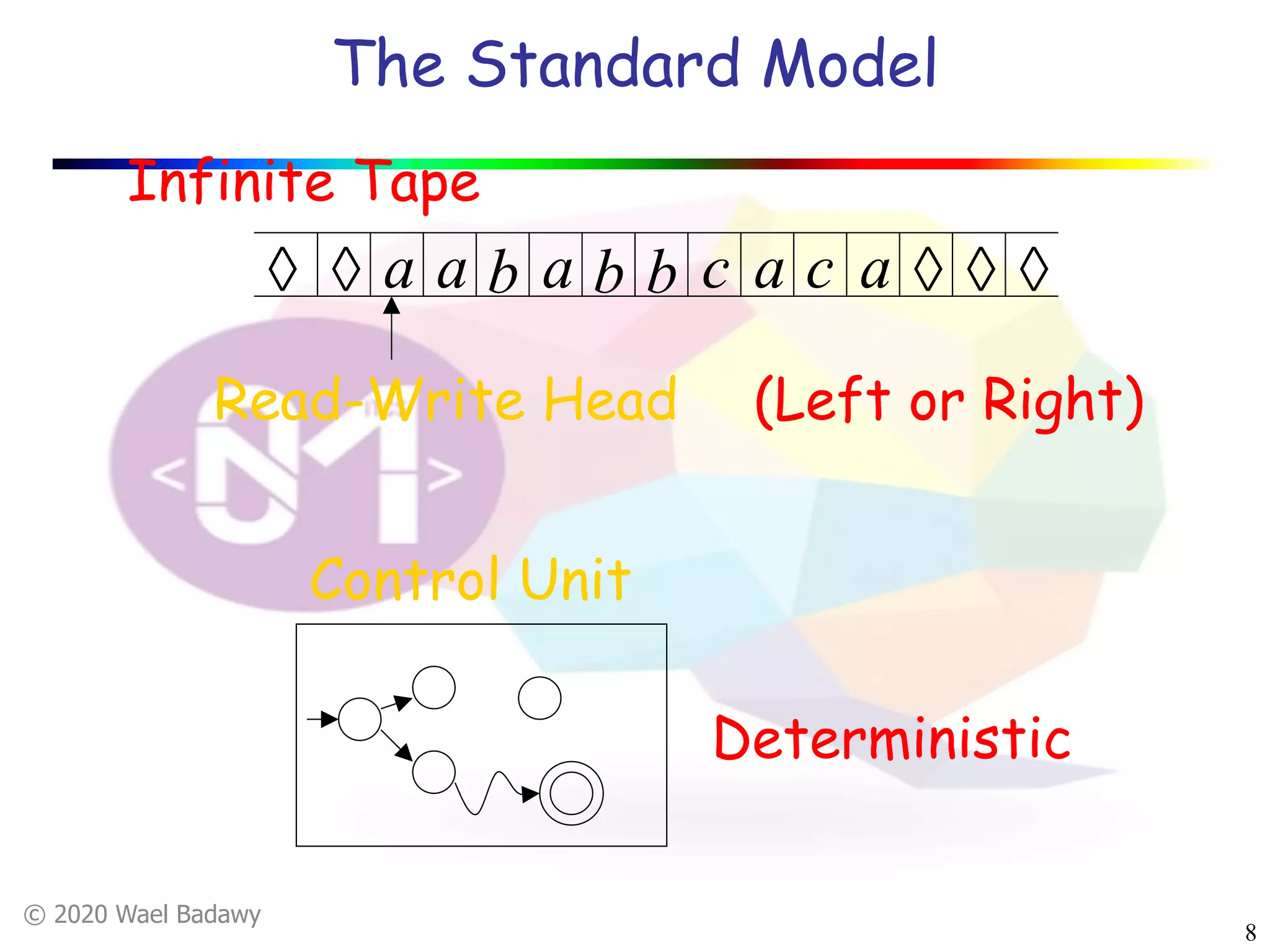
Read-Write Head
Control Unit
àà a a c àà àb a cb b a a
Deterministic
The Standard Model
Infinite Tape
(Left or Right)
© 2020 Wael Badawy
Variations of the Standard
Model
9
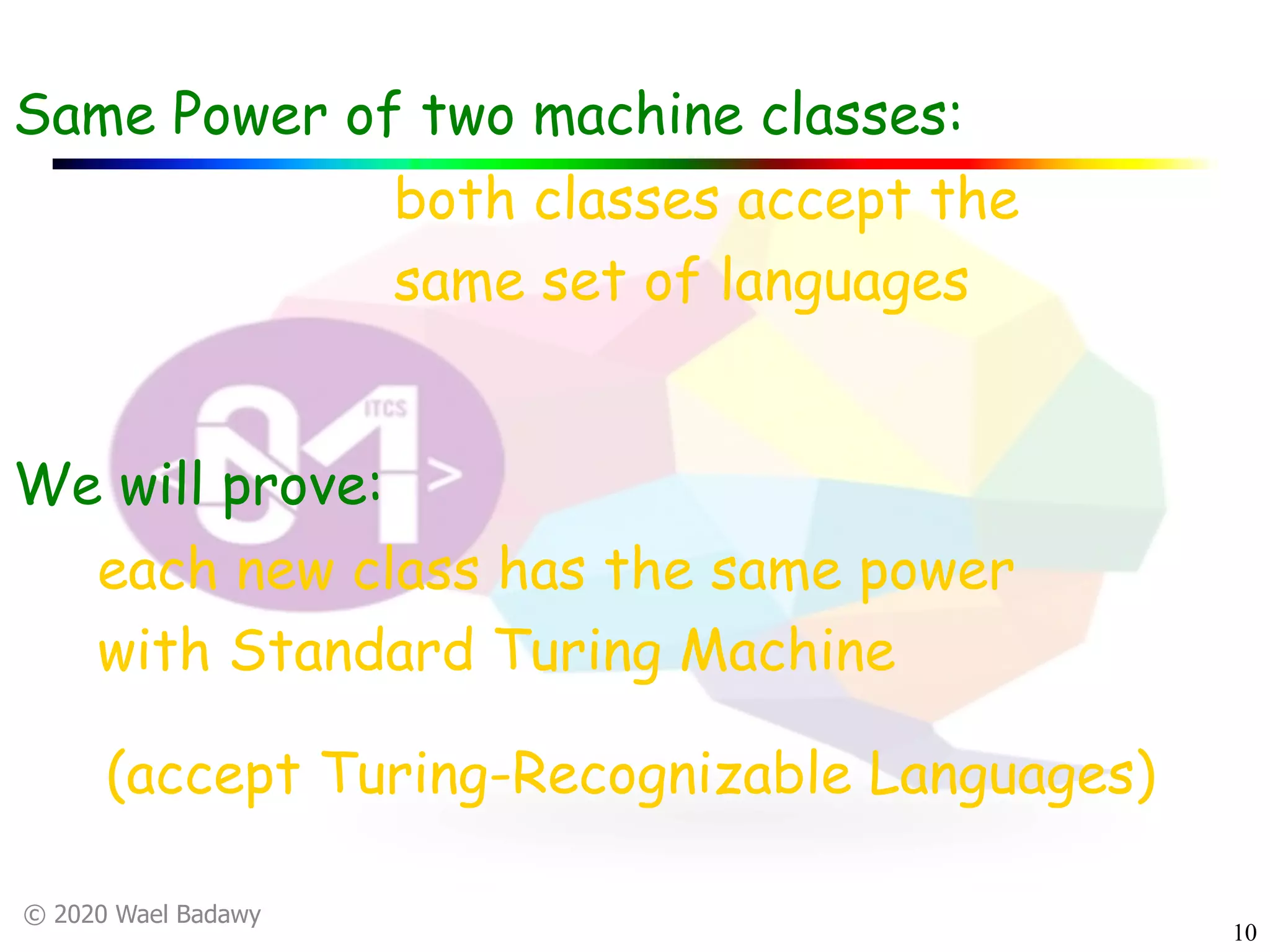
• Stay-Option
• Semi-Infinite Tape
• Multitape
• Multidimensional
• Nondeterministic
Turing machines with:
Different Turing Machine Classes
© 2020 Wael Badawy
10
We will prove:
each new class has the same power
with Standard Turing Machine
Same Power of two machine classes:
both classes accept the
same set of languages
(accept Turing-Recognizable Languages)
© 2020 Wael Badawy
11
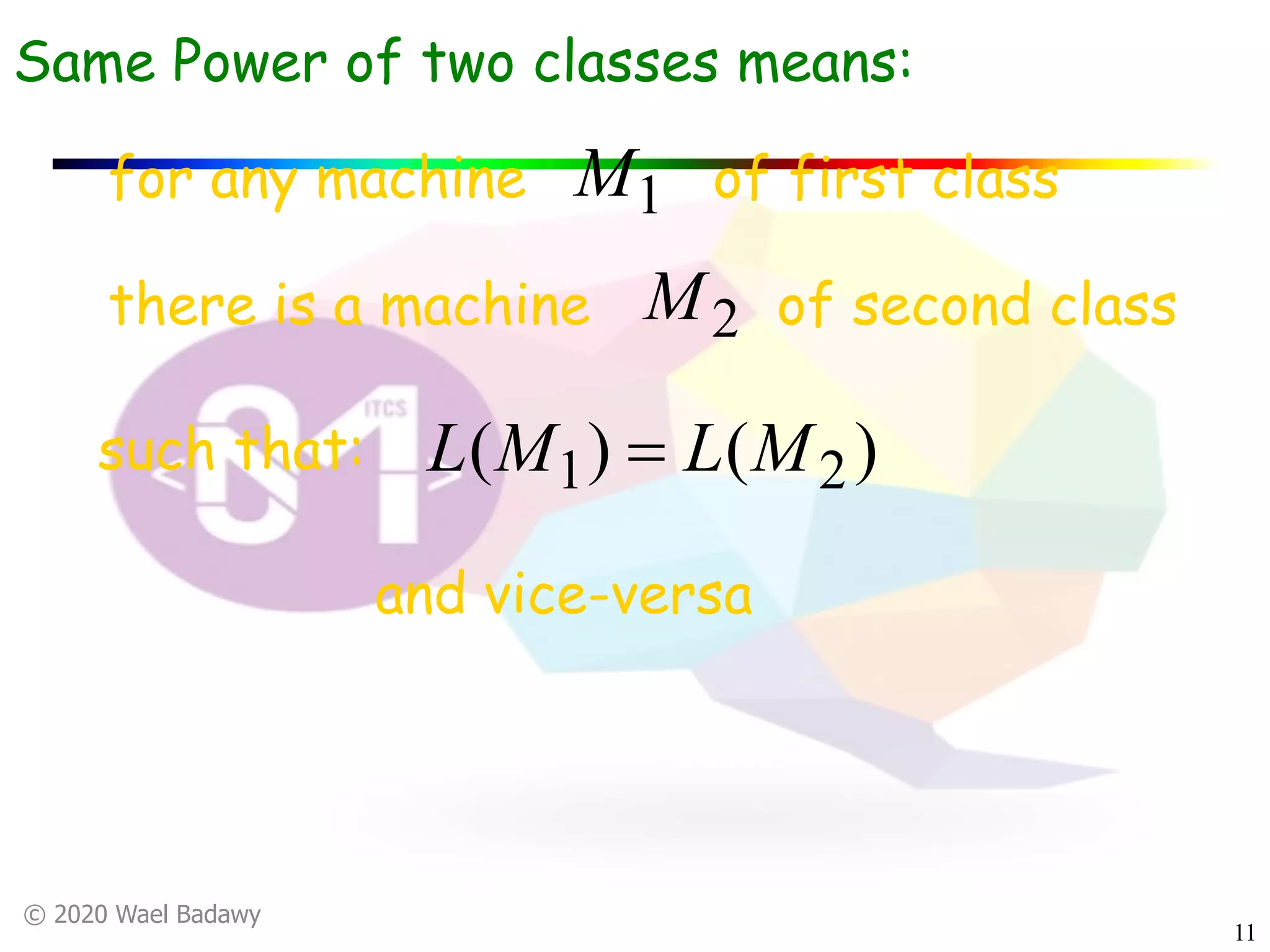
Same Power of two classes means:
for any machine of first class1M
there is a machine of second class2M
such that: )()( 21 MLML =
and vice-versa
© 2020 Wael Badawy
12
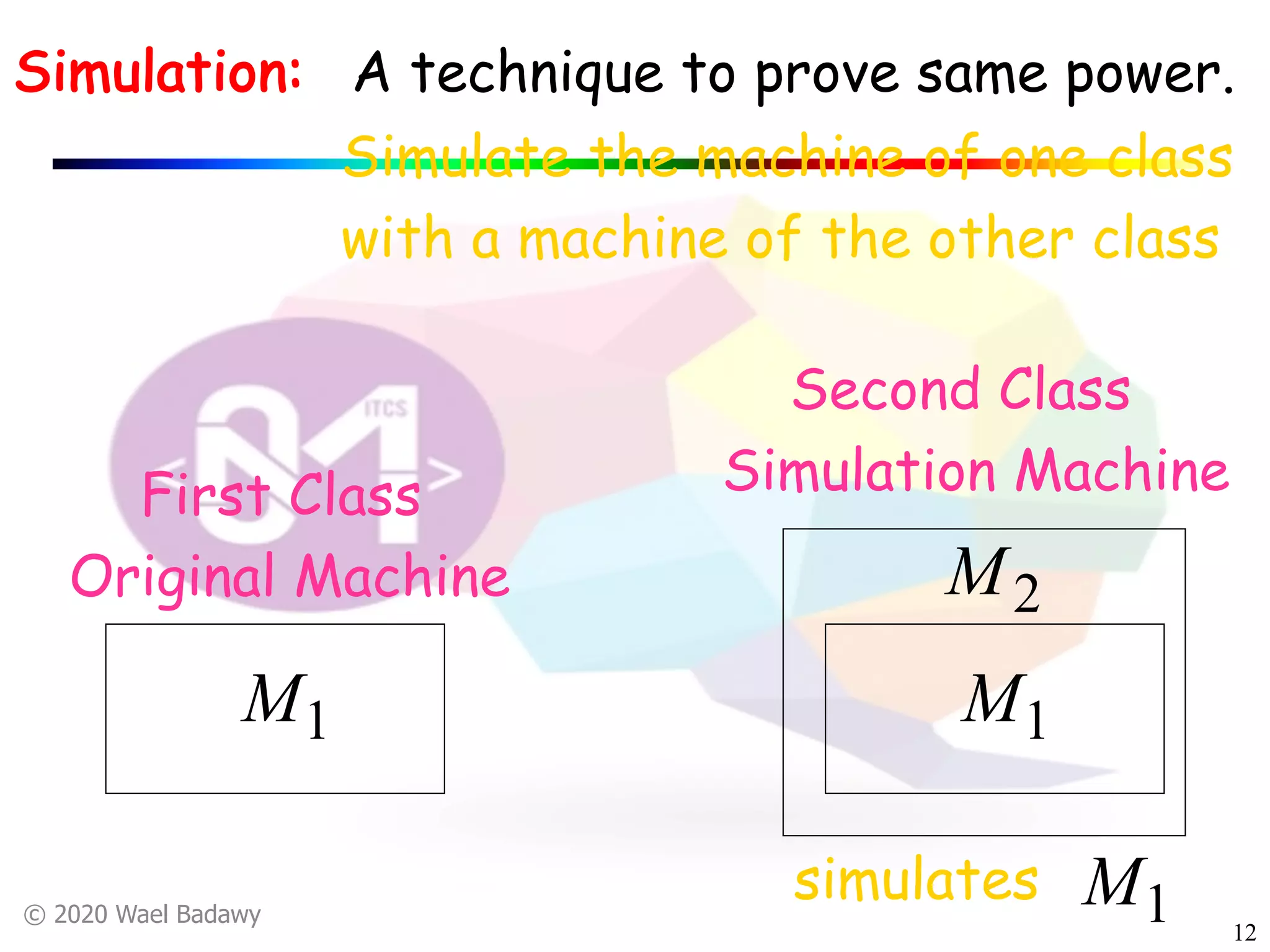
A technique to prove same power.Simulation:
Simulate the machine of one class
with a machine of the other class
First Class
Original Machine
1M 1M
2M
Second Class
Simulation Machine
simulates 1M
© 2020 Wael Badawy
13
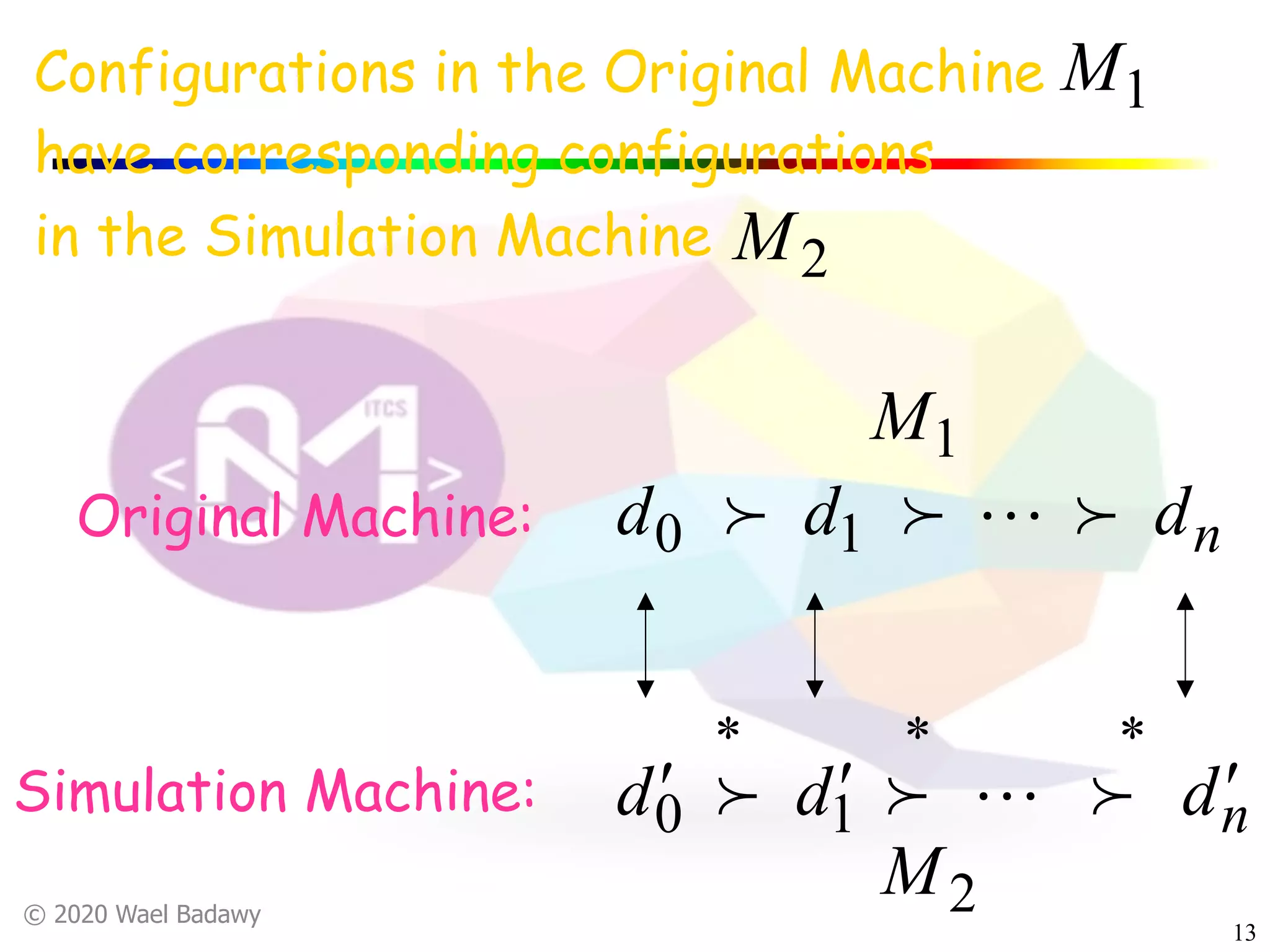
Configurations in the Original Machine
have corresponding configurations
in the Simulation Machine
nddd !"!! 10Original Machine:
Simulation Machine: nddd ¢¢¢
***
!"!! 10
1M
2M
1M
2M
© 2020 Wael Badawy
14
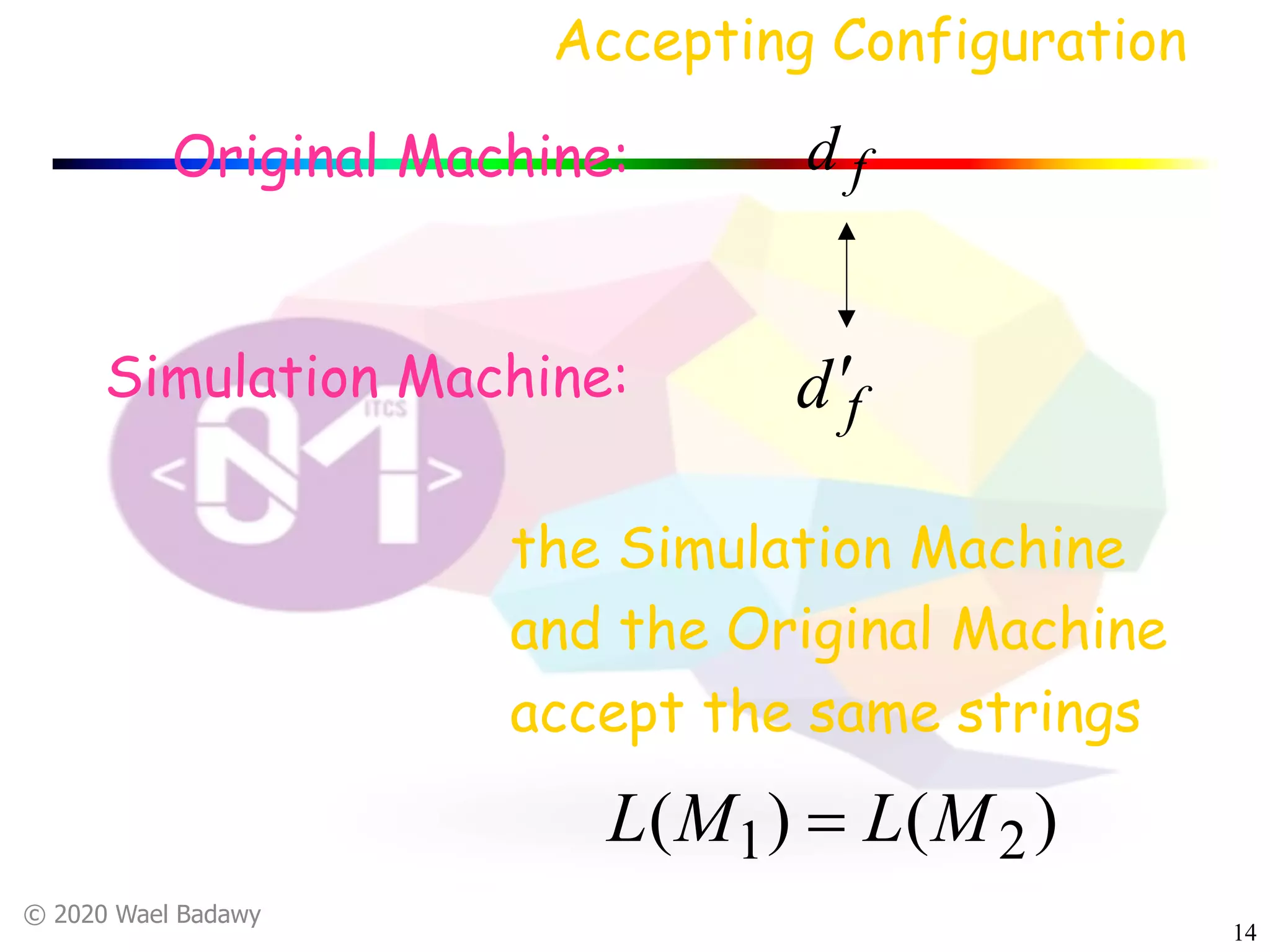
the Simulation Machine
and the Original Machine
accept the same strings
fdOriginal Machine:
Simulation Machine:
fd¢
Accepting Configuration
)()( 21 MLML =
© 2020 Wael Badawy
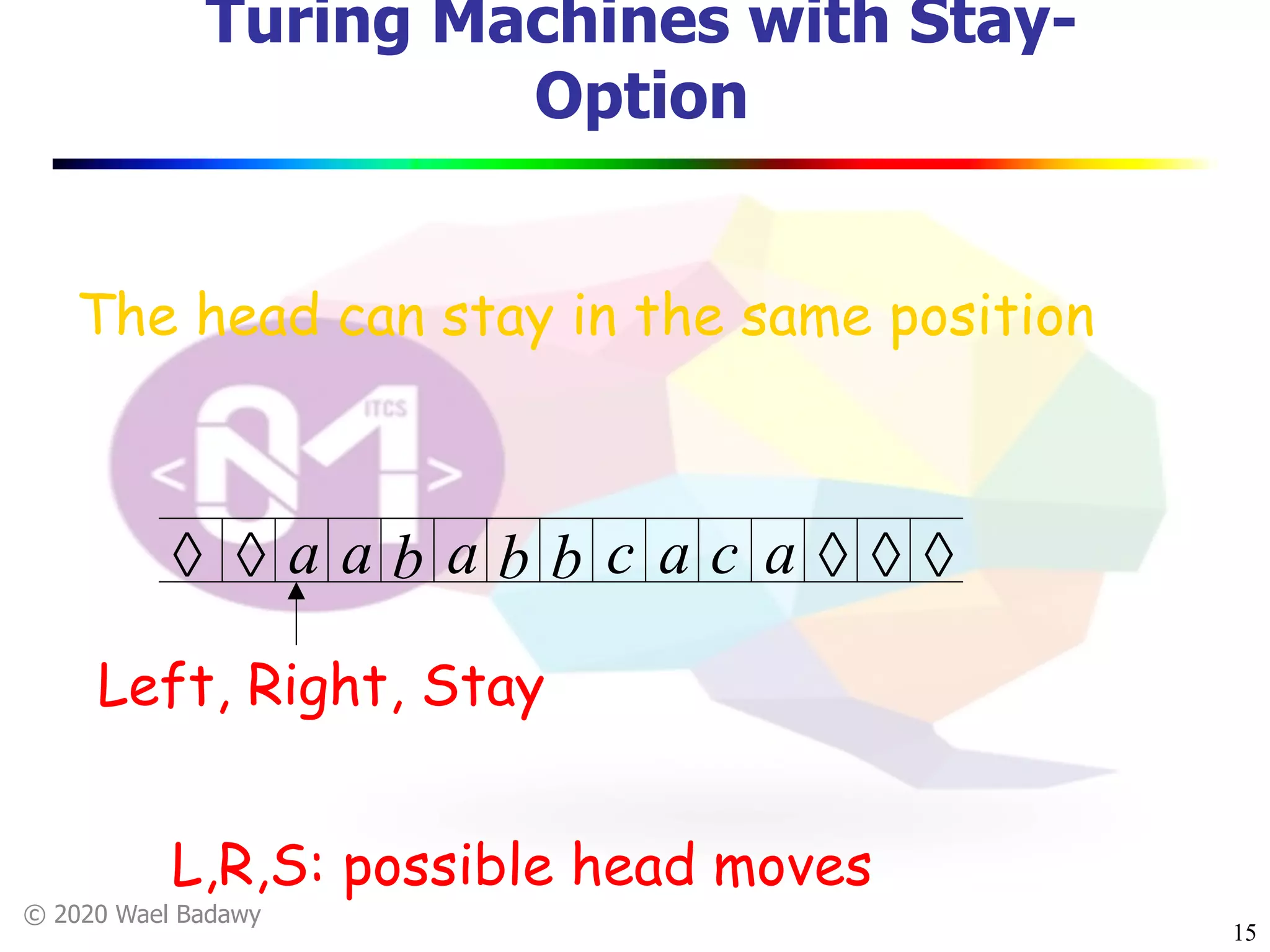
Turing Machines with Stay-
Option
15
The head can stay in the same position
àà a a c àà àb a cb b a a
Left, Right, Stay
L,R,S: possible head moves
© 2020 Wael Badawy
16
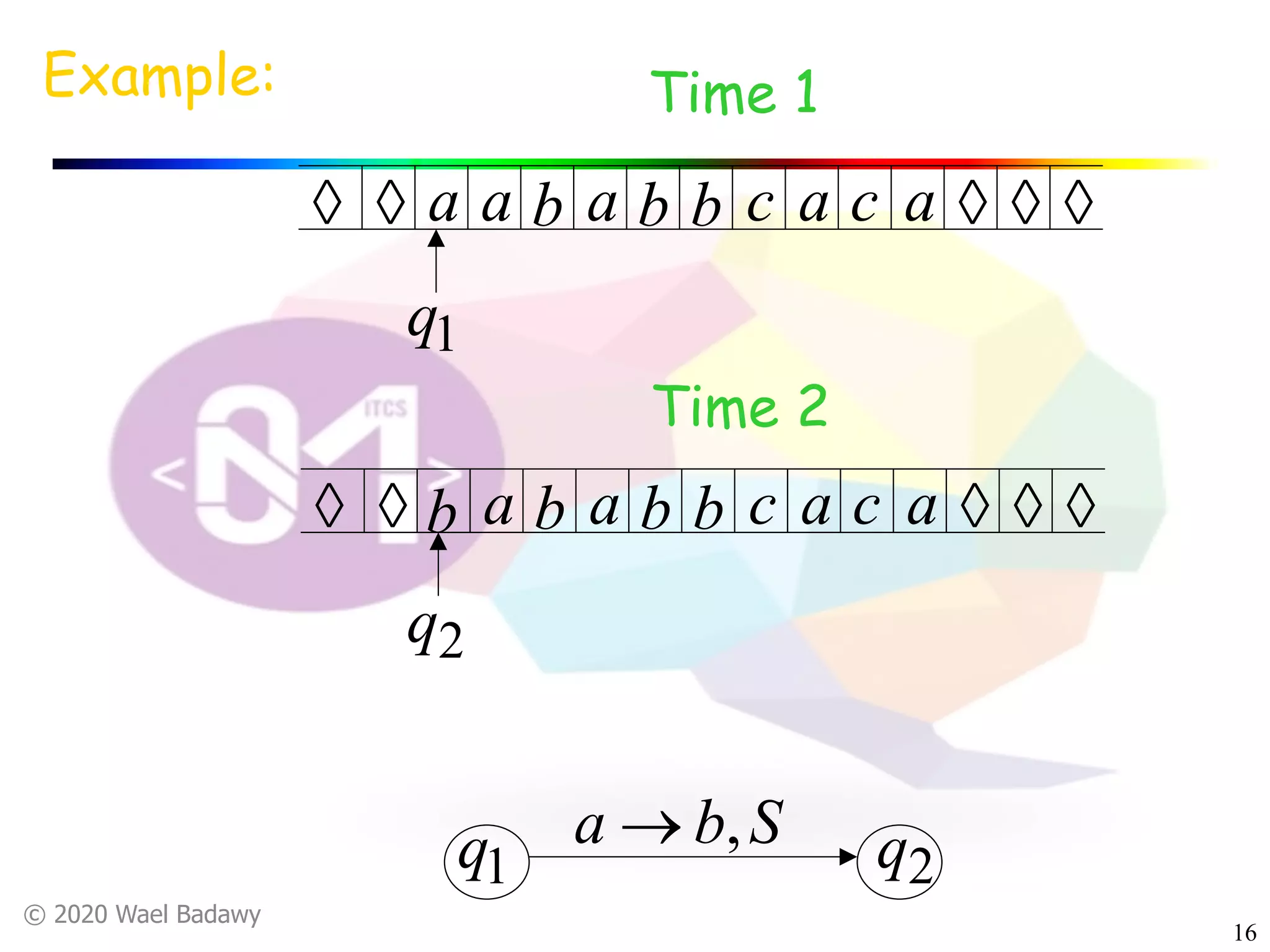
Example:
àà a a c àà àb a cb b a a
Time 1
àà b a c àà àb a cb b a a
Time 2
1q 2q
1q
2q
Sba ,®
© 2020 Wael Badawy
17
Stay-Option machines
have the same power with
Standard Turing machines
Theorem:
Proof: 1. Stay-Option Machines
simulate Standard Turing machines
2. Standard Turing machines
simulate Stay-Option machines
© 2020 Wael Badawy
18
1. Stay-Option Machines
simulate Standard Turing machines
Trivial: any standard Turing machine
is also a Stay-Option machine
© 2020 Wael Badawy
19
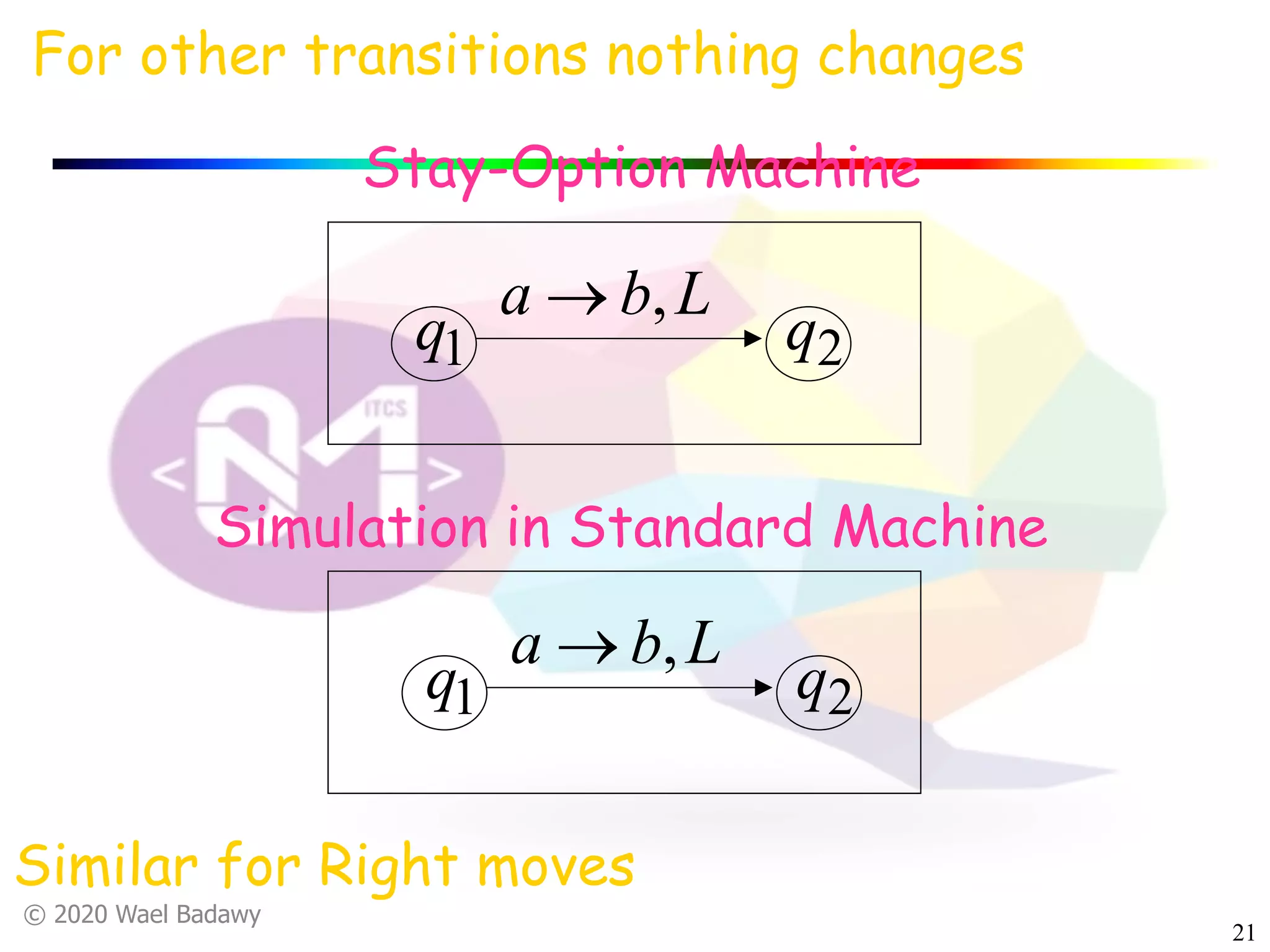
2. Standard Turing machines
simulate Stay-Option machines
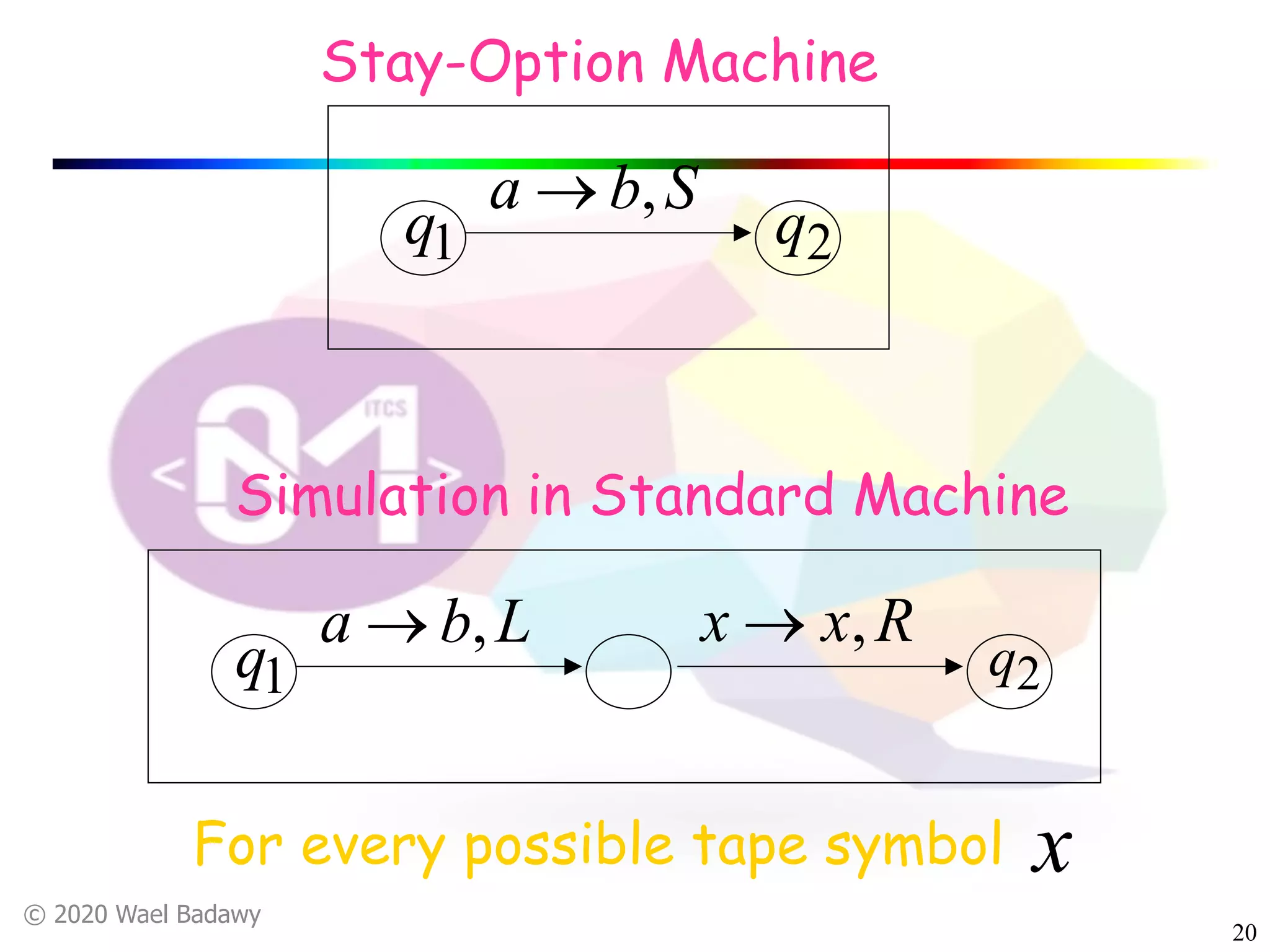
We need to simulate the stay head option
with two head moves, one left and one right
© 2020 Wael Badawy
20
1q 2q
Sba ,®
1q
Lba ,®
2q
Rxx ,®
Stay-Option Machine
Simulation in Standard Machine
For every possible tape symbol x
© 2020 Wael Badawy
21
1q 2q
Lba ,®
1q 2q
Lba ,®
Stay-Option Machine
Simulation in Standard Machine
Similar for Right moves
For other transitions nothing changes
© 2020 Wael Badawy
22
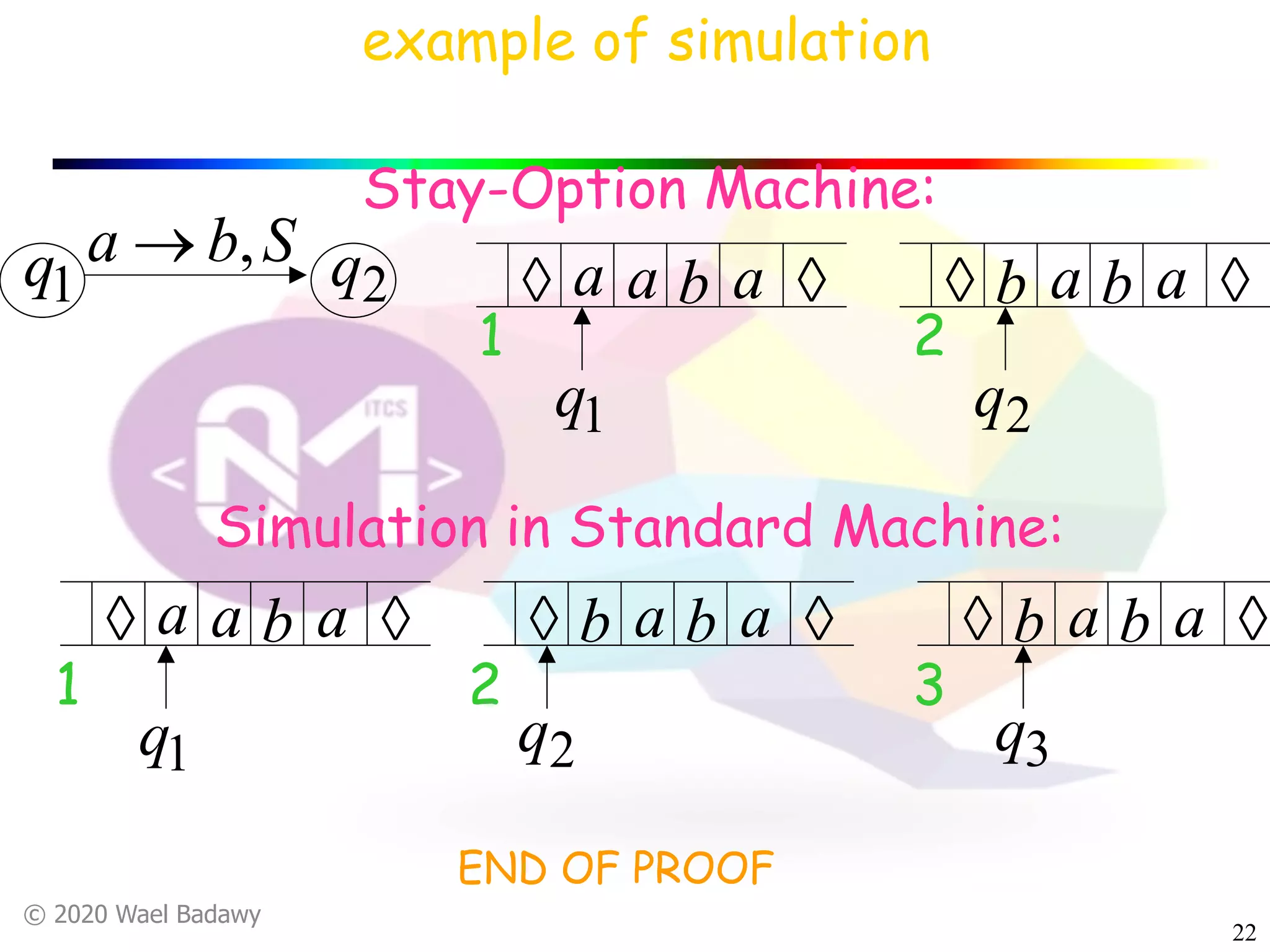
example of simulation
à àa a b a
1q
Stay-Option Machine:
1
à àb a b a
2q
2
1q 2qSba ,®
Simulation in Standard Machine:
à àa a b a
1q
1
à àb a b a
2q
2
à àb a b a
3q
3
END OF PROOF
© 2020 Wael Badawy
23
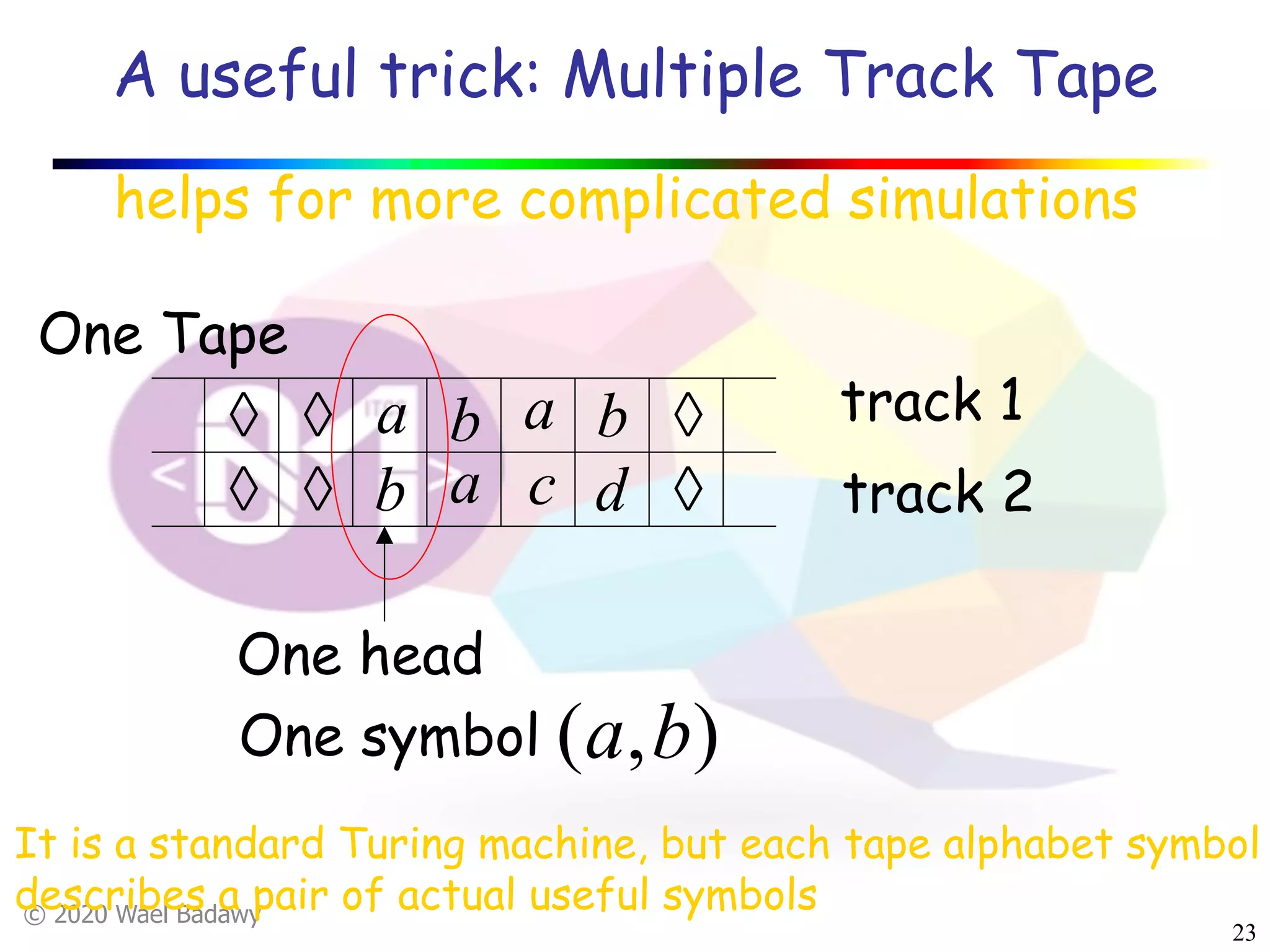
A useful trick: Multiple Track Tape
à
à
à
à
à
à
b
d
a
b
b
a
a
c
track 1
track 2
One symbol ),( ba
One head
helps for more complicated simulations
One Tape
It is a standard Turing machine, but each tape alphabet symbol
describes a pair of actual useful symbols
© 2020 Wael Badawy
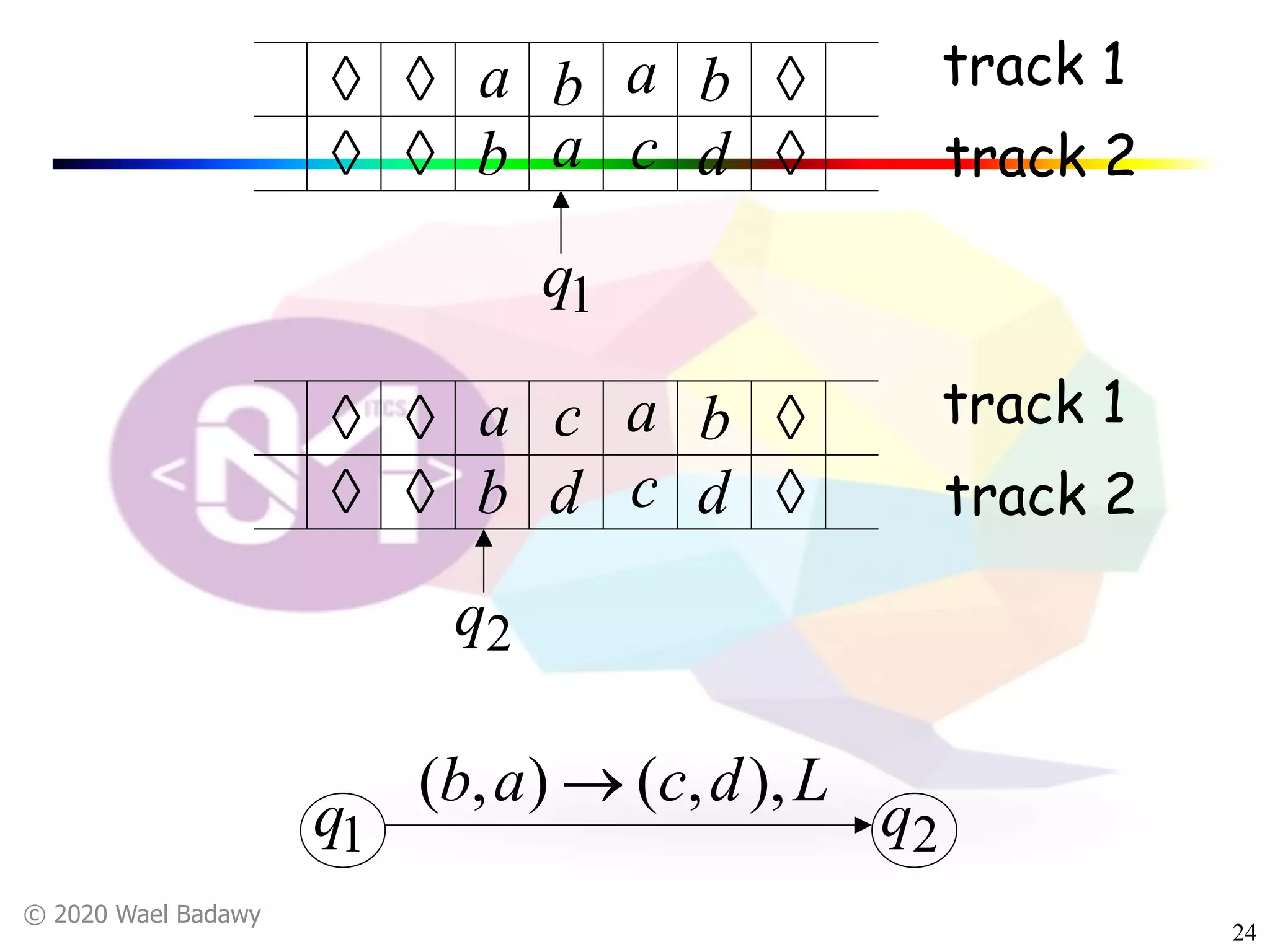
24
à
à
à
à
à
à
b
d
a
b
b
a
a
c
track 1
track 2
1q 2q
Ldcab ),,(),( ®
1q
à
à
à
à
à
à
b
d
a
b
c
d
a
c
track 1
track 2
2q
© 2020 Wael Badawy
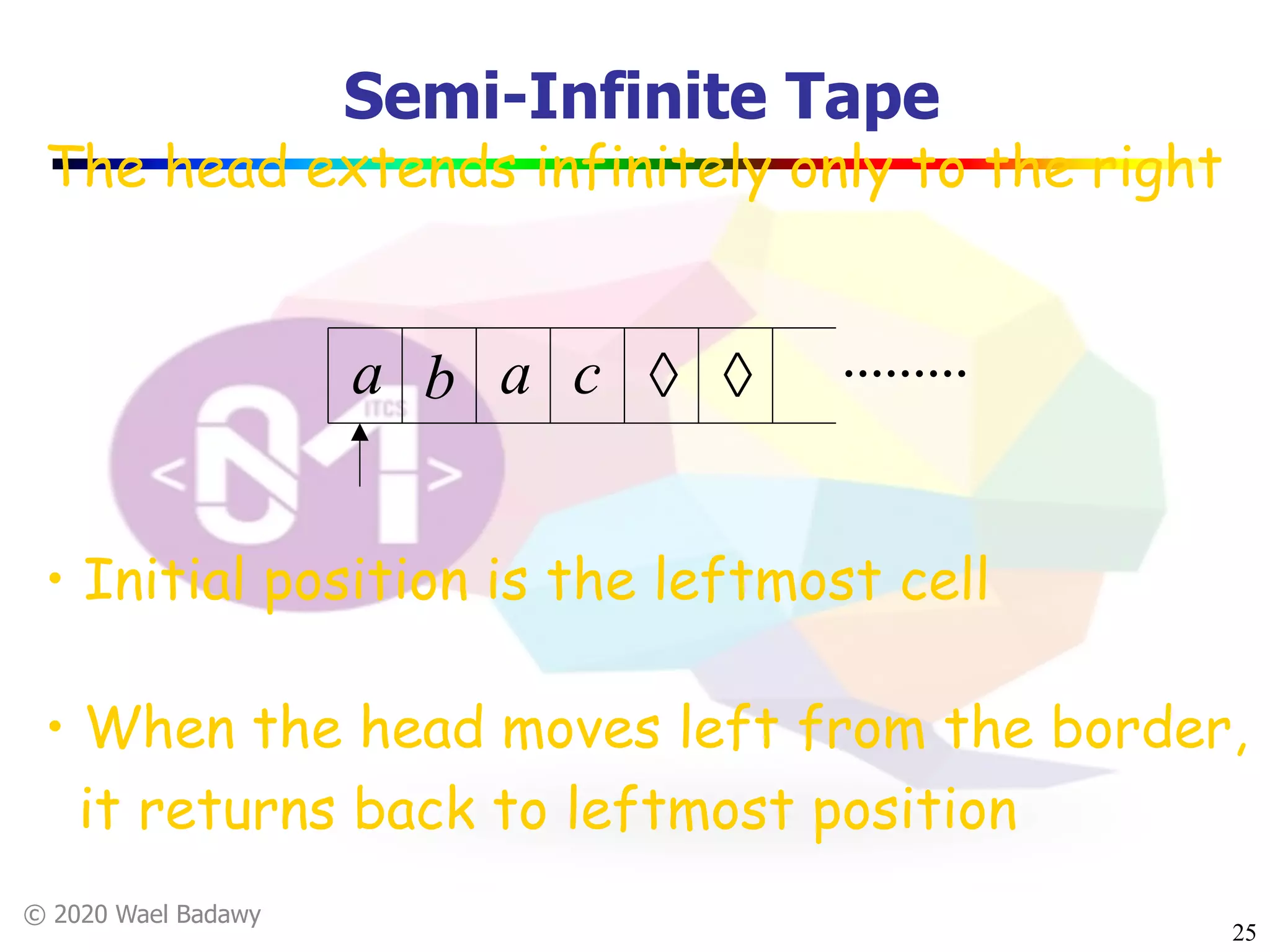
Semi-Infinite Tape
25
.........a b a c à à
• When the head moves left from the border,
it returns back to leftmost position
The head extends infinitely only to the right
• Initial position is the leftmost cell
© 2020 Wael Badawy
26
Semi-Infinite machines
have the same power with
Standard Turing machines
Theorem:
Proof:
2. Semi-Infinite Machines
simulate Standard Turing machines
1. Standard Turing machines
simulate Semi-Infinite machines
© 2020 Wael Badawy
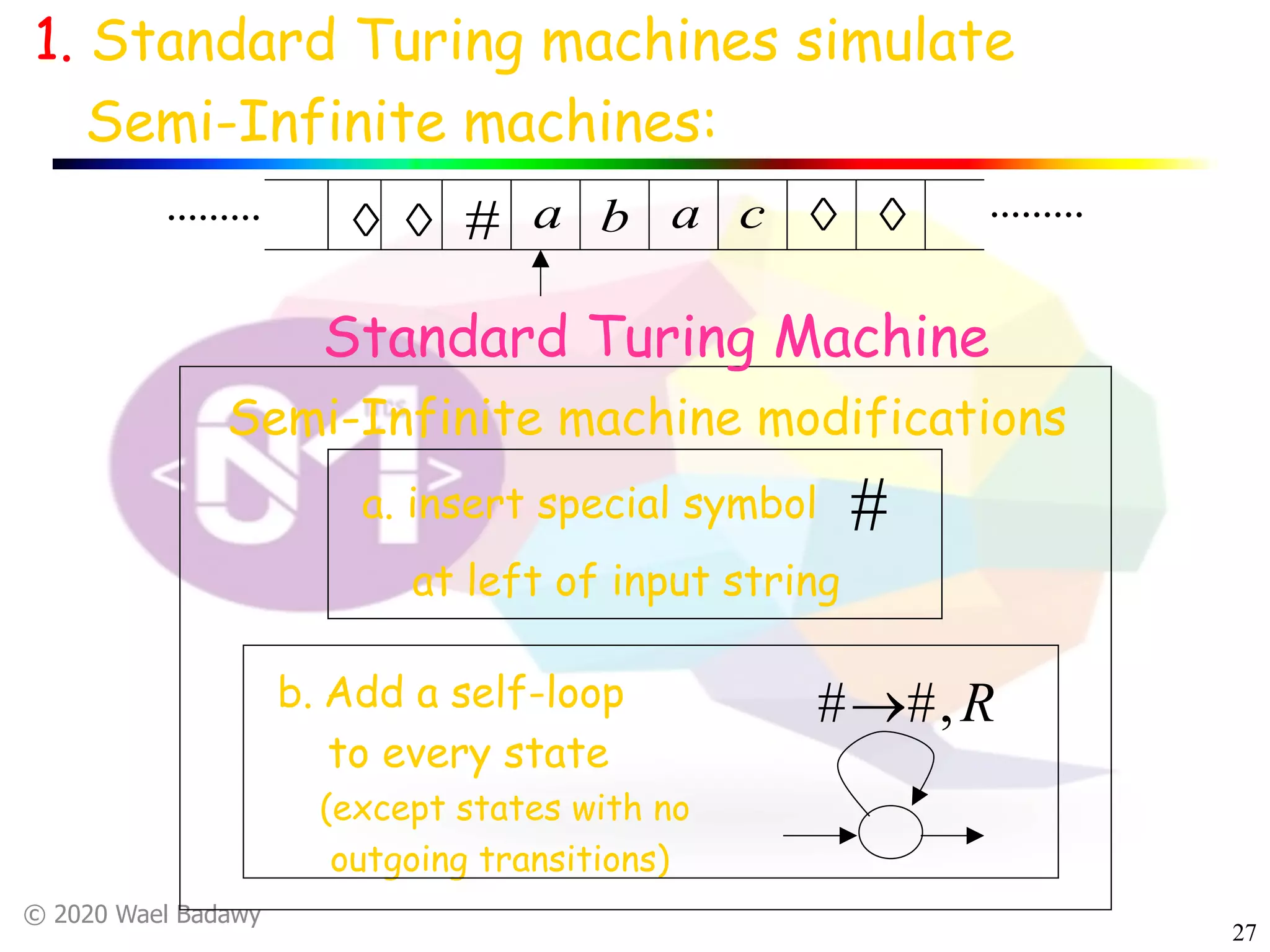
27
1. Standard Turing machines simulate
Semi-Infinite machines:
a. insert special symbol
at left of input string
#
a b a c à à#
b. Add a self-loop
to every state
(except states with no
outgoing transitions)
R,##®
Standard Turing Machine
àà
Semi-Infinite machine modifications
..................
© 2020 Wael Badawy
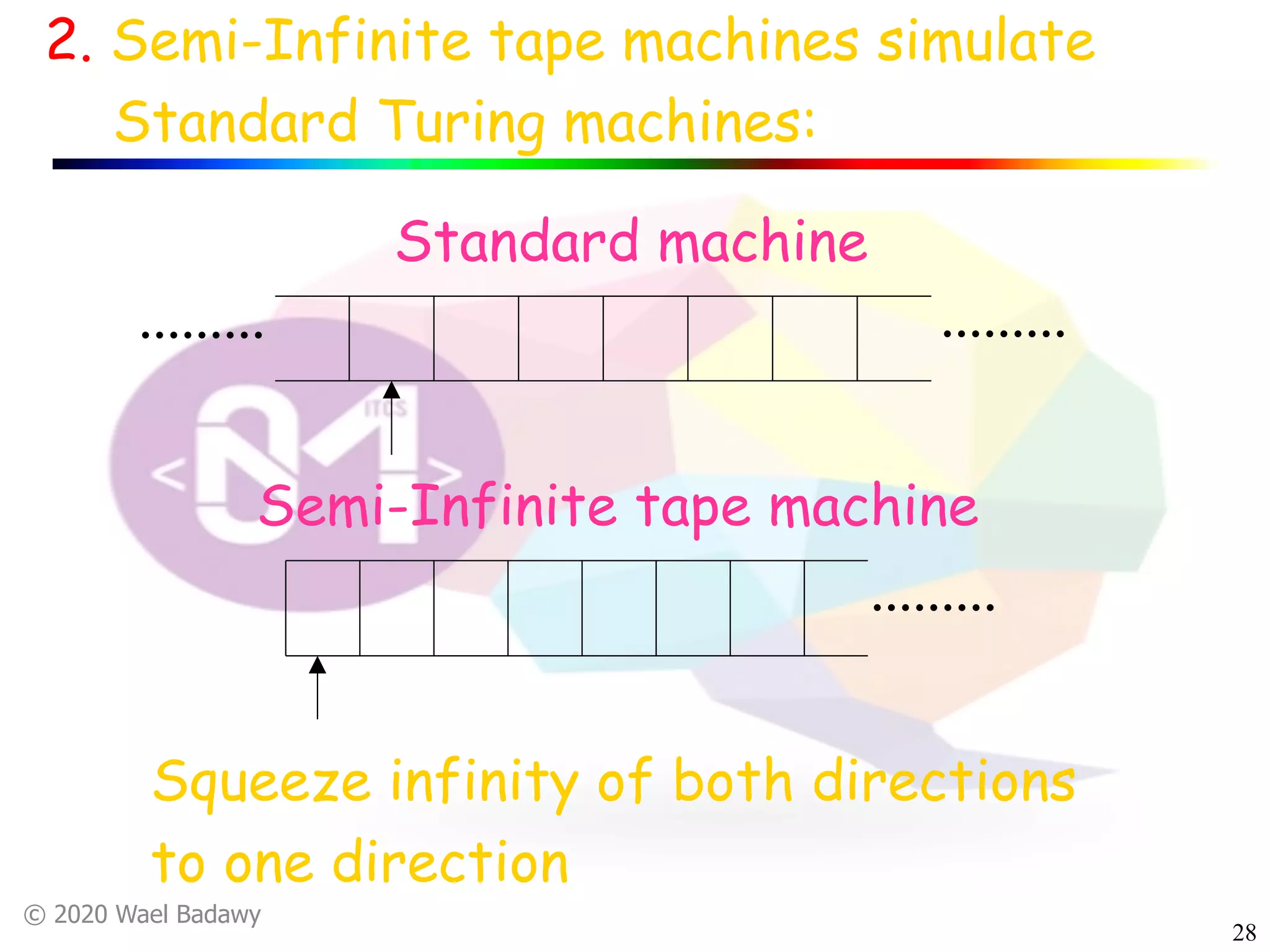
28
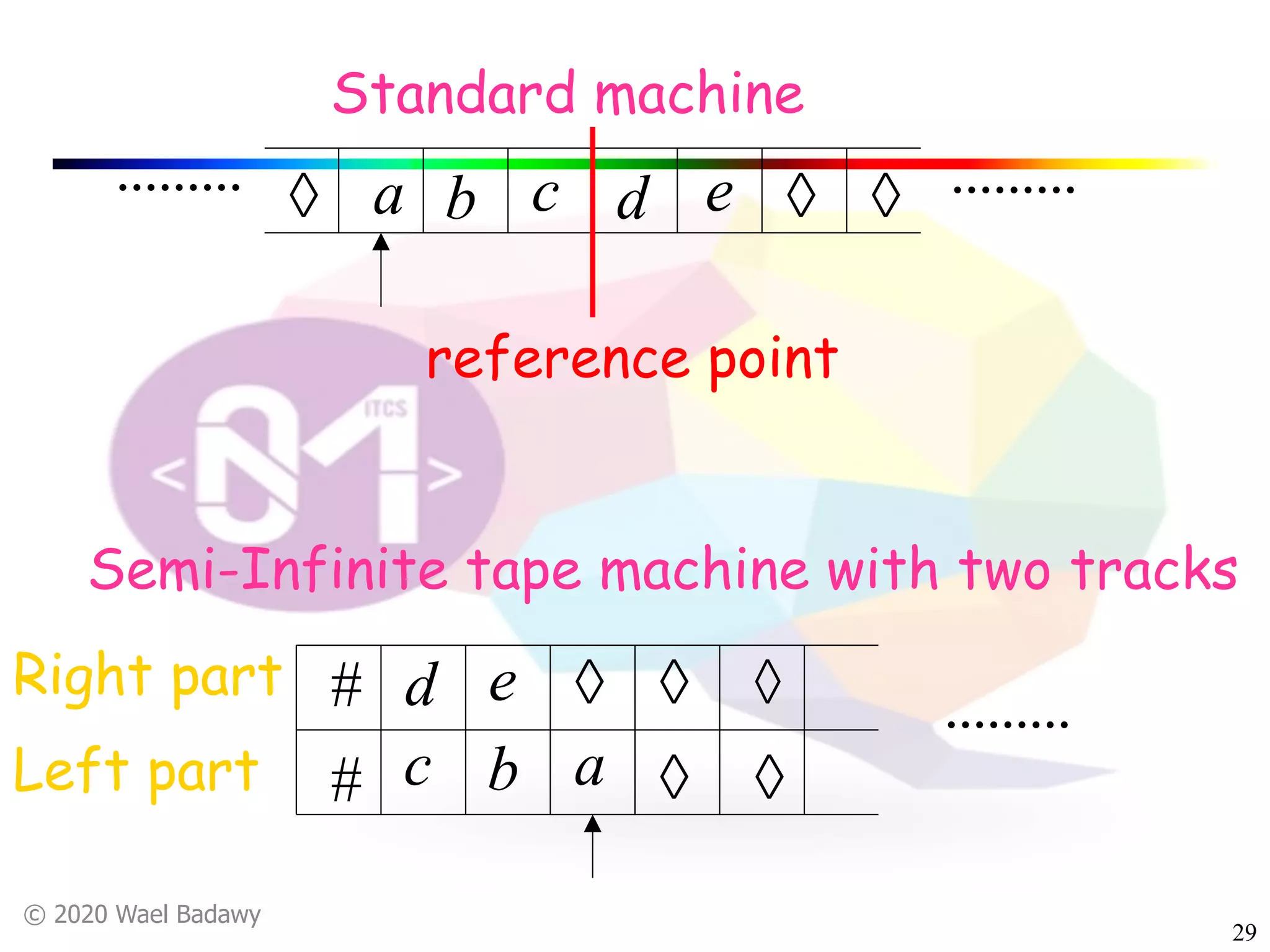
2. Semi-Infinite tape machines simulate
Standard Turing machines:
Standard machine
.........
Semi-Infinite tape machine
..................
Squeeze infinity of both directions
to one direction
© 2020 Wael Badawy
29
Standard machine
.........
Semi-Infinite tape machine with two tracks
..................
reference point
#
#
Right part
Left part
à à àa b c d e
ac b
d e à à
à
à
à
© 2020 Wael Badawy
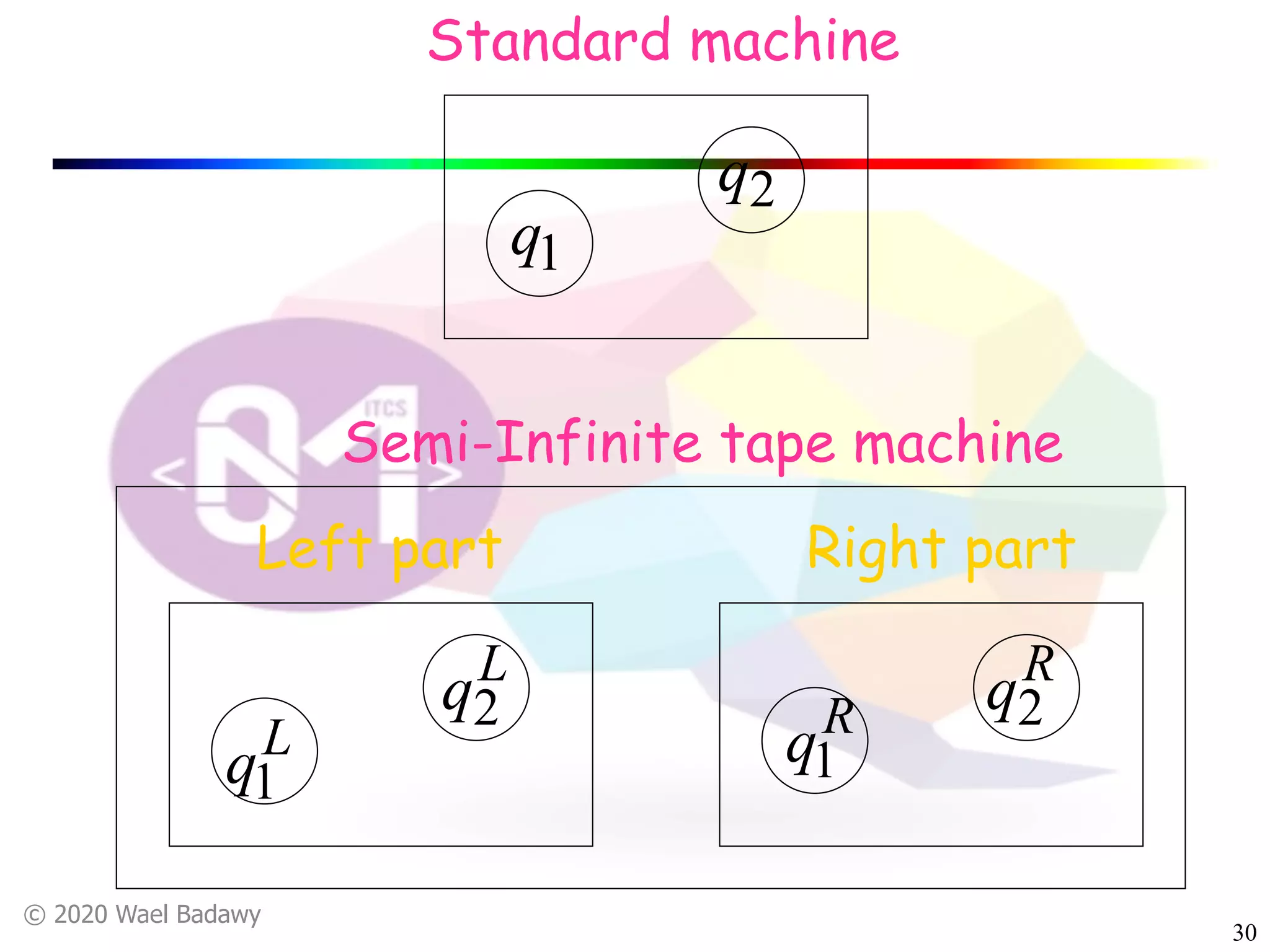
30
1q
2q
R
q2
L
q1
L
q2 R
q1
Left part Right part
Standard machine
Semi-Infinite tape machine
© 2020 Wael Badawy
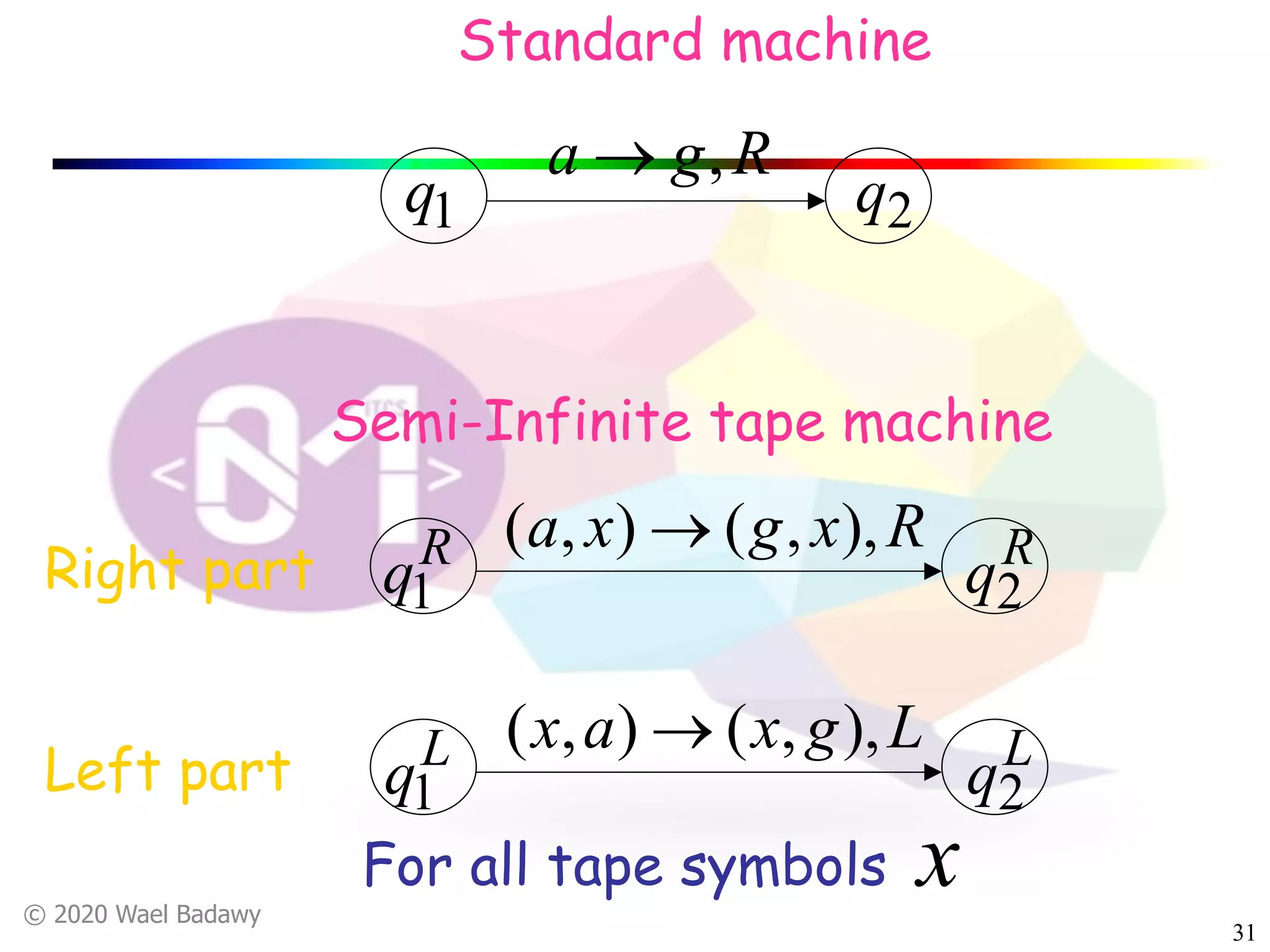
31
1q 2q
Rga ,®
Standard machine
L
q1
L
q2
Lgxax ),,(),( ®
R
q1
R
q2
Rxgxa ),,(),( ®
Semi-Infinite tape machine
Left part
Right part
For all tape symbols x
© 2020 Wael Badawy
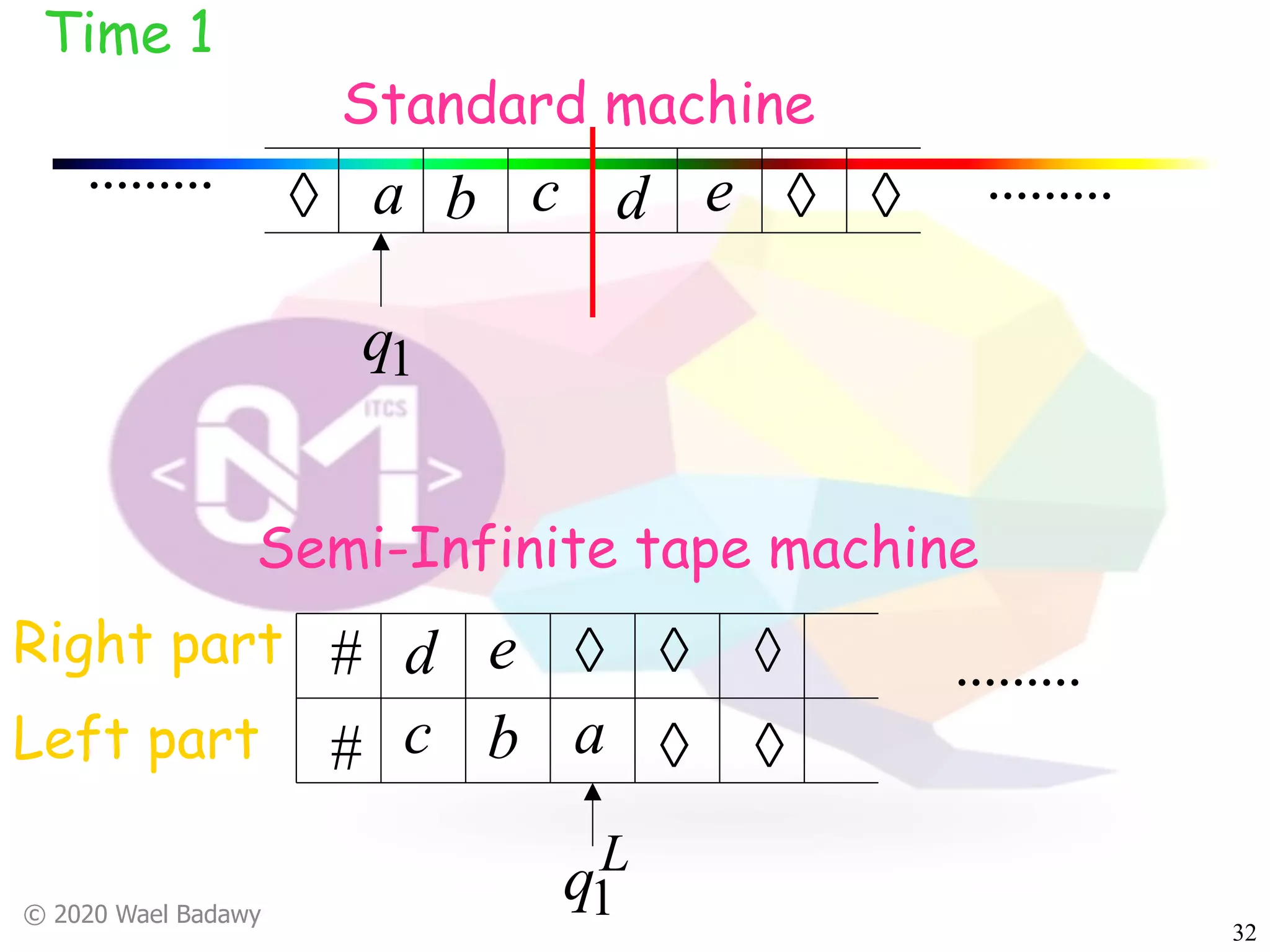
32
Standard machine
..................
à à àa b c d e
1q
.........
Semi-Infinite tape machine
#
#
Right part
Left part ac b
d e à à
à
à
à
L
q1
Time 1
© 2020 Wael Badawy
33
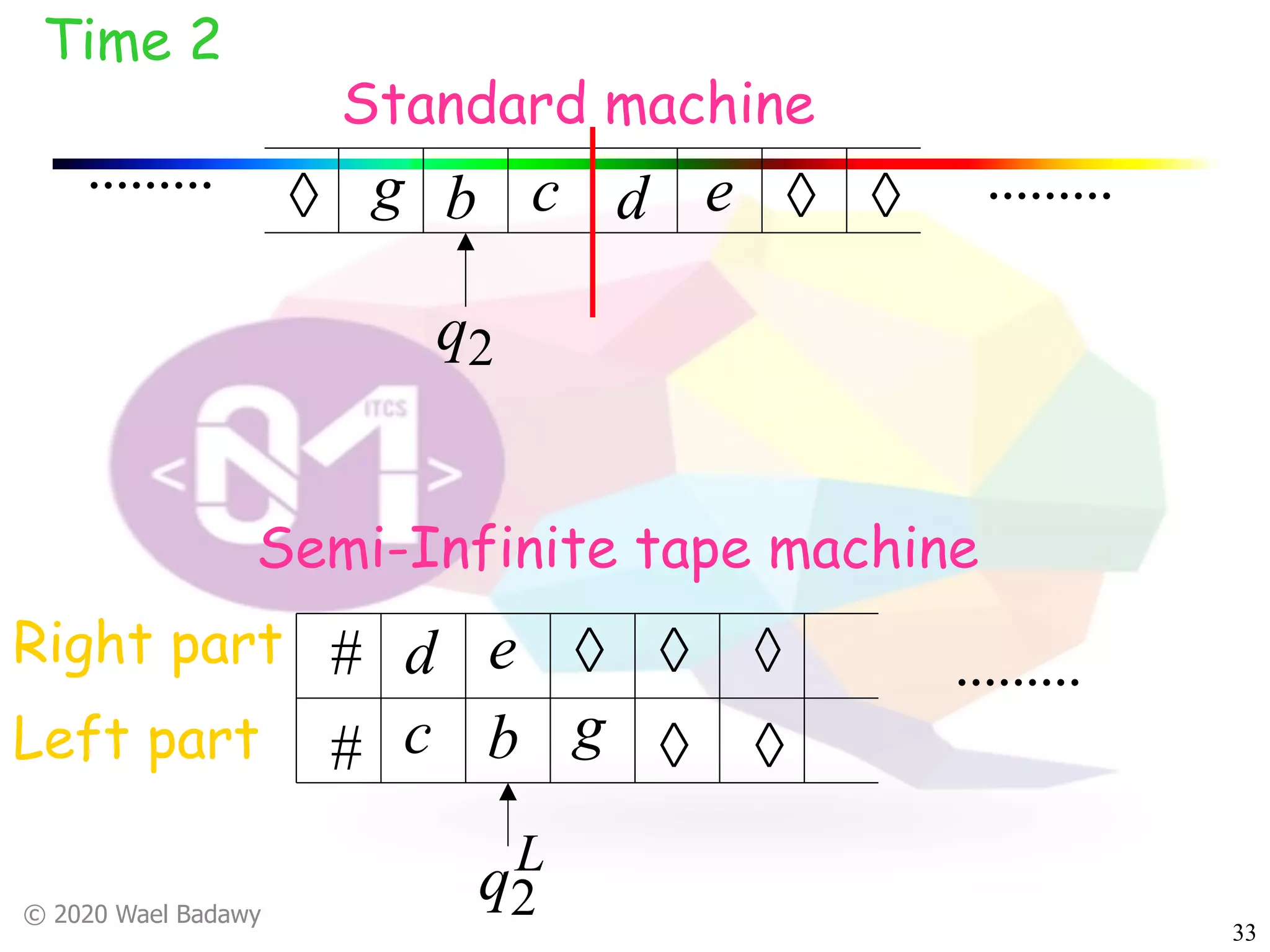
Time 2
à à àg b c d e
2q
#
#
Right part
Left part gc b
d e à à
à
à
à
L
q2
Standard machine
..................
.........
Semi-Infinite tape machine
© 2020 Wael Badawy
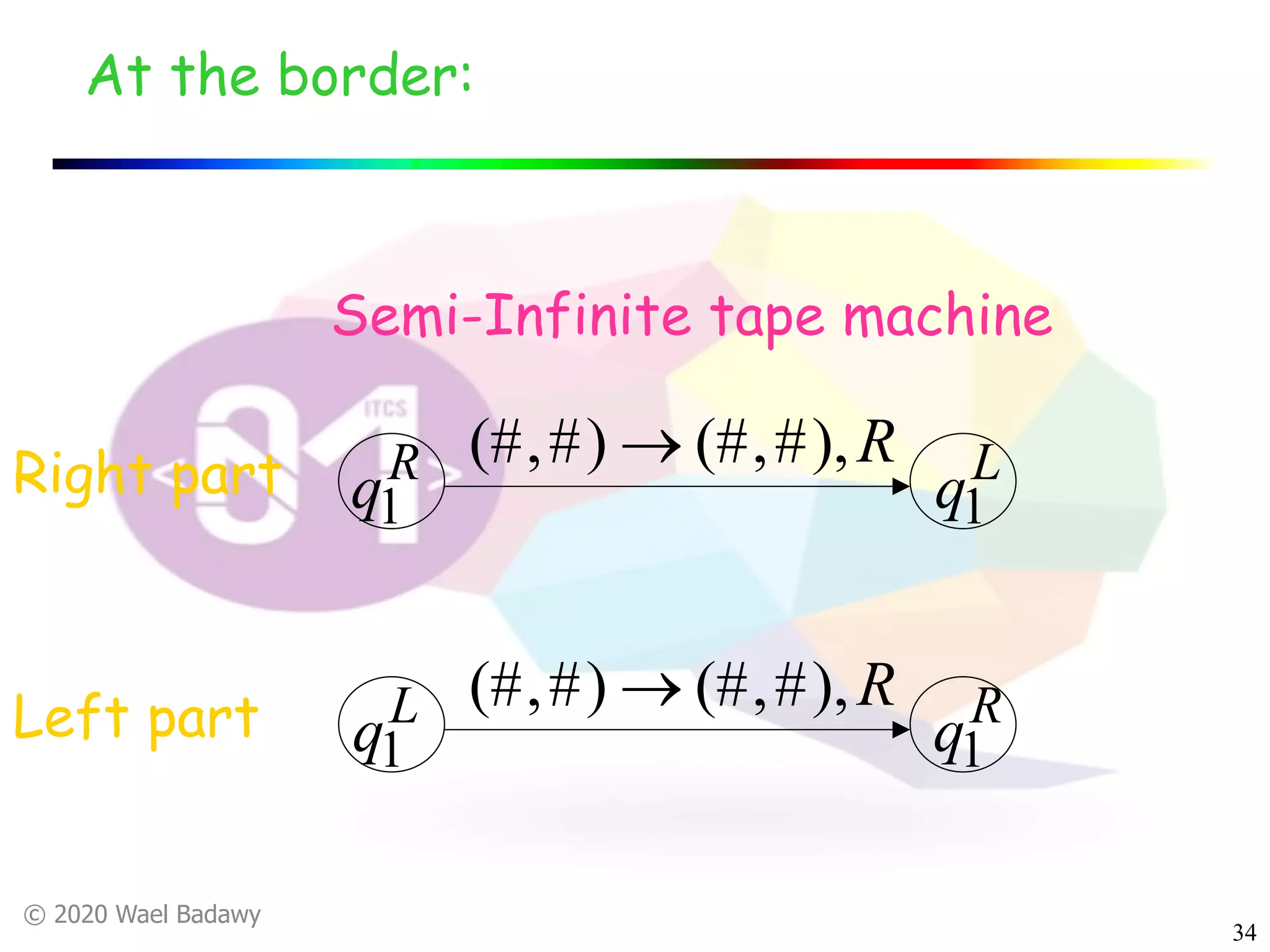
34
L
q1
R
q1
R),#,(#)#,(# ®
Semi-Infinite tape machine
Left part
At the border:
R
q1
L
q1
R),#,(#)#,(# ®Right part
© 2020 Wael Badawy
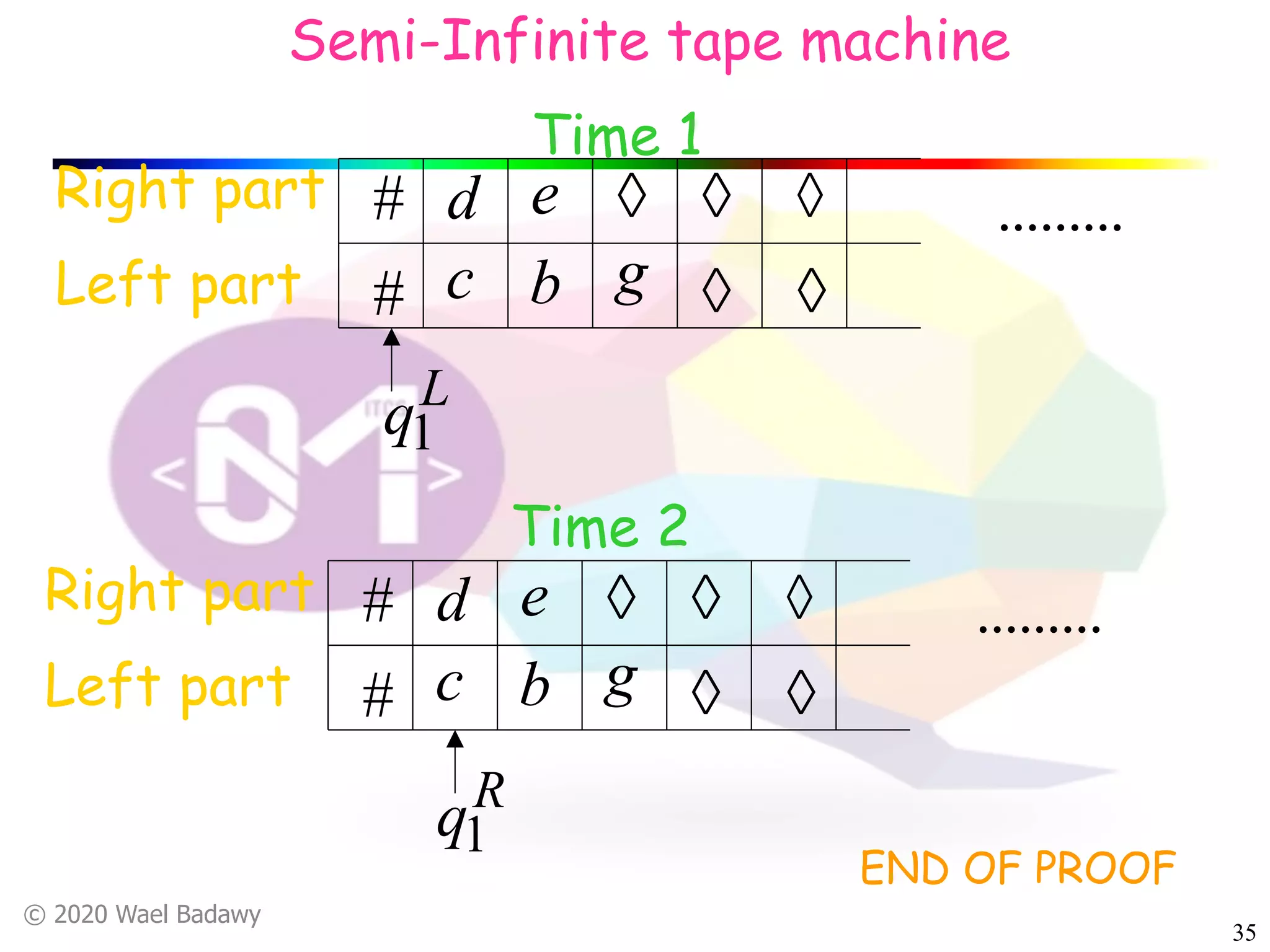
35
.........
Semi-Infinite tape machine
#
#
Right part
Left part gc b
d e à à
à
à
à
L
q1
.........#
#
Right part
Left part gc b
d e à à
à
à
à
R
q1
Time 1
Time 2
END OF PROOF
© 2020 Wael Badawy
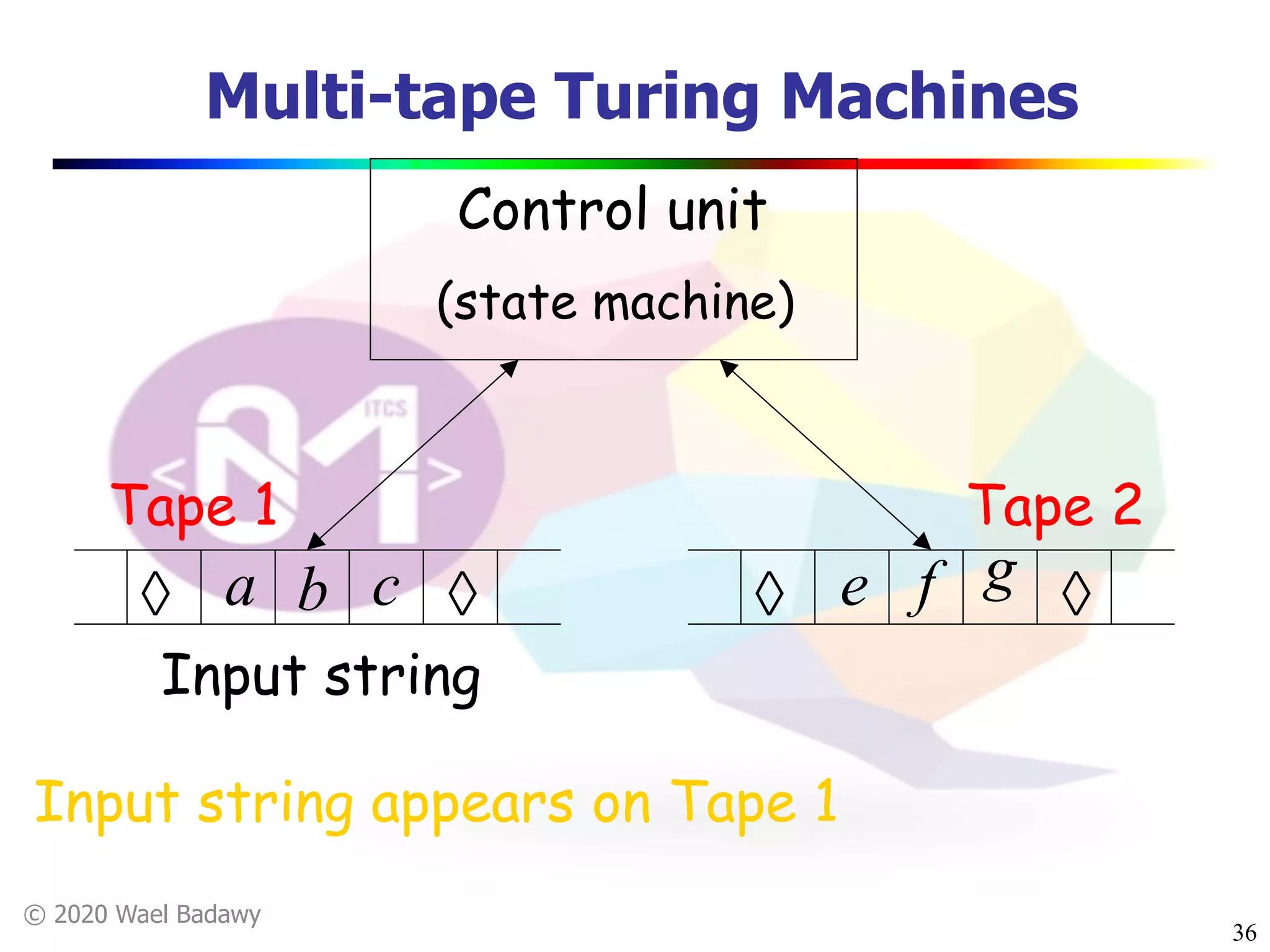
Multi-tape Turing Machines
36
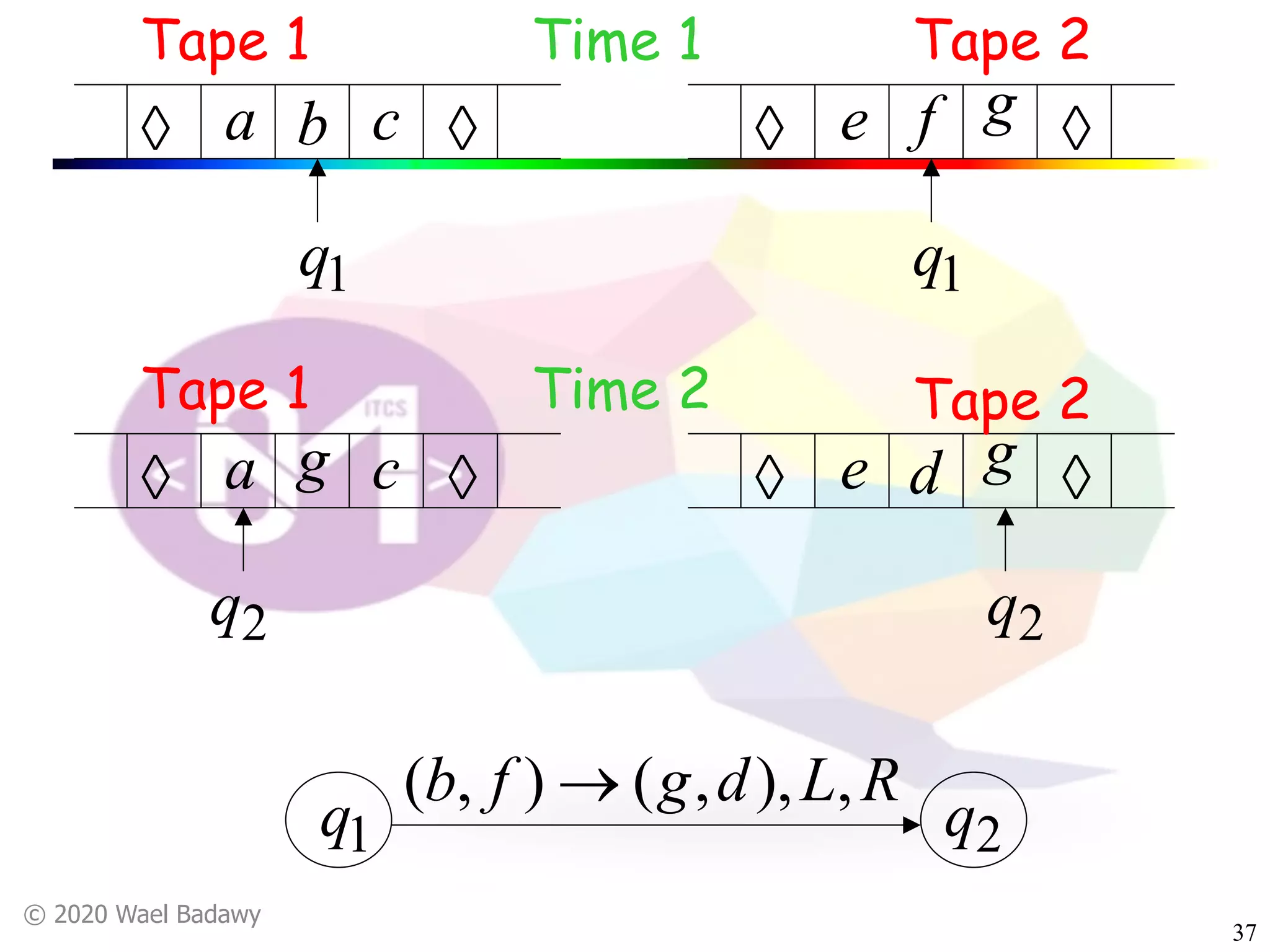
àà a b c àà e f g
Control unit
Tape 1 Tape 2
Input string
Input string appears on Tape 1
(state machine)
© 2020 Wael Badawy
37
àà a b c àà e f g
1q 1q
àà a g c àà e d g
2q 2q
Time 1
Time 2
RLdgfb ,),,(),( ®
1q 2q
Tape 1 Tape 2
Tape 1 Tape 2
© 2020 Wael Badawy
38
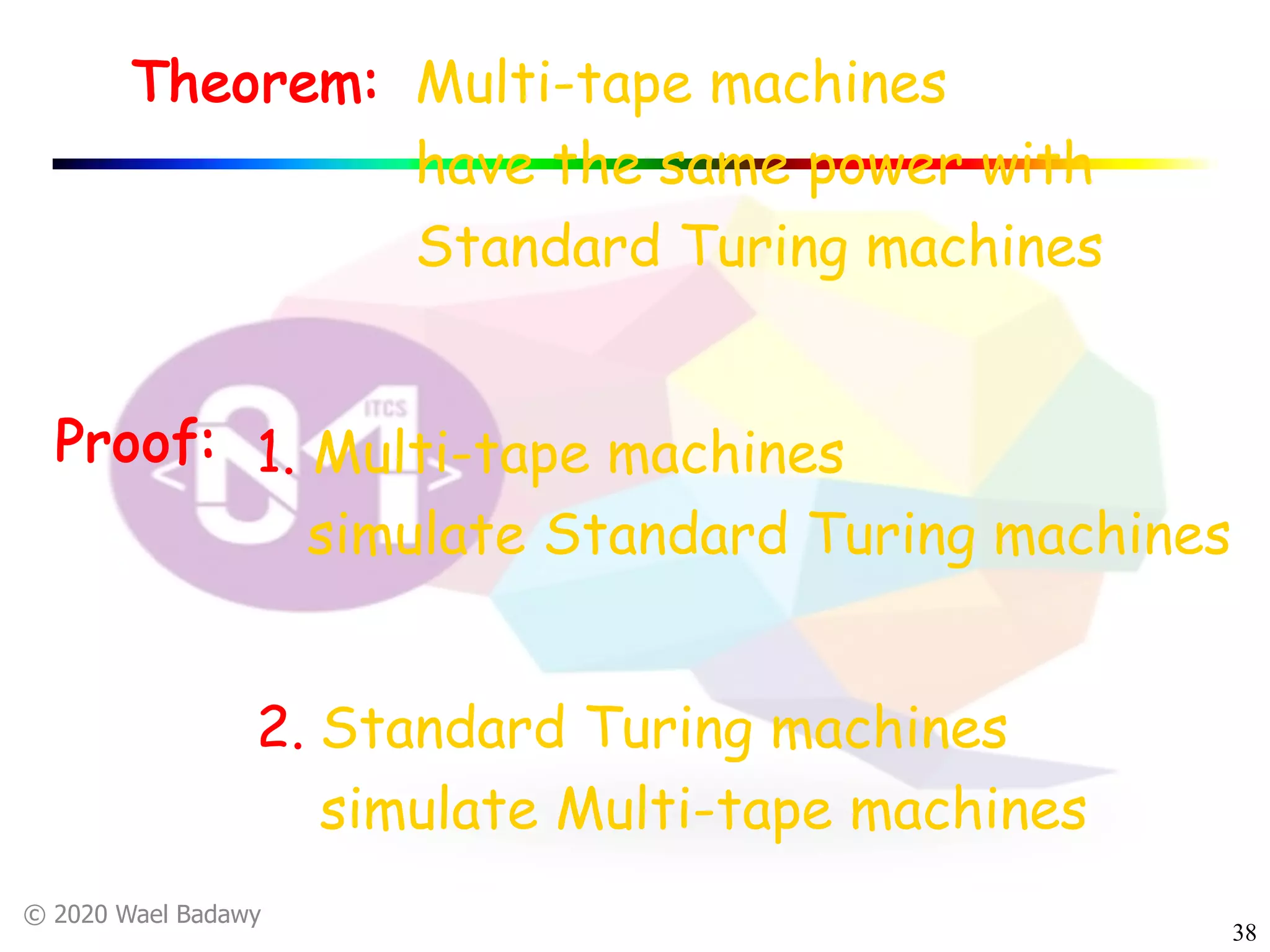
Multi-tape machines
have the same power with
Standard Turing machines
Theorem:
Proof: 1. Multi-tape machines
simulate Standard Turing machines
2. Standard Turing machines
simulate Multi-tape machines
© 2020 Wael Badawy
39
1. Multi-tape machines simulate
Standard Turing Machines:
Trivial: Use one tape
© 2020 Wael Badawy
40
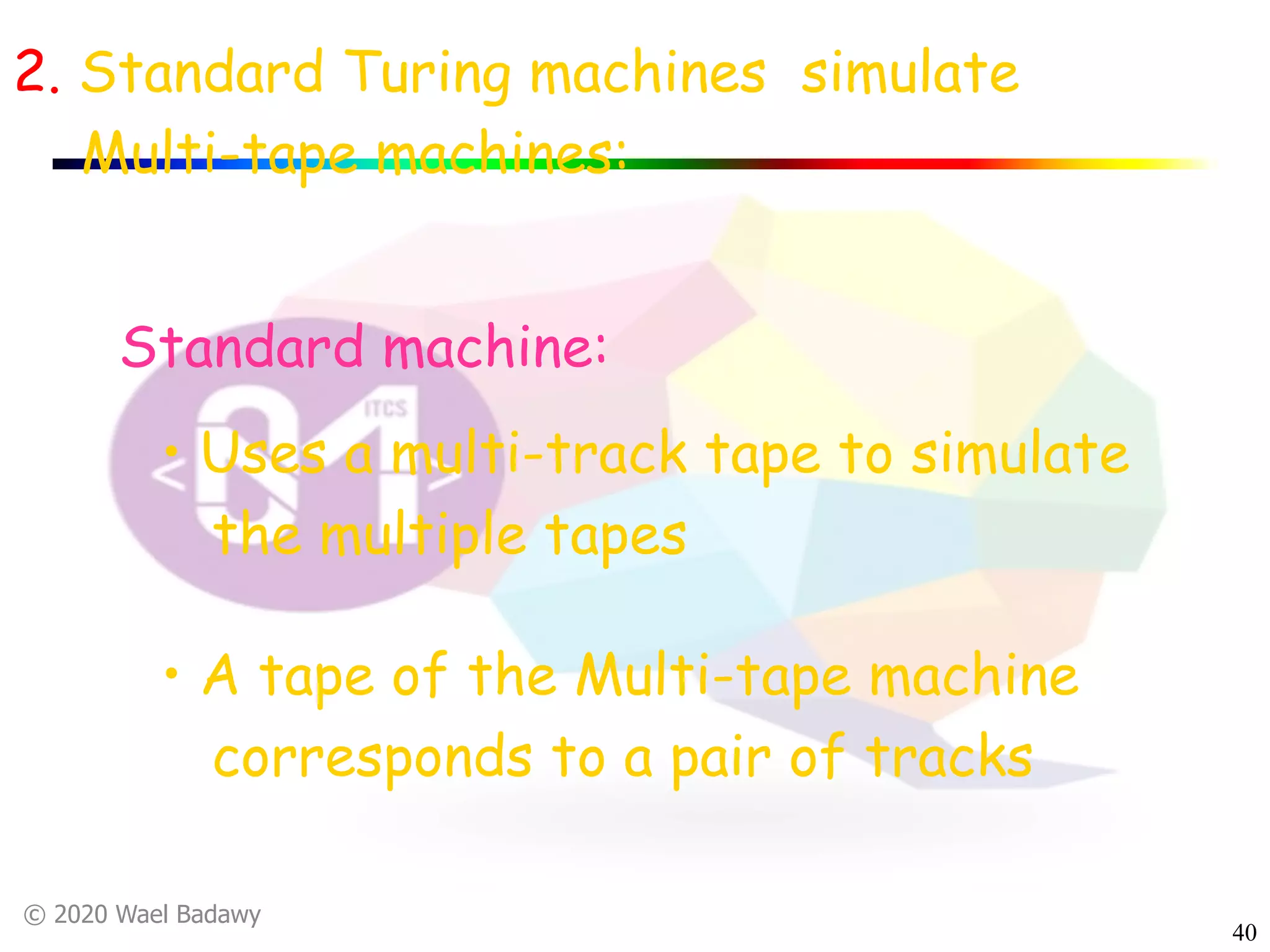
2. Standard Turing machines simulate
Multi-tape machines:
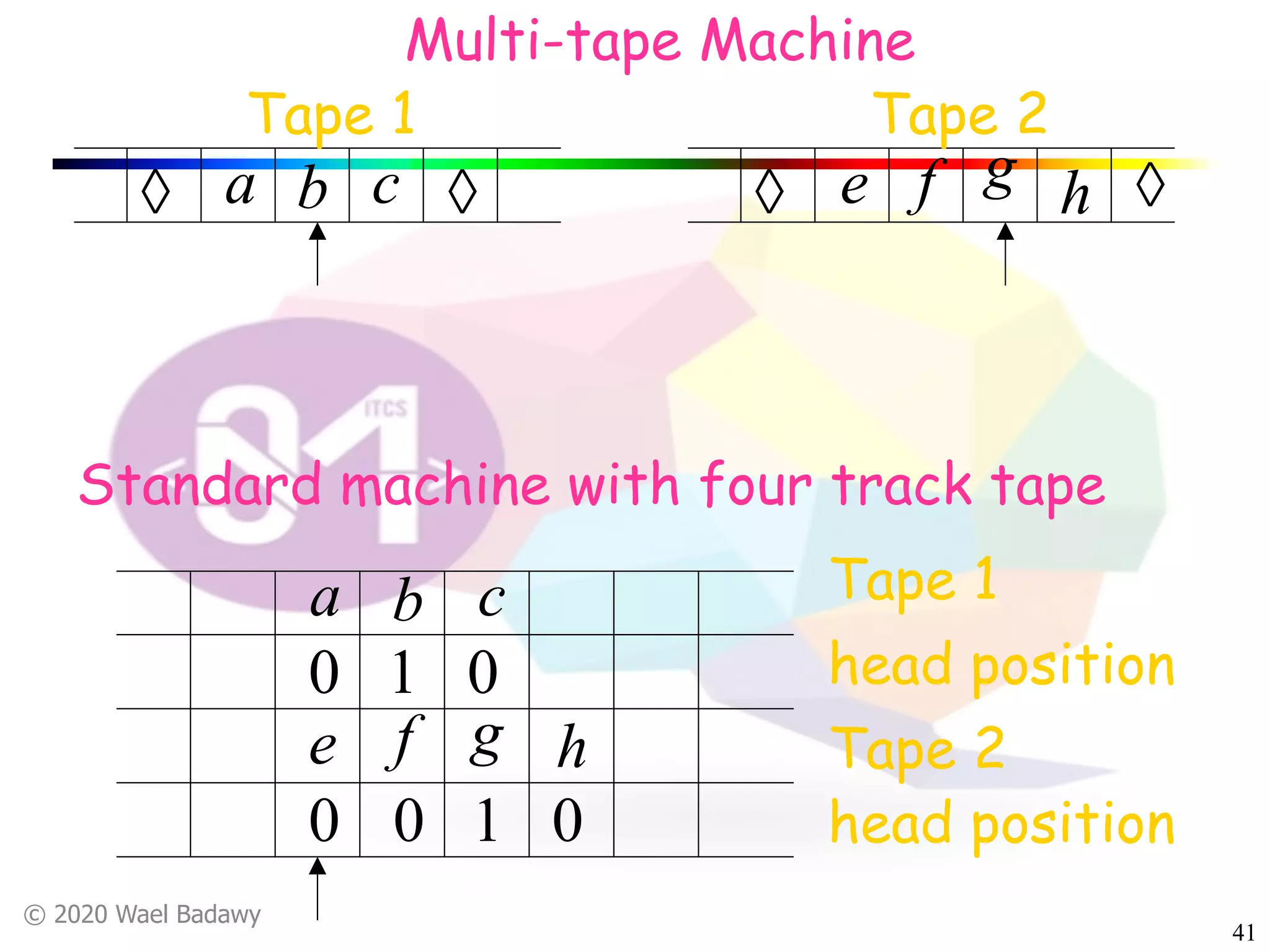
• Uses a multi-track tape to simulate
the multiple tapes
• A tape of the Multi-tape machine
corresponds to a pair of tracks
Standard machine:
© 2020 Wael Badawy
41
àà a b c hà e f g à
Multi-tape Machine
Tape 1 Tape 2
Standard machine with four track tape
a b c
e f g
0 0
0 0
1
1
Tape 1
head position
Tape 2
head position
h
0
© 2020 Wael Badawy
42
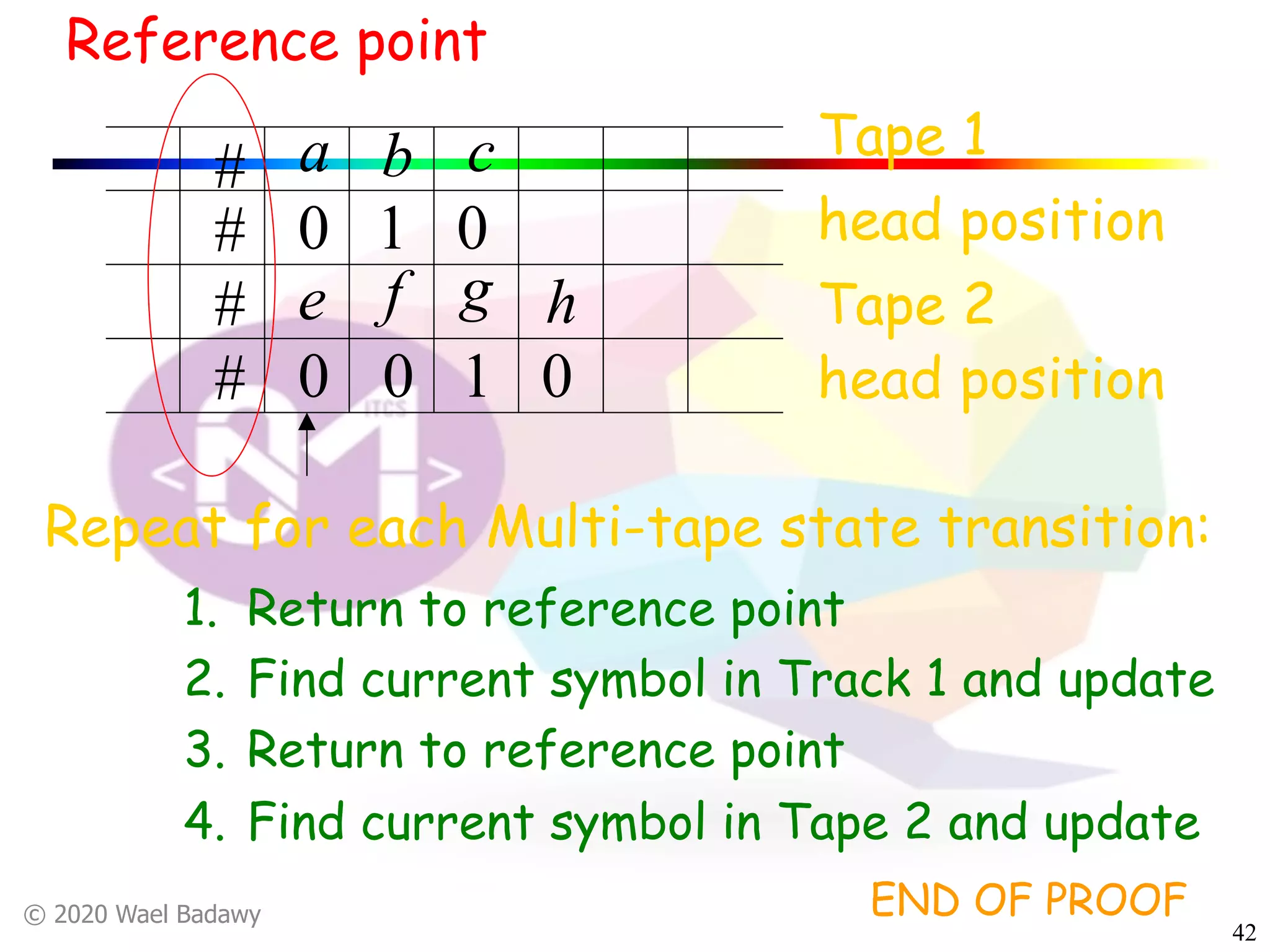
Repeat for each Multi-tape state transition:
1. Return to reference point
2. Find current symbol in Track 1 and update
3. Return to reference point
4. Find current symbol in Tape 2 and update
a b c
e f g
0 0
0 0
1
1
Tape 1
head position
Tape 2
head position
h
0
#
#
#
#
Reference point
END OF PROOF
© 2020 Wael Badawy
43
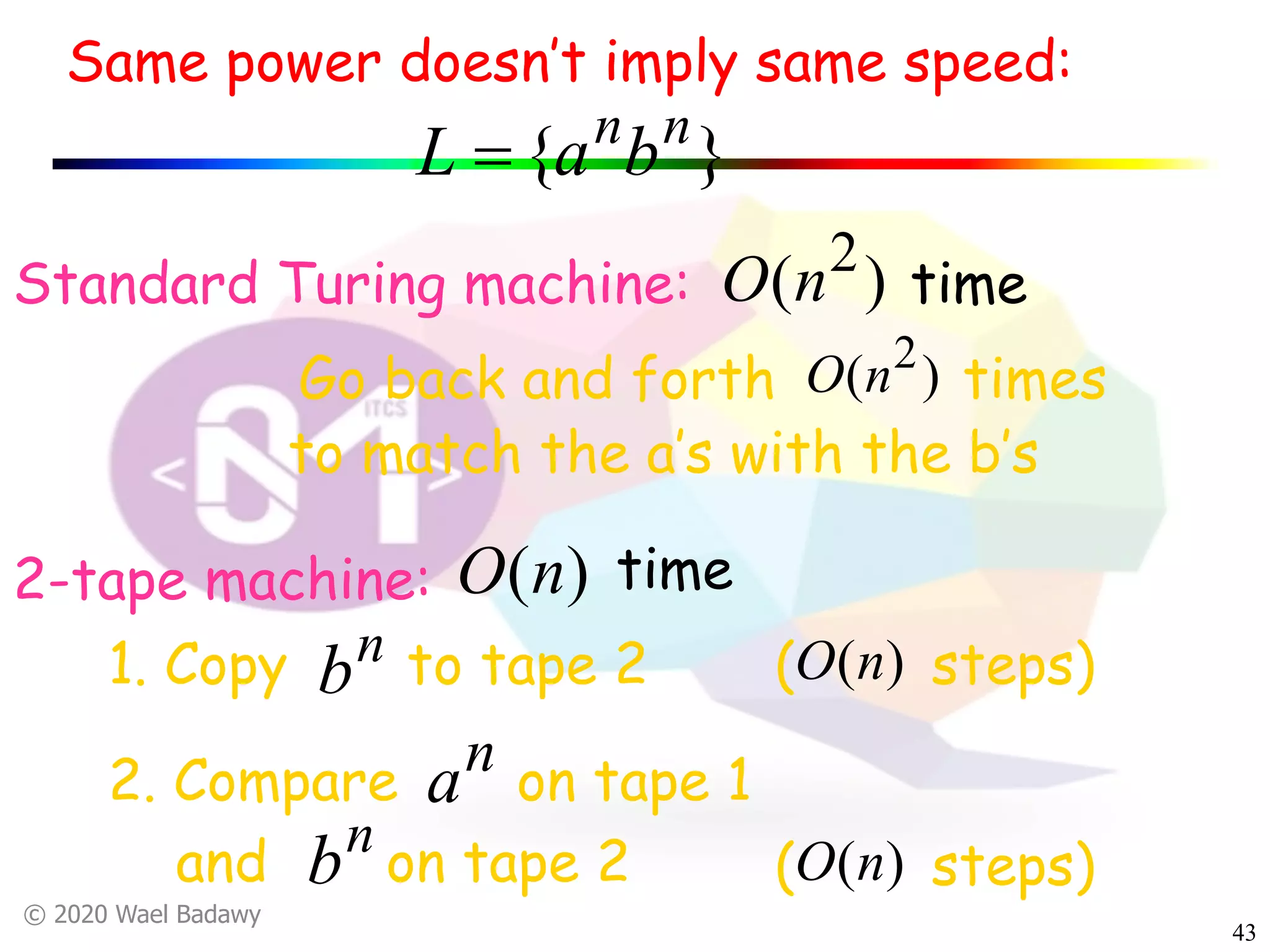
( steps)
}{ nn
baL =
Standard Turing machine:
Go back and forth times)( 2
nO
2-tape machine:
1. Copy to tape 2n
b
2. Compare on tape 1
and on tape 2
)(nO
n
b
n
a
to match the a’s with the b’s
( steps))(nO
)( 2
nO time
)(nO time
Same power doesn’t imply same speed:
© 2020 Wael Badawy
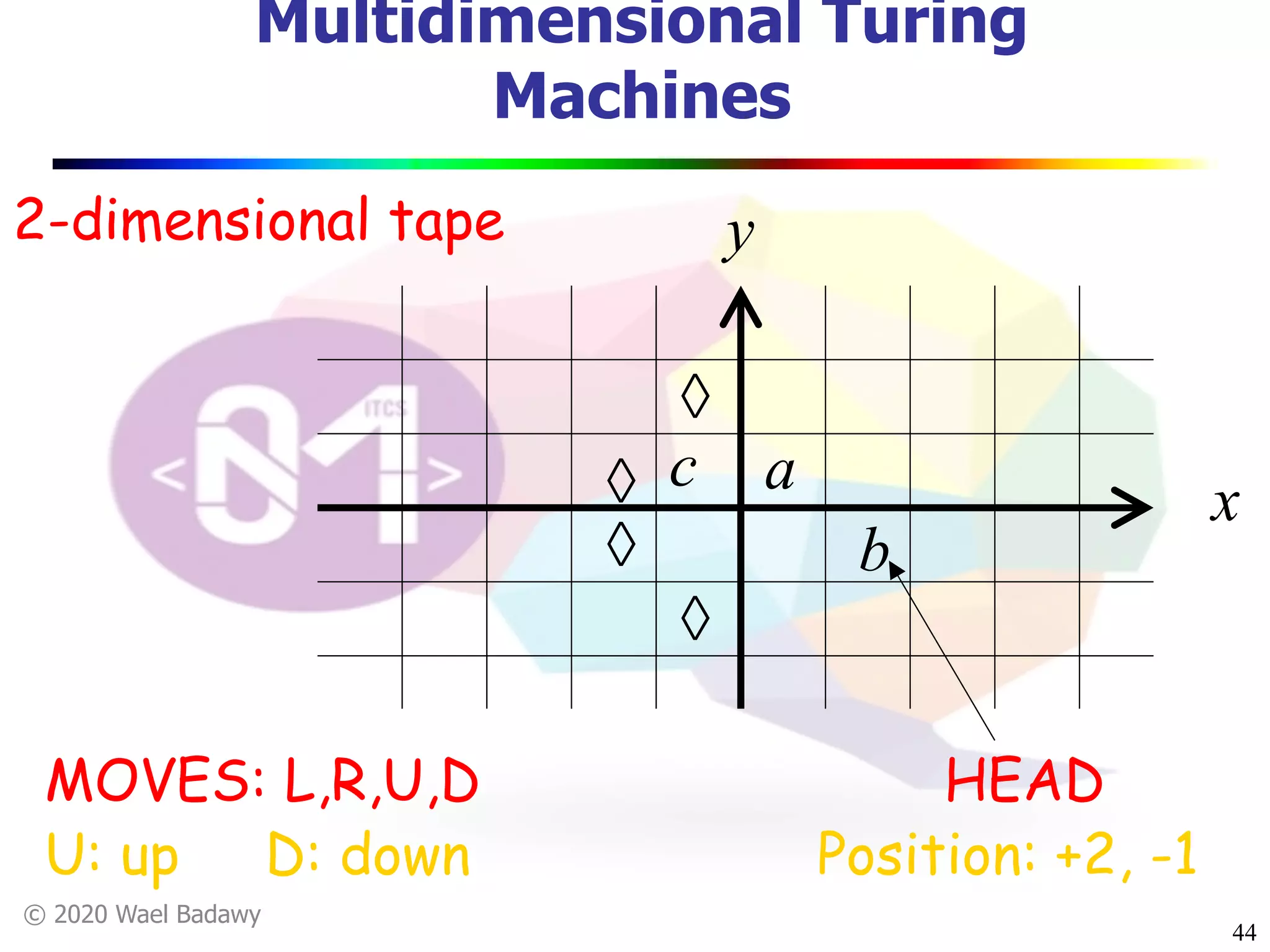
Multidimensional Turing
Machines
44
x
y
a
b
c
2-dimensional tape
HEAD
Position: +2, -1
MOVES: L,R,U,D
U: up D: down
à
à
à
à
© 2020 Wael Badawy
45
Multidimensional machines
have the same power with
Standard Turing machines
Theorem:
Proof: 1. Multidimensional machines
simulate Standard Turing machines
2. Standard Turing machines
simulate Multi-Dimensional machines
© 2020 Wael Badawy
46
1. Multidimensional machines simulate
Standard Turing machines
Trivial: Use one dimension
© 2020 Wael Badawy
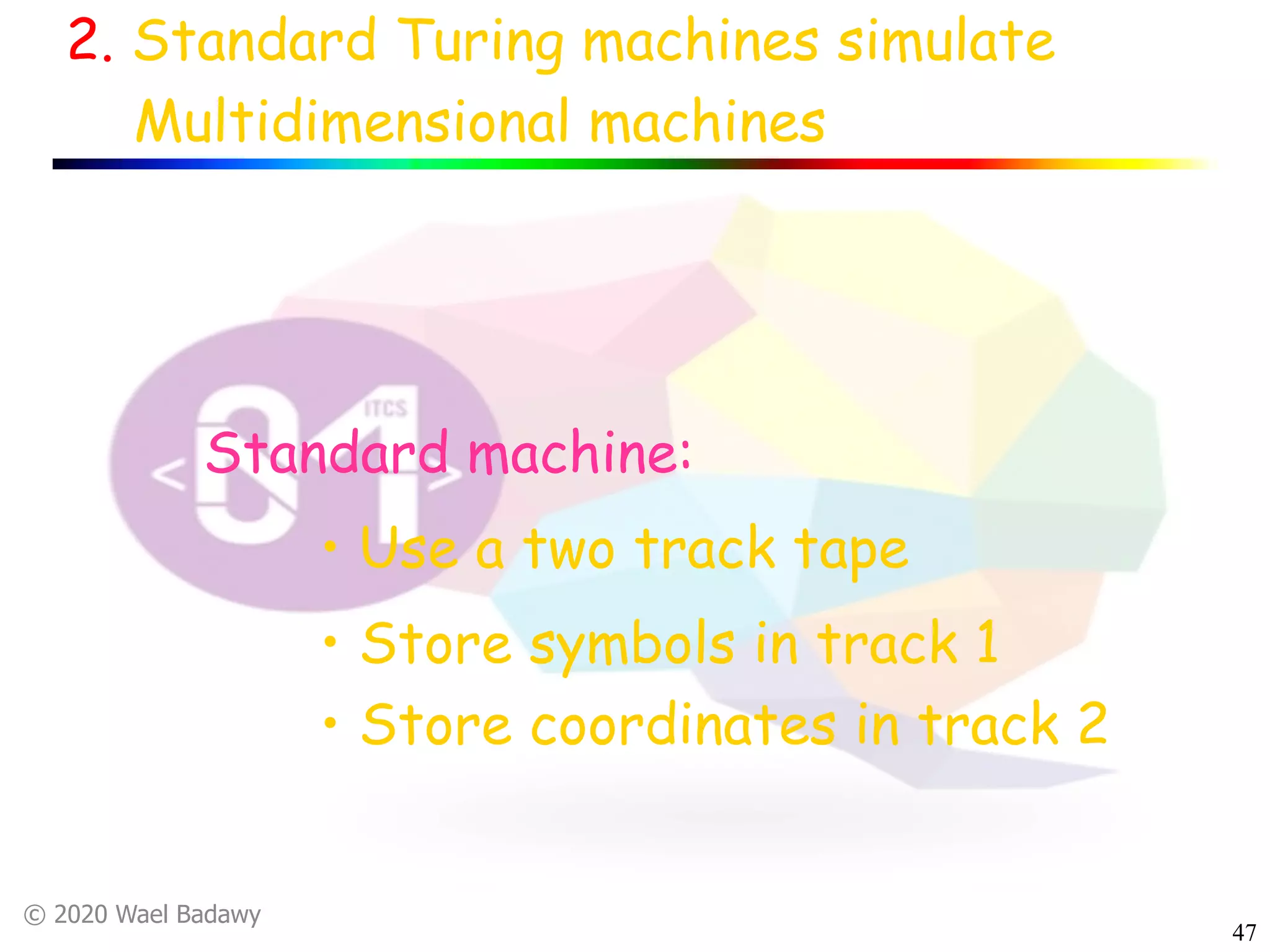
47
2. Standard Turing machines simulate
Multidimensional machines
Standard machine:
• Use a two track tape
• Store symbols in track 1
• Store coordinates in track 2
© 2020 Wael Badawy
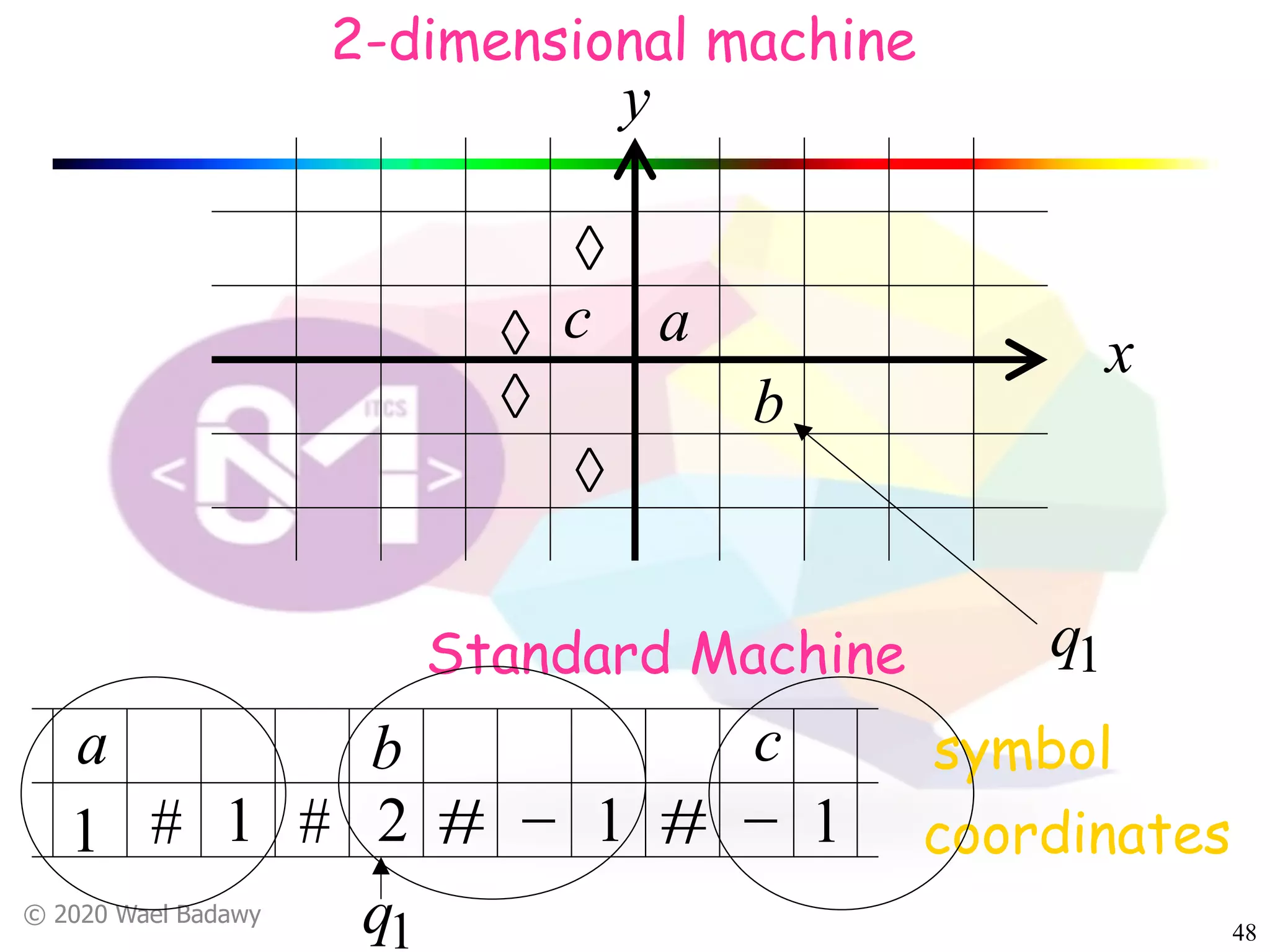
48
x
y
a
b
cà
à
à
à
a
1
b
#
symbol
coordinates
2-dimensional machine
Standard Machine
1 # 2 # 1-
c
# -
1q
1q
1
© 2020 Wael Badawy
49
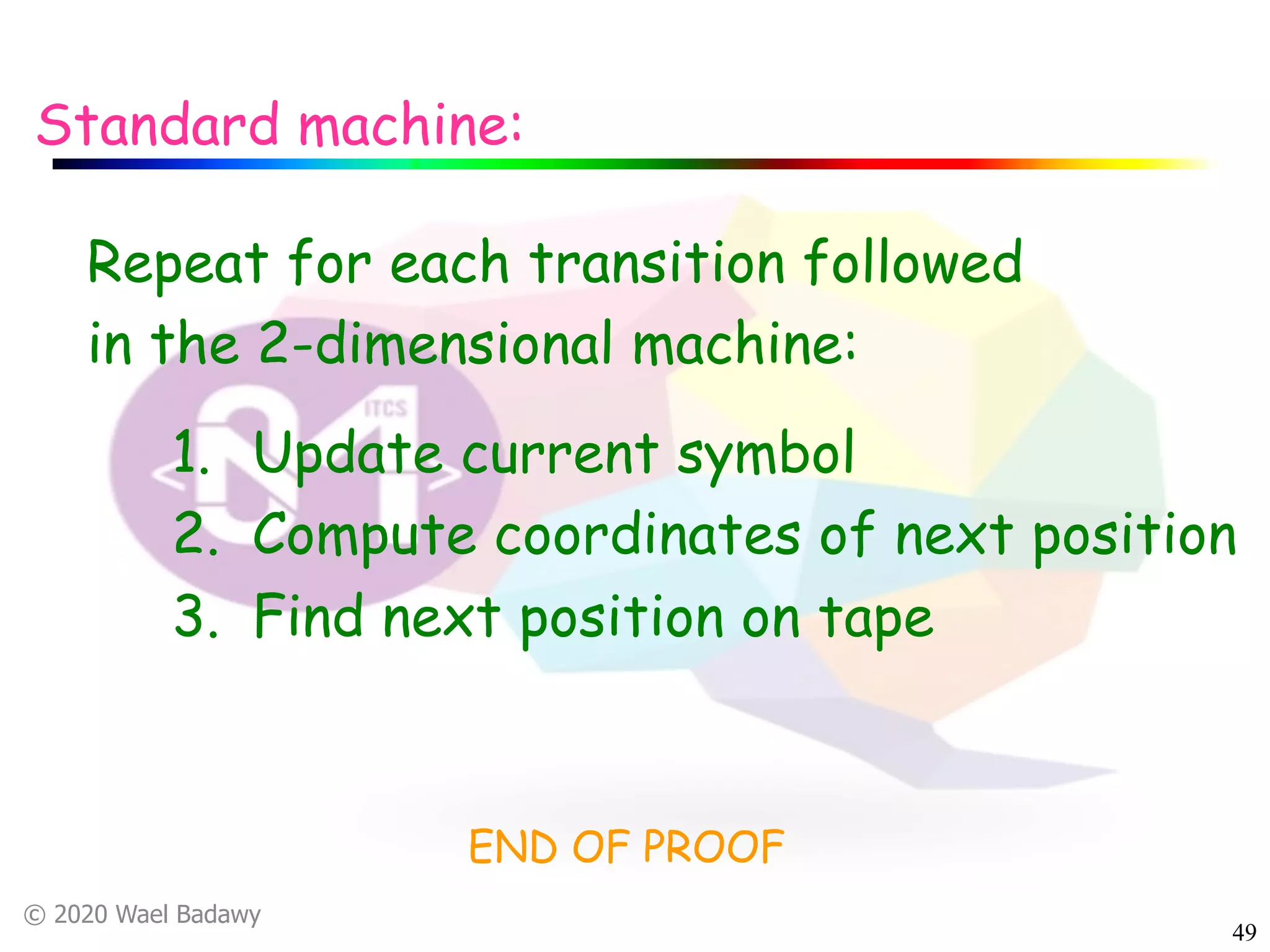
Repeat for each transition followed
in the 2-dimensional machine:
1. Update current symbol
2. Compute coordinates of next position
3. Find next position on tape
Standard machine:
END OF PROOF
© 2020 Wael Badawy
Nondeterministic Turing
Machines
50
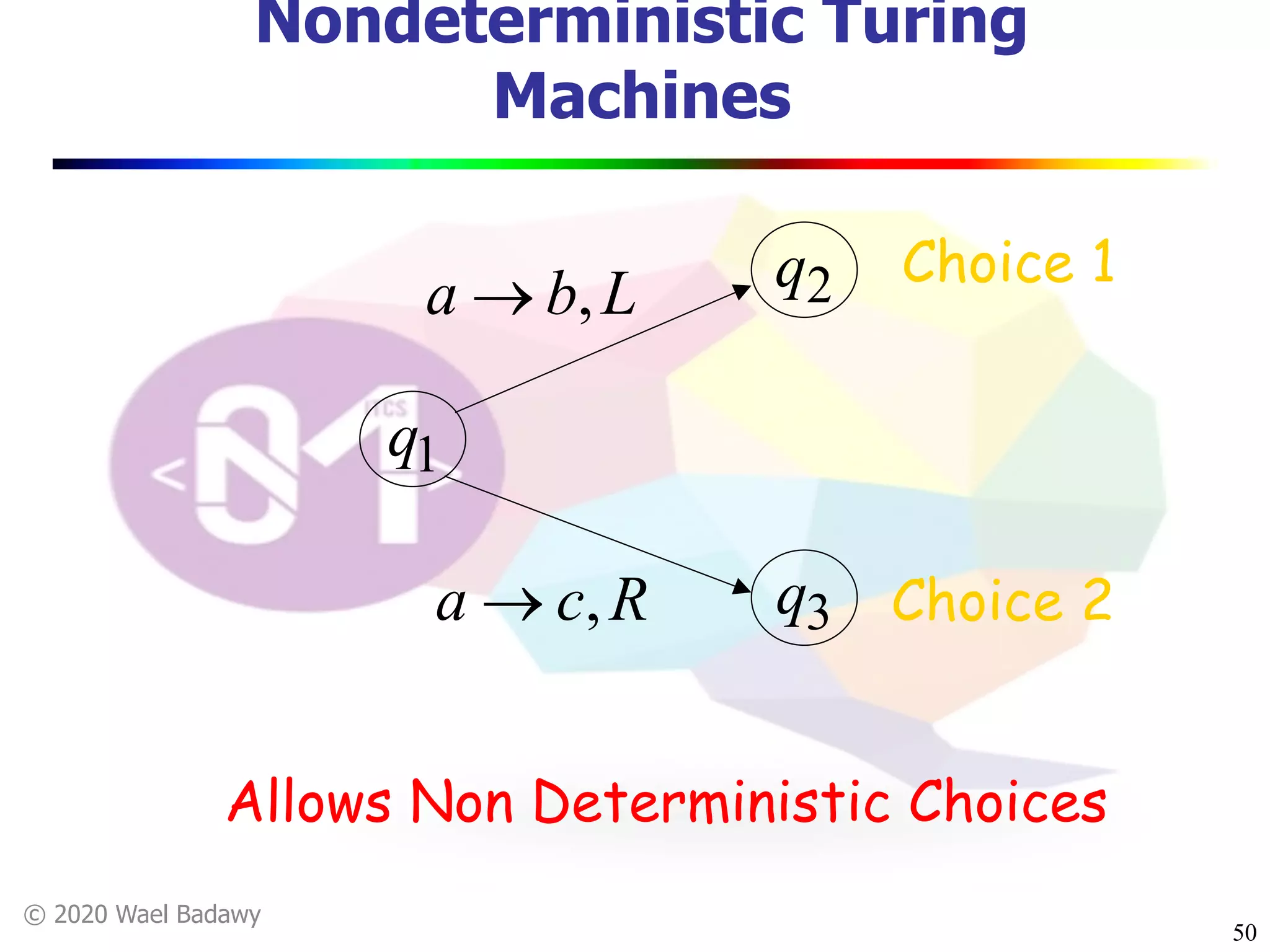
Lba ,®
Rca ,®
1q
2q
3q
Allows Non Deterministic Choices
Choice 1
Choice 2
© 2020 Wael Badawy
51
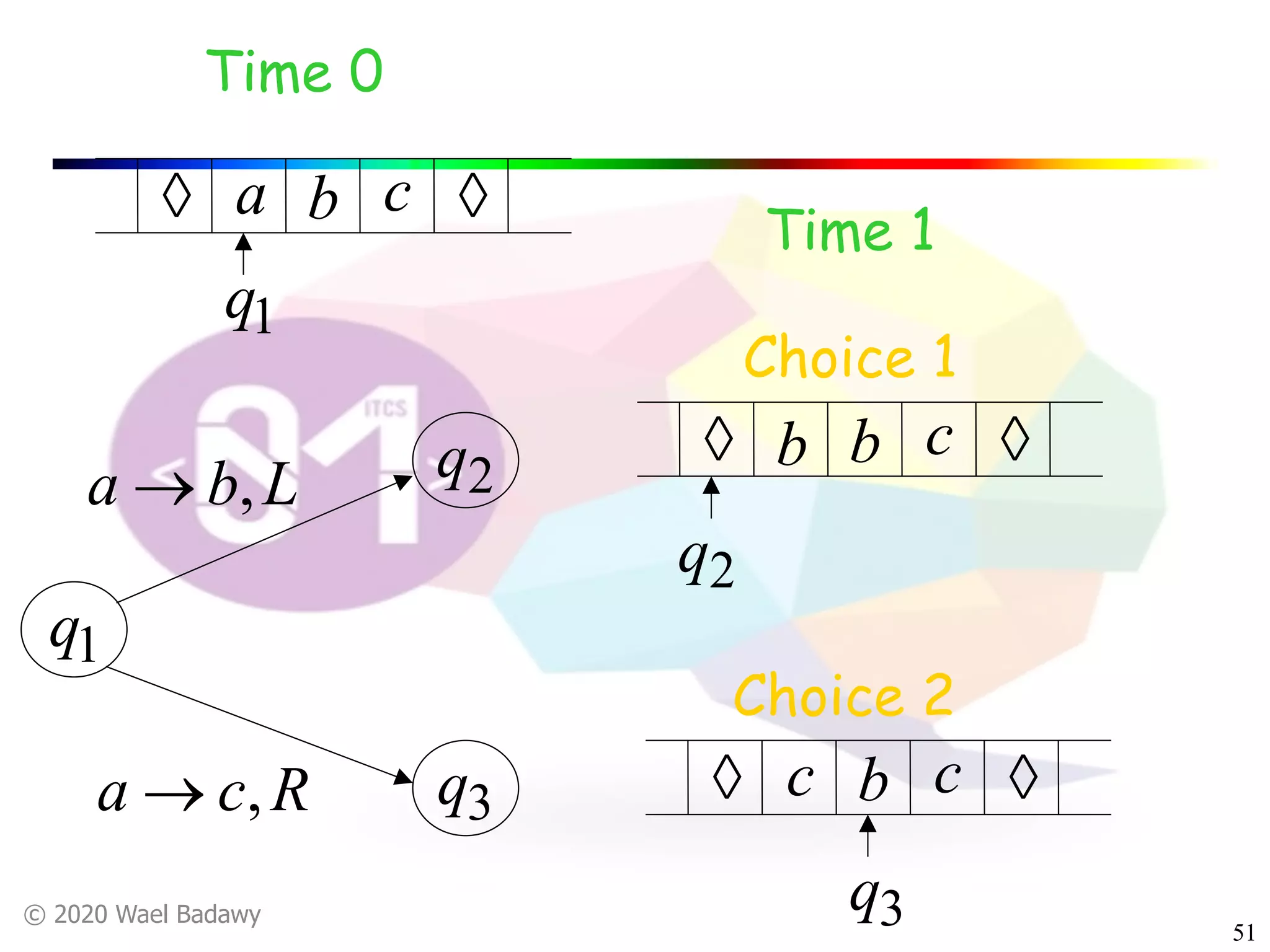
a b cà à
1q
Lba ,®
Rca ,®
1q
2q
3q
Time 0
Time 1
b b cà à
2q
c b cà à
3q
Choice 1
Choice 2
© 2020 Wael Badawy
52
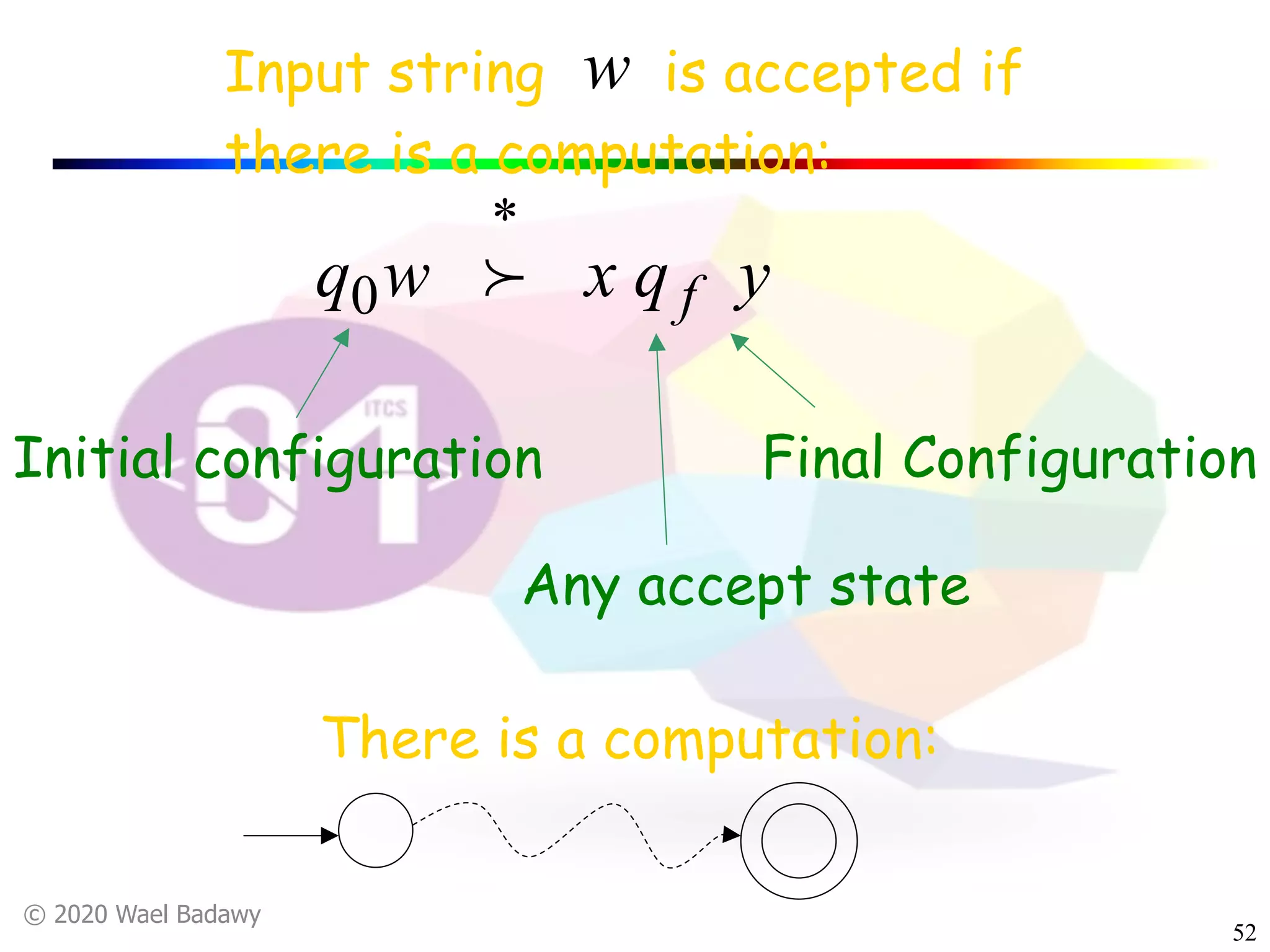
Input string is accepted if
there is a computation:
w
yqxwq f
*
!0
Initial configuration Final Configuration
Any accept state
There is a computation:
© 2020 Wael Badawy
53
Nondeterministic machines
have the same power with
Standard Turing machines
Theorem:
Proof: 1. Nondeterministic machines
simulate Standard Turing machines
2. Standard Turing machines
simulate Nondeterministic machines
© 2020 Wael Badawy
54
1. Nondeterministic Machines simulate
Standard (deterministic) Turing Machines
Trivial: every deterministic machine
is also nondeterministic
© 2020 Wael Badawy
55
2. Standard (deterministic) Turing machines
simulate Nondeterministic machines:
• Stores all possible computations
of the non-deterministic machine
on the 2-dimensional tape
Deterministic machine:
• Uses a 2-dimensional tape
(equivalent to standard Turing machine with one tape)
© 2020 Wael Badawy
56
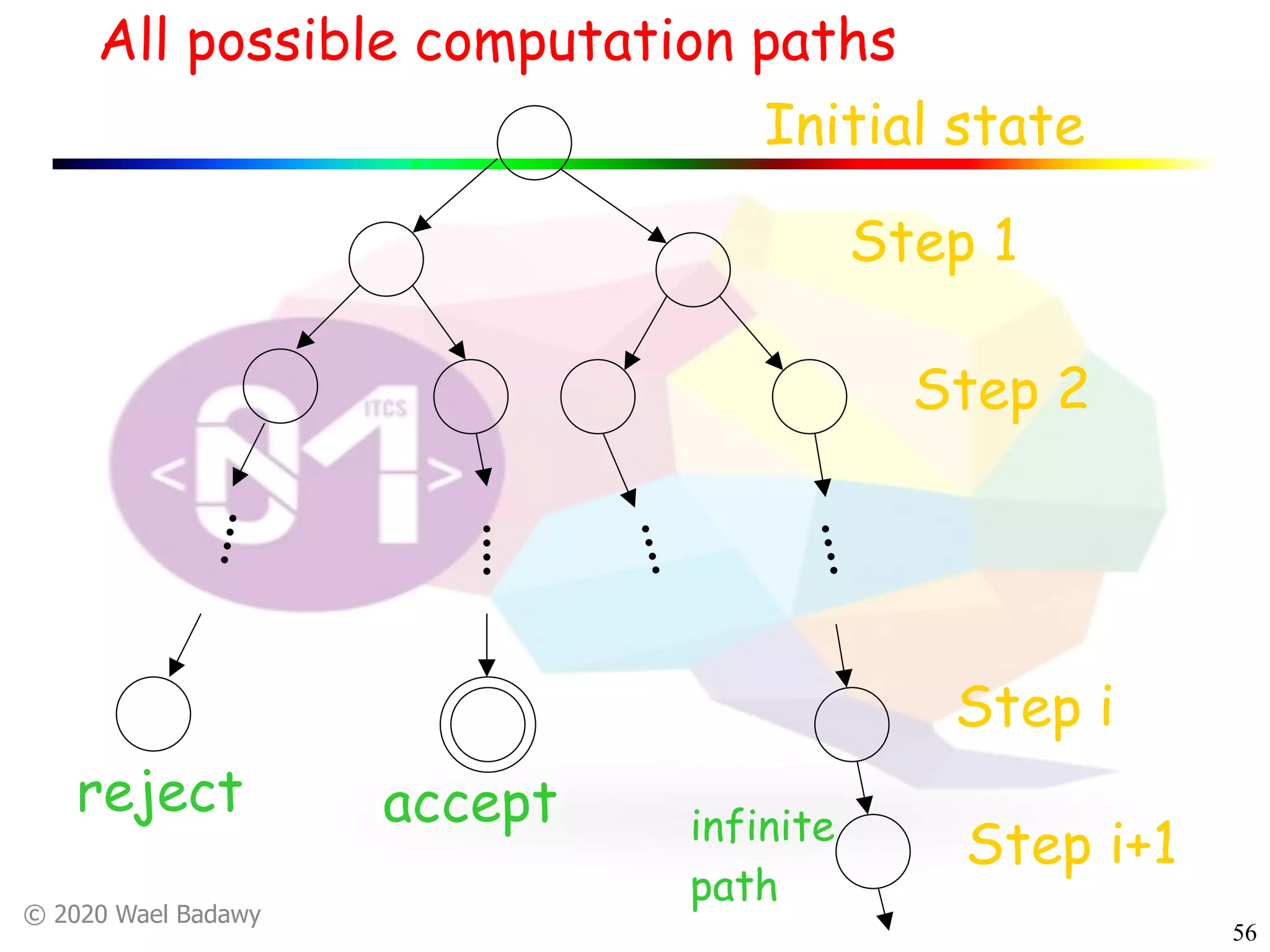
All possible computation paths
Initial state
Step 1
Step 2
Step i
Step i+1
acceptreject
infinite
path
© 2020 Wael Badawy
57
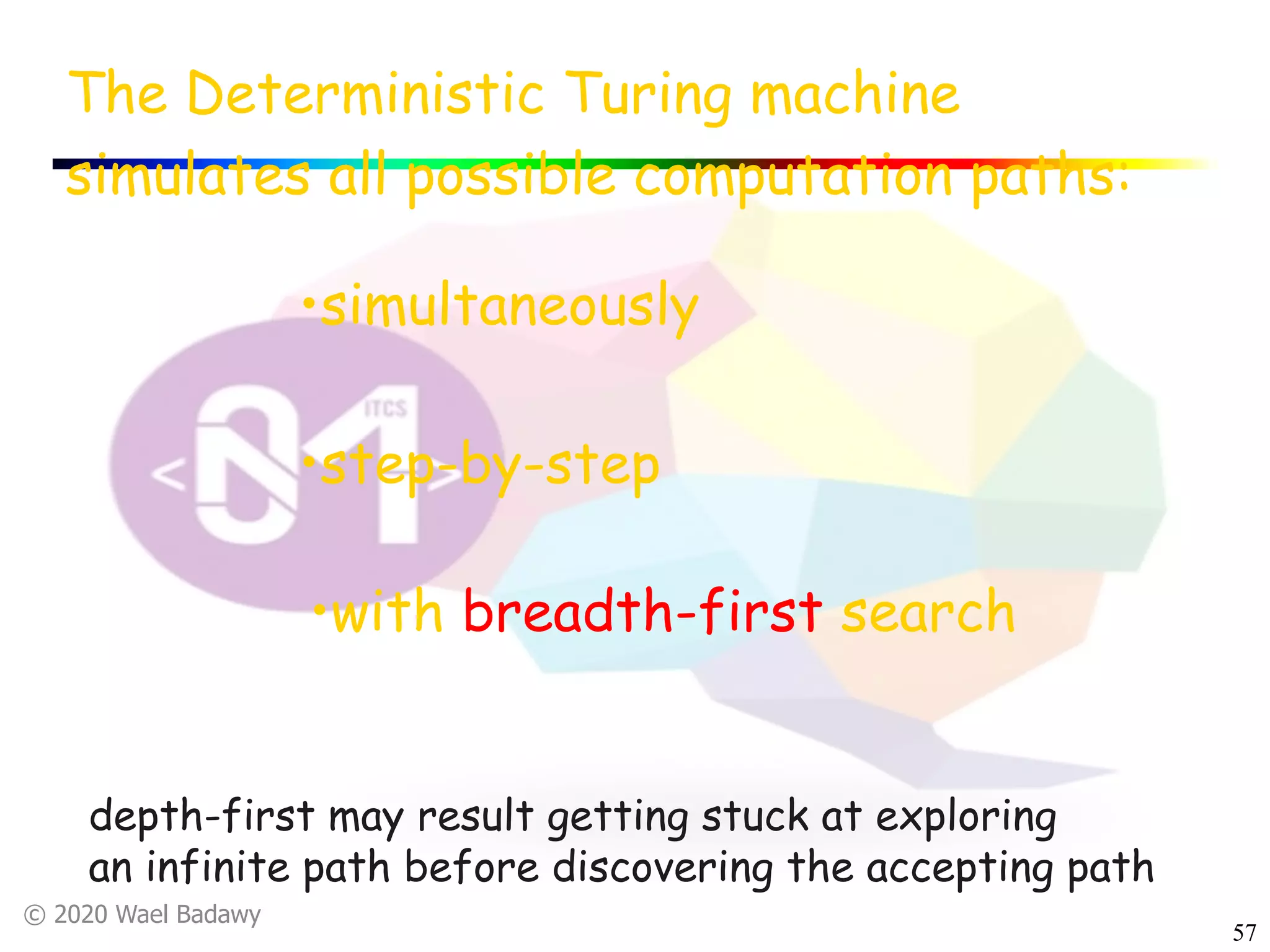
The Deterministic Turing machine
simulates all possible computation paths:
•with breadth-first search
•simultaneously
•step-by-step
depth-first may result getting stuck at exploring
an infinite path before discovering the accepting path
© 2020 Wael Badawy
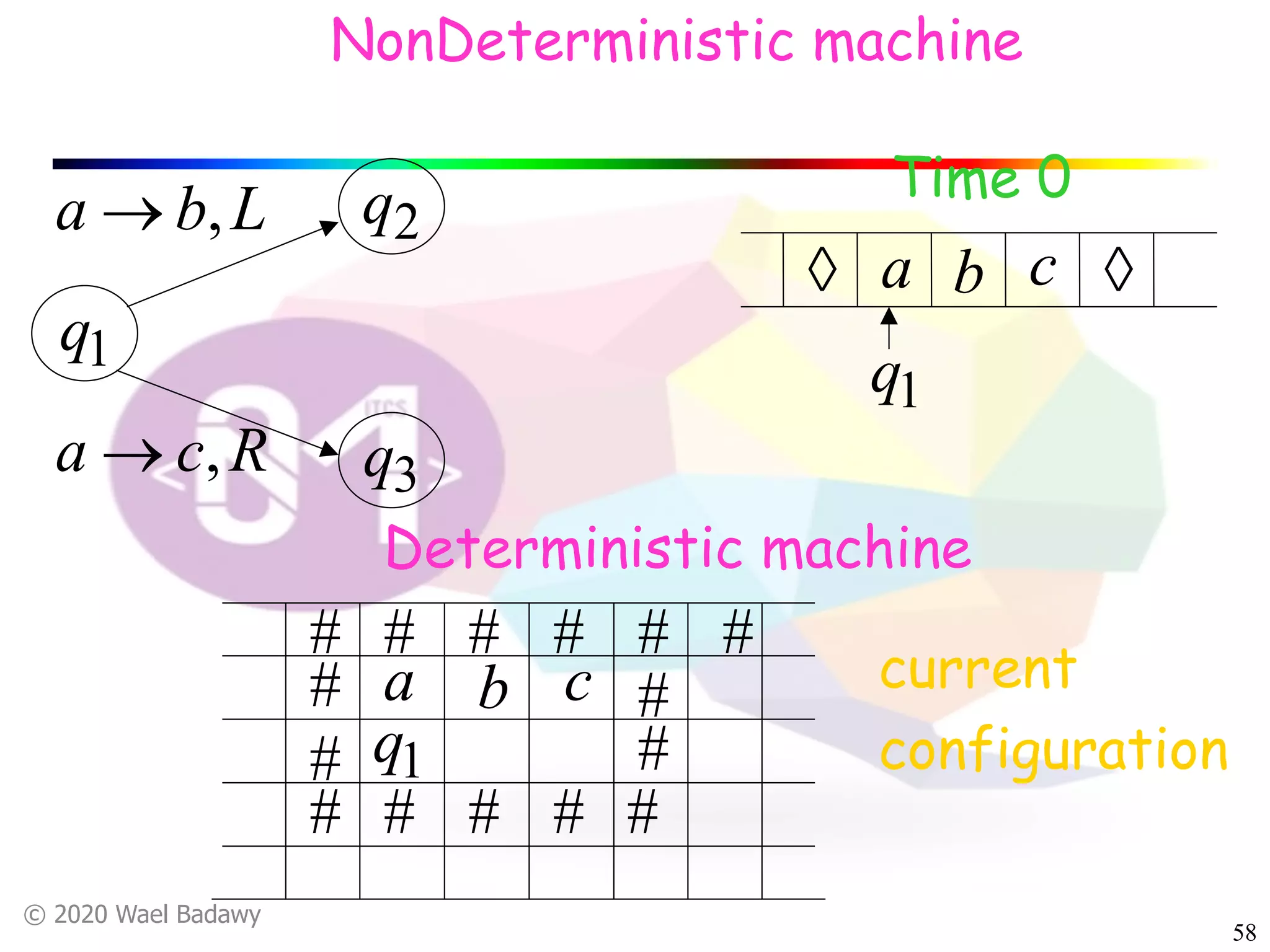
58
a b cà à
1q
Lba ,®
Rca ,®
1q
2q
3q
Time 0
NonDeterministic machine
Deterministic machine
a b c
1q
# # # # ##
#
#
# # #
#
#
# #
current
configuration
© 2020 Wael Badawy
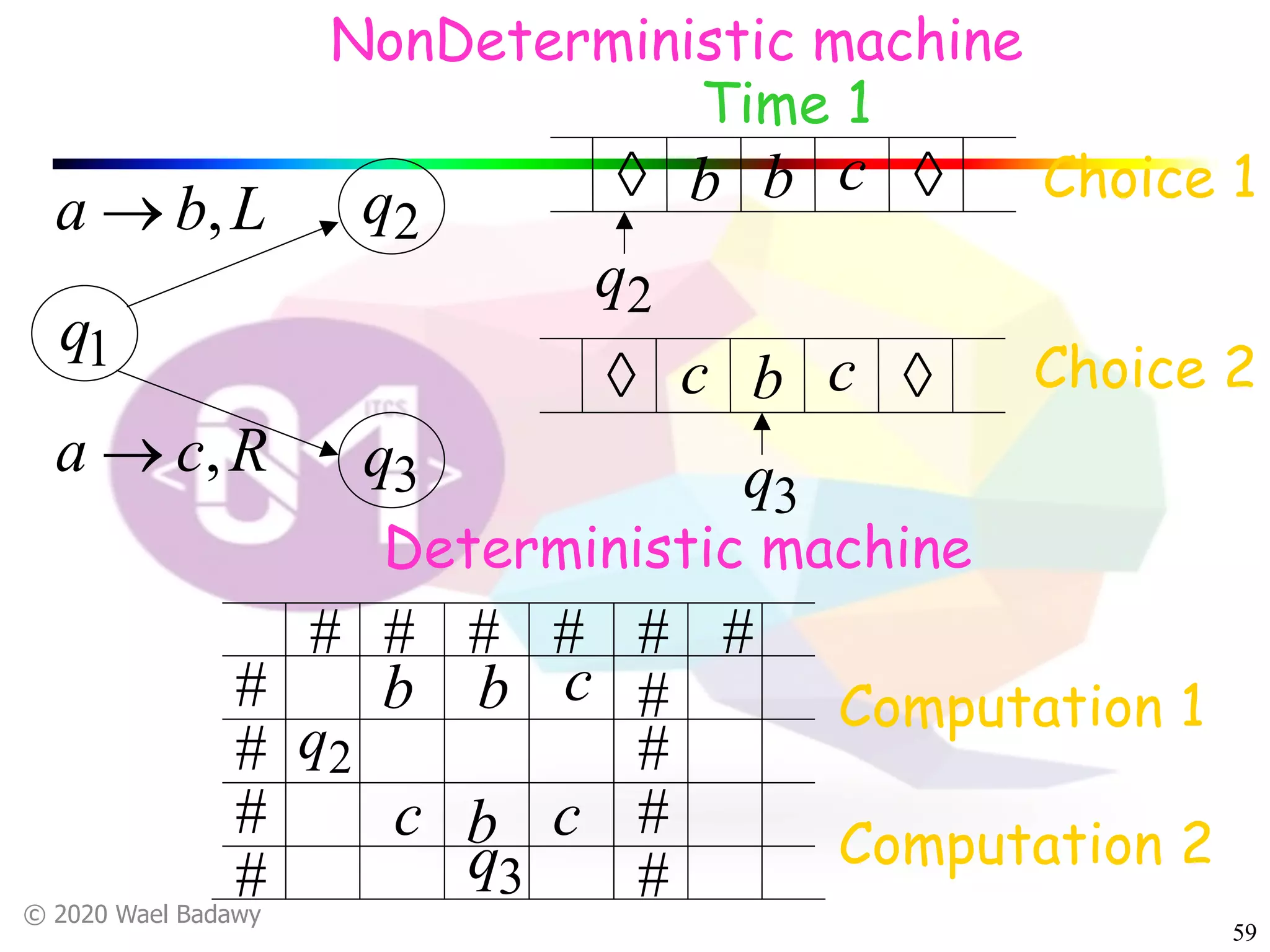
59
Lba ,®
Rca ,®
1q
2q
3q
b b c
2q
# # # # ##
#
# #
#
# #
Computation 1
b b cà à
2q
Choice 1
c b cà à
3q
Choice 2
c b c
3q ##
Computation 2
NonDeterministic machine
Deterministic machine
Time 1
© 2020 Wael Badawy
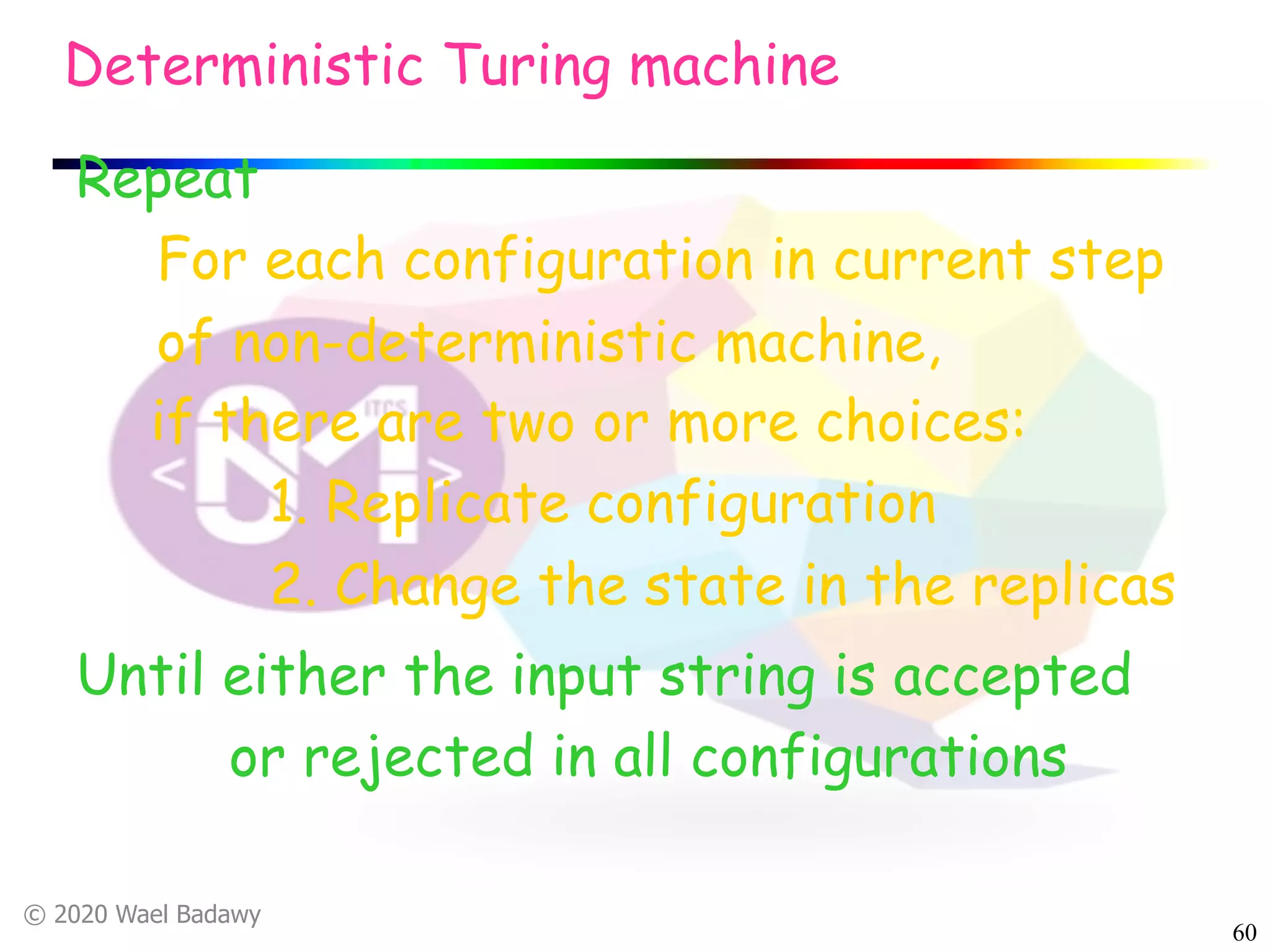
60
Repeat
For each configuration in current step
of non-deterministic machine,
if there are two or more choices:
1. Replicate configuration
2. Change the state in the replicas
Deterministic Turing machine
Until either the input string is accepted
or rejected in all configurations
© 2020 Wael Badawy
61
If the non-deterministic machine accepts
the input string:
The deterministic machine accepts and halts too
The simulation takes in the worst case
exponential time compared to the
shortest length of an accepting path
© 2020 Wael Badawy
62
If the non-deterministic machine does not
accept the input string:
1. The simulation halts if all paths
reach a halting state
OR
2. The simulation never terminates
if there is a never-ending path (infinite loop)
In either case the deterministic machine
rejects too (1. by halting or 2. by simulating the infinite loop)
END OF PROOF

Turing variations

  • 1.
    © 2020 WaelBadawy 1 Turing’s Thesis 1 DISCLAIMER: This video is optimized for HD large display using patented and patent-pending “Nile Codec”, the first Egyptian Video Codec for more information, PLEASE check https://NileCodec.com Also available as a PodCast
  • 2.
    © 2020 WaelBadawy Copyright © 2020 Wael Badawy. All rights reserved n This video is subject to copyright owned by Wael Badawy “WB”. Any reproduction or republication of all or part of this video is expressly prohibited unless WB has explicitly granted its prior written consent. All other rights reserved. n This video is intended for education and information only and is offered AS IS, without any warranty of the accuracy or the quality of the content. Any other use is strictly prohibited. The viewer is fully responsible to verify the accuracy of the contents received without any claims of costs or liability arising . n The names, trademarks service marked as logos of WB or the sponsors appearing in this video may not be used in any any product or service, without prior express written permission from WB and the video sponsors n Neither WB nor any party involved in creating, producing or delivering information and material via this video shall be liable for any direction, incidental, consequential, indirect of punitive damages arising out of access to, use or inability to use this content or any errors or omissions in the content thereof. n If you will continue to watch this video, you agree to the terms above and other terms that may be available on http://nu.edu.eg & https://caiwave.net 2
  • 3.
  • 4.
    © 2020 WaelBadawy 4 Turing’s thesis (1930): Any computation carried out by mechanical means can be performed by a Turing Machine
  • 5.
    © 2020 WaelBadawy 5 Algorithm: An algorithm for a problem is a Turing Machine which solves the problem The algorithm describes the steps of the mechanical means This is easily translated to computation steps of a Turing machine
  • 6.
    © 2020 WaelBadawy 6 When we say: There exists an algorithm We mean: There exists a Turing Machine that executes the algorithm
  • 7.
  • 8.
    © 2020 WaelBadawy 8 Read-Write Head Control Unit àà a a c àà àb a cb b a a Deterministic The Standard Model Infinite Tape (Left or Right)
  • 9.
    © 2020 WaelBadawy Variations of the Standard Model 9 • Stay-Option • Semi-Infinite Tape • Multitape • Multidimensional • Nondeterministic Turing machines with: Different Turing Machine Classes
  • 10.
    © 2020 WaelBadawy 10 We will prove: each new class has the same power with Standard Turing Machine Same Power of two machine classes: both classes accept the same set of languages (accept Turing-Recognizable Languages)
  • 11.
    © 2020 WaelBadawy 11 Same Power of two classes means: for any machine of first class1M there is a machine of second class2M such that: )()( 21 MLML = and vice-versa
  • 12.
    © 2020 WaelBadawy 12 A technique to prove same power.Simulation: Simulate the machine of one class with a machine of the other class First Class Original Machine 1M 1M 2M Second Class Simulation Machine simulates 1M
  • 13.
    © 2020 WaelBadawy 13 Configurations in the Original Machine have corresponding configurations in the Simulation Machine nddd !"!! 10Original Machine: Simulation Machine: nddd ¢¢¢ *** !"!! 10 1M 2M 1M 2M
  • 14.
    © 2020 WaelBadawy 14 the Simulation Machine and the Original Machine accept the same strings fdOriginal Machine: Simulation Machine: fd¢ Accepting Configuration )()( 21 MLML =
  • 15.
    © 2020 WaelBadawy Turing Machines with Stay- Option 15 The head can stay in the same position àà a a c àà àb a cb b a a Left, Right, Stay L,R,S: possible head moves
  • 16.
    © 2020 WaelBadawy 16 Example: àà a a c àà àb a cb b a a Time 1 àà b a c àà àb a cb b a a Time 2 1q 2q 1q 2q Sba ,®
  • 17.
    © 2020 WaelBadawy 17 Stay-Option machines have the same power with Standard Turing machines Theorem: Proof: 1. Stay-Option Machines simulate Standard Turing machines 2. Standard Turing machines simulate Stay-Option machines
  • 18.
    © 2020 WaelBadawy 18 1. Stay-Option Machines simulate Standard Turing machines Trivial: any standard Turing machine is also a Stay-Option machine
  • 19.
    © 2020 WaelBadawy 19 2. Standard Turing machines simulate Stay-Option machines We need to simulate the stay head option with two head moves, one left and one right
  • 20.
    © 2020 WaelBadawy 20 1q 2q Sba ,® 1q Lba ,® 2q Rxx ,® Stay-Option Machine Simulation in Standard Machine For every possible tape symbol x
  • 21.
    © 2020 WaelBadawy 21 1q 2q Lba ,® 1q 2q Lba ,® Stay-Option Machine Simulation in Standard Machine Similar for Right moves For other transitions nothing changes
  • 22.
    © 2020 WaelBadawy 22 example of simulation à àa a b a 1q Stay-Option Machine: 1 à àb a b a 2q 2 1q 2qSba ,® Simulation in Standard Machine: à àa a b a 1q 1 à àb a b a 2q 2 à àb a b a 3q 3 END OF PROOF
  • 23.
    © 2020 WaelBadawy 23 A useful trick: Multiple Track Tape à à à à à à b d a b b a a c track 1 track 2 One symbol ),( ba One head helps for more complicated simulations One Tape It is a standard Turing machine, but each tape alphabet symbol describes a pair of actual useful symbols
  • 24.
    © 2020 WaelBadawy 24 à à à à à à b d a b b a a c track 1 track 2 1q 2q Ldcab ),,(),( ® 1q à à à à à à b d a b c d a c track 1 track 2 2q
  • 25.
    © 2020 WaelBadawy Semi-Infinite Tape 25 .........a b a c à à • When the head moves left from the border, it returns back to leftmost position The head extends infinitely only to the right • Initial position is the leftmost cell
  • 26.
    © 2020 WaelBadawy 26 Semi-Infinite machines have the same power with Standard Turing machines Theorem: Proof: 2. Semi-Infinite Machines simulate Standard Turing machines 1. Standard Turing machines simulate Semi-Infinite machines
  • 27.
    © 2020 WaelBadawy 27 1. Standard Turing machines simulate Semi-Infinite machines: a. insert special symbol at left of input string # a b a c à à# b. Add a self-loop to every state (except states with no outgoing transitions) R,##® Standard Turing Machine àà Semi-Infinite machine modifications ..................
  • 28.
    © 2020 WaelBadawy 28 2. Semi-Infinite tape machines simulate Standard Turing machines: Standard machine ......... Semi-Infinite tape machine .................. Squeeze infinity of both directions to one direction
  • 29.
    © 2020 WaelBadawy 29 Standard machine ......... Semi-Infinite tape machine with two tracks .................. reference point # # Right part Left part à à àa b c d e ac b d e à à à à à
  • 30.
    © 2020 WaelBadawy 30 1q 2q R q2 L q1 L q2 R q1 Left part Right part Standard machine Semi-Infinite tape machine
  • 31.
    © 2020 WaelBadawy 31 1q 2q Rga ,® Standard machine L q1 L q2 Lgxax ),,(),( ® R q1 R q2 Rxgxa ),,(),( ® Semi-Infinite tape machine Left part Right part For all tape symbols x
  • 32.
    © 2020 WaelBadawy 32 Standard machine .................. à à àa b c d e 1q ......... Semi-Infinite tape machine # # Right part Left part ac b d e à à à à à L q1 Time 1
  • 33.
    © 2020 WaelBadawy 33 Time 2 à à àg b c d e 2q # # Right part Left part gc b d e à à à à à L q2 Standard machine .................. ......... Semi-Infinite tape machine
  • 34.
    © 2020 WaelBadawy 34 L q1 R q1 R),#,(#)#,(# ® Semi-Infinite tape machine Left part At the border: R q1 L q1 R),#,(#)#,(# ®Right part
  • 35.
    © 2020 WaelBadawy 35 ......... Semi-Infinite tape machine # # Right part Left part gc b d e à à à à à L q1 .........# # Right part Left part gc b d e à à à à à R q1 Time 1 Time 2 END OF PROOF
  • 36.
    © 2020 WaelBadawy Multi-tape Turing Machines 36 àà a b c àà e f g Control unit Tape 1 Tape 2 Input string Input string appears on Tape 1 (state machine)
  • 37.
    © 2020 WaelBadawy 37 àà a b c àà e f g 1q 1q àà a g c àà e d g 2q 2q Time 1 Time 2 RLdgfb ,),,(),( ® 1q 2q Tape 1 Tape 2 Tape 1 Tape 2
  • 38.
    © 2020 WaelBadawy 38 Multi-tape machines have the same power with Standard Turing machines Theorem: Proof: 1. Multi-tape machines simulate Standard Turing machines 2. Standard Turing machines simulate Multi-tape machines
  • 39.
    © 2020 WaelBadawy 39 1. Multi-tape machines simulate Standard Turing Machines: Trivial: Use one tape
  • 40.
    © 2020 WaelBadawy 40 2. Standard Turing machines simulate Multi-tape machines: • Uses a multi-track tape to simulate the multiple tapes • A tape of the Multi-tape machine corresponds to a pair of tracks Standard machine:
  • 41.
    © 2020 WaelBadawy 41 àà a b c hà e f g à Multi-tape Machine Tape 1 Tape 2 Standard machine with four track tape a b c e f g 0 0 0 0 1 1 Tape 1 head position Tape 2 head position h 0
  • 42.
    © 2020 WaelBadawy 42 Repeat for each Multi-tape state transition: 1. Return to reference point 2. Find current symbol in Track 1 and update 3. Return to reference point 4. Find current symbol in Tape 2 and update a b c e f g 0 0 0 0 1 1 Tape 1 head position Tape 2 head position h 0 # # # # Reference point END OF PROOF
  • 43.
    © 2020 WaelBadawy 43 ( steps) }{ nn baL = Standard Turing machine: Go back and forth times)( 2 nO 2-tape machine: 1. Copy to tape 2n b 2. Compare on tape 1 and on tape 2 )(nO n b n a to match the a’s with the b’s ( steps))(nO )( 2 nO time )(nO time Same power doesn’t imply same speed:
  • 44.
    © 2020 WaelBadawy Multidimensional Turing Machines 44 x y a b c 2-dimensional tape HEAD Position: +2, -1 MOVES: L,R,U,D U: up D: down à à à à
  • 45.
    © 2020 WaelBadawy 45 Multidimensional machines have the same power with Standard Turing machines Theorem: Proof: 1. Multidimensional machines simulate Standard Turing machines 2. Standard Turing machines simulate Multi-Dimensional machines
  • 46.
    © 2020 WaelBadawy 46 1. Multidimensional machines simulate Standard Turing machines Trivial: Use one dimension
  • 47.
    © 2020 WaelBadawy 47 2. Standard Turing machines simulate Multidimensional machines Standard machine: • Use a two track tape • Store symbols in track 1 • Store coordinates in track 2
  • 48.
    © 2020 WaelBadawy 48 x y a b cà à à à a 1 b # symbol coordinates 2-dimensional machine Standard Machine 1 # 2 # 1- c # - 1q 1q 1
  • 49.
    © 2020 WaelBadawy 49 Repeat for each transition followed in the 2-dimensional machine: 1. Update current symbol 2. Compute coordinates of next position 3. Find next position on tape Standard machine: END OF PROOF
  • 50.
    © 2020 WaelBadawy Nondeterministic Turing Machines 50 Lba ,® Rca ,® 1q 2q 3q Allows Non Deterministic Choices Choice 1 Choice 2
  • 51.
    © 2020 WaelBadawy 51 a b cà à 1q Lba ,® Rca ,® 1q 2q 3q Time 0 Time 1 b b cà à 2q c b cà à 3q Choice 1 Choice 2
  • 52.
    © 2020 WaelBadawy 52 Input string is accepted if there is a computation: w yqxwq f * !0 Initial configuration Final Configuration Any accept state There is a computation:
  • 53.
    © 2020 WaelBadawy 53 Nondeterministic machines have the same power with Standard Turing machines Theorem: Proof: 1. Nondeterministic machines simulate Standard Turing machines 2. Standard Turing machines simulate Nondeterministic machines
  • 54.
    © 2020 WaelBadawy 54 1. Nondeterministic Machines simulate Standard (deterministic) Turing Machines Trivial: every deterministic machine is also nondeterministic
  • 55.
    © 2020 WaelBadawy 55 2. Standard (deterministic) Turing machines simulate Nondeterministic machines: • Stores all possible computations of the non-deterministic machine on the 2-dimensional tape Deterministic machine: • Uses a 2-dimensional tape (equivalent to standard Turing machine with one tape)
  • 56.
    © 2020 WaelBadawy 56 All possible computation paths Initial state Step 1 Step 2 Step i Step i+1 acceptreject infinite path
  • 57.
    © 2020 WaelBadawy 57 The Deterministic Turing machine simulates all possible computation paths: •with breadth-first search •simultaneously •step-by-step depth-first may result getting stuck at exploring an infinite path before discovering the accepting path
  • 58.
    © 2020 WaelBadawy 58 a b cà à 1q Lba ,® Rca ,® 1q 2q 3q Time 0 NonDeterministic machine Deterministic machine a b c 1q # # # # ## # # # # # # # # # current configuration
  • 59.
    © 2020 WaelBadawy 59 Lba ,® Rca ,® 1q 2q 3q b b c 2q # # # # ## # # # # # # Computation 1 b b cà à 2q Choice 1 c b cà à 3q Choice 2 c b c 3q ## Computation 2 NonDeterministic machine Deterministic machine Time 1
  • 60.
    © 2020 WaelBadawy 60 Repeat For each configuration in current step of non-deterministic machine, if there are two or more choices: 1. Replicate configuration 2. Change the state in the replicas Deterministic Turing machine Until either the input string is accepted or rejected in all configurations
  • 61.
    © 2020 WaelBadawy 61 If the non-deterministic machine accepts the input string: The deterministic machine accepts and halts too The simulation takes in the worst case exponential time compared to the shortest length of an accepting path
  • 62.
    © 2020 WaelBadawy 62 If the non-deterministic machine does not accept the input string: 1. The simulation halts if all paths reach a halting state OR 2. The simulation never terminates if there is a never-ending path (infinite loop) In either case the deterministic machine rejects too (1. by halting or 2. by simulating the infinite loop) END OF PROOF