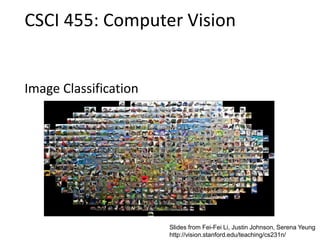
Image Classification
CSCI 455: Computer Vision
Slides from Fei-Fei Li, Justin Johnson, Serena Yeung
http://vision.stanford.edu/teaching/cs231n/
Today
• Image classification pipeline
• Training, validation, testing
• Nearest neighbor classification
• Linear classification
• Building up to CNNs for learning
– Next four lectures on deep learning
References
• Stanford CS231N
– http://cs231n.stanford.edu/
Where to from here?
• Scene Understanding
• Big data – lots of images
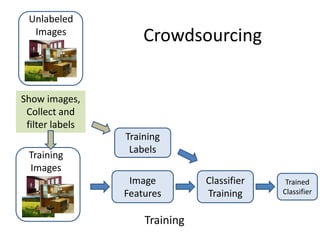
• Crowd sourcing – lots of people
• Deep Learning – lots of compute
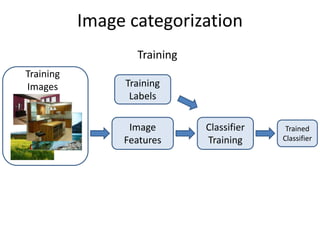
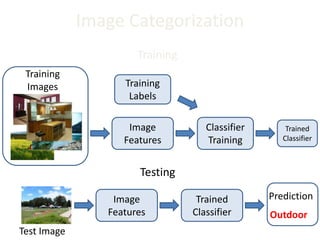
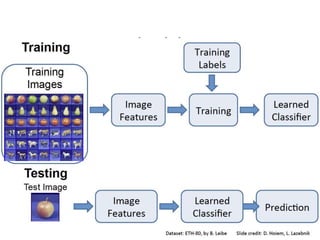
Image categorization
Training
Labels
Training
Images
Classifier
Training
Training
Image
Features
Trained
Classifier
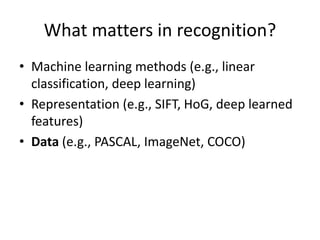
What matters in recognition?
• Machine learning methods (e.g., linear
classification, deep learning)
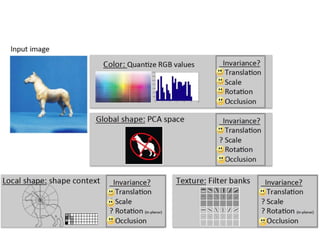
• Representation (e.g., SIFT, HoG, deep learned
features)
• Data (e.g., PASCAL, ImageNet, COCO)
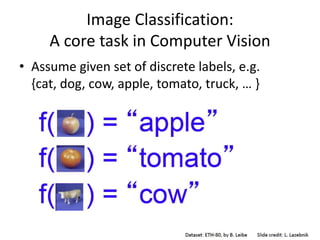
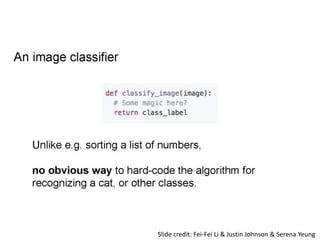
Image Classification:
A core task in Computer Vision
• Assume given set of discrete labels, e.g.
{cat, dog, cow, apple, tomato, truck, … }
Image classification demo
https://cloud.google.com/vision/
See also:
https://aws.amazon.com/rekognition/
https://www.clarifai.com/
https://azure.microsoft.com/en-us/services/cognitive-services/computer-vision/
…
Slide credit: Fei-Fei Li & Justin Johnson & Serena Yeung
Image
Features
Testing
Test Image
Trained
Classifier Outdoor
Prediction
Image Categorization
Training
Labels
Training
Images
Classifier
Training
Image
Features
Trained
Classifier
Training
Crowdsourcing
Training
Labels
Training
Images
Classifier
Training
Training
Image
Features
Trained
Classifier
Show images,
Collect and
filter labels
Unlabeled
Images
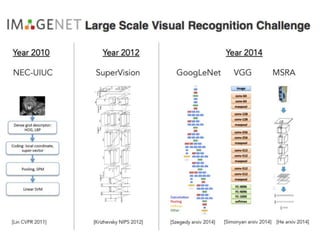
Deep Learning (or convnets, CNNs)
• Since 2012, huge impact, best results
• Can soak up all the data for better prediction
Image Classification
Slides from Andrej Karpathy and Fei-Fei Li
http://vision.stanford.edu/teaching/cs231n/
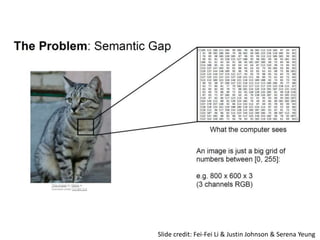
Image Classification: Problem
Slide credit: Fei-Fei Li & Justin Johnson & Serena Yeung
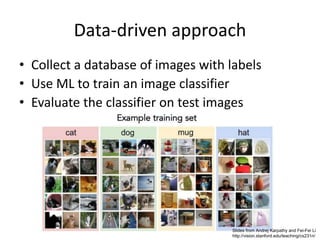
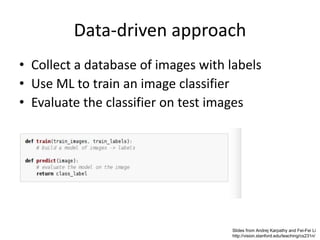
Data-driven approach
• Collect a database of images with labels
• Use ML to train an image classifier
• Evaluate the classifier on test images
Slides from Andrej Karpathy and Fei-Fei Li
http://vision.stanford.edu/teaching/cs231n/
Data-driven approach
• Collect a database of images with labels
• Use ML to train an image classifier
• Evaluate the classifier on test images
Slides from Andrej Karpathy and Fei-Fei Li
http://vision.stanford.edu/teaching/cs231n/
Classifiers
• Nearest Neighbor
• kNN (“k-Nearest Neighbors”)
• Linear Classifier
• Neural Network
• Deep Neural Network
• …
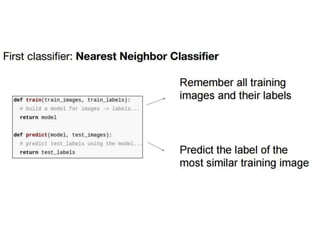
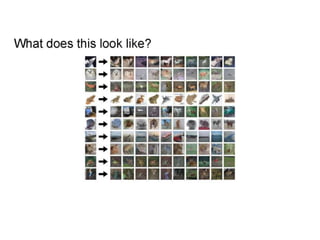
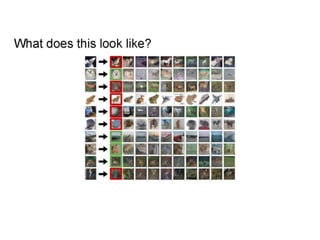
First: Nearest Neighbor (NN) Classifier
• Train
– Remember all training images and their labels
• Predict
– Find the closest (most similar) training image
– Predict its label as the true label
CIFAR-10 and NN results
Slides from Andrej Karpathy and Fei-Fei Li
http://vision.stanford.edu/teaching/cs231n/
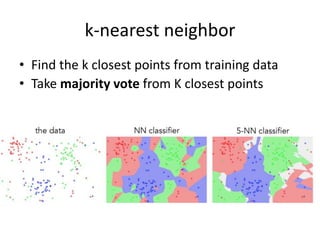
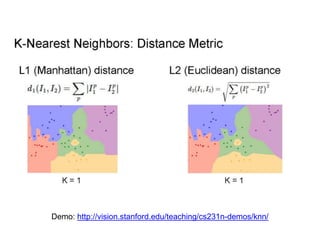
k-nearest neighbor
• Find the k closest points from training data
• Take majority vote from K closest points
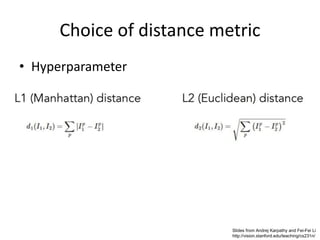
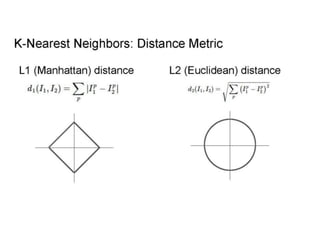
How to find the most similar training
image? What is the distance metric?
Slides from Andrej Karpathy and Fei-Fei Li
http://vision.stanford.edu/teaching/cs231n/
Choice of distance metric
• Hyperparameter
Slides from Andrej Karpathy and Fei-Fei Li
http://vision.stanford.edu/teaching/cs231n/
Demo: http://vision.stanford.edu/teaching/cs231n-demos/knn/
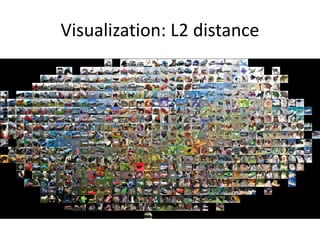
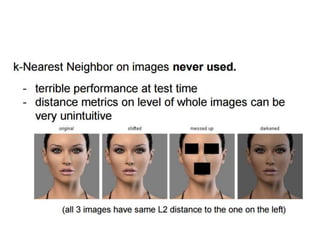
Visualization: L2 distance
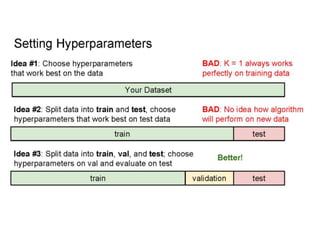
Hyperparameters
Hyperparameters
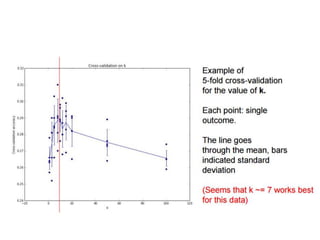
• What is the best distance to use?
• What is the best value of k to use?
• These are hyperparameters: choices about
the algorithm that we set rather than learn
• How do we set them?
– One option: try them all and see what works best
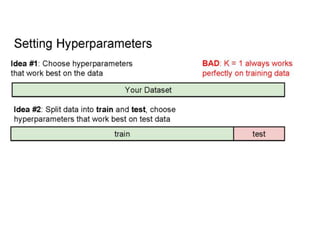
Recap: How to pick hyperparameters?
• Methodology
– Train and test
– Train, validate, test
• Train for original model
• Validate to find hyperparameters
• Test to understand generalizability
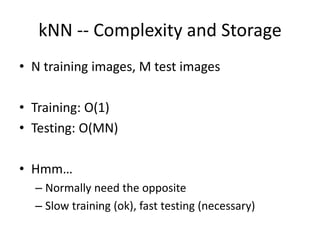
kNN -- Complexity and Storage
• N training images, M test images
• Training: O(1)
• Testing: O(MN)
• Hmm…
– Normally need the opposite
– Slow training (ok), fast testing (necessary)
k-Nearest Neighbors: Summary
• In image classification we start with a training
set of images and labels, and must predict labels
on the test set
• The K-Nearest Neighbors classifier predicts labels
based on nearest training examples
• Distance metric and K are hyperparameters
• Choose hyperparameters using the validation
set; only run on the test set once at the very end!
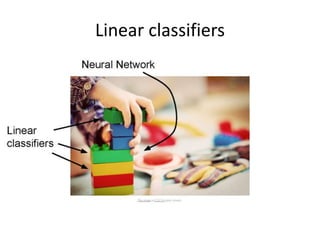
Linear classifiers
Instead
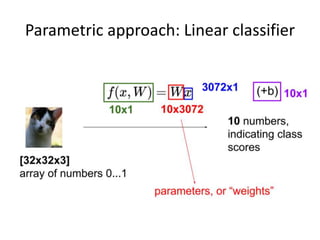
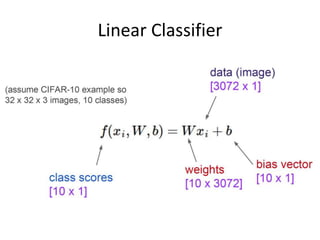
• Image classification using linear classifiers
• Need
– Score function: raw data to class scores
– Loss function: agreement between predicted
scores and ground truth labels
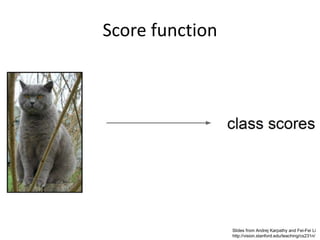
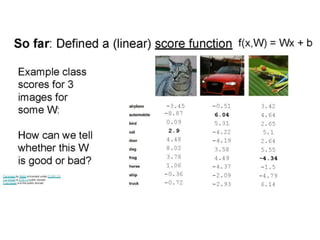
Score function
Slides from Andrej Karpathy and Fei-Fei Li
http://vision.stanford.edu/teaching/cs231n/
Score function: f
Parametric approach: Linear classifier
Linear Classifier
Linear Classifier
Computing scores
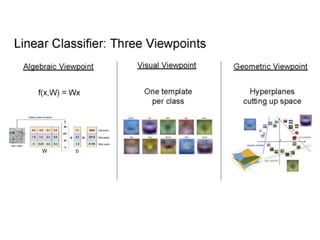
Interpretation: Template matching
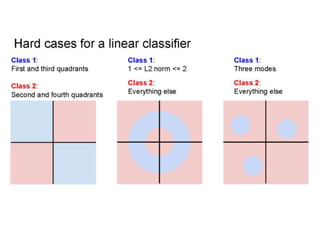
Geometric Interpretation
Linear classifiers
• Find linear function (hyperplane) to separate
positive and negative examples
0:negative
0:positive


b
b
ii
ii
wxx
wxx
Which hyperplane is best?
We will come back to this
later
Recap
• Learning methods
– k-Nearest Neighbors
– Linear classification
• Classifier outputs a score function giving a
score to each class
• Today: how do we define how good a classifier
is based on the training data? (Spoiler: define
a loss function)
Linear classification
Output scores
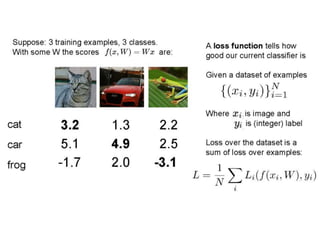
Loss function, cost/objective function
• Given ground truth labels (yi), scores f(xi, W)
– how unhappy are we with the scores?
• Loss function or objective/cost function
measures unhappiness
• During training, want to find the parameters W
that minimizes the loss function
Simpler example: binary classification
• Two classes (e.g., “cat” and “not cat”)
– AKA “positive” and “negative” classes
cat not cat
Linear classifiers
• Find linear function (hyperplane) to separate
positive and negative examples
0:negative
0:positive


b
b
ii
ii
wxx
wxx
Which hyperplane is best?
We need a loss function to
decide
What is a good loss function?
• One possibility
– Number of misclassified examples
– Problems: discrete, can’t break ties
– We want the loss to lead to good generalization
– We want the loss to work for more than 2 classes
Loss: 2 Loss: 0 Loss: 0
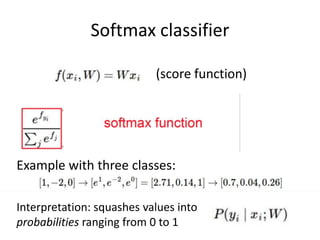
Softmax classifier
Interpretation: squashes values into
probabilities ranging from 0 to 1
(score function)
Example with three classes:
Cross-entropy loss
(score function)
Losses
• Cross-entropy loss is just one possible loss
function
– One nice property is that it reinterprets scores as
probabilities, which have a natural meaning
• SVM (max-margin) loss functions also used to
be popular
– But currently, cross-entropy is the most common
classification loss
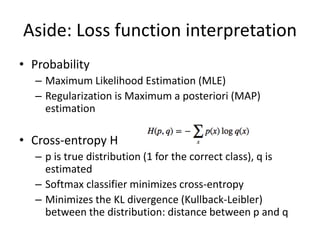
Aside: Loss function interpretation
• Probability
– Maximum Likelihood Estimation (MLE)
– Regularization is Maximum a posteriori (MAP)
estimation
• Cross-entropy H
– p is true distribution (1 for the correct class), q is
estimated
– Softmax classifier minimizes cross-entropy
– Minimizes the KL divergence (Kullback-Leibler)
between the distribution: distance between p and q
SVM vs. Softmax
Summary
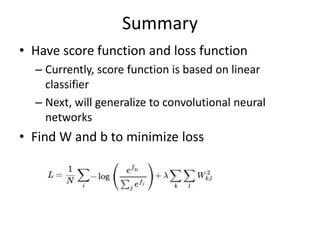
• Have score function and loss function
– Currently, score function is based on linear
classifier
– Next, will generalize to convolutional neural
networks
• Find W and b to minimize loss

Computer Vision image classification