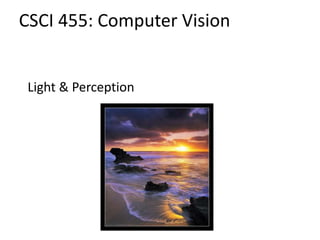
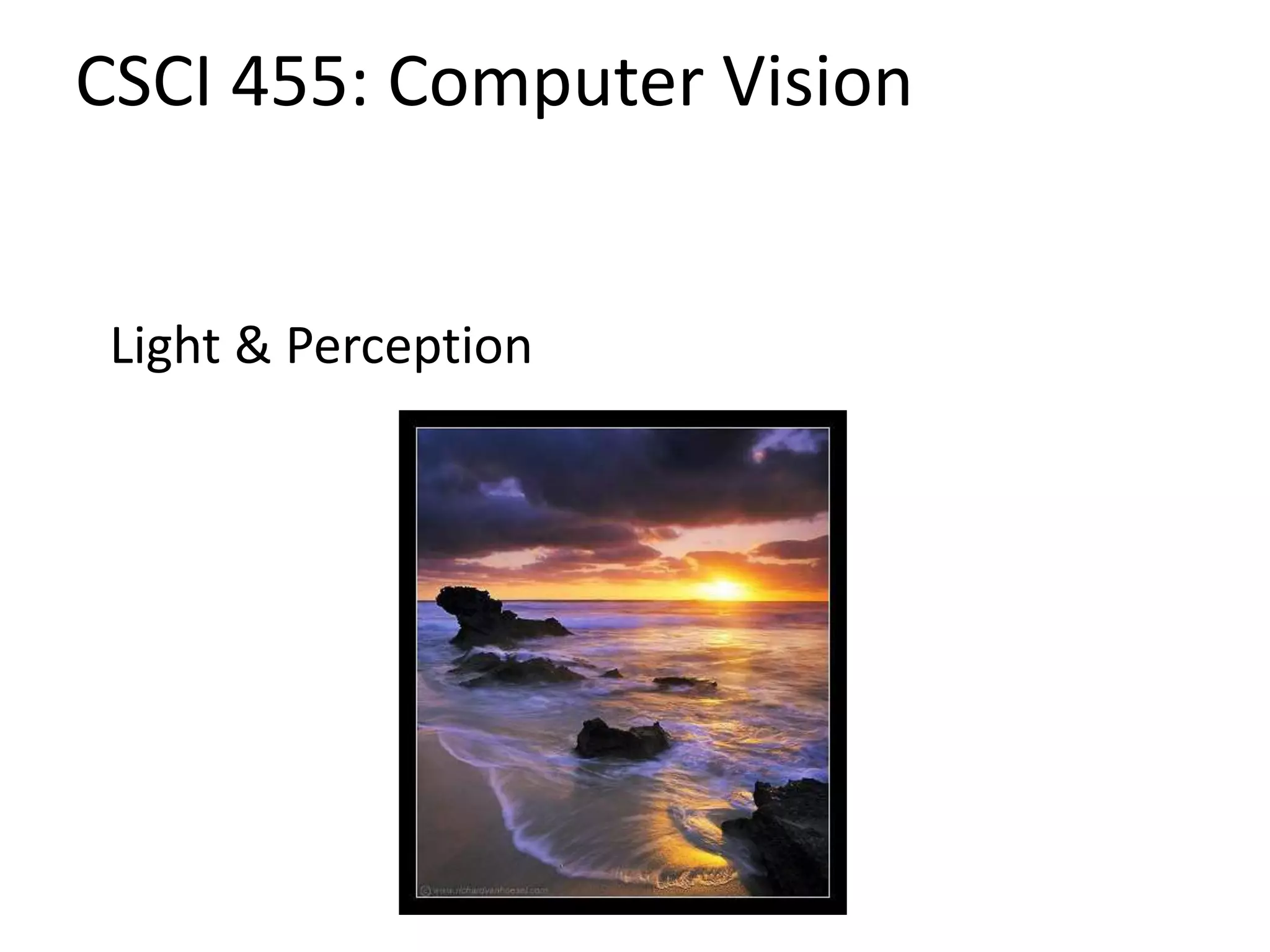
Light & Perception
CSCI 455: Computer Vision
Road map
• Finishing up geometry
• Next: deep learning and hot topics in
computer vision
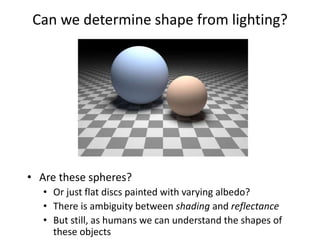
Can we determine shape from lighting?
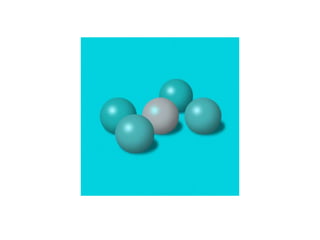
• Are these spheres?
• Or just flat discs painted with varying albedo?
• There is ambiguity between shading and reflectance
• But still, as humans we can understand the shapes of
these objects
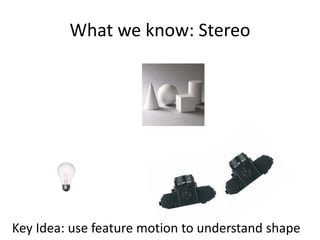
What we know: Stereo
Key Idea: use feature motion to understand shape
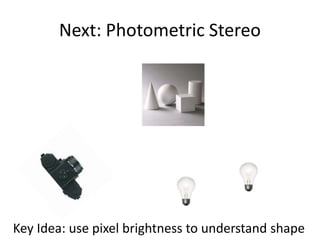
Next: Photometric Stereo
Key Idea: use pixel brightness to understand shape
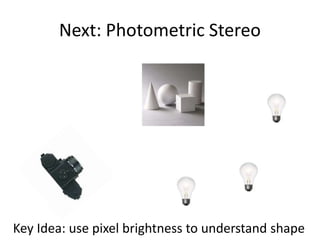
Next: Photometric Stereo
Key Idea: use pixel brightness to understand shape
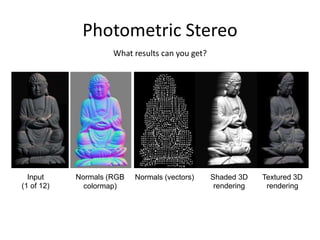
Photometric Stereo
Input
(1 of 12)
Normals (RGB
colormap)
Normals (vectors) Shaded 3D
rendering
Textured 3D
rendering
What results can you get?
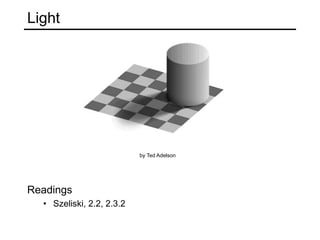
Light
by Ted Adelson
Readings
• Szeliski, 2.2, 2.3.2
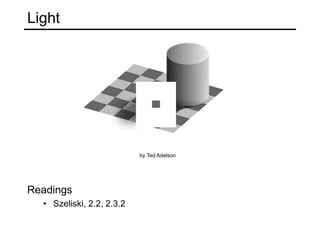
Light
by Ted Adelson
Readings
• Szeliski, 2.2, 2.3.2
Properties of light
Today
• What is light?
• How do we measure it?
• How does light propagate?
• How does light interact with matter?
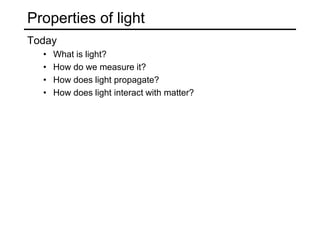
Radiometry
What determines the brightness of a pixel?
Light source properties
Surface properties
Surface properties
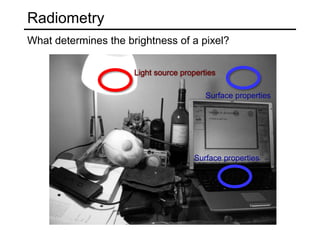
Radiometry
What determines the brightness of a pixel?
https://www.instagram.com/p/BtgX55ZBhU-/@robertwestonbreshears
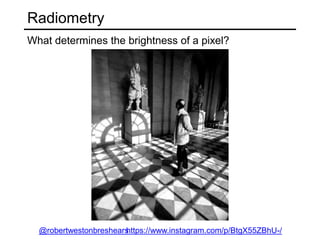
Radiometry
What determines the brightness of a pixel?
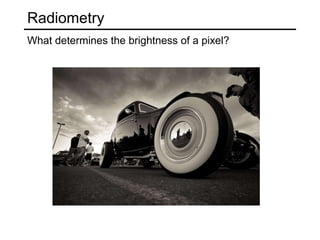
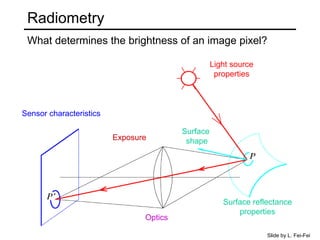
Radiometry
What determines the brightness of an image pixel?
Light source
properties
Surface
shape
Surface reflectance
properties
Optics
Sensor characteristics
Slide by L. Fei-Fei
Exposure
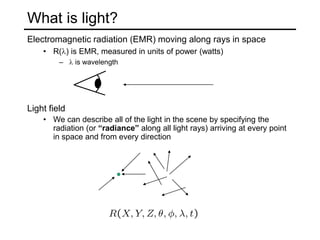
What is light?
Electromagnetic radiation (EMR) moving along rays in space
• R(l) is EMR, measured in units of power (watts)
– l is wavelength
Light field
• We can describe all of the light in the scene by specifying the
radiation (or “radiance” along all light rays) arriving at every point
in space and from every direction
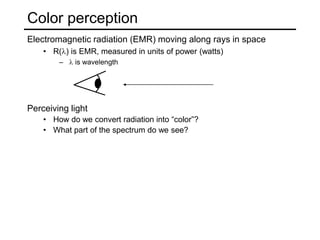
Color perception
Electromagnetic radiation (EMR) moving along rays in space
• R(l) is EMR, measured in units of power (watts)
– l is wavelength
Perceiving light
• How do we convert radiation into “color”?
• What part of the spectrum do we see?
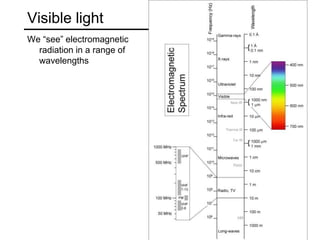
Visible light
We “see” electromagnetic
radiation in a range of
wavelengths
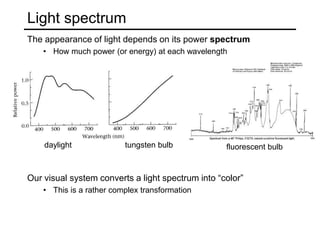
Light spectrum
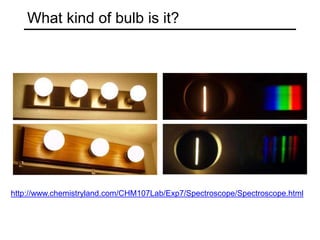
The appearance of light depends on its power spectrum
• How much power (or energy) at each wavelength
daylight tungsten bulb
Our visual system converts a light spectrum into “color”
• This is a rather complex transformation
fluorescent bulb
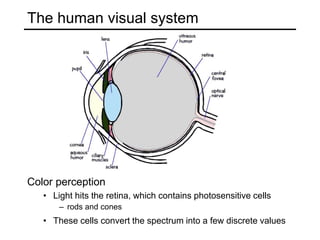
The human visual system
Color perception
• Light hits the retina, which contains photosensitive cells
– rods and cones
• These cells convert the spectrum into a few discrete values
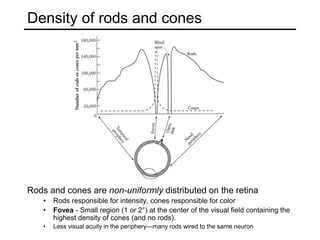
Density of rods and cones
Rods and cones are non-uniformly distributed on the retina
• Rods responsible for intensity, cones responsible for color
• Fovea - Small region (1 or 2°) at the center of the visual field containing the
highest density of cones (and no rods).
• Less visual acuity in the periphery—many rods wired to the same neuron
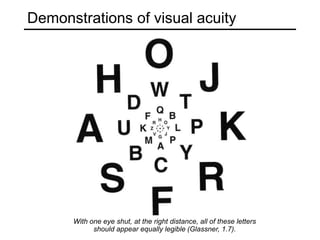
Demonstrations of visual acuity
With one eye shut, at the right distance, all of these letters
should appear equally legible (Glassner, 1.7).
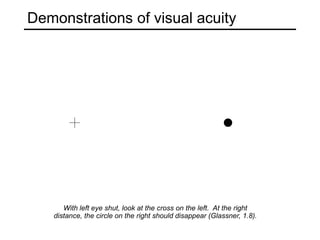
Demonstrations of visual acuity
With left eye shut, look at the cross on the left. At the right
distance, the circle on the right should disappear (Glassner, 1.8).
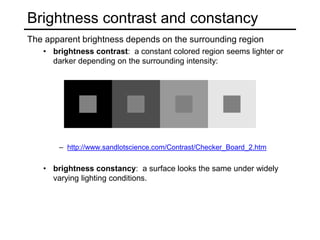
Brightness contrast and constancy
The apparent brightness depends on the surrounding region
• brightness contrast: a constant colored region seems lighter or
darker depending on the surrounding intensity:
– http://www.sandlotscience.com/Contrast/Checker_Board_2.htm
• brightness constancy: a surface looks the same under widely
varying lighting conditions.
Light response is nonlinear
Our visual system has a large dynamic range
• We can resolve both light and dark things at the same time
• One mechanism for achieving this is that we sense light
intensity on a logarithmic scale
– an exponential intensity ramp will be seen as a linear ramp
• Another mechanism is adaptation
– rods and cones adapt to be more sensitive in low light, less
sensitive in bright light.
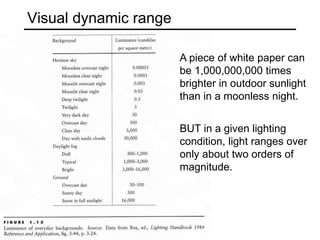
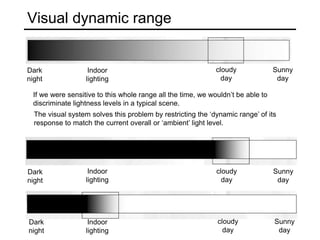
Visual dynamic range
A piece of white paper can
be 1,000,000,000 times
brighter in outdoor sunlight
than in a moonless night.
BUT in a given lighting
condition, light ranges over
only about two orders of
magnitude.
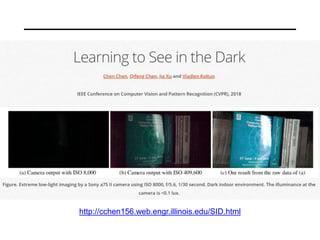
http://cchen156.web.engr.illinois.edu/SID.html
Visual dynamic range
Dark
night
Indoor
lighting
cloudy
day
Sunny
day
If we were sensitive to this whole range all the time, we wouldn’t be able to
discriminate lightness levels in a typical scene.
The visual system solves this problem by restricting the ‘dynamic range’ of its
response to match the current overall or ‘ambient’ light level.
Dark
night
Indoor
lighting
cloudy
day
Sunny
day
Dark
night
Indoor
lighting
cloudy
day
Sunny
day
Color perception
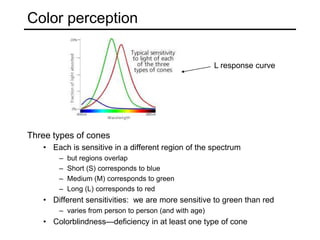
Three types of cones
• Each is sensitive in a different region of the spectrum
– but regions overlap
– Short (S) corresponds to blue
– Medium (M) corresponds to green
– Long (L) corresponds to red
• Different sensitivities: we are more sensitive to green than red
– varies from person to person (and with age)
• Colorblindness—deficiency in at least one type of cone
L response curve
Color perception
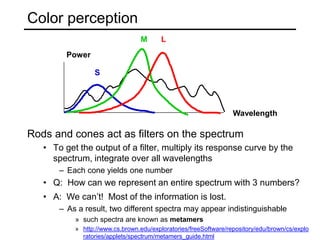
Rods and cones act as filters on the spectrum
• To get the output of a filter, multiply its response curve by the
spectrum, integrate over all wavelengths
– Each cone yields one number
• Q: How can we represent an entire spectrum with 3 numbers?
S
M L
Wavelength
Power
• A: We can’t! Most of the information is lost.
– As a result, two different spectra may appear indistinguishable
» such spectra are known as metamers
» http://www.cs.brown.edu/exploratories/freeSoftware/repository/edu/brown/cs/explo
ratories/applets/spectrum/metamers_guide.html
What kind of bulb is it?
http://www.chemistryland.com/CHM107Lab/Exp7/Spectroscope/Spectroscope.html
Perception summary
The mapping from radiance to perceived color
is quite complex!
• We throw away most of the data
• We apply a logarithm
• Brightness affected by pupil size
• Brightness contrast and constancy effects
The same is true for cameras
• But we have tools to correct for these effects
– (Computational Photography)
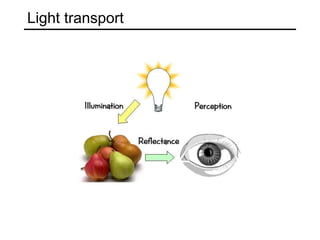
Light transport
Light sources
Basic types
• point source
• directional source
– a point source that is infinitely far away
• area source
– a union of point sources
More generally
• a light field can describe *any* distribution of light sources
What happens when light hits an object?
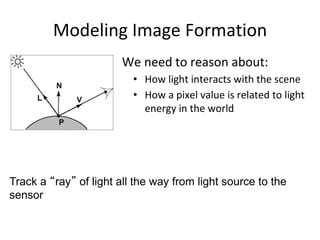
Modeling Image Formation
Track a “ray” of light all the way from light source to the
sensor
We need to reason about:
• How light interacts with the scene
• How a pixel value is related to light
energy in the world
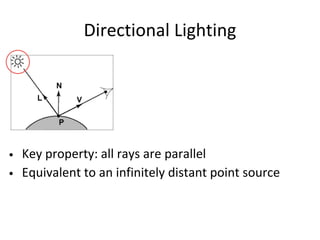
Directional Lighting
• Key property: all rays are parallel
• Equivalent to an infinitely distant point source
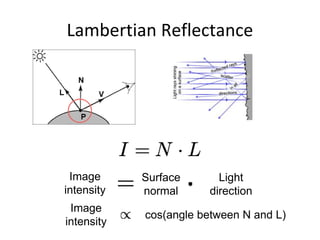
Lambertian Reflectance
Image
intensity
Surface
normal
Light
direction
Image
intensity
cos(angle between N and L)
© Kavita Bala, Computer Science, Cornell University
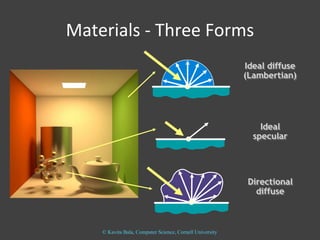
Materials - Three Forms
Ideal diffuse
(Lambertian)
Ideal
specular
Directional
diffuse
© Kavita Bala, Computer Science, Cornell University
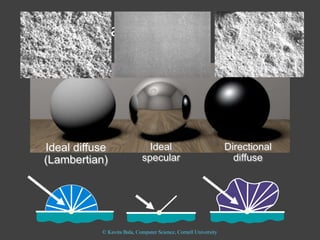
Reflectance—Three Forms
Ideal diffuse
(Lambertian)
Directional
diffuse
Ideal
specular
© Kavita Bala, Computer Science, Cornell University
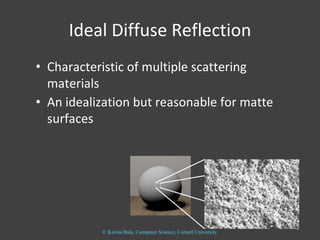
Ideal Diffuse Reflection
• Characteristic of multiple scattering
materials
• An idealization but reasonable for matte
surfaces
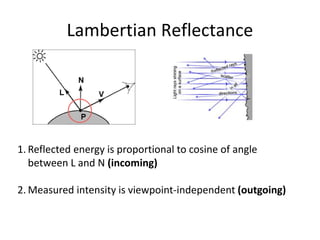
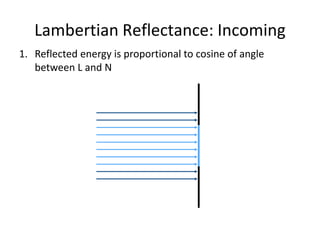
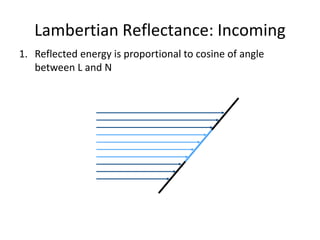
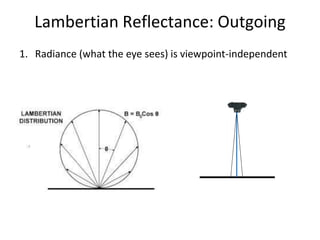
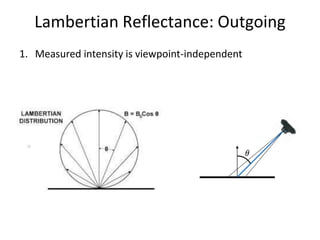
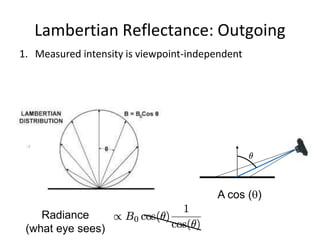
Lambertian Reflectance
1. Reflected energy is proportional to cosine of angle
between L and N (incoming)
2. Measured intensity is viewpoint-independent (outgoing)
Lambertian Reflectance: Incoming
1. Reflected energy is proportional to cosine of angle
between L and N
Lambertian Reflectance: Incoming
1. Reflected energy is proportional to cosine of angle
between L and N
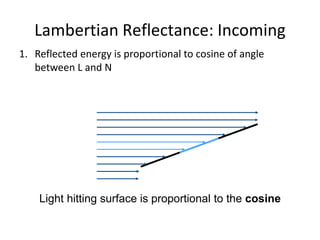
Lambertian Reflectance: Incoming
Light hitting surface is proportional to the cosine
1. Reflected energy is proportional to cosine of angle
between L and N
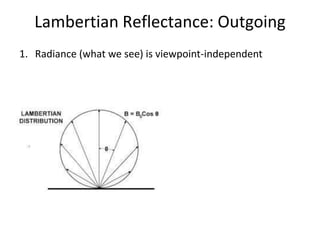
Lambertian Reflectance: Outgoing
1. Radiance (what we see) is viewpoint-independent
Lambertian Reflectance: Outgoing
1. Radiance (what the eye sees) is viewpoint-independent
Lambertian Reflectance: Outgoing
1. Measured intensity is viewpoint-independent
Lambertian Reflectance: Outgoing
Radiance
(what eye sees)
1. Measured intensity is viewpoint-independent
A cos (q)
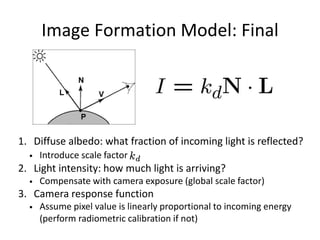
Image Formation Model: Final
1. Diffuse albedo: what fraction of incoming light is reflected?
• Introduce scale factor
2. Light intensity: how much light is arriving?
• Compensate with camera exposure (global scale factor)
3. Camera response function
• Assume pixel value is linearly proportional to incoming energy
(perform radiometric calibration if not)
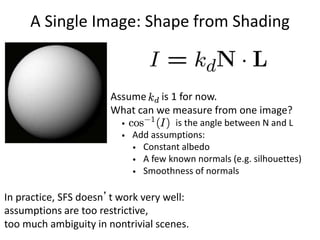
A Single Image: Shape from Shading
Assume is 1 for now.
What can we measure from one image?
• is the angle between N and L
• Add assumptions:
• Constant albedo
• A few known normals (e.g. silhouettes)
• Smoothness of normals
In practice, SFS doesn’t work very well:
assumptions are too restrictive,
too much ambiguity in nontrivial scenes.
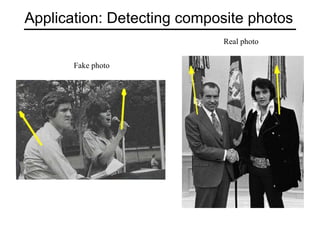
Application: Detecting composite photos
Fake photo
Real photo
Questions?

Computer vision - light

  • 1.
    Light & Perception CSCI455: Computer Vision
  • 3.
    Road map • Finishingup geometry • Next: deep learning and hot topics in computer vision
  • 4.
    Can we determineshape from lighting? • Are these spheres? • Or just flat discs painted with varying albedo? • There is ambiguity between shading and reflectance • But still, as humans we can understand the shapes of these objects
  • 5.
    What we know:Stereo Key Idea: use feature motion to understand shape
  • 6.
    Next: Photometric Stereo KeyIdea: use pixel brightness to understand shape
  • 7.
    Next: Photometric Stereo KeyIdea: use pixel brightness to understand shape
  • 8.
    Photometric Stereo Input (1 of12) Normals (RGB colormap) Normals (vectors) Shaded 3D rendering Textured 3D rendering What results can you get?
  • 10.
  • 11.
  • 12.
    Properties of light Today •What is light? • How do we measure it? • How does light propagate? • How does light interact with matter?
  • 13.
    Radiometry What determines thebrightness of a pixel? Light source properties Surface properties Surface properties
  • 14.
    Radiometry What determines thebrightness of a pixel? https://www.instagram.com/p/BtgX55ZBhU-/@robertwestonbreshears
  • 15.
    Radiometry What determines thebrightness of a pixel?
  • 16.
    Radiometry What determines thebrightness of an image pixel? Light source properties Surface shape Surface reflectance properties Optics Sensor characteristics Slide by L. Fei-Fei Exposure
  • 17.
    What is light? Electromagneticradiation (EMR) moving along rays in space • R(l) is EMR, measured in units of power (watts) – l is wavelength Light field • We can describe all of the light in the scene by specifying the radiation (or “radiance” along all light rays) arriving at every point in space and from every direction
  • 18.
    Color perception Electromagnetic radiation(EMR) moving along rays in space • R(l) is EMR, measured in units of power (watts) – l is wavelength Perceiving light • How do we convert radiation into “color”? • What part of the spectrum do we see?
  • 19.
    Visible light We “see”electromagnetic radiation in a range of wavelengths
  • 20.
    Light spectrum The appearanceof light depends on its power spectrum • How much power (or energy) at each wavelength daylight tungsten bulb Our visual system converts a light spectrum into “color” • This is a rather complex transformation fluorescent bulb
  • 21.
    The human visualsystem Color perception • Light hits the retina, which contains photosensitive cells – rods and cones • These cells convert the spectrum into a few discrete values
  • 22.
    Density of rodsand cones Rods and cones are non-uniformly distributed on the retina • Rods responsible for intensity, cones responsible for color • Fovea - Small region (1 or 2°) at the center of the visual field containing the highest density of cones (and no rods). • Less visual acuity in the periphery—many rods wired to the same neuron
  • 23.
    Demonstrations of visualacuity With one eye shut, at the right distance, all of these letters should appear equally legible (Glassner, 1.7).
  • 24.
    Demonstrations of visualacuity With left eye shut, look at the cross on the left. At the right distance, the circle on the right should disappear (Glassner, 1.8).
  • 25.
    Brightness contrast andconstancy The apparent brightness depends on the surrounding region • brightness contrast: a constant colored region seems lighter or darker depending on the surrounding intensity: – http://www.sandlotscience.com/Contrast/Checker_Board_2.htm • brightness constancy: a surface looks the same under widely varying lighting conditions.
  • 26.
    Light response isnonlinear Our visual system has a large dynamic range • We can resolve both light and dark things at the same time • One mechanism for achieving this is that we sense light intensity on a logarithmic scale – an exponential intensity ramp will be seen as a linear ramp • Another mechanism is adaptation – rods and cones adapt to be more sensitive in low light, less sensitive in bright light.
  • 27.
    Visual dynamic range Apiece of white paper can be 1,000,000,000 times brighter in outdoor sunlight than in a moonless night. BUT in a given lighting condition, light ranges over only about two orders of magnitude.
  • 28.
  • 29.
    Visual dynamic range Dark night Indoor lighting cloudy day Sunny day Ifwe were sensitive to this whole range all the time, we wouldn’t be able to discriminate lightness levels in a typical scene. The visual system solves this problem by restricting the ‘dynamic range’ of its response to match the current overall or ‘ambient’ light level. Dark night Indoor lighting cloudy day Sunny day Dark night Indoor lighting cloudy day Sunny day
  • 30.
    Color perception Three typesof cones • Each is sensitive in a different region of the spectrum – but regions overlap – Short (S) corresponds to blue – Medium (M) corresponds to green – Long (L) corresponds to red • Different sensitivities: we are more sensitive to green than red – varies from person to person (and with age) • Colorblindness—deficiency in at least one type of cone L response curve
  • 31.
    Color perception Rods andcones act as filters on the spectrum • To get the output of a filter, multiply its response curve by the spectrum, integrate over all wavelengths – Each cone yields one number • Q: How can we represent an entire spectrum with 3 numbers? S M L Wavelength Power • A: We can’t! Most of the information is lost. – As a result, two different spectra may appear indistinguishable » such spectra are known as metamers » http://www.cs.brown.edu/exploratories/freeSoftware/repository/edu/brown/cs/explo ratories/applets/spectrum/metamers_guide.html
  • 32.
    What kind ofbulb is it? http://www.chemistryland.com/CHM107Lab/Exp7/Spectroscope/Spectroscope.html
  • 33.
    Perception summary The mappingfrom radiance to perceived color is quite complex! • We throw away most of the data • We apply a logarithm • Brightness affected by pupil size • Brightness contrast and constancy effects The same is true for cameras • But we have tools to correct for these effects – (Computational Photography)
  • 34.
  • 35.
    Light sources Basic types •point source • directional source – a point source that is infinitely far away • area source – a union of point sources More generally • a light field can describe *any* distribution of light sources What happens when light hits an object?
  • 36.
    Modeling Image Formation Tracka “ray” of light all the way from light source to the sensor We need to reason about: • How light interacts with the scene • How a pixel value is related to light energy in the world
  • 37.
    Directional Lighting • Keyproperty: all rays are parallel • Equivalent to an infinitely distant point source
  • 38.
  • 39.
    © Kavita Bala,Computer Science, Cornell University Materials - Three Forms Ideal diffuse (Lambertian) Ideal specular Directional diffuse
  • 40.
    © Kavita Bala,Computer Science, Cornell University Reflectance—Three Forms Ideal diffuse (Lambertian) Directional diffuse Ideal specular
  • 41.
    © Kavita Bala,Computer Science, Cornell University Ideal Diffuse Reflection • Characteristic of multiple scattering materials • An idealization but reasonable for matte surfaces
  • 42.
    Lambertian Reflectance 1. Reflectedenergy is proportional to cosine of angle between L and N (incoming) 2. Measured intensity is viewpoint-independent (outgoing)
  • 43.
    Lambertian Reflectance: Incoming 1.Reflected energy is proportional to cosine of angle between L and N
  • 44.
    Lambertian Reflectance: Incoming 1.Reflected energy is proportional to cosine of angle between L and N
  • 45.
    Lambertian Reflectance: Incoming Lighthitting surface is proportional to the cosine 1. Reflected energy is proportional to cosine of angle between L and N
  • 46.
    Lambertian Reflectance: Outgoing 1.Radiance (what we see) is viewpoint-independent
  • 47.
    Lambertian Reflectance: Outgoing 1.Radiance (what the eye sees) is viewpoint-independent
  • 48.
    Lambertian Reflectance: Outgoing 1.Measured intensity is viewpoint-independent
  • 49.
    Lambertian Reflectance: Outgoing Radiance (whateye sees) 1. Measured intensity is viewpoint-independent A cos (q)
  • 50.
    Image Formation Model:Final 1. Diffuse albedo: what fraction of incoming light is reflected? • Introduce scale factor 2. Light intensity: how much light is arriving? • Compensate with camera exposure (global scale factor) 3. Camera response function • Assume pixel value is linearly proportional to incoming energy (perform radiometric calibration if not)
  • 51.
    A Single Image:Shape from Shading Assume is 1 for now. What can we measure from one image? • is the angle between N and L • Add assumptions: • Constant albedo • A few known normals (e.g. silhouettes) • Smoothness of normals In practice, SFS doesn’t work very well: assumptions are too restrictive, too much ambiguity in nontrivial scenes.
  • 52.
    Application: Detecting compositephotos Fake photo Real photo
  • 53.