Computer Literacy
BASICS: A
Comprehensive Guide
to IC3, 5th Edition
Lesson 17
Working with Graphics
1 Morrison / Wells / Ruffolo
Lesson17
Morrison / Wells / Ruffolo CLB: A Comp Guide to IC3 5E
Objectives
 Format columns, borders, and shading.
 Insert clip art and pictures.
 Resize, crop, and position graphics.
 Modify graphic colors and apply styles and
effects to clip art and pictures.
 Remove the background from a picture and
adjust the contrast and brightness.
 Use drawing tools to create your own graphics.
222
Lesson17
Morrison / Wells / Ruffolo CLB: A Comp Guide to IC3 5E
Objectives (continued)
 Use built-in, predesigned, and formatted layouts
to create your own graphics.
 Capture a picture of the application screen.
333
Lesson17
Morrison / Wells / Ruffolo CLB: A Comp Guide to IC3 5E
Words to Know
 manual column
break
 outcrop
 resizing
 section
 section break
 shape
 sizing handles
 banner
 clip art
 crop
 desktop publishing
 drawing canvas
 drawing objects
 graphics
444
Lesson17
Morrison / Wells / Ruffolo CLB: A Comp Guide to IC3 5E
Words to Know (continued)
 SmartArt
 text box
 WordArt
555
Lesson17
Morrison / Wells / Ruffolo CLB: A Comp Guide to IC3 5E
Formatting Columns, Borders, and
Shading
666
 Desktop publishing is the process of
creating a document using a computer to lay
out text and graphics.
 One common example of desktop publishing
is newsletters, which are often formatted in
multiple columns with headings, borders,
shading, and pictures.
Lesson17
Morrison / Wells / Ruffolo CLB: A Comp Guide to IC3 5E
Formatting Columns, Borders, and
Shading (continued)
777
 Formatting Text in Columns
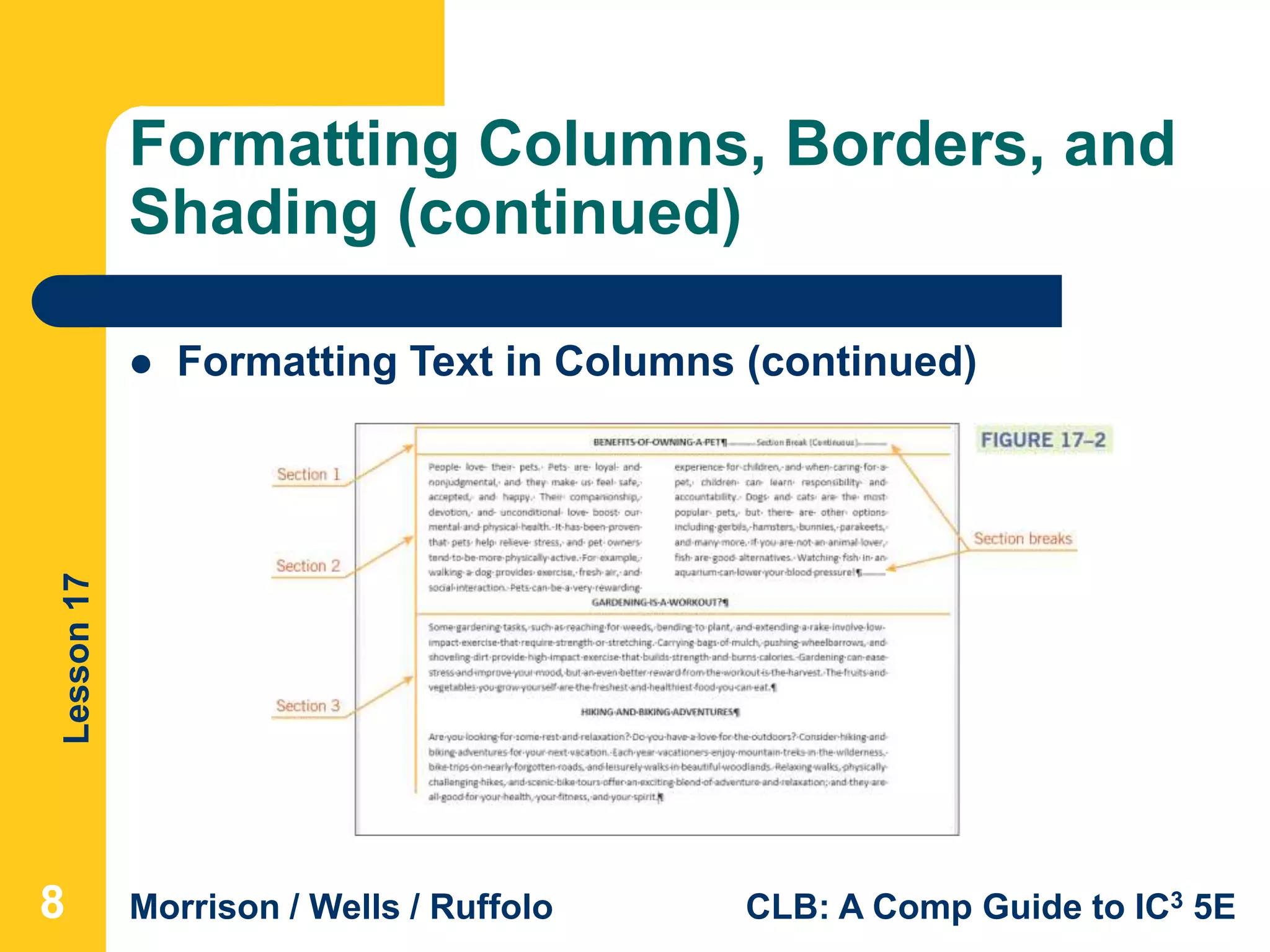
 A section is an area within a document that can have its
own separate page formats such as the page orientation,
margins, and the number of columns.
 To change the page formats for one portion of the document,
you must divide the document into multiple sections by
creating a section break.
 A section break controls the section formatting of the text
that precedes it.
 After dividing the document into multiple sections, you can
apply different formats in each section.
Lesson17
Morrison / Wells / Ruffolo CLB: A Comp Guide to IC3 5E
Formatting Columns, Borders, and
Shading (continued)
888
 Formatting Text in Columns (continued)
Lesson17
Morrison / Wells / Ruffolo CLB: A Comp Guide to IC3 5E
Formatting Columns, Borders, and
Shading (continued)
999
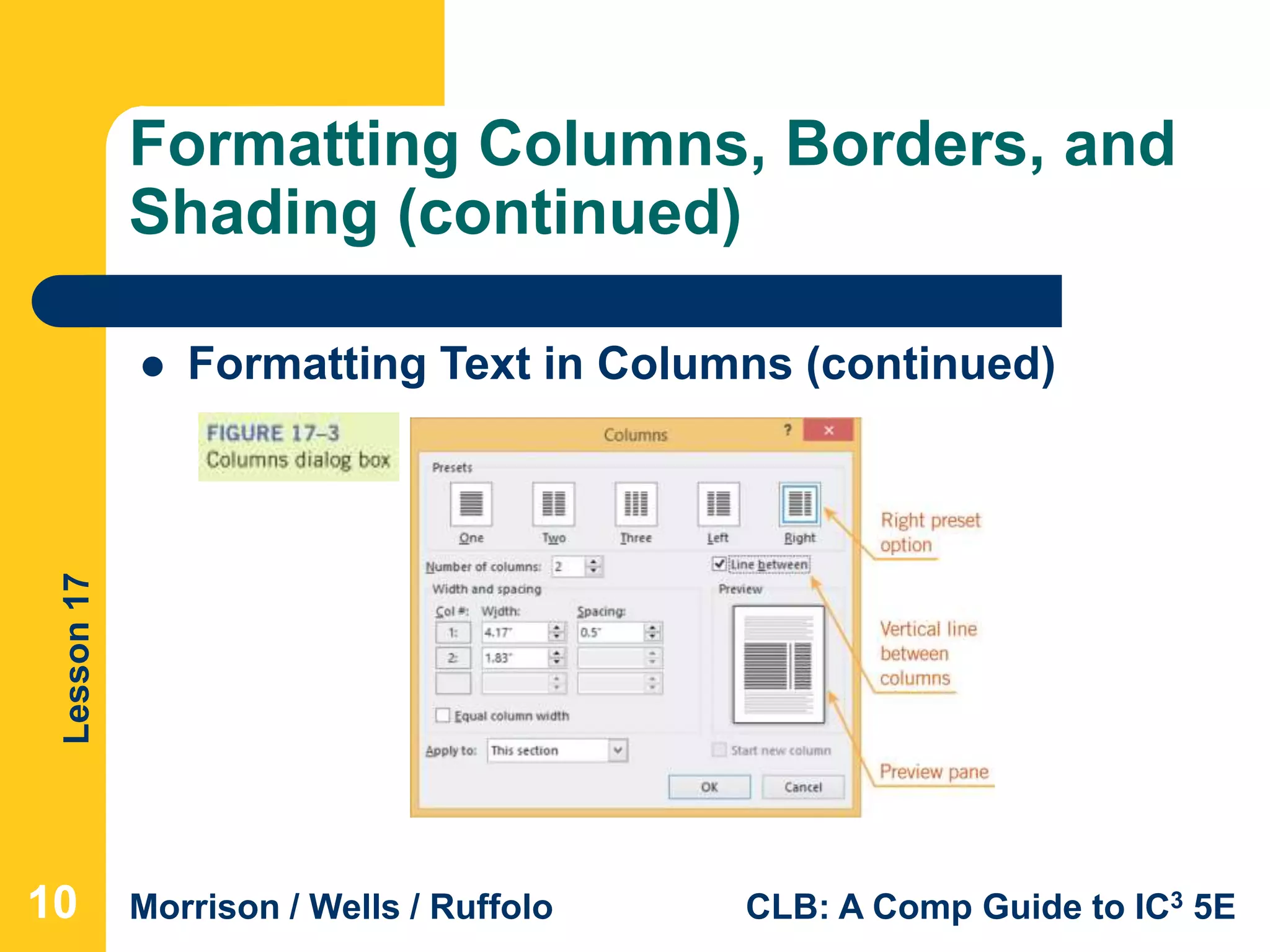
 Formatting Text in Columns (continued)
 Word provides several multicolumn formats,
and you can modify these formats to meet
your needs.
 A column heading often is formatted as a
single-column banner, which is a headline that
spreads the full width of the page.
 A manual column break adjusts where a
column ends.
Lesson17
Morrison / Wells / Ruffolo CLB: A Comp Guide to IC3 5E
Formatting Columns, Borders, and
Shading (continued)
101010
 Formatting Text in Columns (continued)
Lesson17
Morrison / Wells / Ruffolo CLB: A Comp Guide to IC3 5E
Formatting Columns, Borders, and
Shading (continued)
111111
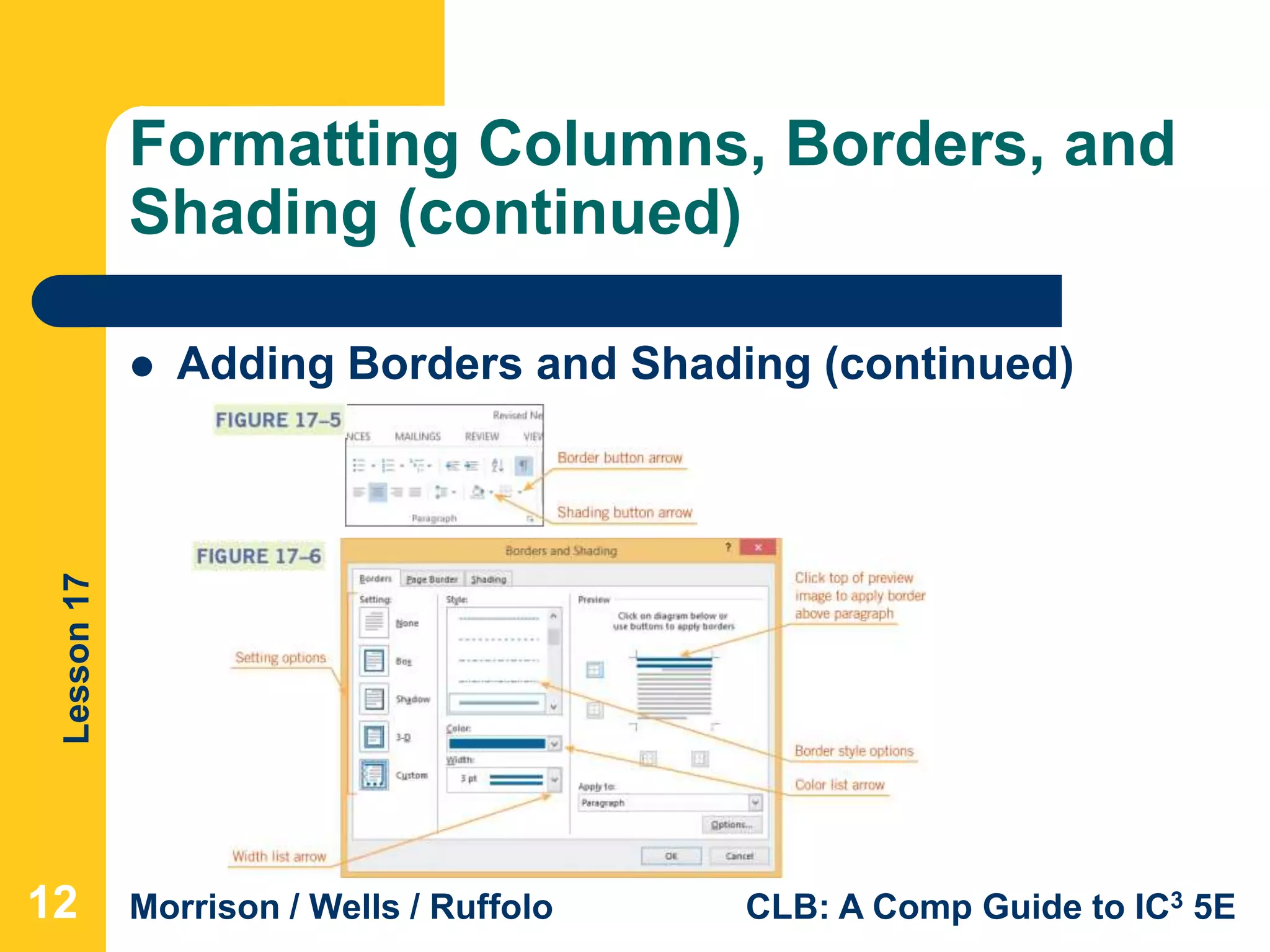
 Adding Borders and Shading
 Word offers many options for applying borders
above, below, and around paragraphs of text.
 The borders can be customized by changing the
line color, the line style, and the thickness of the
line.
 You can also enhance the document content by
adding shading behind text.
Lesson17
Morrison / Wells / Ruffolo CLB: A Comp Guide to IC3 5E
Formatting Columns, Borders, and
Shading (continued)
121212
 Adding Borders and Shading (continued)
Lesson17
Morrison / Wells / Ruffolo CLB: A Comp Guide to IC3 5E
Inserting and Formatting Graphics
131313
 Graphics are non-text items such as digital
photos, scanned images, and pictures.
 You can insert images created or modified in
other applications such as a graphics or
drafting application.
 Graphics created in other applications are
saved in a variety of formats, including JPEG
(*.jpg), TIFF (*.tif), and bitmap (*.bmp).
Lesson17
Morrison / Wells / Ruffolo CLB: A Comp Guide to IC3 5E
Inserting and Formatting Graphics
(continued)
141414
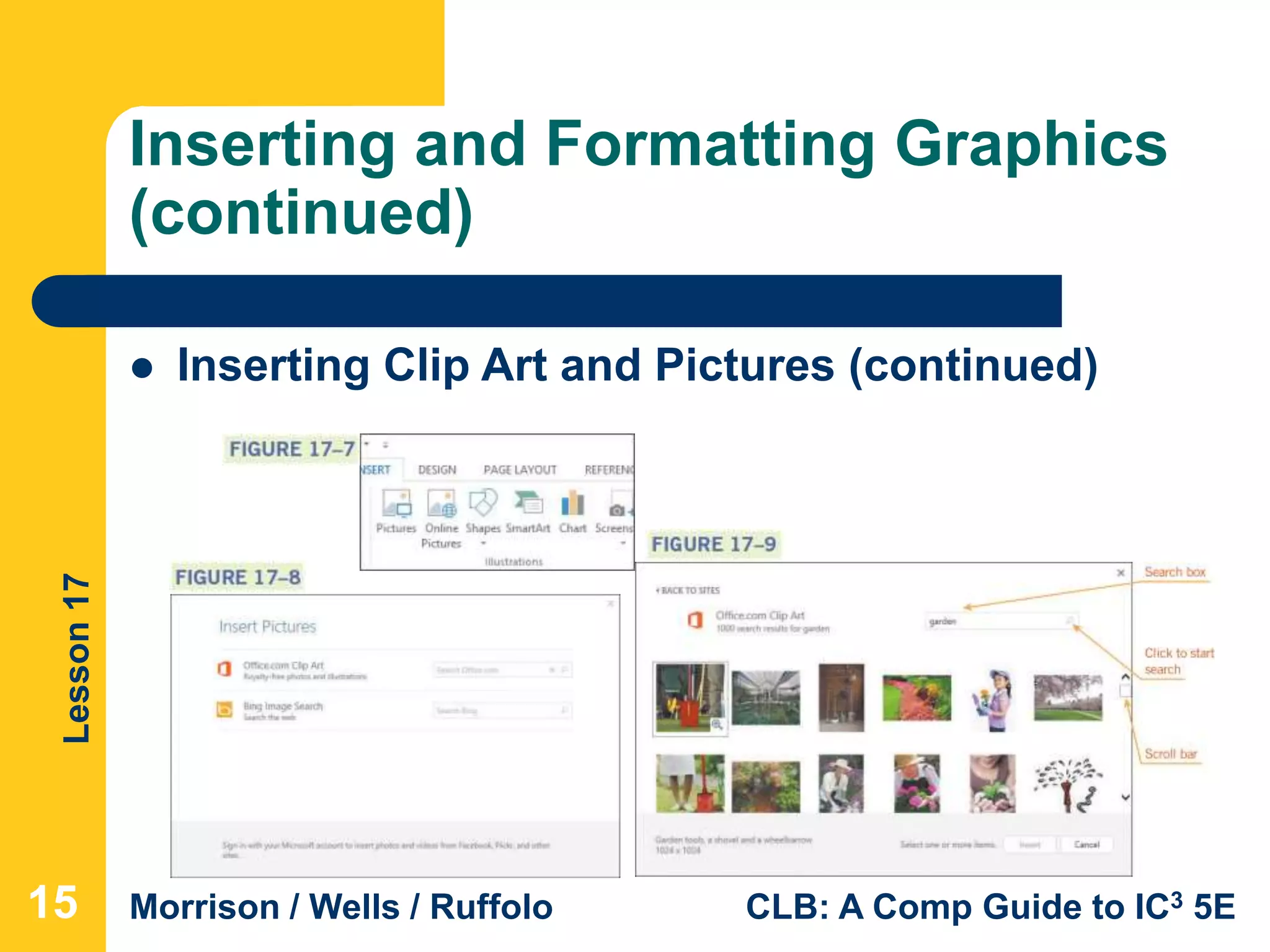
 Inserting Clip Art and Pictures
 Clip art is a graphic that is ready to insert into a
document.
 Word has numerous illustrations and photographs
you can access online.
 You can search for photos and clip art at the
Microsoft Office.com Web site.
 You can access pictures you have saved in the My
Pictures folder, or on SkyDrive or other sites.
Lesson17
Morrison / Wells / Ruffolo CLB: A Comp Guide to IC3 5E
Inserting and Formatting Graphics
(continued)
151515
 Inserting Clip Art and Pictures (continued)
Lesson17
Morrison / Wells / Ruffolo CLB: A Comp Guide to IC3 5E
Inserting and Formatting Graphics
(continued)
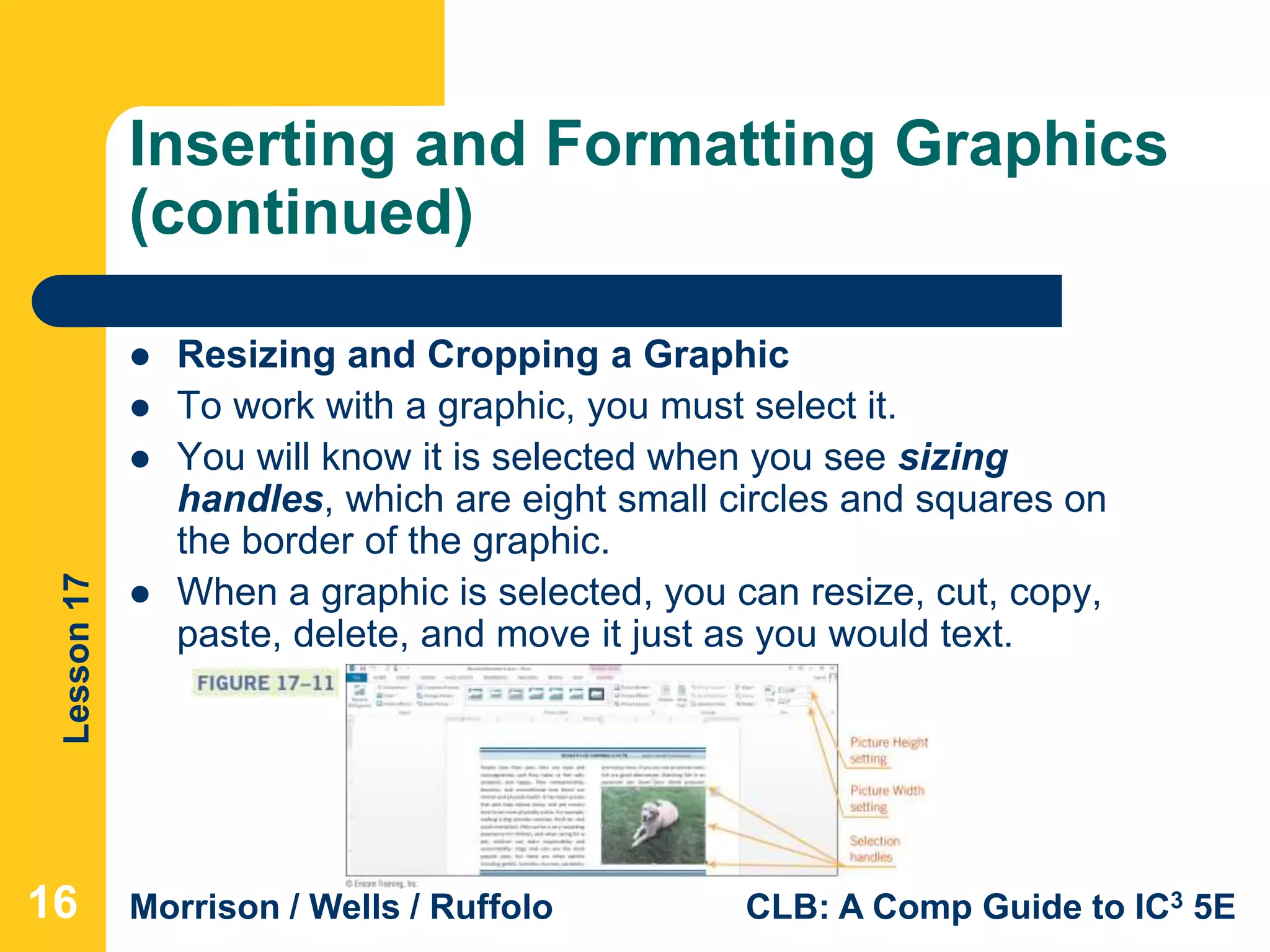
 Resizing and Cropping a Graphic
 To work with a graphic, you must select it.
 You will know it is selected when you see sizing
handles, which are eight small circles and squares on
the border of the graphic.
 When a graphic is selected, you can resize, cut, copy,
paste, delete, and move it just as you would text.
16
Lesson17
Morrison / Wells / Ruffolo CLB: A Comp Guide to IC3 5E
Inserting and Formatting Graphics
(continued)
 Resizing and Cropping a
Graphic (continued)
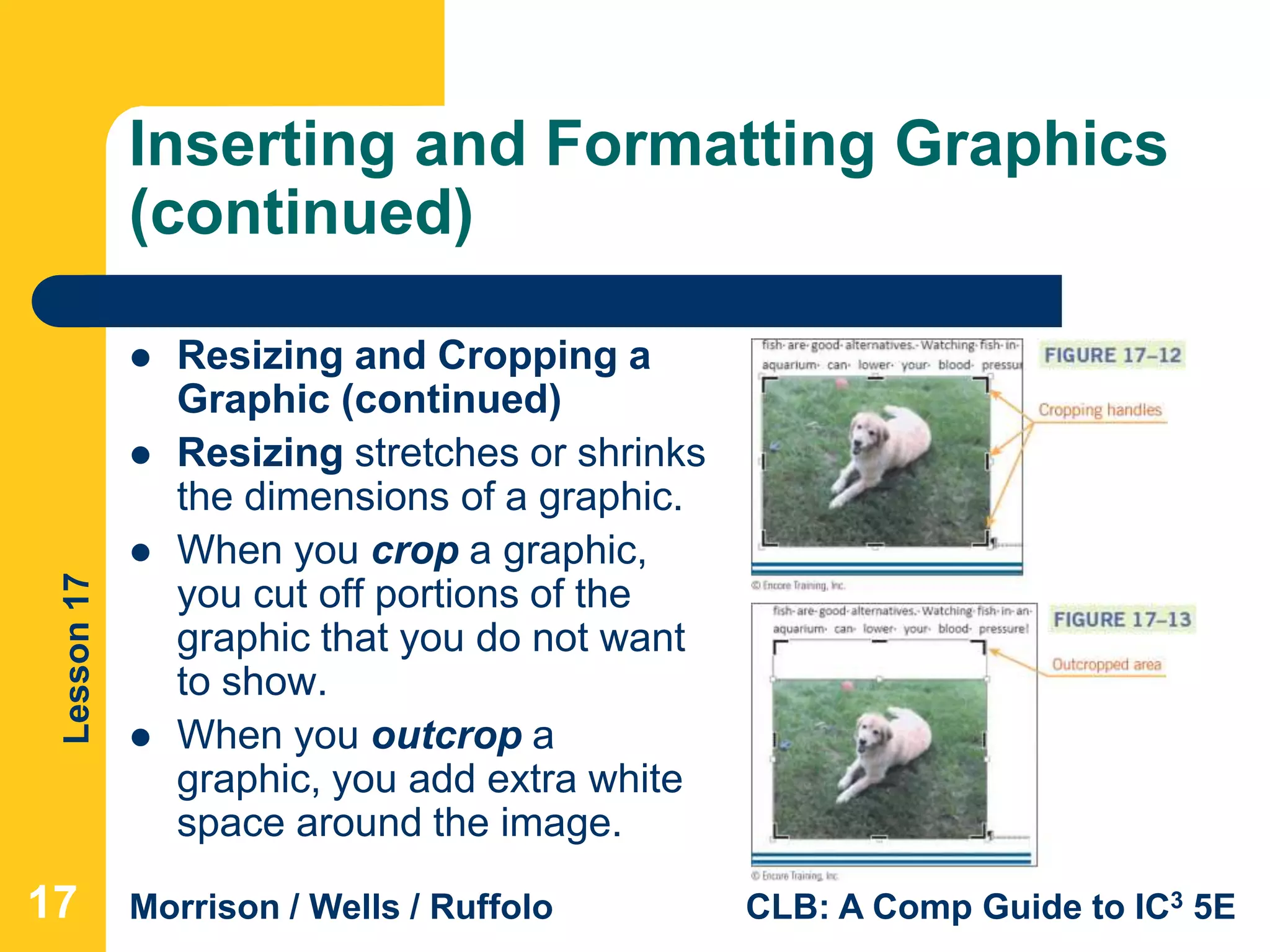
 Resizing stretches or shrinks
the dimensions of a graphic.
 When you crop a graphic,
you cut off portions of the
graphic that you do not want
to show.
 When you outcrop a
graphic, you add extra white
space around the image.
17
Lesson17
Morrison / Wells / Ruffolo CLB: A Comp Guide to IC3 5E
Inserting and Formatting Graphics
(continued)
 Positioning a Graphic
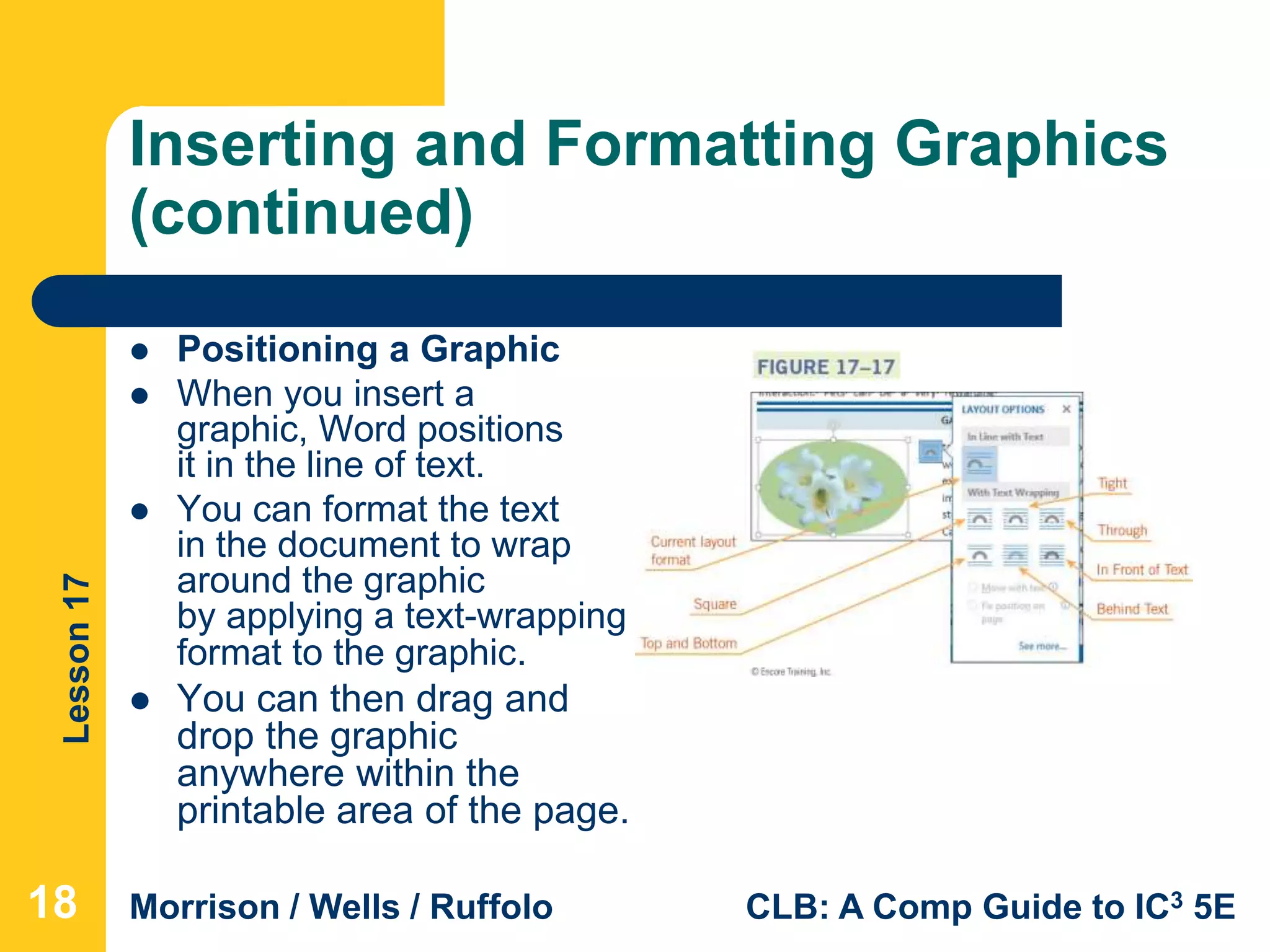
 When you insert a
graphic, Word positions
it in the line of text.
 You can format the text
in the document to wrap
around the graphic
by applying a text-wrapping
format to the graphic.
 You can then drag and
drop the graphic
anywhere within the
printable area of the page.
18
Lesson17
Morrison / Wells / Ruffolo CLB: A Comp Guide to IC3 5E
Inserting and Formatting Graphics
(continued)
191919
 Adjusting Colors and Applying Styles and Effects
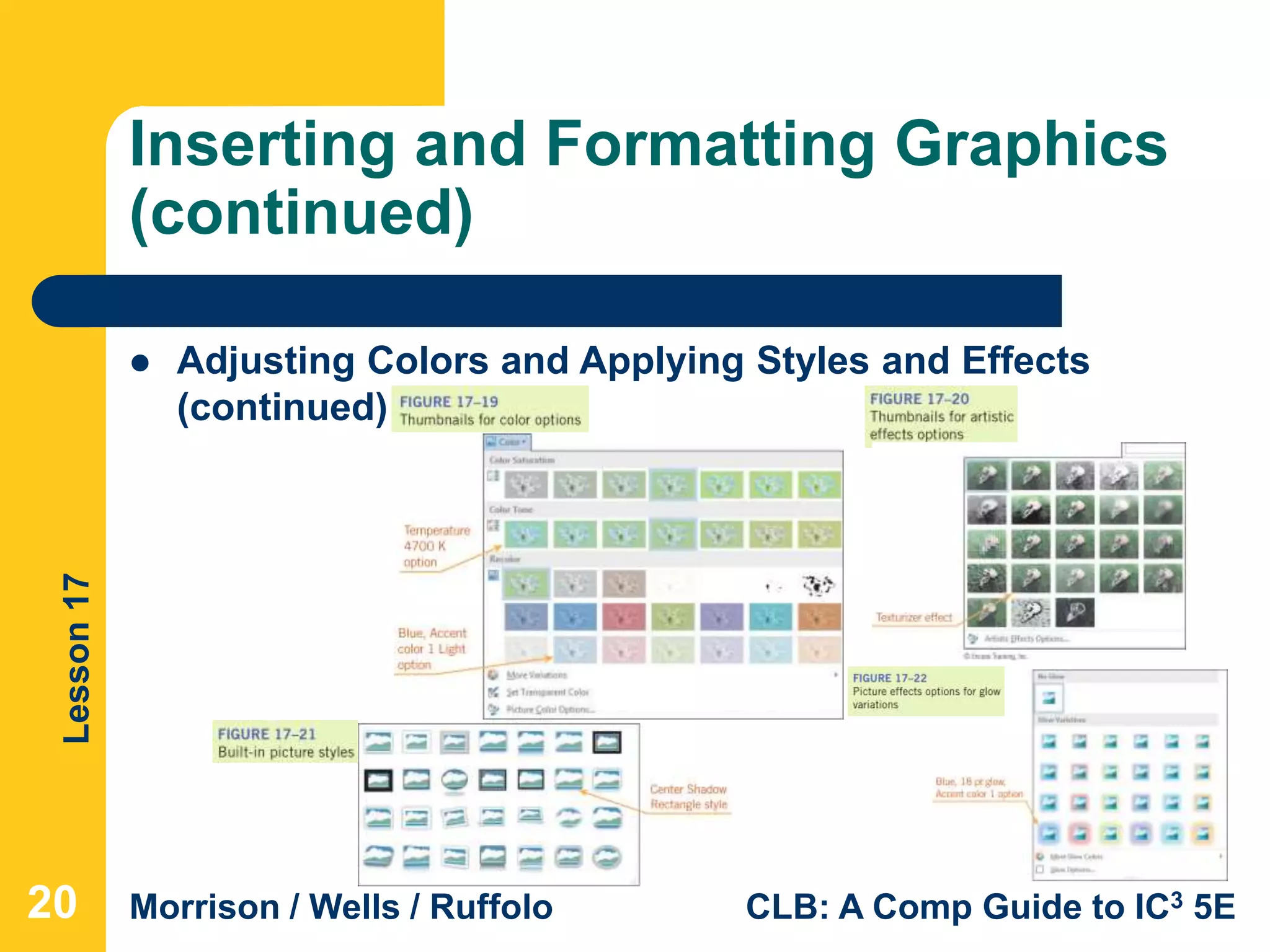
 You can customize clip art or a photograph by changing
its colors.
 You can recolor both photos and illustrations.
 For photos, there are also options for changing the color
saturation and the color tone.
 You can apply border styles and other special formats,
such as shadows, soft edges, and 3-D effects.
 You can add artistic effects to make a picture look like a
sketch or a painting.
Lesson17
Morrison / Wells / Ruffolo CLB: A Comp Guide to IC3 5E
Inserting and Formatting Graphics
(continued)
20
 Adjusting Colors and Applying Styles and Effects
(continued)
Lesson17
Morrison / Wells / Ruffolo CLB: A Comp Guide to IC3 5E
Inserting and Formatting Graphics
(continued)
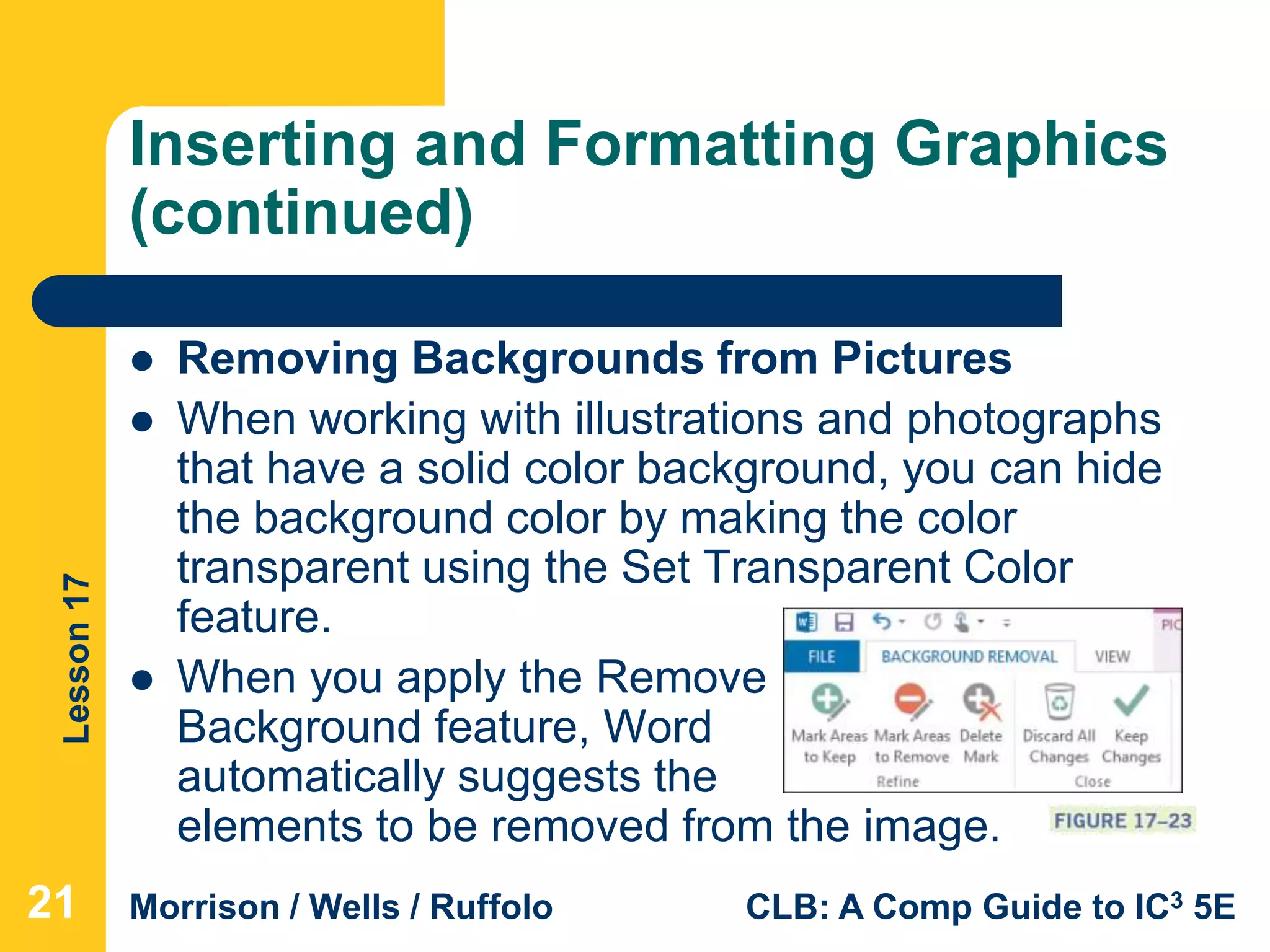
 Removing Backgrounds from Pictures
 When working with illustrations and photographs
that have a solid color background, you can hide
the background color by making the color
transparent using the Set Transparent Color
feature.
 When you apply the Remove
Background feature, Word
automatically suggests the
elements to be removed from the image.
21
Lesson17
Morrison / Wells / Ruffolo CLB: A Comp Guide to IC3 5E
Inserting and Formatting Graphics
(continued)
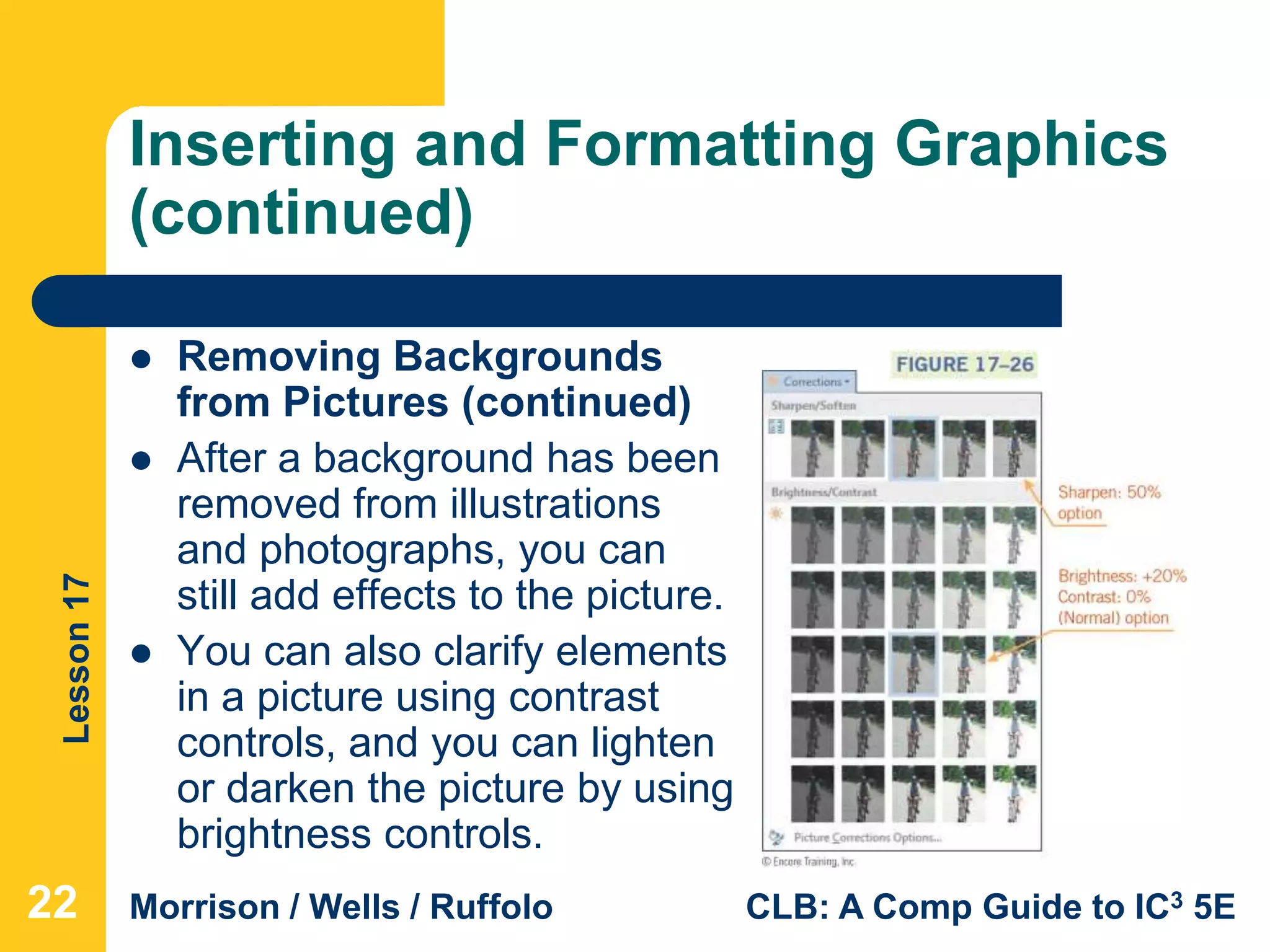
 Removing Backgrounds
from Pictures (continued)
 After a background has been
removed from illustrations
and photographs, you can
still add effects to the picture.
 You can also clarify elements
in a picture using contrast
controls, and you can lighten
or darken the picture by using
brightness controls.
22
Lesson17
Morrison / Wells / Ruffolo CLB: A Comp Guide to IC3 5E
Creating Your Own Graphics
232323
 Sometimes you may need to create
your own graphics.
 For example, you may want to create a
fancy title for a document, a map, or an
organizational chart.
 Word offers several tools to simplify
these tasks.
Lesson17
Morrison / Wells / Ruffolo CLB: A Comp Guide to IC3 5E
Creating Your Own Graphics
(continued)
242424
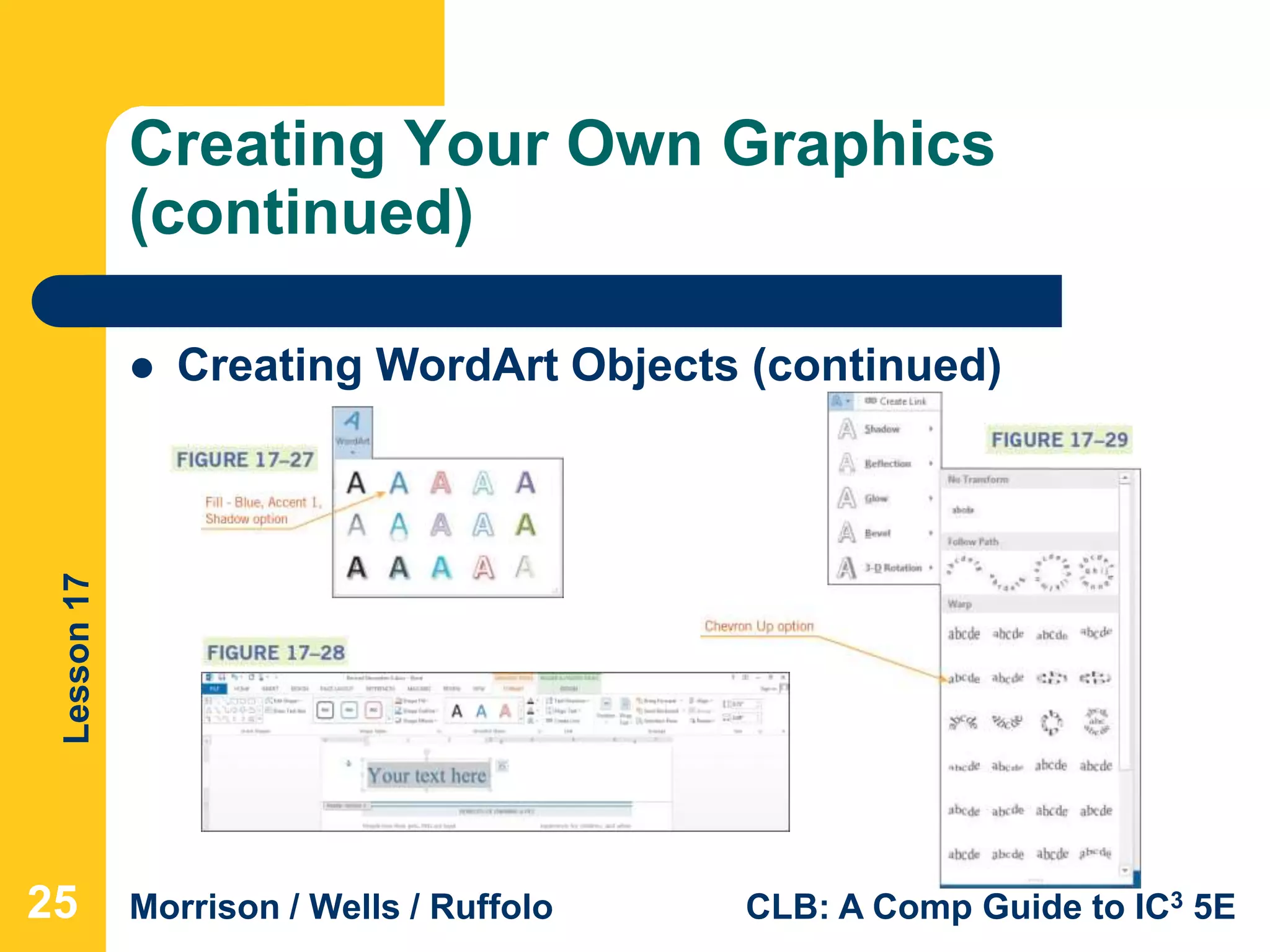
 Creating WordArt Objects
 WordArt is a feature that transforms text into a
graphic.
 The WordArt graphic is created in a text box,
which is a drawing object that displays text.
 You can edit the text and you can fit the text
within a preset shape, apply a gradient file,
change the angle of the text, and apply special
effects such as text borders and shadows.
Lesson17
Morrison / Wells / Ruffolo CLB: A Comp Guide to IC3 5E
Creating Your Own Graphics
(continued)
25
 Creating WordArt Objects (continued)
Lesson17
Morrison / Wells / Ruffolo CLB: A Comp Guide to IC3 5E
Creating Your Own Graphics
(continued)
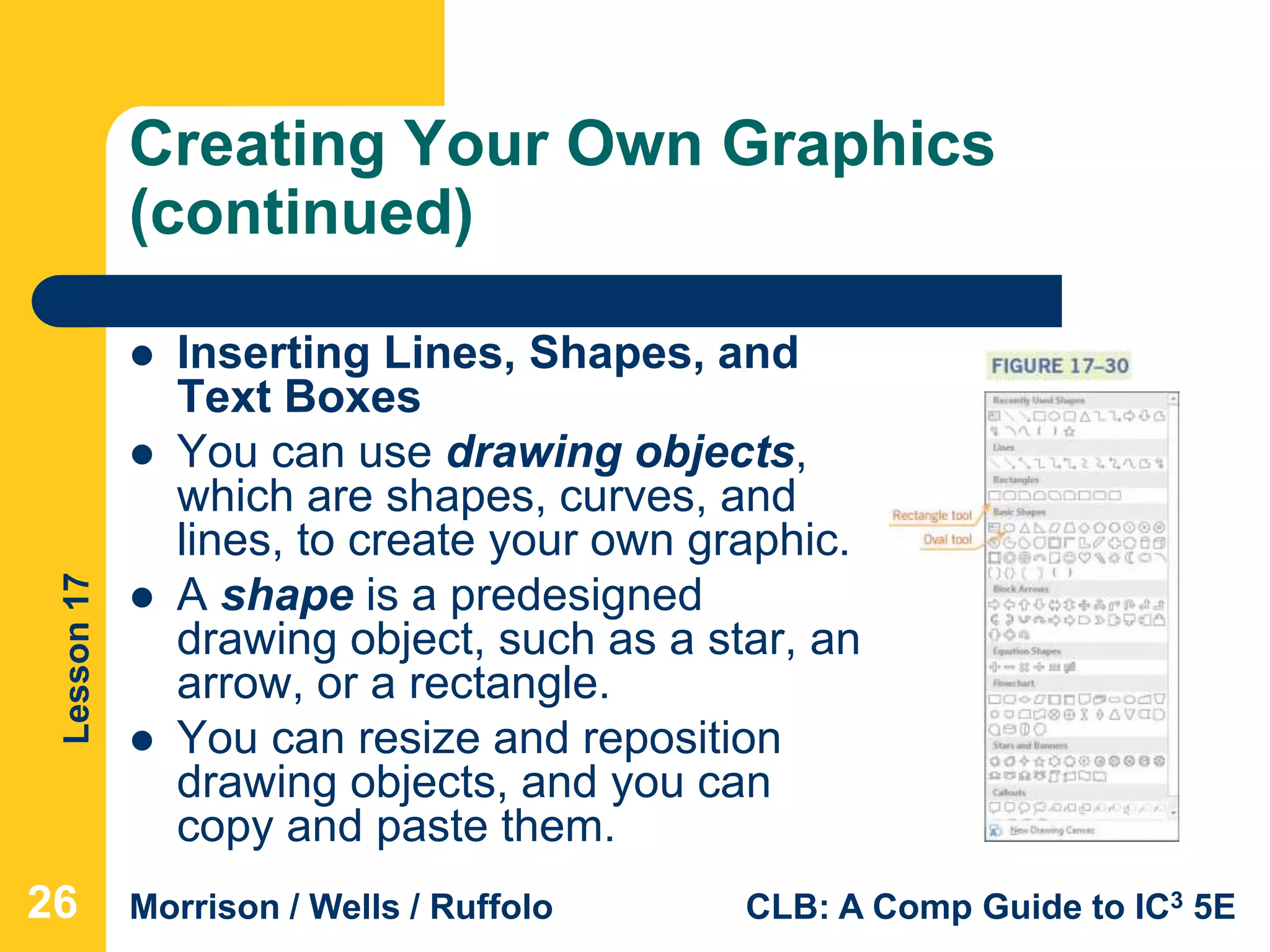
 Inserting Lines, Shapes, and
Text Boxes
 You can use drawing objects,
which are shapes, curves, and
lines, to create your own graphic.
 A shape is a predesigned
drawing object, such as a star, an
arrow, or a rectangle.
 You can resize and reposition
drawing objects, and you can
copy and paste them.
26
Lesson17
Morrison / Wells / Ruffolo CLB: A Comp Guide to IC3 5E
Creating Your Own Graphics
(continued)
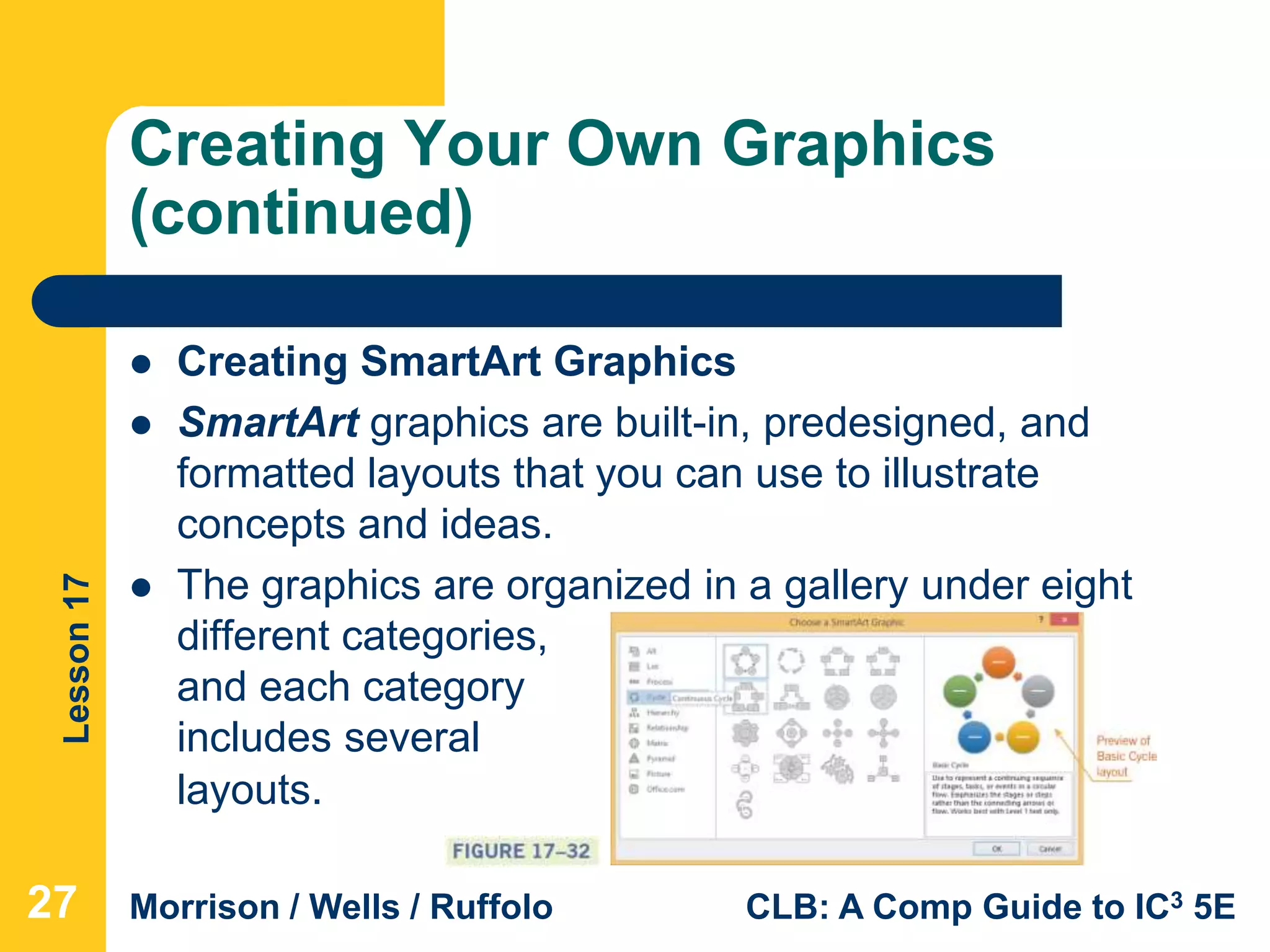
 Creating SmartArt Graphics
 SmartArt graphics are built-in, predesigned, and
formatted layouts that you can use to illustrate
concepts and ideas.
 The graphics are organized in a gallery under eight
different categories,
and each category
includes several
layouts.
27
Lesson17
Morrison / Wells / Ruffolo CLB: A Comp Guide to IC3 5E
Creating Your Own Graphics
(continued)
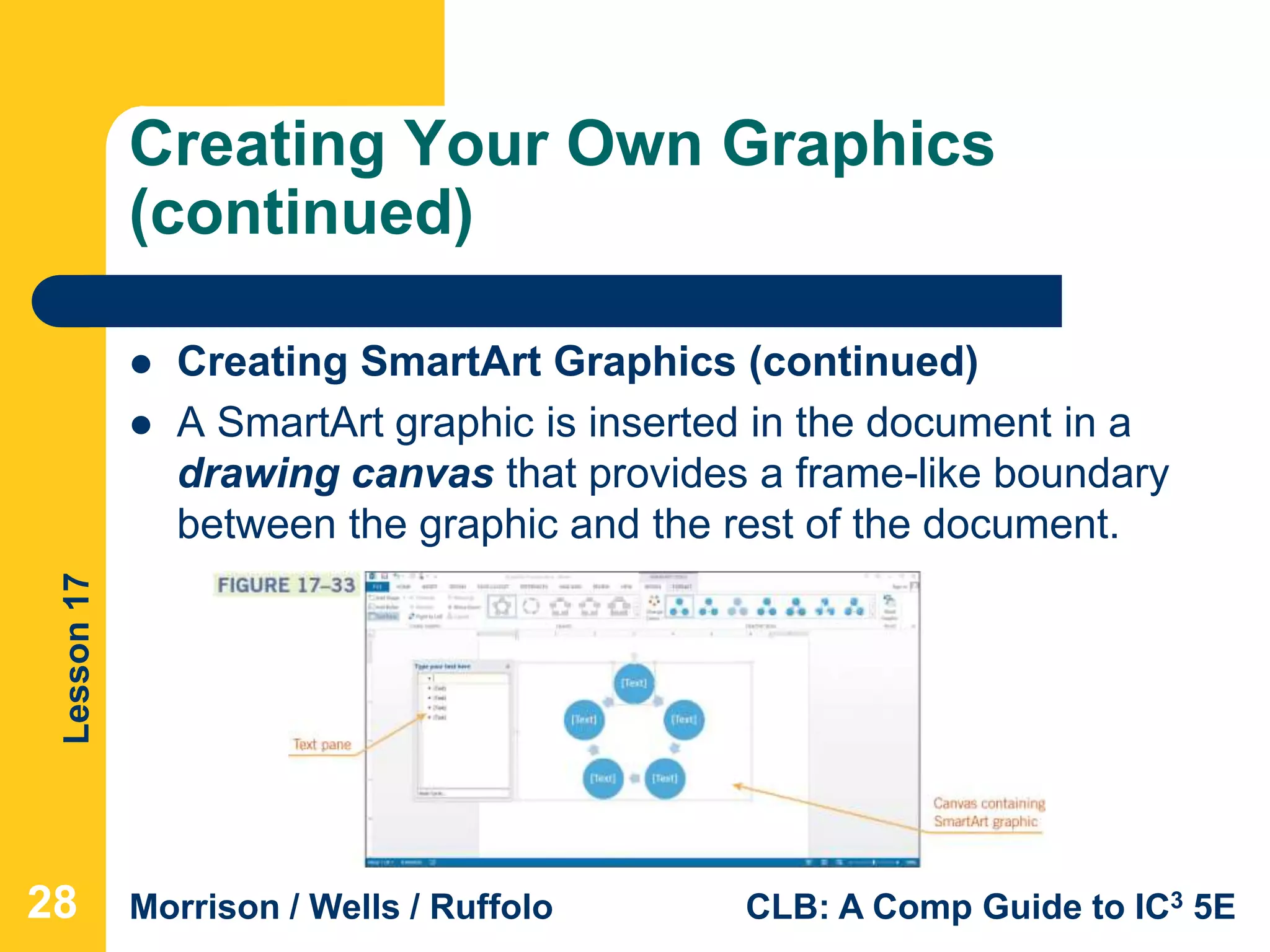
 Creating SmartArt Graphics (continued)
 A SmartArt graphic is inserted in the document in a
drawing canvas that provides a frame-like boundary
between the graphic and the rest of the document.
28
Lesson17
Morrison / Wells / Ruffolo CLB: A Comp Guide to IC3 5E
Creating Your Own Graphics
(continued)
292929
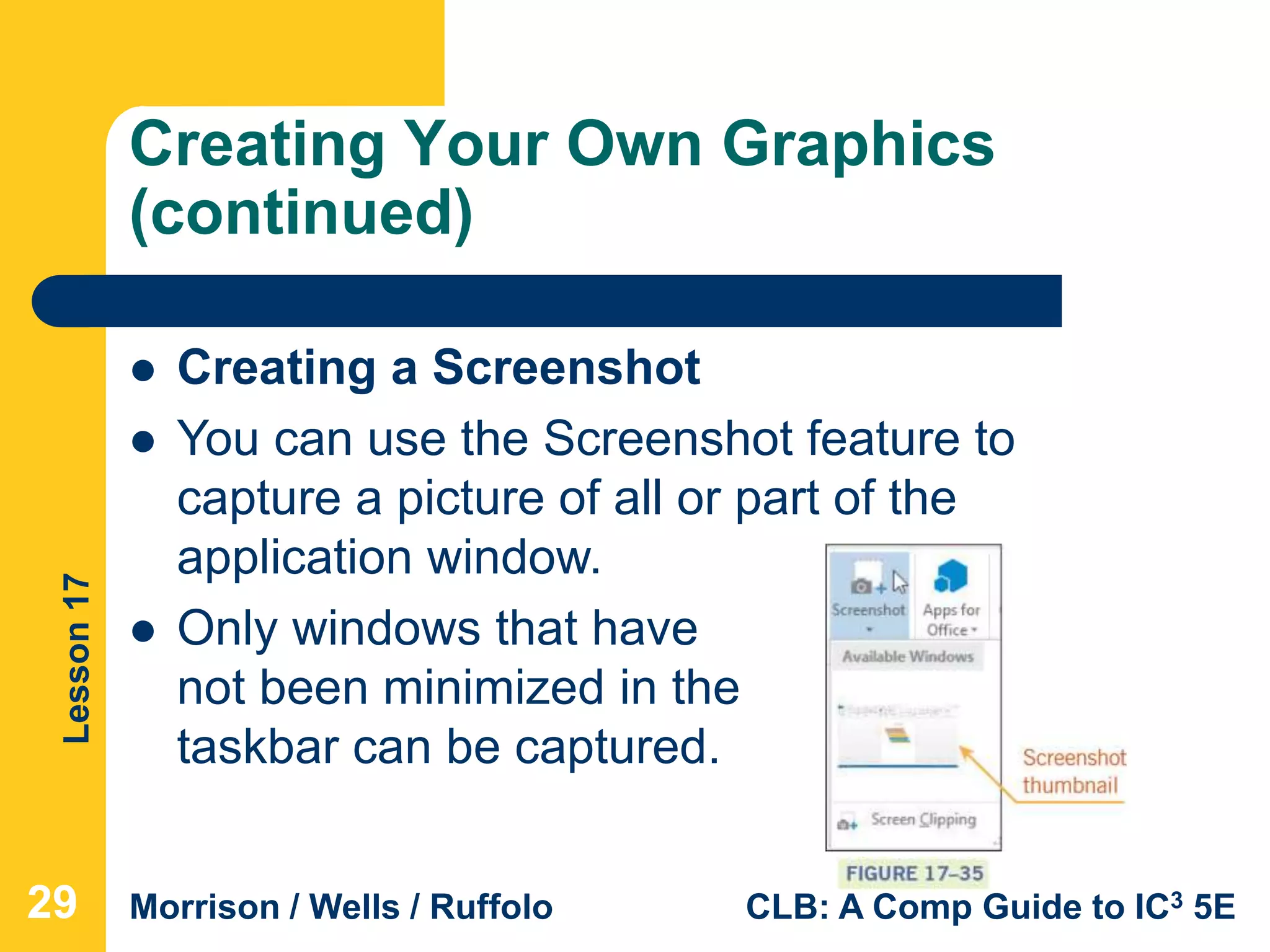
 Creating a Screenshot
 You can use the Screenshot feature to
capture a picture of all or part of the
application window.
 Only windows that have
not been minimized in the
taskbar can be captured.
Lesson17
Morrison / Wells / Ruffolo CLB: A Comp Guide to IC3 5E
Summary
In this lesson, you learned:
 Text can be arranged in a variety of multicolumn
formats, all within the same document.
 Borders and shading are effective tools for
enhancing the appearance and effectiveness of
a document. You can choose from a variety of
options for line styles, colors, and shading
effects.
303030
Lesson17
Morrison / Wells / Ruffolo CLB: A Comp Guide to IC3 5E
Summary (continued)
 Clip art and pictures help to enhance the
appearance and effectiveness of a document.
 You can resize and crop graphics, and you can
choose from several options to position the graphic
in the document.
 You can further enhance graphics by changing the
colors, applying special effects, removing
backgrounds, and adjusting the contrast and
brightness.
313131
Lesson17
Morrison / Wells / Ruffolo CLB: A Comp Guide to IC3 5E
Summary (continued)
 To add emphasis to your document, you can use the
WordArt feature to make text decorative.
 You can create your own graphics using drawing
tools, shapes, and text boxes.
 SmartArt graphics are useful in illustrating concepts
and ideas.
 The screenshot feature enables you to capture a
picture of all or part of the application window.
323232

Computer Literacy Lesson 17

  • 1.
    Computer Literacy BASICS: A ComprehensiveGuide to IC3, 5th Edition Lesson 17 Working with Graphics 1 Morrison / Wells / Ruffolo
  • 2.
    Lesson17 Morrison / Wells/ Ruffolo CLB: A Comp Guide to IC3 5E Objectives  Format columns, borders, and shading.  Insert clip art and pictures.  Resize, crop, and position graphics.  Modify graphic colors and apply styles and effects to clip art and pictures.  Remove the background from a picture and adjust the contrast and brightness.  Use drawing tools to create your own graphics. 222
  • 3.
    Lesson17 Morrison / Wells/ Ruffolo CLB: A Comp Guide to IC3 5E Objectives (continued)  Use built-in, predesigned, and formatted layouts to create your own graphics.  Capture a picture of the application screen. 333
  • 4.
    Lesson17 Morrison / Wells/ Ruffolo CLB: A Comp Guide to IC3 5E Words to Know  manual column break  outcrop  resizing  section  section break  shape  sizing handles  banner  clip art  crop  desktop publishing  drawing canvas  drawing objects  graphics 444
  • 5.
    Lesson17 Morrison / Wells/ Ruffolo CLB: A Comp Guide to IC3 5E Words to Know (continued)  SmartArt  text box  WordArt 555
  • 6.
    Lesson17 Morrison / Wells/ Ruffolo CLB: A Comp Guide to IC3 5E Formatting Columns, Borders, and Shading 666  Desktop publishing is the process of creating a document using a computer to lay out text and graphics.  One common example of desktop publishing is newsletters, which are often formatted in multiple columns with headings, borders, shading, and pictures.
  • 7.
    Lesson17 Morrison / Wells/ Ruffolo CLB: A Comp Guide to IC3 5E Formatting Columns, Borders, and Shading (continued) 777  Formatting Text in Columns  A section is an area within a document that can have its own separate page formats such as the page orientation, margins, and the number of columns.  To change the page formats for one portion of the document, you must divide the document into multiple sections by creating a section break.  A section break controls the section formatting of the text that precedes it.  After dividing the document into multiple sections, you can apply different formats in each section.
  • 8.
    Lesson17 Morrison / Wells/ Ruffolo CLB: A Comp Guide to IC3 5E Formatting Columns, Borders, and Shading (continued) 888  Formatting Text in Columns (continued)
  • 9.
    Lesson17 Morrison / Wells/ Ruffolo CLB: A Comp Guide to IC3 5E Formatting Columns, Borders, and Shading (continued) 999  Formatting Text in Columns (continued)  Word provides several multicolumn formats, and you can modify these formats to meet your needs.  A column heading often is formatted as a single-column banner, which is a headline that spreads the full width of the page.  A manual column break adjusts where a column ends.
  • 10.
    Lesson17 Morrison / Wells/ Ruffolo CLB: A Comp Guide to IC3 5E Formatting Columns, Borders, and Shading (continued) 101010  Formatting Text in Columns (continued)
  • 11.
    Lesson17 Morrison / Wells/ Ruffolo CLB: A Comp Guide to IC3 5E Formatting Columns, Borders, and Shading (continued) 111111  Adding Borders and Shading  Word offers many options for applying borders above, below, and around paragraphs of text.  The borders can be customized by changing the line color, the line style, and the thickness of the line.  You can also enhance the document content by adding shading behind text.
  • 12.
    Lesson17 Morrison / Wells/ Ruffolo CLB: A Comp Guide to IC3 5E Formatting Columns, Borders, and Shading (continued) 121212  Adding Borders and Shading (continued)
  • 13.
    Lesson17 Morrison / Wells/ Ruffolo CLB: A Comp Guide to IC3 5E Inserting and Formatting Graphics 131313  Graphics are non-text items such as digital photos, scanned images, and pictures.  You can insert images created or modified in other applications such as a graphics or drafting application.  Graphics created in other applications are saved in a variety of formats, including JPEG (*.jpg), TIFF (*.tif), and bitmap (*.bmp).
  • 14.
    Lesson17 Morrison / Wells/ Ruffolo CLB: A Comp Guide to IC3 5E Inserting and Formatting Graphics (continued) 141414  Inserting Clip Art and Pictures  Clip art is a graphic that is ready to insert into a document.  Word has numerous illustrations and photographs you can access online.  You can search for photos and clip art at the Microsoft Office.com Web site.  You can access pictures you have saved in the My Pictures folder, or on SkyDrive or other sites.
  • 15.
    Lesson17 Morrison / Wells/ Ruffolo CLB: A Comp Guide to IC3 5E Inserting and Formatting Graphics (continued) 151515  Inserting Clip Art and Pictures (continued)
  • 16.
    Lesson17 Morrison / Wells/ Ruffolo CLB: A Comp Guide to IC3 5E Inserting and Formatting Graphics (continued)  Resizing and Cropping a Graphic  To work with a graphic, you must select it.  You will know it is selected when you see sizing handles, which are eight small circles and squares on the border of the graphic.  When a graphic is selected, you can resize, cut, copy, paste, delete, and move it just as you would text. 16
  • 17.
    Lesson17 Morrison / Wells/ Ruffolo CLB: A Comp Guide to IC3 5E Inserting and Formatting Graphics (continued)  Resizing and Cropping a Graphic (continued)  Resizing stretches or shrinks the dimensions of a graphic.  When you crop a graphic, you cut off portions of the graphic that you do not want to show.  When you outcrop a graphic, you add extra white space around the image. 17
  • 18.
    Lesson17 Morrison / Wells/ Ruffolo CLB: A Comp Guide to IC3 5E Inserting and Formatting Graphics (continued)  Positioning a Graphic  When you insert a graphic, Word positions it in the line of text.  You can format the text in the document to wrap around the graphic by applying a text-wrapping format to the graphic.  You can then drag and drop the graphic anywhere within the printable area of the page. 18
  • 19.
    Lesson17 Morrison / Wells/ Ruffolo CLB: A Comp Guide to IC3 5E Inserting and Formatting Graphics (continued) 191919  Adjusting Colors and Applying Styles and Effects  You can customize clip art or a photograph by changing its colors.  You can recolor both photos and illustrations.  For photos, there are also options for changing the color saturation and the color tone.  You can apply border styles and other special formats, such as shadows, soft edges, and 3-D effects.  You can add artistic effects to make a picture look like a sketch or a painting.
  • 20.
    Lesson17 Morrison / Wells/ Ruffolo CLB: A Comp Guide to IC3 5E Inserting and Formatting Graphics (continued) 20  Adjusting Colors and Applying Styles and Effects (continued)
  • 21.
    Lesson17 Morrison / Wells/ Ruffolo CLB: A Comp Guide to IC3 5E Inserting and Formatting Graphics (continued)  Removing Backgrounds from Pictures  When working with illustrations and photographs that have a solid color background, you can hide the background color by making the color transparent using the Set Transparent Color feature.  When you apply the Remove Background feature, Word automatically suggests the elements to be removed from the image. 21
  • 22.
    Lesson17 Morrison / Wells/ Ruffolo CLB: A Comp Guide to IC3 5E Inserting and Formatting Graphics (continued)  Removing Backgrounds from Pictures (continued)  After a background has been removed from illustrations and photographs, you can still add effects to the picture.  You can also clarify elements in a picture using contrast controls, and you can lighten or darken the picture by using brightness controls. 22
  • 23.
    Lesson17 Morrison / Wells/ Ruffolo CLB: A Comp Guide to IC3 5E Creating Your Own Graphics 232323  Sometimes you may need to create your own graphics.  For example, you may want to create a fancy title for a document, a map, or an organizational chart.  Word offers several tools to simplify these tasks.
  • 24.
    Lesson17 Morrison / Wells/ Ruffolo CLB: A Comp Guide to IC3 5E Creating Your Own Graphics (continued) 242424  Creating WordArt Objects  WordArt is a feature that transforms text into a graphic.  The WordArt graphic is created in a text box, which is a drawing object that displays text.  You can edit the text and you can fit the text within a preset shape, apply a gradient file, change the angle of the text, and apply special effects such as text borders and shadows.
  • 25.
    Lesson17 Morrison / Wells/ Ruffolo CLB: A Comp Guide to IC3 5E Creating Your Own Graphics (continued) 25  Creating WordArt Objects (continued)
  • 26.
    Lesson17 Morrison / Wells/ Ruffolo CLB: A Comp Guide to IC3 5E Creating Your Own Graphics (continued)  Inserting Lines, Shapes, and Text Boxes  You can use drawing objects, which are shapes, curves, and lines, to create your own graphic.  A shape is a predesigned drawing object, such as a star, an arrow, or a rectangle.  You can resize and reposition drawing objects, and you can copy and paste them. 26
  • 27.
    Lesson17 Morrison / Wells/ Ruffolo CLB: A Comp Guide to IC3 5E Creating Your Own Graphics (continued)  Creating SmartArt Graphics  SmartArt graphics are built-in, predesigned, and formatted layouts that you can use to illustrate concepts and ideas.  The graphics are organized in a gallery under eight different categories, and each category includes several layouts. 27
  • 28.
    Lesson17 Morrison / Wells/ Ruffolo CLB: A Comp Guide to IC3 5E Creating Your Own Graphics (continued)  Creating SmartArt Graphics (continued)  A SmartArt graphic is inserted in the document in a drawing canvas that provides a frame-like boundary between the graphic and the rest of the document. 28
  • 29.
    Lesson17 Morrison / Wells/ Ruffolo CLB: A Comp Guide to IC3 5E Creating Your Own Graphics (continued) 292929  Creating a Screenshot  You can use the Screenshot feature to capture a picture of all or part of the application window.  Only windows that have not been minimized in the taskbar can be captured.
  • 30.
    Lesson17 Morrison / Wells/ Ruffolo CLB: A Comp Guide to IC3 5E Summary In this lesson, you learned:  Text can be arranged in a variety of multicolumn formats, all within the same document.  Borders and shading are effective tools for enhancing the appearance and effectiveness of a document. You can choose from a variety of options for line styles, colors, and shading effects. 303030
  • 31.
    Lesson17 Morrison / Wells/ Ruffolo CLB: A Comp Guide to IC3 5E Summary (continued)  Clip art and pictures help to enhance the appearance and effectiveness of a document.  You can resize and crop graphics, and you can choose from several options to position the graphic in the document.  You can further enhance graphics by changing the colors, applying special effects, removing backgrounds, and adjusting the contrast and brightness. 313131
  • 32.
    Lesson17 Morrison / Wells/ Ruffolo CLB: A Comp Guide to IC3 5E Summary (continued)  To add emphasis to your document, you can use the WordArt feature to make text decorative.  You can create your own graphics using drawing tools, shapes, and text boxes.  SmartArt graphics are useful in illustrating concepts and ideas.  The screenshot feature enables you to capture a picture of all or part of the application window. 323232