Computer Literacy
BASICS: A
Comprehensive Guide
to IC3, 5th Edition
Lesson 15
Working with Tables
1 Morrison / Wells / Ruffolo
Lesson15
Morrison / Wells / Ruffolo CLB: A Comp Guide to IC3 5E
Objectives
 Create a table and insert text.
 Insert and delete rows and columns.
 Adjust column width and row height.
 Use the Draw Table and Eraser tools to create
and edit a table grid.
 Format text alignment and direction within a
table cell.
222
Lesson15
Morrison / Wells / Ruffolo CLB: A Comp Guide to IC3 5E
Objectives (continued)
 Format borders and shading and apply table
styles.
 Sort data in a table.
 Convert text to a table and vice versa.
333
Lesson15
Morrison / Wells / Ruffolo CLB: A Comp Guide to IC3 5E
Words to Know
 gridlines
 header row
 merging cells
 Quick Tables
 splitting cells
 ascending order
 banded columns
 banded rows
 cell
 descending order
444
Lesson15
Morrison / Wells / Ruffolo CLB: A Comp Guide to IC3 5E
Creating a Table
 A table consists of cells that you add content to,
such as text, numbers, or graphics.
 A cell represents one intersection of a row and a
column in a table.
 In a table, rows go across and columns go
down.
 The first row in a table or data source with the
column headings is referred to as the header
row.
555
Lesson15
Morrison / Wells / Ruffolo CLB: A Comp Guide to IC3 5E
Creating a Table (continued)
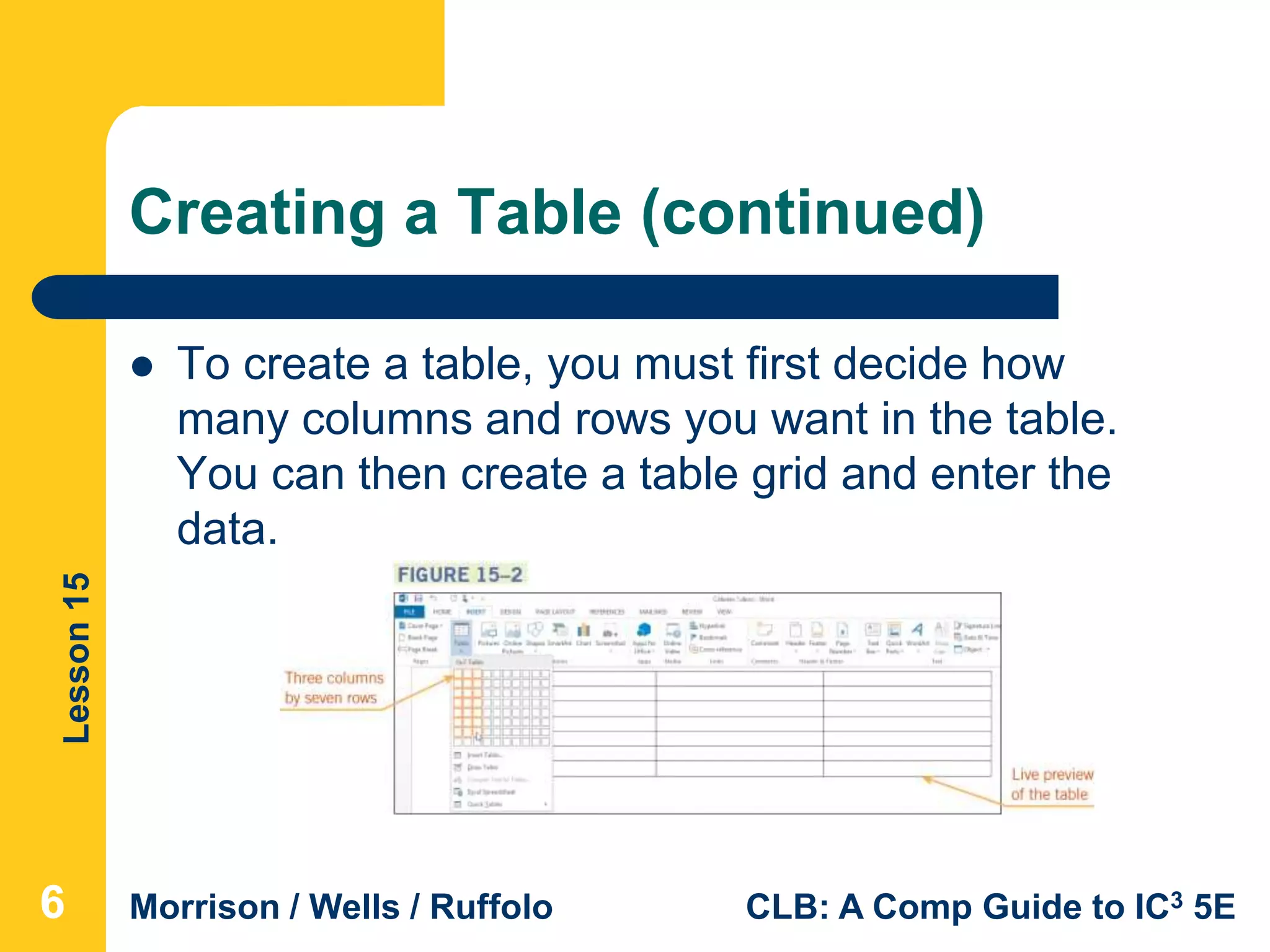
 To create a table, you must first decide how
many columns and rows you want in the table.
You can then create a table grid and enter the
data.
666
Lesson15
Morrison / Wells / Ruffolo CLB: A Comp Guide to IC3 5E
Creating a Table (continued)
 To move the insertion point from one cell to
another, you can press the Tab key or the
arrow keys.
 When you reach the end of a row and press
the Tab key, the insertion point moves to the
first cell in the next row.
777
Lesson15
Morrison / Wells / Ruffolo CLB: A Comp Guide to IC3 5E
Modifying the Table Structure
 Inserting Rows and Columns
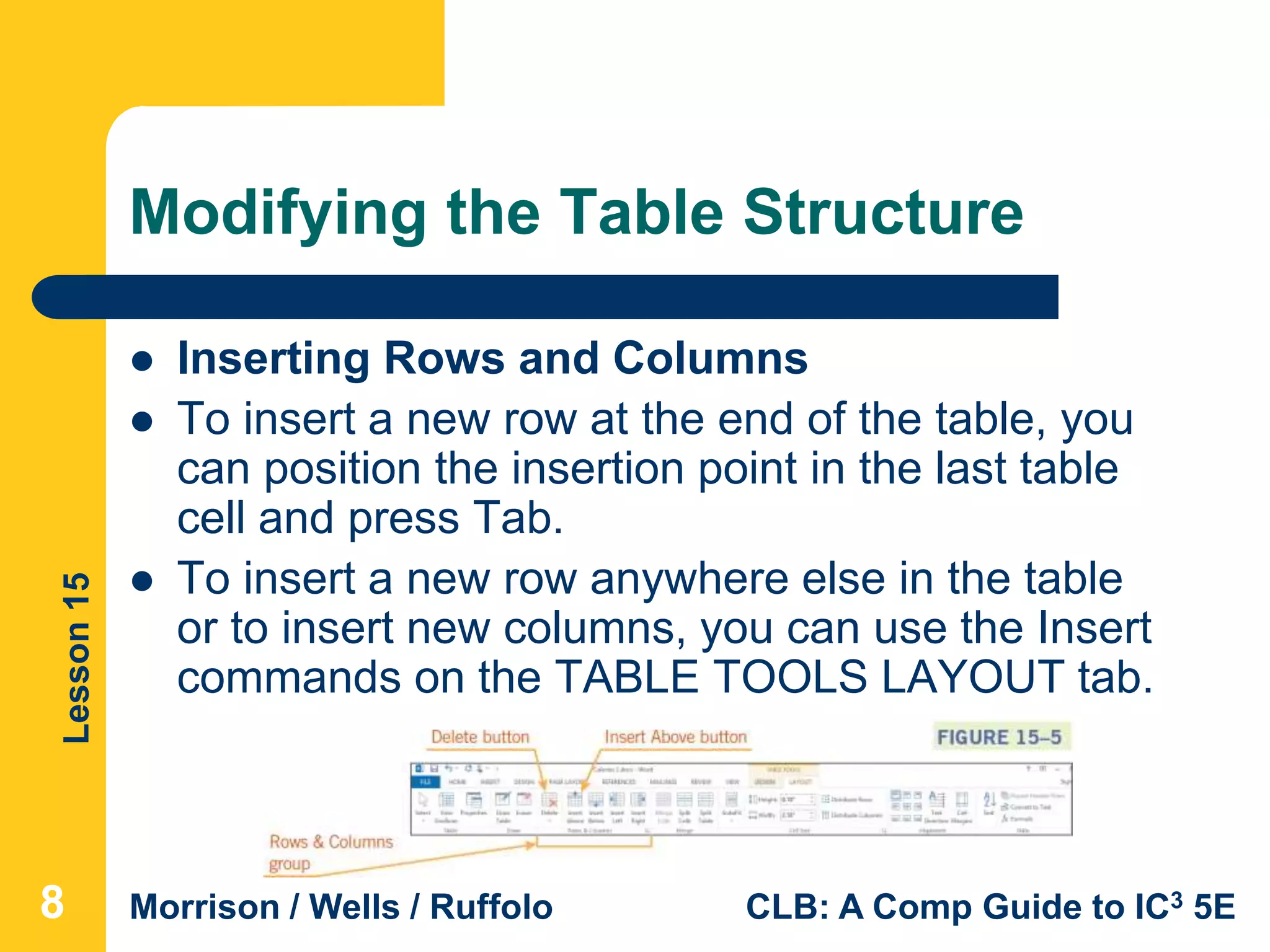
 To insert a new row at the end of the table, you
can position the insertion point in the last table
cell and press Tab.
 To insert a new row anywhere else in the table
or to insert new columns, you can use the Insert
commands on the TABLE TOOLS LAYOUT tab.
888
Lesson15
Morrison / Wells / Ruffolo CLB: A Comp Guide to IC3 5E
Modifying the Table Structure
(continued)
 Deleting Rows and Columns
 When you select cells and use Delete to remove
content, only the cell contents are removed.
 To remove rows or columns, you must use the
Delete commands on the TABLE TOOLS
LAYOUT tab or in a shortcut menu.
 When you delete a row or column, the text in the
cells is also deleted.
999
Lesson15
Morrison / Wells / Ruffolo CLB: A Comp Guide to IC3 5E
Modifying the Table Structure
(continued)
 Adjusting Column Width and Row Height
 You can choose to automatically adjust the width of
one or more columns to accommodate the contents
within the cells, or you can automatically adjust all
column widths at the same time.
 You can also resize the table to fit in the document
window.
 When text wraps to a second line within a cell, the
height of all the cells in that row is automatically
increased.
101010
Lesson15
Morrison / Wells / Ruffolo CLB: A Comp Guide to IC3 5E
Modifying the Table Structure
(continued)
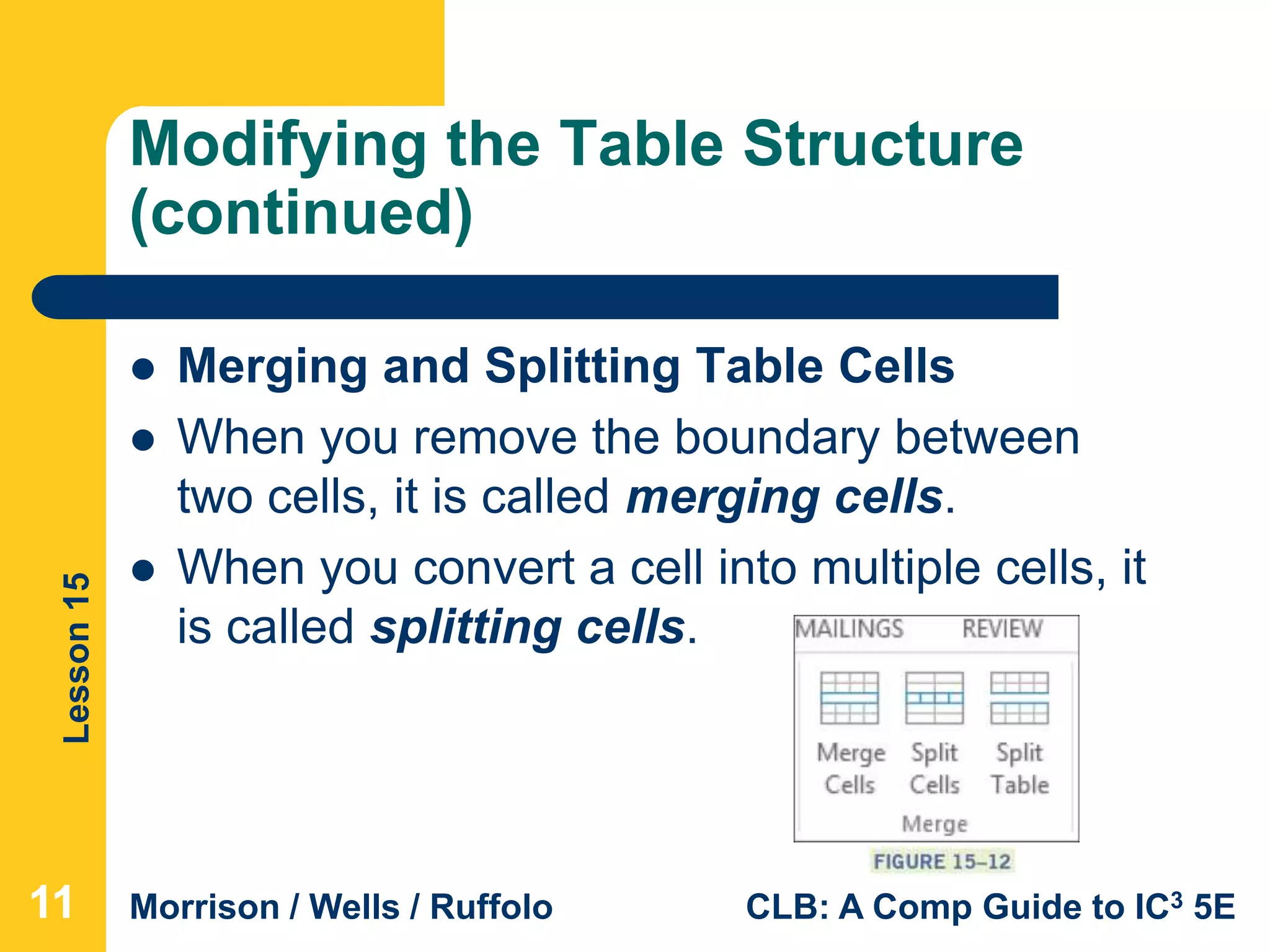
 Merging and Splitting Table Cells
 When you remove the boundary between
two cells, it is called merging cells.
 When you convert a cell into multiple cells, it
is called splitting cells.
111111
Lesson15
Morrison / Wells / Ruffolo CLB: A Comp Guide to IC3 5E
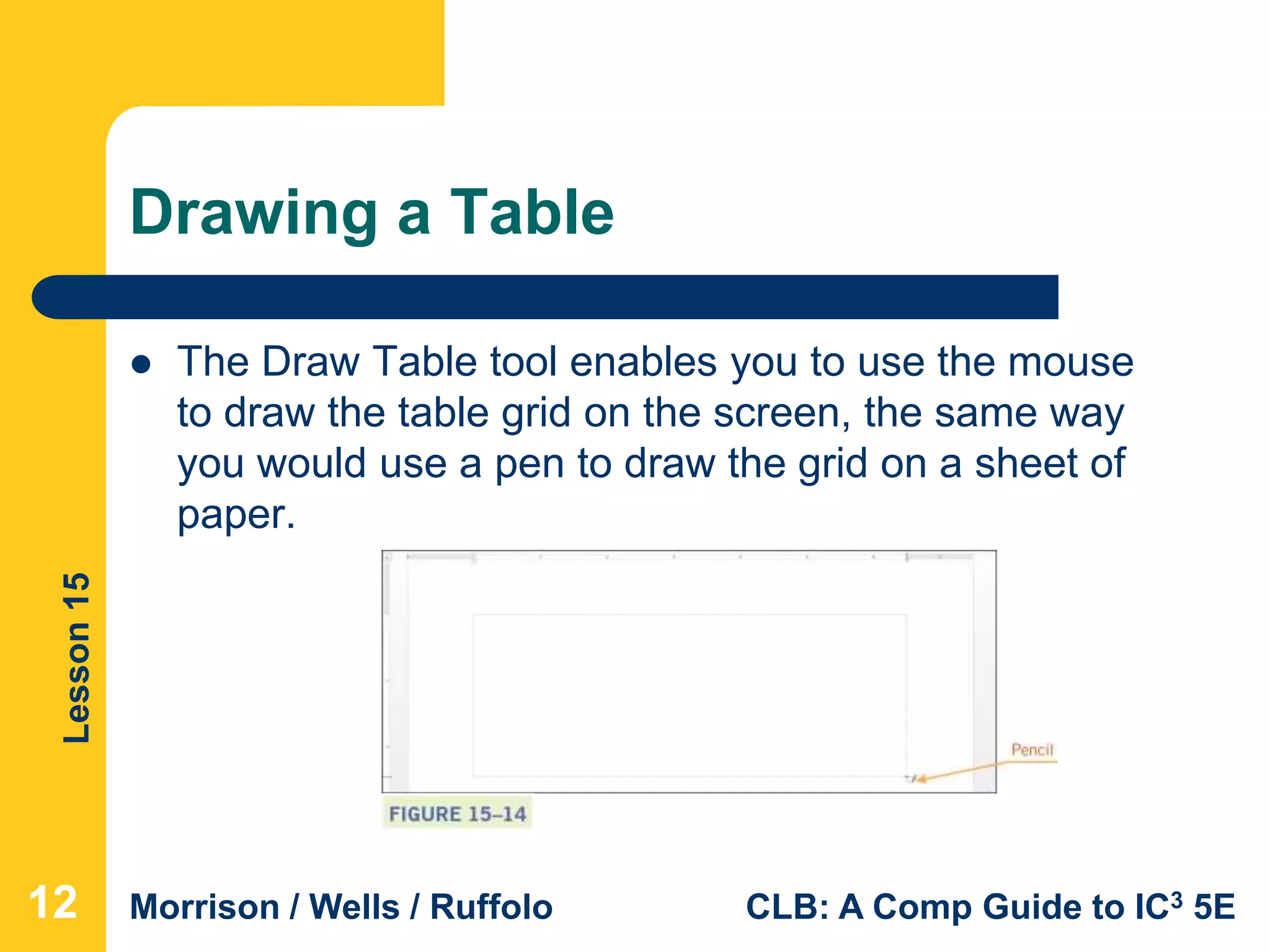
Drawing a Table
 The Draw Table tool enables you to use the mouse
to draw the table grid on the screen, the same way
you would use a pen to draw the grid on a sheet of
paper.
121212
Lesson15
Morrison / Wells / Ruffolo CLB: A Comp Guide to IC3 5E
Formatting Tables
 You can make a table easier to read by enhancing
its appearance.
 Aligning numbers within a cell can make the data
easier to read.
 Changing border colors and adding shading to some
of the cells can help the reader quickly identify
different types of data.
131313
Lesson15
Morrison / Wells / Ruffolo CLB: A Comp Guide to IC3 5E
Formatting Tables (continued)
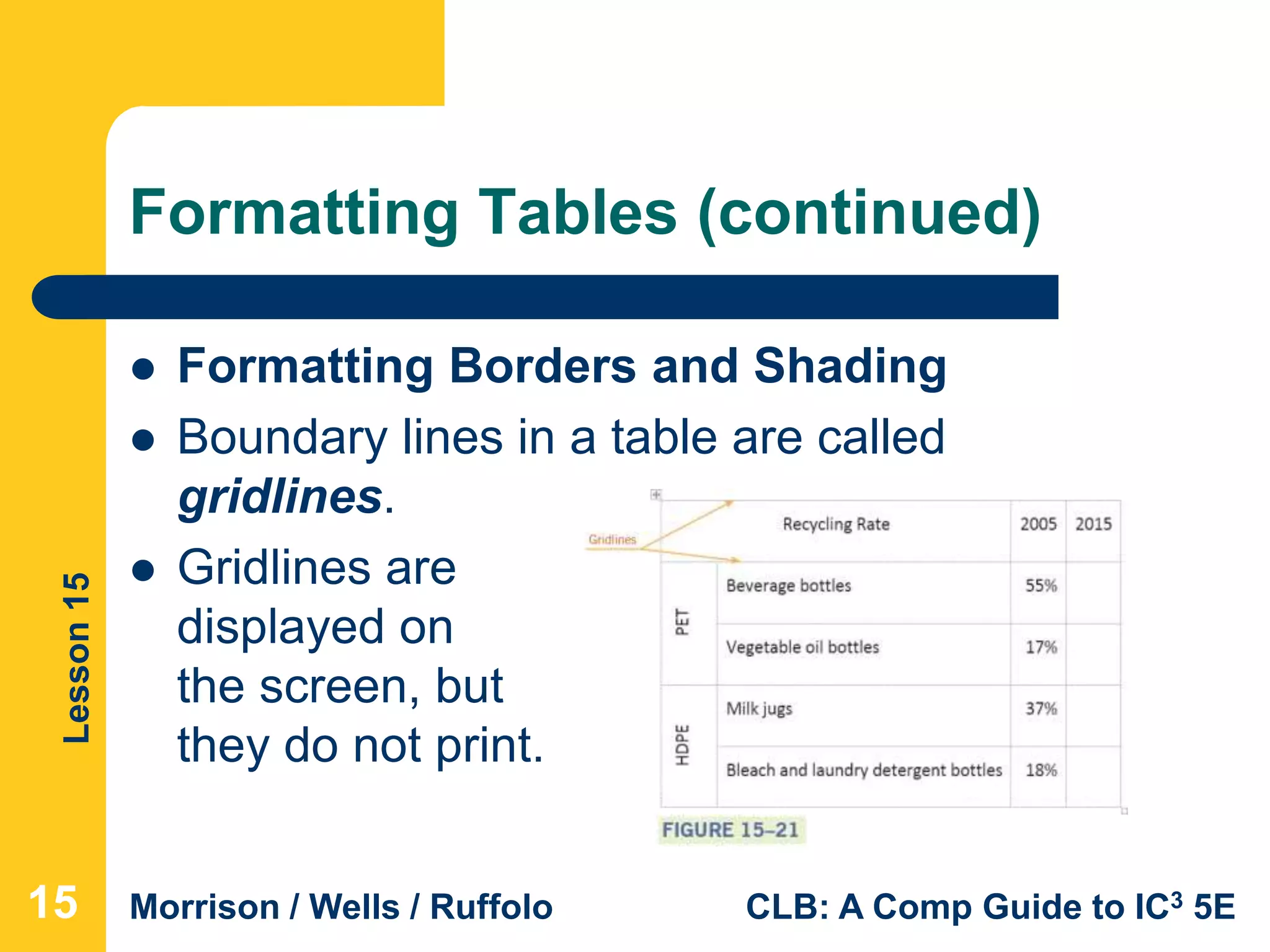
 Aligning Data within Table Cells
 The Alignment group on the TABLE TOOLS
LAYOUT tab provides several commands to align
text within cells.
 You can align text at the top, center, or bottom of a
cell, as well as to the left or right.
 You can change the
direction of text: top
to bottom, bottom to
top, and horizontal.
141414
Lesson15
Morrison / Wells / Ruffolo CLB: A Comp Guide to IC3 5E
Formatting Tables (continued)
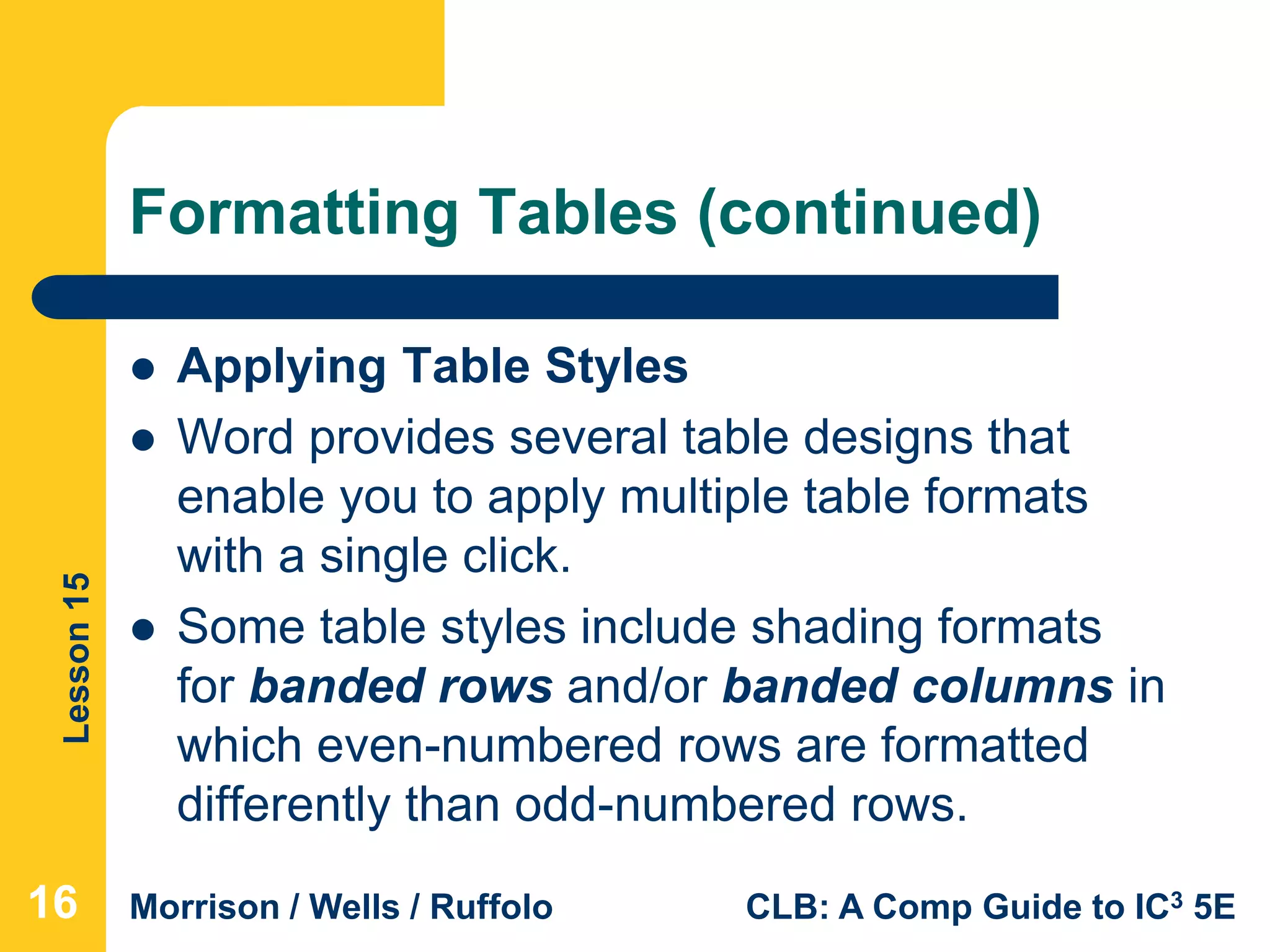
 Formatting Borders and Shading
 Boundary lines in a table are called
gridlines.
 Gridlines are
displayed on
the screen, but
they do not print.
151515
Lesson15
Morrison / Wells / Ruffolo CLB: A Comp Guide to IC3 5E
Formatting Tables (continued)
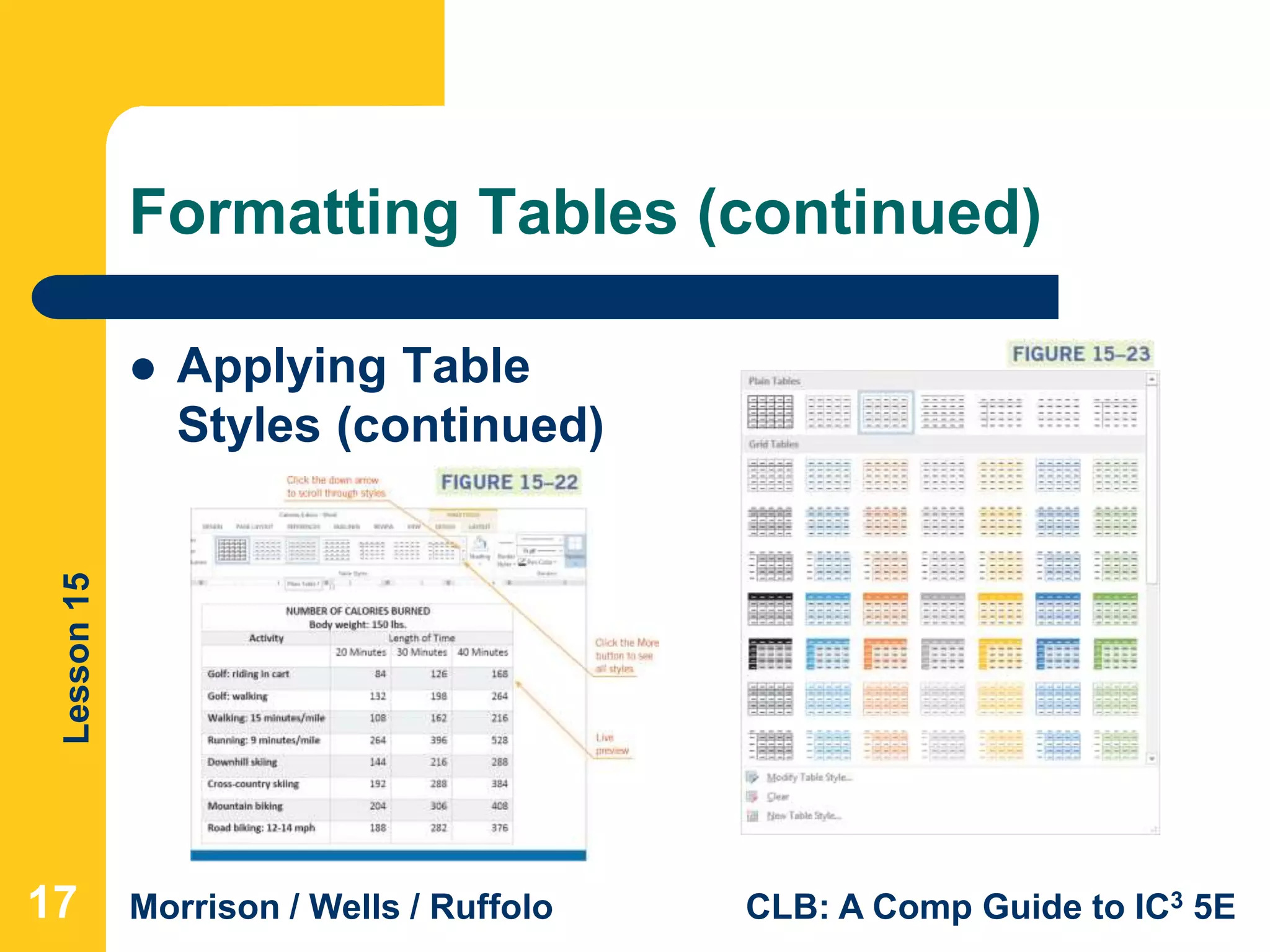
 Applying Table Styles
 Word provides several table designs that
enable you to apply multiple table formats
with a single click.
 Some table styles include shading formats
for banded rows and/or banded columns in
which even-numbered rows are formatted
differently than odd-numbered rows.
161616
Lesson15
Morrison / Wells / Ruffolo CLB: A Comp Guide to IC3 5E
Formatting Tables (continued)
 Applying Table
Styles (continued)
17
Lesson15
Morrison / Wells / Ruffolo CLB: A Comp Guide to IC3 5E
Using Quick Tables
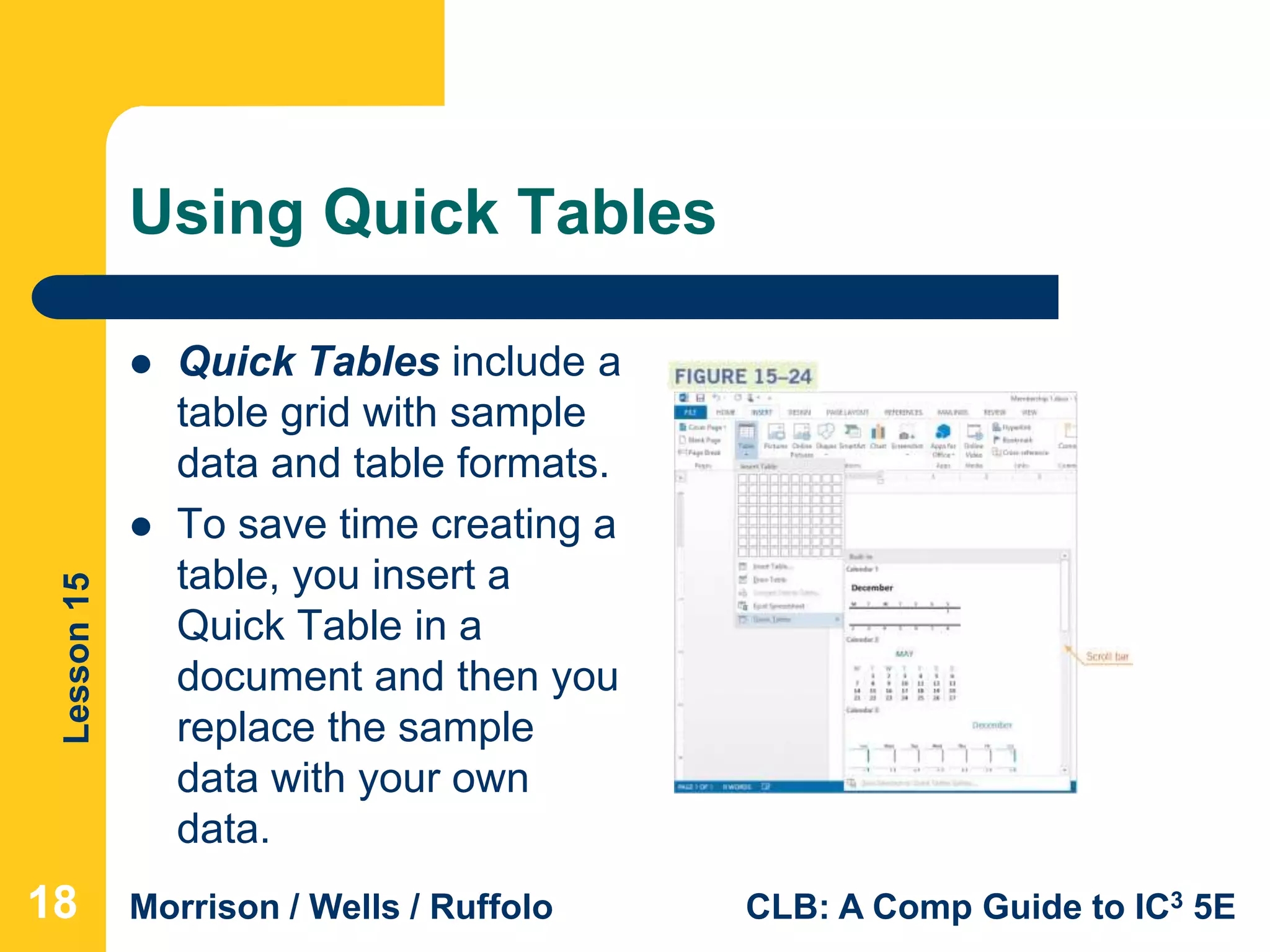
 Quick Tables include a
table grid with sample
data and table formats.
 To save time creating a
table, you insert a
Quick Table in a
document and then you
replace the sample
data with your own
data.
181818
Lesson15
Morrison / Wells / Ruffolo CLB: A Comp Guide to IC3 5E
Using Quick Tables (continued)
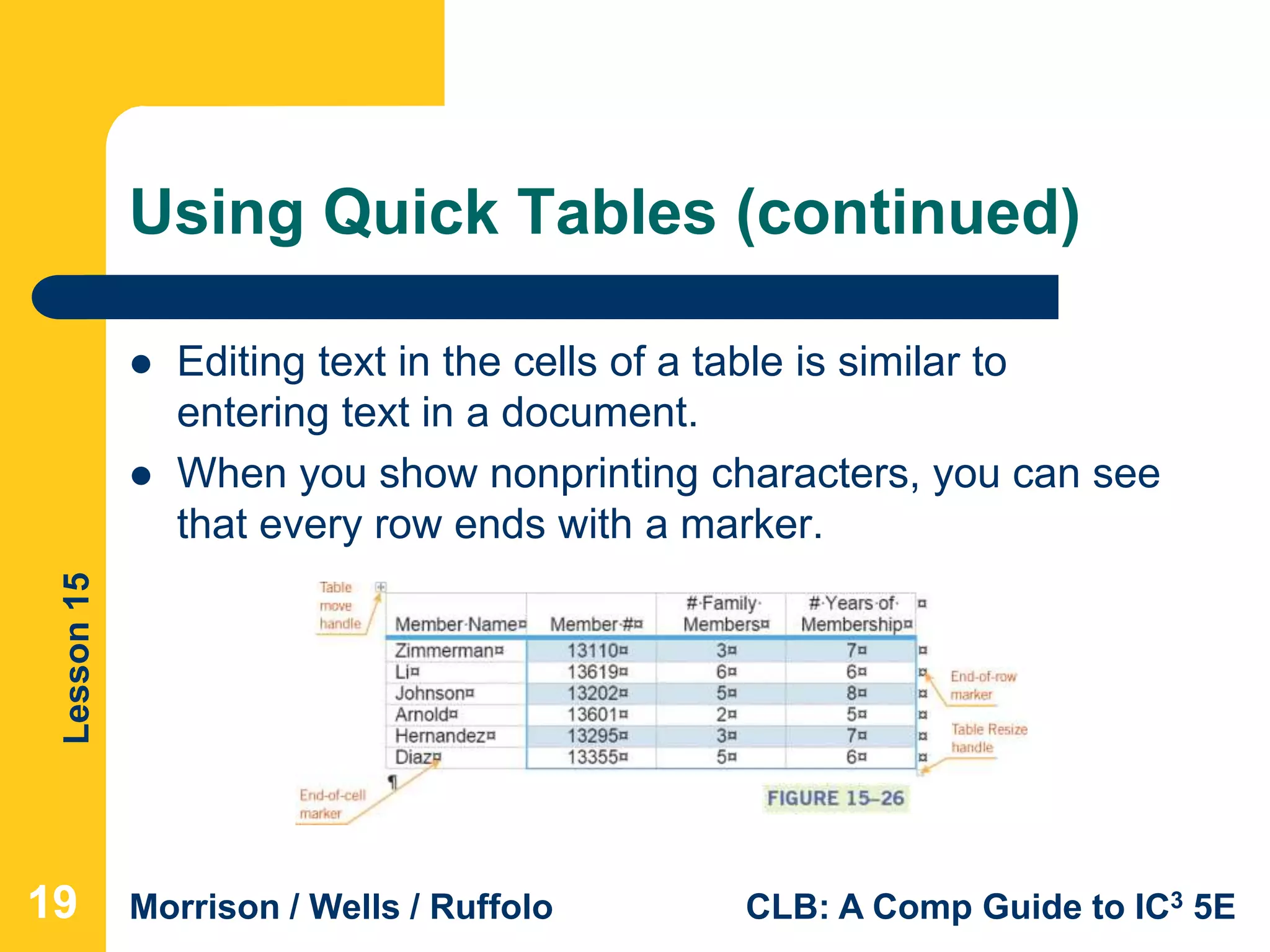
 Editing text in the cells of a table is similar to
entering text in a document.
 When you show nonprinting characters, you can see
that every row ends with a marker.
191919
Lesson15
Morrison / Wells / Ruffolo CLB: A Comp Guide to IC3 5E
Aligning and Resizing Tables on
the Document Page
 To align a table horizontally, you must select the
table, and then you can format the alignment the
same way you align text paragraphs.
 The table move handle can be used to reposition the
table on the page or to select the entire table.
 The resize handle sometimes appears in the lower-
right corner of a table. When you drag this marker,
you can resize the table.
202020
Lesson15
Morrison / Wells / Ruffolo CLB: A Comp Guide to IC3 5E
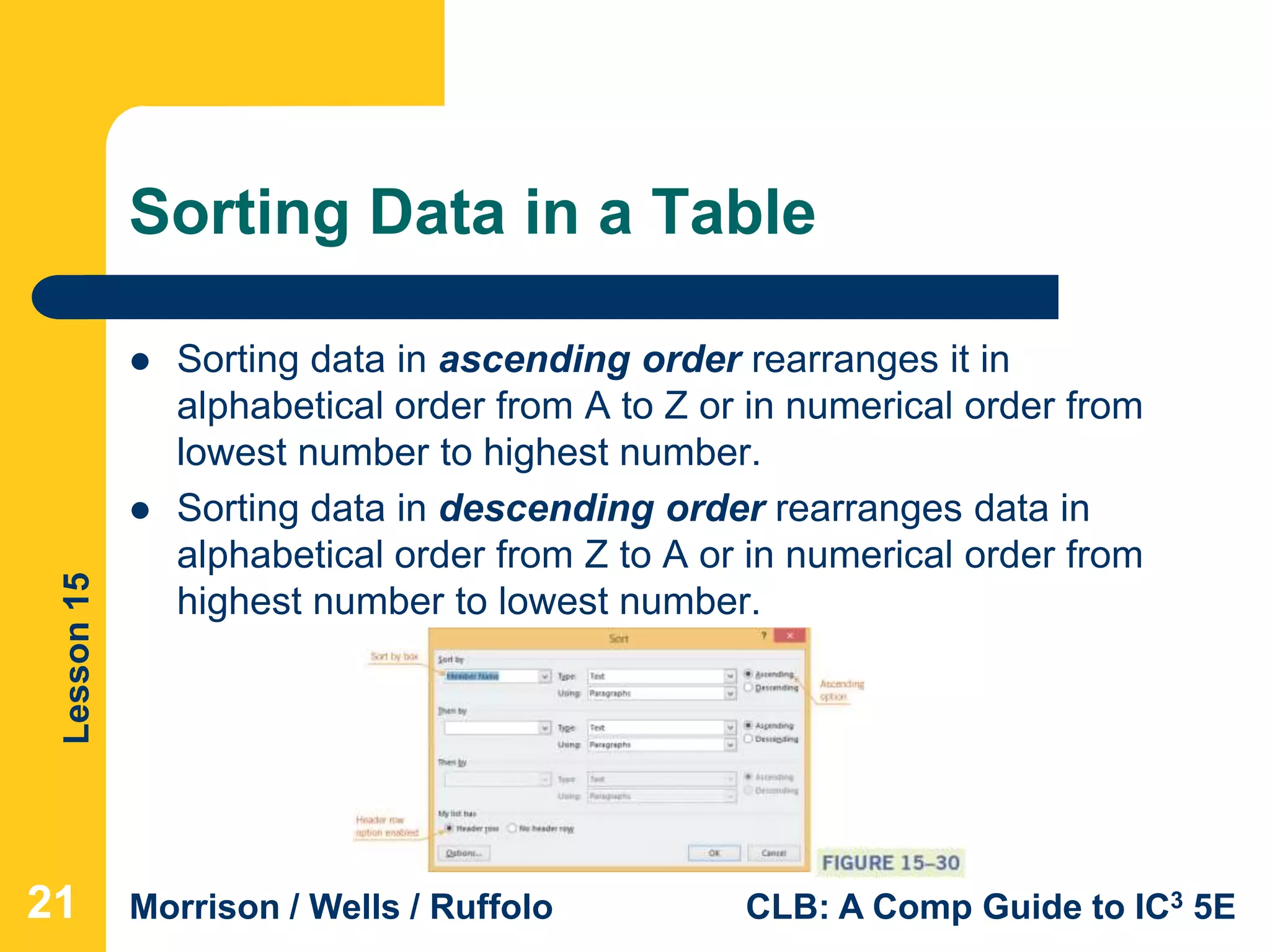
Sorting Data in a Table
 Sorting data in ascending order rearranges it in
alphabetical order from A to Z or in numerical order from
lowest number to highest number.
 Sorting data in descending order rearranges data in
alphabetical order from Z to A or in numerical order from
highest number to lowest number.
212121
Lesson15
Morrison / Wells / Ruffolo CLB: A Comp Guide to IC3 5E
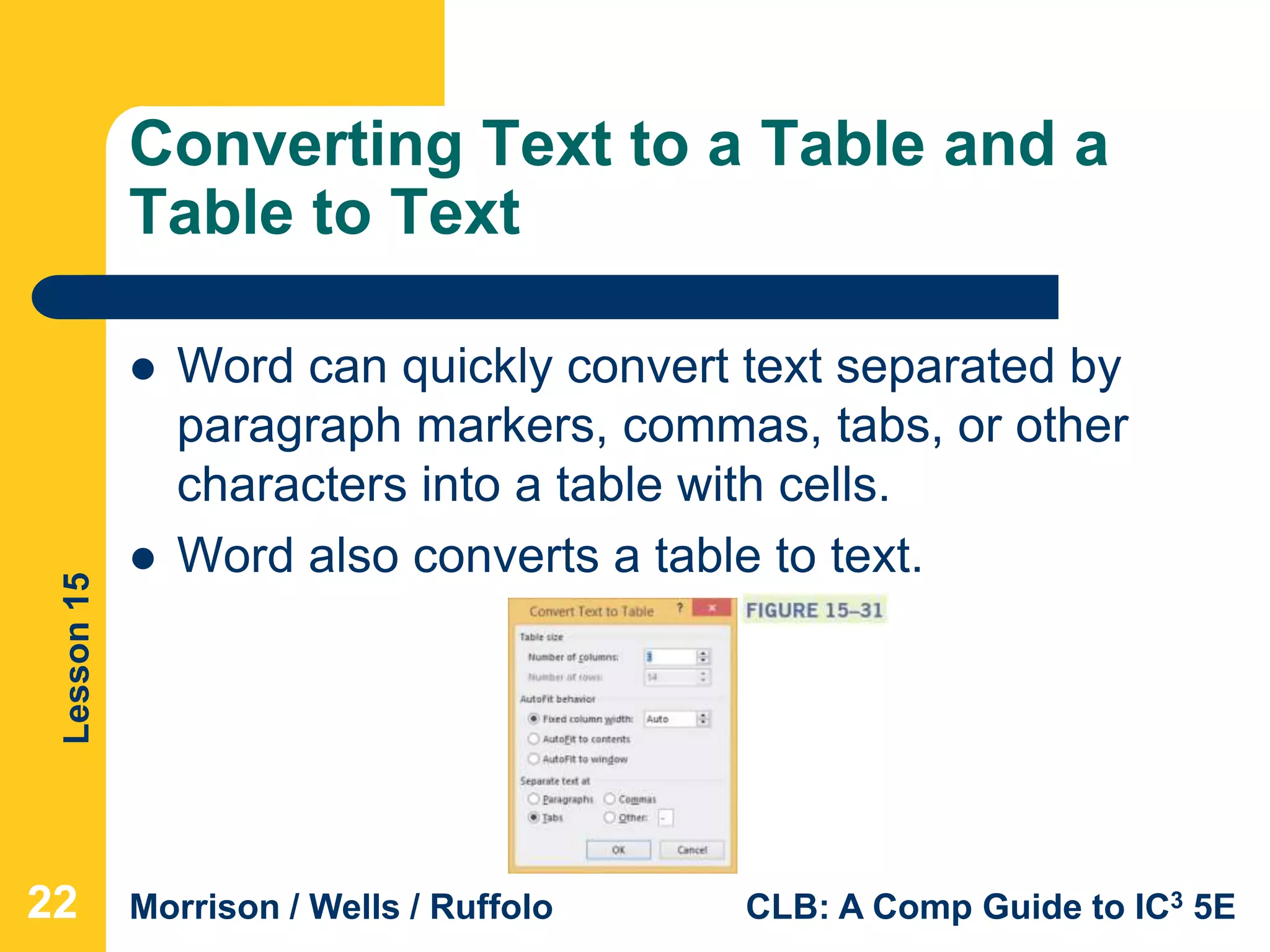
Converting Text to a Table and a
Table to Text
 Word can quickly convert text separated by
paragraph markers, commas, tabs, or other
characters into a table with cells.
 Word also converts a table to text.
222222
Lesson15
Morrison / Wells / Ruffolo CLB: A Comp Guide to IC3 5E
Summary
In this lesson, you learned:
 The table feature in Word enables you to organize
and arrange text and numbers easily.
 To change the layout of information after you create
a table, you can insert and delete rows and columns.
 The AutoFit feature automatically adjusts the width of
a column based on the contents of the cells in a
column.
232323
Lesson15
Morrison / Wells / Ruffolo CLB: A Comp Guide to IC3 5E
Summary (continued)
 The Draw Table tool and the Eraser tool are
especially useful when you need to create a complex
table.
 You can format text alignment in table cells the same
way you apply those formats in other Word
documents.
 Borders and shading greatly enhance the
appearance of a table and often make the table
easier to read. Word provides several built-in styles
to make it fast and easy to apply borders and
shading to a table.
242424
Lesson15
Morrison / Wells / Ruffolo CLB: A Comp Guide to IC3 5E
Summary (continued)
 Word provides Quick Tables that are already
formatted and contain sample data, so you can
quickly create a table.
 You can copy, cut, paste, and move contents within
a table.
 You can use the Sort feature to reorganize the table
contents to emphasize data in different ways.
 Word can convert text to a table or vice versa.
252525

Computer Literacy Lesson 15

  • 1.
    Computer Literacy BASICS: A ComprehensiveGuide to IC3, 5th Edition Lesson 15 Working with Tables 1 Morrison / Wells / Ruffolo
  • 2.
    Lesson15 Morrison / Wells/ Ruffolo CLB: A Comp Guide to IC3 5E Objectives  Create a table and insert text.  Insert and delete rows and columns.  Adjust column width and row height.  Use the Draw Table and Eraser tools to create and edit a table grid.  Format text alignment and direction within a table cell. 222
  • 3.
    Lesson15 Morrison / Wells/ Ruffolo CLB: A Comp Guide to IC3 5E Objectives (continued)  Format borders and shading and apply table styles.  Sort data in a table.  Convert text to a table and vice versa. 333
  • 4.
    Lesson15 Morrison / Wells/ Ruffolo CLB: A Comp Guide to IC3 5E Words to Know  gridlines  header row  merging cells  Quick Tables  splitting cells  ascending order  banded columns  banded rows  cell  descending order 444
  • 5.
    Lesson15 Morrison / Wells/ Ruffolo CLB: A Comp Guide to IC3 5E Creating a Table  A table consists of cells that you add content to, such as text, numbers, or graphics.  A cell represents one intersection of a row and a column in a table.  In a table, rows go across and columns go down.  The first row in a table or data source with the column headings is referred to as the header row. 555
  • 6.
    Lesson15 Morrison / Wells/ Ruffolo CLB: A Comp Guide to IC3 5E Creating a Table (continued)  To create a table, you must first decide how many columns and rows you want in the table. You can then create a table grid and enter the data. 666
  • 7.
    Lesson15 Morrison / Wells/ Ruffolo CLB: A Comp Guide to IC3 5E Creating a Table (continued)  To move the insertion point from one cell to another, you can press the Tab key or the arrow keys.  When you reach the end of a row and press the Tab key, the insertion point moves to the first cell in the next row. 777
  • 8.
    Lesson15 Morrison / Wells/ Ruffolo CLB: A Comp Guide to IC3 5E Modifying the Table Structure  Inserting Rows and Columns  To insert a new row at the end of the table, you can position the insertion point in the last table cell and press Tab.  To insert a new row anywhere else in the table or to insert new columns, you can use the Insert commands on the TABLE TOOLS LAYOUT tab. 888
  • 9.
    Lesson15 Morrison / Wells/ Ruffolo CLB: A Comp Guide to IC3 5E Modifying the Table Structure (continued)  Deleting Rows and Columns  When you select cells and use Delete to remove content, only the cell contents are removed.  To remove rows or columns, you must use the Delete commands on the TABLE TOOLS LAYOUT tab or in a shortcut menu.  When you delete a row or column, the text in the cells is also deleted. 999
  • 10.
    Lesson15 Morrison / Wells/ Ruffolo CLB: A Comp Guide to IC3 5E Modifying the Table Structure (continued)  Adjusting Column Width and Row Height  You can choose to automatically adjust the width of one or more columns to accommodate the contents within the cells, or you can automatically adjust all column widths at the same time.  You can also resize the table to fit in the document window.  When text wraps to a second line within a cell, the height of all the cells in that row is automatically increased. 101010
  • 11.
    Lesson15 Morrison / Wells/ Ruffolo CLB: A Comp Guide to IC3 5E Modifying the Table Structure (continued)  Merging and Splitting Table Cells  When you remove the boundary between two cells, it is called merging cells.  When you convert a cell into multiple cells, it is called splitting cells. 111111
  • 12.
    Lesson15 Morrison / Wells/ Ruffolo CLB: A Comp Guide to IC3 5E Drawing a Table  The Draw Table tool enables you to use the mouse to draw the table grid on the screen, the same way you would use a pen to draw the grid on a sheet of paper. 121212
  • 13.
    Lesson15 Morrison / Wells/ Ruffolo CLB: A Comp Guide to IC3 5E Formatting Tables  You can make a table easier to read by enhancing its appearance.  Aligning numbers within a cell can make the data easier to read.  Changing border colors and adding shading to some of the cells can help the reader quickly identify different types of data. 131313
  • 14.
    Lesson15 Morrison / Wells/ Ruffolo CLB: A Comp Guide to IC3 5E Formatting Tables (continued)  Aligning Data within Table Cells  The Alignment group on the TABLE TOOLS LAYOUT tab provides several commands to align text within cells.  You can align text at the top, center, or bottom of a cell, as well as to the left or right.  You can change the direction of text: top to bottom, bottom to top, and horizontal. 141414
  • 15.
    Lesson15 Morrison / Wells/ Ruffolo CLB: A Comp Guide to IC3 5E Formatting Tables (continued)  Formatting Borders and Shading  Boundary lines in a table are called gridlines.  Gridlines are displayed on the screen, but they do not print. 151515
  • 16.
    Lesson15 Morrison / Wells/ Ruffolo CLB: A Comp Guide to IC3 5E Formatting Tables (continued)  Applying Table Styles  Word provides several table designs that enable you to apply multiple table formats with a single click.  Some table styles include shading formats for banded rows and/or banded columns in which even-numbered rows are formatted differently than odd-numbered rows. 161616
  • 17.
    Lesson15 Morrison / Wells/ Ruffolo CLB: A Comp Guide to IC3 5E Formatting Tables (continued)  Applying Table Styles (continued) 17
  • 18.
    Lesson15 Morrison / Wells/ Ruffolo CLB: A Comp Guide to IC3 5E Using Quick Tables  Quick Tables include a table grid with sample data and table formats.  To save time creating a table, you insert a Quick Table in a document and then you replace the sample data with your own data. 181818
  • 19.
    Lesson15 Morrison / Wells/ Ruffolo CLB: A Comp Guide to IC3 5E Using Quick Tables (continued)  Editing text in the cells of a table is similar to entering text in a document.  When you show nonprinting characters, you can see that every row ends with a marker. 191919
  • 20.
    Lesson15 Morrison / Wells/ Ruffolo CLB: A Comp Guide to IC3 5E Aligning and Resizing Tables on the Document Page  To align a table horizontally, you must select the table, and then you can format the alignment the same way you align text paragraphs.  The table move handle can be used to reposition the table on the page or to select the entire table.  The resize handle sometimes appears in the lower- right corner of a table. When you drag this marker, you can resize the table. 202020
  • 21.
    Lesson15 Morrison / Wells/ Ruffolo CLB: A Comp Guide to IC3 5E Sorting Data in a Table  Sorting data in ascending order rearranges it in alphabetical order from A to Z or in numerical order from lowest number to highest number.  Sorting data in descending order rearranges data in alphabetical order from Z to A or in numerical order from highest number to lowest number. 212121
  • 22.
    Lesson15 Morrison / Wells/ Ruffolo CLB: A Comp Guide to IC3 5E Converting Text to a Table and a Table to Text  Word can quickly convert text separated by paragraph markers, commas, tabs, or other characters into a table with cells.  Word also converts a table to text. 222222
  • 23.
    Lesson15 Morrison / Wells/ Ruffolo CLB: A Comp Guide to IC3 5E Summary In this lesson, you learned:  The table feature in Word enables you to organize and arrange text and numbers easily.  To change the layout of information after you create a table, you can insert and delete rows and columns.  The AutoFit feature automatically adjusts the width of a column based on the contents of the cells in a column. 232323
  • 24.
    Lesson15 Morrison / Wells/ Ruffolo CLB: A Comp Guide to IC3 5E Summary (continued)  The Draw Table tool and the Eraser tool are especially useful when you need to create a complex table.  You can format text alignment in table cells the same way you apply those formats in other Word documents.  Borders and shading greatly enhance the appearance of a table and often make the table easier to read. Word provides several built-in styles to make it fast and easy to apply borders and shading to a table. 242424
  • 25.
    Lesson15 Morrison / Wells/ Ruffolo CLB: A Comp Guide to IC3 5E Summary (continued)  Word provides Quick Tables that are already formatted and contain sample data, so you can quickly create a table.  You can copy, cut, paste, and move contents within a table.  You can use the Sort feature to reorganize the table contents to emphasize data in different ways.  Word can convert text to a table or vice versa. 252525