Tables
Why Use Tables ? Microsoft Word tables can help you arrange your thoughts and data in ways that make sense to the people you're trying to reach. Tables can be a great way to present numbers, but it also does a great job of presenting text and graphics. Just about anything can be put into the table. It's all up to you. In short, a table is a collection of rows and columns that allows you organize text, graphics and data. You have learned how to present information in parallel columns using tabs and columns in Word. Using Word's  Tables  feature, you can format, edit, delete, and move text without affecting the rest of your document.  There are several ways to create tables in Word…….
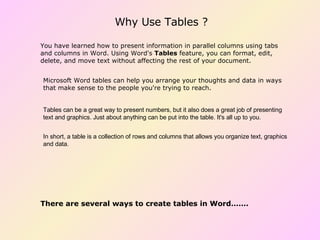
On the Standard Toolbar , Click  the  Insert Table  Button.  Now,  drag  the number of columns and rows you want in your table.  When clicking on the Insert Table button, do not release the mouse button. This will allow the drop down screen to expand as far as your monitor will allow. Standard toolbar – click and drag Drag your mouse diagonally Table 3 Rows by 4 columns 1. Creating Tables Using the Insert Table Button on the Standard toolbar                        
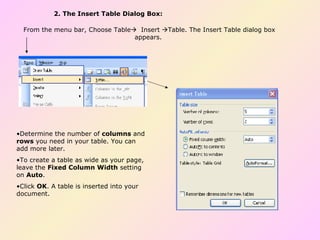
From the menu bar, Choose Table    Insert   Table. The Insert Table dialog box appears.  Determine the number of  columns  and  rows  you need in your table. You can add more later. To create a table as wide as your page, leave the  Fixed Column Width  setting on  Auto .  Click  OK . A table is inserted into your document.  2. The Insert Table Dialog Box:
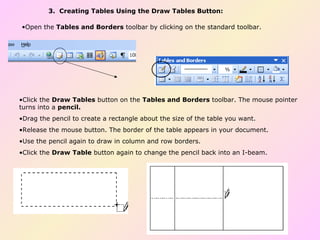
Click the  Draw Tables  button on the  Tables and Borders  toolbar. The mouse pointer turns into a  pencil.  Drag the pencil to create a rectangle about the size of the table you want.  Release the mouse button. The border of the table appears in your document.  Use the pencil again to draw in column and row borders.  Click the  Draw Table  button again to change the pencil back into an I-beam.  Open the  Tables and Borders  toolbar by clicking on the standard toolbar. 3.  Creating Tables Using the Draw Tables Button:
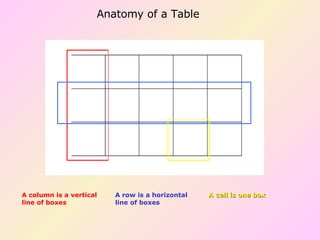
Anatomy of a Table A column is a vertical line of boxes A row is a horizontal line of boxes A cell is one box
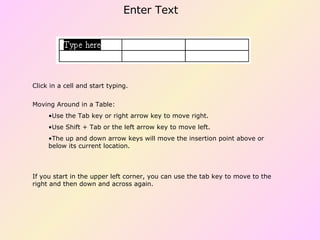
Enter Text Click in a cell and start typing.  If you start in the upper left corner, you can use the tab key to move to the right and then down and across again. Moving Around in a Table: Use the Tab key or right arrow key to move right.  Use Shift + Tab or the left arrow key to move left.  The up and down arrow keys will move the insertion point above or below its current location.
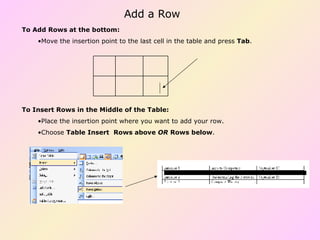
To Insert Rows in the Middle of the Table: Place the insertion point where you want to add your row.  Choose  Table   Insert   Rows above   OR   Rows below .  To Add Rows at the bottom: Move the insertion point to the last cell in the table and press  Tab . Add a Row
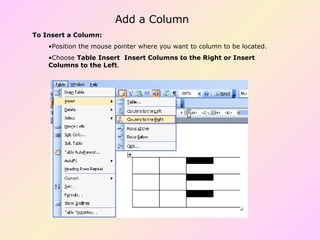
To Insert a Column: Position the mouse pointer where you want to column to be located.  Choose  Table   Insert   Insert Columns to the Right or Insert Columns to the Left .  Add a Column
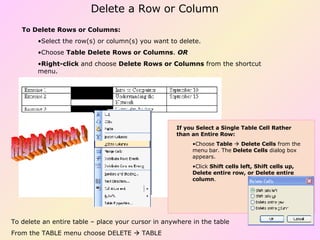
To Delete Rows or Columns: Select the row(s) or column(s) you want to delete.  Choose  Table   Delete   Rows or Columns .  OR   Right-click  and choose  Delete Rows or Columns  from the shortcut menu.  If you Select a Single Table Cell Rather than an Entire Row: Choose  Table      Delete   Cells  from the menu bar. The  Delete Cells  dialog box appears.  Click  Shift cells left, Shift cells up, Delete entire row, or Delete entire column .  Right Click ! To delete an entire table – place your cursor in anywhere in the table From the TABLE menu choose DELETE    TABLE Delete a Row or Column
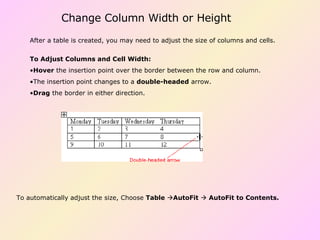
Change Column Width or Height To Adjust Columns and Cell Width: Hover  the insertion point over the border between the row and column.  The insertion point changes to a  double-headed  arrow.  Drag  the border in either direction.  After a table is created, you may need to adjust the size of columns and cells. To automatically adjust the size, Choose  Table    AutoFit      AutoFit to Contents.
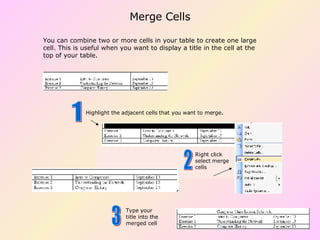
You can combine two or more cells in your table to create one large cell. This is useful when you want to display a title in the cell at the top of your table. Highlight the adjacent cells that you want to merge . Right click select merge cells Type your title into the merged cell 1 2 3 Merge Cells
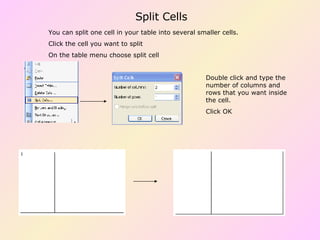
You can split one cell in your table into several smaller cells. Click the cell you want to split On the table menu choose split cell Double click and type the number of columns and rows that you want inside the cell. Click OK Split Cells
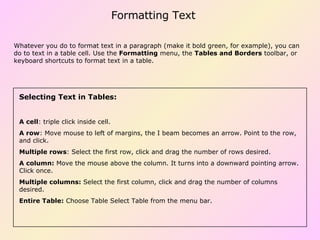
Formatting Text Selecting Text in Tables:  A cell : triple click inside cell.  A row : Move mouse to left of margins, the I beam becomes an arrow. Point to the row, and click. Multiple rows : Select the first row, click and drag the number of rows desired.  A column:  Move the mouse above the column. It turns into a downward pointing arrow. Click once.  Multiple columns:  Select the first column, click and drag the number of columns desired. Entire Table:  Choose Table Select Table from the menu bar.  Whatever you do to format text in a paragraph (make it bold green, for example), you can do to text in a table cell. Use the  Formatting  menu, the  Tables and Borders  toolbar, or keyboard shortcuts to format text in a table.
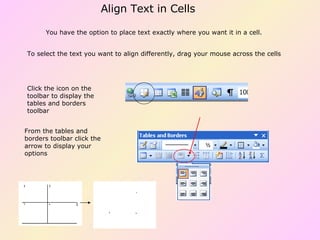
You have the option to place text exactly where you want it in a cell.  To select the text you want to align differently, drag your mouse across the cells From the tables and borders toolbar click the arrow to display your options Click the icon on the toolbar to display the tables and borders toolbar Align Text in Cells
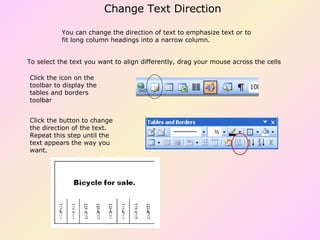
You can change the direction of text to emphasize text or to fit long column headings into a narrow column. Click the icon on the toolbar to display the tables and borders toolbar To select the text you want to align differently, drag your mouse across the cells Click the button to change the direction of the text. Repeat this step until the text appears the way you want. Change Text Direction
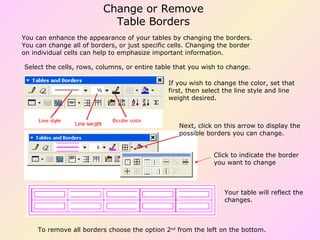
You can enhance the appearance of your tables by changing the borders. You can change all of borders, or just specific cells. Changing the border on individual cells can help to emphasize important information. Select the cells, rows, columns, or entire table that you wish to change. If you wish to change the color, set that first, then select the line style and line weight desired. Next, click on this arrow to display the possible borders you can change.  Click to indicate the border you want to change Your table will reflect the changes. To remove all borders choose the option 2 nd  from the left on the bottom. Change or Remove Table Borders
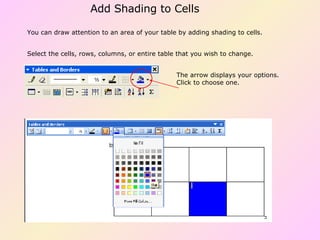
You can draw attention to an area of your table by adding shading to cells. Select the cells, rows, columns, or entire table that you wish to change. The arrow displays your options. Click to choose one. Add Shading to Cells
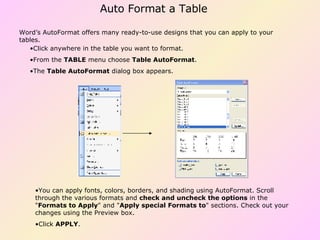
Click anywhere in the table you want to format.  From the  TABLE  menu choose  Table AutoFormat .  The  Table AutoFormat  dialog box appears.  Word’s AutoFormat offers many ready-to-use designs that you can apply to your tables. You can apply fonts, colors, borders, and shading using AutoFormat. Scroll through the various formats and  check and uncheck the options  in the " Formats to Apply " and " Apply special Formats to " sections. Check out your changes using the Preview box.  Click  APPLY .  Auto Format a Table
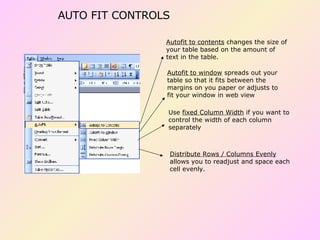
Autofit to contents  changes the size of your table based on the amount of text in the table. Autofit to window  spreads out your table so that it fits between the margins on you paper or adjusts to fit your window in web view Use  fixed Column Width  if you want to control the width of each column separately  Distribute Rows / Columns Evenly   allows you to readjust and space each cell evenly. AUTO FIT CONTROLS
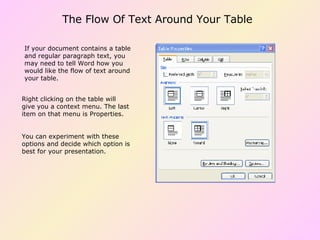
The Flow Of Text Around Your Table If your document contains a table and regular paragraph text, you may need to tell Word how you would like the flow of text around your table. Right clicking on the table will give you a context menu. The last item on that menu is Properties. You can experiment with these options and decide which option is best for your presentation.
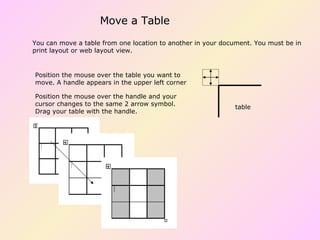
Move a Table You can move a table from one location to another in your document. You must be in print layout or web layout view. Position the mouse over the table you want to move. A handle appears in the upper left corner Position the mouse over the handle and your cursor changes to the same 2 arrow symbol. Drag your table with the handle. table
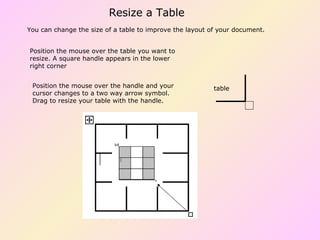
Resize a Table You can change the size of a table to improve the layout of your document. Position the mouse over the table you want to resize. A square handle appears in the lower right corner Position the mouse over the handle and your cursor changes to a two way arrow symbol. Drag to resize your table with the handle. table

Tables

  • 1.
  • 2.
    Why Use Tables? Microsoft Word tables can help you arrange your thoughts and data in ways that make sense to the people you're trying to reach. Tables can be a great way to present numbers, but it also does a great job of presenting text and graphics. Just about anything can be put into the table. It's all up to you. In short, a table is a collection of rows and columns that allows you organize text, graphics and data. You have learned how to present information in parallel columns using tabs and columns in Word. Using Word's Tables feature, you can format, edit, delete, and move text without affecting the rest of your document. There are several ways to create tables in Word…….
  • 3.
    On the StandardToolbar , Click the Insert Table Button. Now, drag the number of columns and rows you want in your table. When clicking on the Insert Table button, do not release the mouse button. This will allow the drop down screen to expand as far as your monitor will allow. Standard toolbar – click and drag Drag your mouse diagonally Table 3 Rows by 4 columns 1. Creating Tables Using the Insert Table Button on the Standard toolbar                        
  • 4.
    From the menubar, Choose Table  Insert  Table. The Insert Table dialog box appears. Determine the number of columns and rows you need in your table. You can add more later. To create a table as wide as your page, leave the Fixed Column Width setting on Auto . Click OK . A table is inserted into your document. 2. The Insert Table Dialog Box:
  • 5.
    Click the Draw Tables button on the Tables and Borders toolbar. The mouse pointer turns into a pencil. Drag the pencil to create a rectangle about the size of the table you want. Release the mouse button. The border of the table appears in your document. Use the pencil again to draw in column and row borders. Click the Draw Table button again to change the pencil back into an I-beam. Open the Tables and Borders toolbar by clicking on the standard toolbar. 3. Creating Tables Using the Draw Tables Button:
  • 6.
    Anatomy of aTable A column is a vertical line of boxes A row is a horizontal line of boxes A cell is one box
  • 7.
    Enter Text Clickin a cell and start typing. If you start in the upper left corner, you can use the tab key to move to the right and then down and across again. Moving Around in a Table: Use the Tab key or right arrow key to move right. Use Shift + Tab or the left arrow key to move left. The up and down arrow keys will move the insertion point above or below its current location.
  • 8.
    To Insert Rowsin the Middle of the Table: Place the insertion point where you want to add your row. Choose Table Insert Rows above OR Rows below . To Add Rows at the bottom: Move the insertion point to the last cell in the table and press Tab . Add a Row
  • 9.
    To Insert aColumn: Position the mouse pointer where you want to column to be located. Choose Table Insert Insert Columns to the Right or Insert Columns to the Left . Add a Column
  • 10.
    To Delete Rowsor Columns: Select the row(s) or column(s) you want to delete. Choose Table Delete Rows or Columns . OR Right-click and choose Delete Rows or Columns from the shortcut menu. If you Select a Single Table Cell Rather than an Entire Row: Choose Table  Delete Cells from the menu bar. The Delete Cells dialog box appears. Click Shift cells left, Shift cells up, Delete entire row, or Delete entire column . Right Click ! To delete an entire table – place your cursor in anywhere in the table From the TABLE menu choose DELETE  TABLE Delete a Row or Column
  • 11.
    Change Column Widthor Height To Adjust Columns and Cell Width: Hover the insertion point over the border between the row and column. The insertion point changes to a double-headed arrow. Drag the border in either direction. After a table is created, you may need to adjust the size of columns and cells. To automatically adjust the size, Choose Table  AutoFit  AutoFit to Contents.
  • 12.
    You can combinetwo or more cells in your table to create one large cell. This is useful when you want to display a title in the cell at the top of your table. Highlight the adjacent cells that you want to merge . Right click select merge cells Type your title into the merged cell 1 2 3 Merge Cells
  • 13.
    You can splitone cell in your table into several smaller cells. Click the cell you want to split On the table menu choose split cell Double click and type the number of columns and rows that you want inside the cell. Click OK Split Cells
  • 14.
    Formatting Text SelectingText in Tables: A cell : triple click inside cell. A row : Move mouse to left of margins, the I beam becomes an arrow. Point to the row, and click. Multiple rows : Select the first row, click and drag the number of rows desired. A column: Move the mouse above the column. It turns into a downward pointing arrow. Click once. Multiple columns: Select the first column, click and drag the number of columns desired. Entire Table: Choose Table Select Table from the menu bar. Whatever you do to format text in a paragraph (make it bold green, for example), you can do to text in a table cell. Use the Formatting menu, the Tables and Borders toolbar, or keyboard shortcuts to format text in a table.
  • 15.
    You have theoption to place text exactly where you want it in a cell. To select the text you want to align differently, drag your mouse across the cells From the tables and borders toolbar click the arrow to display your options Click the icon on the toolbar to display the tables and borders toolbar Align Text in Cells
  • 16.
    You can changethe direction of text to emphasize text or to fit long column headings into a narrow column. Click the icon on the toolbar to display the tables and borders toolbar To select the text you want to align differently, drag your mouse across the cells Click the button to change the direction of the text. Repeat this step until the text appears the way you want. Change Text Direction
  • 17.
    You can enhancethe appearance of your tables by changing the borders. You can change all of borders, or just specific cells. Changing the border on individual cells can help to emphasize important information. Select the cells, rows, columns, or entire table that you wish to change. If you wish to change the color, set that first, then select the line style and line weight desired. Next, click on this arrow to display the possible borders you can change. Click to indicate the border you want to change Your table will reflect the changes. To remove all borders choose the option 2 nd from the left on the bottom. Change or Remove Table Borders
  • 18.
    You can drawattention to an area of your table by adding shading to cells. Select the cells, rows, columns, or entire table that you wish to change. The arrow displays your options. Click to choose one. Add Shading to Cells
  • 19.
    Click anywhere inthe table you want to format. From the TABLE menu choose Table AutoFormat . The Table AutoFormat dialog box appears. Word’s AutoFormat offers many ready-to-use designs that you can apply to your tables. You can apply fonts, colors, borders, and shading using AutoFormat. Scroll through the various formats and check and uncheck the options in the " Formats to Apply " and " Apply special Formats to " sections. Check out your changes using the Preview box. Click APPLY . Auto Format a Table
  • 20.
    Autofit to contents changes the size of your table based on the amount of text in the table. Autofit to window spreads out your table so that it fits between the margins on you paper or adjusts to fit your window in web view Use fixed Column Width if you want to control the width of each column separately Distribute Rows / Columns Evenly allows you to readjust and space each cell evenly. AUTO FIT CONTROLS
  • 21.
    The Flow OfText Around Your Table If your document contains a table and regular paragraph text, you may need to tell Word how you would like the flow of text around your table. Right clicking on the table will give you a context menu. The last item on that menu is Properties. You can experiment with these options and decide which option is best for your presentation.
  • 22.
    Move a TableYou can move a table from one location to another in your document. You must be in print layout or web layout view. Position the mouse over the table you want to move. A handle appears in the upper left corner Position the mouse over the handle and your cursor changes to the same 2 arrow symbol. Drag your table with the handle. table
  • 23.
    Resize a TableYou can change the size of a table to improve the layout of your document. Position the mouse over the table you want to resize. A square handle appears in the lower right corner Position the mouse over the handle and your cursor changes to a two way arrow symbol. Drag to resize your table with the handle. table