Automated Systems
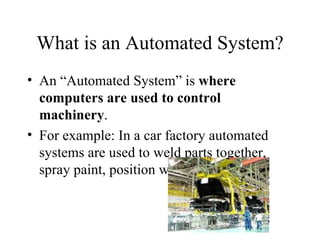
What is an Automated System? An “Automated System” is  where computers are used to control machinery . For example: In a car factory automated systems are used to weld parts together, spray paint, position windscreens, etc
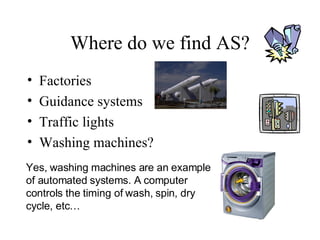
Where do we find AS? Factories Guidance systems Traffic lights Washing machines? Yes, washing machines are an example of automated systems. A computer  controls the timing of wash, spin, dry cycle, etc…
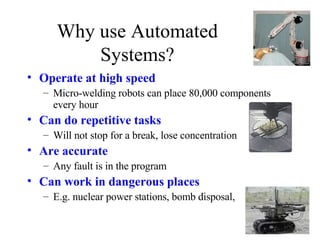
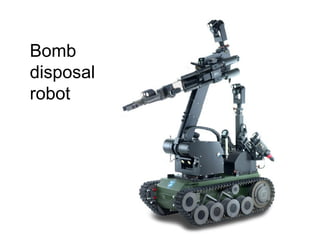
Why use Automated Systems? Operate at high speed Micro-welding robots can place 80,000 components every hour Can do repetitive tasks Will not stop for a break, lose concentration Are accurate Any fault is in the program Can work in dangerous places E.g. nuclear power stations, bomb disposal,
Bomb disposal robot
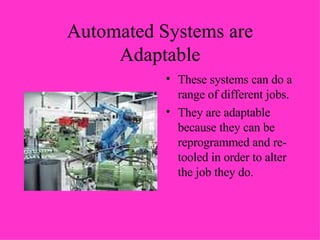
Automated Systems are Adaptable These systems can do a range of different jobs. They are adaptable because they can be reprogrammed and re-tooled in order to alter the job they do.
Task 1 Chemical Factory Glasgow Science Centre Tower Car factory North Sea Oil Industry Factory making microchips For each of the above give a reason why an automated system is being used.
In a  chemical factory  they can monitor sensors to warn of accidental spillage, they can transport  dangerous chemicals  throughout the factory, can be in charge of mixing chemicals together in the right amounts. On an  oil rig  they can check for gas/oil leeks, control the drill, monitor the flow of oil through the pipelines to the shore.
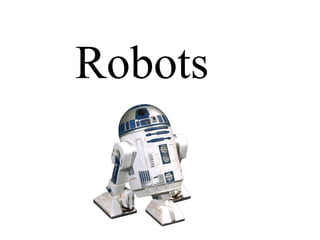
Robots
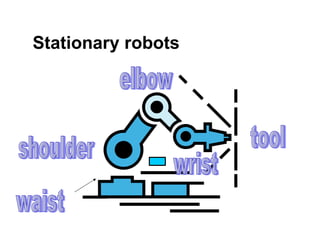
waist shoulder elbow wrist tool Stationary robots
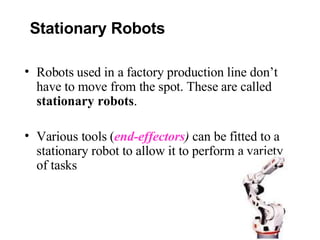
Robots used in a factory production line don’t have to move from the spot. These are called  stationary robots . Various tools ( end-effectors )  can be fitted to a stationary robot to allow it to perform a variety of tasks Stationary Robots
Task 2 Write out a list of tools that can be fitted to a robot arm.
Tools The tool at the end of the arm could be:- A welding gun A paint spray A gripper A screwdriver A wrench A suction pad (for lifting fragile objects) A tool for fixing electronic components
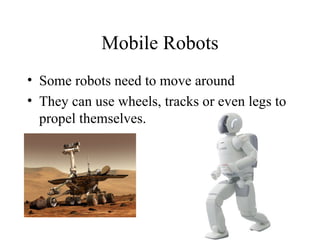
Mobile Robots Some robots need to move around They can use wheels, tracks or even legs to propel themselves.
How are mobile robots guided? Magnetic Guidance The robot follows a magnetic field which comes from a cable buried in the factory floor.  Sensors detect the magnetic field and give information (feedback) to the processor which controls the way the robot moves.
Magnetic guidance system Expensive to install as floor has to be dug up. Not good in areas where there is a lot of metal as this can confuse the robot. Good if there is a complicated route to follow Better in dirty areas
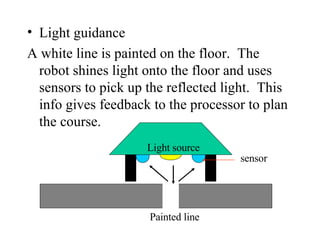
Light guidance A white line is painted on the floor.  The robot shines light onto the floor and uses sensors to pick up the reflected light.  This info gives feedback to the processor to plan the course. Light source Painted line sensor
Light Guidance System Cheap to install – just paint a line Easy to change paths Not good in dirty areas as the line will not be clear (also if cardboard or paper lying around).
Task 3 1. Which tasks will a) a mobile robot  ; b) a stationary robot  carry out in a car factory? 2. Which type of guidance system would be easier to install?  Explain why. 3. Describe the job of a sensor in a guidance system.
Computer Aided Design
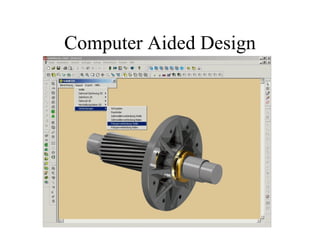
Computer Aided Design CAD  for short CAD systems are used by in manufacturing and also by architects and planners to make complex designs Advantages They make it easy to produce complicated drawings Easy to make changes once finished Can visualise products before they are made Making extra copies is easy, just send more to the plotter
CAD CAD systems require high-resolution monitors… why? To give required detail in the design Also require powerful processors and lots of storage for 3 dimensional graphics
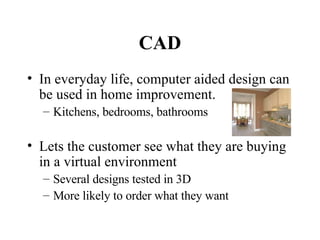
CAD In everyday life, computer aided design can be used in home improvement. Kitchens, bedrooms, bathrooms Lets the customer see what they are buying in a virtual environment Several designs tested in 3D More likely to order what they want
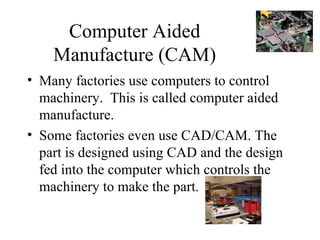
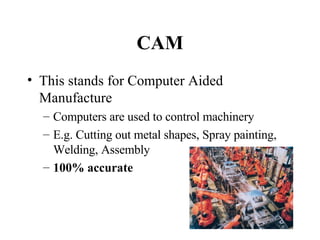
Computer Aided Manufacture (CAM) Many factories use computers to control machinery.  This is called computer aided manufacture. Some factories even use CAD/CAM. The part is designed using CAD and the design fed into the computer which controls the machinery to make the part.
CAM This stands for Computer Aided Manufacture Computers are used to control machinery E.g. Cutting out metal shapes, Spray painting, Welding, Assembly 100% accurate
Integrated CAD/CAM Some industries practice integrated CAD and CAM. Parts designed on computer are fed straight to CAM system which cut out the part
Simulation
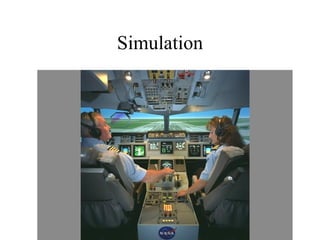
Simulation Simulation is using computers to create a model of a real life situation Flying a plane, driving a car, carrying out an operation Computer takes control signals and outputs result to screen Can be used for training – why? No risk, less cost, repeated over and over, precise control of environment.
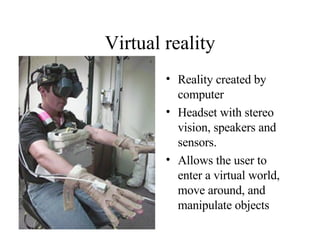
Virtual reality Reality created by computer Headset with stereo vision, speakers and sensors. Allows the user to enter a virtual world, move around, and manipulate objects
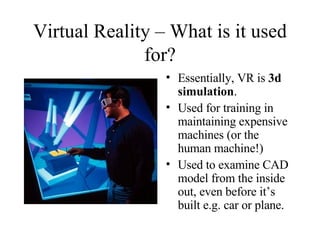
Virtual Reality – What is it used for? Essentially, VR is  3d simulation . Used for training in maintaining expensive machines (or the human machine!) Used to examine CAD model from the inside out, even before it’s built e.g. car or plane.
Now do Knowledge check 1 in the Automated Systems booklet
Using a Control Language Automated systems are controlled by programs written in a high level language called a control language. These have special features, such as commands for controlling robot movements and input/output facilities, which help design the programs.
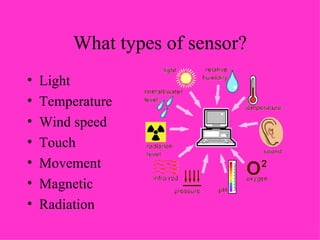
Sensors Robots take information from the outside world using  sensors These include: Light sensor Magnetic sensor Heat sensor Touch sensor
Sensors AS is using computers to control machinery… how does this work? Can think of it as Input, Process, Output. Sensors  input  feedback about the real world to a  process or which decides what  output  is needed.
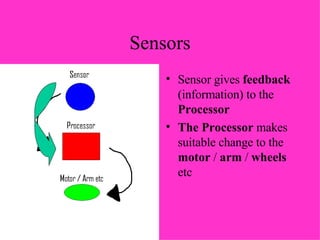
Sensors Sensor gives  feedback  (information) to the  Processor The Processor  makes suitable change to the  motor  /  arm  /  wheels  etc
What types of sensor? Light Temperature Wind speed Touch Movement Magnetic Radiation
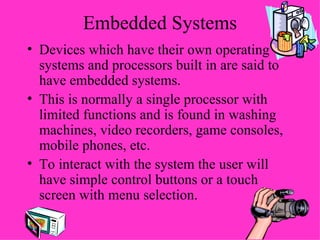
Embedded Systems Devices which have their own operating systems and processors built in are said to have embedded systems. This is normally a single processor with limited functions and is found in washing machines, video recorders, game consoles, mobile phones, etc. To interact with the system the user will have simple control buttons or a touch screen with menu selection.
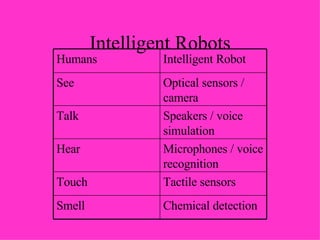
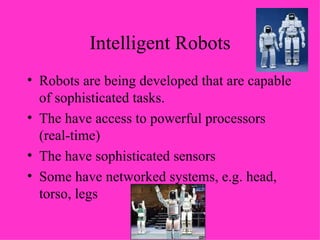
Intelligent Robots Robots are being developed that are capable of sophisticated tasks. The have access to powerful processors (real-time) The have sophisticated sensors Some have networked systems, e.g. head, torso, legs
Intelligent Robots Chemical detection Smell Tactile sensors Touch Microphones / voice recognition Hear Speakers / voice simulation Talk Optical sensors / camera See Intelligent Robot Humans
Task 4 Write out a list of machines with embedded systems in them.
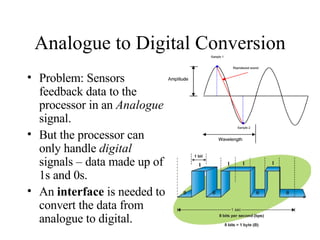
Analogue to Digital Conversion Problem: Sensors feedback data to the processor in an  Analogue  signal. But the processor can only handle  digital  signals – data made up of 1s and 0s. An  interface  is needed to convert the data from analogue to digital.
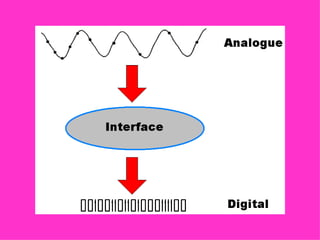
Analogue to Digital Conversion It’s like the sensor and processor are speaking two different languages! The solution:  A device called an  Interface  goes between the sensor and the processor and translates Analogue signals to Digital signals.
 
A/D convertor An interface that changes Analogue signals to Digital signals is called an Analogue/Digital convertor (A/D) Sampling (Diagram) A D/A convertor simply changes the signal the other way round.  Used to send signals to arm/tools from the processor.
Task 5 Why does an automated system need an interface? What is the job of a D/A convertor on a system controlling a robot arm? List the range of sensors that could be found on an intelligent robot.
Real-time processing Often, a system controlled by sensors has to react  instantly  to feedback from the sensors. E.g. Crash detection. For this, we use  real-time processing This allows the automated system to react fast enough to control machinery effectively. E.g. aircraft landing, robotic arm or other machinery, missiles, etc
Glasgow Science Centre Tower
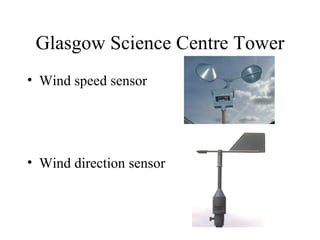
Glasgow Science Centre Tower Where are Automated Systems used here? The tower is specially shaped so it can face into the wind The wind changes direction so the tower needs to rotate Automated Systems are used to control the rotation of the tower.
Glasgow Science Centre Tower Wind speed sensor Wind direction sensor
Glasgow Science Centre Tower Task 6  Which sensors does the Science Centre use? Why is an automated system used to control the position of the tower?
Now do knowledge check 2 – page 14
Initial Costs These are the costs in bringing in an automated system. They include: Buying and fitting computer system Buying robots Buying and laying guidance system Installing sensors Writing the programs (software) Training workers
Long Term Savings It can cost many millions to set up an automated system.  So why do companies do it? They do it because it will eventually save them money. The ways they save money are: Lower wage bill as there are fewer workers Increased production – more items made with less wastage Increase in quality of items as machines are more accurate and don’t have ‘off days’.
Task 7 How can the high initial costs be justified? (Why are companies willing to pay so much for an automated system?)
Affect on Jobs Automated Systems affect people’s employment in 3 ways: New jobs created Retraining of existing staff Redundancy Sometimes there is resistance by employees against the installation of Automated Systems
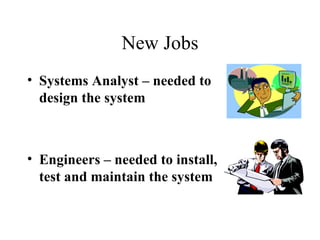
New Jobs Systems Analyst – needed to design the system  Engineers – needed to install, test and maintain the system
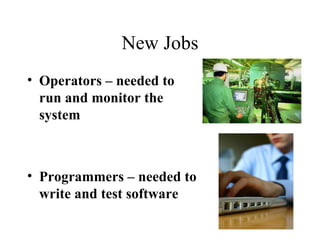
New Jobs Operators – needed to run and monitor the system Programmers – needed to write and test software
Effects on the Design of the workplace The workplace (factory, etc) may need to be completely redesigned to include the following: Sensors Guidance System Power cables Data cables Controlling computer system Safety systems
Safety Systems Keep robots and people separate if necessary Hatched off areas (yellow criss-cross) where workers have restricted access Appropriate warning in the workplace  Collision detection sensors on the robot  Horn and/or flashing light on robot
Now complete task 8 on page 17. Go onto knowledge check 3
Revision Questions In an chemical factory, what could a mobile robot be used for? Describe the use of Virtual Reality in a CAD system? Describe a control language. How does a A/D convertor work? Describe 3 things an analyst would think about when redesigning a workplace.
DVD Credit material End of unit progress check

Automated Systems Credit

  • 1.
  • 2.
    What is anAutomated System? An “Automated System” is where computers are used to control machinery . For example: In a car factory automated systems are used to weld parts together, spray paint, position windscreens, etc
  • 3.
    Where do wefind AS? Factories Guidance systems Traffic lights Washing machines? Yes, washing machines are an example of automated systems. A computer controls the timing of wash, spin, dry cycle, etc…
  • 4.
    Why use AutomatedSystems? Operate at high speed Micro-welding robots can place 80,000 components every hour Can do repetitive tasks Will not stop for a break, lose concentration Are accurate Any fault is in the program Can work in dangerous places E.g. nuclear power stations, bomb disposal,
  • 5.
  • 6.
    Automated Systems areAdaptable These systems can do a range of different jobs. They are adaptable because they can be reprogrammed and re-tooled in order to alter the job they do.
  • 7.
    Task 1 ChemicalFactory Glasgow Science Centre Tower Car factory North Sea Oil Industry Factory making microchips For each of the above give a reason why an automated system is being used.
  • 8.
    In a chemical factory they can monitor sensors to warn of accidental spillage, they can transport dangerous chemicals throughout the factory, can be in charge of mixing chemicals together in the right amounts. On an oil rig they can check for gas/oil leeks, control the drill, monitor the flow of oil through the pipelines to the shore.
  • 9.
  • 10.
    waist shoulder elbowwrist tool Stationary robots
  • 11.
    Robots used ina factory production line don’t have to move from the spot. These are called stationary robots . Various tools ( end-effectors ) can be fitted to a stationary robot to allow it to perform a variety of tasks Stationary Robots
  • 12.
    Task 2 Writeout a list of tools that can be fitted to a robot arm.
  • 13.
    Tools The toolat the end of the arm could be:- A welding gun A paint spray A gripper A screwdriver A wrench A suction pad (for lifting fragile objects) A tool for fixing electronic components
  • 14.
    Mobile Robots Somerobots need to move around They can use wheels, tracks or even legs to propel themselves.
  • 15.
    How are mobilerobots guided? Magnetic Guidance The robot follows a magnetic field which comes from a cable buried in the factory floor. Sensors detect the magnetic field and give information (feedback) to the processor which controls the way the robot moves.
  • 16.
    Magnetic guidance systemExpensive to install as floor has to be dug up. Not good in areas where there is a lot of metal as this can confuse the robot. Good if there is a complicated route to follow Better in dirty areas
  • 17.
    Light guidance Awhite line is painted on the floor. The robot shines light onto the floor and uses sensors to pick up the reflected light. This info gives feedback to the processor to plan the course. Light source Painted line sensor
  • 18.
    Light Guidance SystemCheap to install – just paint a line Easy to change paths Not good in dirty areas as the line will not be clear (also if cardboard or paper lying around).
  • 19.
    Task 3 1.Which tasks will a) a mobile robot ; b) a stationary robot carry out in a car factory? 2. Which type of guidance system would be easier to install? Explain why. 3. Describe the job of a sensor in a guidance system.
  • 20.
  • 21.
    Computer Aided DesignCAD for short CAD systems are used by in manufacturing and also by architects and planners to make complex designs Advantages They make it easy to produce complicated drawings Easy to make changes once finished Can visualise products before they are made Making extra copies is easy, just send more to the plotter
  • 22.
    CAD CAD systemsrequire high-resolution monitors… why? To give required detail in the design Also require powerful processors and lots of storage for 3 dimensional graphics
  • 23.
    CAD In everydaylife, computer aided design can be used in home improvement. Kitchens, bedrooms, bathrooms Lets the customer see what they are buying in a virtual environment Several designs tested in 3D More likely to order what they want
  • 24.
    Computer Aided Manufacture(CAM) Many factories use computers to control machinery. This is called computer aided manufacture. Some factories even use CAD/CAM. The part is designed using CAD and the design fed into the computer which controls the machinery to make the part.
  • 25.
    CAM This standsfor Computer Aided Manufacture Computers are used to control machinery E.g. Cutting out metal shapes, Spray painting, Welding, Assembly 100% accurate
  • 26.
    Integrated CAD/CAM Someindustries practice integrated CAD and CAM. Parts designed on computer are fed straight to CAM system which cut out the part
  • 27.
  • 28.
    Simulation Simulation isusing computers to create a model of a real life situation Flying a plane, driving a car, carrying out an operation Computer takes control signals and outputs result to screen Can be used for training – why? No risk, less cost, repeated over and over, precise control of environment.
  • 29.
    Virtual reality Realitycreated by computer Headset with stereo vision, speakers and sensors. Allows the user to enter a virtual world, move around, and manipulate objects
  • 30.
    Virtual Reality –What is it used for? Essentially, VR is 3d simulation . Used for training in maintaining expensive machines (or the human machine!) Used to examine CAD model from the inside out, even before it’s built e.g. car or plane.
  • 31.
    Now do Knowledgecheck 1 in the Automated Systems booklet
  • 32.
    Using a ControlLanguage Automated systems are controlled by programs written in a high level language called a control language. These have special features, such as commands for controlling robot movements and input/output facilities, which help design the programs.
  • 33.
    Sensors Robots takeinformation from the outside world using sensors These include: Light sensor Magnetic sensor Heat sensor Touch sensor
  • 34.
    Sensors AS isusing computers to control machinery… how does this work? Can think of it as Input, Process, Output. Sensors input feedback about the real world to a process or which decides what output is needed.
  • 35.
    Sensors Sensor gives feedback (information) to the Processor The Processor makes suitable change to the motor / arm / wheels etc
  • 36.
    What types ofsensor? Light Temperature Wind speed Touch Movement Magnetic Radiation
  • 37.
    Embedded Systems Deviceswhich have their own operating systems and processors built in are said to have embedded systems. This is normally a single processor with limited functions and is found in washing machines, video recorders, game consoles, mobile phones, etc. To interact with the system the user will have simple control buttons or a touch screen with menu selection.
  • 38.
    Intelligent Robots Robotsare being developed that are capable of sophisticated tasks. The have access to powerful processors (real-time) The have sophisticated sensors Some have networked systems, e.g. head, torso, legs
  • 39.
    Intelligent Robots Chemicaldetection Smell Tactile sensors Touch Microphones / voice recognition Hear Speakers / voice simulation Talk Optical sensors / camera See Intelligent Robot Humans
  • 40.
    Task 4 Writeout a list of machines with embedded systems in them.
  • 41.
    Analogue to DigitalConversion Problem: Sensors feedback data to the processor in an Analogue signal. But the processor can only handle digital signals – data made up of 1s and 0s. An interface is needed to convert the data from analogue to digital.
  • 42.
    Analogue to DigitalConversion It’s like the sensor and processor are speaking two different languages! The solution: A device called an Interface goes between the sensor and the processor and translates Analogue signals to Digital signals.
  • 43.
  • 44.
    A/D convertor Aninterface that changes Analogue signals to Digital signals is called an Analogue/Digital convertor (A/D) Sampling (Diagram) A D/A convertor simply changes the signal the other way round. Used to send signals to arm/tools from the processor.
  • 45.
    Task 5 Whydoes an automated system need an interface? What is the job of a D/A convertor on a system controlling a robot arm? List the range of sensors that could be found on an intelligent robot.
  • 46.
    Real-time processing Often,a system controlled by sensors has to react instantly to feedback from the sensors. E.g. Crash detection. For this, we use real-time processing This allows the automated system to react fast enough to control machinery effectively. E.g. aircraft landing, robotic arm or other machinery, missiles, etc
  • 47.
  • 48.
    Glasgow Science CentreTower Where are Automated Systems used here? The tower is specially shaped so it can face into the wind The wind changes direction so the tower needs to rotate Automated Systems are used to control the rotation of the tower.
  • 49.
    Glasgow Science CentreTower Wind speed sensor Wind direction sensor
  • 50.
    Glasgow Science CentreTower Task 6 Which sensors does the Science Centre use? Why is an automated system used to control the position of the tower?
  • 51.
    Now do knowledgecheck 2 – page 14
  • 52.
    Initial Costs Theseare the costs in bringing in an automated system. They include: Buying and fitting computer system Buying robots Buying and laying guidance system Installing sensors Writing the programs (software) Training workers
  • 53.
    Long Term SavingsIt can cost many millions to set up an automated system. So why do companies do it? They do it because it will eventually save them money. The ways they save money are: Lower wage bill as there are fewer workers Increased production – more items made with less wastage Increase in quality of items as machines are more accurate and don’t have ‘off days’.
  • 54.
    Task 7 Howcan the high initial costs be justified? (Why are companies willing to pay so much for an automated system?)
  • 55.
    Affect on JobsAutomated Systems affect people’s employment in 3 ways: New jobs created Retraining of existing staff Redundancy Sometimes there is resistance by employees against the installation of Automated Systems
  • 56.
    New Jobs SystemsAnalyst – needed to design the system Engineers – needed to install, test and maintain the system
  • 57.
    New Jobs Operators– needed to run and monitor the system Programmers – needed to write and test software
  • 58.
    Effects on theDesign of the workplace The workplace (factory, etc) may need to be completely redesigned to include the following: Sensors Guidance System Power cables Data cables Controlling computer system Safety systems
  • 59.
    Safety Systems Keeprobots and people separate if necessary Hatched off areas (yellow criss-cross) where workers have restricted access Appropriate warning in the workplace Collision detection sensors on the robot Horn and/or flashing light on robot
  • 60.
    Now complete task8 on page 17. Go onto knowledge check 3
  • 61.
    Revision Questions Inan chemical factory, what could a mobile robot be used for? Describe the use of Virtual Reality in a CAD system? Describe a control language. How does a A/D convertor work? Describe 3 things an analyst would think about when redesigning a workplace.
  • 62.
    DVD Credit materialEnd of unit progress check