Presentation On
8086 MICROPROCESSOR ARCHITECTURE
Daffodil International University
Submitted To:
Mahbuba Maliha Mourin
Lecturer
Daffodil International University
Submitted By:
Nirnay Mukharjee – 143 – 15 – 4421
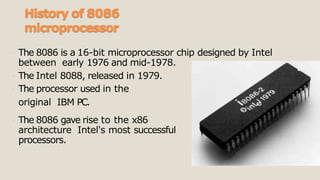
History of 8086
microprocessor
 The 8086 is a 16-bit microprocessor chip designed by Intel
between early 1976 and mid-1978.
 The Intel 8088, released in 1979.
 The processor used in the
original IBM PC.
 The 8086 gave rise to the x86
architecture Intel's most successful
processors.
which eventuallybecame
Features of Intel– 8086
microprocessor
• It is a 16-bitmicroprocessor.
• 8086has a 20bitaddress buscan
access up to220 memory locations (1MB).
• It can support upto64K I/O ports.
• It provides 16-bitregisters
• It has multiplexedaddress and databusAD0-AD15 and
A16 – A19.
Internal Architecture
of8086
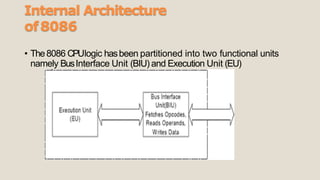
• The8086 CPUlogic hasbeen partitioned into two functional units
namely BusInterface Unit (BIU) and Execution Unit (EU)
Internal Architecture
of8086
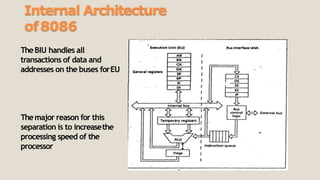
TheBIU handles all
transactions of data and
addresses on the buses forEU
Themajor reason for this
separation is to increasethe
processing speed of the
processor
20-bit physical
address
Physical Address (20 Bits)
Adder
Segment Register (16 bits) 0 0 0 0
Offset Value (16 bits)
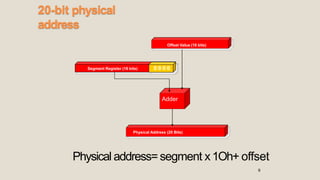
Physical address= segment x1Oh+ offset
9
Bus Interface
Unit
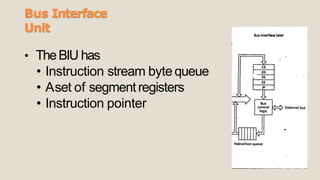
• TheBIU has
• Instruction stream bytequeue
• Aset of segmentregisters
• Instruction pointer
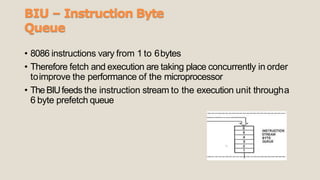
BIU – Instruction Byte
Queue
• 8086 instructions vary from 1 to 6bytes
• Therefore fetch and execution are taking place concurrently in order
toimprove the performance of the microprocessor
• TheBIUfeeds the instruction stream to the execution unit througha
6 byte prefetch queue
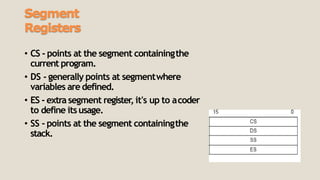
Segment
Registers
• CS - points at the segment containingthe
current program.
• DS - generally points at segmentwhere
variables are defined.
• ES - extrasegment register, it's up to acoder
to define itsusage.
• SS - points at the segment containingthe
stack.
Instruction
pointer
• IP - the instructionpointer:
1. Always points to next instruction tobe executed
2. Offset address relative to CS
• IP register always works together with CS
segment register and it points tocurrently
executing instruction.
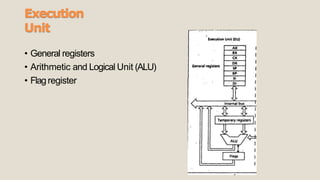
Execution
Unit
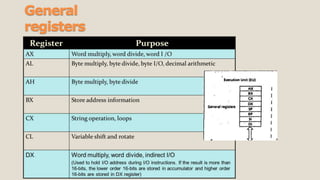
• General registers
• Arithmetic and Logical Unit (ALU)
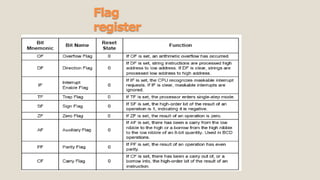
• Flagregister
General
registers
Flag
register
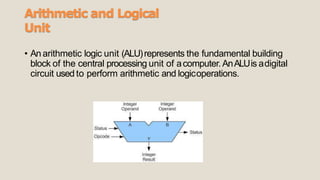
Arithmetic and Logical
Unit
• An arithmetic logic unit (ALU)represents the fundamental building
block of the central processing unit of acomputer.AnALUis adigital
circuit used to perform arithmetic and logicoperations.
Thank You

Microprocessor presentation

  • 1.
  • 2.
    Daffodil International University SubmittedTo: Mahbuba Maliha Mourin Lecturer Daffodil International University Submitted By: Nirnay Mukharjee – 143 – 15 – 4421
  • 3.
    History of 8086 microprocessor The 8086 is a 16-bit microprocessor chip designed by Intel between early 1976 and mid-1978.  The Intel 8088, released in 1979.  The processor used in the original IBM PC.  The 8086 gave rise to the x86 architecture Intel's most successful processors. which eventuallybecame
  • 4.
    Features of Intel–8086 microprocessor • It is a 16-bitmicroprocessor. • 8086has a 20bitaddress buscan access up to220 memory locations (1MB). • It can support upto64K I/O ports. • It provides 16-bitregisters • It has multiplexedaddress and databusAD0-AD15 and A16 – A19.
  • 5.
    Internal Architecture of8086 • The8086CPUlogic hasbeen partitioned into two functional units namely BusInterface Unit (BIU) and Execution Unit (EU)
  • 6.
    Internal Architecture of8086 TheBIU handlesall transactions of data and addresses on the buses forEU Themajor reason for this separation is to increasethe processing speed of the processor
  • 7.
    20-bit physical address Physical Address(20 Bits) Adder Segment Register (16 bits) 0 0 0 0 Offset Value (16 bits) Physical address= segment x1Oh+ offset 9
  • 8.
    Bus Interface Unit • TheBIUhas • Instruction stream bytequeue • Aset of segmentregisters • Instruction pointer
  • 9.
    BIU – InstructionByte Queue • 8086 instructions vary from 1 to 6bytes • Therefore fetch and execution are taking place concurrently in order toimprove the performance of the microprocessor • TheBIUfeeds the instruction stream to the execution unit througha 6 byte prefetch queue
  • 10.
    Segment Registers • CS -points at the segment containingthe current program. • DS - generally points at segmentwhere variables are defined. • ES - extrasegment register, it's up to acoder to define itsusage. • SS - points at the segment containingthe stack.
  • 11.
    Instruction pointer • IP -the instructionpointer: 1. Always points to next instruction tobe executed 2. Offset address relative to CS • IP register always works together with CS segment register and it points tocurrently executing instruction.
  • 12.
    Execution Unit • General registers •Arithmetic and Logical Unit (ALU) • Flagregister
  • 13.
  • 14.
  • 15.
    Arithmetic and Logical Unit •An arithmetic logic unit (ALU)represents the fundamental building block of the central processing unit of acomputer.AnALUis adigital circuit used to perform arithmetic and logicoperations.
  • 16.