A
SEMINAR ON
METHODS FOR COMPOSITIONAL ANALYSIS OF
POLYSACCHARIDES
BY
Dr. ARUIMA KARKUN
ASST. PROFESSOR
G.D. RUNGTA COLLEGE OF SCIENCE & TECHNOLOGY
KOHKA KURUD BHILAI DURG (C.G.) 1
METHODS FOR COMPOSITIONAL ANALYSIS OF
POLYSACCHARIDES
INTRODUCTION
ANALYSIS
ENZYMATIC TREATMENT METHOD
HYDROLYSIS METHOD
ANALYTICAL METHOD
GAS LIQUID CHROMATOGRAPHY
HIGH PERFORMANCE LIQUID
CHROMATOGRAPHY
NMR METHOD
CONCLUSION
SUMMARY
REFERENCE 2
C
O
N
T
E
N
T
S
METHODS FOR COMPOSITIONAL ANALYSIS OF
POLYSACCHARIDES
Polysaccharides are long carbohydrate molecules of
monosaccharide units joined together by glycosidic
bonds.
 They range in structure from linear to highly
branched.
They may be amorphous or even insoluble in water.
Polysaccharides have a general formula of Cn(H2O)n
where n is usually a large number between 200 and
2500.
3
I
N
T
R
O
D
U
C
T
I
O
N
METHODS FOR COMPOSITIONAL ANALYSIS OF
POLYSACCHARIDEs
There are two types of polysaccharides-
(i)-Homopolysaccharides-Contains only one type of
monomer.
 On hydrolysis, they yield only one type of
monosaccharide. Examples:Starch, cellulose,
glycogen
(ii)-Heteropolysaccharides-Contain two or more
types of monomers.
 On hydrolysis, they yield mixture of
monosaccharides. Examples: hyaluronic acid,
chondriotin sulphate, heparin, and mureins.
4
I
N
T
R
O
D
U
C
T
I
O
N
METHODS FOR COMPOSITIONAL ANALYSIS OF
POLYSACCHARIDES
Analysis is the process of breaking a complex topic
or substance into smaller parts to gain a better
understanding of it.
The separating of any material or abstract entity into
its constituent elements.
Following methods are used for compositional
analysis of polysaccharides-
-Enzymatic treatment method
-Hydrolysis method
5
A
N
A
L
Y
S
I
S
METHODS FOR COMOSITIONAL ANALYSIS OF
POLYSACCHARIDES
The analysis of oligosaccharides/polysaccharides is
complicated as they contain variety of bondings.
Therefore before proceeding for analysis protein and
lipid moieties are removed by treating with specific
enzymes.
then subjected to stepwise degradation with specific
reagents to reveal the position of glycosidic bonds.
For example-
Exhaustive methylation with methyl iodide
in strongly basic medium yields fully methylated
oligosaccharides. 6
E
N
Z
Y
M
A
T
C
M
E
T
H
O
D
METHODS FOR COMPOSITIONAL ANALYSIS OF
POLYSACCHARIDES
Which on acid hydrolysis yields monosaccharides
methylated at every hydroxyl group except those
involved in glycosidic bond.
By this treatment the position of bonding can be
ascertained.
7
E
N
Z
Y
M
A
T
C
M
E
T
H
O
D
METHODS FOR COMPOSITIONAL ANALYSIS OF
POLYSACCHARIDES
Characterisation of polysaccharides can be done by
hydrolysis with strong acids.
Which yields a mixture of monosaccharides.
These monosaccharides can be converted into
volatile derivatives and analysed by GLC.
Besides acid hydrolysis polysaccharides may be
hydrolysed with specific endoglycosidases to yield
smaller oligosaccharides.
8
H
Y
D
R
O
L
Y
S
I
S
M
E
T
H
O
D
METHODS FOR COMPOSITIONAL ANALYSIS OF
POLYSACCHARIDES
ANALYTICAL METHODS
Chromatography
Gas liquid chromatography
High performance liquid chromatography
Spectroscopic method
Nuclear magnetic resonance (NMR) spectroscopy
9
METHODS FOR COMPOSITIONAL ANALYSIS OF
POLYSACCHARIDES
CHROMATOGRAPHY
Chromatography usually consists of a mobile phase and
a stationary phase.
The mobile phase refers to the mixture of substances
(to be separated ),dissolved in a liquid or a gas.
The various constituents of the mixture travel at
different speeds, causing them to separate.
The separation is based on the interaction between the
mobile and stationary phases.
10
A
N
A
L
Y
T
I
C
A
L
M
E
T
H
O
D
S
METHODS FOR COMPOSITIONAL ANALYSIS OF
POLYSACCHARIDES
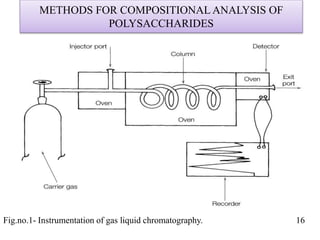
GAS LIQUID CHROMATOGRAPHY
 All forms of chromatography involve a stationary
phase and a mobile phase.
In all the other forms of chromatography you will
meet at this level, the mobile phase is a liquid.
In gas-liquid chromatography, the mobile phase is a
gas such as helium and the stationary phase is a high
boiling point liquid absorbed onto a solid.
A FLOW SCHEME OF GAS CHROMATOGRAPHY
INJECTION OF THE SAMPLE
Very small quantities of the sample that you are trying
11
A
N
A
L
Y
T
I
C
A
L
M
E
T
H
O
D
S
METHODS FOR COMPOSITIONAL ANALYSIS OF
POLYSACCHARIDES
to analyse are injected into the machine using a small
syringe.
The injector is contained in an oven whose
temperature can be controlled. It is hot enough so that
all the sample boils and is carried into the column as a
gas by the helium.
HOW TO COLUMN WORKS
There are two main types of column in gas-liquid
chromatography. One of these is a long thin tube
packed with the stationary phase; the other is even
thinner and has the stationary phase bonded to its
inner surface. 12
A
N
A
L
Y
T
I
C
A
L
M
E
T
H
O
D
S
METHODS FOR COMPOSITIONAL ANALYSIS OF
POLYSACCHARIDES
The column is typically made of stainless steel and is
between 1 and 4 metres long with an internal
diameter of up to 4 mm.
It is coiled up so that it will fit into a thermostatically
controlled oven.
This is coated with a high boiling liquid - typically a
waxy polymer.
The temperature of the column can be varied from
about 50°C to 250°C.
It is cooler than the injector oven, so that some
components of the mixture may condense at the
beginning of the column. 13
A
N
A
L
Y
T
I
C
A
L
M
E
T
H
O
D
S
METHODS FOR COMPOSITIONAL ANALYSIS OF
POLYSACCHARIDES
How separation works on the column
some molecules may dissolve in the liquid stationary
phase Some compounds will be more soluble in the
liquid than others.
The more soluble ones will spend more of their time
absorbed into the stationary phase; the less soluble
ones will spend more of their time in the gas.
The process where a substance divides itself between
two immiscible solvents because it is more soluble in
one than the other is known as partition.
14
A
N
A
L
Y
T
I
C
A
L
M
E
T
H
O
D
S
METHODS FOR COMPOSITIONAL ANALYSIS OF
POLYSACCHARIDES
RETENTION TIME
The time taken for a particular compound to travel
through the column to the detector is known as its
retention time.
This time is measured from the time at which the sample
is injected to the point at which the display shows a
maximum peak height for that compound.
Interpreting the output from the detector-
The output will be recorded as a series of peaks - each
one representing a compound in the mixture passing
through the detector. 15
A
N
A
L
Y
T
I
C
A
L
M
E
T
H
O
D
S
METHODS FOR COMPOSITIONAL ANALYSIS OF
POLYSACCHARIDES
Fig.no.1- Instrumentation of gas liquid chromatography. 16
METHODS FOR COMPOSITIONAL ANALYSIS OF
POLYSACCHARIDES
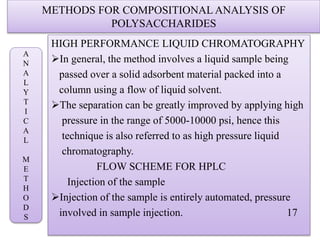
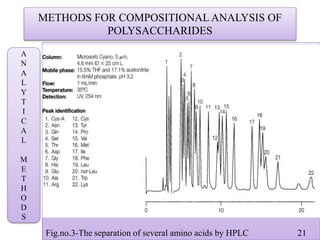
HIGH PERFORMANCE LIQUID CHROMATOGRAPHY
In general, the method involves a liquid sample being
passed over a solid adsorbent material packed into a
column using a flow of liquid solvent.
The separation can be greatly improved by applying high
pressure in the range of 5000-10000 psi, hence this
technique is also referred to as high pressure liquid
chromatography.
FLOW SCHEME FOR HPLC
Injection of the sample
Injection of the sample is entirely automated, pressure
involved in sample injection. 17
A
N
A
L
Y
T
I
C
A
L
M
E
T
H
O
D
S
METHODS FOR COMPOSITIONAL ANALYSIS OF
POLYSACCHARIDES
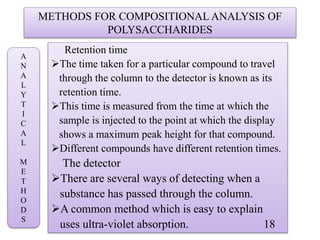
Retention time
The time taken for a particular compound to travel
through the column to the detector is known as its
retention time.
This time is measured from the time at which the
sample is injected to the point at which the display
shows a maximum peak height for that compound.
Different compounds have different retention times.
The detector
There are several ways of detecting when a
substance has passed through the column.
A common method which is easy to explain
uses ultra-violet absorption. 18
A
N
A
L
Y
T
I
C
A
L
M
E
T
H
O
D
S
METHODS FOR COMPOSITIONAL ANALYSIS OF
POLYSACCHARIDES
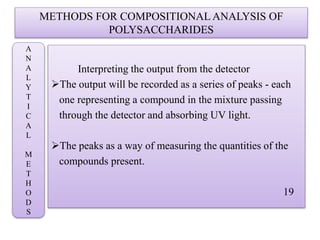
Interpreting the output from the detector
The output will be recorded as a series of peaks - each
one representing a compound in the mixture passing
through the detector and absorbing UV light.
The peaks as a way of measuring the quantities of the
compounds present.
19
A
N
A
L
Y
T
I
C
A
L
M
E
T
H
O
D
S
METHODS FOR COMPOSITIONAL ANALYSIS OF
POLYSACCHARIDES
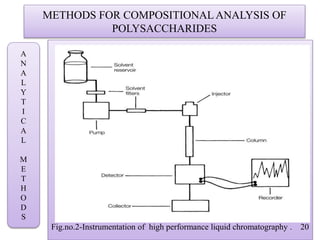
Fig.no.2-Instrumentation of high performance liquid chromatography . 20
A
N
A
L
Y
T
I
C
A
L
M
E
T
H
O
D
S
METHODS FOR COMPOSITIONAL ANALYSIS OF
POLYSACCHARIDES
Fig.no.3-The separation of several amino acids by HPLC 21
A
N
A
L
Y
T
I
C
A
L
M
E
T
H
O
D
S
METHODS FOR COMPOSITIONAL ANALYIS OF
POLYSACCHARIDES
NMR SPECTROSCOPY
Nuclear magnetic resonance spectroscopy, commonly
referred to as NMR, has become the preeminent
technique for determining the structure of organic
compounds.
A method is presented for the detailed and accurate
quantitative determination of the monomeric
composition of polysaccharides.
In NMR molecular sample usually dissolve in a liquid
solvent, is place in a magnetic field and the absorption
of radio frequency by certain nuclei is measured.
 All nuclei possess positive charge which causes
nuclei to act as tiny magnet.
22
A
N
A
L
Y
T
I
C
A
L
M
E
T
H
O
D
S
METHODS FOR COMPOSITIONAL ANALYSIS OF
POLYSACCHARIDES
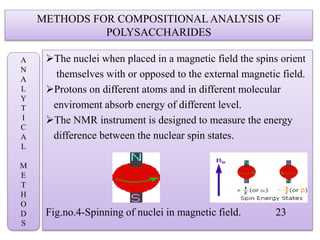
The nuclei when placed in a magnetic field the spins orient
themselves with or opposed to the external magnetic field.
Protons on different atoms and in different molecular
enviroment absorb energy of different level.
The NMR instrument is designed to measure the energy
difference between the nuclear spin states.
Fig.no.4-Spinning of nuclei in magnetic field. 23
A
N
A
L
Y
T
I
C
A
L
M
E
T
H
O
D
S
METHODS FOR COMPOSITIONAL ANALYSIS OF
POLYSACCHARIDES
The magnetic moment of the lower energy +1/2 state is
aligned with the external field, but that of the higher
energy -1/2 spin state is opposed to the external field.
Note that the arrow representing the external field points
North.
Strong magnetic fields are necessary for NMR
spectroscopy.
NMR experiment are not limited to the study of protons.
 Resonance signal from the other atomic nuclei
including C13 , P31 can be detected. 24
A
N
A
L
Y
T
I
C
A
L
M
E
T
H
O
D
S
METHODS FOR COMPOSITIONAL ANALYSIS OF
POLYSACCHARIDES
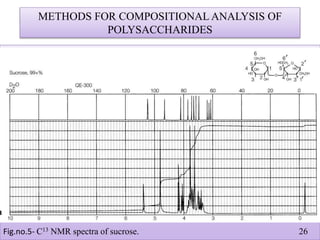
C13 NMR technique have been specially valuable for
the study of carbohydrates, amino acids, fatty acid
structures.
P31 spectra of phosphorylated biomolecules display a
peak for each type of phosphorus.
For example-
The catabolism of glucose by glycolysis in
erythrocytes has been monitored by C13 NMR and the
movement of ATP in phosphoryl group transfer processes
has been studied by P31 NMR.
25
A
N
A
L
Y
T
I
C
A
L
M
E
T
H
O
D
S
METHODS FOR COMPOSITIONAL ANALYSIS OF
POLYSACCHARIDES
Fig.no.5- C13 NMR spectra of sucrose. 26
METHODS FOR COMPOSITIONAL ANALYSIS
OF POLYSACCHARIDES
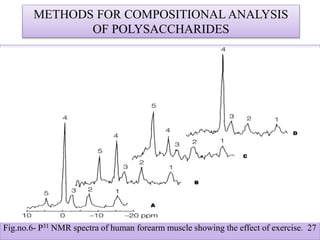
Fig.no.6- P31 NMR spectra of human forearm muscle showing the effect of exercise. 27
METHODS FOR COMPOSITIONAL ANALYSIS OF
POLYSACCHARIDES
A-before exercise
B&C-during 19 minutes of exercise
D-5-6 minutes after C
Peak as signments-1-β phosphorus of ATP
2-α phosphorus of ATP, 3-γ phosphorus of ATP
4-phosphocreatine, 5- inorganic phosphate
Phosphocreatine is used as a major source of energy
during exercise.
It is hydrolysed to creatine and inorganic phosphate.
The level of ATP remains relatively constant during
exercise because it is produced and used at about the
same rate. 28
A
N
A
L
Y
T
I
C
A
L
M
E
T
H
O
D
S
METHODS FOR COMPOSITIONAANALYSIS OF
POLYSACCHARIDES
Polysaccharides or complex carbohydrates are
generally very large molecular weight molecule also
composed of monosaccharide chains.
Polysaccharides are complex as they contain variety
of bondings.
Polysaccharides have a general formula of Cn(H2O)n
where n is usually a large number between 200 and
2500.
Analysis is the process of breaking a complex topic
or substance into smaller parts to gain a better
understanding of it. 29
C
O
N
C
L
U
S
I
O
N
METHODS FOR COMPOSITIONAL ANALYSIS OF
POLYSACCHARIDES
The analysis of oligosaccharides/polysaccharides is
complicated as they contain variety of bondings.
Therefore before proceeding for analysis protein and
lipid moieties are removed by treating with specific
enzymes.
Characterisation of polysaccharides can be done by
hydrolysis with strong acids.
Following analytical methods are used for the analysis-
Chromatography
Gas liquid chromatography
High performance liquid chromatography
Nuclear magnetic resonance spectroscopy 30
S
U
M
M
A
R
Y
METHODS FOR COMPOSITIONAL ANALYSIS OF
POLYSACCHARIDES
C.B.Powar 2006 Biochemistry
& G.R.Chatwal
Michael M.Cox 2008 Principles of
David L.Nelson Biochemistry
U. Satyanarayana 2010 Biochemistry
Rodney Boyer Third edition Modern
experimental
biochemistry
Some contents from net-
www.chemguide.co.uk
www.novapublishers.com
31
R
E
F
E
R
E
N
C
E

Compositional analysis of Polysaccharide

  • 1.
    A SEMINAR ON METHODS FORCOMPOSITIONAL ANALYSIS OF POLYSACCHARIDES BY Dr. ARUIMA KARKUN ASST. PROFESSOR G.D. RUNGTA COLLEGE OF SCIENCE & TECHNOLOGY KOHKA KURUD BHILAI DURG (C.G.) 1
  • 2.
    METHODS FOR COMPOSITIONALANALYSIS OF POLYSACCHARIDES INTRODUCTION ANALYSIS ENZYMATIC TREATMENT METHOD HYDROLYSIS METHOD ANALYTICAL METHOD GAS LIQUID CHROMATOGRAPHY HIGH PERFORMANCE LIQUID CHROMATOGRAPHY NMR METHOD CONCLUSION SUMMARY REFERENCE 2 C O N T E N T S
  • 3.
    METHODS FOR COMPOSITIONALANALYSIS OF POLYSACCHARIDES Polysaccharides are long carbohydrate molecules of monosaccharide units joined together by glycosidic bonds.  They range in structure from linear to highly branched. They may be amorphous or even insoluble in water. Polysaccharides have a general formula of Cn(H2O)n where n is usually a large number between 200 and 2500. 3 I N T R O D U C T I O N
  • 4.
    METHODS FOR COMPOSITIONALANALYSIS OF POLYSACCHARIDEs There are two types of polysaccharides- (i)-Homopolysaccharides-Contains only one type of monomer.  On hydrolysis, they yield only one type of monosaccharide. Examples:Starch, cellulose, glycogen (ii)-Heteropolysaccharides-Contain two or more types of monomers.  On hydrolysis, they yield mixture of monosaccharides. Examples: hyaluronic acid, chondriotin sulphate, heparin, and mureins. 4 I N T R O D U C T I O N
  • 5.
    METHODS FOR COMPOSITIONALANALYSIS OF POLYSACCHARIDES Analysis is the process of breaking a complex topic or substance into smaller parts to gain a better understanding of it. The separating of any material or abstract entity into its constituent elements. Following methods are used for compositional analysis of polysaccharides- -Enzymatic treatment method -Hydrolysis method 5 A N A L Y S I S
  • 6.
    METHODS FOR COMOSITIONALANALYSIS OF POLYSACCHARIDES The analysis of oligosaccharides/polysaccharides is complicated as they contain variety of bondings. Therefore before proceeding for analysis protein and lipid moieties are removed by treating with specific enzymes. then subjected to stepwise degradation with specific reagents to reveal the position of glycosidic bonds. For example- Exhaustive methylation with methyl iodide in strongly basic medium yields fully methylated oligosaccharides. 6 E N Z Y M A T C M E T H O D
  • 7.
    METHODS FOR COMPOSITIONALANALYSIS OF POLYSACCHARIDES Which on acid hydrolysis yields monosaccharides methylated at every hydroxyl group except those involved in glycosidic bond. By this treatment the position of bonding can be ascertained. 7 E N Z Y M A T C M E T H O D
  • 8.
    METHODS FOR COMPOSITIONALANALYSIS OF POLYSACCHARIDES Characterisation of polysaccharides can be done by hydrolysis with strong acids. Which yields a mixture of monosaccharides. These monosaccharides can be converted into volatile derivatives and analysed by GLC. Besides acid hydrolysis polysaccharides may be hydrolysed with specific endoglycosidases to yield smaller oligosaccharides. 8 H Y D R O L Y S I S M E T H O D
  • 9.
    METHODS FOR COMPOSITIONALANALYSIS OF POLYSACCHARIDES ANALYTICAL METHODS Chromatography Gas liquid chromatography High performance liquid chromatography Spectroscopic method Nuclear magnetic resonance (NMR) spectroscopy 9
  • 10.
    METHODS FOR COMPOSITIONALANALYSIS OF POLYSACCHARIDES CHROMATOGRAPHY Chromatography usually consists of a mobile phase and a stationary phase. The mobile phase refers to the mixture of substances (to be separated ),dissolved in a liquid or a gas. The various constituents of the mixture travel at different speeds, causing them to separate. The separation is based on the interaction between the mobile and stationary phases. 10 A N A L Y T I C A L M E T H O D S
  • 11.
    METHODS FOR COMPOSITIONALANALYSIS OF POLYSACCHARIDES GAS LIQUID CHROMATOGRAPHY  All forms of chromatography involve a stationary phase and a mobile phase. In all the other forms of chromatography you will meet at this level, the mobile phase is a liquid. In gas-liquid chromatography, the mobile phase is a gas such as helium and the stationary phase is a high boiling point liquid absorbed onto a solid. A FLOW SCHEME OF GAS CHROMATOGRAPHY INJECTION OF THE SAMPLE Very small quantities of the sample that you are trying 11 A N A L Y T I C A L M E T H O D S
  • 12.
    METHODS FOR COMPOSITIONALANALYSIS OF POLYSACCHARIDES to analyse are injected into the machine using a small syringe. The injector is contained in an oven whose temperature can be controlled. It is hot enough so that all the sample boils and is carried into the column as a gas by the helium. HOW TO COLUMN WORKS There are two main types of column in gas-liquid chromatography. One of these is a long thin tube packed with the stationary phase; the other is even thinner and has the stationary phase bonded to its inner surface. 12 A N A L Y T I C A L M E T H O D S
  • 13.
    METHODS FOR COMPOSITIONALANALYSIS OF POLYSACCHARIDES The column is typically made of stainless steel and is between 1 and 4 metres long with an internal diameter of up to 4 mm. It is coiled up so that it will fit into a thermostatically controlled oven. This is coated with a high boiling liquid - typically a waxy polymer. The temperature of the column can be varied from about 50°C to 250°C. It is cooler than the injector oven, so that some components of the mixture may condense at the beginning of the column. 13 A N A L Y T I C A L M E T H O D S
  • 14.
    METHODS FOR COMPOSITIONALANALYSIS OF POLYSACCHARIDES How separation works on the column some molecules may dissolve in the liquid stationary phase Some compounds will be more soluble in the liquid than others. The more soluble ones will spend more of their time absorbed into the stationary phase; the less soluble ones will spend more of their time in the gas. The process where a substance divides itself between two immiscible solvents because it is more soluble in one than the other is known as partition. 14 A N A L Y T I C A L M E T H O D S
  • 15.
    METHODS FOR COMPOSITIONALANALYSIS OF POLYSACCHARIDES RETENTION TIME The time taken for a particular compound to travel through the column to the detector is known as its retention time. This time is measured from the time at which the sample is injected to the point at which the display shows a maximum peak height for that compound. Interpreting the output from the detector- The output will be recorded as a series of peaks - each one representing a compound in the mixture passing through the detector. 15 A N A L Y T I C A L M E T H O D S
  • 16.
    METHODS FOR COMPOSITIONALANALYSIS OF POLYSACCHARIDES Fig.no.1- Instrumentation of gas liquid chromatography. 16
  • 17.
    METHODS FOR COMPOSITIONALANALYSIS OF POLYSACCHARIDES HIGH PERFORMANCE LIQUID CHROMATOGRAPHY In general, the method involves a liquid sample being passed over a solid adsorbent material packed into a column using a flow of liquid solvent. The separation can be greatly improved by applying high pressure in the range of 5000-10000 psi, hence this technique is also referred to as high pressure liquid chromatography. FLOW SCHEME FOR HPLC Injection of the sample Injection of the sample is entirely automated, pressure involved in sample injection. 17 A N A L Y T I C A L M E T H O D S
  • 18.
    METHODS FOR COMPOSITIONALANALYSIS OF POLYSACCHARIDES Retention time The time taken for a particular compound to travel through the column to the detector is known as its retention time. This time is measured from the time at which the sample is injected to the point at which the display shows a maximum peak height for that compound. Different compounds have different retention times. The detector There are several ways of detecting when a substance has passed through the column. A common method which is easy to explain uses ultra-violet absorption. 18 A N A L Y T I C A L M E T H O D S
  • 19.
    METHODS FOR COMPOSITIONALANALYSIS OF POLYSACCHARIDES Interpreting the output from the detector The output will be recorded as a series of peaks - each one representing a compound in the mixture passing through the detector and absorbing UV light. The peaks as a way of measuring the quantities of the compounds present. 19 A N A L Y T I C A L M E T H O D S
  • 20.
    METHODS FOR COMPOSITIONALANALYSIS OF POLYSACCHARIDES Fig.no.2-Instrumentation of high performance liquid chromatography . 20 A N A L Y T I C A L M E T H O D S
  • 21.
    METHODS FOR COMPOSITIONALANALYSIS OF POLYSACCHARIDES Fig.no.3-The separation of several amino acids by HPLC 21 A N A L Y T I C A L M E T H O D S
  • 22.
    METHODS FOR COMPOSITIONALANALYIS OF POLYSACCHARIDES NMR SPECTROSCOPY Nuclear magnetic resonance spectroscopy, commonly referred to as NMR, has become the preeminent technique for determining the structure of organic compounds. A method is presented for the detailed and accurate quantitative determination of the monomeric composition of polysaccharides. In NMR molecular sample usually dissolve in a liquid solvent, is place in a magnetic field and the absorption of radio frequency by certain nuclei is measured.  All nuclei possess positive charge which causes nuclei to act as tiny magnet. 22 A N A L Y T I C A L M E T H O D S
  • 23.
    METHODS FOR COMPOSITIONALANALYSIS OF POLYSACCHARIDES The nuclei when placed in a magnetic field the spins orient themselves with or opposed to the external magnetic field. Protons on different atoms and in different molecular enviroment absorb energy of different level. The NMR instrument is designed to measure the energy difference between the nuclear spin states. Fig.no.4-Spinning of nuclei in magnetic field. 23 A N A L Y T I C A L M E T H O D S
  • 24.
    METHODS FOR COMPOSITIONALANALYSIS OF POLYSACCHARIDES The magnetic moment of the lower energy +1/2 state is aligned with the external field, but that of the higher energy -1/2 spin state is opposed to the external field. Note that the arrow representing the external field points North. Strong magnetic fields are necessary for NMR spectroscopy. NMR experiment are not limited to the study of protons.  Resonance signal from the other atomic nuclei including C13 , P31 can be detected. 24 A N A L Y T I C A L M E T H O D S
  • 25.
    METHODS FOR COMPOSITIONALANALYSIS OF POLYSACCHARIDES C13 NMR technique have been specially valuable for the study of carbohydrates, amino acids, fatty acid structures. P31 spectra of phosphorylated biomolecules display a peak for each type of phosphorus. For example- The catabolism of glucose by glycolysis in erythrocytes has been monitored by C13 NMR and the movement of ATP in phosphoryl group transfer processes has been studied by P31 NMR. 25 A N A L Y T I C A L M E T H O D S
  • 26.
    METHODS FOR COMPOSITIONALANALYSIS OF POLYSACCHARIDES Fig.no.5- C13 NMR spectra of sucrose. 26
  • 27.
    METHODS FOR COMPOSITIONALANALYSIS OF POLYSACCHARIDES Fig.no.6- P31 NMR spectra of human forearm muscle showing the effect of exercise. 27
  • 28.
    METHODS FOR COMPOSITIONALANALYSIS OF POLYSACCHARIDES A-before exercise B&C-during 19 minutes of exercise D-5-6 minutes after C Peak as signments-1-β phosphorus of ATP 2-α phosphorus of ATP, 3-γ phosphorus of ATP 4-phosphocreatine, 5- inorganic phosphate Phosphocreatine is used as a major source of energy during exercise. It is hydrolysed to creatine and inorganic phosphate. The level of ATP remains relatively constant during exercise because it is produced and used at about the same rate. 28 A N A L Y T I C A L M E T H O D S
  • 29.
    METHODS FOR COMPOSITIONAANALYSISOF POLYSACCHARIDES Polysaccharides or complex carbohydrates are generally very large molecular weight molecule also composed of monosaccharide chains. Polysaccharides are complex as they contain variety of bondings. Polysaccharides have a general formula of Cn(H2O)n where n is usually a large number between 200 and 2500. Analysis is the process of breaking a complex topic or substance into smaller parts to gain a better understanding of it. 29 C O N C L U S I O N
  • 30.
    METHODS FOR COMPOSITIONALANALYSIS OF POLYSACCHARIDES The analysis of oligosaccharides/polysaccharides is complicated as they contain variety of bondings. Therefore before proceeding for analysis protein and lipid moieties are removed by treating with specific enzymes. Characterisation of polysaccharides can be done by hydrolysis with strong acids. Following analytical methods are used for the analysis- Chromatography Gas liquid chromatography High performance liquid chromatography Nuclear magnetic resonance spectroscopy 30 S U M M A R Y
  • 31.
    METHODS FOR COMPOSITIONALANALYSIS OF POLYSACCHARIDES C.B.Powar 2006 Biochemistry & G.R.Chatwal Michael M.Cox 2008 Principles of David L.Nelson Biochemistry U. Satyanarayana 2010 Biochemistry Rodney Boyer Third edition Modern experimental biochemistry Some contents from net- www.chemguide.co.uk www.novapublishers.com 31 R E F E R E N C E