Cheese production
presented by
Bangaru karthik
Dept.of Microbiology
Definition
• Cheese can be defined as a consolidated
curd of milk solids in which milk fat is
entrapped by coagulated casein
• Several hundered varieties of cheese can
be manufactured by particular
combination of salt, temperature, pH and
culture used
Basic steps in cheese production
• Curdling of milk
• Draining the curd to remove moisture
• Salting
• ripening
Curdling of milk
• Curdling can be done either by adding
starter culture or enzyme renin to milk
• Organisms used as starter
• Streptococcus cremoris
• Streptococcus lactis
• Streptococcus thermophilus
• Lactobacillus lactis
• Lactobacillus bulgaricus
What happens during curdling?
• During curdling reaction casein gets
coagulated
Mechanism of casein coagulation
• The initial pH of the milk is about 6.8, at
this pH casein do not undergo coagulation
• Casein coagulates when pH reduces to
4.6/4.7
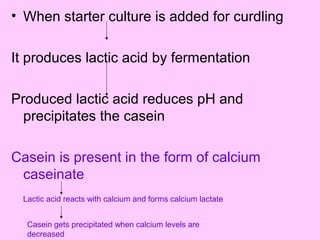
• When starter culture is added for curdling
It produces lactic acid by fermentation
Produced lactic acid reduces pH and
precipitates the casein
Casein is present in the form of calcium
caseinate
Lactic acid reacts with calcium and forms calcium lactate
Casein gets precipitated when calcium levels are
decreased
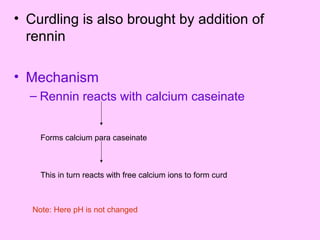
• Curdling is also brought by addition of
rennin
• Mechanism
– Rennin reacts with calcium caseinate
Forms calcium para caseinate
This in turn reacts with free calcium ions to form curd
Note: Here pH is not changed
Draining of curd
• The straw colored liquid called whey is
produced during curdling of milk
• It is separated from milk by
• Applying pressure
• With out applying pressure
Application of pressure depends on the type of
cheese
Eg: If it is soft cheese , pressure is not applied for
removal of whey but, in case of hard cheese
pressure is applied for removal of whey
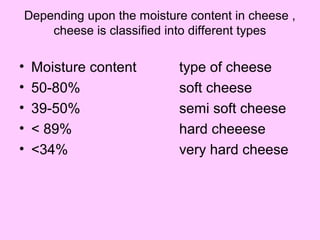
Depending upon the moisture content in cheese ,
cheese is classified into different types
• Moisture content type of cheese
• 50-80% soft cheese
• 39-50% semi soft cheese
• < 89% hard cheeese
• <34% very hard cheese
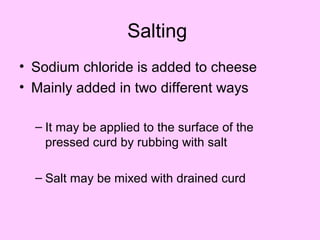
Salting
• Sodium chloride is added to cheese
• Mainly added in two different ways
– It may be applied to the surface of the
pressed curd by rubbing with salt
– Salt may be mixed with drained curd
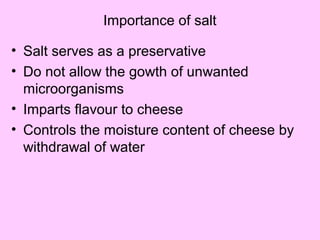
Importance of salt
• Salt serves as a preservative
• Do not allow the gowth of unwanted
microorganisms
• Imparts flavour to cheese
• Controls the moisture content of cheese by
withdrawal of water
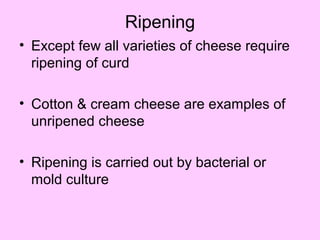
Ripening
• Except few all varieties of cheese require
ripening of curd
• Cotton & cream cheese are examples of
unripened cheese
• Ripening is carried out by bacterial or
mold culture
Different varieties of cheese
• Roquefort cheese
• Camembert cheese
• Swiss cheese
• Cheddar cheese
• Limberger cheese
Roquefort cheese
• Originated in southern France
• Made from sheep milk originally
• Now a days made of cows milk
• Starter culture used is Penicillium
roqueforti
Procedure
• Curd is inoculated with P.roqueforti
• After inoculation, the inoculated curd is placed in ripening
room
• The temperature and humidity are carefully controlled
• Incubated until fungal growth is maximum
• Inoculated curd is then placed at lower temperature to
inhibit fungal growth
• NOTE: holes should be made in the curd to provide
means of aeration deep in the curd
Principle of cheese making
• Settling the milk (add starter and coagulam to
prewarmed milk)
• Cut the coagulam
• Allow to cook the cut coagulam
• Remove whey from curd
• Allow the curd particles to knit
• Salting
• Pressing
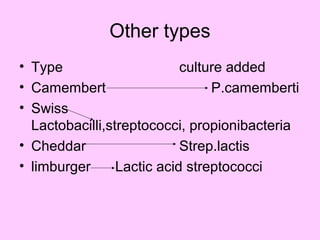
Other types
• Type culture added
• Camembert P.camemberti
• Swiss
Lactobacilli,streptococci, propionibacteria
• Cheddar Strep.lactis
• limburger Lactic acid streptococci
THANK YOU
Thank you

Cheese production

  • 1.
    Cheese production presented by Bangarukarthik Dept.of Microbiology
  • 2.
    Definition • Cheese canbe defined as a consolidated curd of milk solids in which milk fat is entrapped by coagulated casein • Several hundered varieties of cheese can be manufactured by particular combination of salt, temperature, pH and culture used
  • 3.
    Basic steps incheese production • Curdling of milk • Draining the curd to remove moisture • Salting • ripening
  • 4.
    Curdling of milk •Curdling can be done either by adding starter culture or enzyme renin to milk • Organisms used as starter • Streptococcus cremoris • Streptococcus lactis • Streptococcus thermophilus • Lactobacillus lactis • Lactobacillus bulgaricus
  • 5.
    What happens duringcurdling? • During curdling reaction casein gets coagulated
  • 6.
    Mechanism of caseincoagulation • The initial pH of the milk is about 6.8, at this pH casein do not undergo coagulation • Casein coagulates when pH reduces to 4.6/4.7
  • 7.
    • When starterculture is added for curdling It produces lactic acid by fermentation Produced lactic acid reduces pH and precipitates the casein Casein is present in the form of calcium caseinate Lactic acid reacts with calcium and forms calcium lactate Casein gets precipitated when calcium levels are decreased
  • 8.
    • Curdling isalso brought by addition of rennin • Mechanism – Rennin reacts with calcium caseinate Forms calcium para caseinate This in turn reacts with free calcium ions to form curd Note: Here pH is not changed
  • 9.
    Draining of curd •The straw colored liquid called whey is produced during curdling of milk • It is separated from milk by • Applying pressure • With out applying pressure Application of pressure depends on the type of cheese Eg: If it is soft cheese , pressure is not applied for removal of whey but, in case of hard cheese pressure is applied for removal of whey
  • 10.
    Depending upon themoisture content in cheese , cheese is classified into different types • Moisture content type of cheese • 50-80% soft cheese • 39-50% semi soft cheese • < 89% hard cheeese • <34% very hard cheese
  • 11.
    Salting • Sodium chlorideis added to cheese • Mainly added in two different ways – It may be applied to the surface of the pressed curd by rubbing with salt – Salt may be mixed with drained curd
  • 12.
    Importance of salt •Salt serves as a preservative • Do not allow the gowth of unwanted microorganisms • Imparts flavour to cheese • Controls the moisture content of cheese by withdrawal of water
  • 13.
    Ripening • Except fewall varieties of cheese require ripening of curd • Cotton & cream cheese are examples of unripened cheese • Ripening is carried out by bacterial or mold culture
  • 14.
    Different varieties ofcheese • Roquefort cheese • Camembert cheese • Swiss cheese • Cheddar cheese • Limberger cheese
  • 15.
    Roquefort cheese • Originatedin southern France • Made from sheep milk originally • Now a days made of cows milk • Starter culture used is Penicillium roqueforti
  • 16.
    Procedure • Curd isinoculated with P.roqueforti • After inoculation, the inoculated curd is placed in ripening room • The temperature and humidity are carefully controlled • Incubated until fungal growth is maximum • Inoculated curd is then placed at lower temperature to inhibit fungal growth • NOTE: holes should be made in the curd to provide means of aeration deep in the curd
  • 17.
    Principle of cheesemaking • Settling the milk (add starter and coagulam to prewarmed milk) • Cut the coagulam • Allow to cook the cut coagulam • Remove whey from curd • Allow the curd particles to knit • Salting • Pressing
  • 18.
    Other types • Typeculture added • Camembert P.camemberti • Swiss Lactobacilli,streptococci, propionibacteria • Cheddar Strep.lactis • limburger Lactic acid streptococci
  • 19.