A
SEMINAR
ON
F L A G E L LA & M O T I L I T Y
G.D.RUNGTA COLLEGE OF SCIENCE & TECHENOLOGY, KOHKA
BHILAI 1
BY:-
Dr. Arunima Karkun
Asst. Professor
 INTRODUCTION
 DEFENITION
 CHEMICAL COMPOSITION
 STRUCTURE
 TYPES
 FLAGELLA- SYNTHESIS
 IMPORTANCE
 FUNCTION
 REFERENCES
S
Y
N
O
P
S
I
S
FLAGELLA & MOTILITY
FLAGELLA & MOTILITY
FIG1- FLAGELLA & FIMBRIAE1
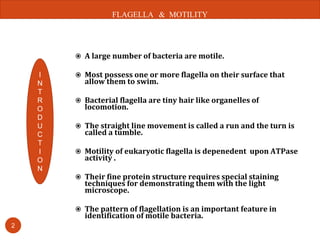
 A large number of bacteria are motile.
 Most possess one or more flagella on their surface that
allow them to swim.
 Bacterial flagella are tiny hair like organelles of
locomotion.
 The straight line movement is called a run and the turn is
called a tumble.
 Motility of eukaryotic flagella is depenedent upon ATPase
activity .
 Their fine protein structure requires special staining
techniques for demonstrating them with the light
microscope.
 The pattern of flagellation is an important feature in
identification of motile bacteria.
I
N
T
R
O
D
U
C
T
I
O
N
FLAGELLA & MOTILITY
2
D
E
F
E
N
I
N
T
I
O
N
FLAGELLA & MOTILITY
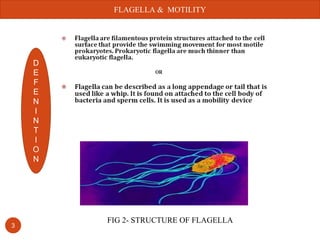
FIG 2- STRUCTURE OF FLAGELLA
3
 Protein-70-81%
 Lipid-13-23%
 Carbohydrate-1-6%
C
H
E
M
I
C
A
L
C
O
M
P
O
S
I
T
I
O
N
FLAGELLA & MOTILITY
4
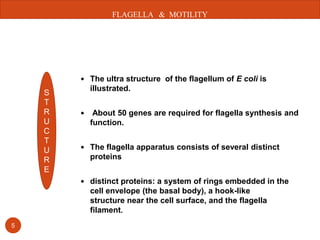
 The ultra structure of the flagellum of E coli is
illustrated.
 About 50 genes are required for flagella synthesis and
function.
 The flagella apparatus consists of several distinct
proteins
 distinct proteins: a system of rings embedded in the
cell envelope (the basal body), a hook-like
structure near the cell surface, and the flagella
filament.
S
T
R
U
C
T
U
R
E
FLAGELLA & MOTILITY
5
 The innermost rings, the M and S rings, located in the plasma
membrane, comprise the motor apparatus.
 The outermost rings, the P and L rings, located in the
periplasme and the outer membrane respectively, function as
bushings to support the rod.
 where it is joined to the hook of the filament on the cell
surface. As the M ring turns, powered by an influx of protons,
the rotary motion is transferred to the filament which turns to
propel the bacterium
S
T
R
U
C
T
U
R
E
FLAGELLA & MOTILITY
6
 Transmission electron microscope studies have
shown that the bacterial flagellum is composed of
three parts:
 The longest & most obvious portion is the flagellar
filament,which extends from the cell surface to the
tip.
 A basal body is embedded in the cell.
 A short curved segment, the flagellar hook, links
the filament to its basal body & acts as flexible
coupling.
 The filament hollow rigid cylinder constructed of
sub unit of the protein flagellar which ranges in
molecular weight from 30,000-60,000 daltons
FLAGELLA & MOTILITY
S
T
R
U
C
T
U
R
E
7
The innermost rings, the M and S rings, located in the
plasma membrane, comprise the motor apparatus.
The outermost rings, the P and L rings, located in the
periplasm and the outer membrane respectively,
function as bushings to support the rod.
where it is joined to the hook of the filament on the cell
surface. As the M ring turns, powered by an influx of
protons, the rotary motion is transferred to the filament
which turns to propel the bacterium
FLAGELLA & MOTILITY
FIG 3– The UltraStructure Of Bacterial Flagella
8
FLAGELLA & MOTILITY
FIG4- MECHANISM OF FLAGELLAR MOVEMENT9
 MONOTRICHOUS
Bacteria have one flagellum if it is located at & end
it is said to be
a polar flagellum .
Ex –pseudomonas v,cholerae
 AMPHITRICHOUS
Bacteria have a single flagellum at each pole .
Ex –organism in clusture,lactobaccilus.
 LOPHOTRICHOUS
Bacteria have a cluster of flagella at one or both
ends
Ex-spirillum,
 PERITRICHOUS
Flagella are spread fairly evenly over the whole
surface of
Peritrichous bacteria.
. Ex proteins vulgaris
FLAGELLA & MOTILITY
T
Y
P
E
S
10
 The synthesis of bacterial flagella is a complex
process involving at least 20-30 gens.
 Besides the gene for flagellin, 10 or more genes
code for hook & basal body proteins, other genes
are concerned with the control of flagella
construction or function.
 When flagella are removed the regeneration of the
flagellar filament can then be studied.
 Transport of many flagellar components is carried
out by an apparatus in the basal body that is a
specialized type III protein secretion system.
FLAGELLA & MOTILITY
F
L
A
G
E
L
L
A
R
-
S
Y
N
T
H
E
S
11
 Filament synthesis is an excellent example
of self-assembly.
 Many structures form spontaneously
through the association of there component
parts without the aid of any special enzymes
or other factors.
 The information required for filament
construction is present in the structure of
the flagellin sub unit it self.
F
L
A
G
E
L
L
A
R
-
S
Y
N
T
H
E
S
FLAGELLA & MOTILITY
12
You should be able to differentiate true motility from
Brownian motility
Brownian movement is usually caused by the activity of
water molecules. (characterized by back and forth
movement)
True motility (the bacterial cells runs and tumble.)
I
M
P
O
R
T
E
N
T
FLAGELLA & MOTILITY
14
Locomotion
 Cilia Or Flagella Responsible For Locomotion In
Ciliate And In Ciliate And Flagella Protozoa
Ctenophores, some Annelida, And
Nemertea,rotifers,some Snails & The Ciliated
Larvae Of Annelid Mollusks & Echinodermata.
 In palamiciue the cilia cover the entire body
surface and the protozoan swims by the help of
its cilia.
 In the larva of annelida,mollusla and
echinodermata cilia are arranged in bands.
Feeding
Many sessile or sluggish animals are celery filter
feeders.
 example – the lancet amphioxus the ascidian
rotifers & the fresh water mussel.
F
U
N
C
T
I
O
N
FLAGELLA & MOTILITY
15
FLAGELLA & MOTILITY
F
U
N
C
T
I
O
N
Respiration
water cunrents created by cillia facilitate
respiration
The continuous movement of water helps
exchanges of gases
Circulation
The animals lacking a true blood –vascular
system
eg- some annelids like tomopteris.
16
C.B. POWER CELL BIOLOGY 3rd Edition
PRESCOTT JOHN HARLEY 5th Edition
&
DONALD KLEIN
GERALD KARP CELL & MOLECULAR 5th Edition
BIOLOGY
R
E
F
R
E
N
E
S
S
FLAGELLA & MOTILITY
17
THANK
YOU
18

Flagella

  • 1.
    A SEMINAR ON F L AG E L LA & M O T I L I T Y G.D.RUNGTA COLLEGE OF SCIENCE & TECHENOLOGY, KOHKA BHILAI 1 BY:- Dr. Arunima Karkun Asst. Professor
  • 2.
     INTRODUCTION  DEFENITION CHEMICAL COMPOSITION  STRUCTURE  TYPES  FLAGELLA- SYNTHESIS  IMPORTANCE  FUNCTION  REFERENCES S Y N O P S I S FLAGELLA & MOTILITY
  • 3.
    FLAGELLA & MOTILITY FIG1-FLAGELLA & FIMBRIAE1
  • 4.
     A largenumber of bacteria are motile.  Most possess one or more flagella on their surface that allow them to swim.  Bacterial flagella are tiny hair like organelles of locomotion.  The straight line movement is called a run and the turn is called a tumble.  Motility of eukaryotic flagella is depenedent upon ATPase activity .  Their fine protein structure requires special staining techniques for demonstrating them with the light microscope.  The pattern of flagellation is an important feature in identification of motile bacteria. I N T R O D U C T I O N FLAGELLA & MOTILITY 2
  • 5.
  • 6.
     Protein-70-81%  Lipid-13-23% Carbohydrate-1-6% C H E M I C A L C O M P O S I T I O N FLAGELLA & MOTILITY 4
  • 7.
     The ultrastructure of the flagellum of E coli is illustrated.  About 50 genes are required for flagella synthesis and function.  The flagella apparatus consists of several distinct proteins  distinct proteins: a system of rings embedded in the cell envelope (the basal body), a hook-like structure near the cell surface, and the flagella filament. S T R U C T U R E FLAGELLA & MOTILITY 5
  • 8.
     The innermostrings, the M and S rings, located in the plasma membrane, comprise the motor apparatus.  The outermost rings, the P and L rings, located in the periplasme and the outer membrane respectively, function as bushings to support the rod.  where it is joined to the hook of the filament on the cell surface. As the M ring turns, powered by an influx of protons, the rotary motion is transferred to the filament which turns to propel the bacterium S T R U C T U R E FLAGELLA & MOTILITY 6
  • 9.
     Transmission electronmicroscope studies have shown that the bacterial flagellum is composed of three parts:  The longest & most obvious portion is the flagellar filament,which extends from the cell surface to the tip.  A basal body is embedded in the cell.  A short curved segment, the flagellar hook, links the filament to its basal body & acts as flexible coupling.  The filament hollow rigid cylinder constructed of sub unit of the protein flagellar which ranges in molecular weight from 30,000-60,000 daltons FLAGELLA & MOTILITY S T R U C T U R E 7
  • 10.
    The innermost rings,the M and S rings, located in the plasma membrane, comprise the motor apparatus. The outermost rings, the P and L rings, located in the periplasm and the outer membrane respectively, function as bushings to support the rod. where it is joined to the hook of the filament on the cell surface. As the M ring turns, powered by an influx of protons, the rotary motion is transferred to the filament which turns to propel the bacterium FLAGELLA & MOTILITY FIG 3– The UltraStructure Of Bacterial Flagella 8
  • 11.
    FLAGELLA & MOTILITY FIG4-MECHANISM OF FLAGELLAR MOVEMENT9
  • 12.
     MONOTRICHOUS Bacteria haveone flagellum if it is located at & end it is said to be a polar flagellum . Ex –pseudomonas v,cholerae  AMPHITRICHOUS Bacteria have a single flagellum at each pole . Ex –organism in clusture,lactobaccilus.  LOPHOTRICHOUS Bacteria have a cluster of flagella at one or both ends Ex-spirillum,  PERITRICHOUS Flagella are spread fairly evenly over the whole surface of Peritrichous bacteria. . Ex proteins vulgaris FLAGELLA & MOTILITY T Y P E S 10
  • 13.
     The synthesisof bacterial flagella is a complex process involving at least 20-30 gens.  Besides the gene for flagellin, 10 or more genes code for hook & basal body proteins, other genes are concerned with the control of flagella construction or function.  When flagella are removed the regeneration of the flagellar filament can then be studied.  Transport of many flagellar components is carried out by an apparatus in the basal body that is a specialized type III protein secretion system. FLAGELLA & MOTILITY F L A G E L L A R - S Y N T H E S 11
  • 14.
     Filament synthesisis an excellent example of self-assembly.  Many structures form spontaneously through the association of there component parts without the aid of any special enzymes or other factors.  The information required for filament construction is present in the structure of the flagellin sub unit it self. F L A G E L L A R - S Y N T H E S FLAGELLA & MOTILITY 12
  • 15.
    You should beable to differentiate true motility from Brownian motility Brownian movement is usually caused by the activity of water molecules. (characterized by back and forth movement) True motility (the bacterial cells runs and tumble.) I M P O R T E N T FLAGELLA & MOTILITY 14
  • 16.
    Locomotion  Cilia OrFlagella Responsible For Locomotion In Ciliate And In Ciliate And Flagella Protozoa Ctenophores, some Annelida, And Nemertea,rotifers,some Snails & The Ciliated Larvae Of Annelid Mollusks & Echinodermata.  In palamiciue the cilia cover the entire body surface and the protozoan swims by the help of its cilia.  In the larva of annelida,mollusla and echinodermata cilia are arranged in bands. Feeding Many sessile or sluggish animals are celery filter feeders.  example – the lancet amphioxus the ascidian rotifers & the fresh water mussel. F U N C T I O N FLAGELLA & MOTILITY 15
  • 17.
    FLAGELLA & MOTILITY F U N C T I O N Respiration watercunrents created by cillia facilitate respiration The continuous movement of water helps exchanges of gases Circulation The animals lacking a true blood –vascular system eg- some annelids like tomopteris. 16
  • 18.
    C.B. POWER CELLBIOLOGY 3rd Edition PRESCOTT JOHN HARLEY 5th Edition & DONALD KLEIN GERALD KARP CELL & MOLECULAR 5th Edition BIOLOGY R E F R E N E S S FLAGELLA & MOTILITY 17
  • 19.