Polysaccharides – Xanthan Gum
M.Sc. Biotechnology Part II (Sem III)
Paper III - Unit III
Mumbai University
By: Mayur D. Chauhan
1
Polysaccharides
• They are long chains of polymeric
carbohydrates.
• Monosaccharides are linked together by
Glycosidic bonds.
• Homogenous Polysaccharide & Heterogenous
Polysaccharide.
• Properties depend upon the monosaccharide
units.
2
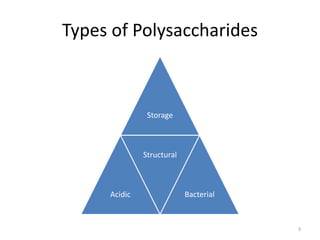
Types of Polysaccharides
Storage
Acidic
Structural
Bacterial
3
1. Storage Polysaccharides
• Starch: Starch is glucose polymer in plants in
which glucopyranose units are bonded by alpha-
linkages. It is made up of a mixture of amylose
(15–20%) and amylopectin (80–85%)
• Glycogen: Glycogen is the analogue of starch and
is sometimes referred to as animal starch, having
a similar structure to amylopectin but more
extensively branched and compact than starch.
Glycogen is a polymer of α(1→4) glycosidic bonds
linked, with α(1→6) linked branches
4
2. Structural Polysaccharides
• Arabinoxylans: They are found in both the
primary and secondary cell walls of plants and
are the copolymers of two pentose sugars:
arabinose and xylose.
• Cellulose: Cell wall component of plants.
Cellulose is a polymer made with repeated
glucose units bonded together by beta-
linkages.
5
• Chitin: Chitin is one of many naturally
occurring polymers and it forms a structural
component of many animals, such as
exoskeletons. It is closely related to cellulose
in that it is a long unbranched chain of glucose
derivatives.
• Pectins: Pectins are a family of complex
polysaccharides that contain 1,4-linked α-D-
galactosyluronic acid residues. They are
present in most primary cell walls and in the
non-woody parts of terrestrial plants.
6
3. Acidic Polysaccharides
• Polysaccharides that contain carboxyl groups,
phosphate groups or sulfuric ester groups.
7
4. Bacterial Capsular Polysaccharides
• Pathogenic bacteria commonly produce a thick, mucous-
like, layer of polysaccharide. This "capsule" cloaks antigenic
proteins on the bacterial surface that would otherwise
provoke an immune response and thereby lead to the
destruction of the bacteria.
• Mixtures of capsular polysaccharides, either conjugated or
native are used as vaccines.
• Bacteria and many other microbes, including fungi and
algae, often secrete polysaccharides to help them adhere
to surfaces and to prevent them from drying out.
• Examples: X. campestris, X. phaseoli, X. malvacearum, X.
carotae, X. juglandis etc.
8
Xanthan Gum
• Polysaccharide secreted by the bacterium
Xanthomonas campestris.
• Xanthomonas campestris was originally
isolated from the Rutabaga plant.
• It produces viscid and gummy colonies on agar
media.
9
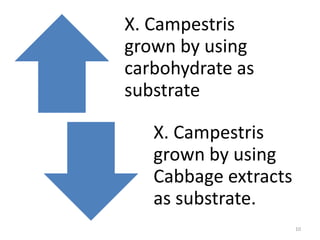
X. Campestris
grown by using
carbohydrate as
substrate
X. Campestris
grown by using
Cabbage extracts
as substrate.
10
• Commercially produced Xanthan Gum was
identical to naturally produced Xanthan Gum.
• Essential requirements during the process of
Fermentation:
1. Glucose, Sucrose, Starch, Corn sugar, Acid
whey (Cheese production) as Carbon Sources.
2. Ammonium chloride, Magnesium sulphate
and certain trace elements were required for
optimum growth.
3. pH should be maintained
11
• During fermentation, the pH of the medium
decreases due to the formation of metabolic
acids.
• Xanthan gum also has acidic functions but if
the pH reaches a critical point like 5.0, the
gum production decreases drastically.
• A nearly neutral pH allows the gum synthesis
to continue until all the carbohydrate
substrate gets utilized and the fermentation is
complete.
12
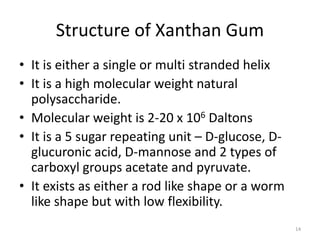
• Optimum temperature should be around 280 C
• Also at 1-5% glucose concentration has been
found to provide best xanthan gum yields.
• Aeration and Agitation should be proper
13
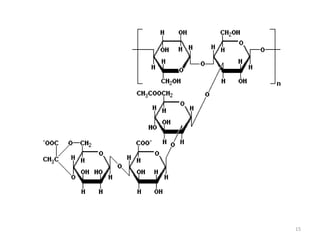
Structure of Xanthan Gum
• It is either a single or multi stranded helix
• It is a high molecular weight natural
polysaccharide.
• Molecular weight is 2-20 x 106 Daltons
• It is a 5 sugar repeating unit – D-glucose, D-
glucuronic acid, D-mannose and 2 types of
carboxyl groups acetate and pyruvate.
• It exists as either a rod like shape or a worm
like shape but with low flexibility.
14
15
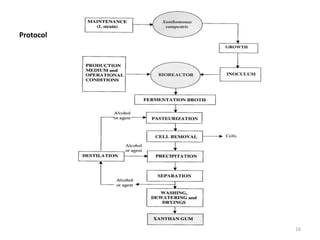
Protocol
16
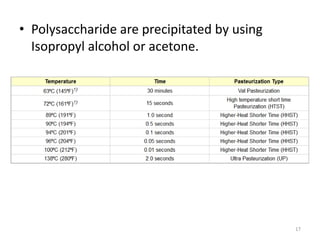
• Polysaccharide are precipitated by using
Isopropyl alcohol or acetone.
17
Properties of Xanthan Gum
• 1. Rheological Properties: Most important
property of Xanthan gum is to control the
rheological properties of fluids.
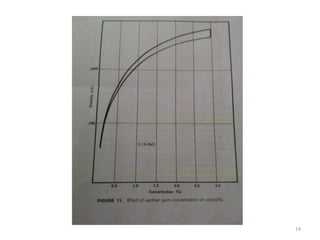
• Xanthan gum gets dissolved in hot or cold
water upon stirring to form a high viscosity
even at low gum concentrations.
18
19
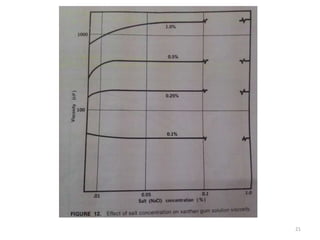
• At low concentrations of Xanthan Gum (0.1%),
addition of NaCl causes a slight reduction in
viscosity.
• At concentrations of Xanthan gum of 0.25% or
higher, addition of NaCl causes an increase in
viscosity.
• So the higher the Xanthan gum concentration,
the higher the concentration of salt required
to achieve maximum viscosity.
20
21
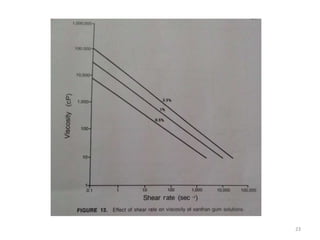
• The Viscosity of Xanthan gum in aqueous
solutions is Pseudoplastic.
• Pseudoplastic means reduction of viscosity
when shear forces are applied.
22
23
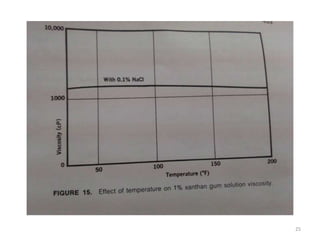
2. Effect of Heat on properties of
Xanthan Gum
• Normal solutions show a decrease in the viscosity
when they are heated.
• Xanthan gum solutions show an increase in the
viscosity when they are heated, after an initial
decrease.
• Reason is transformation of a double helical
structure to a random coil which leads to increase
in the volume of the molecule.
• Xanthan gum solutions have excellent thermal
stability.
24
25
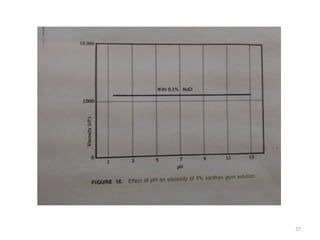
3. Effect of pH
• The viscosity of Xanthan gum solutions in the
presence of a low level of salt, 0.1% NaCl, is
independent of pH over the pH range 1.5-13
26
27
Compatibility of Xanthan gum with
other solutions
• Dissolves directly in many acid solutions like
5% sulfuric acid, 5% Nitric acid, 5 % acetic
acid, 5% acetic acid, 10% Hydrochloric acid,
25% phosphoric acid.
• Solutions remains thermally stable at ambient
temperature for several months.
• Also compatible with methanol, ethanol,
isopropanol and acetone.
28
• Enzymes like protease, cellulase,
hemicellulase, pectinase and amylase will not
degrade xanthan gum in solution.
• It can be degraded by strong oxidizing agents
like peroxides, persulfates and hypochlorites.
This degradation is elevated at high
temperatures.
29
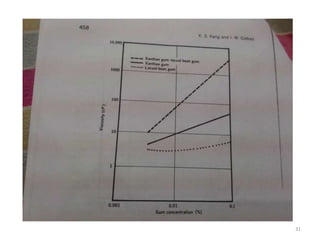
Interaction with Galactomannans
• Xanthan gum can also react with Guar Gum
and Locust bean gum.
• The viscosity of combination (Xanthan + Guar)
is greater than would be expected from the
individual viscosities.
• In the case of locust bean gum, the synergistic
viscosity increases at low gum concentration
but as the concentration of the gum is
increased, a heat reversible gel is formed.
30
31
32

Polysaccharides Xanthan gum & other examples

  • 1.
    Polysaccharides – XanthanGum M.Sc. Biotechnology Part II (Sem III) Paper III - Unit III Mumbai University By: Mayur D. Chauhan 1
  • 2.
    Polysaccharides • They arelong chains of polymeric carbohydrates. • Monosaccharides are linked together by Glycosidic bonds. • Homogenous Polysaccharide & Heterogenous Polysaccharide. • Properties depend upon the monosaccharide units. 2
  • 3.
  • 4.
    1. Storage Polysaccharides •Starch: Starch is glucose polymer in plants in which glucopyranose units are bonded by alpha- linkages. It is made up of a mixture of amylose (15–20%) and amylopectin (80–85%) • Glycogen: Glycogen is the analogue of starch and is sometimes referred to as animal starch, having a similar structure to amylopectin but more extensively branched and compact than starch. Glycogen is a polymer of α(1→4) glycosidic bonds linked, with α(1→6) linked branches 4
  • 5.
    2. Structural Polysaccharides •Arabinoxylans: They are found in both the primary and secondary cell walls of plants and are the copolymers of two pentose sugars: arabinose and xylose. • Cellulose: Cell wall component of plants. Cellulose is a polymer made with repeated glucose units bonded together by beta- linkages. 5
  • 6.
    • Chitin: Chitinis one of many naturally occurring polymers and it forms a structural component of many animals, such as exoskeletons. It is closely related to cellulose in that it is a long unbranched chain of glucose derivatives. • Pectins: Pectins are a family of complex polysaccharides that contain 1,4-linked α-D- galactosyluronic acid residues. They are present in most primary cell walls and in the non-woody parts of terrestrial plants. 6
  • 7.
    3. Acidic Polysaccharides •Polysaccharides that contain carboxyl groups, phosphate groups or sulfuric ester groups. 7
  • 8.
    4. Bacterial CapsularPolysaccharides • Pathogenic bacteria commonly produce a thick, mucous- like, layer of polysaccharide. This "capsule" cloaks antigenic proteins on the bacterial surface that would otherwise provoke an immune response and thereby lead to the destruction of the bacteria. • Mixtures of capsular polysaccharides, either conjugated or native are used as vaccines. • Bacteria and many other microbes, including fungi and algae, often secrete polysaccharides to help them adhere to surfaces and to prevent them from drying out. • Examples: X. campestris, X. phaseoli, X. malvacearum, X. carotae, X. juglandis etc. 8
  • 9.
    Xanthan Gum • Polysaccharidesecreted by the bacterium Xanthomonas campestris. • Xanthomonas campestris was originally isolated from the Rutabaga plant. • It produces viscid and gummy colonies on agar media. 9
  • 10.
    X. Campestris grown byusing carbohydrate as substrate X. Campestris grown by using Cabbage extracts as substrate. 10
  • 11.
    • Commercially producedXanthan Gum was identical to naturally produced Xanthan Gum. • Essential requirements during the process of Fermentation: 1. Glucose, Sucrose, Starch, Corn sugar, Acid whey (Cheese production) as Carbon Sources. 2. Ammonium chloride, Magnesium sulphate and certain trace elements were required for optimum growth. 3. pH should be maintained 11
  • 12.
    • During fermentation,the pH of the medium decreases due to the formation of metabolic acids. • Xanthan gum also has acidic functions but if the pH reaches a critical point like 5.0, the gum production decreases drastically. • A nearly neutral pH allows the gum synthesis to continue until all the carbohydrate substrate gets utilized and the fermentation is complete. 12
  • 13.
    • Optimum temperatureshould be around 280 C • Also at 1-5% glucose concentration has been found to provide best xanthan gum yields. • Aeration and Agitation should be proper 13
  • 14.
    Structure of XanthanGum • It is either a single or multi stranded helix • It is a high molecular weight natural polysaccharide. • Molecular weight is 2-20 x 106 Daltons • It is a 5 sugar repeating unit – D-glucose, D- glucuronic acid, D-mannose and 2 types of carboxyl groups acetate and pyruvate. • It exists as either a rod like shape or a worm like shape but with low flexibility. 14
  • 15.
  • 16.
  • 17.
    • Polysaccharide areprecipitated by using Isopropyl alcohol or acetone. 17
  • 18.
    Properties of XanthanGum • 1. Rheological Properties: Most important property of Xanthan gum is to control the rheological properties of fluids. • Xanthan gum gets dissolved in hot or cold water upon stirring to form a high viscosity even at low gum concentrations. 18
  • 19.
  • 20.
    • At lowconcentrations of Xanthan Gum (0.1%), addition of NaCl causes a slight reduction in viscosity. • At concentrations of Xanthan gum of 0.25% or higher, addition of NaCl causes an increase in viscosity. • So the higher the Xanthan gum concentration, the higher the concentration of salt required to achieve maximum viscosity. 20
  • 21.
  • 22.
    • The Viscosityof Xanthan gum in aqueous solutions is Pseudoplastic. • Pseudoplastic means reduction of viscosity when shear forces are applied. 22
  • 23.
  • 24.
    2. Effect ofHeat on properties of Xanthan Gum • Normal solutions show a decrease in the viscosity when they are heated. • Xanthan gum solutions show an increase in the viscosity when they are heated, after an initial decrease. • Reason is transformation of a double helical structure to a random coil which leads to increase in the volume of the molecule. • Xanthan gum solutions have excellent thermal stability. 24
  • 25.
  • 26.
    3. Effect ofpH • The viscosity of Xanthan gum solutions in the presence of a low level of salt, 0.1% NaCl, is independent of pH over the pH range 1.5-13 26
  • 27.
  • 28.
    Compatibility of Xanthangum with other solutions • Dissolves directly in many acid solutions like 5% sulfuric acid, 5% Nitric acid, 5 % acetic acid, 5% acetic acid, 10% Hydrochloric acid, 25% phosphoric acid. • Solutions remains thermally stable at ambient temperature for several months. • Also compatible with methanol, ethanol, isopropanol and acetone. 28
  • 29.
    • Enzymes likeprotease, cellulase, hemicellulase, pectinase and amylase will not degrade xanthan gum in solution. • It can be degraded by strong oxidizing agents like peroxides, persulfates and hypochlorites. This degradation is elevated at high temperatures. 29
  • 30.
    Interaction with Galactomannans •Xanthan gum can also react with Guar Gum and Locust bean gum. • The viscosity of combination (Xanthan + Guar) is greater than would be expected from the individual viscosities. • In the case of locust bean gum, the synergistic viscosity increases at low gum concentration but as the concentration of the gum is increased, a heat reversible gel is formed. 30
  • 31.
  • 32.