CARBOHYDRATES:
STRUCTURE AND
FUNCTION
By
Dr. Sumbul Fatma
Objectives
To understand:
 The structure of carbohydrates of
physiological significance
 The main role of carbohydrates in
providing and storing of energy
 The structure and function of
glycosaminoglycans
OVERVIEW
Carbohydrates:
The most abundant organic molecules in nature
The empiric formula is (CH2O)n, “hydrates of
carbon”
Carbohydrates:
provide important part of energy in diet
Act as the storage form of energy in the body
are structural component of cell membranes
OVERVIEW
 Many diseases associated with disorders
of carbohydrate metabolism including:
Diabetes mellitus
Galactosemia
Glycogen storage diseases
Lactose intolerance
CONT’D
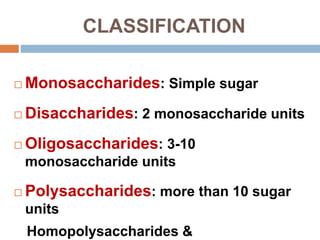
CLASSIFICATION
 Monosaccharides: Simple sugar
 Disaccharides: 2 monosaccharide units
 Oligosaccharides: 3-10
monosaccharide units
 Polysaccharides: more than 10 sugar
units
Homopolysaccharides &
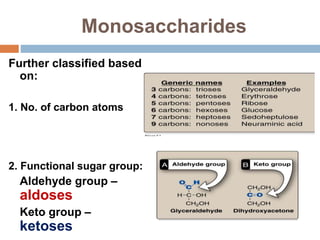
Monosaccharides
Further classified based
on:
1. No. of carbon atoms
2. Functional sugar group:
Aldehyde group –
aldoses
Keto group –
ketoses
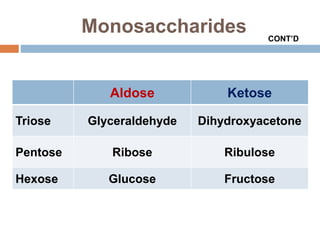
Monosaccharides
Aldose Ketose
Triose Glyceraldehyde Dihydroxyacetone
Pentose Ribose Ribulose
Hexose Glucose Fructose
CONT’D
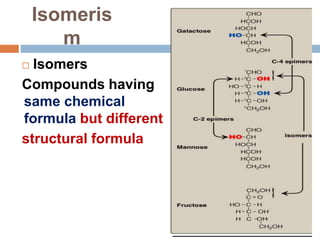
Isomeris
m
 Isomers
Compounds having
same chemical
formula but different
structural formula
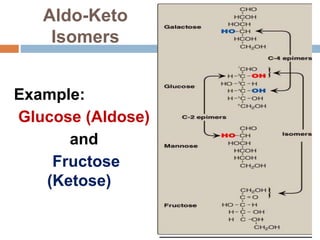
Aldo-Keto
Isomers
Example:
Glucose (Aldose)
and
Fructose
(Ketose)
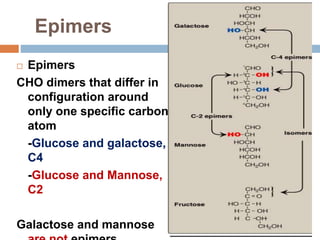
Epimers
 Epimers
CHO dimers that differ in
configuration around
only one specific carbon
atom
-Glucose and galactose,
C4
-Glucose and Mannose,
C2
Galactose and mannose
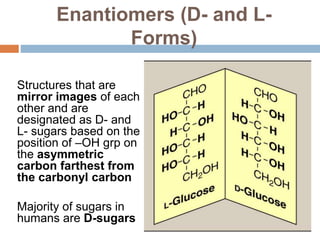
Structures that are
mirror images of each
other and are
designated as D- and
L- sugars based on the
position of –OH grp on
the asymmetric
carbon farthest from
the carbonyl carbon
Majority of sugars in
humans are D-sugars
Enantiomers (D- and L-
Forms)
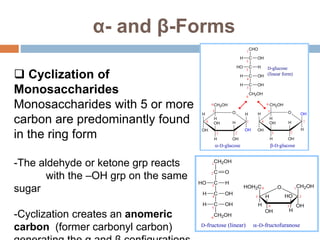
α- and β-Forms
CH2OH
C O
C H
HO
C OH
H
C OH
H
CH2OH
HOH2C
OH
CH2OH
H
OH H
H HO
O
1
6
5
4
3
2
6
5
4 3
2
1
D-fructose (linear) -D-fructofuranose
H O
OH
H
OH
H
OH
CH2OH
H
OH
H H O
OH
H
OH
H
OH
CH2OH
H
H
OH
-D-glucose -D-glucose
2
3
4
5
6
1 1
6
5
4
3 2
H
CHO
C OH
C H
HO
C OH
H
C OH
H
CH2OH
1
5
2
3
4
6
D-glucose
(linear form)
 Cyclization of
Monosaccharides
Monosaccharides with 5 or more
carbon are predominantly found
in the ring form
-The aldehyde or ketone grp reacts
with the –OH grp on the same
sugar
-Cyclization creates an anomeric
carbon (former carbonyl carbon)
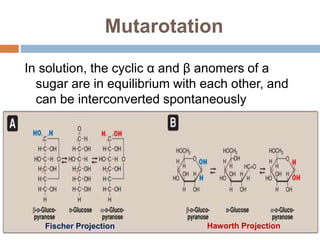
Mutarotation
In solution, the cyclic α and β anomers of a
sugar are in equilibrium with each other, and
can be interconverted spontaneously
Fischer Projection
Haworth Projection
Fischer Projection
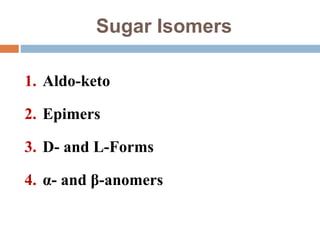
Sugar Isomers
1. Aldo-keto
2. Epimers
3. D- and L-Forms
4. α- and β-anomers
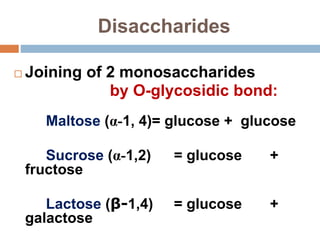
Disaccharides
 Joining of 2 monosaccharides
by O-glycosidic bond:
Maltose (α-1, 4)= glucose + glucose
Sucrose (α-1,2) = glucose +
fructose
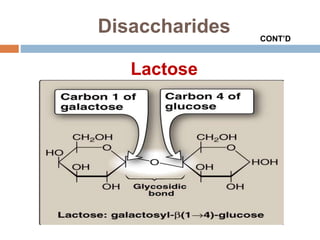
Lactose (β-1,4) = glucose +
galactose
Disaccharides
Lactose
CONT’D
Polysaccharides
 Homopolysaccharides:
Branched:
Glycogen and starch (α-glycosidic
polymer)
Unbranched:
Cellulose (β-glycosidic polymer)
 Heteropolysaccharides:
e.g., glycosaminoglycans (GAGs)
Reducing Sugars
 If the O on the anomeric C of a sugar is not
attached to any other structure (Free), that
sugar can act as a reducing agent
 Reducing sugars reduce chromogenic agents
like Benedict’s reagent or Fehling’s solution to
give a colored precipitate
 Urine is tested for the presence of reducing
sugars using these colorimetric tests
Reducing Sugars
 Examples:
Monosaccharides
Maltose and Lactose
Sucrose is non-reducing, Why?
CONT’D
Complex Carbohydrates
 Carbohydrates attached to non-
carbohydrate structures by glycosidic
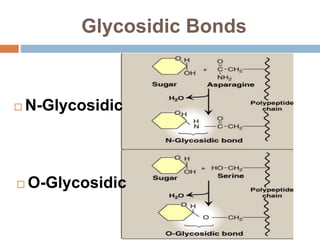
bonds (O- or N-type) e.g.,
1. Purine and pyrimidine bases in nucleic
acids
2. Bilirubin
3. Proteins in glycoproteins and
proteoglycans
Glycosidic Bonds
 N-Glycosidic
 O-Glycosidic
Glycosaminoglycans (GAGs)
 Glycosaminoglycans (GAGs) are large complexes
of negatively charged heteropolysaccharide
chains
 are associated with a small amount of protein,
forming proteoglycans, which consist of over 95
percent carbohydrate
 bind with large amounts of water, producing the
gel-like matrix that forms body's ground substance
 The viscous, lubricating properties of mucous
secretions also result from GAGs, which led to the
original naming of these compounds as
mucopolysaccharides
Glycosaminoglycans (GAGs)
 GAGs are linear polymers of repeating
disaccharide units
[acidic sugar-amino sugar]n
 The amino sugar (usually sulfated) is
either
D-glucosamine or D-
galactosamine
 The acidic sugar is either
D-glucuronic acid or L-iduronic
acid
 GAGs are strongly negatively-charged:
Resilience of GAGs
Relationship between glycosaminoglycan
structure and function
 Because of negative charges, the GAG chains
tend to be extended in solution and repel each
other and when brought together, they "slip" past
each other
This produces the "slippery" consistency of
mucous secretions and synovial fluid
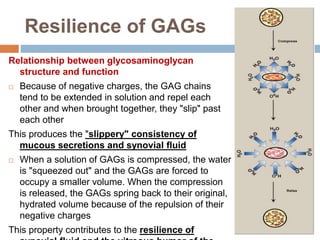
 When a solution of GAGs is compressed, the water
is "squeezed out" and the GAGs are forced to
occupy a smaller volume. When the compression
is released, the GAGs spring back to their original,
hydrated volume because of the repulsion of their
negative charges
This property contributes to the resilience of
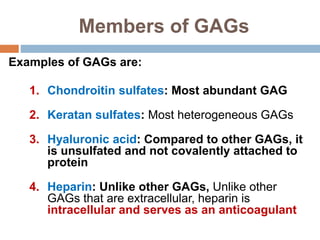
Examples of GAGs are:
1. Chondroitin sulfates: Most abundant GAG
2. Keratan sulfates: Most heterogeneous GAGs
3. Hyaluronic acid: Compared to other GAGs, it
is unsulfated and not covalently attached to
protein
4. Heparin: Unlike other GAGs, Unlike other
GAGs that are extracellular, heparin is
intracellular and serves as an anticoagulant
Members of GAGs
Take home Message
Structure and function of carbohydrates
 Mono-, Di-, and Poly-saccharides
 Sugar Isomers: Aldo-keto, epimers, D- and L-,
α- and β-anomers
 Complex carbohydrates:
e.g., Glycosaminoglycans and
proteoglycans
 Structure and function of GAGs
 Examples of GAGs: chondroitin sulfate, keratin
sulfate, hyaluronic acid and heparin
Reference
 Lippincott’s Illustrated reviews- Biochemistry,
6th Edition, pages- 83-86 and 157-159

Lecture 4-Structure and function of carbohydrates .ppt

  • 1.
  • 2.
    Objectives To understand:  Thestructure of carbohydrates of physiological significance  The main role of carbohydrates in providing and storing of energy  The structure and function of glycosaminoglycans
  • 3.
    OVERVIEW Carbohydrates: The most abundantorganic molecules in nature The empiric formula is (CH2O)n, “hydrates of carbon” Carbohydrates: provide important part of energy in diet Act as the storage form of energy in the body are structural component of cell membranes
  • 4.
    OVERVIEW  Many diseasesassociated with disorders of carbohydrate metabolism including: Diabetes mellitus Galactosemia Glycogen storage diseases Lactose intolerance CONT’D
  • 5.
    CLASSIFICATION  Monosaccharides: Simplesugar  Disaccharides: 2 monosaccharide units  Oligosaccharides: 3-10 monosaccharide units  Polysaccharides: more than 10 sugar units Homopolysaccharides &
  • 6.
    Monosaccharides Further classified based on: 1.No. of carbon atoms 2. Functional sugar group: Aldehyde group – aldoses Keto group – ketoses
  • 7.
    Monosaccharides Aldose Ketose Triose GlyceraldehydeDihydroxyacetone Pentose Ribose Ribulose Hexose Glucose Fructose CONT’D
  • 8.
    Isomeris m  Isomers Compounds having samechemical formula but different structural formula
  • 9.
  • 10.
    Epimers  Epimers CHO dimersthat differ in configuration around only one specific carbon atom -Glucose and galactose, C4 -Glucose and Mannose, C2 Galactose and mannose
  • 11.
    Structures that are mirrorimages of each other and are designated as D- and L- sugars based on the position of –OH grp on the asymmetric carbon farthest from the carbonyl carbon Majority of sugars in humans are D-sugars Enantiomers (D- and L- Forms)
  • 12.
    α- and β-Forms CH2OH CO C H HO C OH H C OH H CH2OH HOH2C OH CH2OH H OH H H HO O 1 6 5 4 3 2 6 5 4 3 2 1 D-fructose (linear) -D-fructofuranose H O OH H OH H OH CH2OH H OH H H O OH H OH H OH CH2OH H H OH -D-glucose -D-glucose 2 3 4 5 6 1 1 6 5 4 3 2 H CHO C OH C H HO C OH H C OH H CH2OH 1 5 2 3 4 6 D-glucose (linear form)  Cyclization of Monosaccharides Monosaccharides with 5 or more carbon are predominantly found in the ring form -The aldehyde or ketone grp reacts with the –OH grp on the same sugar -Cyclization creates an anomeric carbon (former carbonyl carbon)
  • 13.
    Mutarotation In solution, thecyclic α and β anomers of a sugar are in equilibrium with each other, and can be interconverted spontaneously Fischer Projection Haworth Projection Fischer Projection
  • 14.
    Sugar Isomers 1. Aldo-keto 2.Epimers 3. D- and L-Forms 4. α- and β-anomers
  • 15.
    Disaccharides  Joining of2 monosaccharides by O-glycosidic bond: Maltose (α-1, 4)= glucose + glucose Sucrose (α-1,2) = glucose + fructose Lactose (β-1,4) = glucose + galactose
  • 16.
  • 17.
    Polysaccharides  Homopolysaccharides: Branched: Glycogen andstarch (α-glycosidic polymer) Unbranched: Cellulose (β-glycosidic polymer)  Heteropolysaccharides: e.g., glycosaminoglycans (GAGs)
  • 18.
    Reducing Sugars  Ifthe O on the anomeric C of a sugar is not attached to any other structure (Free), that sugar can act as a reducing agent  Reducing sugars reduce chromogenic agents like Benedict’s reagent or Fehling’s solution to give a colored precipitate  Urine is tested for the presence of reducing sugars using these colorimetric tests
  • 19.
    Reducing Sugars  Examples: Monosaccharides Maltoseand Lactose Sucrose is non-reducing, Why? CONT’D
  • 20.
    Complex Carbohydrates  Carbohydratesattached to non- carbohydrate structures by glycosidic bonds (O- or N-type) e.g., 1. Purine and pyrimidine bases in nucleic acids 2. Bilirubin 3. Proteins in glycoproteins and proteoglycans
  • 21.
  • 22.
    Glycosaminoglycans (GAGs)  Glycosaminoglycans(GAGs) are large complexes of negatively charged heteropolysaccharide chains  are associated with a small amount of protein, forming proteoglycans, which consist of over 95 percent carbohydrate  bind with large amounts of water, producing the gel-like matrix that forms body's ground substance  The viscous, lubricating properties of mucous secretions also result from GAGs, which led to the original naming of these compounds as mucopolysaccharides
  • 23.
    Glycosaminoglycans (GAGs)  GAGsare linear polymers of repeating disaccharide units [acidic sugar-amino sugar]n  The amino sugar (usually sulfated) is either D-glucosamine or D- galactosamine  The acidic sugar is either D-glucuronic acid or L-iduronic acid  GAGs are strongly negatively-charged:
  • 24.
    Resilience of GAGs Relationshipbetween glycosaminoglycan structure and function  Because of negative charges, the GAG chains tend to be extended in solution and repel each other and when brought together, they "slip" past each other This produces the "slippery" consistency of mucous secretions and synovial fluid  When a solution of GAGs is compressed, the water is "squeezed out" and the GAGs are forced to occupy a smaller volume. When the compression is released, the GAGs spring back to their original, hydrated volume because of the repulsion of their negative charges This property contributes to the resilience of
  • 25.
    Examples of GAGsare: 1. Chondroitin sulfates: Most abundant GAG 2. Keratan sulfates: Most heterogeneous GAGs 3. Hyaluronic acid: Compared to other GAGs, it is unsulfated and not covalently attached to protein 4. Heparin: Unlike other GAGs, Unlike other GAGs that are extracellular, heparin is intracellular and serves as an anticoagulant Members of GAGs
  • 26.
    Take home Message Structureand function of carbohydrates  Mono-, Di-, and Poly-saccharides  Sugar Isomers: Aldo-keto, epimers, D- and L-, α- and β-anomers  Complex carbohydrates: e.g., Glycosaminoglycans and proteoglycans  Structure and function of GAGs  Examples of GAGs: chondroitin sulfate, keratin sulfate, hyaluronic acid and heparin
  • 27.
    Reference  Lippincott’s Illustratedreviews- Biochemistry, 6th Edition, pages- 83-86 and 157-159