Mrs.K.Sudha Rameshwari,
Assistant Professor, Department of PG Biochemistry,
V.V.Vanniaperumal college for women, Virudhunagar, Tamilnadu
Introduction
• Streptomycin is an antibiotic
• It was discovered by Schatz,Bugie and Waksman (1944) in
one of the soil isolates Streptomyces griseus
• Most of the industry used this parent strain for streptomycin
production today also.
• Mutation and selection employed to increase yields to the
present day levels.
• But,nowadays also Streptomycin is produced by streptomyces
griseus and only a few strains of this organism have the
ability to produce reasonable yields of the antibiotic
• It is active against gram Positive and Negative bacteria and
against the tuberculosis organism Mycobacterium tuberculi
Uses
 It has been used therapeutically in the treatment of
infections caused by organisms resistant to Penicillin
 It is also used in the treatment of plant diseases
caused by bacteria
 It is used in the treatment of tuberculosis caused by
Mycobacterium tuberculi.
Disadvantage
 In man, prolonged streptomycin treatment
at high dosage can produce neuro toxic
reactions
 particularly problems in balance
maintenance and partial hearing loss
 Chemical reduction of streptomycin to
dihydrostreptomycin decreases this
neurotoxicity.
 Some microorganisms gain resistance
relatively easily to streptomycin and
streptomycin therapy.
 So, it is carried out in conjuction with para
aminosalicyclic acid or isoniazid
(isonicotinic acid hydrazide) to decrease
this resistance build up in sensitive
microorganisms
Chemical structure
• Streptomycin and dihydrostreptomycin are basic
compounds
• They are usually prepared as salts
• Streptomycin is available as the hydrochloride
C21H39N2O12.3HCL as a crystalline hydrochlroide
double salt with calcium chloride or as the
phosphate or sulfate
• Dihydrostreptomycin as the hydrochloride or
sulfate
 Depending on the strain of this organism
being used or on the production of medium,
small amounts of mannosidostreptomycin
or hydroxy streptomycin are accumulated in
addition to streptomycin
 Some mannosido streptomycin is produced
early in the fermentation, but this antibiotic
is largely enzymatically degraded by
Streptomyces griseus to sterptyomycin at the
time of harvest
 The mannosidostreptomycin is not desired
because of its low antibiotic activity
 The use of precursors does not increase yields of
streptomycin
 Most of the carbon of the streptomycin molecule
has shown to originate from glucose and not from
the more complex carbon compounds of the
medium , although some of the carbon molecule
originate from carbon di oxide
 The carbonyl function on the streptose moiety is
involved in the antibiotic activity of streptomycin.
 Most chemical additions to the carbonyl group
destroy the antibiotic activity.
Chemical Structure of Streptomycin
 Streptomycin is characterised chemically as an
aminoglycoside antibiotic.
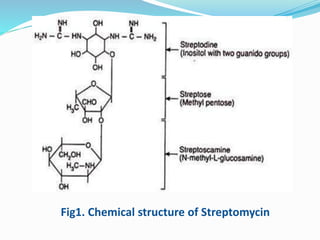
 It consists of three components linked glycosidically
(by ether bonds):
(i) Streptidine (inositol with two guanido groups),
(ii) Streptose (methyl pentose), and
(iii)Streptoscamine (N-methyl-L-glycosamine) as shown
in Fig. 1
Both guanido groups of streptidine are essential for the
antibiotic activity and removal of one group reduces
antibiotic activity upto 90%.
 Dihydrostreptomycin is produced by reduction of
carbonyl group on the streptose moiety
Fig1. Chemical structure of Streptomycin
Mechanism of Action of Streptomycin:
 Streptomycin, like other aminoglycosidic antibiotics (e.g.,
gentamycin, neomycin, kanamycin, tobramycin), inhibits protein
synthesis in bacterial cells by binding to the 30S subunit of
ribosomes.
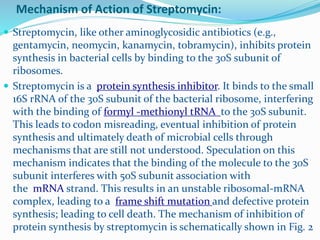
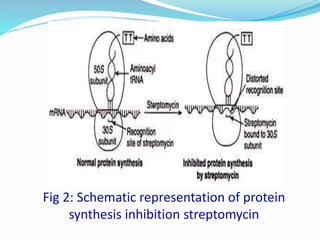
 Streptomycin is a protein synthesis inhibitor. It binds to the small
16S rRNA of the 30S subunit of the bacterial ribosome, interfering
with the binding of formyl -methionyl tRNA to the 30S subunit.
This leads to codon misreading, eventual inhibition of protein
synthesis and ultimately death of microbial cells through
mechanisms that are still not understood. Speculation on this
mechanism indicates that the binding of the molecule to the 30S
subunit interferes with 50S subunit association with
the mRNA strand. This results in an unstable ribosomal-mRNA
complex, leading to a frame shift mutation and defective protein
synthesis; leading to cell death. The mechanism of inhibition of
protein synthesis by streptomycin is schematically shown in Fig. 2
Fig 2: Schematic representation of protein
synthesis inhibition streptomycin
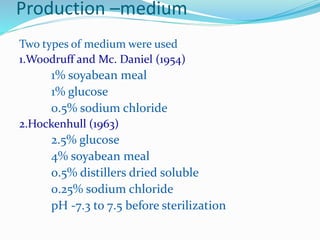
Production –medium
Two types of medium were used
1.Woodruff and Mc. Daniel (1954)
1% soyabean meal
1% glucose
0.5% sodium chloride
2.Hockenhull (1963)
2.5% glucose
4% soyabean meal
0.5% distillers dried soluble
0.25% sodium chloride
pH -7.3 to 7.5 before sterilization
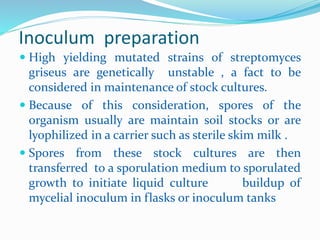
Inoculum preparation
 High yielding mutated strains of streptomyces
griseus are genetically unstable , a fact to be
considered in maintenance of stock cultures.
 Because of this consideration, spores of the
organism usually are maintain soil stocks or are
lyophilized in a carrier such as sterile skim milk .
 Spores from these stock cultures are then
transferred to a sporulation medium to sporulated
growth to initiate liquid culture buildup of
mycelial inoculum in flasks or inoculum tanks
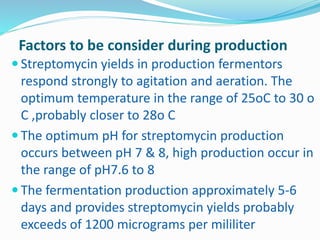
Factors to be consider during production
 Streptomycin yields in production fermentors
respond strongly to agitation and aeration. The
optimum temperature in the range of 25oC to 30 o
C ,probably closer to 28o C
 The optimum pH for streptomycin production
occurs between pH 7 & 8, high production occur in
the range of pH7.6 to 8
 The fermentation production approximately 5-6
days and provides streptomycin yields probably
exceeds of 1200 micrograms per mililiter
Contaminants
 Contaminants decrease the antibiotic yield
 Actinophage
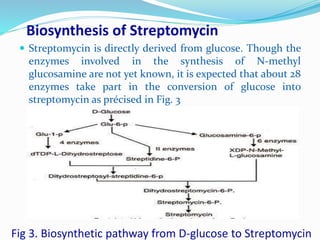
Biosynthesis of Streptomycin
 Streptomycin is directly derived from glucose. Though the
enzymes involved in the synthesis of N-methyl
glucosamine are not yet known, it is expected that about 28
enzymes take part in the conversion of glucose into
streptomycin as précised in Fig. 3
Fig 3. Biosynthetic pathway from D-glucose to Streptomycin
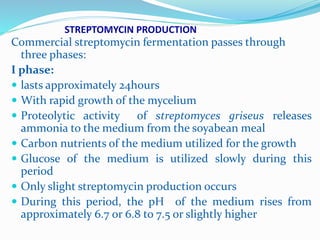
Commercial streptomycin fermentation passes through
three phases:
I phase:
 lasts approximately 24hours
 With rapid growth of the mycelium
 Proteolytic activity of streptomyces griseus releases
ammonia to the medium from the soyabean meal
 Carbon nutrients of the medium utilized for the growth
 Glucose of the medium is utilized slowly during this
period
 Only slight streptomycin production occurs
 During this period, the pH of the medium rises from
approximately 6.7 or 6.8 to 7.5 or slightly higher
STREPTOMYCIN PRODUCTION
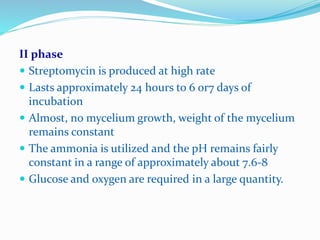
II phase
 Streptomycin is produced at high rate
 Lasts approximately 24 hours to 6 or7 days of
incubation
 Almost, no mycelium growth, weight of the mycelium
remains constant
 The ammonia is utilized and the pH remains fairly
constant in a range of approximately about 7.6-8
 Glucose and oxygen are required in a large quantity.
III phase
 Sugar has been depleted from the medium
 Streptomycin production ceases
 Mycelium undergoes autolysis, releasing
ammonia and the pH value rises
 The fermentation , however usually is harvested
before cell lysis.
Harvest and Recovery of streptomycin
After completion of fermentation the mycelium is
separated from the broth by filtration. Streptomycin is
recovered by several methods. The choice of procedure
depending on the industrial concern.
In one procedure,
 The streptomycin is adsorbed from the broth onto the
activated carbon and then eluted from the carbon with
dilute acid. The eluted streptomycin is precipitated by
acetone, filtered and dried before further purification.
In an alternative procedure,
 The fermentation broth is acidified, filtered
and neutralized. It is then passed through a
column containing a cation exchange resin to
adsorb the streptomycin from the broth.
 The column is then washed with water and the
antibiotic is eluted with hydrochloric acid or
cyclohexanol or phosphoric acid. It is then
concentrated at about 60°C under vacuum
almost to dryness.
 The streptomycin is then dissolved in methanol
and filtered and acetone is added to the filtrate to
precipitate the antibiotic. The precipitate is again
washed with acetone and vacuum dried. It is purified
further by dissolving in methanol. The streptomycin in
pure form is extracted as calcium chloride complex.
Byproduct Vitamin B12
 Vitamin B12 is produced as a byproduct which will not
affect adversely the yield of streptomycin.
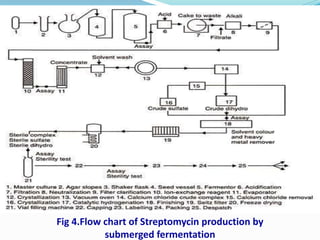
Fig 4.Flow chart of Streptomycin production by
submerged fermentation
REFERENCES
 Industrial Microbiology -Casida
 Industrial Microbiology –A.H.Patel
 http://www.biologydiscussion.com/medical-
microbiology/streptomycin-discovery-structure-and-mechanism-
antibiotics/55919

Streptomycin production

  • 1.
    Mrs.K.Sudha Rameshwari, Assistant Professor,Department of PG Biochemistry, V.V.Vanniaperumal college for women, Virudhunagar, Tamilnadu
  • 2.
    Introduction • Streptomycin isan antibiotic • It was discovered by Schatz,Bugie and Waksman (1944) in one of the soil isolates Streptomyces griseus • Most of the industry used this parent strain for streptomycin production today also. • Mutation and selection employed to increase yields to the present day levels. • But,nowadays also Streptomycin is produced by streptomyces griseus and only a few strains of this organism have the ability to produce reasonable yields of the antibiotic • It is active against gram Positive and Negative bacteria and against the tuberculosis organism Mycobacterium tuberculi
  • 3.
    Uses  It hasbeen used therapeutically in the treatment of infections caused by organisms resistant to Penicillin  It is also used in the treatment of plant diseases caused by bacteria  It is used in the treatment of tuberculosis caused by Mycobacterium tuberculi.
  • 4.
    Disadvantage  In man,prolonged streptomycin treatment at high dosage can produce neuro toxic reactions  particularly problems in balance maintenance and partial hearing loss  Chemical reduction of streptomycin to dihydrostreptomycin decreases this neurotoxicity.
  • 5.
     Some microorganismsgain resistance relatively easily to streptomycin and streptomycin therapy.  So, it is carried out in conjuction with para aminosalicyclic acid or isoniazid (isonicotinic acid hydrazide) to decrease this resistance build up in sensitive microorganisms
  • 6.
    Chemical structure • Streptomycinand dihydrostreptomycin are basic compounds • They are usually prepared as salts • Streptomycin is available as the hydrochloride C21H39N2O12.3HCL as a crystalline hydrochlroide double salt with calcium chloride or as the phosphate or sulfate • Dihydrostreptomycin as the hydrochloride or sulfate
  • 7.
     Depending onthe strain of this organism being used or on the production of medium, small amounts of mannosidostreptomycin or hydroxy streptomycin are accumulated in addition to streptomycin  Some mannosido streptomycin is produced early in the fermentation, but this antibiotic is largely enzymatically degraded by Streptomyces griseus to sterptyomycin at the time of harvest  The mannosidostreptomycin is not desired because of its low antibiotic activity
  • 8.
     The useof precursors does not increase yields of streptomycin  Most of the carbon of the streptomycin molecule has shown to originate from glucose and not from the more complex carbon compounds of the medium , although some of the carbon molecule originate from carbon di oxide  The carbonyl function on the streptose moiety is involved in the antibiotic activity of streptomycin.  Most chemical additions to the carbonyl group destroy the antibiotic activity.
  • 9.
    Chemical Structure ofStreptomycin  Streptomycin is characterised chemically as an aminoglycoside antibiotic.  It consists of three components linked glycosidically (by ether bonds): (i) Streptidine (inositol with two guanido groups), (ii) Streptose (methyl pentose), and (iii)Streptoscamine (N-methyl-L-glycosamine) as shown in Fig. 1 Both guanido groups of streptidine are essential for the antibiotic activity and removal of one group reduces antibiotic activity upto 90%.  Dihydrostreptomycin is produced by reduction of carbonyl group on the streptose moiety
  • 10.
    Fig1. Chemical structureof Streptomycin
  • 11.
    Mechanism of Actionof Streptomycin:  Streptomycin, like other aminoglycosidic antibiotics (e.g., gentamycin, neomycin, kanamycin, tobramycin), inhibits protein synthesis in bacterial cells by binding to the 30S subunit of ribosomes.  Streptomycin is a protein synthesis inhibitor. It binds to the small 16S rRNA of the 30S subunit of the bacterial ribosome, interfering with the binding of formyl -methionyl tRNA to the 30S subunit. This leads to codon misreading, eventual inhibition of protein synthesis and ultimately death of microbial cells through mechanisms that are still not understood. Speculation on this mechanism indicates that the binding of the molecule to the 30S subunit interferes with 50S subunit association with the mRNA strand. This results in an unstable ribosomal-mRNA complex, leading to a frame shift mutation and defective protein synthesis; leading to cell death. The mechanism of inhibition of protein synthesis by streptomycin is schematically shown in Fig. 2
  • 12.
    Fig 2: Schematicrepresentation of protein synthesis inhibition streptomycin
  • 13.
    Production –medium Two typesof medium were used 1.Woodruff and Mc. Daniel (1954) 1% soyabean meal 1% glucose 0.5% sodium chloride 2.Hockenhull (1963) 2.5% glucose 4% soyabean meal 0.5% distillers dried soluble 0.25% sodium chloride pH -7.3 to 7.5 before sterilization
  • 14.
    Inoculum preparation  Highyielding mutated strains of streptomyces griseus are genetically unstable , a fact to be considered in maintenance of stock cultures.  Because of this consideration, spores of the organism usually are maintain soil stocks or are lyophilized in a carrier such as sterile skim milk .  Spores from these stock cultures are then transferred to a sporulation medium to sporulated growth to initiate liquid culture buildup of mycelial inoculum in flasks or inoculum tanks
  • 15.
    Factors to beconsider during production  Streptomycin yields in production fermentors respond strongly to agitation and aeration. The optimum temperature in the range of 25oC to 30 o C ,probably closer to 28o C  The optimum pH for streptomycin production occurs between pH 7 & 8, high production occur in the range of pH7.6 to 8  The fermentation production approximately 5-6 days and provides streptomycin yields probably exceeds of 1200 micrograms per mililiter
  • 16.
    Contaminants  Contaminants decreasethe antibiotic yield  Actinophage
  • 17.
    Biosynthesis of Streptomycin Streptomycin is directly derived from glucose. Though the enzymes involved in the synthesis of N-methyl glucosamine are not yet known, it is expected that about 28 enzymes take part in the conversion of glucose into streptomycin as précised in Fig. 3 Fig 3. Biosynthetic pathway from D-glucose to Streptomycin
  • 18.
    Commercial streptomycin fermentationpasses through three phases: I phase:  lasts approximately 24hours  With rapid growth of the mycelium  Proteolytic activity of streptomyces griseus releases ammonia to the medium from the soyabean meal  Carbon nutrients of the medium utilized for the growth  Glucose of the medium is utilized slowly during this period  Only slight streptomycin production occurs  During this period, the pH of the medium rises from approximately 6.7 or 6.8 to 7.5 or slightly higher STREPTOMYCIN PRODUCTION
  • 19.
    II phase  Streptomycinis produced at high rate  Lasts approximately 24 hours to 6 or7 days of incubation  Almost, no mycelium growth, weight of the mycelium remains constant  The ammonia is utilized and the pH remains fairly constant in a range of approximately about 7.6-8  Glucose and oxygen are required in a large quantity.
  • 20.
    III phase  Sugarhas been depleted from the medium  Streptomycin production ceases  Mycelium undergoes autolysis, releasing ammonia and the pH value rises  The fermentation , however usually is harvested before cell lysis.
  • 21.
    Harvest and Recoveryof streptomycin After completion of fermentation the mycelium is separated from the broth by filtration. Streptomycin is recovered by several methods. The choice of procedure depending on the industrial concern. In one procedure,  The streptomycin is adsorbed from the broth onto the activated carbon and then eluted from the carbon with dilute acid. The eluted streptomycin is precipitated by acetone, filtered and dried before further purification.
  • 22.
    In an alternativeprocedure,  The fermentation broth is acidified, filtered and neutralized. It is then passed through a column containing a cation exchange resin to adsorb the streptomycin from the broth.  The column is then washed with water and the antibiotic is eluted with hydrochloric acid or cyclohexanol or phosphoric acid. It is then concentrated at about 60°C under vacuum almost to dryness.
  • 23.
     The streptomycinis then dissolved in methanol and filtered and acetone is added to the filtrate to precipitate the antibiotic. The precipitate is again washed with acetone and vacuum dried. It is purified further by dissolving in methanol. The streptomycin in pure form is extracted as calcium chloride complex. Byproduct Vitamin B12  Vitamin B12 is produced as a byproduct which will not affect adversely the yield of streptomycin.
  • 24.
    Fig 4.Flow chartof Streptomycin production by submerged fermentation
  • 25.
    REFERENCES  Industrial Microbiology-Casida  Industrial Microbiology –A.H.Patel  http://www.biologydiscussion.com/medical- microbiology/streptomycin-discovery-structure-and-mechanism- antibiotics/55919