Mechanical Engineering Dept. 1
• Introduction to composite materials: Definition,
classification of composites based matrix materials &
reinforcements, manufacturing of fibrous composites,
laminated composites, particulate composites (Hand
lay-up, Filament winding, Pultrusion, Slip casting and
Stir casting), advantages and application of
composites. [06]
What is a composite Material?
Mechanical Engineering Dept. 2
Broad Definition: Two or more chemically distinct materials which when
combined have improved properties over the individual materials. OR
A combination of 2 or more materials having compositional variations and
depicting properties distinctively different from those of the individual.
Composites could be natural or synthetic.
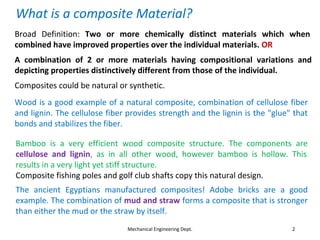
Wood is a good example of a natural composite, combination of cellulose fiber
and lignin. The cellulose fiber provides strength and the lignin is the "glue" that
bonds and stabilizes the fiber.
The ancient Egyptians manufactured composites! Adobe bricks are a good
example. The combination of mud and straw forms a composite that is stronger
than either the mud or the straw by itself.
Bamboo is a very efficient wood composite structure. The components are
cellulose and lignin, as in all other wood, however bamboo is hollow. This
results in a very light yet stiff structure.
Composite fishing poles and golf club shafts copy this natural design.
Composites
Mechanical Engineering Dept. 3
Composites are combinations of two materials in which one of
the material is called the reinforcing phase, is in the form of
fibers, sheets, or particles, and is embedded in the other
material called the matrix phase.
Typically, reinforcing materials are stronger and harder whereas the matrix
is usually a ductile or tough material. If the composite is designed and
fabricated correctly, it combines the strength of the reinforcement with the
toughness of the matrix to achieve a combination of desirable properties
not available in any single conventional material.
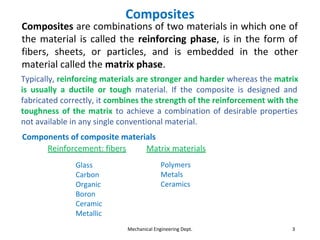
Reinforcement: fibers
Glass
Carbon
Organic
Boron
Ceramic
Metallic
Matrix materials
Polymers
Metals
Ceramics
Components of composite materials
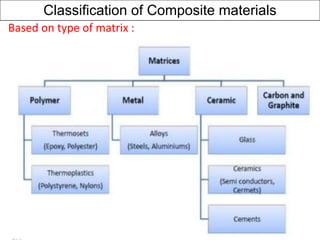
Classification of Composite materials
Based on type of matrix :
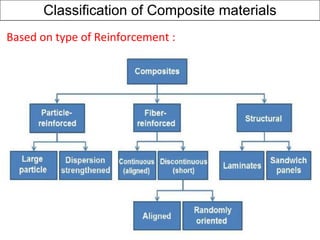
Classification of Composite materials
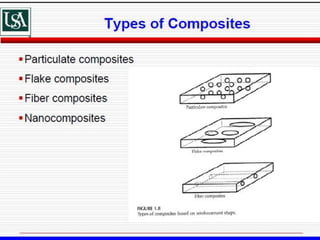
Based on type of Reinforcement :
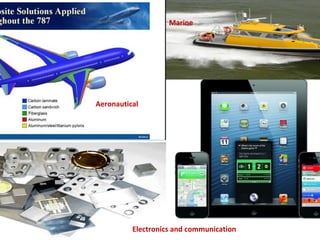
Aeronautical
Marine
Electronics and communication
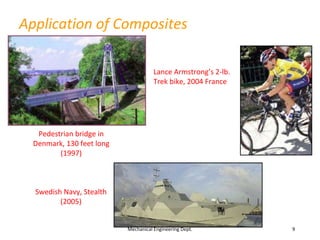
Application of Composites
Mechanical Engineering Dept. 9
Pedestrian bridge in
Denmark, 130 feet long
(1997)
Swedish Navy, Stealth
(2005)
Lance Armstrong’s 2-lb.
Trek bike, 2004 France
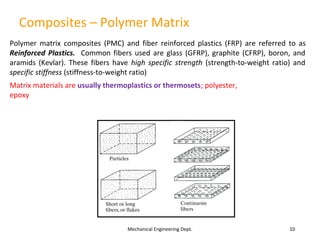
Composites – Polymer Matrix
Mechanical Engineering Dept. 10
Polymer matrix composites (PMC) and fiber reinforced plastics (FRP) are referred to as
Reinforced Plastics. Common fibers used are glass (GFRP), graphite (CFRP), boron, and
aramids (Kevlar). These fibers have high specific strength (strength-to-weight ratio) and
specific stiffness (stiffness-to-weight ratio)
Matrix materials are usually thermoplastics or thermosets; polyester,
epoxy
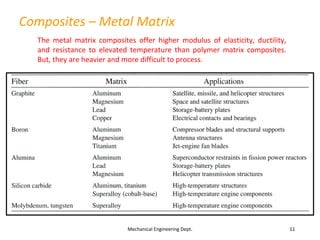
Composites – Metal Matrix
Mechanical Engineering Dept. 11
The metal matrix composites offer higher modulus of elasticity, ductility,
and resistance to elevated temperature than polymer matrix composites.
But, they are heavier and more difficult to process.
Composites – Ceramic Matrix
Mechanical Engineering Dept. 12
Ceramic matrix composites (CMC) are used in applications where
resistance to high temperature and corrosive environment is desired.
CMCs are strong and stiff but they lack toughness (ductility).
Matrix materials are usually silicon carbide, silicon nitride and aluminum
oxide, and mullite (compound of aluminum, silicon and oxygen). They
retain their strength up to 1650o
C.
Fiber materials used commonly are carbon and aluminum oxide.
Applications are in jet and automobile engines, deep-see mining,
cutting tools, dies and pressure vessels.
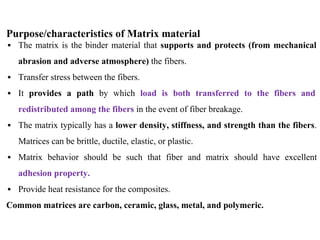
Purpose/characteristics of Matrix material
▪ The matrix is the binder material that supports and protects (from mechanical
abrasion and adverse atmosphere) the fibers.
▪ Transfer stress between the fibers.
▪ It provides a path by which load is both transferred to the fibers and
redistributed among the fibers in the event of fiber breakage.
▪ The matrix typically has a lower density, stiffness, and strength than the fibers.
Matrices can be brittle, ductile, elastic, or plastic.
▪ Matrix behavior should be such that fiber and matrix should have excellent
adhesion property.
▪ Provide heat resistance for the composites.
Common matrices are carbon, ceramic, glass, metal, and polymeric.
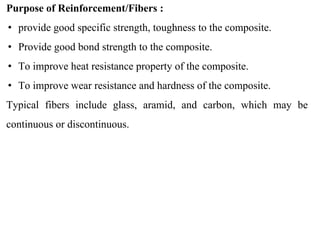
Purpose of Reinforcement/Fibers :
• provide good specific strength, toughness to the composite.
• Provide good bond strength to the composite.
• To improve heat resistance property of the composite.
• To improve wear resistance and hardness of the composite.
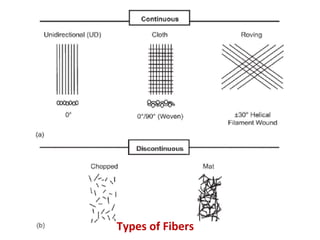
Typical fibers include glass, aramid, and carbon, which may be
continuous or discontinuous.
Types of Fibers
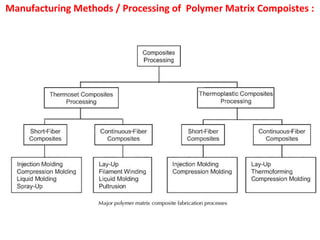
Manufacturing Methods / Processing of Polymer Matrix Compoistes :
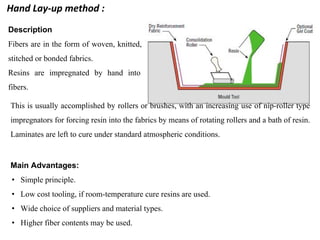
Description
Fibers are in the form of woven, knitted,
stitched or bonded fabrics.
Resins are impregnated by hand into
fibers.
This is usually accomplished by rollers or brushes, with an increasing use of nip-roller type
impregnators for forcing resin into the fabrics by means of rotating rollers and a bath of resin.
Laminates are left to cure under standard atmospheric conditions.
Main Advantages:
• Simple principle.
• Low cost tooling, if room-temperature cure resins are used.
• Wide choice of suppliers and material types.
• Higher fiber contents may be used.
Hand Lay-up method :
Disadvantages:
• Resin mixing, laminate resin contents, and laminate quality are very dependent
on the skills of laminators. Low resin content laminates cannot usually be
achieved without the incorporation of excessive quantities of voids.
• Health and safety considerations of resins. The lower molecular weights of hand
lay-up resins are harmful than higher molecular weight products.
• Difficult to process if the viscosity of the resins is higher.
Typical Applications:
Standard wind-turbine blades, production boats, architectural mouldings.
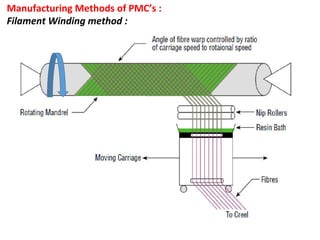
Manufacturing Methods of PMC’s :
Filament Winding method :
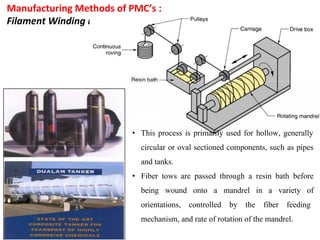
Manufacturing Methods of PMC’s :
Filament Winding method :
• This process is primarily used for hollow, generally
circular or oval sectioned components, such as pipes
and tanks.
• Fiber tows are passed through a resin bath before
being wound onto a mandrel in a variety of
orientations, controlled by the fiber feeding
mechanism, and rate of rotation of the mandrel.
Manufacturing Methods of PMC’s :
Filament Winding method :
Main Advantages:
i) This can be a very fast and therefore economic method.
ii) Resin content can be controlled by metering the resin onto each fiber tow through
nips or dies.
iii) Structural properties of laminates can be very good since straight fibers can be
laid in a complex pattern to match the applied loads.
Main Disadvantages:
i) The process is limited to convex shaped components.
ii) Fiber cannot easily be laid exactly along the length of a component- Skill.
iii) Mandrel costs for large components can be high.
iv) Typical Applications:
Chemical storage tanks and pipelines, gas cylinders, fire-fighters breathing tanks.
Manufacturing Methods of PMC’s :
Pultrusion method :
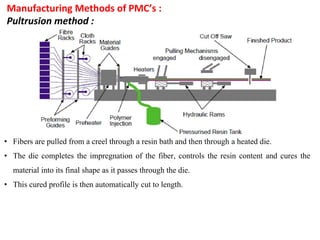
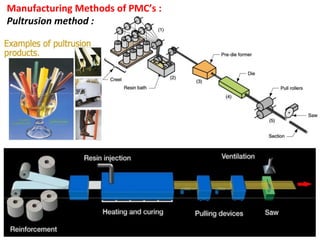
• Fibers are pulled from a creel through a resin bath and then through a heated die.
• The die completes the impregnation of the fiber, controls the resin content and cures the
material into its final shape as it passes through the die.
• This cured profile is then automatically cut to length.
Manufacturing Methods of PMC’s :
Pultrusion method :
Manufacturing Methods of PMC’s :
Pultrusion method :
Main Advantages:
i) This can be a very fast, economic way of impregnating and curing materials.
ii) Resin content can be accurately controlled.
iii) Fiber cost is minimised since the majority is taken from a creel.
iv) Structural properties of laminates can be very good since the profiles have very straight fibers
and high fiber volume fractions can be obtained.
v) Resin impregnation area can be enclosed thus limiting volatile emissions.
Main Disadvantages:
i) Limited to constant or near constant cross-section components- symmetrical
ii) Heated die costs can be high.
Typical Applications:
Beams and girders used in roof structures, bridges, ladders, frameworks.
Metal Matrix Composites (MMC):
Introduction:
Metal Matrix Composite (MMC) is a material consisting of a metallic matrix
combined with metallic (lead, tungsten, molybdenum) or a ceramic
(oxides, carbides) dispersed phase.
Properties of MMC’s:
• High strength, fracture toughness and stiffness.
• They can withstand elevated temperature in corrosive environment.
• Most metals and alloys could be used as matrices.
• The reinforcement are stable over a range of temperature and non-reactive too.
• Light metals form the matrix and the reinforcements are of high moduli.
Main types of MMC:
• Aluminum Matrix Composites (AMC)
• Magnesium Matrix Composites
• Titanium Matrix Composites
• Copper Matrix Composites
Metal Matrix Composites (MMC):
Introduction:
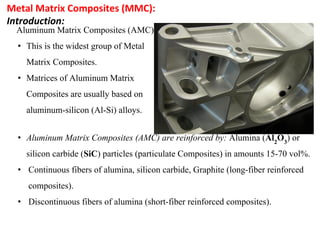
Aluminum Matrix Composites (AMC)
• This is the widest group of Metal
Matrix Composites.
• Matrices of Aluminum Matrix
Composites are usually based on
aluminum-silicon (Al-Si) alloys.
• Aluminum Matrix Composites (AMC) are reinforced by: Alumina (Al2
O3
) or
silicon carbide (SiC) particles (particulate Composites) in amounts 15-70 vol%.
• Continuous fibers of alumina, silicon carbide, Graphite (long-fiber reinforced
composites).
• Discontinuous fibers of alumina (short-fiber reinforced composites).
Metal Matrix Composites (MMC):
Introduction:
Aluminum Matrix Composites are manufactured by the following fabrication methods:
• Powder metallurgy (sintering);
• Stir casting;
• Infiltration.
The following properties are typical for Aluminum Matrix Composites:
• High strength even at elevated temperatures;
• High stiffness (modulus of elasticity);
• Low density;
• High thermal conductivity;
• Excellent abrasion resistance.
❖ Aluminum Matrix Composites (AMC) are used for manufacturing automotive
parts (pistons, pushrods, brake components), brake rotors for high speed
trains, bicycles, golf clubs, and electronic substrates.
Metal Matrix Composites (MMC):
Introduction:
Magnesium Matrix Composites
• Magnesium Matrix Composites are reinforced mainly by silicon carbide (SiC) particles
(particulate composites)
The following properties are typical for Magnesium Matrix Composites:
• Low density;
• High stiffness (modulus of elasticity);
• High wear resistance;
• Good strength even at elevated temperatures;
• Good creep resistance.
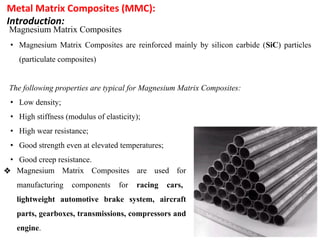
❖ Magnesium Matrix Composites are used for
manufacturing components for racing cars,
lightweight automotive brake system, aircraft
parts, gearboxes, transmissions, compressors and
engine.
Metal Matrix Composites (MMC):
Introduction:
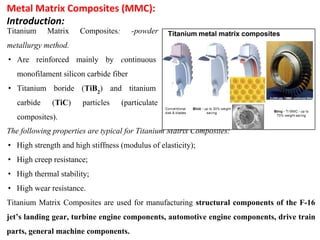
The following properties are typical for Titanium Matrix Composites:
• High strength and high stiffness (modulus of elasticity);
• High creep resistance;
• High thermal stability;
• High wear resistance.
Titanium Matrix Composites are used for manufacturing structural components of the F-16
jet’s landing gear, turbine engine components, automotive engine components, drive train
parts, general machine components.
Titanium Matrix Composites: -powder
metallurgy method.
• Are reinforced mainly by continuous
monofilament silicon carbide fiber
• Titanium boride (TiB2
) and titanium
carbide (TiC) particles (particulate
composites).
Metal Matrix Composites (MMC):
Introduction:
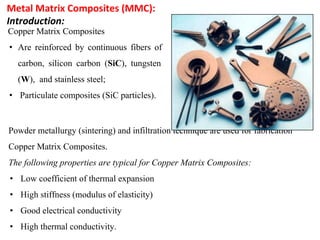
Powder metallurgy (sintering) and infiltration technique are used for fabrication
Copper Matrix Composites.
The following properties are typical for Copper Matrix Composites:
• Low coefficient of thermal expansion
• High stiffness (modulus of elasticity)
• Good electrical conductivity
• High thermal conductivity.
Copper Matrix Composites
• Are reinforced by continuous fibers of
carbon, silicon carbon (SiC), tungsten
(W), and stainless steel;
• Particulate composites (SiC particles).
Metal Matrix Composites (MMC):
Fabrication Methods:
Liquid state fabrication of Metal Matrix Composites
▪ Liquid state fabrication of Metal Matrix Composites involves incorporation
of dispersed phase into a molten matrix metal, followed by its solidification.
▪ In order to provide high level of mechanical properties of the composite, good
interfacial bonding (wetting) between the dispersed phase and the liquid matrix
should be obtained.
The methods of liquid state fabrication of Metal Matrix Composites:
Stir Casting
Infiltration
• Gas Pressure Infiltration
• Squeeze Casting Infiltration
• Pressure Die Infiltration
Metal Matrix Composites (MMC):
Fabrication Methods:
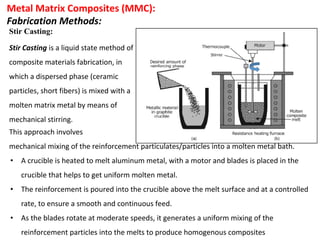
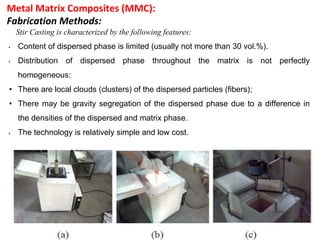
Stir Casting:
This approach involves
mechanical mixing of the reinforcement particulates/particles into a molten metal bath.
• A crucible is heated to melt aluminum metal, with a motor and blades is placed in the
crucible that helps to get uniform molten metal.
• The reinforcement is poured into the crucible above the melt surface and at a controlled
rate, to ensure a smooth and continuous feed.
• As the blades rotate at moderate speeds, it generates a uniform mixing of the
reinforcement particles into the melts to produce homogenous composites
Stir Casting is a liquid state method of
composite materials fabrication, in
which a dispersed phase (ceramic
particles, short fibers) is mixed with a
molten matrix metal by means of
mechanical stirring.
Metal Matrix Composites (MMC):
Fabrication Methods:
Stir Casting is characterized by the following features:
• Content of dispersed phase is limited (usually not more than 30 vol.%).
• Distribution of dispersed phase throughout the matrix is not perfectly
homogeneous:
• There are local clouds (clusters) of the dispersed particles (fibers);
• There may be gravity segregation of the dispersed phase due to a difference in
the densities of the dispersed and matrix phase.
• The technology is relatively simple and low cost.
35
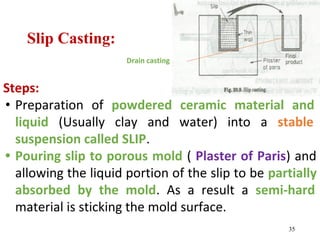
Slip Casting:
Steps:
• Preparation of powdered ceramic material and
liquid (Usually clay and water) into a stable
suspension called SLIP.
• Pouring slip to porous mold ( Plaster of Paris) and
allowing the liquid portion of the slip to be partially
absorbed by the mold. As a result a semi-hard
material is sticking the mold surface.
Drain casting
36
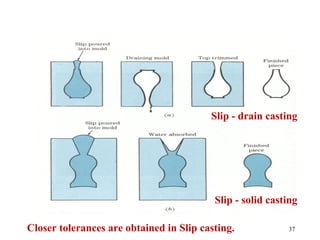
• When sufficient wall thickness is formed, casting is
interrupted and excess slip is poured out of the cavity. It is
known as drain casting.
Solid shape may be made by allowing the casting to continue
until the entire mold cavity is filled. It is known as solid
casting.
• Material in the mold is allowed to dry to provide
strength for handling and subsequent removal of the part
from the mold.
• Finally, fired to attain the required BOND strength,
microstructure and other properties.
New variation in slip casting process are Pressure and
Vacuum.
Slip casting is advantageous for forming thin walled,
complex shapes of uniform thickness.
37
Slip - solid casting
Slip - drain casting
Closer tolerances are obtained in Slip casting.

Composite materials.pdf .

  • 1.
    Mechanical Engineering Dept.1 • Introduction to composite materials: Definition, classification of composites based matrix materials & reinforcements, manufacturing of fibrous composites, laminated composites, particulate composites (Hand lay-up, Filament winding, Pultrusion, Slip casting and Stir casting), advantages and application of composites. [06]
  • 2.
    What is acomposite Material? Mechanical Engineering Dept. 2 Broad Definition: Two or more chemically distinct materials which when combined have improved properties over the individual materials. OR A combination of 2 or more materials having compositional variations and depicting properties distinctively different from those of the individual. Composites could be natural or synthetic. Wood is a good example of a natural composite, combination of cellulose fiber and lignin. The cellulose fiber provides strength and the lignin is the "glue" that bonds and stabilizes the fiber. The ancient Egyptians manufactured composites! Adobe bricks are a good example. The combination of mud and straw forms a composite that is stronger than either the mud or the straw by itself. Bamboo is a very efficient wood composite structure. The components are cellulose and lignin, as in all other wood, however bamboo is hollow. This results in a very light yet stiff structure. Composite fishing poles and golf club shafts copy this natural design.
  • 3.
    Composites Mechanical Engineering Dept.3 Composites are combinations of two materials in which one of the material is called the reinforcing phase, is in the form of fibers, sheets, or particles, and is embedded in the other material called the matrix phase. Typically, reinforcing materials are stronger and harder whereas the matrix is usually a ductile or tough material. If the composite is designed and fabricated correctly, it combines the strength of the reinforcement with the toughness of the matrix to achieve a combination of desirable properties not available in any single conventional material. Reinforcement: fibers Glass Carbon Organic Boron Ceramic Metallic Matrix materials Polymers Metals Ceramics Components of composite materials
  • 4.
    Classification of Compositematerials Based on type of matrix :
  • 5.
    Classification of Compositematerials Based on type of Reinforcement :
  • 8.
  • 9.
    Application of Composites MechanicalEngineering Dept. 9 Pedestrian bridge in Denmark, 130 feet long (1997) Swedish Navy, Stealth (2005) Lance Armstrong’s 2-lb. Trek bike, 2004 France
  • 10.
    Composites – PolymerMatrix Mechanical Engineering Dept. 10 Polymer matrix composites (PMC) and fiber reinforced plastics (FRP) are referred to as Reinforced Plastics. Common fibers used are glass (GFRP), graphite (CFRP), boron, and aramids (Kevlar). These fibers have high specific strength (strength-to-weight ratio) and specific stiffness (stiffness-to-weight ratio) Matrix materials are usually thermoplastics or thermosets; polyester, epoxy
  • 11.
    Composites – MetalMatrix Mechanical Engineering Dept. 11 The metal matrix composites offer higher modulus of elasticity, ductility, and resistance to elevated temperature than polymer matrix composites. But, they are heavier and more difficult to process.
  • 12.
    Composites – CeramicMatrix Mechanical Engineering Dept. 12 Ceramic matrix composites (CMC) are used in applications where resistance to high temperature and corrosive environment is desired. CMCs are strong and stiff but they lack toughness (ductility). Matrix materials are usually silicon carbide, silicon nitride and aluminum oxide, and mullite (compound of aluminum, silicon and oxygen). They retain their strength up to 1650o C. Fiber materials used commonly are carbon and aluminum oxide. Applications are in jet and automobile engines, deep-see mining, cutting tools, dies and pressure vessels.
  • 14.
    Purpose/characteristics of Matrixmaterial ▪ The matrix is the binder material that supports and protects (from mechanical abrasion and adverse atmosphere) the fibers. ▪ Transfer stress between the fibers. ▪ It provides a path by which load is both transferred to the fibers and redistributed among the fibers in the event of fiber breakage. ▪ The matrix typically has a lower density, stiffness, and strength than the fibers. Matrices can be brittle, ductile, elastic, or plastic. ▪ Matrix behavior should be such that fiber and matrix should have excellent adhesion property. ▪ Provide heat resistance for the composites. Common matrices are carbon, ceramic, glass, metal, and polymeric.
  • 15.
    Purpose of Reinforcement/Fibers: • provide good specific strength, toughness to the composite. • Provide good bond strength to the composite. • To improve heat resistance property of the composite. • To improve wear resistance and hardness of the composite. Typical fibers include glass, aramid, and carbon, which may be continuous or discontinuous.
  • 16.
  • 17.
    Manufacturing Methods /Processing of Polymer Matrix Compoistes :
  • 18.
    Description Fibers are inthe form of woven, knitted, stitched or bonded fabrics. Resins are impregnated by hand into fibers. This is usually accomplished by rollers or brushes, with an increasing use of nip-roller type impregnators for forcing resin into the fabrics by means of rotating rollers and a bath of resin. Laminates are left to cure under standard atmospheric conditions. Main Advantages: • Simple principle. • Low cost tooling, if room-temperature cure resins are used. • Wide choice of suppliers and material types. • Higher fiber contents may be used. Hand Lay-up method :
  • 19.
    Disadvantages: • Resin mixing,laminate resin contents, and laminate quality are very dependent on the skills of laminators. Low resin content laminates cannot usually be achieved without the incorporation of excessive quantities of voids. • Health and safety considerations of resins. The lower molecular weights of hand lay-up resins are harmful than higher molecular weight products. • Difficult to process if the viscosity of the resins is higher. Typical Applications: Standard wind-turbine blades, production boats, architectural mouldings.
  • 20.
    Manufacturing Methods ofPMC’s : Filament Winding method :
  • 21.
    Manufacturing Methods ofPMC’s : Filament Winding method : • This process is primarily used for hollow, generally circular or oval sectioned components, such as pipes and tanks. • Fiber tows are passed through a resin bath before being wound onto a mandrel in a variety of orientations, controlled by the fiber feeding mechanism, and rate of rotation of the mandrel.
  • 22.
    Manufacturing Methods ofPMC’s : Filament Winding method : Main Advantages: i) This can be a very fast and therefore economic method. ii) Resin content can be controlled by metering the resin onto each fiber tow through nips or dies. iii) Structural properties of laminates can be very good since straight fibers can be laid in a complex pattern to match the applied loads. Main Disadvantages: i) The process is limited to convex shaped components. ii) Fiber cannot easily be laid exactly along the length of a component- Skill. iii) Mandrel costs for large components can be high. iv) Typical Applications: Chemical storage tanks and pipelines, gas cylinders, fire-fighters breathing tanks.
  • 23.
    Manufacturing Methods ofPMC’s : Pultrusion method : • Fibers are pulled from a creel through a resin bath and then through a heated die. • The die completes the impregnation of the fiber, controls the resin content and cures the material into its final shape as it passes through the die. • This cured profile is then automatically cut to length.
  • 24.
    Manufacturing Methods ofPMC’s : Pultrusion method :
  • 25.
    Manufacturing Methods ofPMC’s : Pultrusion method : Main Advantages: i) This can be a very fast, economic way of impregnating and curing materials. ii) Resin content can be accurately controlled. iii) Fiber cost is minimised since the majority is taken from a creel. iv) Structural properties of laminates can be very good since the profiles have very straight fibers and high fiber volume fractions can be obtained. v) Resin impregnation area can be enclosed thus limiting volatile emissions. Main Disadvantages: i) Limited to constant or near constant cross-section components- symmetrical ii) Heated die costs can be high. Typical Applications: Beams and girders used in roof structures, bridges, ladders, frameworks.
  • 26.
    Metal Matrix Composites(MMC): Introduction: Metal Matrix Composite (MMC) is a material consisting of a metallic matrix combined with metallic (lead, tungsten, molybdenum) or a ceramic (oxides, carbides) dispersed phase. Properties of MMC’s: • High strength, fracture toughness and stiffness. • They can withstand elevated temperature in corrosive environment. • Most metals and alloys could be used as matrices. • The reinforcement are stable over a range of temperature and non-reactive too. • Light metals form the matrix and the reinforcements are of high moduli. Main types of MMC: • Aluminum Matrix Composites (AMC) • Magnesium Matrix Composites • Titanium Matrix Composites • Copper Matrix Composites
  • 27.
    Metal Matrix Composites(MMC): Introduction: Aluminum Matrix Composites (AMC) • This is the widest group of Metal Matrix Composites. • Matrices of Aluminum Matrix Composites are usually based on aluminum-silicon (Al-Si) alloys. • Aluminum Matrix Composites (AMC) are reinforced by: Alumina (Al2 O3 ) or silicon carbide (SiC) particles (particulate Composites) in amounts 15-70 vol%. • Continuous fibers of alumina, silicon carbide, Graphite (long-fiber reinforced composites). • Discontinuous fibers of alumina (short-fiber reinforced composites).
  • 28.
    Metal Matrix Composites(MMC): Introduction: Aluminum Matrix Composites are manufactured by the following fabrication methods: • Powder metallurgy (sintering); • Stir casting; • Infiltration. The following properties are typical for Aluminum Matrix Composites: • High strength even at elevated temperatures; • High stiffness (modulus of elasticity); • Low density; • High thermal conductivity; • Excellent abrasion resistance. ❖ Aluminum Matrix Composites (AMC) are used for manufacturing automotive parts (pistons, pushrods, brake components), brake rotors for high speed trains, bicycles, golf clubs, and electronic substrates.
  • 29.
    Metal Matrix Composites(MMC): Introduction: Magnesium Matrix Composites • Magnesium Matrix Composites are reinforced mainly by silicon carbide (SiC) particles (particulate composites) The following properties are typical for Magnesium Matrix Composites: • Low density; • High stiffness (modulus of elasticity); • High wear resistance; • Good strength even at elevated temperatures; • Good creep resistance. ❖ Magnesium Matrix Composites are used for manufacturing components for racing cars, lightweight automotive brake system, aircraft parts, gearboxes, transmissions, compressors and engine.
  • 30.
    Metal Matrix Composites(MMC): Introduction: The following properties are typical for Titanium Matrix Composites: • High strength and high stiffness (modulus of elasticity); • High creep resistance; • High thermal stability; • High wear resistance. Titanium Matrix Composites are used for manufacturing structural components of the F-16 jet’s landing gear, turbine engine components, automotive engine components, drive train parts, general machine components. Titanium Matrix Composites: -powder metallurgy method. • Are reinforced mainly by continuous monofilament silicon carbide fiber • Titanium boride (TiB2 ) and titanium carbide (TiC) particles (particulate composites).
  • 31.
    Metal Matrix Composites(MMC): Introduction: Powder metallurgy (sintering) and infiltration technique are used for fabrication Copper Matrix Composites. The following properties are typical for Copper Matrix Composites: • Low coefficient of thermal expansion • High stiffness (modulus of elasticity) • Good electrical conductivity • High thermal conductivity. Copper Matrix Composites • Are reinforced by continuous fibers of carbon, silicon carbon (SiC), tungsten (W), and stainless steel; • Particulate composites (SiC particles).
  • 32.
    Metal Matrix Composites(MMC): Fabrication Methods: Liquid state fabrication of Metal Matrix Composites ▪ Liquid state fabrication of Metal Matrix Composites involves incorporation of dispersed phase into a molten matrix metal, followed by its solidification. ▪ In order to provide high level of mechanical properties of the composite, good interfacial bonding (wetting) between the dispersed phase and the liquid matrix should be obtained. The methods of liquid state fabrication of Metal Matrix Composites: Stir Casting Infiltration • Gas Pressure Infiltration • Squeeze Casting Infiltration • Pressure Die Infiltration
  • 33.
    Metal Matrix Composites(MMC): Fabrication Methods: Stir Casting: This approach involves mechanical mixing of the reinforcement particulates/particles into a molten metal bath. • A crucible is heated to melt aluminum metal, with a motor and blades is placed in the crucible that helps to get uniform molten metal. • The reinforcement is poured into the crucible above the melt surface and at a controlled rate, to ensure a smooth and continuous feed. • As the blades rotate at moderate speeds, it generates a uniform mixing of the reinforcement particles into the melts to produce homogenous composites Stir Casting is a liquid state method of composite materials fabrication, in which a dispersed phase (ceramic particles, short fibers) is mixed with a molten matrix metal by means of mechanical stirring.
  • 34.
    Metal Matrix Composites(MMC): Fabrication Methods: Stir Casting is characterized by the following features: • Content of dispersed phase is limited (usually not more than 30 vol.%). • Distribution of dispersed phase throughout the matrix is not perfectly homogeneous: • There are local clouds (clusters) of the dispersed particles (fibers); • There may be gravity segregation of the dispersed phase due to a difference in the densities of the dispersed and matrix phase. • The technology is relatively simple and low cost.
  • 35.
    35 Slip Casting: Steps: • Preparationof powdered ceramic material and liquid (Usually clay and water) into a stable suspension called SLIP. • Pouring slip to porous mold ( Plaster of Paris) and allowing the liquid portion of the slip to be partially absorbed by the mold. As a result a semi-hard material is sticking the mold surface. Drain casting
  • 36.
    36 • When sufficientwall thickness is formed, casting is interrupted and excess slip is poured out of the cavity. It is known as drain casting. Solid shape may be made by allowing the casting to continue until the entire mold cavity is filled. It is known as solid casting. • Material in the mold is allowed to dry to provide strength for handling and subsequent removal of the part from the mold. • Finally, fired to attain the required BOND strength, microstructure and other properties. New variation in slip casting process are Pressure and Vacuum. Slip casting is advantageous for forming thin walled, complex shapes of uniform thickness.
  • 37.
    37 Slip - solidcasting Slip - drain casting Closer tolerances are obtained in Slip casting.