Composite Materials
Definition of Compsites
Composites are engineered materials
made from two or more constituent
materials with significantly different
physical or chemical properties and which
remain separate and distinct on a
macroscopic level within the finished
structure.
Composite materials are generally used
for buildings, bridges, and structures such as
boat hulls, swimming pool panels, bathtubs,
storage tanks, imitation granite and cultured
marble sinks and countertops. The most
advanced examples perform routinely on
spacecraft and aircraft in demanding
environments.
Increasingly it is becoming evident that
the lines of demarcation between
traditional disciplines such as metallurgy,
ceramics and polymers are getting quite
blurry.
Matrix Rule
The matrix material surrounds and supports the
reinforcement materials by maintaining their relative
positions.
The matrix material largely determines the
processing method.
Reinforcement Rule
The reinforcements impart their special mechanical
and physical properties to enhance the matrix
properties.
The Final Result
• If the composite is designed and
fabricated correctly, it combines
the strength of the reinforcement
with the toughness of the matrix
to achieve a combination of
desirable properties not available
in any single conventional
material.
For example:
• polymer/ceramic composites
have a higher modulus than the
polymer component,
• but are not as brittle as
ceramics.
•Typically, reinforcing
materials are strong with
low densities while the
matrix is usually a ductile,
or tough, material.
Considerations for Selecting the
Reinforcements & Matrix
• There are certain considerations for
selecting the reinforcements and the matrix
such as:
melting point, volatility (instability),
density, elastic modulus, coefficient of
thermal expansion, strength,
creep characteristics, fracture toughness &
compatibility between fiber & matrix.
Combatibility
The last consideration of
compatibility is divided into three
categories, namely:
• chemical compatibility,
• thermal compatibility &
• compatibility with the environment
Reinforcements Types
• Reinforcing phase, is in the form of:
• fibers,
• Whiskers,
• Sheets &
• particles
• and is embedded in the other
materials (the matrix phase).
Composites According to Type of
Reinforcement a: particles, b: whiskers,
c: continuous fibers, d: sheet laminate
a b
C d
This leads to
either addition of properties:
GLASS + POLYESTER = GRP
(strength) (chemical resistance) (strength and
chemical
resistance)
or unique properties:
GLASS + POLYESTER = GRP
(brittle) (brittle) (tough!)
Alternative matrix materials
• Fibre: boron; carbon, graphite, SiC, alumina.
• Matrix: aluminium; magnesium; titanium; copper
• Fibres improve high temperature creep and thermal
expansion.
Metal Matrix Composites
(MMCs)
Polymer Matrix Composites
(PMCs)
Thermoplastics
Tough; high melt viscosity; and
recyclable
Thermosets
Brittle; low viscosity before cure;
not recyclable
Ceramic Matrix Composites
(CMCs)
• Fibre: SiC; alumina; Silicon Nitride
• Matrix: SiC; alumina; glass-ceramic;
Silicon Nitride
Fibres improve toughness
Why are composites used in engineering?
• Weight saving (High strength to weight ratio)
• High corrosion resistance
• High toughness & High T. S. at elevated temp.
• Better Fatigue properties
• Manufacturing advantages:
- novel geometries
- low cost tooling
• Design freedoms
- continuous property spectrum
- anisotropic properties
• Ease of repair
Strength of Composites
• The strength of the composite
depends primarily on the
amount, arrangement and type
of fiber (or particle)
reinforcement in the resin.
• Typically, the higher the
reinforcement content, the greater the
strength.
• In some cases, glass fibers are
combined with other fibers, such as
carbon or aramid composite that
combines the properties of more than
one reinforcing material.
1- Particle Reinforcement
• Particles used for reinforcing include:
• ceramics (SiC) and glasses particles,
• metal particles such as aluminum,
• polymers and
• carbon.
The Rule of Particles
• Particles are used to
• Increase the modulus of the matrix,
• To decrease the ductility of the
matrix.
• Particles are also used to produce
inexpensive composites.
Example of Particle Composite
• An example of particle
reinforced composites is
car tire
• which has carbon particles in
a matrix of the elastomeric
polymer poly-iso-butylene.
Another Example
Another example for particle-reinforced
composite is concrete where the
aggregates ( sand & gravel) are the
particles and cement is the matrix.
PRCs support higher tensile,
compressive and shear stresses.
2-Fiber-reinforced
Composites:
• Reinforcing fibers can be made of
metals, ceramics, glasses, or
polymers graphite or carbon
fibers. Fibers increase the modulus
of the matrix material.
• Practically any material (polymers,
metals, glass or ceramics) can be
transformed into a fibrous form.
• An important attribute of fine fibers is
their flexibility.
• A high degree of flexibility is really a
charectertsitic of a material having a
low modulus and a small diameter.
Glass Fiber
• Glasses or amorphous materials show the
phenomena of time dependent-strain,
called visco-elasticity. Above the glass
transition temperature, Tg, such materials
show Newtonian viscosity, i.e. the stress
is proportional to the strain rate. This
property is exploited in the drawing of
fiber and sheet forms.
Advantages of Ceramic Fibers
• Continuous ceramic fibers are very good
for reinforcing ceramic materials. They
combine rather high strength and elastic
modulus with high temperature capability
and a general freedom from
environmental attacks, making them
attractive as reinforcements in high temp.
ap.
It is convenient to divide the ceramic
reinforcements into:
• oxide and
• non-oxide categories.
The oxides groups contains ceramic oxides
such as Al2O3, (Al2O3+SiO2) & ZrO2.
While the non-oxide group includes: B,
C, SiC, Si3N4 & BN.
A comparison between the ceramic
& composite stress-strain behaviour
Limitation of using fiber
reinforcement
• Fibers are difficult to process into
composites which makes fiber-
reinforced composites relatively
expensive.
Effect of fiber parameters on
Composite properties
• The arrangement or orientation
of the fibers relative to one
another, the fiber concentration,
and the distribution all have a
significant influence on the
strength and other properties of
fiber-reinforced composites.
Where to use discontinuous
fibers
• Applications involving totally
multidirectional applied
stresses normally use
discontinuous fibers, which
are randomly oriented in the
matrix material.
• Consideration of orientation
and fiber length for a particular
composites depends on the level
and nature of the applied stress
as well as fabrication cost.
Short fiber advantages
• Production rates for short-fiber
composites (both aligned and
randomly oriented) are rapid, and
complicated shapes can be formed
which are not possible with
continuous fiber reinforcement.
Fiber orientation in fiber reinforced
composites.
Modulus of Fiber-Reinforced
Composites:
• Fibers have a very high modulus
along their axis, but have a low
modulus perpendicular to their
axis. If the fibers are all parallel,
the modulus of a fiber reinforced
composite depends upon which
direction you're measuring.
Modulus of Composite Materials
• The modulus of the entire
composite, matrix plus
reinforcment, is governed by the
rule of mixtures when measuring
along the length of the fiber by
the equation:
Ec = EfVf + EmVm
Where:
• Ec is the modulus of the entire composite along
the length of the fiber.
• Ef is the modulus of the fiber along the length
of the fiber.
• Vf is the volume percent occupied by the fibers.
• Em is the modulus of the matrix (usually not
dependent upon direction)
• Vm is the volume percent occupied by the
matrix (equal to (1-Vf)).
Tensile strength and elastic modulus
when fibers are parallel to the
direction of stress.
tensile strength and elastic modulus when
fibers are perpendicular to the direction
of stress.
How to overcome the
directional problems
• Fiber composite
manufacturers often rotate
layers of fibers to avoid
directional variations in the
modulus.
Structural Composites:
• Common structural composite types are:
• Laminar
• Sandwich Panels
Laminar:
• Is composed of two-dimensional sheets or panels
that have a preferred high strength direction
such as is found in wood and continuous and
aligned fiber-reinforced plastics. The layers are
stacked and cemented together such that the
orientation of the high-strength direction varies
with each successive layer. One example of a
relatively complex structure is plywood.
Sandwich Panels
Consist of two strong outer sheets which
are called face sheets and may be made of
aluminum alloys, fiber reinforced
plastics, titanium alloys or steel. Face
sheets carry most of the loading and
stresses. Core may be a honeycomb
structure which has less density than the
face sheets and resists perpendicular
stresses and provides shear rigidity.
Why composites aren’t used more
in engineering?
• High cost of raw materials
• Lack of design standards
• Few ‘mass production’ processes
available
• Properties of laminated composites:
- low through-thickness strength
- low interlaminar shear strength
• No ‘off the shelf’ properties - performance
depends on quality of manufacture
There are no ‘off the shelf’
properties with composites. Both
the structure and the material are
made at the same time.
Material quality depends on quality
of manufacture.
Applications of Composite
Materials
• Examples of some current
application of composites include
the diesel piston, brake-shoes
and pads, tires and the
Beechcraft aircraft in which
100% of the structural
components are composites.
• Fiber-reinforced composites are
used in some of the most
advanced, and therefore most
expensive, sports equipment,
such as a racing bicycle frame
which consists of carbon fibers in
a thermoset polymer matrix.
• Body parts of race cars and some other
cars are composites made of fiberglass
in a thermoset matrix.
Sandwich panels can be used in variety
of applications which include roofs,
floors, walls of buildings and in
aircraft, for wings, fuselage and tail-
plane skins.
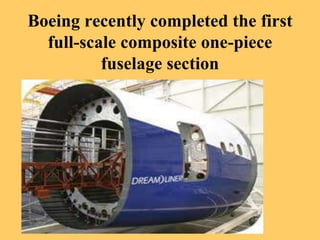
Boeing recently completed the first
full-scale composite one-piece
fuselage section
Composites in Aviation.ppt

Composites in Aviation.ppt

  • 3.
    Composite Materials Definition ofCompsites Composites are engineered materials made from two or more constituent materials with significantly different physical or chemical properties and which remain separate and distinct on a macroscopic level within the finished structure.
  • 4.
    Composite materials aregenerally used for buildings, bridges, and structures such as boat hulls, swimming pool panels, bathtubs, storage tanks, imitation granite and cultured marble sinks and countertops. The most advanced examples perform routinely on spacecraft and aircraft in demanding environments.
  • 5.
    Increasingly it isbecoming evident that the lines of demarcation between traditional disciplines such as metallurgy, ceramics and polymers are getting quite blurry.
  • 6.
    Matrix Rule The matrixmaterial surrounds and supports the reinforcement materials by maintaining their relative positions. The matrix material largely determines the processing method. Reinforcement Rule The reinforcements impart their special mechanical and physical properties to enhance the matrix properties.
  • 7.
    The Final Result •If the composite is designed and fabricated correctly, it combines the strength of the reinforcement with the toughness of the matrix to achieve a combination of desirable properties not available in any single conventional material.
  • 8.
    For example: • polymer/ceramiccomposites have a higher modulus than the polymer component, • but are not as brittle as ceramics.
  • 9.
    •Typically, reinforcing materials arestrong with low densities while the matrix is usually a ductile, or tough, material.
  • 10.
    Considerations for Selectingthe Reinforcements & Matrix • There are certain considerations for selecting the reinforcements and the matrix such as: melting point, volatility (instability), density, elastic modulus, coefficient of thermal expansion, strength, creep characteristics, fracture toughness & compatibility between fiber & matrix.
  • 11.
    Combatibility The last considerationof compatibility is divided into three categories, namely: • chemical compatibility, • thermal compatibility & • compatibility with the environment
  • 12.
    Reinforcements Types • Reinforcingphase, is in the form of: • fibers, • Whiskers, • Sheets & • particles • and is embedded in the other materials (the matrix phase).
  • 13.
    Composites According toType of Reinforcement a: particles, b: whiskers, c: continuous fibers, d: sheet laminate a b C d
  • 14.
    This leads to eitheraddition of properties: GLASS + POLYESTER = GRP (strength) (chemical resistance) (strength and chemical resistance) or unique properties: GLASS + POLYESTER = GRP (brittle) (brittle) (tough!)
  • 15.
  • 16.
    • Fibre: boron;carbon, graphite, SiC, alumina. • Matrix: aluminium; magnesium; titanium; copper • Fibres improve high temperature creep and thermal expansion. Metal Matrix Composites (MMCs)
  • 17.
    Polymer Matrix Composites (PMCs) Thermoplastics Tough;high melt viscosity; and recyclable Thermosets Brittle; low viscosity before cure; not recyclable
  • 18.
    Ceramic Matrix Composites (CMCs) •Fibre: SiC; alumina; Silicon Nitride • Matrix: SiC; alumina; glass-ceramic; Silicon Nitride Fibres improve toughness
  • 19.
    Why are compositesused in engineering? • Weight saving (High strength to weight ratio) • High corrosion resistance • High toughness & High T. S. at elevated temp. • Better Fatigue properties • Manufacturing advantages: - novel geometries - low cost tooling • Design freedoms - continuous property spectrum - anisotropic properties • Ease of repair
  • 20.
    Strength of Composites •The strength of the composite depends primarily on the amount, arrangement and type of fiber (or particle) reinforcement in the resin.
  • 21.
    • Typically, thehigher the reinforcement content, the greater the strength. • In some cases, glass fibers are combined with other fibers, such as carbon or aramid composite that combines the properties of more than one reinforcing material.
  • 22.
    1- Particle Reinforcement •Particles used for reinforcing include: • ceramics (SiC) and glasses particles, • metal particles such as aluminum, • polymers and • carbon.
  • 23.
    The Rule ofParticles • Particles are used to • Increase the modulus of the matrix, • To decrease the ductility of the matrix. • Particles are also used to produce inexpensive composites.
  • 24.
    Example of ParticleComposite • An example of particle reinforced composites is car tire • which has carbon particles in a matrix of the elastomeric polymer poly-iso-butylene.
  • 25.
    Another Example Another examplefor particle-reinforced composite is concrete where the aggregates ( sand & gravel) are the particles and cement is the matrix. PRCs support higher tensile, compressive and shear stresses.
  • 26.
    2-Fiber-reinforced Composites: • Reinforcing fiberscan be made of metals, ceramics, glasses, or polymers graphite or carbon fibers. Fibers increase the modulus of the matrix material.
  • 27.
    • Practically anymaterial (polymers, metals, glass or ceramics) can be transformed into a fibrous form. • An important attribute of fine fibers is their flexibility. • A high degree of flexibility is really a charectertsitic of a material having a low modulus and a small diameter.
  • 28.
    Glass Fiber • Glassesor amorphous materials show the phenomena of time dependent-strain, called visco-elasticity. Above the glass transition temperature, Tg, such materials show Newtonian viscosity, i.e. the stress is proportional to the strain rate. This property is exploited in the drawing of fiber and sheet forms.
  • 29.
    Advantages of CeramicFibers • Continuous ceramic fibers are very good for reinforcing ceramic materials. They combine rather high strength and elastic modulus with high temperature capability and a general freedom from environmental attacks, making them attractive as reinforcements in high temp. ap.
  • 30.
    It is convenientto divide the ceramic reinforcements into: • oxide and • non-oxide categories. The oxides groups contains ceramic oxides such as Al2O3, (Al2O3+SiO2) & ZrO2. While the non-oxide group includes: B, C, SiC, Si3N4 & BN.
  • 31.
    A comparison betweenthe ceramic & composite stress-strain behaviour
  • 32.
    Limitation of usingfiber reinforcement • Fibers are difficult to process into composites which makes fiber- reinforced composites relatively expensive.
  • 33.
    Effect of fiberparameters on Composite properties • The arrangement or orientation of the fibers relative to one another, the fiber concentration, and the distribution all have a significant influence on the strength and other properties of fiber-reinforced composites.
  • 34.
    Where to usediscontinuous fibers • Applications involving totally multidirectional applied stresses normally use discontinuous fibers, which are randomly oriented in the matrix material.
  • 35.
    • Consideration oforientation and fiber length for a particular composites depends on the level and nature of the applied stress as well as fabrication cost.
  • 36.
    Short fiber advantages •Production rates for short-fiber composites (both aligned and randomly oriented) are rapid, and complicated shapes can be formed which are not possible with continuous fiber reinforcement.
  • 37.
    Fiber orientation infiber reinforced composites.
  • 38.
    Modulus of Fiber-Reinforced Composites: •Fibers have a very high modulus along their axis, but have a low modulus perpendicular to their axis. If the fibers are all parallel, the modulus of a fiber reinforced composite depends upon which direction you're measuring.
  • 39.
    Modulus of CompositeMaterials • The modulus of the entire composite, matrix plus reinforcment, is governed by the rule of mixtures when measuring along the length of the fiber by the equation: Ec = EfVf + EmVm
  • 40.
    Where: • Ec isthe modulus of the entire composite along the length of the fiber. • Ef is the modulus of the fiber along the length of the fiber. • Vf is the volume percent occupied by the fibers. • Em is the modulus of the matrix (usually not dependent upon direction) • Vm is the volume percent occupied by the matrix (equal to (1-Vf)).
  • 41.
    Tensile strength andelastic modulus when fibers are parallel to the direction of stress.
  • 42.
    tensile strength andelastic modulus when fibers are perpendicular to the direction of stress.
  • 43.
    How to overcomethe directional problems • Fiber composite manufacturers often rotate layers of fibers to avoid directional variations in the modulus.
  • 44.
    Structural Composites: • Commonstructural composite types are: • Laminar • Sandwich Panels
  • 45.
    Laminar: • Is composedof two-dimensional sheets or panels that have a preferred high strength direction such as is found in wood and continuous and aligned fiber-reinforced plastics. The layers are stacked and cemented together such that the orientation of the high-strength direction varies with each successive layer. One example of a relatively complex structure is plywood.
  • 46.
    Sandwich Panels Consist oftwo strong outer sheets which are called face sheets and may be made of aluminum alloys, fiber reinforced plastics, titanium alloys or steel. Face sheets carry most of the loading and stresses. Core may be a honeycomb structure which has less density than the face sheets and resists perpendicular stresses and provides shear rigidity.
  • 48.
    Why composites aren’tused more in engineering? • High cost of raw materials • Lack of design standards • Few ‘mass production’ processes available • Properties of laminated composites: - low through-thickness strength - low interlaminar shear strength • No ‘off the shelf’ properties - performance depends on quality of manufacture
  • 49.
    There are no‘off the shelf’ properties with composites. Both the structure and the material are made at the same time. Material quality depends on quality of manufacture.
  • 50.
    Applications of Composite Materials •Examples of some current application of composites include the diesel piston, brake-shoes and pads, tires and the Beechcraft aircraft in which 100% of the structural components are composites.
  • 51.
    • Fiber-reinforced compositesare used in some of the most advanced, and therefore most expensive, sports equipment, such as a racing bicycle frame which consists of carbon fibers in a thermoset polymer matrix.
  • 52.
    • Body partsof race cars and some other cars are composites made of fiberglass in a thermoset matrix. Sandwich panels can be used in variety of applications which include roofs, floors, walls of buildings and in aircraft, for wings, fuselage and tail- plane skins.
  • 53.
    Boeing recently completedthe first full-scale composite one-piece fuselage section