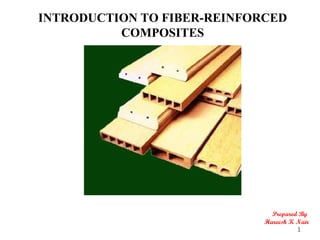




INTRODUCTION TO FIBER-REINFORCED
COMPOSITES
1
Prepared By
Hareesh K Nair
1.1 History and Definition
Origins of Composites
The rapid development and use of composite materials beginning
in the 1940s had three main driving forces.
1.Military vehicles, such as airplanes, helicopters, and
rockets, placed a premium on high-strength, light-weight
materials.
2.Polymer industries were quickly growing and tried to
expand the market of plastics to a variety of applications.
3.The extremely high theoretical strength of certain
materials, such as glass fibers, was being discovered.
2
Cont…
One may conveniently speak of four generations of composites:
1st
generation (1940s): Glass Fiber Reinforced Composites
2nd
generation (1960s): High Performance Composites in the post-
Sputnik era
3rd
generation (1970s & 1980s): The Search for New Markets and
the Synergy of Properties
4th
generation (1990s): Hybrid Materials, Nanocomposites and
Biomimetic Strategies
Composite Material Definition
A Composite material (also called a composition material or shortened
to composite) is a material made from two or more constituent materials with
significantly different physical or chemical properties that, when combined,
produce a material with characteristics different from the individual
components.
3
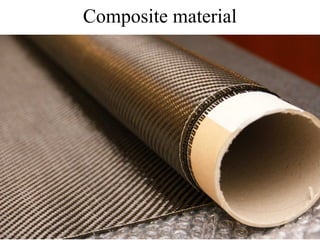
Composite material
4
• Wattle and daub is one of the
oldest manmade composite
materials, at over 6000 years
old. Concrete is also a
composite material, and is
used more than any other
man-made material in the
world. As of 2006, about 7.5
billion cubic meters of
concrete are made each year
—more than one cubic metre
for every person on Earth.
Fiber-reinforced composite
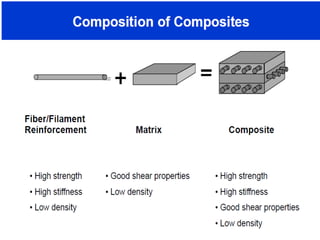
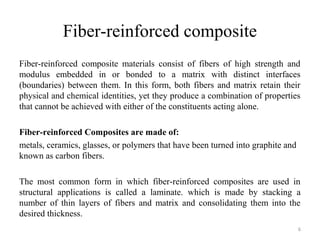
Fiber-reinforced composite materials consist of fibers of high strength and
modulus embedded in or bonded to a matrix with distinct interfaces
(boundaries) between them. In this form, both fibers and matrix retain their
physical and chemical identities, yet they produce a combination of properties
that cannot be achieved with either of the constituents acting alone.
Fiber-reinforced Composites are made of:
metals, ceramics, glasses, or polymers that have been turned into graphite and
known as carbon fibers.
The most common form in which fiber-reinforced composites are used in
structural applications is called a laminate. which is made by stacking a
number of thin layers of fibers and matrix and consolidating them into the
desired thickness.
6
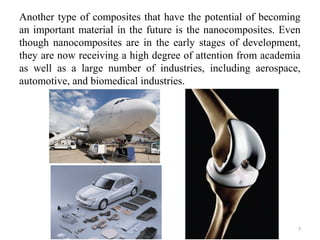
Another type of composites that have the potential of becoming
an important material in the future is the nanocomposites. Even
though nanocomposites are in the early stages of development,
they are now receiving a high degree of attention from academia
as well as a large number of industries, including aerospace,
automotive, and biomedical industries.
7
1.2 General Characteristics
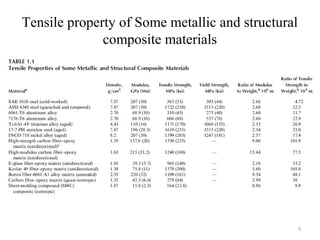
Many fiber-re in forced polymers offer a combination of strength and modulus
that are either comparable to or better than many traditional metallic materials.
Because of their low density, the strength–weight ratios and modulus– weight
ratios of these composite materials are markedly superior to those of metallic
materials
the properties of a fiber-reinforced composite depend strongly on the direction
of measurement, and therefore, they are not isotropic materials and not like
steel and aluminium alloys
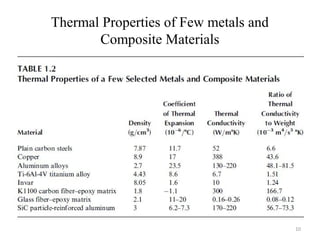
Coefficient of thermal expansion (CTE) for many fiber-reinforced composites
is much lower than that for metals. As a result, composite structures may
exhibit a better dimensional stability over a wide temperature range
8
Tensile property of Some metallic and structural
composite materials
9
Thermal Properties of Few metals and
Composite Materials
10
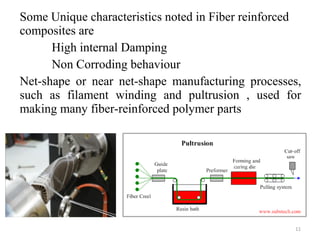
Some Unique characteristics noted in Fiber reinforced
composites are
High internal Damping
Non Corroding behaviour
Net-shape or near net-shape manufacturing processes,
such as filament winding and pultrusion , used for
making many fiber-reinforced polymer parts
11
1.3 Application
Commercial and industrial applications of fiber-reinforced polymer
composites are so varied and the major structural application areas, which
include
Aircraft and Military Applications
Space Applications
Automotive Applications
Sporting Goods Applications
Marine Applications
Infrastructure
12
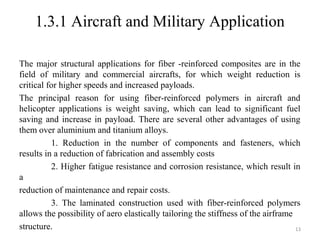
1.3.1 Aircraft and Military Application
The major structural applications for fiber -reinforced composites are in the
field of military and commercial aircrafts, for which weight reduction is
critical for higher speeds and increased payloads.
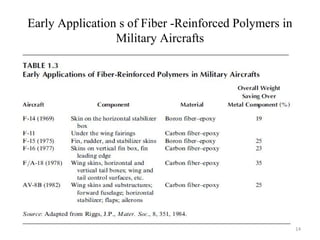
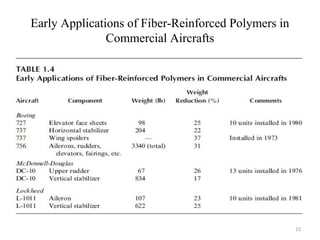
The principal reason for using fiber-reinforced polymers in aircraft and
helicopter applications is weight saving, which can lead to significant fuel
saving and increase in payload. There are several other advantages of using
them over aluminium and titanium alloys.
1. Reduction in the number of components and fasteners, which
results in a reduction of fabrication and assembly costs
2. Higher fatigue resistance and corrosion resistance, which result in
a
reduction of maintenance and repair costs.
3. The laminated construction used with fiber-reinforced polymers
allows the possibility of aero elastically tailoring the stiffness of the airframe
structure. 13
Early Application s of Fiber -Reinforced Polymers in
Military Aircrafts
14
Early Applications of Fiber-Reinforced Polymers in
Commercial Aircrafts
15
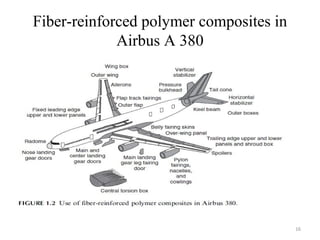
Fiber-reinforced polymer composites in
Airbus A 380
16
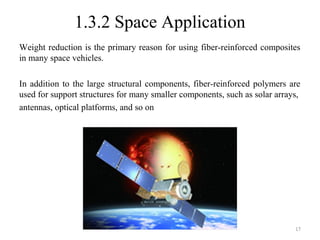
1.3.2 Space Application
Weight reduction is the primary reason for using fiber-reinforced composites
in many space vehicles.
In addition to the large structural components, fiber-reinforced polymers are
used for support structures for many smaller components, such as solar arrays,
antennas, optical platforms, and so on
17
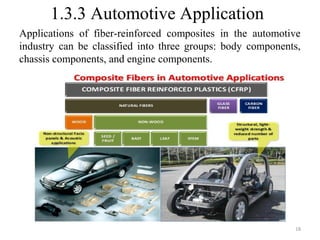
1.3.3 Automotive Application
Applications of fiber-reinforced composites in the automotive
industry can be classified into three groups: body components,
chassis components, and engine components.
18
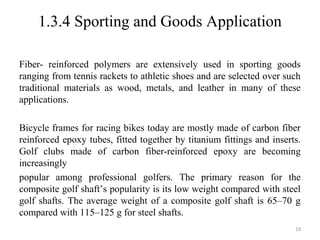
1.3.4 Sporting and Goods Application
Fiber- reinforced polymers are extensively used in sporting goods
ranging from tennis rackets to athletic shoes and are selected over such
traditional materials as wood, metals, and leather in many of these
applications.
Bicycle frames for racing bikes today are mostly made of carbon fiber
reinforced epoxy tubes, fitted together by titanium fittings and inserts.
Golf clubs made of carbon fiber-reinforced epoxy are becoming
increasingly
popular among professional golfers. The primary reason for the
composite golf shaft’s popularity is its low weight compared with steel
golf shafts. The average weight of a composite golf shaft is 65–70 g
compared with 115–125 g for steel shafts.
19
20
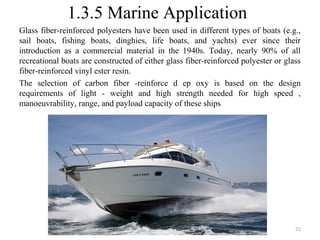
1.3.5 Marine Application
Glass fiber-reinforced polyesters have been used in different types of boats (e.g.,
sail boats, fishing boats, dinghies, life boats, and yachts) ever since their
introduction as a commercial material in the 1940s. Today, nearly 90% of all
recreational boats are constructed of either glass fiber-reinforced polyester or glass
fiber-reinforced vinyl ester resin.
The selection of carbon fiber -reinforce d ep oxy is based on the design
requirements of light - weight and high strength needed for high speed ,
manoeuvrability, range, and payload capacity of these ships
21
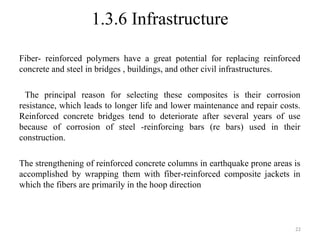
1.3.6 Infrastructure
Fiber- reinforced polymers have a great potential for replacing reinforced
concrete and steel in bridges , buildings, and other civil infrastructures.
The principal reason for selecting these composites is their corrosion
resistance, which leads to longer life and lower maintenance and repair costs.
Reinforced concrete bridges tend to deteriorate after several years of use
because of corrosion of steel -reinforcing bars (re bars) used in their
construction.
The strengthening of reinforced concrete columns in earthquake prone areas is
accomplished by wrapping them with fiber-reinforced composite jackets in
which the fibers are primarily in the hoop direction
22
Infrastructure Applications
23
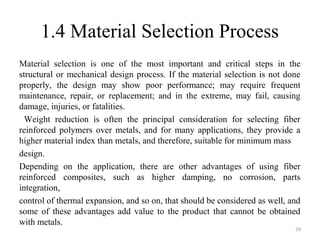
1.4 Material Selection Process
Material selection is one of the most important and critical steps in the
structural or mechanical design process. If the material selection is not done
properly, the design may show poor performance; may require frequent
maintenance, repair, or replacement; and in the extreme, may fail, causing
damage, injuries, or fatalities.
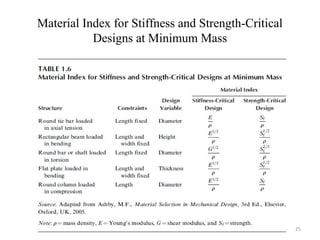
Weight reduction is often the principal consideration for selecting fiber
reinforced polymers over metals, and for many applications, they provide a
higher material index than metals, and therefore, suitable for minimum mass
design.
Depending on the application, there are other advantages of using fiber
reinforced composites, such as higher damping, no corrosion, parts
integration,
control of thermal expansion, and so on, that should be considered as well, and
some of these advantages add value to the product that cannot be obtained
with metals.
24
Material Index for Stiffness and Strength-Critical
Designs at Minimum Mass
25
Material selection is more important and it requires the
knowledge of the performance requirements of the structure or
component under consideration.
26
References
1. C.E. Harris, J.H. Starnes, Jr., and M.J. Shuart, Design and manufacturing of
aerospace composite structures, state-of-the-art assessment, J. Aircraft, 39:545
(2002).
2. C. Soutis, Carbon fiber reinforced plastics in aircraft applications, Mater.
Sci. Eng., A, 412:171 (2005).
3. J.V. Noyes, Composites in the construction of the Lear Fan 2100 aircraft,
Composites, 14:129 (1983).
4. R.L. Pinckney, Helicopter rotor blades, Appl. Composite Mat., ASTM STP,
524:108 (1973).
27
28

Fiber Re-inforced composites introduction

  • 1.
  • 2.
    1.1 History andDefinition Origins of Composites The rapid development and use of composite materials beginning in the 1940s had three main driving forces. 1.Military vehicles, such as airplanes, helicopters, and rockets, placed a premium on high-strength, light-weight materials. 2.Polymer industries were quickly growing and tried to expand the market of plastics to a variety of applications. 3.The extremely high theoretical strength of certain materials, such as glass fibers, was being discovered. 2
  • 3.
    Cont… One may convenientlyspeak of four generations of composites: 1st generation (1940s): Glass Fiber Reinforced Composites 2nd generation (1960s): High Performance Composites in the post- Sputnik era 3rd generation (1970s & 1980s): The Search for New Markets and the Synergy of Properties 4th generation (1990s): Hybrid Materials, Nanocomposites and Biomimetic Strategies Composite Material Definition A Composite material (also called a composition material or shortened to composite) is a material made from two or more constituent materials with significantly different physical or chemical properties that, when combined, produce a material with characteristics different from the individual components. 3
  • 4.
  • 5.
    • Wattle anddaub is one of the oldest manmade composite materials, at over 6000 years old. Concrete is also a composite material, and is used more than any other man-made material in the world. As of 2006, about 7.5 billion cubic meters of concrete are made each year —more than one cubic metre for every person on Earth.
  • 6.
    Fiber-reinforced composite Fiber-reinforced compositematerials consist of fibers of high strength and modulus embedded in or bonded to a matrix with distinct interfaces (boundaries) between them. In this form, both fibers and matrix retain their physical and chemical identities, yet they produce a combination of properties that cannot be achieved with either of the constituents acting alone. Fiber-reinforced Composites are made of: metals, ceramics, glasses, or polymers that have been turned into graphite and known as carbon fibers. The most common form in which fiber-reinforced composites are used in structural applications is called a laminate. which is made by stacking a number of thin layers of fibers and matrix and consolidating them into the desired thickness. 6
  • 7.
    Another type ofcomposites that have the potential of becoming an important material in the future is the nanocomposites. Even though nanocomposites are in the early stages of development, they are now receiving a high degree of attention from academia as well as a large number of industries, including aerospace, automotive, and biomedical industries. 7
  • 8.
    1.2 General Characteristics Manyfiber-re in forced polymers offer a combination of strength and modulus that are either comparable to or better than many traditional metallic materials. Because of their low density, the strength–weight ratios and modulus– weight ratios of these composite materials are markedly superior to those of metallic materials the properties of a fiber-reinforced composite depend strongly on the direction of measurement, and therefore, they are not isotropic materials and not like steel and aluminium alloys Coefficient of thermal expansion (CTE) for many fiber-reinforced composites is much lower than that for metals. As a result, composite structures may exhibit a better dimensional stability over a wide temperature range 8
  • 9.
    Tensile property ofSome metallic and structural composite materials 9
  • 10.
    Thermal Properties ofFew metals and Composite Materials 10
  • 11.
    Some Unique characteristicsnoted in Fiber reinforced composites are High internal Damping Non Corroding behaviour Net-shape or near net-shape manufacturing processes, such as filament winding and pultrusion , used for making many fiber-reinforced polymer parts 11
  • 12.
    1.3 Application Commercial andindustrial applications of fiber-reinforced polymer composites are so varied and the major structural application areas, which include Aircraft and Military Applications Space Applications Automotive Applications Sporting Goods Applications Marine Applications Infrastructure 12
  • 13.
    1.3.1 Aircraft andMilitary Application The major structural applications for fiber -reinforced composites are in the field of military and commercial aircrafts, for which weight reduction is critical for higher speeds and increased payloads. The principal reason for using fiber-reinforced polymers in aircraft and helicopter applications is weight saving, which can lead to significant fuel saving and increase in payload. There are several other advantages of using them over aluminium and titanium alloys. 1. Reduction in the number of components and fasteners, which results in a reduction of fabrication and assembly costs 2. Higher fatigue resistance and corrosion resistance, which result in a reduction of maintenance and repair costs. 3. The laminated construction used with fiber-reinforced polymers allows the possibility of aero elastically tailoring the stiffness of the airframe structure. 13
  • 14.
    Early Application sof Fiber -Reinforced Polymers in Military Aircrafts 14
  • 15.
    Early Applications ofFiber-Reinforced Polymers in Commercial Aircrafts 15
  • 16.
  • 17.
    1.3.2 Space Application Weightreduction is the primary reason for using fiber-reinforced composites in many space vehicles. In addition to the large structural components, fiber-reinforced polymers are used for support structures for many smaller components, such as solar arrays, antennas, optical platforms, and so on 17
  • 18.
    1.3.3 Automotive Application Applicationsof fiber-reinforced composites in the automotive industry can be classified into three groups: body components, chassis components, and engine components. 18
  • 19.
    1.3.4 Sporting andGoods Application Fiber- reinforced polymers are extensively used in sporting goods ranging from tennis rackets to athletic shoes and are selected over such traditional materials as wood, metals, and leather in many of these applications. Bicycle frames for racing bikes today are mostly made of carbon fiber reinforced epoxy tubes, fitted together by titanium fittings and inserts. Golf clubs made of carbon fiber-reinforced epoxy are becoming increasingly popular among professional golfers. The primary reason for the composite golf shaft’s popularity is its low weight compared with steel golf shafts. The average weight of a composite golf shaft is 65–70 g compared with 115–125 g for steel shafts. 19
  • 20.
  • 21.
    1.3.5 Marine Application Glassfiber-reinforced polyesters have been used in different types of boats (e.g., sail boats, fishing boats, dinghies, life boats, and yachts) ever since their introduction as a commercial material in the 1940s. Today, nearly 90% of all recreational boats are constructed of either glass fiber-reinforced polyester or glass fiber-reinforced vinyl ester resin. The selection of carbon fiber -reinforce d ep oxy is based on the design requirements of light - weight and high strength needed for high speed , manoeuvrability, range, and payload capacity of these ships 21
  • 22.
    1.3.6 Infrastructure Fiber- reinforcedpolymers have a great potential for replacing reinforced concrete and steel in bridges , buildings, and other civil infrastructures. The principal reason for selecting these composites is their corrosion resistance, which leads to longer life and lower maintenance and repair costs. Reinforced concrete bridges tend to deteriorate after several years of use because of corrosion of steel -reinforcing bars (re bars) used in their construction. The strengthening of reinforced concrete columns in earthquake prone areas is accomplished by wrapping them with fiber-reinforced composite jackets in which the fibers are primarily in the hoop direction 22
  • 23.
  • 24.
    1.4 Material SelectionProcess Material selection is one of the most important and critical steps in the structural or mechanical design process. If the material selection is not done properly, the design may show poor performance; may require frequent maintenance, repair, or replacement; and in the extreme, may fail, causing damage, injuries, or fatalities. Weight reduction is often the principal consideration for selecting fiber reinforced polymers over metals, and for many applications, they provide a higher material index than metals, and therefore, suitable for minimum mass design. Depending on the application, there are other advantages of using fiber reinforced composites, such as higher damping, no corrosion, parts integration, control of thermal expansion, and so on, that should be considered as well, and some of these advantages add value to the product that cannot be obtained with metals. 24
  • 25.
    Material Index forStiffness and Strength-Critical Designs at Minimum Mass 25
  • 26.
    Material selection ismore important and it requires the knowledge of the performance requirements of the structure or component under consideration. 26
  • 27.
    References 1. C.E. Harris,J.H. Starnes, Jr., and M.J. Shuart, Design and manufacturing of aerospace composite structures, state-of-the-art assessment, J. Aircraft, 39:545 (2002). 2. C. Soutis, Carbon fiber reinforced plastics in aircraft applications, Mater. Sci. Eng., A, 412:171 (2005). 3. J.V. Noyes, Composites in the construction of the Lear Fan 2100 aircraft, Composites, 14:129 (1983). 4. R.L. Pinckney, Helicopter rotor blades, Appl. Composite Mat., ASTM STP, 524:108 (1973). 27
  • 28.

Editor's Notes

  • #9 for example, near an attachment. In some applications, such as electronic packaging, where quick and effective heat dissipation is needed to prevent component failure or malfunctioning due to overheating and undesirable temperature rise, thermal conductivity is an important material property to consider. In these applications, some fiber-reinforced composites may excel over metals because of the combination of their high thermal conductivity–weight ratio (Table 1.2) and low CTE. On the other hand, electrical conductivity of fiber-reinforced polymers is, in general, lower than that of metals